
Cognitive Adaptations for Social Exchange Leda Cosmides Center


- Slides: 56
Cognitive Adaptations for Social Exchange Leda Cosmides Center for Evolutionary Psychology and Department of Psychology University of California, Santa Barbara www. psych. ucsb. edu/research/cep
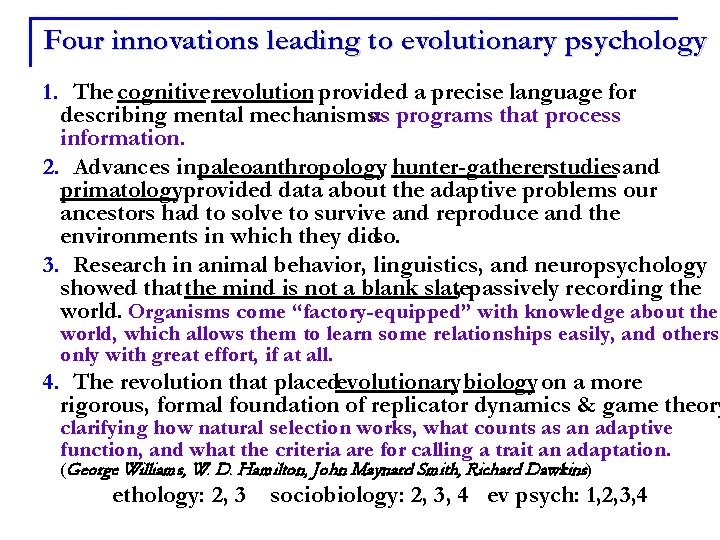
Four innovations leading to evolutionary psychology 1. The cognitive revolution provided a precise language for describing mental mechanisms: as programs that process information. 2. Advances in paleoanthropology, hunter-gathererstudies and primatologyprovided data about the adaptive problems our ancestors had to solve to survive and reproduce and the environments in which they didso. 3. Research in animal behavior, linguistics, and neuropsychology showed that the mind is not a blank slate , passively recording the world. Organisms come “factory-equipped” with knowledge about the world, which allows them to learn some relationships easily, and others only with great effort, if at all. 4. The revolution that placedevolutionary biology on a more rigorous, formal foundation of replicator dynamics & game theory clarifying how natural selection works, what counts as an adaptive function, and what the criteria are for calling a trait an adaptation. (George Williams, W. D. Hamilton, John Maynard Smith, Richard Dawkins) ethology: 2, 3 sociobiology: 2, 3, 4 ev psych: 1, 2, 3, 4
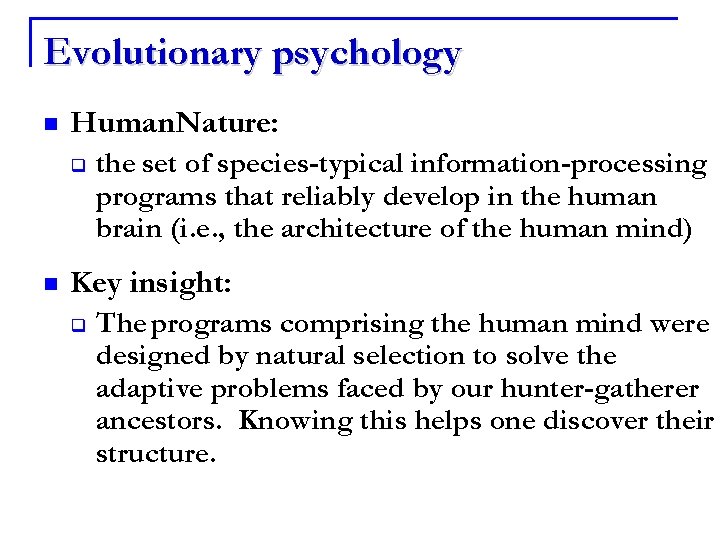
Evolutionary psychology n Human. Nature: q n the set of species-typical information-processing programs that reliably develop in the human brain (i. e. , the architecture of the human mind) Key insight: q The programs comprising the human mind were designed by natural selection to solve the adaptive problems faced by our hunter-gatherer ancestors. Knowing this helps one discover their structure.
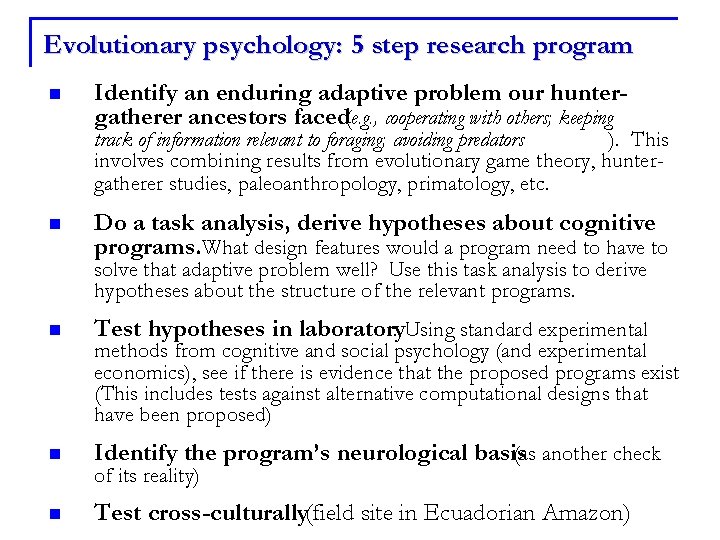
Evolutionary psychology: 5 step research program n Identify an enduring adaptive problem our huntergatherer ancestors faced(e. g. , cooperating with others; keeping track of information relevant to foraging; avoiding predators ). This involves combining results from evolutionary game theory, huntergatherer studies, paleoanthropology, primatology, etc. n Do a task analysis, derive hypotheses about cognitive programs. What design features would a program need to have to solve that adaptive problem well? Use this task analysis to derive hypotheses about the structure of the relevant programs. n Test hypotheses in laboratory : Using standard experimental n Identify the program’s neurological basis (as another check n Test cross-culturally(field site in Ecuadorian Amazon) methods from cognitive and social psychology (and experimental economics), see if there is evidence that the proposed programs exist (This includes tests against alternative computational designs that have been proposed) of its reality)
Causal connections between the 4 developments n The brain is an evolved computer(#1), whose programs were sculpted over evolutionary time by the ancestral environments and selection pressures experienced by the hunter-gatherers from whom we are descended(#2 and #4). n Individual behavior is generated by this computer, in response to information that the person experiences(#1). n Although the behavior these programs generate would, on average, have been adaptive (reproduction-promoting) in ancestral environments, there is no guarantee that it will be so now. Modern environments differ importantly from ancestral ones (esp. social environments).
Causal connections between the 4 developments n n The brain must be comprised of many different programs, each specialized for solving a different adaptive problem our ancestors faced – i. e. , the mind cannot be a blank slate(#3). q This can be shown by using results from replicator dynamics (#4) to define adaptive problems, and then carefully dissecting the computational requirements of any program capable of solving those problems q (e. g. , a program that is well-designed for choosing mates will embody different preferences and inferences than one that is well-designed for choosing foods). If you want to understand human culture and society, you need to understand these domain-specific programs.
Reasoning instincts n n n Complexly specialized for solving an adaptive problem Reliablydevelop in all normal humanbeings Develop without any consciouseffort Develop without any formalinstruction Applied without awareness of their underlying logic Distinct from more general abilities to process information or behave intelligently after Pinker, 1994
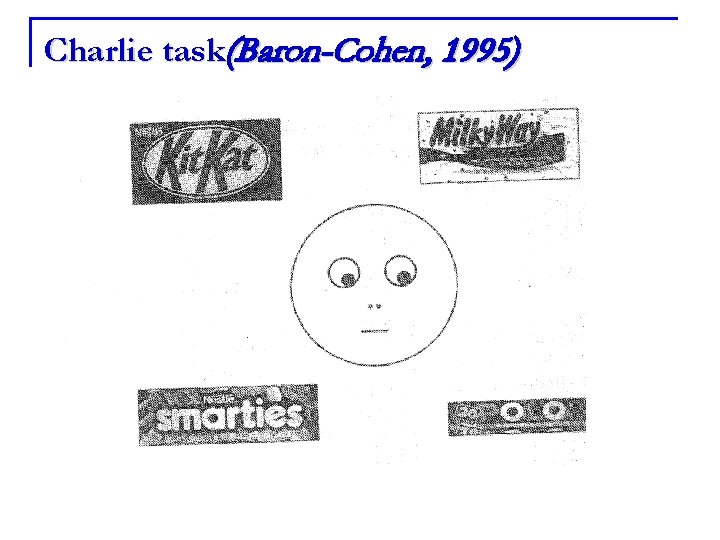
Charlie task(Baron-Cohen, 1995)
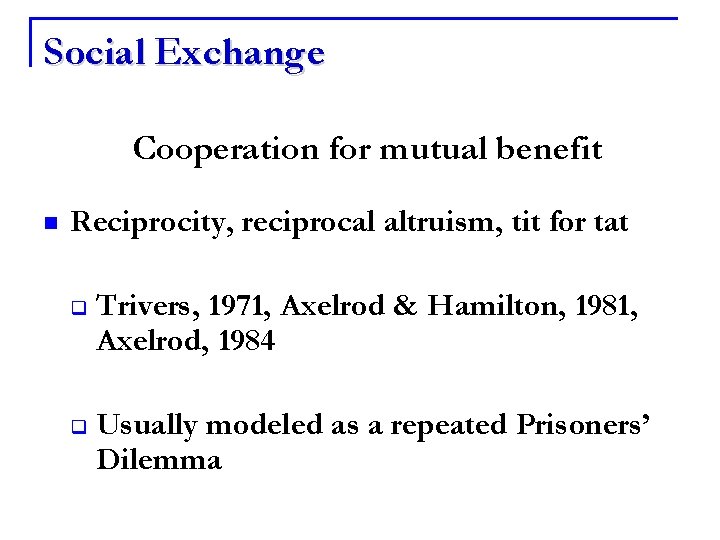
Social Exchange Cooperation for mutual benefit n Reciprocity, reciprocal altruism, tit for tat q q Trivers, 1971, Axelrod & Hamilton, 1981, Axelrod, 1984 Usually modeled as a repeated Prisoners’ Dilemma
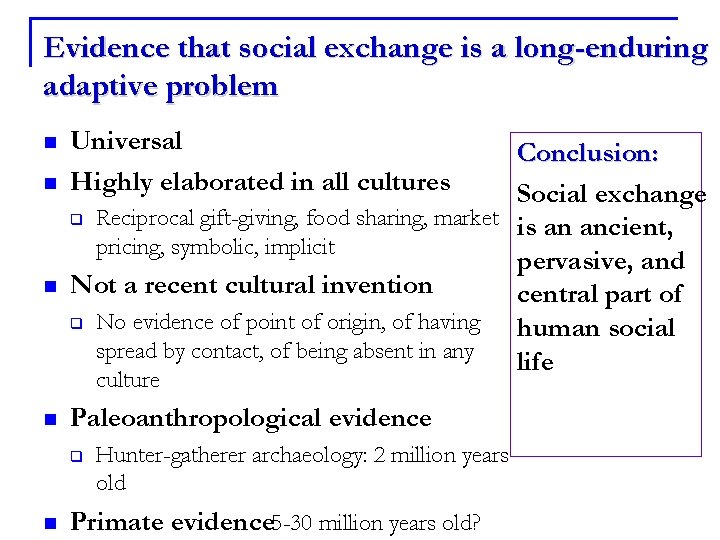
Evidence that social exchange is a long-enduring adaptive problem n n n Universal Highly elaborated in all cultures Conclusion: Social exchange q Reciprocal gift-giving, food sharing, market is an ancient, pricing, symbolic, implicit pervasive, and Not a recent cultural invention central part of q No evidence of point of origin, of having human social spread by contact, of being absent in any life culture n Paleoanthropological evidence q n Hunter-gatherer archaeology: 2 million years old Primate evidence 5 -30 million years old?
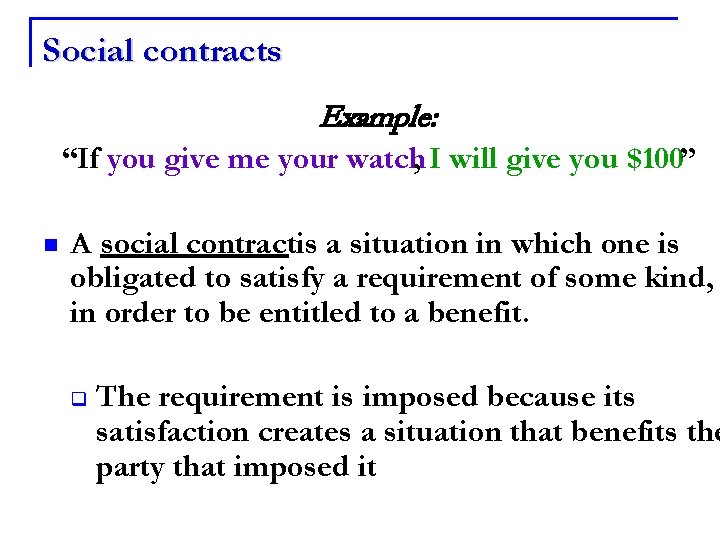
Social contracts Example: “If you give me your watch, I will give you $100” n A social contractis a situation in which one is obligated to satisfy a requirement of some kind, in order to be entitled to a benefit. q The requirement is imposed because its satisfaction creates a situation that benefits the party that imposed it
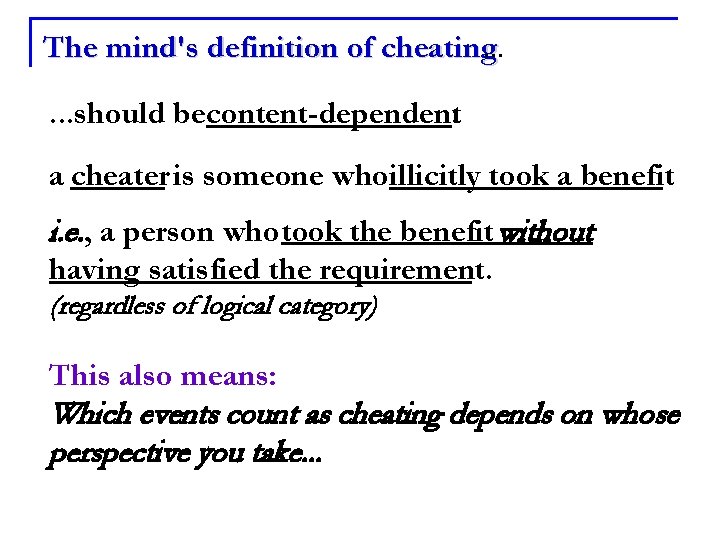
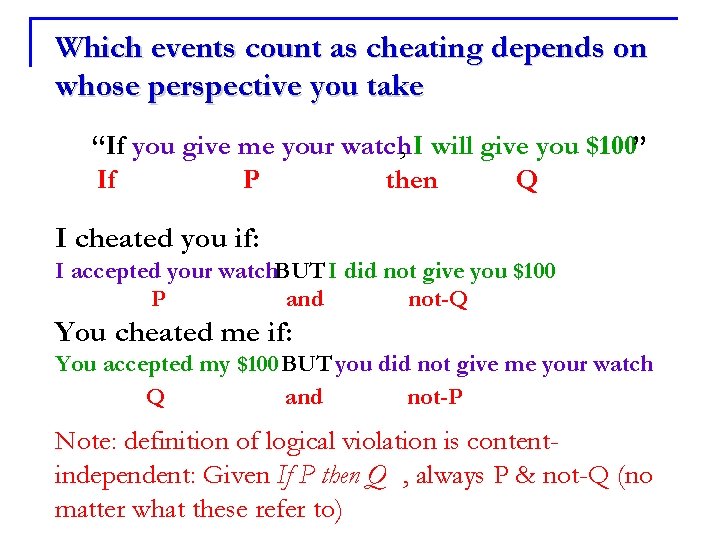
The mind's definition of cheating. . . should becontent-dependent: a cheater is someone whoillicitly took a benefit i. e. , a person who took the benefit without having satisfied the requirement. (regardless of logical category) This also means: Which events count as cheating depends on whose perspective you take. . .
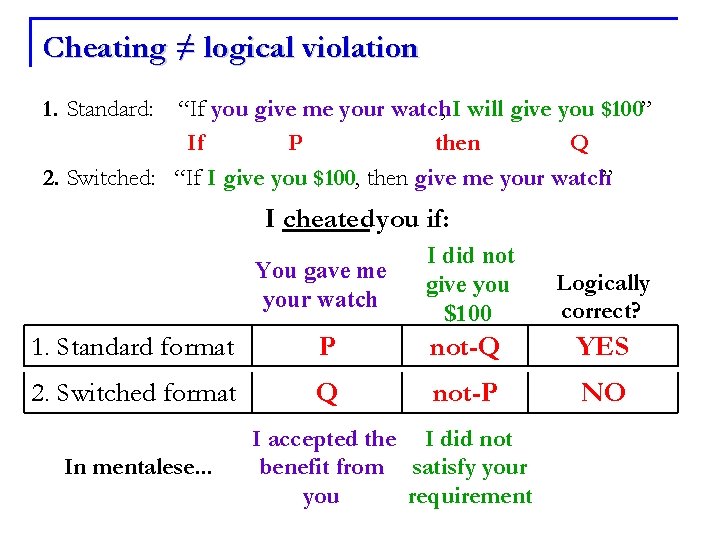
Which events count as cheating depends on whose perspective you take “If you give me your watch, I will give you $100” If P then Q I cheated you if: I accepted your watch. BUT I did not give you $100 P and not-Q You cheated me if: You accepted my $100 BUT you did not give me your watch Q and not-P Note: definition of logical violation is contentindependent: Given If P then Q , always P & not-Q (no matter what these refer to)
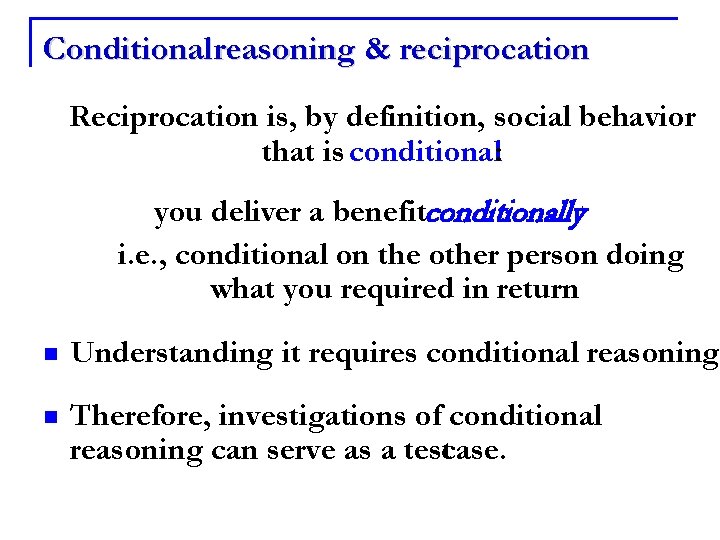
Conditional reasoning & reciprocation Reciprocation is, by definition, social behavior that is conditional: you deliver a benefitconditionally i. e. , conditional on the other person doing what you required in return n Understanding it requires conditional reasoning. n Therefore, investigations of conditional reasoning can serve as a testcase.
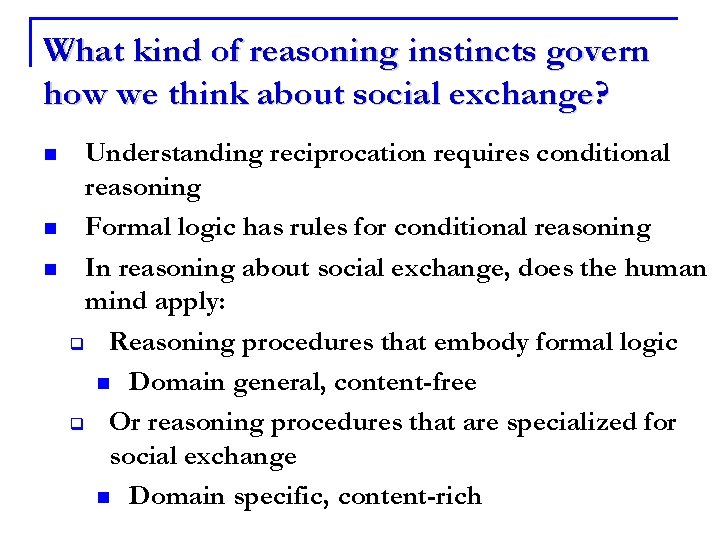
What kind of reasoning instincts govern how we think about social exchange? n n n Understanding reciprocation requires conditional reasoning Formal logic has rules for conditional reasoning In reasoning about social exchange, does the human mind apply: q Reasoning procedures that embody formal logic n Domain general, content-free q Or reasoning procedures that are specialized for social exchange n Domain specific, content-rich
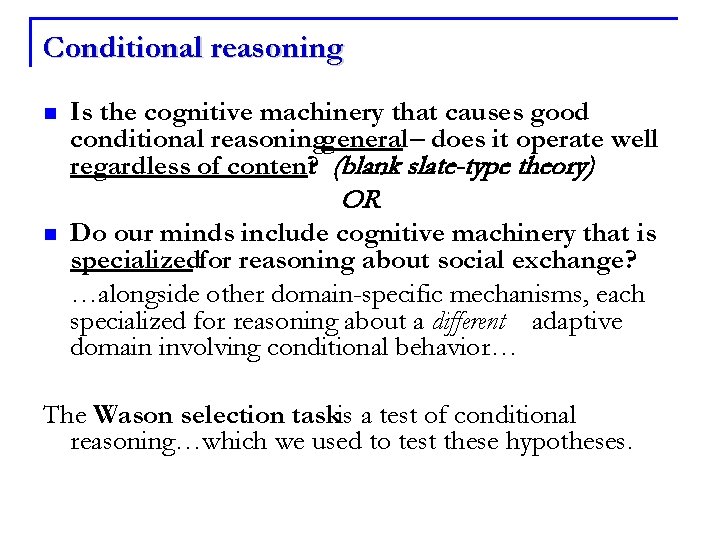
Conditional reasoning n Is the cognitive machinery that causes good conditional reasoninggeneral – does it operate well regardless of content? (blank slate-type theory) OR n Do our minds include cognitive machinery that is specializedfor reasoning about social exchange? …alongside other domain-specific mechanisms, each specialized for reasoning about a different adaptive domain involving conditional behavior… The Wason selection taskis a test of conditional reasoning…which we used to test these hypotheses.
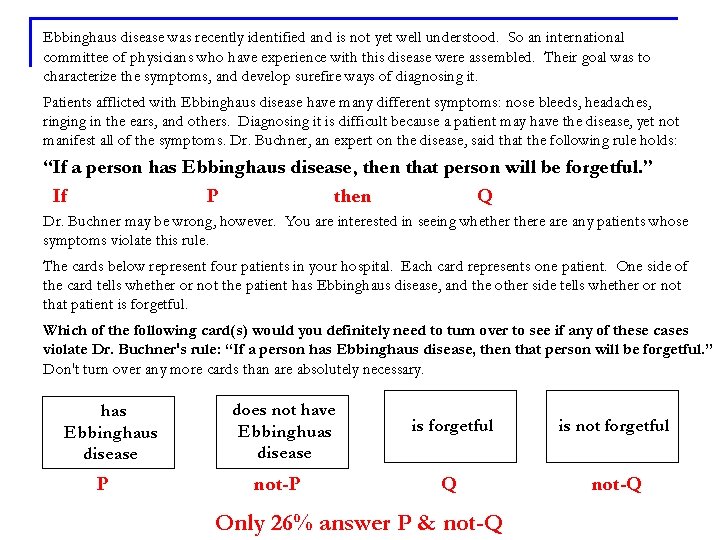
Ebbinghaus disease was recently identified and is not yet well understood. So an international committee of physicians who have experience with this disease were assembled. Their goal was to characterize the symptoms, and develop surefire ways of diagnosing it. Patients afflicted with Ebbinghaus disease have many different symptoms: nose bleeds, headaches, ringing in the ears, and others. Diagnosing it is difficult because a patient may have the disease, yet not manifest all of the symptoms. Dr. Buchner, an expert on the disease, said that the following rule holds: “If a person has Ebbinghaus disease, then that person will be forgetful. ” If P then Q Dr. Buchner may be wrong, however. You are interested in seeing whethere any patients whose symptoms violate this rule. The cards below represent four patients in your hospital. Each card represents one patient. One side of the card tells whether or not the patient has Ebbinghaus disease, and the other side tells whether or not that patient is forgetful. Which of the following card(s) would you definitely need to turn over to see if any of these cases violate Dr. Buchner's rule: “If a person has Ebbinghaus disease, then that person will be forgetful. ” Don't turn over any more cards than are absolutely necessary. has Ebbinghaus disease P does not have Ebbinghuas disease not-P is forgetful is not forgetful Q not-Q Only 26% answer P & not-Q
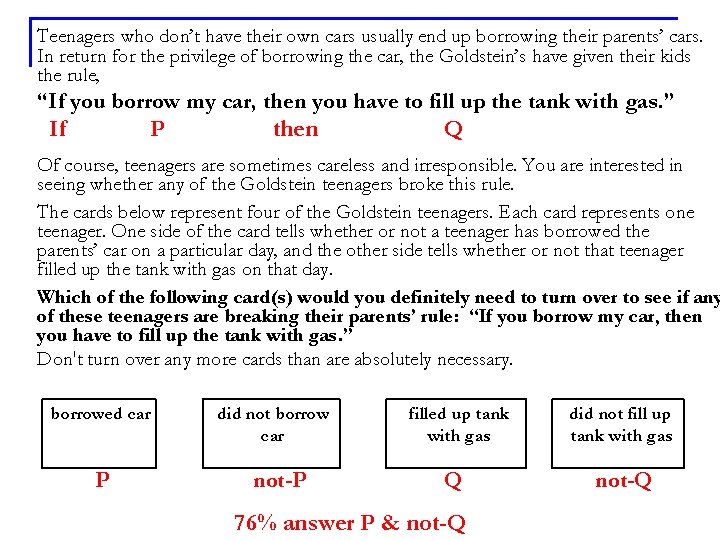
Teenagers who don’t have their own cars usually end up borrowing their parents’ cars. In return for the privilege of borrowing the car, the Goldstein’s have given their kids the rule, “If you borrow my car, then you have to fill up the tank with gas. ” If P then Q Of course, teenagers are sometimes careless and irresponsible. You are interested in seeing whether any of the Goldstein teenagers broke this rule. The cards below represent four of the Goldstein teenagers. Each card represents one teenager. One side of the card tells whether or not a teenager has borrowed the parents’ car on a particular day, and the other side tells whether or not that teenager filled up the tank with gas on that day. Which of the following card(s) would you definitely need to turn over to see if any of these teenagers are breaking their parents’ rule: “If you borrow my car, then you have to fill up the tank with gas. ” Don't turn over any more cards than are absolutely necessary. borrowed car P did not borrow car not-P filled up tank with gas did not fill up tank with gas Q not-Q 76% answer P & not-Q
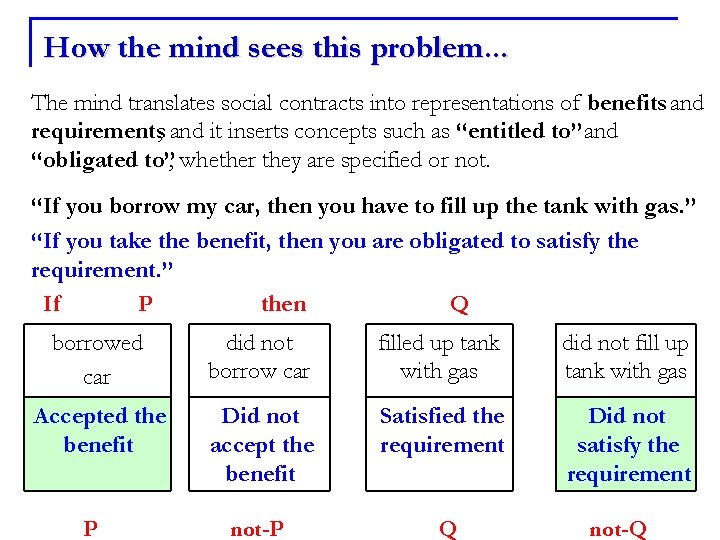
How the mind sees this problem. . . The mind translates social contracts into representations of benefits and requirements, and it inserts concepts such as “entitled to” and “obligated to”, whether they are specified or not. “If you borrow my car, then you have to fill up the tank with gas. ” “If you take the benefit, then you are obligated to satisfy the requirement. ” If P then Q borrowed car did not borrow car filled up tank with gas did not fill up tank with gas Accepted the benefit Did not accept the benefit Satisfied the requirement Did not satisfy the requirement not-P Q P not-Q
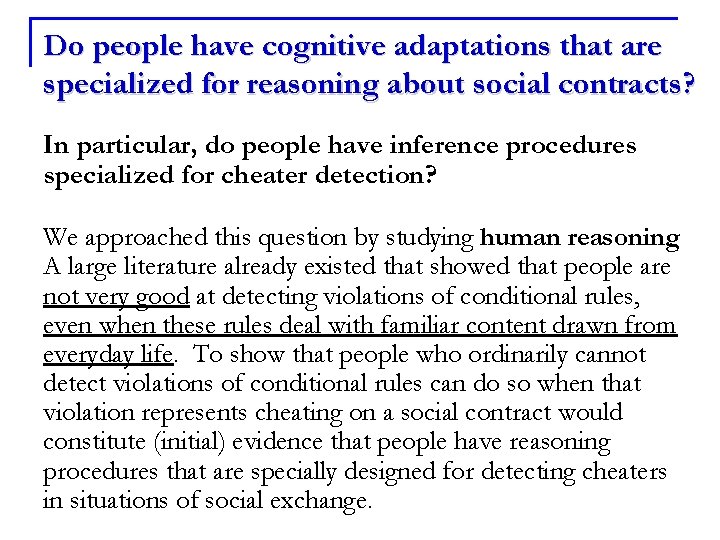
Do people have cognitive adaptations that are specialized for reasoning about social contracts? In particular, do people have inference procedures specialized for cheater detection? We approached this question by studying human reasoning. A large literature already existed that showed that people are not very good at detecting violations of conditional rules, even when these rules deal with familiar content drawn from everyday life. To show that people who ordinarily cannot detect violations of conditional rules can do so when that violation represents cheating on a social contract would constitute (initial) evidence that people have reasoning procedures that are specially designed for detecting cheaters in situations of social exchange.
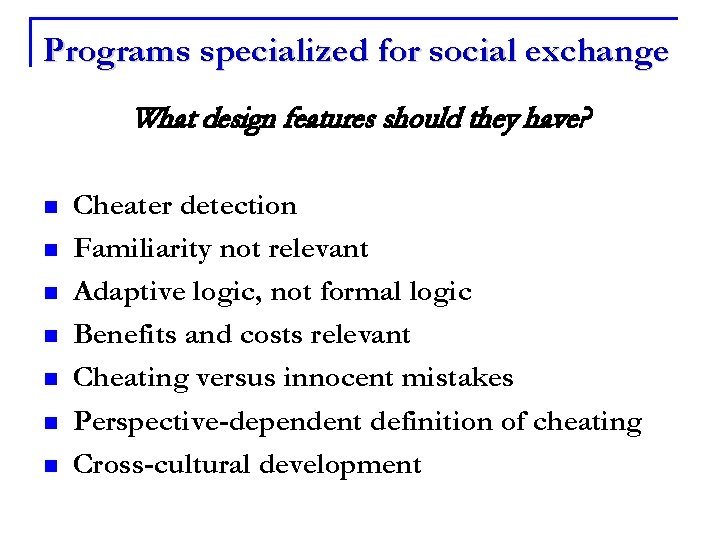
Programs specialized for social exchange What design features should they have? n n n n Cheater detection Familiarity not relevant Adaptive logic, not formal logic Benefits and costs relevant Cheating versus innocent mistakes Perspective-dependent definition of cheating Cross-cultural development
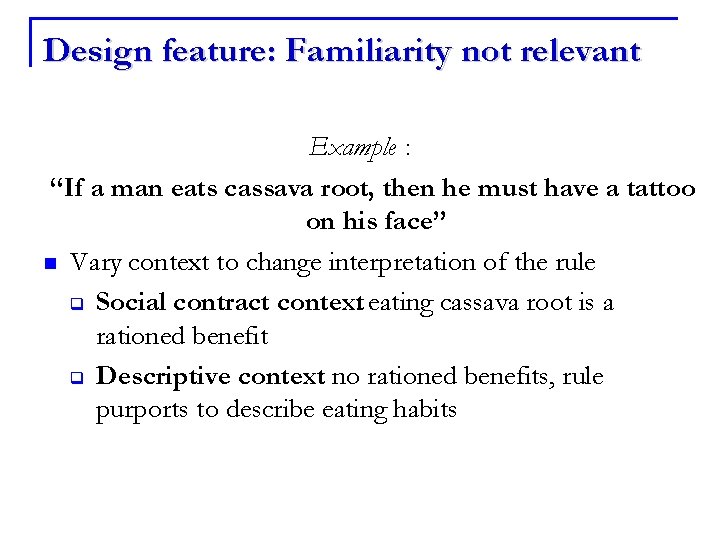
Design feature: Familiarity not relevant Example : “If a man eats cassava root, then he must have a tattoo on his face” n Vary context to change interpretation of the rule q Social contract context : eating cassava root is a rationed benefit q Descriptive context: no rationed benefits, rule purports to describe eating habits
Social contract reasoning: Unfamiliar content Standard form Exp 1: Social contract = social rule Exp 2: Social contract = personal exchange Cosmides, 1985, 1989
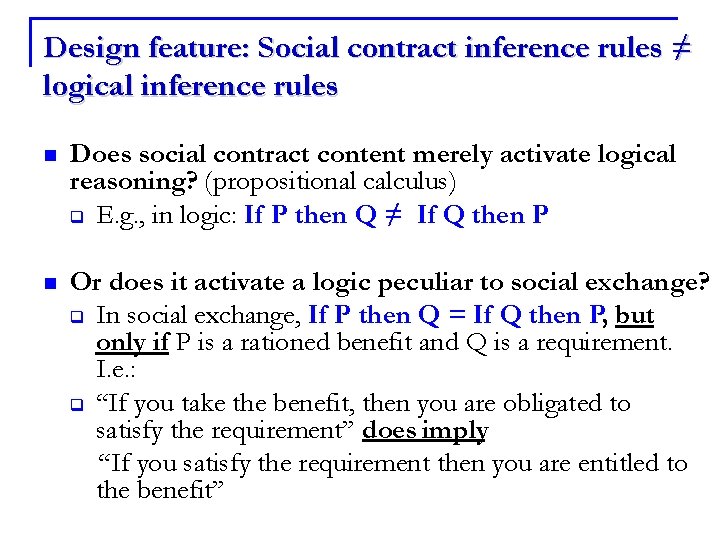
Design feature: Social contract inference rules ≠ logical inference rules n Does social contract content merely activate logical reasoning? (propositional calculus) q E. g. , in logic: If P then Q ≠ If Q then P n Or does it activate a logic peculiar to social exchange? q In social exchange, If P then Q = If Q then P, but only if P is a rationed benefit and Q is a requirement. I. e. : q “If you take the benefit, then you are obligated to satisfy the requirement” does imply “If you satisfy the requirement then you are entitled to the benefit”
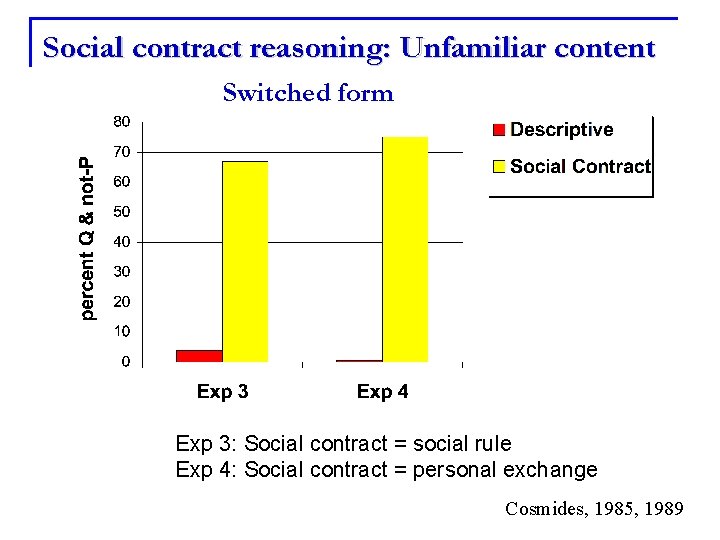
Cheating ≠ logical violation 1. Standard: “If you give me your watch, I will give you $100” If P then Q 2. Switched: “If I give you $100, then give me your watch” I cheated you if: You gave me your watch I did not give you $100 Logically correct? 1. Standard format P not-Q YES 2. Switched format Q not-P NO In mentalese. . . I accepted the I did not benefit from satisfy your you requirement
Social contract reasoning: Unfamiliar content Switched form Exp 3: Social contract = social rule Exp 4: Social contract = personal exchange Cosmides, 1985, 1989
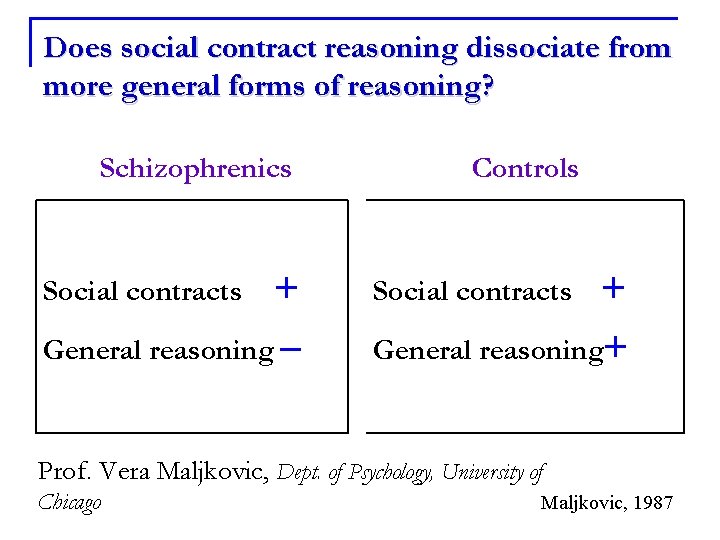
Does social contract reasoning dissociate from more general forms of reasoning? Schizophrenics Controls + General reasoning – Social contracts + General reasoning+ Prof. Vera Maljkovic, Dept. of Psychology, University of Chicago Maljkovic, 1987
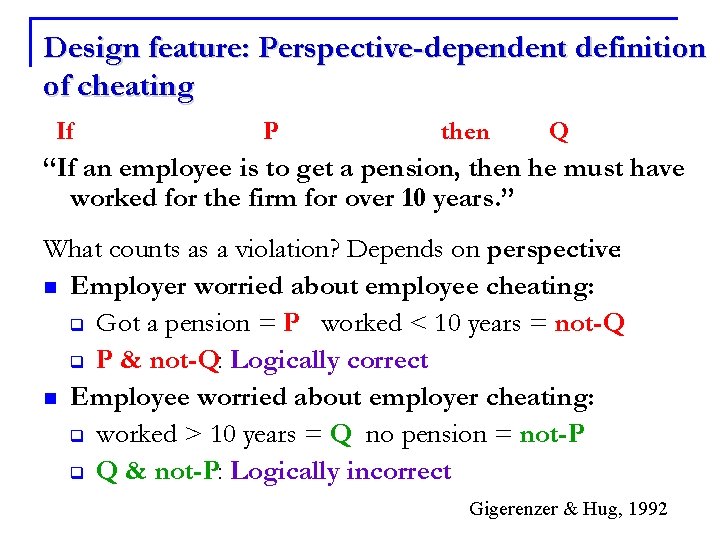
Design feature: Perspective-dependent definition of cheating If P then Q “If an employee is to get a pension, then he must have worked for the firm for over 10 years. ” What counts as a violation? Depends on perspective: n Employer worried about employee cheating: q Got a pension = P worked < 10 years = not-Q q P & not-Q: Logically correct n Employee worried about employer cheating: q worked > 10 years = Q no pension = not-P q Q & not-P: Logically incorrect Gigerenzer & Hug, 1992
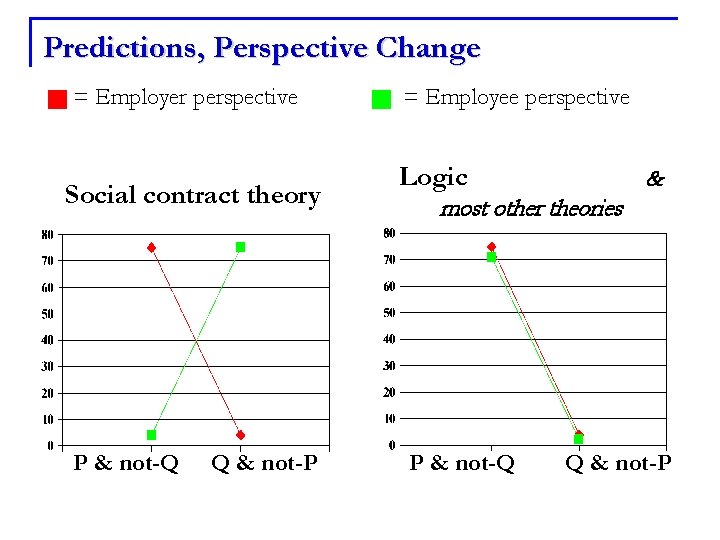
Predictions, Perspective Change = Employer perspective Social contract theory P & not-Q Q & not-P = Employee perspective Logic & most other theories P & not-Q Q & not-P
Results, Perspective Change = Employer perspective P & not-Q = Employee perspective Q & not-P Therefore: n What counts as cheating is computed in a perspectivedependent way n Performance good from each perspective n Not logic Gigerenzer & Hug, 1992
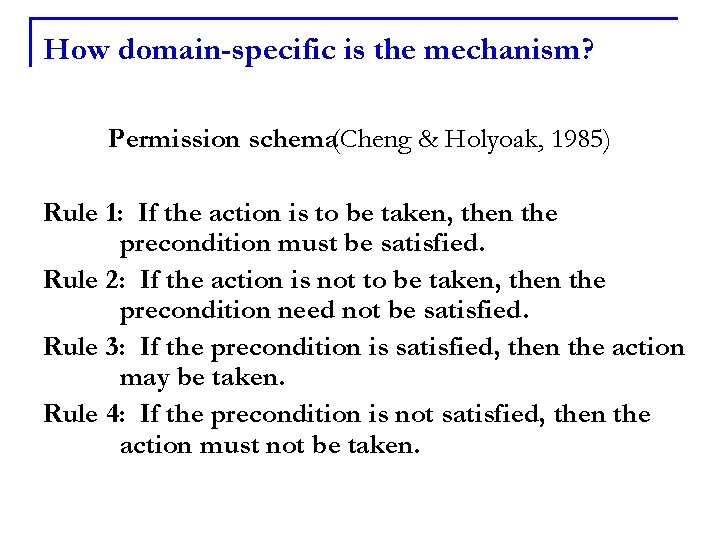
How domain-specific is the mechanism? Permission schema(Cheng & Holyoak, 1985) Rule 1: If the action is to be taken, then the precondition must be satisfied. Rule 2: If the action is not to be taken, then the precondition need not be satisfied. Rule 3: If the precondition is satisfied, then the action may be taken. Rule 4: If the precondition is not satisfied, then the action must not be taken.
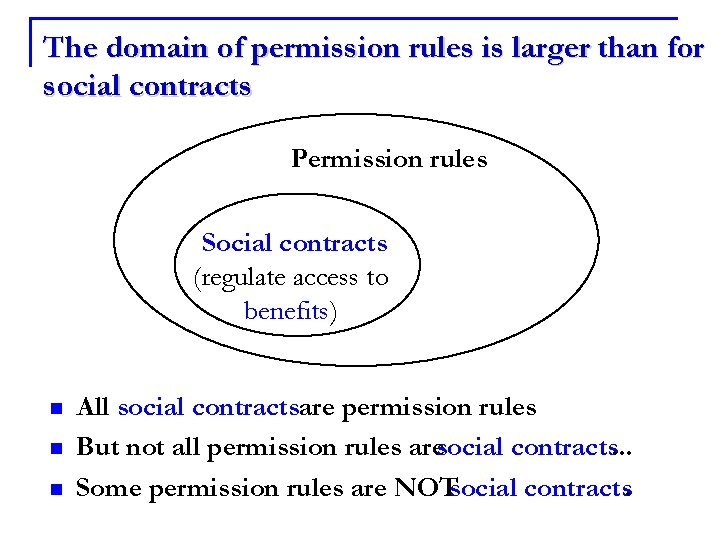
The domain of permission rules is larger than for social contracts Permission rules Social contracts (regulate access to benefits) n n n All social contractsare permission rules But not all permission rules aresocial contracts. . . Some permission rules are NOTsocial contracts.
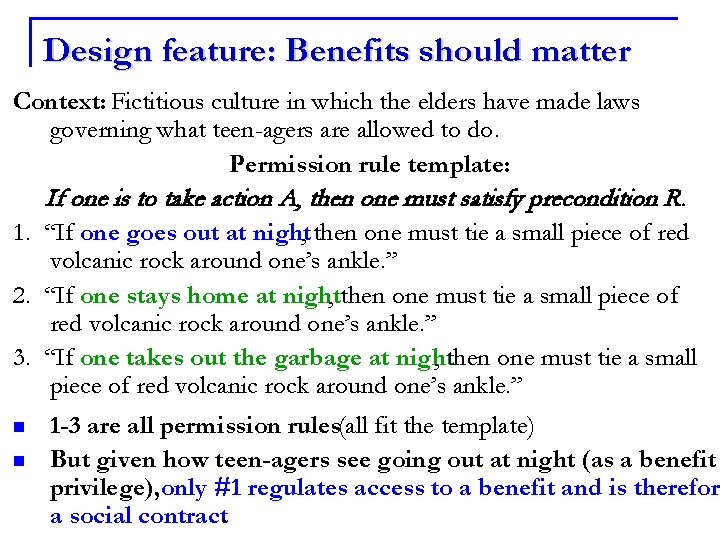
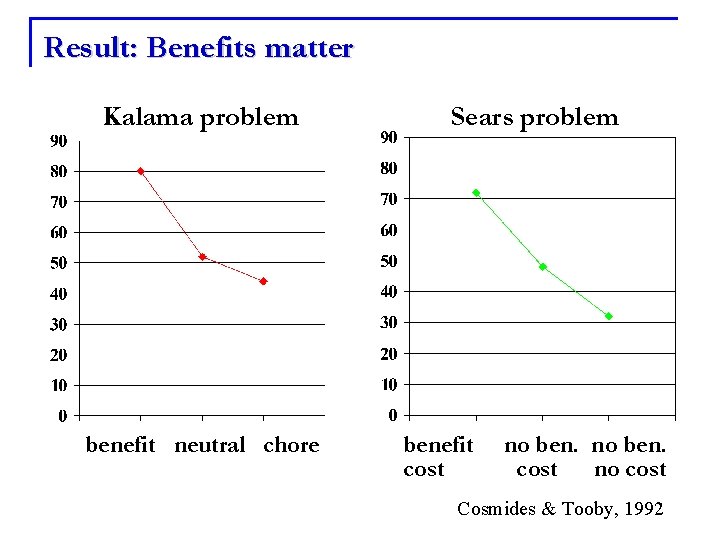
Design feature: Benefits should matter Context: Fictitious culture in which the elders have made laws governing what teen-agers are allowed to do. Permission rule template: If one is to take action A, then one must satisfy precondition R. 1. “If one goes out at night, then one must tie a small piece of red volcanic rock around one’s ankle. ” 2. “If one stays home at night, then one must tie a small piece of red volcanic rock around one’s ankle. ” 3. “If one takes out the garbage at night , then one must tie a small piece of red volcanic rock around one’s ankle. ” n n 1 -3 are all permission rules(all fit the template) But given how teen-agers see going out at night (as a benefit privilege), only #1 regulates access to a benefit and is therefore a social contract.
Result: Benefits matter Kalama problem benefit neutral chore Sears problem benefit cost no ben. cost no cost Cosmides & Tooby, 1992
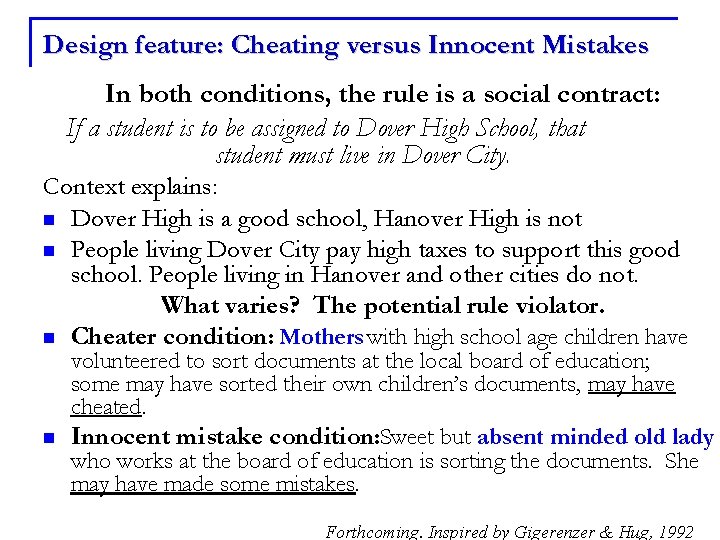
Design feature: Cheating versus Innocent Mistakes In both conditions, the rule is a social contract: If a student is to be assigned to Dover High School, that student must live in Dover City. Context explains: n Dover High is a good school, Hanover High is not n People living Dover City pay high taxes to support this good school. People living in Hanover and other cities do not. What varies? The potential rule violator. n Cheater condition: Mothers with high school age children have n volunteered to sort documents at the local board of education; some may have sorted their own children’s documents, may have cheated. Innocent mistake condition: Sweet but absent minded old lady who works at the board of education is sorting the documents. She may have made some mistakes. Forthcoming. Inspired by Gigerenzer & Hug, 1992
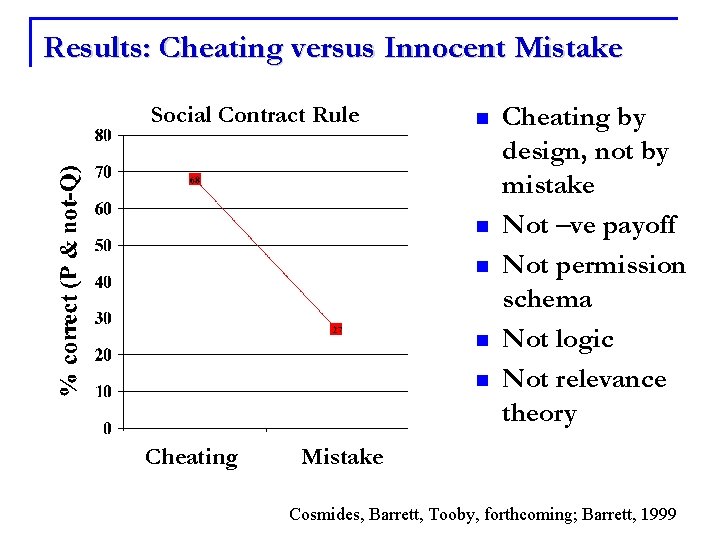
Results: Cheating versus Innocent Mistake Social Contract Rule n n n Cheating by design, not by mistake Not –ve payoff Not permission schema Not logic Not relevance theory Mistake Cosmides, Barrett, Tooby, forthcoming; Barrett, 1999
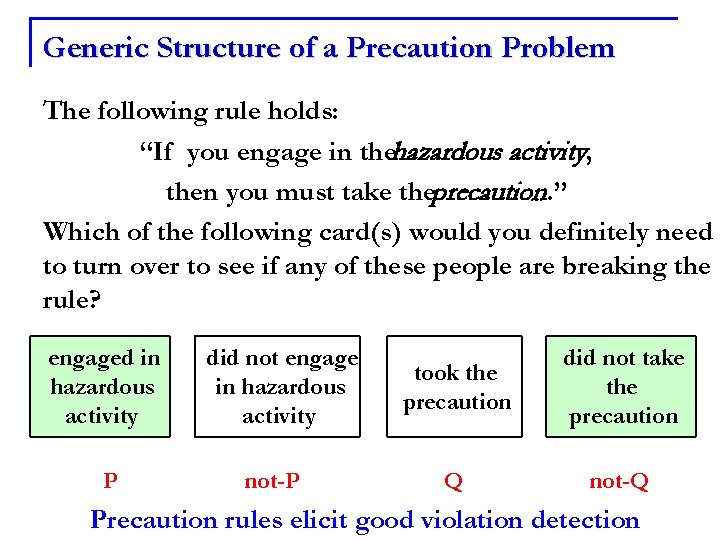
Generic Structure of a Precaution Problem The following rule holds: “If you engage in thehazardous activity, then you must take theprecaution. ” Which of the following card(s) would you definitely need to turn over to see if any of these people are breaking the rule? engaged in hazardous activity P did not engage in hazardous activity not-P took the precaution did not take the precaution Q not-Q Precaution rules elicit good violation detection
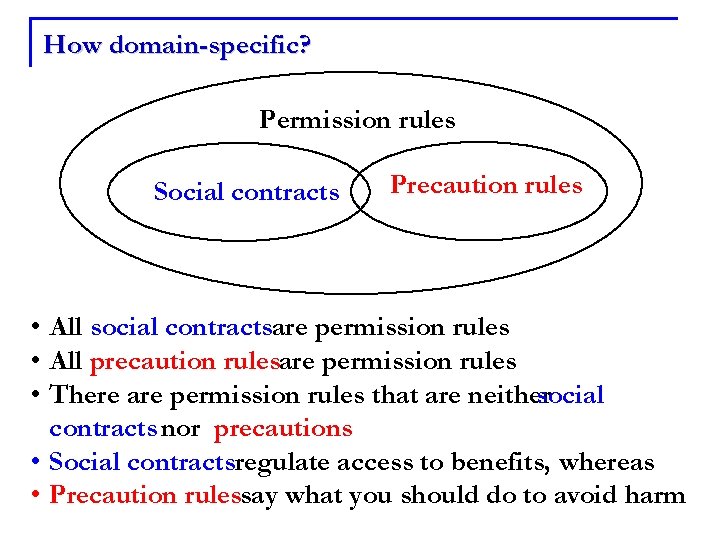
How domain-specific? Permission rules Social contracts Precaution rules • All social contractsare permission rules • All precaution rulesare permission rules • There are permission rules that are neither social contracts nor precautions • Social contractsregulate access to benefits, whereas • Precaution rulessay what you should do to avoid harm
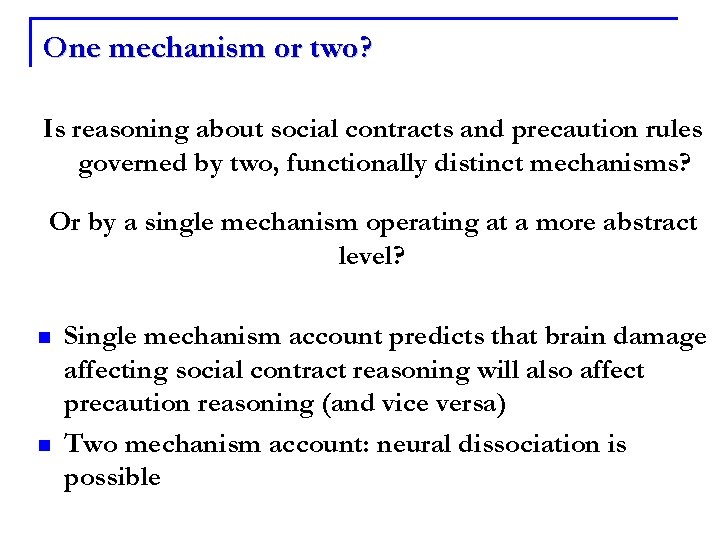
One mechanism or two? Is reasoning about social contracts and precaution rules governed by two, functionally distinct mechanisms? Or by a single mechanism operating at a more abstract level? n n Single mechanism account predicts that brain damage affecting social contract reasoning will also affect precaution reasoning (and vice versa) Two mechanism account: neural dissociation is possible
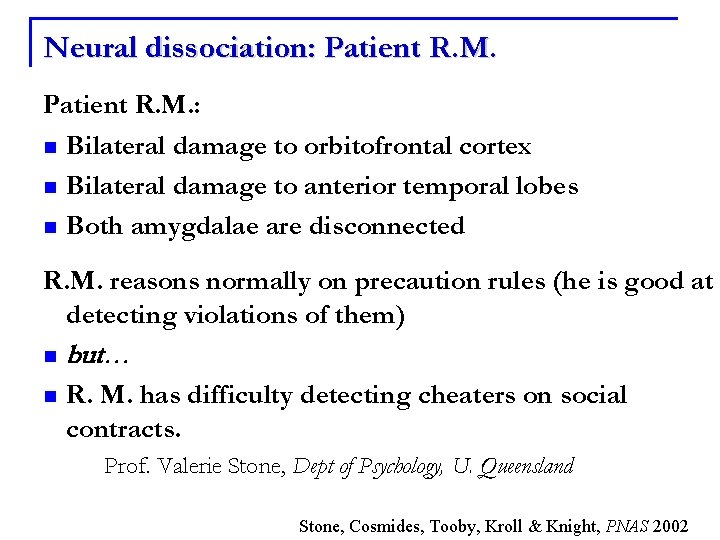
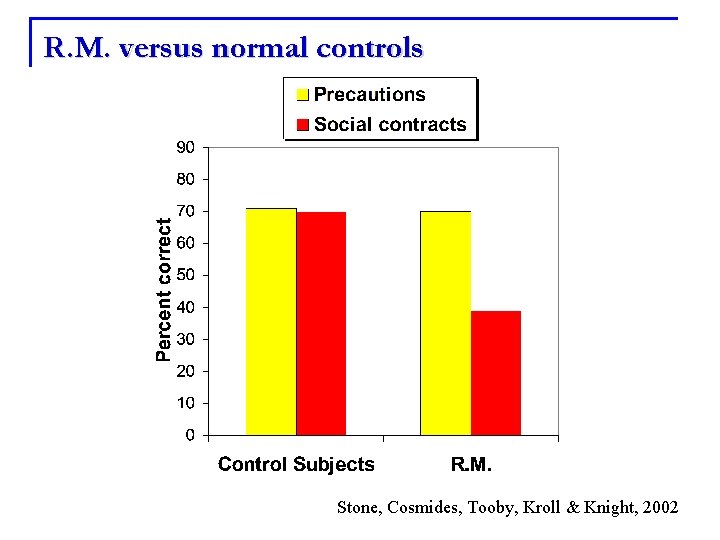
Neural dissociation: Patient R. M. : n Bilateral damage to orbitofrontal cortex n Bilateral damage to anterior temporal lobes n Both amygdalae are disconnected R. M. reasons normally on precaution rules (he is good at detecting violations of them) n but… n R. M. has difficulty detecting cheaters on social contracts. Prof. Valerie Stone, Dept of Psychology, U. Queensland Stone, Cosmides, Tooby, Kroll & Knight, PNAS 2002
R. M. versus normal controls Stone, Cosmides, Tooby, Kroll & Knight, 2002
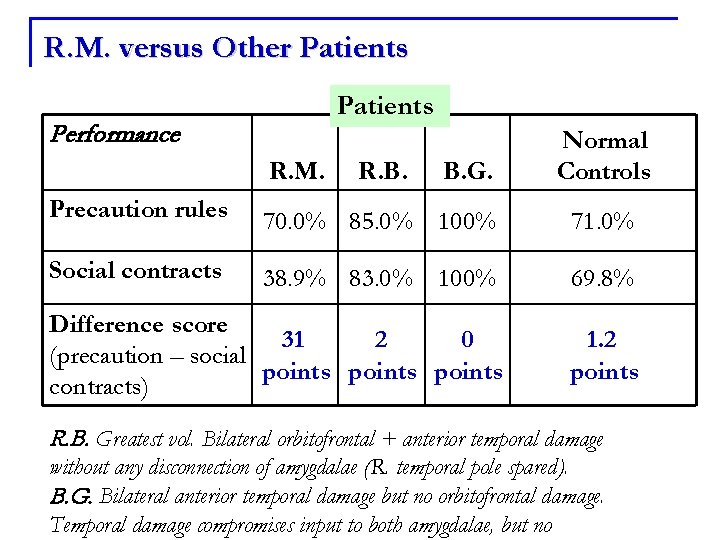
R. M. versus Other Patients Performance R. M. R. B. G. Normal Controls Precaution rules 70. 0% 85. 0% 100% 71. 0% Social contracts 38. 9% 83. 0% 100% 69. 8% Difference score 31 2 0 (precaution – social points contracts) 1. 2 points R. B. Greatest vol. Bilateral orbitofrontal + anterior temporal damage without any disconnection of amygdalae (R. temporal pole spared). B. G. Bilateral anterior temporal damage but no orbitofrontal damage. Temporal damage compromises input to both amygdalae, but no
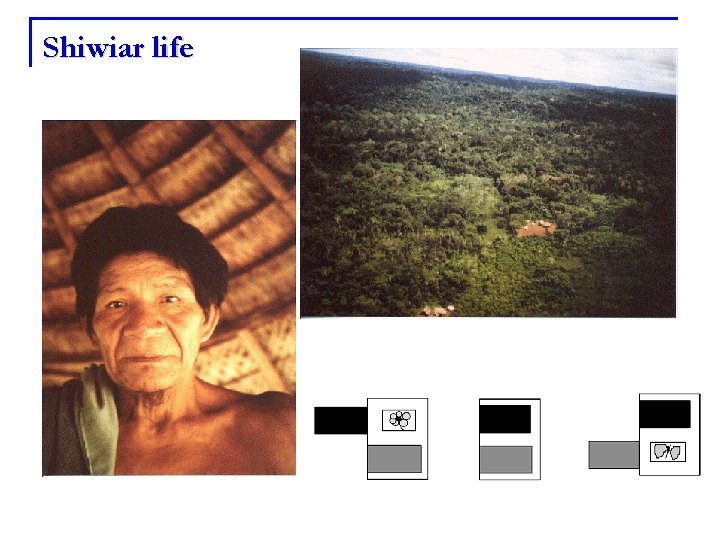
Does the cheater detection subroutine develop cross-culturally? Same pattern of reasoning responses in: n USA, Britain, Germany, France, Hong Kong, Italy, Japan. What about non-industrial societies? Shiwiar hunter-horticulturalists in Ecuadorian Amazon n Task adapted for non-literate, non-Western population n Cultural setting as different as possible along most dimensions Prof. Larry Sugiyama, Dept. of Anthropology, U. Oregon
Shiwiar life
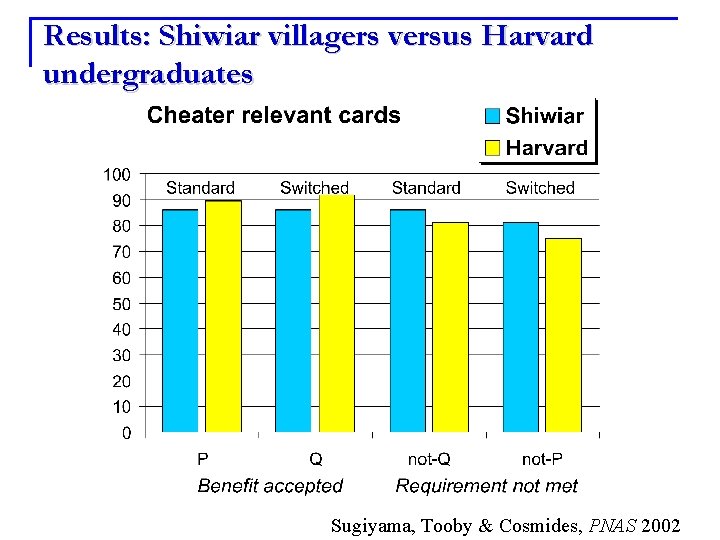
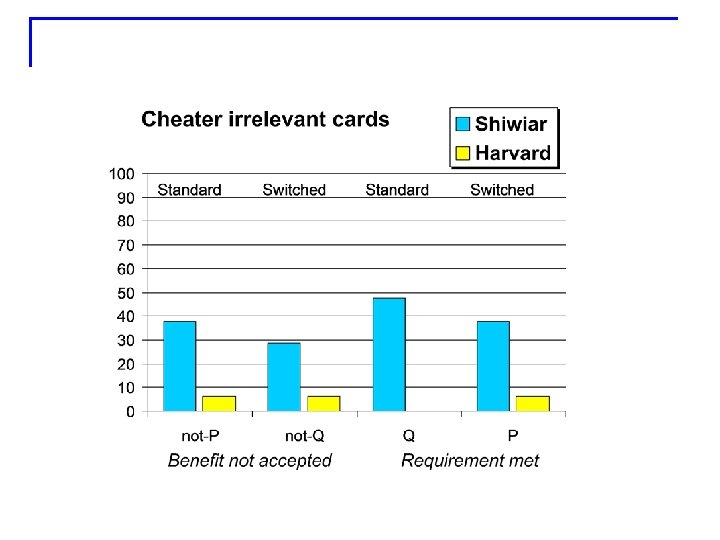
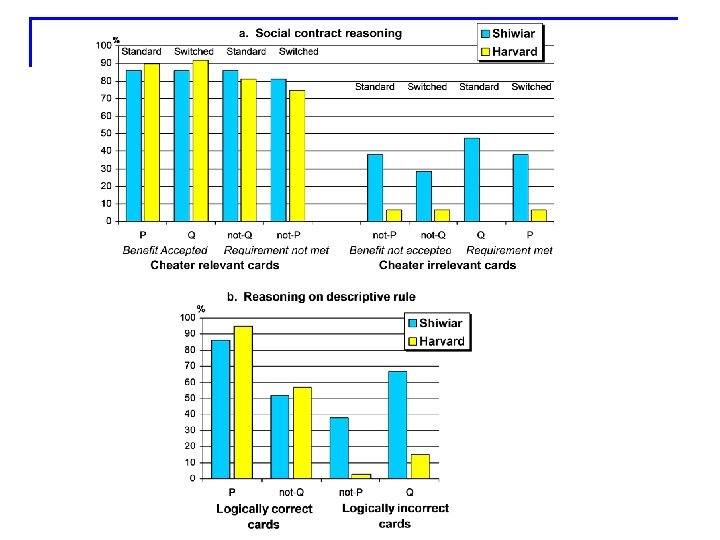
Results: Shiwiar villagers versus Harvard undergraduates Sugiyama, Tooby & Cosmides, PNAS 2002
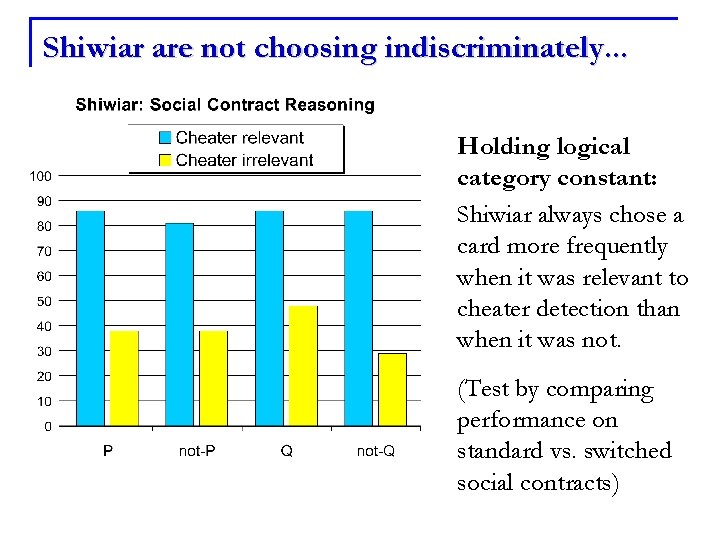
Shiwiar are not choosing indiscriminately. . . Holding logical category constant: Shiwiar always chose a card more frequently when it was relevant to cheater detection than when it was not. (Test by comparing performance on standard vs. switched social contracts)
Adaptations are aspects of the phenotype that were designed by natural selection What counts as evidence? To show that an aspect of the phenotype is an adaptation, one must produce evidence that it is well-designed for solving an adaptive problem that the species faced in the past. E. g. , to say that an organism has cognitive procedures that are adaptations for detecting cheaters: n One must show that these procedures are well-designed for detecting cheaters on social contracts. n One must also show that their design features are not more parsimoniously explained as byproducts of cognitive processes that evolved to solve some other kind of problem, or a more general class of problem.
Evidence of Special Design The cognitive programs governing reasoning about social contracts have the following design features: (all predicted in advance) 1. They operate even inunfamiliarsituations. 2. They embodyimplicational proceduresspecified by the computational theory(entitlement, obligation; switched SCs) 3. They have proceduresspecializedfor cheater detection. 4. These procedures areneurally dissociable. 5. These procedures are foundcross-culturally. 6. The definition of cheating they embody is contentdependent. (accepting a benefit without satisfying the requirement)
Evidence of Special Design, continued 7. 8. 9. This definition isperspective-dependent. The cheater detection procedures cannot detect violations of social contracts that do not correspond to cheating(no innocent mistakes) The algorithms do not operate so as to detect cheaters unless the rule has been assigned the costbenefit structureof a social contract(no benefit, no effect) The algorithms are as good at computing the cost-benefit representation of a social contract from the perspective of one party as from the perspective of another. 11. Precocial competence(3 & 4 year olds; Nunez & Harris) 12. They do not include altruist detection 10.
Byproduct Hypotheses A number of byproduct hypotheses have been empirically eliminated. For example: n Familiarity cannot explain the social contract effects. n Logic cannot explain the social contract effects. That is, social contract content does not merely facilitate the application of the rules of inference of the propositional calculus. n Content-independent deontic logic cannot explain the social contract effects. E. g. , permission schema theory cannot explain them. (Not good at just any social rule) n Social contract content does not merely “afford” clear thinking. n Content-independent forms of relevance theory cannot explain the social contract effects (see Fiddick, Cosmides & Tooby, 2000, Cognition) n The mere presence of payoffs does not elicit the detection of violations. That is, no content-independent, domain-general, “blank slate”-type
Conclusion n The human mind contains a neurocognitive adaptation that is functionally specialized for reasoning about social exchange, which includes a subroutine for detecting cheaters. n This neurocognitive system reliably develops in the human cognitive architecture in a species-typical manner. (It is one component of human nature).
Thank you! Some other research at the CEP: n n n Kin detection: altruism & incest aversion Computational approach to motivation: anger, guilt Coalitional psychology (“us” versus “them”) n n Collective action & free riders Judgment under uncertainty n n n Predator-prey reasoning Visual attention to animals Precautionary reasoning Moral sentiments Memory systems q Scope hypothesis q Personality system, self Center for Evolutionary Psychologywebsite: www. psych. ucsb. edu/research/cep
Domain-specific social contract algorithms: Built by a domain-general learning process? Each alternative theory posits different evolved machinery and, therefore, makes different predictions. Domain-generalprocesses are content-free. They get all of their content from the environment experienced by individual organisms. n Therefore the content of schemas built, and the kind of schemas built, should reflect the statistical distribution of problems found in a given (modern) society. n It should not reflect the distribution of problems found under ancestral circumstances. n What is there to be afraid of? Chicago children, Maurer, 1965
Domain-specific social contract algorithms: Built by a domain-general learning process? The dog that did not bark. Domain general learning predicts: n n n There should be permission schemas: permissions are, by definition, more common than social contracts. (But these do not develop). (Also: Why not be good at violations that are mistakes? ) There should be schemas for detecting violations of conditionals from other currently important domains. (e. g. , trouble-shooting in fixing appliances should yield schemas good at detecting violations of causal rules. These do not appear to exist. ) Should see variation across cultures, with the SC algorithms developing in some but not others. (Seems universal)