
Cognitive Abilities What does intelligence mean to you
Cognitive Abilities
What does intelligence mean to you? Isaac Newton Maria Curie Woodrow Wilson Thomas Edison Albert Einstein Leonardo da Vinci

Intelligence: The Definition l Robert Sternberg created the three characteristics that include intelligence: 1. 2. 3. Being able to learn, remember, reason , and perform other information-processing skills Using those skills to solve problems Being able to alter or adapt to new or changing environments
The Beginnings l l Intelligence tests began in France in 1904 by Alfred Binet which tested the child's mental age against the chronological age. Lewis Terman published his version of the test in english known as the Stanford-Binet test. He developed a process of which the mental age was divided by chronological age and then multiplied by 100. This was called the intelligence quotient or IQ. An Example: An IQ of a 10 year old who scored at the mental age of twelve would have an IQ of 120. 12/10 x 100 = 120 Any questions see table on page 362
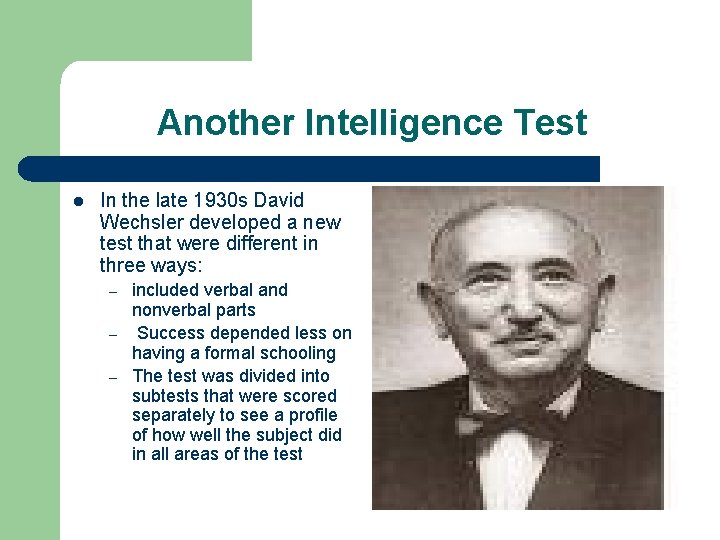
Another Intelligence Test l In the late 1930 s David Wechsler developed a new test that were different in three ways: – – – included verbal and nonverbal parts Success depended less on having a formal schooling The test was divided into subtests that were scored separately to see a profile of how well the subject did in all areas of the test
Reliability and Validity If you stepped on a scale, checked your weight, stepped off, and then stepped back on, and found your weight increased by 30 pounds, you would know it was time to get a new scale. This is an example of reliability. It is the degree to which a test can be repeated. Imagine that your scale is reliable, but it says you weigh thirty pounds. Unless you are a small child this would prove invalid. Validity is the degree to which test scores are interpreted correctly and used appropriately.
How Reliable Are Intelligence Tests? l IQ scores obtained before the age of seven typically do not correlate well with scores given later for two key reasons: a) Test items used with very young children are different from those used with older children b) In early years, cognitive abilities change rapidly and at different rates for different children For teenagers and adults, the stability of IQ scores is high, normally above. 85
How Valid Are Intelligence Tests? l l Because Psychologist do not fully agree on a single definition of intelligence, they don’t have a single standard to compare intelligence tests. They can only assess the validity of intelligence test scores for specific purposes. Intelligence test scores appear to be most valid for assessing aspect of intelligence that are related to schoolwork, like abstract reasoning and verbal comprehension.
Nature vs. Nurture l l Research shows that genetics play a major role in Intelligence. Twins separated at birth have the same IQ even though they are raised in different areas. Environment plays an important role in what IQ a child will have. The more stimulating the environment, the higher the IQ.
Socioeconomic Differences and the Four l l Parents jobs and status depend on characteristics related to their own intelligence Parents income affects their children’s environment in ways that can increase or decrease IQ scores Motivational differences may play a role, parents in upper and middle classes tend to play a more dominate role in the child’s education Colleges, universities and businesses usually select people who score high on various cognitive ability tests
The Psychometric Approach l l Psychometric approach- A way of studying intelligence that emphasizes analysis of the products of intelligence, especially scores on intelligence tests. Is intelligence on general trait or is it bundle of specific traits?
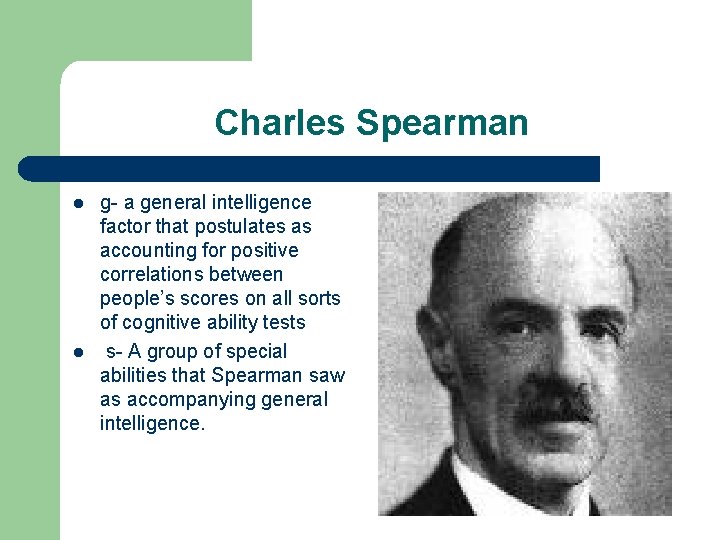
Charles Spearman l l g- a general intelligence factor that postulates as accounting for positive correlations between people’s scores on all sorts of cognitive ability tests s- A group of special abilities that Spearman saw as accompanying general intelligence.
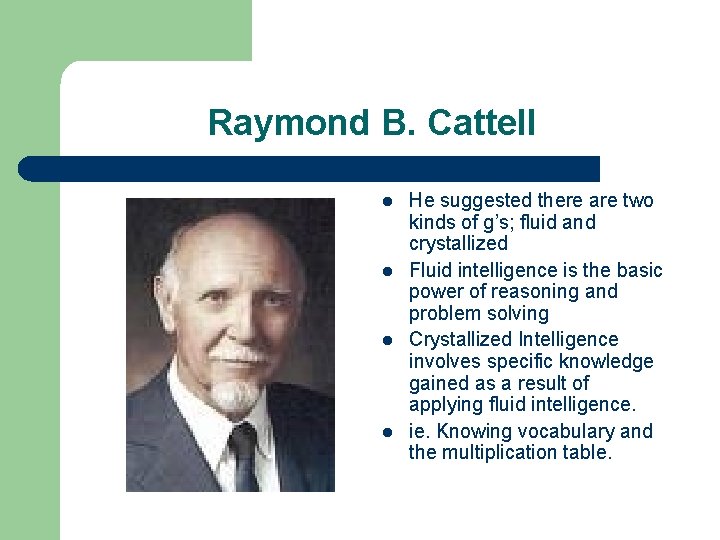
Raymond B. Cattell l l He suggested there are two kinds of g’s; fluid and crystallized Fluid intelligence is the basic power of reasoning and problem solving Crystallized Intelligence involves specific knowledge gained as a result of applying fluid intelligence. ie. Knowing vocabulary and the multiplication table.
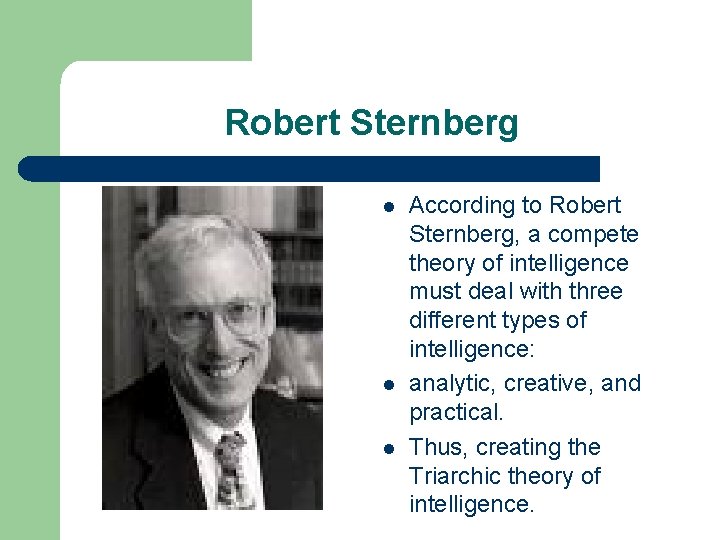
Robert Sternberg l l l According to Robert Sternberg, a compete theory of intelligence must deal with three different types of intelligence: analytic, creative, and practical. Thus, creating the Triarchic theory of intelligence.
Multiple Intelligences l Eight semi-independent kinds of intelligence postulated by Howard Gardner. l l l l l Linguistic intelligence Logical intelligence Mathematical intelligence Spatial intelligence- understanding relationships between objects Musical intelligence Body-kinesthetic intelligence Intrapersonal intelligence-self understanding Interpersonal intelligence- understand interact with others Naturalistic intelligence- ability to see patterns in nature
Howard Gardner received a lot of criticism with his eight ideas of intelligence. It was said to defeat the purpose of the test because in his theory everyone had a strong intelligence where some scientist were only interested in math and reading. What do you think? ?
Creativity… l l The capacity to produce new, high-quality ideas or products. Divergent thinking- the ability to think along many alternative pats to generate many different solutions to a problem.
Divergent Thinking Imagine all the things that would happen if we did not have any principals in our school?
Mentally Challenged l They are different from other children in three main ways: l l They perform certain mental operations more slowly, such as retrieving information from longterm memory They simply know fewer facts about the world They are not very good at remembering to use mental strategies that may be important in learning and problem solving They are deficient in Metacognition, of the knowledge of what strategies to apply, when to apply them, and how to apply them in new situations.
Learning Disabilities l l People show a significant discrepancy between their measured intelligence and their academic performance. There are Two main kinds: l l Dyslexia- they see letters as distorted or jumbled Dysphasia – difficulty in understand spoken words
- Slides: 20