
Cognition Memory Thought Chapter 11 Our filing system




- Slides: 78
Cognition (Memory & Thought) Chapter 11
Our filing system Pledge of Allegiance, Indians starting line-up, 3 rd grade, Lines from your favorite movie, State capitals, First love Going beyond memory, how do we think? How do we solve problems? How do we store memories?
Memory Memory- capacity to register, store, and recover information over time (learning) Cognition – all the mental activities associated with thinking, knowing and remembering information Metacognition - thinking about how you think Introspection - used by the Structuralists in late 1800 s to uncover details of human thought process
Theories of Memory Molecular Theory (James Mc. Connell) Memory stored in RNA molecules EX: Flatworm experiment Mc. Connell made the astonishing discovery that memory has an identifiable chemical basis. He trained flatworms to run mazes, and noted how long it took to do so. Then Mc. Connell took the trained worms and ground them up and fed them to untrained worms. The untrained worms learned to run the maze a lot faster than the original worms had, apparently demonstrating that there was some sort of information in the trained worms that survived being ground up and ingested. The hypothesis was that the information was somehow encoded in RNA molecules, and could be physically transferred from one individual to another.
Bummer Mc. Connell’s research has never been replicated He did create quite a media frenzy and many well known psychologists were intrigued by his original findings. The frenzy quickly died down when no one was able to replicate the same results
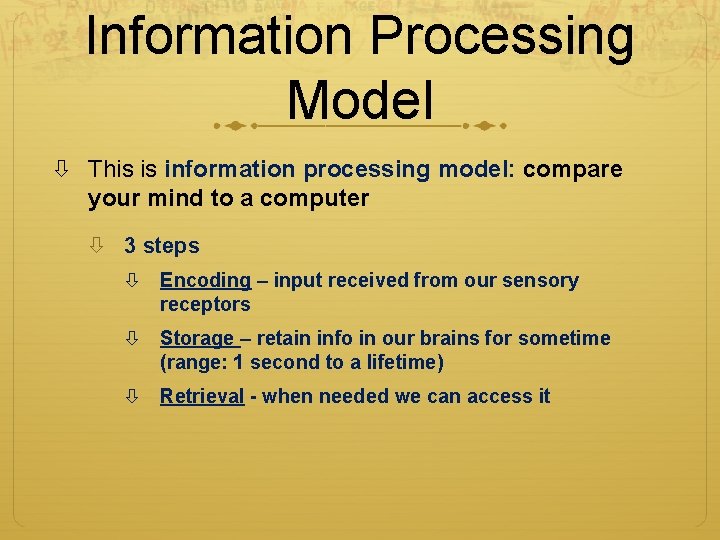
Information Processing Model This is information processing model: compare your mind to a computer 3 steps Encoding – input received from our sensory receptors Storage – retain info in our brains for sometime (range: 1 second to a lifetime) Retrieval - when needed we can access it
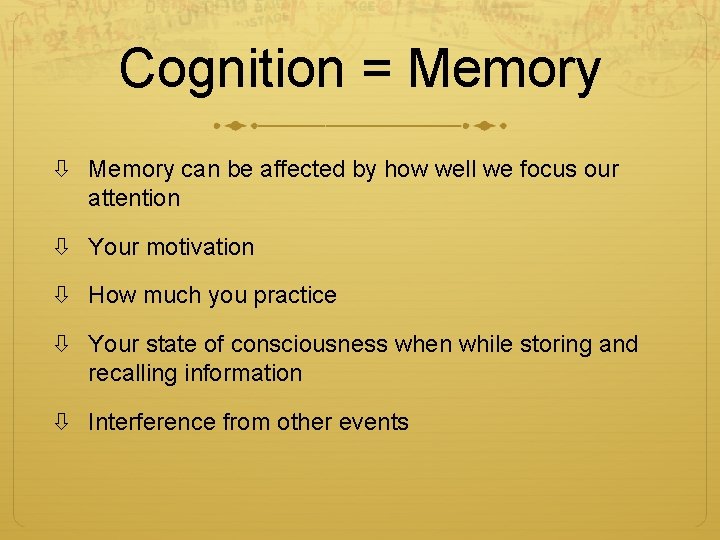
Cognition = Memory can be affected by how well we focus our attention Your motivation How much you practice Your state of consciousness when while storing and recalling information Interference from other events
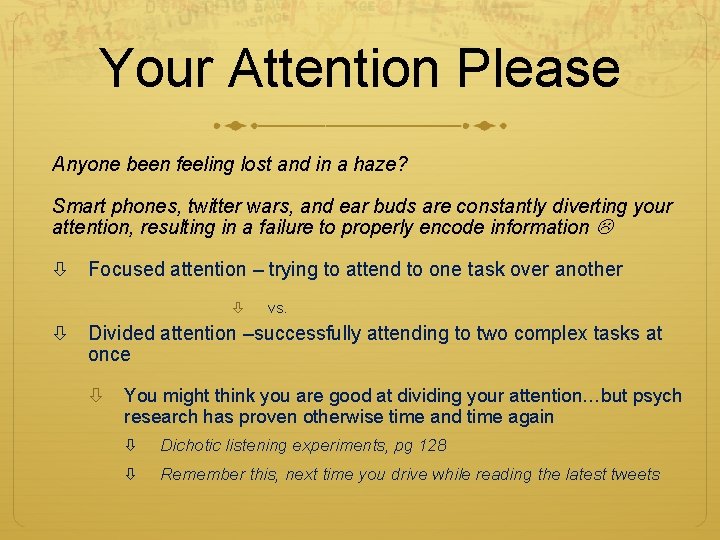
Your Attention Please Anyone been feeling lost and in a haze? Smart phones, twitter wars, and ear buds are constantly diverting your attention, resulting in a failure to properly encode information Focused attention – trying to attend to one task over another vs. Divided attention –successfully attending to two complex tasks at once You might think you are good at dividing your attention…but psych research has proven otherwise time and time again Dichotic listening experiments, pg 128 Remember this, next time you drive while reading the latest tweets
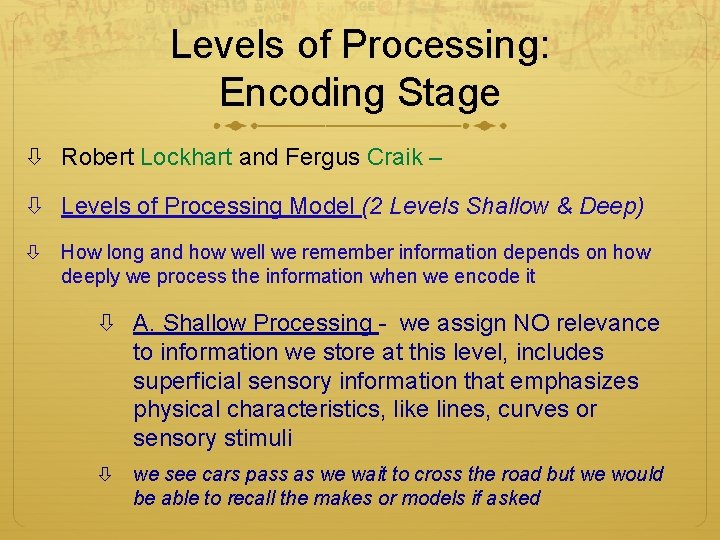
Levels of Processing: Encoding Stage Robert Lockhart and Fergus Craik – Levels of Processing Model (2 Levels Shallow & Deep) How long and how well we remember information depends on how deeply we process the information when we encode it A. Shallow Processing - we assign NO relevance to information we store at this level, includes superficial sensory information that emphasizes physical characteristics, like lines, curves or sensory stimuli we see cars pass as we wait to cross the road but we would be able to recall the makes or models if asked
Levels of Processing: Encoding Stage Deep processing – when we attach meaning to information and create associations between new and old information/memories Semantic Encoding – deeper level, emphasizes the meaning of verbal input, can be passed to short or long term memory Best way to remember a new person’s names at a social event Creating associations between new memory and old memories is called – Elaboration Processing information deemed important or relevant more deeply by relating the new information to ourselves, making it easier to recall – self-reference effect or self-referent encoding
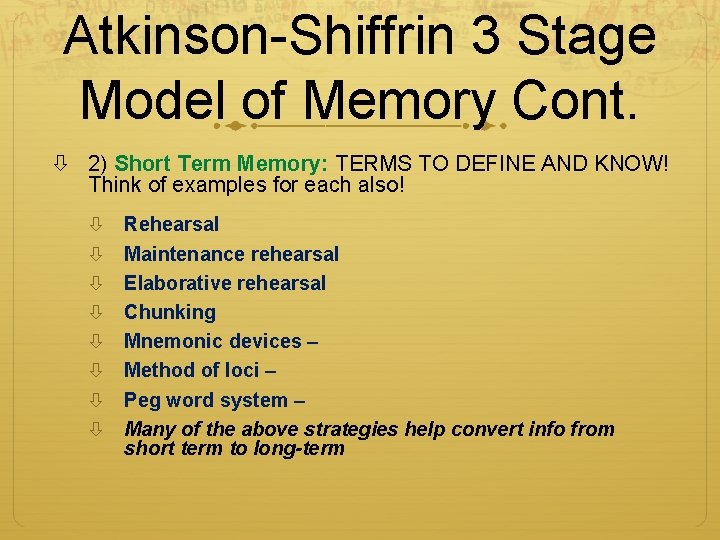
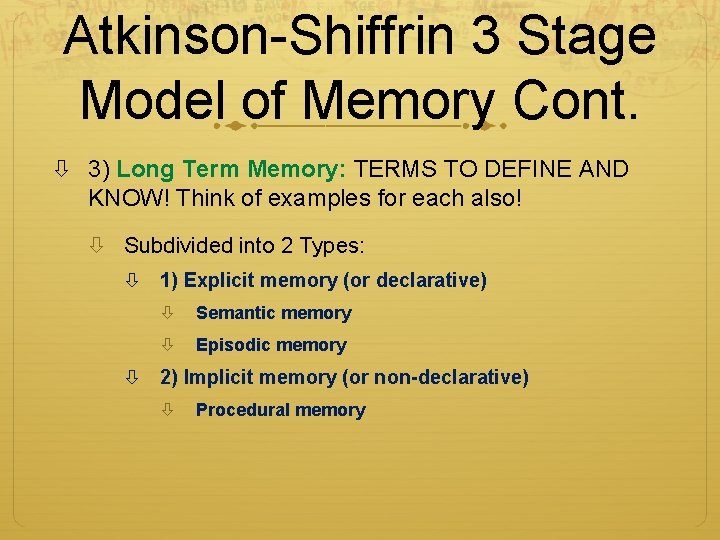
Atkinson-Shiffrin 3 Stage Model of Memory We have 3 different memory systems characterized by time frames 1) Sensory memory – memory system that holds external events from the senses for up to a few seconds 2) Short-term memory – “working memory”, 20 seconds before forgotten, capacity is 7 + or - 2 3) Long-term memory – relatively permanent storage with unlimited capacity
Simon Anyone? http: //www. kidsmathgamesonline. com/memory/simon. html
Vocab Assignment #1 Define all terms on slides 14 -19 Expect these terms on your daily quiz List them on notebook paper in the same chunked groups as they appear on the slides
Atkinson-Shiffrin 3 Stage Model of Memory Cont. 1) Sensory Memory: TERMS TO DEFINE AND KNOW! Visual encoding Iconic memory Acoustic encoding Echoic memory Selective attention Automatic processing Parallel processing Effortful processing Feature extraction
Atkinson-Shiffrin 3 Stage Model of Memory Cont. 2) Short Term Memory: TERMS TO DEFINE AND KNOW! Think of examples for each also! Rehearsal Maintenance rehearsal Elaborative rehearsal Chunking Mnemonic devices – Method of loci – Peg word system – Many of the above strategies help convert info from short term to long-term
Atkinson-Shiffrin 3 Stage Model of Memory Cont. 3) Long Term Memory: TERMS TO DEFINE AND KNOW! Think of examples for each also! Subdivided into 2 Types: 1) Explicit memory (or declarative) Semantic memory Episodic memory 2) Implicit memory (or non-declarative) Procedural memory
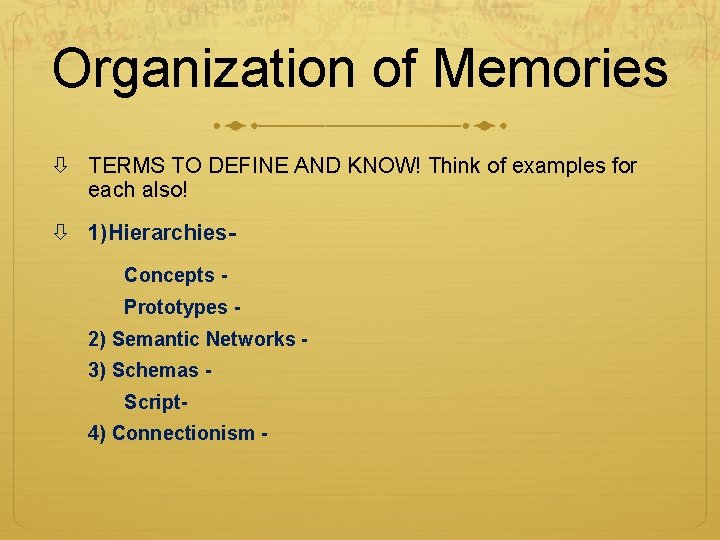
Organization of Memories TERMS TO DEFINE AND KNOW! Think of examples for each also! 1)Hierarchies. Concepts Prototypes 2) Semantic Networks 3) Schemas Script 4) Connectionism -
Related Memory Terms TERMS TO DEFINE AND KNOW! Think of examples for each also! Artificial Intelligence (AI) – Neural network or Parallel processing model
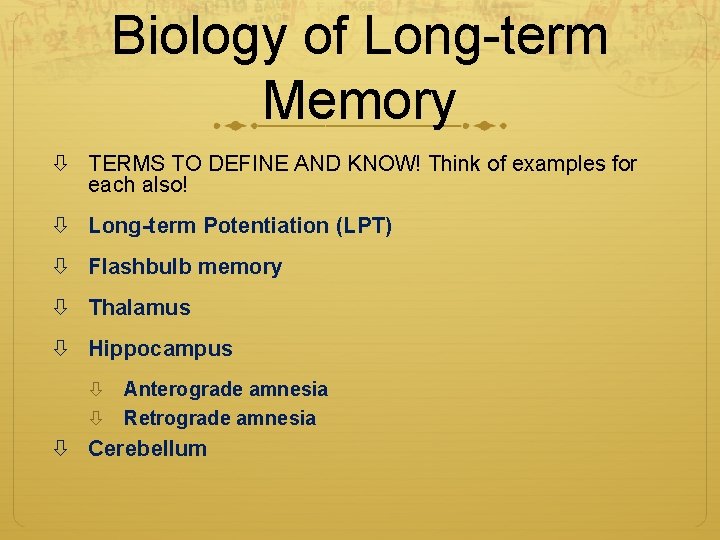
Biology of Long-term Memory TERMS TO DEFINE AND KNOW! Think of examples for each also! Long-term Potentiation (LPT) Flashbulb memory Thalamus Hippocampus Anterograde amnesia Retrograde amnesia Cerebellum
Retrieval and Memory Elizabeth Loftus - Confabulation & Eye Witness Testimony 60 Minutes https: //www. youtube. com/watch? v=nb. ARxi. M 0 W_Q
Vocab Assignment #2 Define all the listed (undefined) terms on slides 22 -30 Be prepared to see these on your next daily quiz
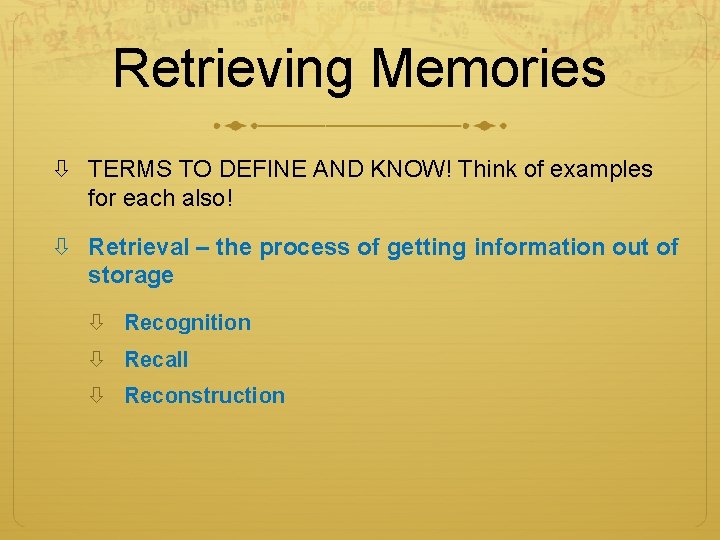
Retrieving Memories TERMS TO DEFINE AND KNOW! Think of examples for each also! Retrieval – the process of getting information out of storage Recognition Recall Reconstruction
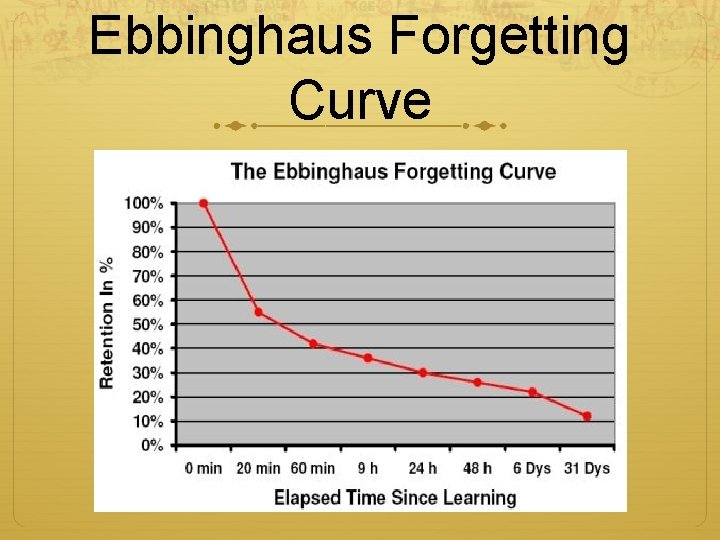
Ebbinghaus Summarize Ebbinghaus’ Forgetting Curve Theory (pg 131) Also define these terms related to his research: savings method overlearning effect serial positioning effect primacy effect recency effect
Retrieval Cues TERMS TO DEFINE AND KNOW! Think of examples for each also! Retrieval Cues Priming Encoding specificity principle Context- dependent memory effect Mood congruence – State-dependent - Distributed practice Massed practice -
Reconstruction TERMS TO DEFINE AND KNOW! Think of examples for each also! Repression – (Freud) Confabulation Summarize Elizabeth Loftus’ Theory on Confabulation (eye witness testimony) Misinformation effect Misattribution error
Retrieval + Interference = Forgetting TERMS TO DEFINE AND KNOW! Think of examples for each also! Forgetting – the inability to retrieve information Tip-of-the-tongue phenomenon Interference Proactive interference Retroactive interference
Combat Forgetting Overlearning – Elaborative rehearsal – Differs from maintenance rehearsal which is just utilizing STM to keep info 20 seconds
Language Phonemes Morphemes Grammar Syntax Semantics
Language Acquisition Babbling Holophrastic speech Telegraphic speech Overgeneralizations (over-regularization)
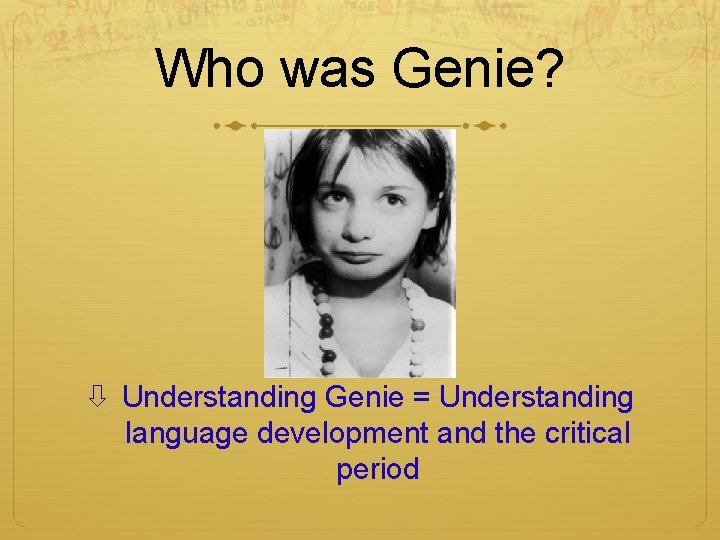
Theory on Language Acquisition Nature (nativist) vs Nurture______ Noam Chomsky Language acquisition device / Behaviorist, like Skinner / Shaping, reinforcement Critical Period - Lenneberg Genie the feral child
Who was Genie? Understanding Genie = Understanding language development and the critical period
Theory on Language Acquisition Social Interactivist Perspective- most psychologist and linguists believe our acquisition of language is a combo of both the nature and nurture side of the debate Bio and Cognitive Psychologists Have proven we have development of dense neuron connections during he 1 st few years of life = critical to master language
Theory on Language Acquisition Benjamin Whorf (linguist) Linguistic Relativity Hypothesis - language guides and determines our thinking & perceptions * largely discredited and controversial Most researchers and theorist believe the opposite: our experiences, perceptions, and thinking guide our language acquisition
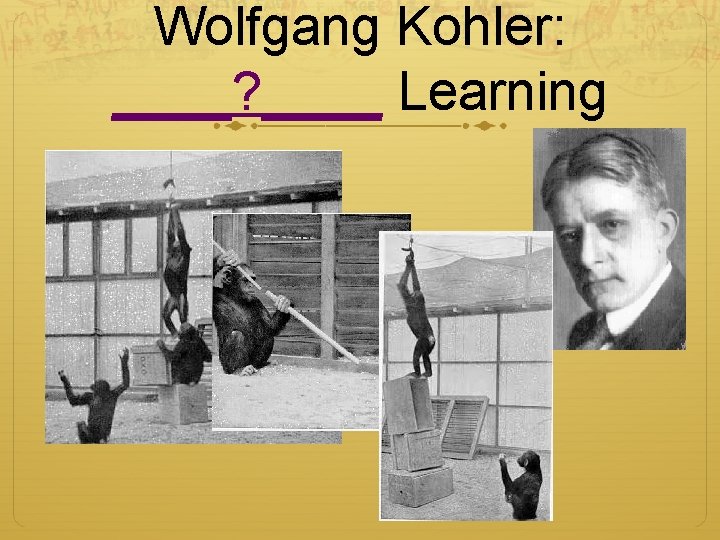
Wolfgang Kohler: ____? ____ Learning
Kohler: Insight Learning Kohler attempted to prove that animals arrive at a solution through insight rather than trial and error. Kohler's experiments consisted of placing chimps in an enclosed area and presenting them with a reward that was out of reach, such as bananas. In one experiment, Kohler placed bananas outside Sultan's cage and two bamboo sticks inside his cage. Neither stick was long enough to reach the bananas so the only way to reach the bananas was to put the sticks together. After some contemplation, Sultan put the two sticks together and created a stick long enough to reach the bananas outside his cage. Another study involved bananas suspended from the roof. The chimps first tried to knock them down by using a stick. Then, the chimps learned to stack boxes on top of one another to climb up to the bananas.
Wolfgang Kohler: Insight Learning Kohler described three properties of insight learning: First, insight-learning is based on the animal perceiving the solution to the problem. Second, insight-leaning is not dependent on rewards. Third, once a problem has been solved, it is easier to solve a similar problem.
Vocab Assignment #3 Define terms on slides 38 - 41 Expect to see them in your next daily quiz
Problem Solving Algorithm Heuristic Insight learning – WOLFGANG KOHLER & chimpanzees (co-founder of Gestalt Psych) Trial and Error Approach Inductive reasoning Deductive reasoning
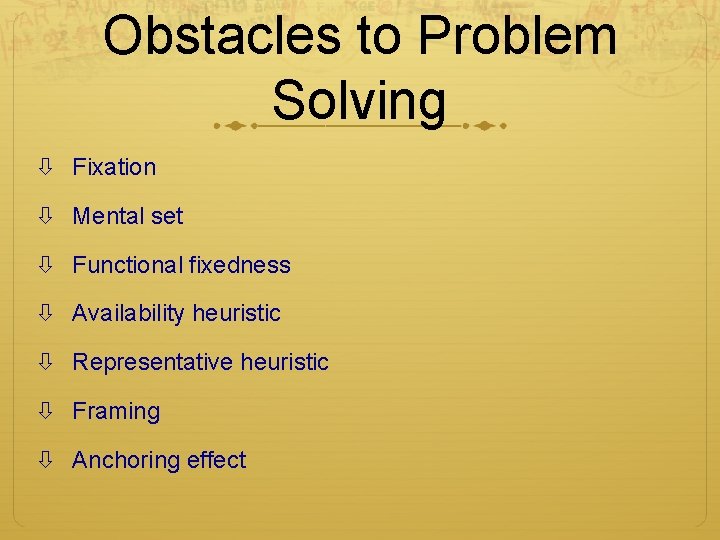
Obstacles to Problem Solving Fixation Mental set Functional fixedness Availability heuristic Representative heuristic Framing Anchoring effect
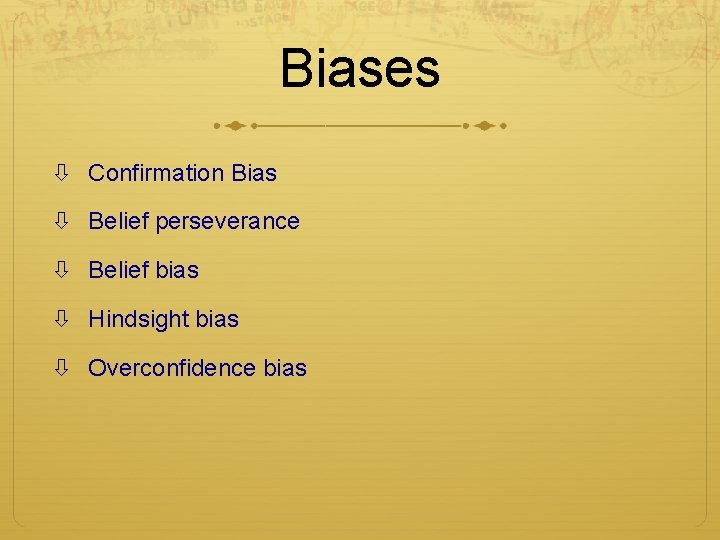
Biases Confirmation Bias Belief perseverance Belief bias Hindsight bias Overconfidence bias
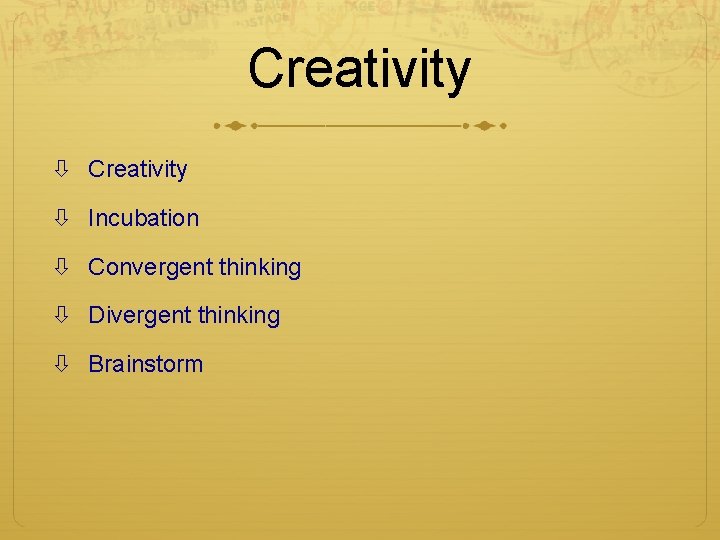
Creativity Incubation Convergent thinking Divergent thinking Brainstorm
Let’s Review Some Key Terms
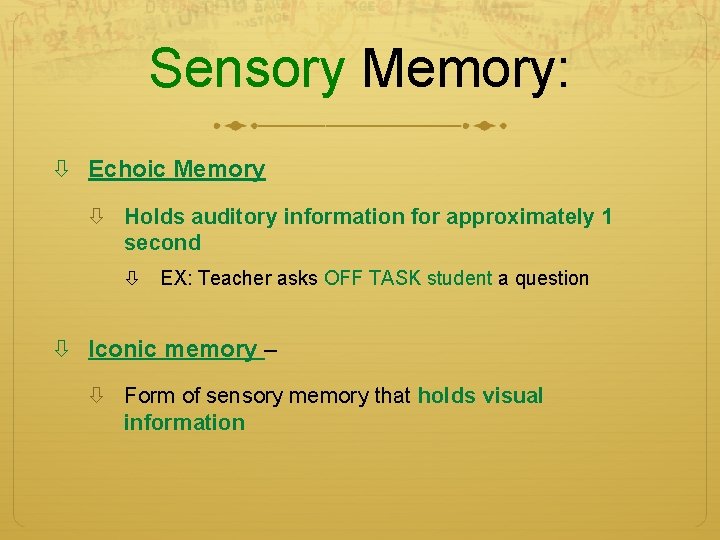
Sensory Memory: Echoic Memory Holds auditory information for approximately 1 second EX: Teacher asks OFF TASK student a question Iconic memory – Form of sensory memory that holds visual information
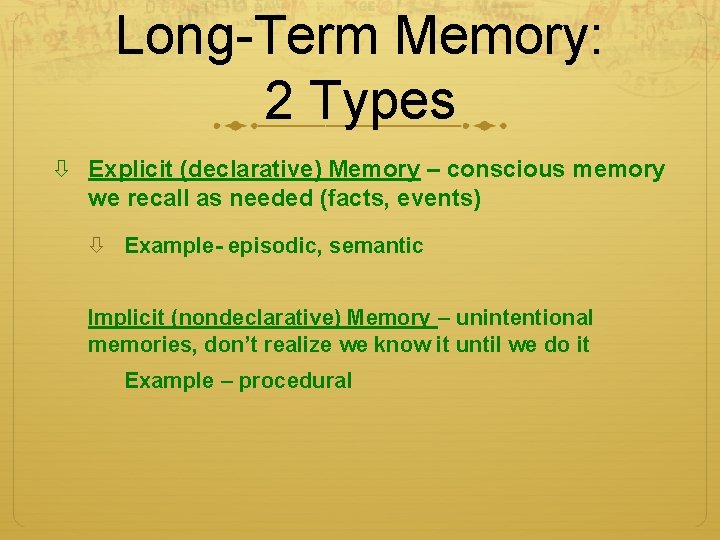
Long-Term Memory: 2 Types Explicit (declarative) Memory – conscious memory we recall as needed (facts, events) Example- episodic, semantic Implicit (nondeclarative) Memory – unintentional memories, don’t realize we know it until we do it Example – procedural
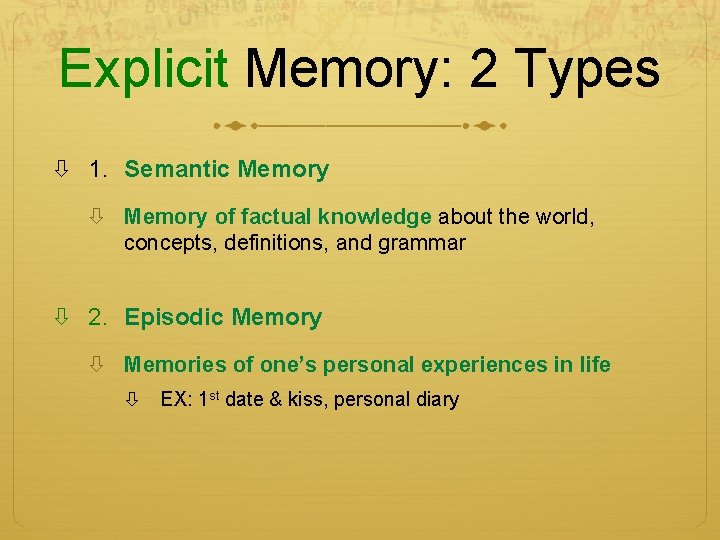
Explicit Memory: 2 Types 1. Semantic Memory of factual knowledge about the world, concepts, definitions, and grammar 2. Episodic Memory Memories of one’s personal experiences in life EX: 1 st date & kiss, personal diary
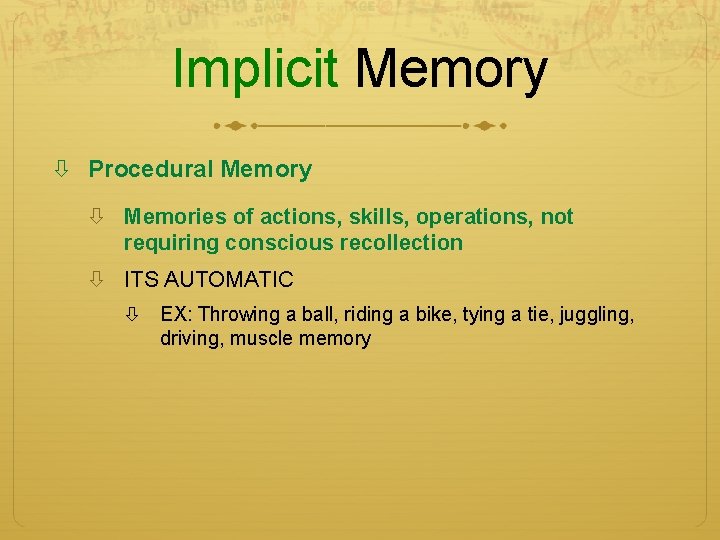
Implicit Memory Procedural Memory Memories of actions, skills, operations, not requiring conscious recollection ITS AUTOMATIC EX: Throwing a ball, riding a bike, tying a tie, juggling, driving, muscle memory
Unique Type of Memory Yet another specific type of memory: Eidetic Memory (“photographic memory”) Retain detailed visual image for several minutes, or longer, like Sheldon Cooper
Review: What type of memory do these terms fall under? Selective Attention Feature Extraction Effortful Processing Parallel processing Automatic Processing
Review: What type of memory do these terms fall under? Chunking Rehearsal
Stages of Memory Short-term Memory to HOW can we do this? Chunking Rehearsal Mnemonic device Long-term Memory
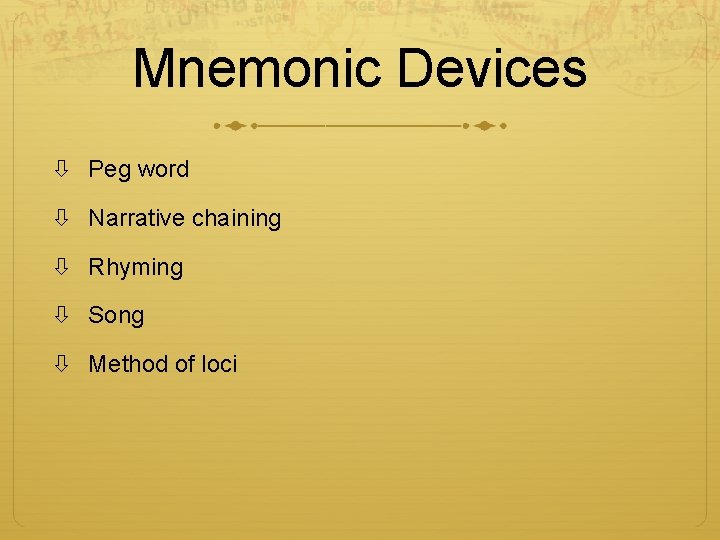
Mnemonic Devices Peg word Narrative chaining Rhyming Song Method of loci
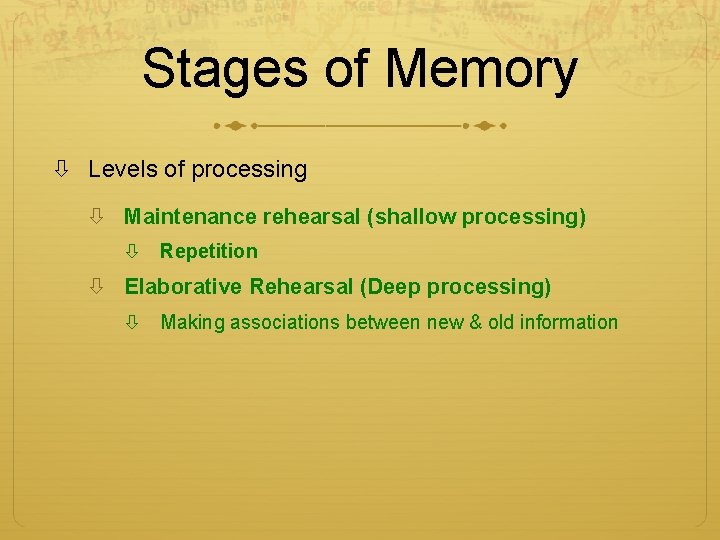
Stages of Memory Levels of processing Maintenance rehearsal (shallow processing) Repetition Elaborative Rehearsal (Deep processing) Making associations between new & old information
Stages of Memory 50 states in 1 minute Activity On a separate/scrap piece of paper List the 50 states! You have 1 minute, GO!
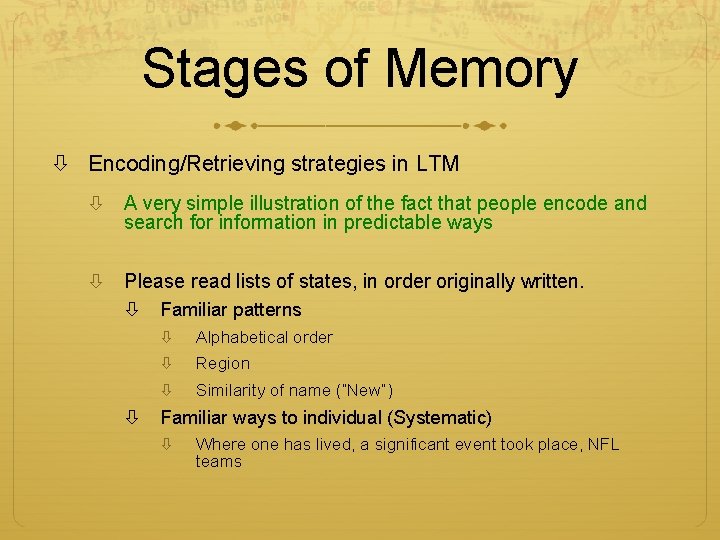
Stages of Memory Encoding/Retrieving strategies in LTM A very simple illustration of the fact that people encode and search for information in predictable ways Please read lists of states, in order originally written. Familiar patterns Alphabetical order Region Similarity of name (“New”) Familiar ways to individual (Systematic) Where one has lived, a significant event took place, NFL teams
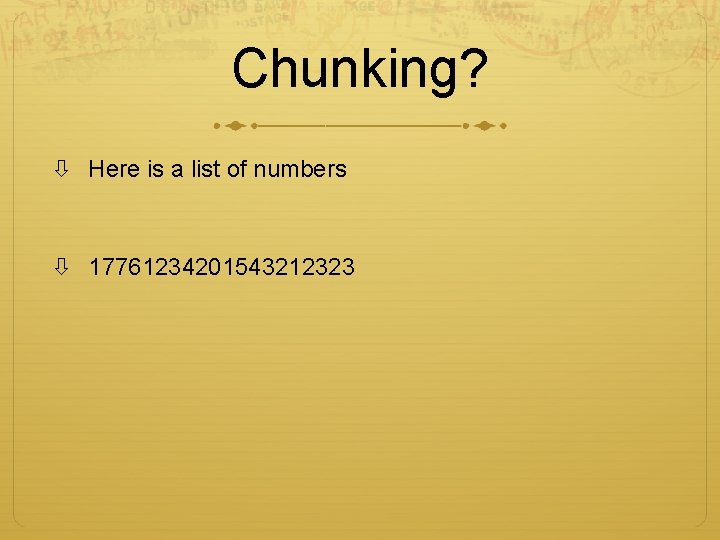
Chunking? Here is a list of numbers 17761234201543212323
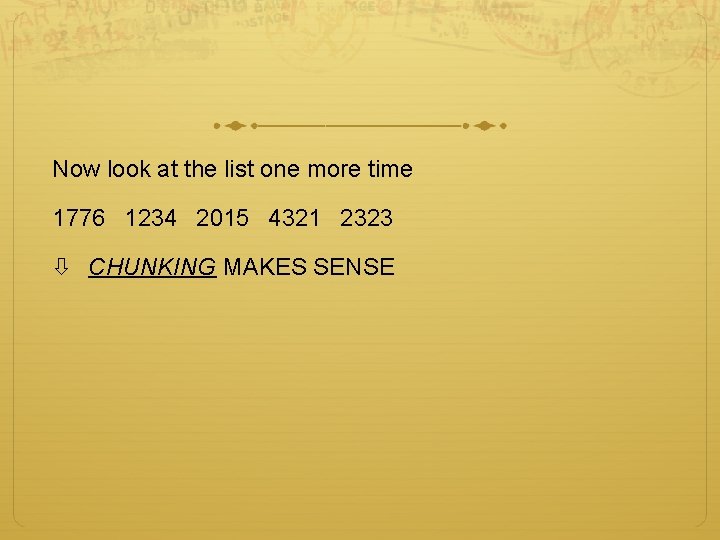
Now look at the list one more time 1776 1234 2015 4321 2323 CHUNKING MAKES SENSE
Stages of Memory 3. Long-Term Memory Storing almost unlimited amounts of information over long periods of time LTM information organized by categories and features
Money, Money We have saved, held, and spent money our whole lives. You should be an expert. Whose portrait is on a $10? Is Lincoln facing the left or right on the penny?
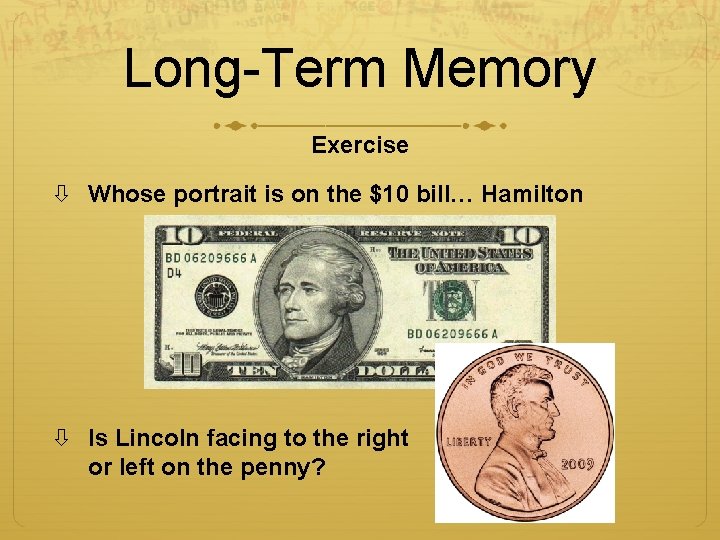
Long-Term Memory Exercise Whose portrait is on the $10 bill… Hamilton Is Lincoln facing to the right or left on the penny?
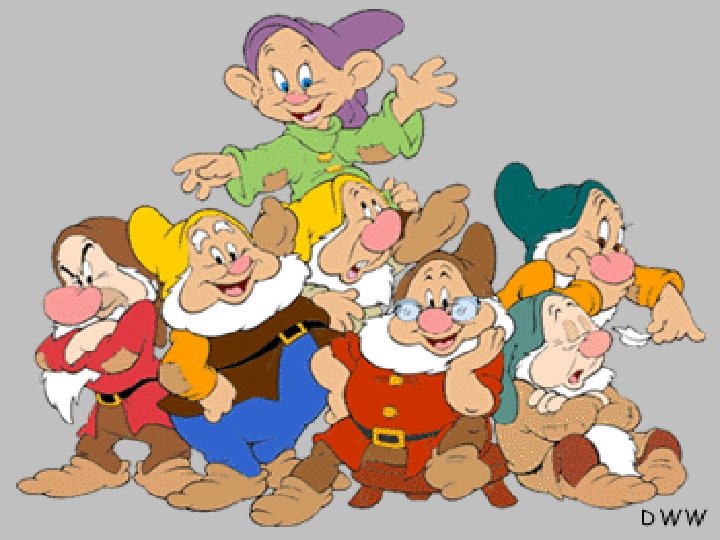
Retrieval of Information Key to retrieval is organization and deep processing Recognition - identification of something with priming or cues present (multiple choice) Recall- retrieval of information with no cue (fill in blank) Identify previously learned information Can you recall the 7 dwarfs? What if I show you a picture (provide a cue), can you recognize all 7?
Retrieval of Information Confabulation – Elizabeth Loftus Unconsciously filling in memory gaps Eye witness testimony – what mistakes did Jennifer make when picking Ronald Cotton? Misinformation effect – when we incorporate misleading information into our memory of an event Misattribution error – forgetting what really happened, or distortion of information at retrieval – we confuse the source of the information (“source amnesia”)
Remember developmental theory of cognition? Schemas – Piaget term (remember assimilation and accommodation too? ) Learned generalizations and preconceptions about objects, events, and people A cognitive framework or concept that helps organize & interpret information Created based on expectations by past experiences
Schemas & Constructive Memory Rumor Chain Does long-term memory get distorted during encoding or retrieval by prior knowledge, particularly by schemas about the world, which include gender role expectations and other bias? VOLUNTEERS anyone?
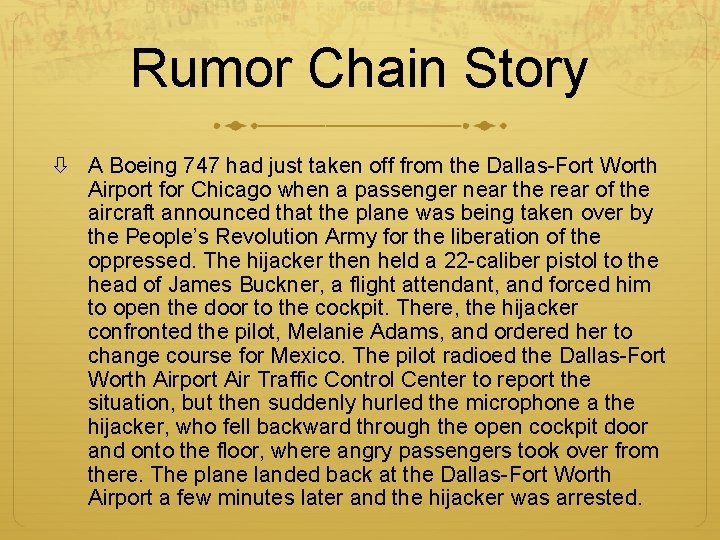
Rumor Chain Story A Boeing 747 had just taken off from the Dallas-Fort Worth Airport for Chicago when a passenger near the rear of the aircraft announced that the plane was being taken over by the People’s Revolution Army for the liberation of the oppressed. The hijacker then held a 22 -caliber pistol to the head of James Buckner, a flight attendant, and forced him to open the door to the cockpit. There, the hijacker confronted the pilot, Melanie Adams, and ordered her to change course for Mexico. The pilot radioed the Dallas-Fort Worth Airport Air Traffic Control Center to report the situation, but then suddenly hurled the microphone a the hijacker, who fell backward through the open cockpit door and onto the floor, where angry passengers took over from there. The plane landed back at the Dallas-Fort Worth Airport a few minutes later and the hijacker was arrested.
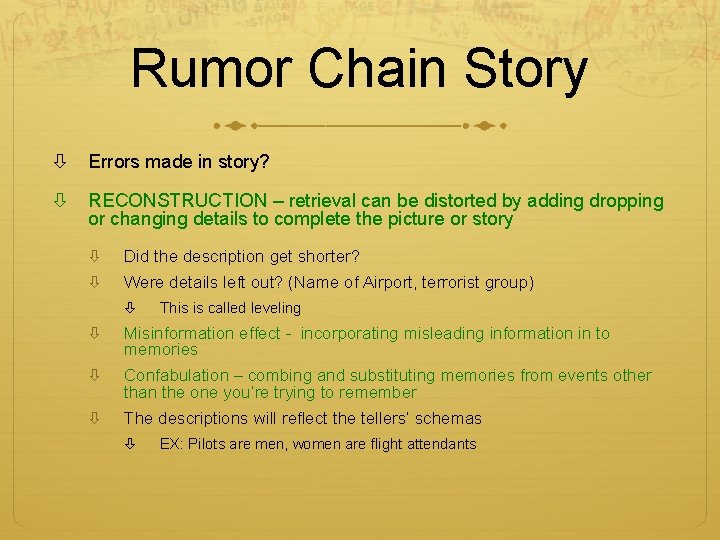
Rumor Chain Story Errors made in story? RECONSTRUCTION – retrieval can be distorted by adding dropping or changing details to complete the picture or story Did the description get shorter? Were details left out? (Name of Airport, terrorist group) This is called leveling Misinformation effect - incorporating misleading information in to memories Confabulation – combing and substituting memories from events other than the one you’re trying to remember The descriptions will reflect the tellers’ schemas EX: Pilots are men, women are flight attendants
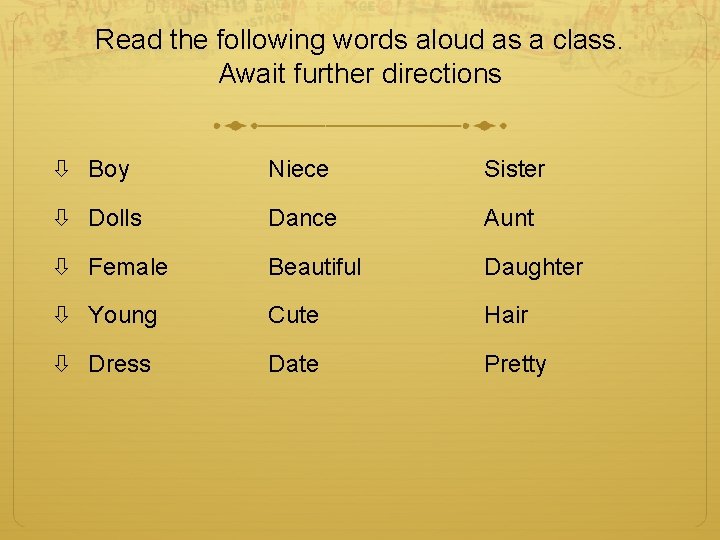
Read the following words aloud as a class. Await further directions Boy Niece Sister Dolls Dance Aunt Female Beautiful Daughter Young Cute Hair Dress Date Pretty
Primacy & Recency Effect How many people recalled the word “girl” = reconstructive memory! Serial Positioning Effect Primacy (best at the beginning of the list) Recency (best at the end of the list) The work of Herman Ebbinghaus Relearning effect Overlearning effect
Forgetting Inability to retrieve information in Long Term Memory Herman Ebbinghaus- “Forgetting Curve” Steep decline initially then gradual decline Conducted one of the 1 st studies of retention and forgetting in the late 1800 s. He learned a large number of nonsense syllables, 3 -letter combinations that had no meaning, studying the material until he could recite it perfectly. He then, tested himself on what he remembered after certan periods of time had elapsed.
Ebbinghaus Forgetting Curve
Forgetting Interference (Inhibition) Theory Memories inhibit retrieval of other memories Proactive Interference Prior info inhibits retrieval of new memories, can’t remember the new ( you move, asked your address you give old one) Retroactive Interference New inhibits retrieval of prior memories, cant remember older info (insert example here)
Repression Freudian Defense Mechanism Unpleasant experiences are kept out of consciousness and cannot be retrieved voluntarily EX: False accusation based in repressed memories
Amnesia Causes Organic: Head injury physical trauma or disease Rapid forgetting New information fades from memory with a few minutes Old memories, such as those from childhood, are NOT retained Permanent
Amnesia ü Loss of one’s identity and personal history without obvious brain injury ü Rare ü Can’t recall past memories and have to start new lives ü Never able to store new memories There are two types: anterograde & retrograde
Amnesia Anterograde Inability to form new memories, can’t put them into explicit memory Damage to hippocampus People find themselves constantly forgetting information, people or events after a few seconds or minutes Data does not transfer successfully from their conscious short-term memory into permanent long-term memory “ 50 First Dates” Retrograde Memory loss for a segment of past usually around injury or trauma The loss of pre-existing memories to conscious recollection The person may memorize new things that occur after the onset of amnesia Unable to recall some or all of their life or identity prior to the onset. “Overboard”
Anterograde & Retrograde
Brain Diseases Alzheimer’s disease is a neurodegenerative brain disease that gradually erodes an individual’s memory, intellectual abilities and personality. During the early stages, the most obvious symptom is an inability to learn and remember new information. In advanced stages, the ability to think, speak or perform such basic tasks as getting dressed or eating is severely impaired. The time between diagnosis and death typically ranges from seven to 10 years.
Maze