
CoEvolution of Stanford University the Silicon Valley 1950
- Slides: 46
Co-Evolution of Stanford University & the Silicon Valley: 1950 to Today Presentation by Jon Sandelin Stanford University Office of Technology Licensing jon. sandelin@stanford. edu http: //otl. stanford. edu
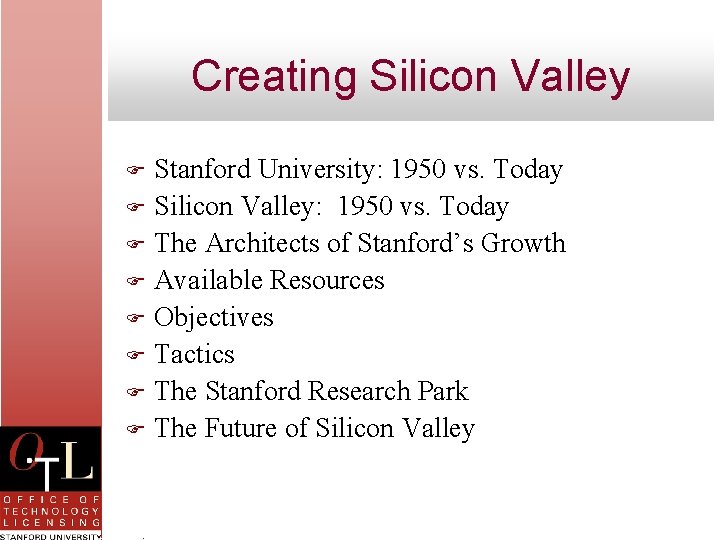
Creating Silicon Valley Stanford University: 1950 vs. Today F Silicon Valley: 1950 vs. Today F The Architects of Stanford’s Growth F Available Resources F Objectives F Tactics F The Stanford Research Park F The Future of Silicon Valley F
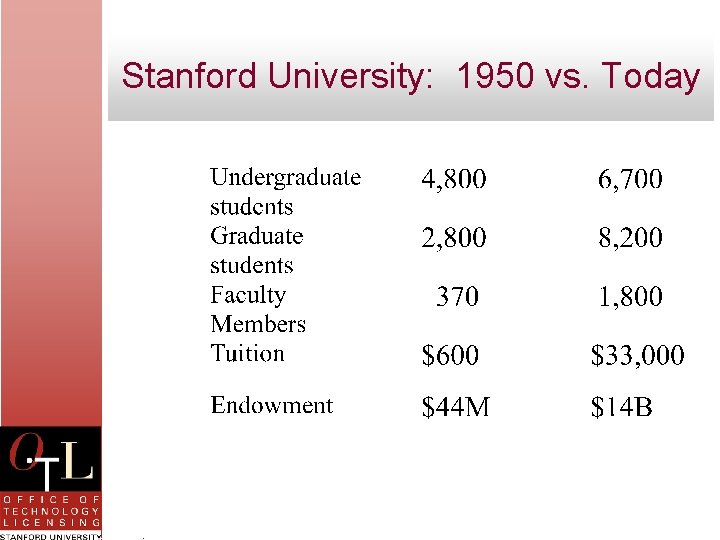
Stanford University: 1950 vs. Today
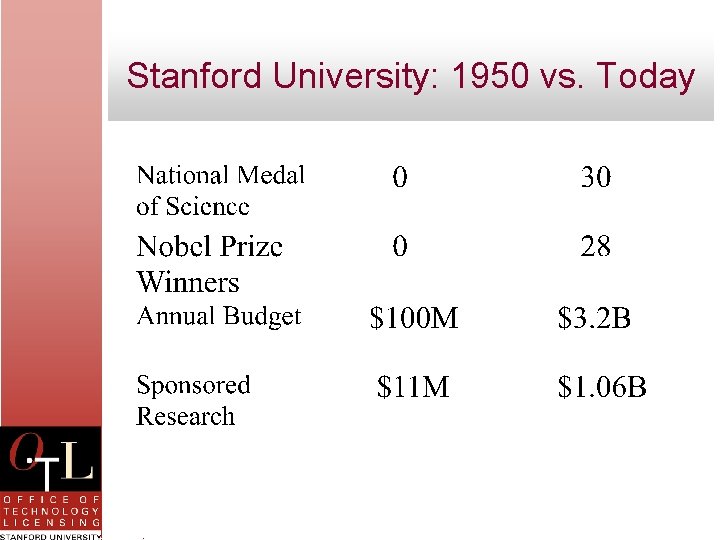
Stanford University: 1950 vs. Today
Summary F In 1950, Stanford was a leading regionally-known university struggling financially F In 2007, Stanford is a top-tier internationally-known university that is financially secure and a key part of the Silicon Valley Cluster
Silicon Valley in 1950 F Did not exist (mostly fruit orchards) F First lease in Stanford Industrial Park to Varian Corporation signed in October, 1951; Generally referred to as the birth of Silicon Valley
Silicon Valley Today F F F F F A Region of 1500 Square Miles 2. 3 million people 1. 35 million jobs Headquarters for over 400 public companies Average salary of $65, 000 Venture Capital Investments of over $8 billion Average lease rate of $1. 50 square foot (20% vacancy rate) A return to 1997/98 levels after Internet Boom and Bust The Future: Convergence of Biotechnologies; Information Technologies; and Nanotechnologies
Summary In 1950, Silicon Valley did not exist, but Stanford University was planting the seeds from which it would grow and develop F In 2007, emerging from recovery mode, it has: (1) the technical, social, and educational infrastructure; (2) capital sources; and (3) intellectual pool of talent to surge forward in the coming years. It is widely viewed as the international standard for hi-tech regional growth and wealth creation. F
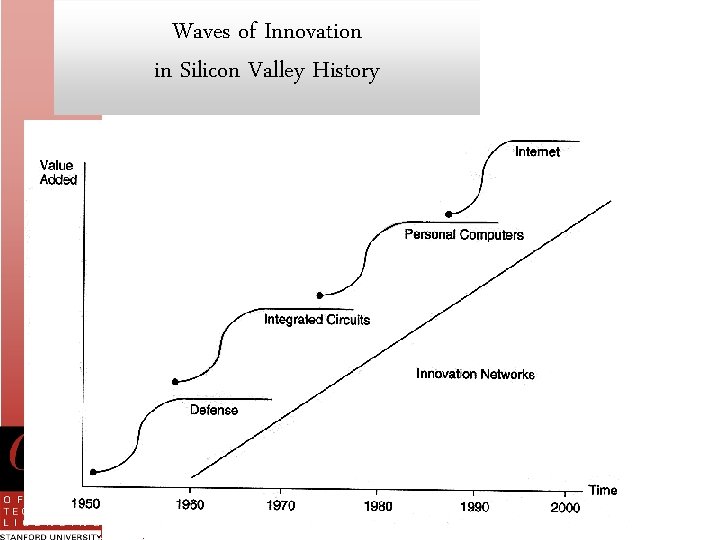
Waves of Innovation in Silicon Valley History Ecology of skills and organizations
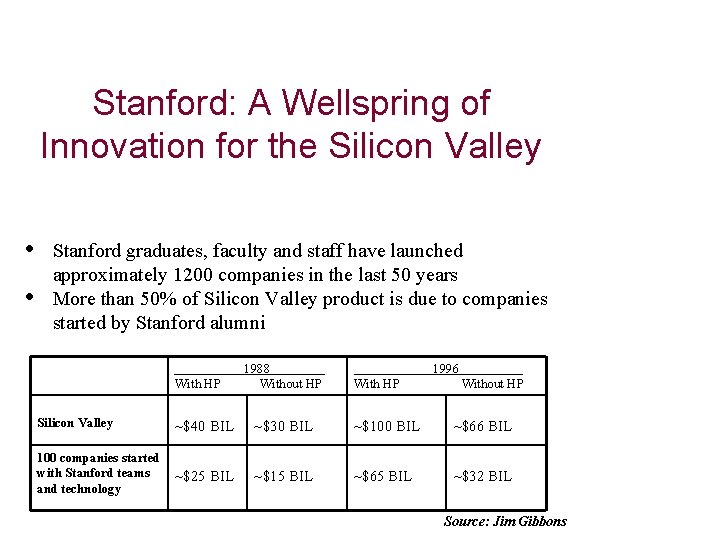
Stanford: A Wellspring of Innovation for the Silicon Valley • • Stanford graduates, faculty and staff have launched approximately 1200 companies in the last 50 years More than 50% of Silicon Valley product is due to companies started by Stanford alumni With HP 1988 Without HP 1996 With HP Without HP Silicon Valley ~$40 BIL ~$30 BIL ~$100 BIL ~$66 BIL 100 companies started with Stanford teams and technology ~$25 BIL ~$15 BIL ~$65 BIL ~$32 BIL Source: Jim Gibbons
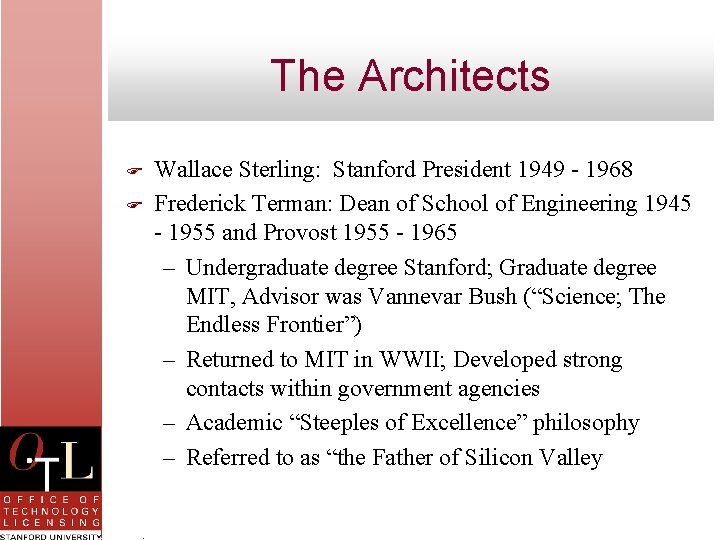
The Architects F F Wallace Sterling: Stanford President 1949 - 1968 Frederick Terman: Dean of School of Engineering 1945 - 1955 and Provost 1955 - 1965 – Undergraduate degree Stanford; Graduate degree MIT, Advisor was Vannevar Bush (“Science; The Endless Frontier”) – Returned to MIT in WWII; Developed strong contacts within government agencies – Academic “Steeples of Excellence” philosophy – Referred to as “the Father of Silicon Valley
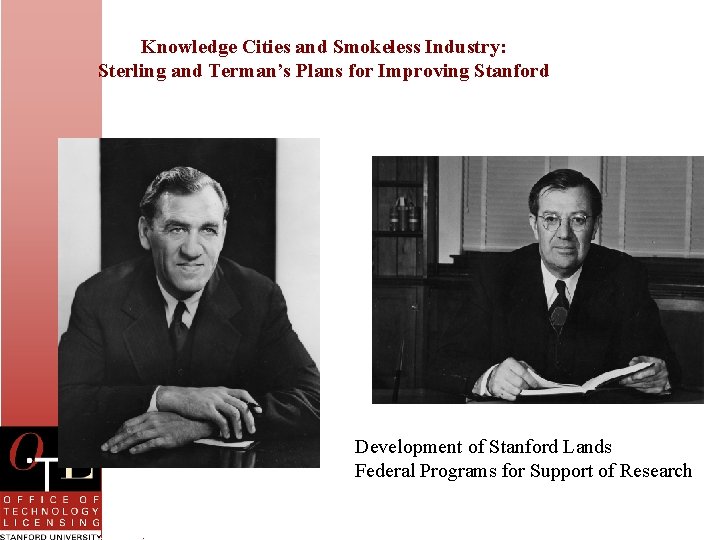
Knowledge Cities and Smokeless Industry: Sterling and Terman’s Plans for Improving Stanford Development of Stanford Lands Federal Programs for Support of Research
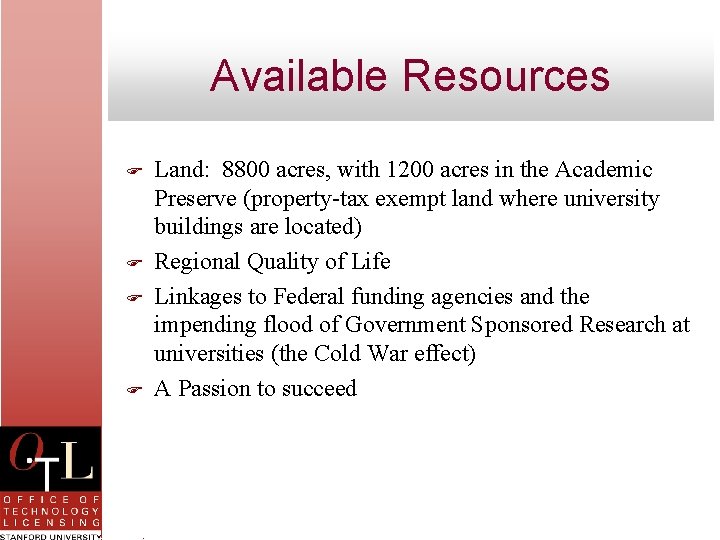
Available Resources F F Land: 8800 acres, with 1200 acres in the Academic Preserve (property-tax exempt land where university buildings are located) Regional Quality of Life Linkages to Federal funding agencies and the impending flood of Government Sponsored Research at universities (the Cold War effect) A Passion to succeed
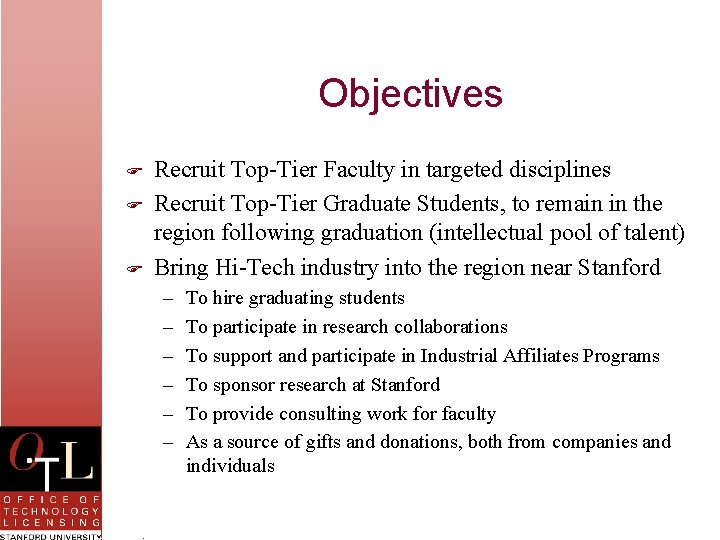
Objectives F F F Recruit Top-Tier Faculty in targeted disciplines Recruit Top-Tier Graduate Students, to remain in the region following graduation (intellectual pool of talent) Bring Hi-Tech industry into the region near Stanford – – – To hire graduating students To participate in research collaborations To support and participate in Industrial Affiliates Programs To sponsor research at Stanford To provide consulting work for faculty As a source of gifts and donations, both from companies and individuals
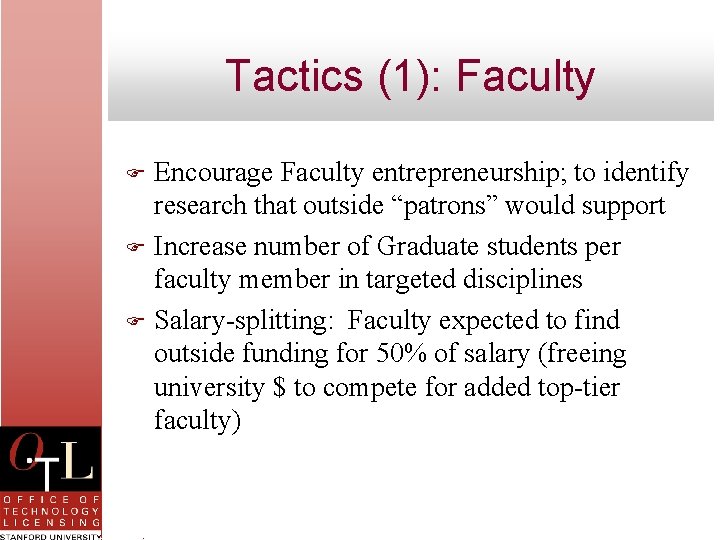
Tactics (1): Faculty Encourage Faculty entrepreneurship; to identify research that outside “patrons” would support F Increase number of Graduate students per faculty member in targeted disciplines F Salary-splitting: Faculty expected to find outside funding for 50% of salary (freeing university $ to compete for added top-tier faculty) F
Tactics (2): Land Use F Campus Housing for Faculty and Senior Staff as recruitment tool F Commercial use to generate income; e. g. Stanford Shopping Center F Provide low cost land leases in the Stanford Industrial Park
Tactics (3): Industry F F F Encourage graduating students and faculty to start companies (H/P example; over 1200 companies to date accounting for over 50% of Silicon Valley output) Create Industrial Park with inexpensive land leases (now over 150 companies in the “Research” Park) Offer cutting-edge education to company employees (Engineering Honors Cooperative Program; now reaches hundreds of companies over the internet) Assist in development of Venture Capital Industry Form Industrial Affiliates Programs (now over 40)
R&D Funding F F F Government Research Funding: Provides the funding for salary splitting of professors and for graduate student stipends. This increased the number and quality of the intellectual capital that was critical to the growth of Silicon Valley; $900 M to Stanford in 2006; $27 B to all U. S. Universities Small Business Innovation Research (SBIR) grants: From Government agencies by competitive bidding; Over $2 B awarded in U. S. in 2006; STTR grants can include funding to universities Industry Research Funding: Created partnerships and research results that strengthened the competitive position of Silicon Valley companies; $50 M to Stanford in 2006; $2. 3 B to U. S. Universities Private Foundations: Rockefeller; Gates; Ford; etc. ; $48 M to Stanford in 2006 Gifts: Primarily from wealthy Alumni; $911 M to Stanford in 2006
Start-up Company Funding F Angels: Typically high wealth individuals that cluster into groups to review investment opportunities; e. g. Band of Angels – Stanford faculty who have made substantial wealth via involvement with startup companies (typically by taking a leave of absence to be a Chief Technical Officer) have formed an informal angels investment group that provide seed funding for many Stanford start-ups F Venture Capital firms: First raise a money fund (typically $100 M to $1 B); then review business plans to select investments – First V/C style investment (in Watkins/Johnson), by Kern County Land Company in 1958, was facilitated by Fredric Terman of Stanford – A very early V/C firm; the Kleiner, Perkins, Kaufield & Byers V/C group was co-founded with Stanford faculty; as was the Mayfield fund in 1968 – About 1/3 of all V/C investments (over $8 B in 2006) is in the Silicon Valley
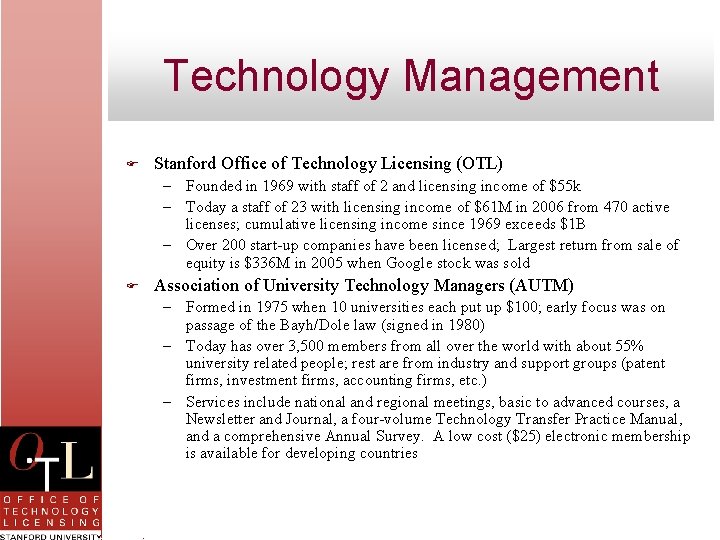
Technology Management F Stanford Office of Technology Licensing (OTL) – Founded in 1969 with staff of 2 and licensing income of $55 k – Today a staff of 23 with licensing income of $61 M in 2006 from 470 active licenses; cumulative licensing income since 1969 exceeds $1 B – Over 200 start-up companies have been licensed; Largest return from sale of equity is $336 M in 2005 when Google stock was sold F Association of University Technology Managers (AUTM) – Formed in 1975 when 10 universities each put up $100; early focus was on passage of the Bayh/Dole law (signed in 1980) – Today has over 3, 500 members from all over the world with about 55% university related people; rest are from industry and support groups (patent firms, investment firms, accounting firms, etc. ) – Services include national and regional meetings, basic to advanced courses, a Newsletter and Journal, a four-volume Technology Transfer Practice Manual, and a comprehensive Annual Survey. A low cost ($25) electronic membership is available for developing countries
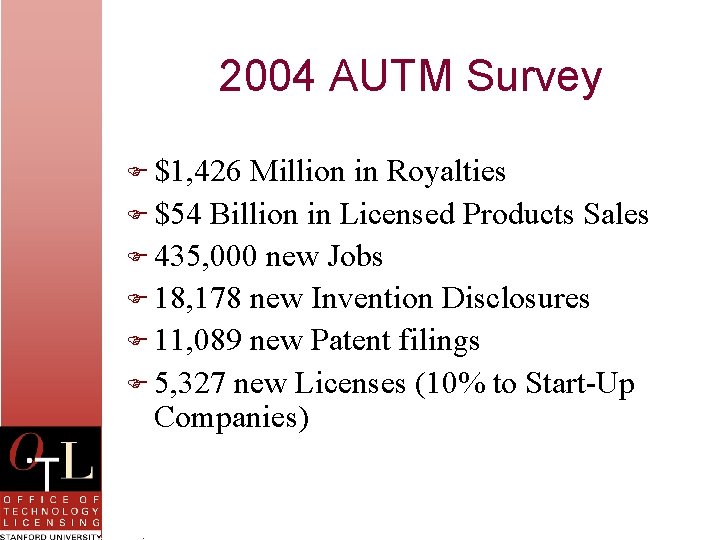
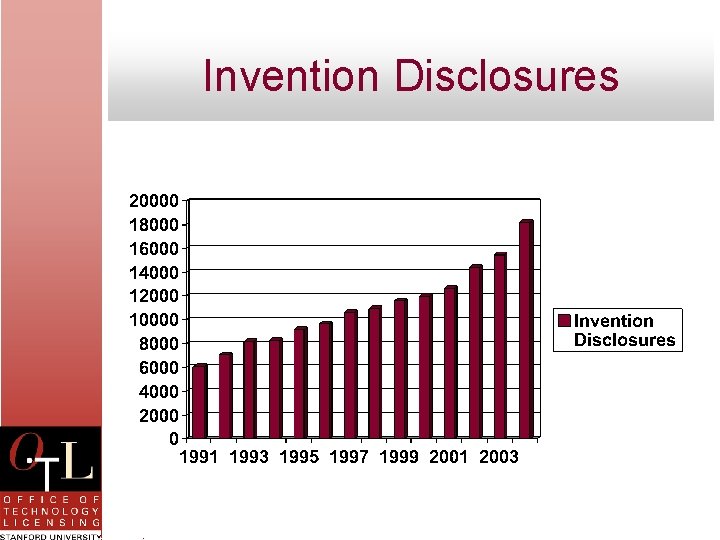
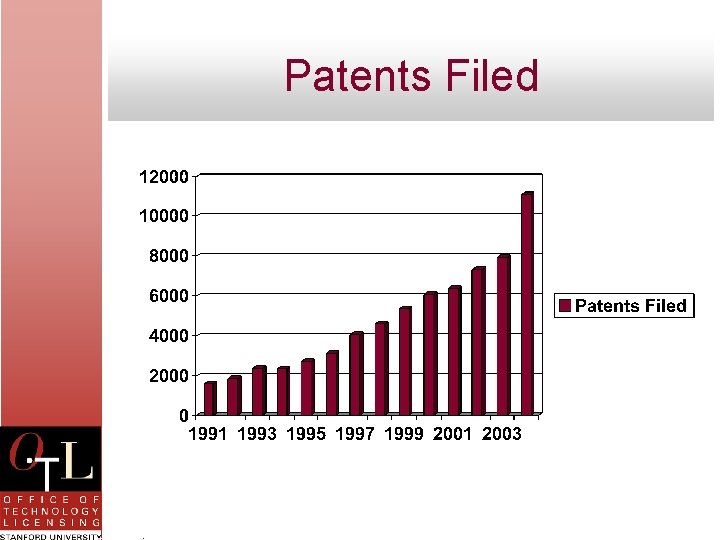
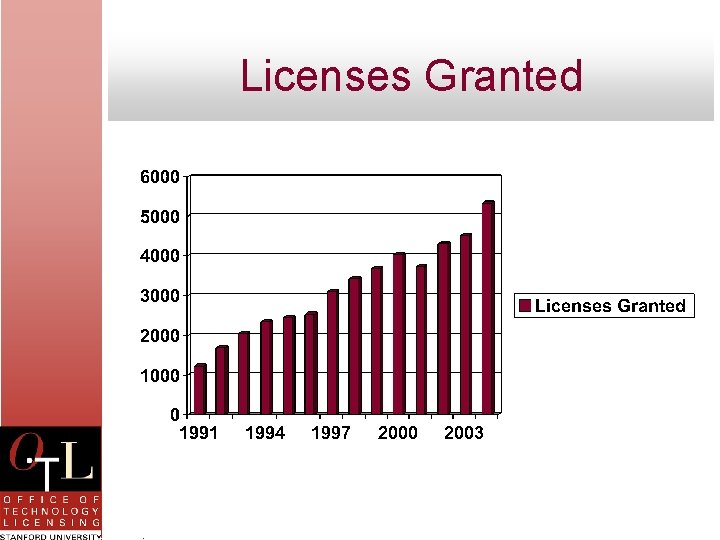
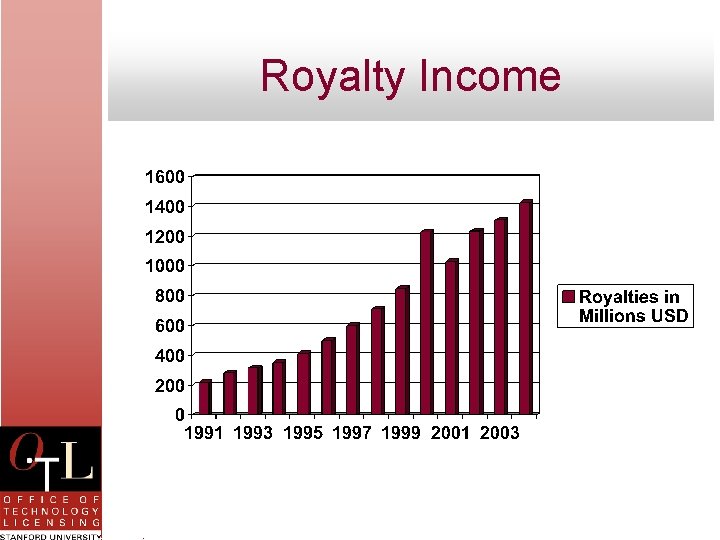
2004 AUTM Survey F $1, 426 Million in Royalties F $54 Billion in Licensed Products Sales F 435, 000 new Jobs F 18, 178 new Invention Disclosures F 11, 089 new Patent filings F 5, 327 new Licenses (10% to Start-Up Companies)
Invention Disclosures
Patents Filed
Licenses Granted
Royalty Income
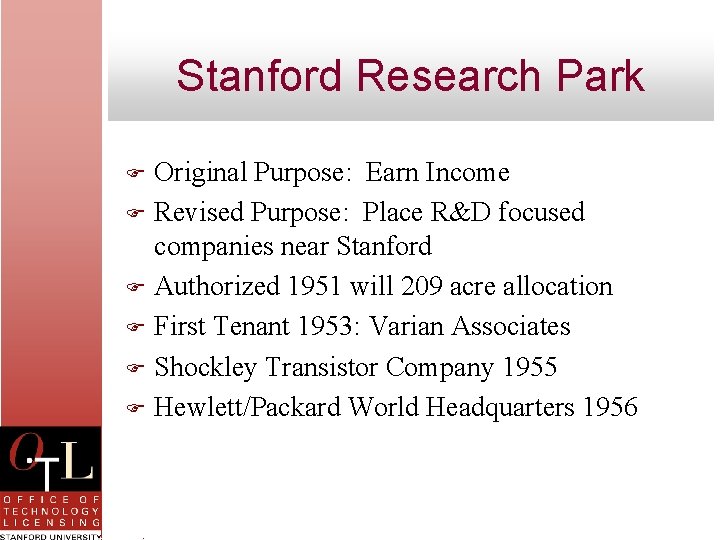
Stanford Research Park Original Purpose: Earn Income F Revised Purpose: Place R&D focused companies near Stanford F Authorized 1951 will 209 acre allocation F First Tenant 1953: Varian Associates F Shockley Transistor Company 1955 F Hewlett/Packard World Headquarters 1956 F
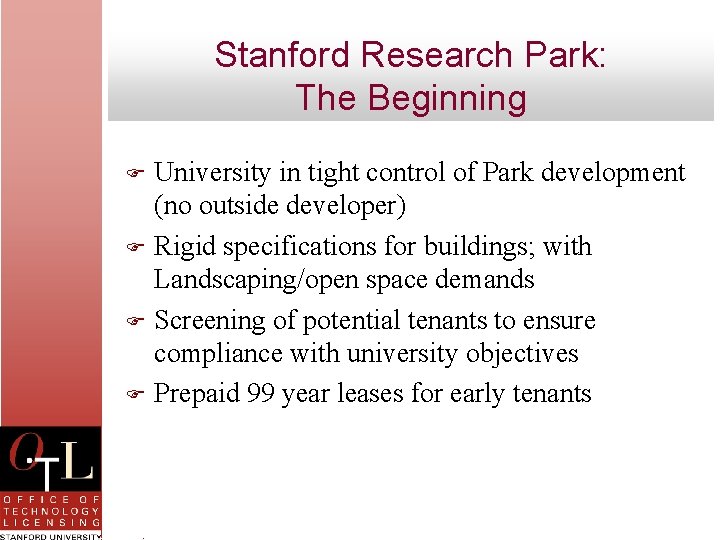
Stanford Research Park: The Beginning University in tight control of Park development (no outside developer) F Rigid specifications for buildings; with Landscaping/open space demands F Screening of potential tenants to ensure compliance with university objectives F Prepaid 99 year leases for early tenants F
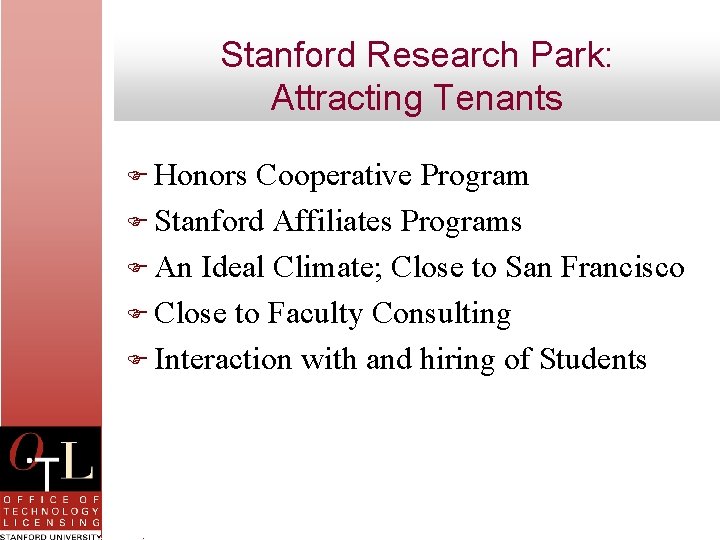
Stanford Research Park: Attracting Tenants F Honors Cooperative Program F Stanford Affiliates Programs F An Ideal Climate; Close to San Francisco F Close to Faculty Consulting F Interaction with and hiring of Students
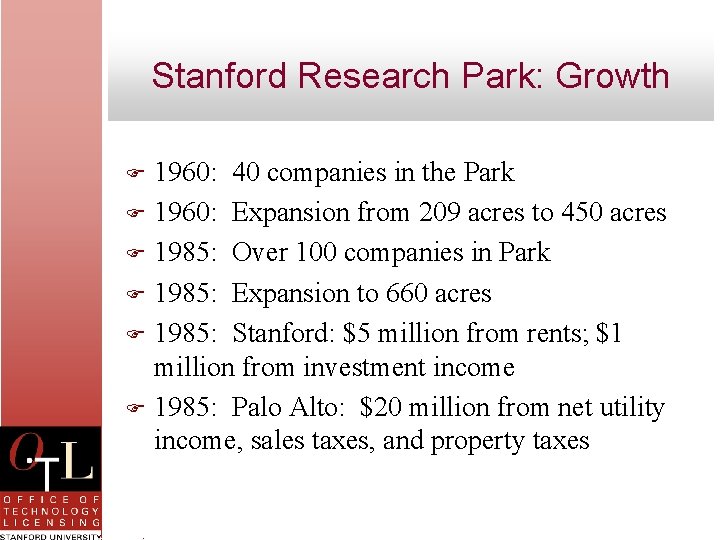
Stanford Research Park: Growth 1960: 40 companies in the Park F 1960: Expansion from 209 acres to 450 acres F 1985: Over 100 companies in Park F 1985: Expansion to 660 acres F 1985: Stanford: $5 million from rents; $1 million from investment income F 1985: Palo Alto: $20 million from net utility income, sales taxes, and property taxes F
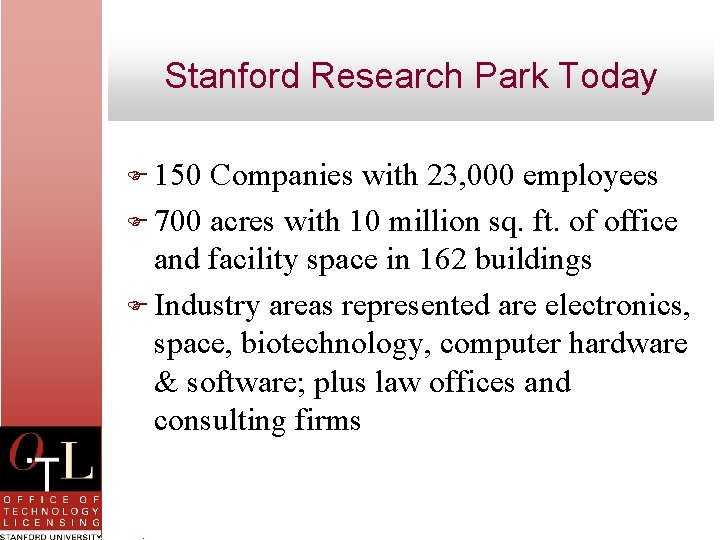
Stanford Research Park Today F 150 Companies with 23, 000 employees F 700 acres with 10 million sq. ft. of office and facility space in 162 buildings F Industry areas represented are electronics, space, biotechnology, computer hardware & software; plus law offices and consulting firms
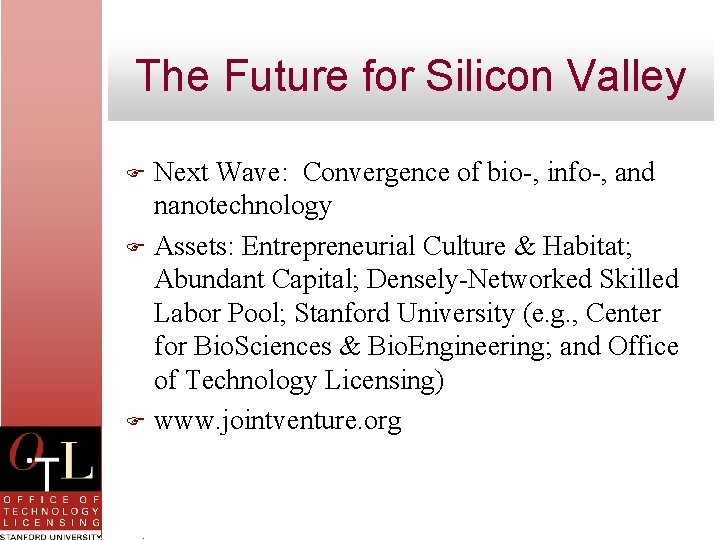
The Future for Silicon Valley Next Wave: Convergence of bio-, info-, and nanotechnology F Assets: Entrepreneurial Culture & Habitat; Abundant Capital; Densely-Networked Skilled Labor Pool; Stanford University (e. g. , Center for Bio. Sciences & Bio. Engineering; and Office of Technology Licensing) F www. jointventure. org F
Stanford Case Studies Presentation by Jon Sandelin Stanford University Office of Technology Licensing jon. sandelin@stanford. edu http: //otl. stanford. edu
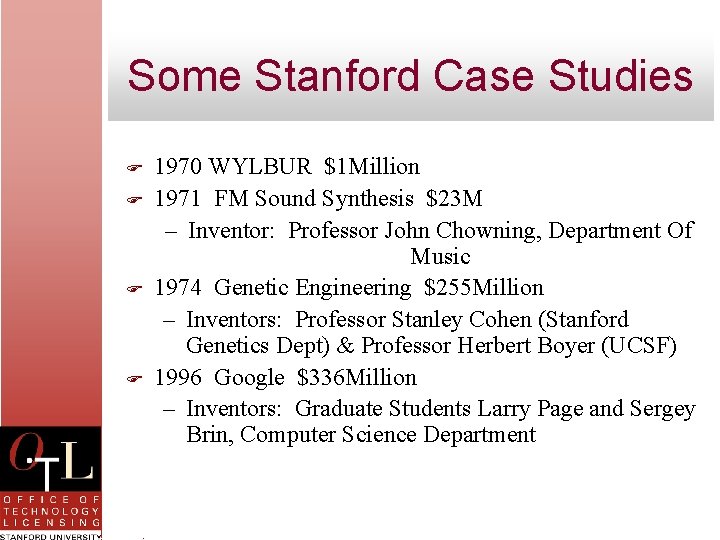
Some Stanford Case Studies F F 1970 WYLBUR $1 Million 1971 FM Sound Synthesis $23 M – Inventor: Professor John Chowning, Department Of Music 1974 Genetic Engineering $255 Million – Inventors: Professor Stanley Cohen (Stanford Genetics Dept) & Professor Herbert Boyer (UCSF) 1996 Google $336 Million – Inventors: Graduate Students Larry Page and Sergey Brin, Computer Science Department
The Wylbur Story F The Beginnings - 1970 F The Company Visit - 1971 F The Threatening Letter - 1972 F OTL to the Rescue: Registration of Copyright and Trademark F A Happy Ending: A very successful licensing arrangement
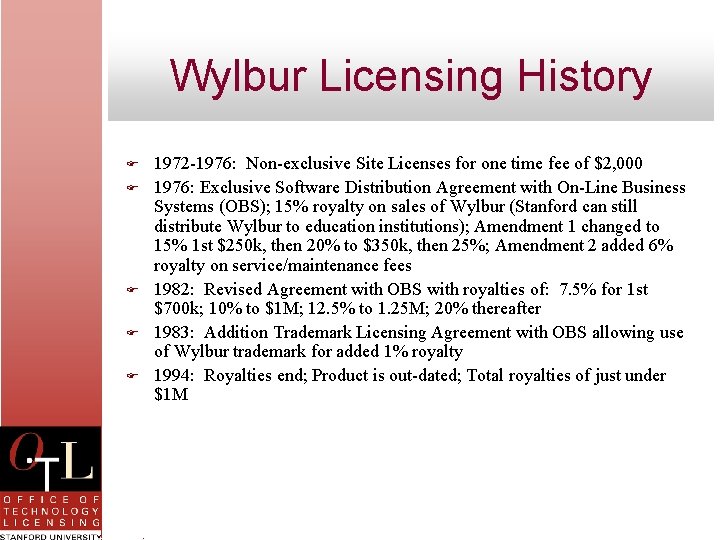
Wylbur Licensing History F F F 1972 -1976: Non-exclusive Site Licenses for one time fee of $2, 000 1976: Exclusive Software Distribution Agreement with On-Line Business Systems (OBS); 15% royalty on sales of Wylbur (Stanford can still distribute Wylbur to education institutions); Amendment 1 changed to 15% 1 st $250 k, then 20% to $350 k, then 25%; Amendment 2 added 6% royalty on service/maintenance fees 1982: Revised Agreement with OBS with royalties of: 7. 5% for 1 st $700 k; 10% to $1 M; 12. 5% to 1. 25 M; 20% thereafter 1983: Addition Trademark Licensing Agreement with OBS allowing use of Wylbur trademark for added 1% royalty 1994: Royalties end; Product is out-dated; Total royalties of just under $1 M
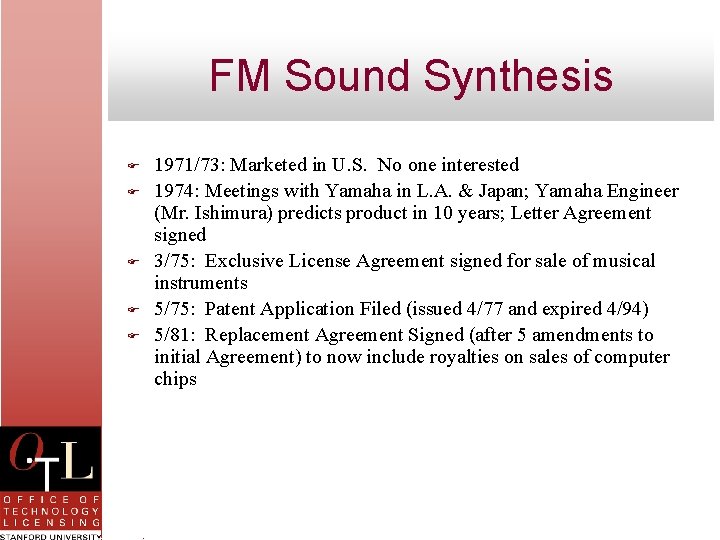
FM Sound Synthesis F F F 1971/73: Marketed in U. S. No one interested 1974: Meetings with Yamaha in L. A. & Japan; Yamaha Engineer (Mr. Ishimura) predicts product in 10 years; Letter Agreement signed 3/75: Exclusive License Agreement signed for sale of musical instruments 5/75: Patent Application Filed (issued 4/77 and expired 4/94) 5/81: Replacement Agreement Signed (after 5 amendments to initial Agreement) to now include royalties on sales of computer chips
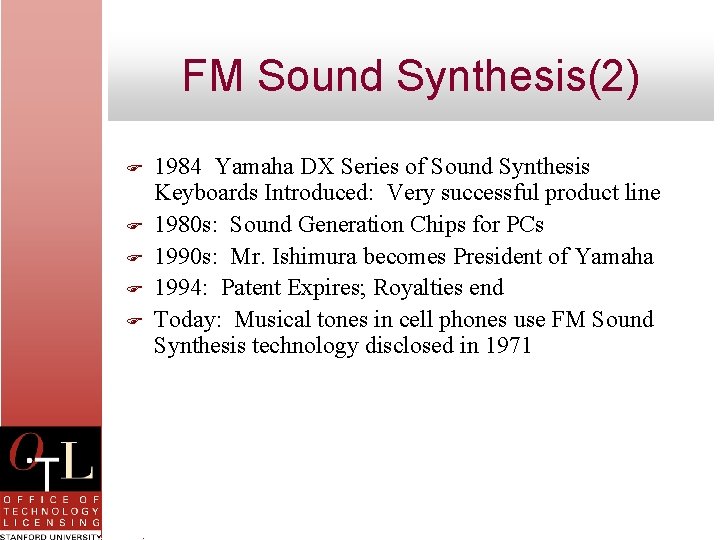
FM Sound Synthesis(2) F F F 1984 Yamaha DX Series of Sound Synthesis Keyboards Introduced: Very successful product line 1980 s: Sound Generation Chips for PCs 1990 s: Mr. Ishimura becomes President of Yamaha 1994: Patent Expires; Royalties end Today: Musical tones in cell phones use FM Sound Synthesis technology disclosed in 1971
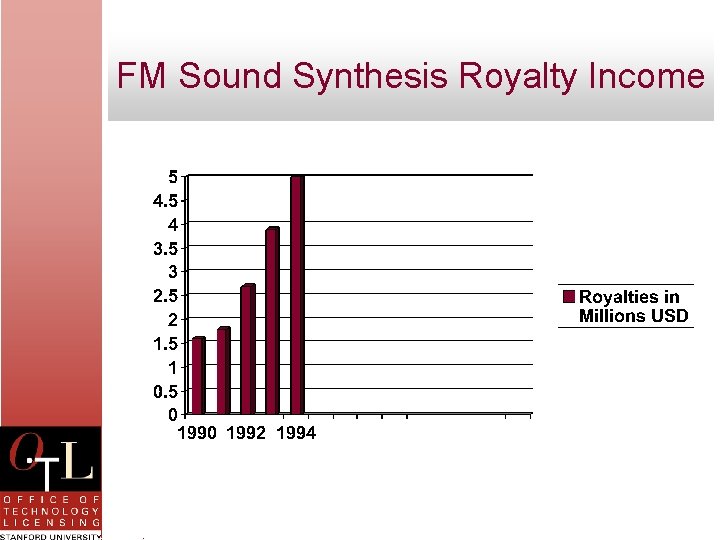
FM Sound Synthesis Royalty Income
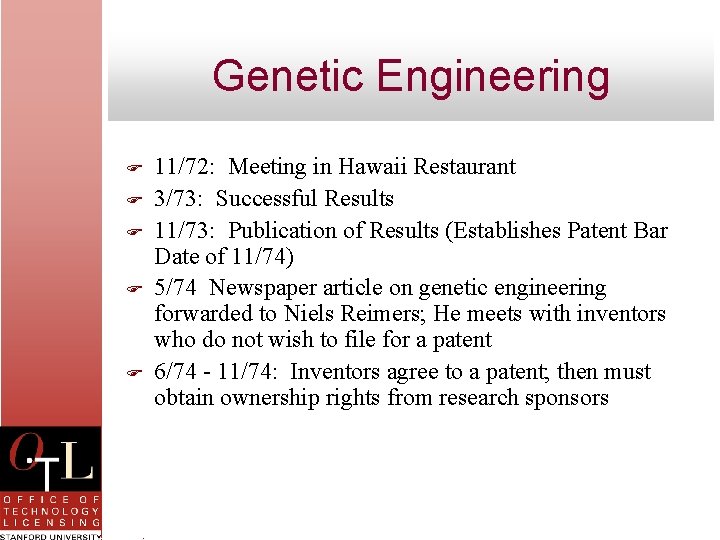
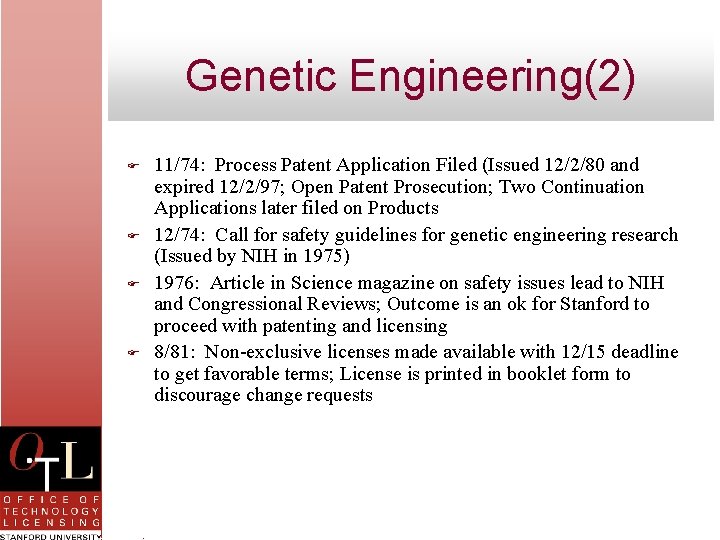
Genetic Engineering F F F 11/72: Meeting in Hawaii Restaurant 3/73: Successful Results 11/73: Publication of Results (Establishes Patent Bar Date of 11/74) 5/74 Newspaper article on genetic engineering forwarded to Niels Reimers; He meets with inventors who do not wish to file for a patent 6/74 - 11/74: Inventors agree to a patent; then must obtain ownership rights from research sponsors
Genetic Engineering(2) F F 11/74: Process Patent Application Filed (Issued 12/2/80 and expired 12/2/97; Open Patent Prosecution; Two Continuation Applications later filed on Products 12/74: Call for safety guidelines for genetic engineering research (Issued by NIH in 1975) 1976: Article in Science magazine on safety issues lead to NIH and Congressional Reviews; Outcome is an ok for Stanford to proceed with patenting and licensing 8/81: Non-exclusive licenses made available with 12/15 deadline to get favorable terms; License is printed in booklet form to discourage change requests
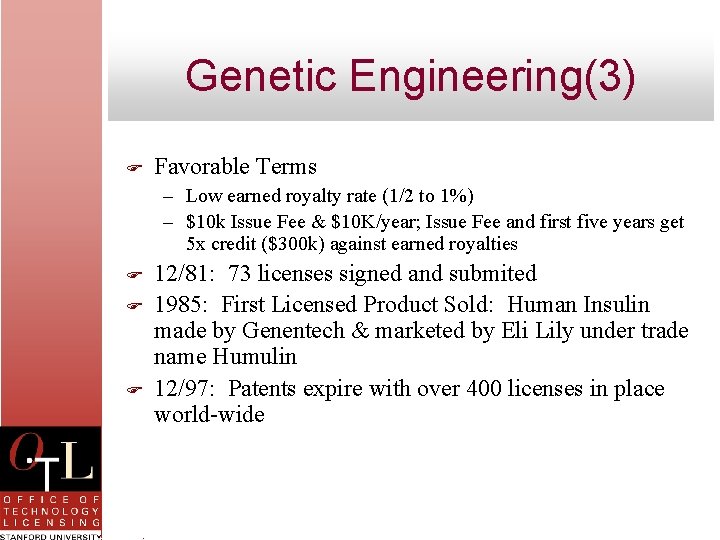
Genetic Engineering(3) F Favorable Terms – Low earned royalty rate (1/2 to 1%) – $10 k Issue Fee & $10 K/year; Issue Fee and first five years get 5 x credit ($300 k) against earned royalties F F F 12/81: 73 licenses signed and submited 1985: First Licensed Product Sold: Human Insulin made by Genentech & marketed by Eli Lily under trade name Humulin 12/97: Patents expire with over 400 licenses in place world-wide
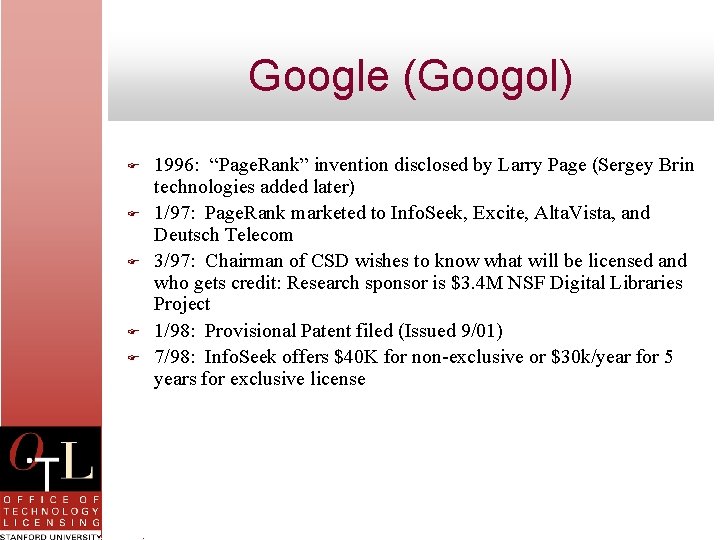
Google (Googol) F F F 1996: “Page. Rank” invention disclosed by Larry Page (Sergey Brin technologies added later) 1/97: Page. Rank marketed to Info. Seek, Excite, Alta. Vista, and Deutsch Telecom 3/97: Chairman of CSD wishes to know what will be licensed and who gets credit: Research sponsor is $3. 4 M NSF Digital Libraries Project 1/98: Provisional Patent filed (Issued 9/01) 7/98: Info. Seek offers $40 K for non-exclusive or $30 k/year for 5 years for exclusive license
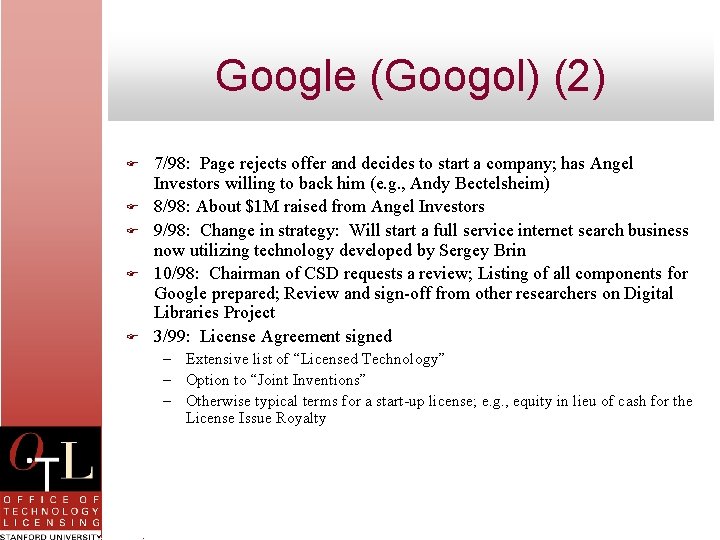
Google (Googol) (2) F F F 7/98: Page rejects offer and decides to start a company; has Angel Investors willing to back him (e. g. , Andy Bectelsheim) 8/98: About $1 M raised from Angel Investors 9/98: Change in strategy: Will start a full service internet search business now utilizing technology developed by Sergey Brin 10/98: Chairman of CSD requests a review; Listing of all components for Google prepared; Review and sign-off from other researchers on Digital Libraries Project 3/99: License Agreement signed – Extensive list of “Licensed Technology” – Option to “Joint Inventions” – Otherwise typical terms for a start-up license; e. g. , equity in lieu of cash for the License Issue Royalty
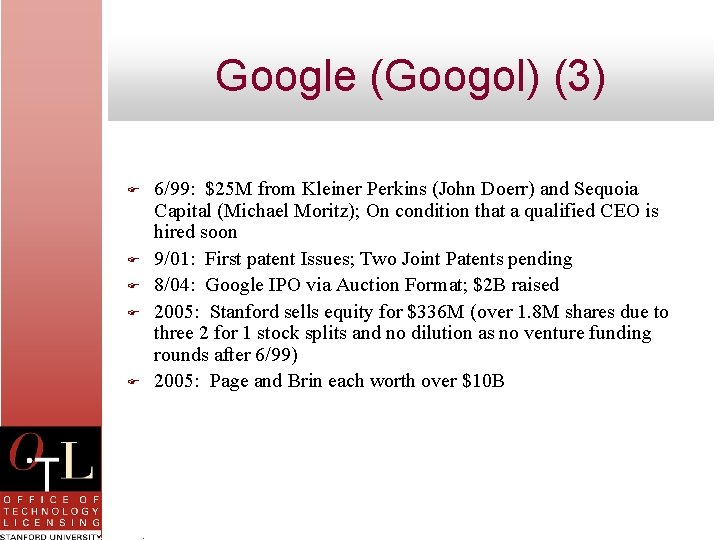
Google (Googol) (3) F F F 6/99: $25 M from Kleiner Perkins (John Doerr) and Sequoia Capital (Michael Moritz); On condition that a qualified CEO is hired soon 9/01: First patent Issues; Two Joint Patents pending 8/04: Google IPO via Auction Format; $2 B raised 2005: Stanford sells equity for $336 M (over 1. 8 M shares due to three 2 for 1 stock splits and no dilution as no venture funding rounds after 6/99) 2005: Page and Brin each worth over $10 B
THE END F Thank You for your Attention!