
Coefficient of Friction The force of friction is
- Slides: 4
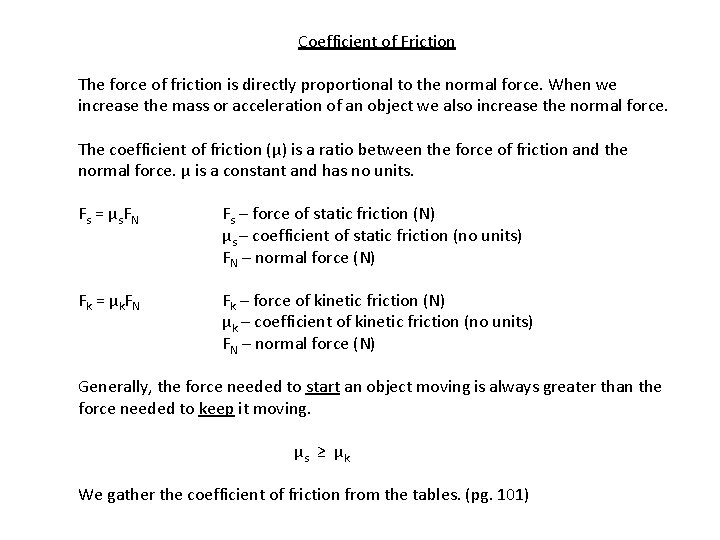
Coefficient of Friction The force of friction is directly proportional to the normal force. When we increase the mass or acceleration of an object we also increase the normal force. The coefficient of friction (µ) is a ratio between the force of friction and the normal force. µ is a constant and has no units. Fs = µs. FN Fs – force of static friction (N) µs – coefficient of static friction (no units) FN – normal force (N) Fk = µk. FN Fk – force of kinetic friction (N) µk – coefficient of kinetic friction (no units) FN – normal force (N) Generally, the force needed to start an object moving is always greater than the force needed to keep it moving. µs ≥ µ k We gather the coefficient of friction from the tables. (pg. 101)
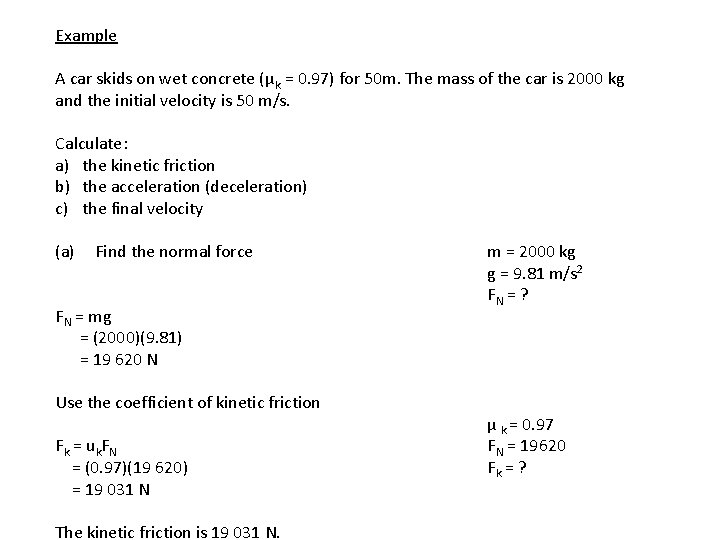
Example A car skids on wet concrete (µk = 0. 97) for 50 m. The mass of the car is 2000 kg and the initial velocity is 50 m/s. Calculate: a) the kinetic friction b) the acceleration (deceleration) c) the final velocity (a) Find the normal force FN = mg = (2000)(9. 81) = 19 620 N Use the coefficient of kinetic friction Fk = uk. FN = (0. 97)(19 620) = 19 031 N The kinetic friction is 19 031 N. m = 2000 kg g = 9. 81 m/s 2 FN = ? µ k = 0. 97 FN = 19620 Fk = ?
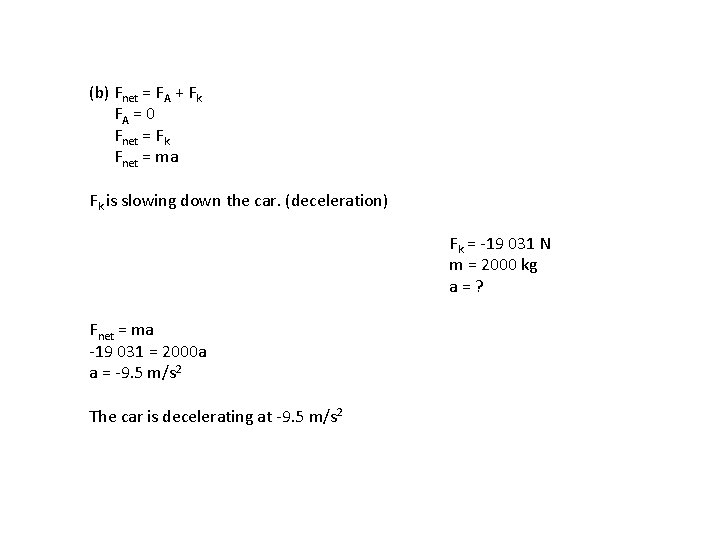
(b) Fnet = FA + Fk FA = 0 Fnet = Fk Fnet = ma Fk is slowing down the car. (deceleration) Fk = -19 031 N m = 2000 kg a=? Fnet = ma -19 031 = 2000 a a = -9. 5 m/s 2 The car is decelerating at -9. 5 m/s 2