
CODING BILLING A PRACTICE LIFELINE ELAINE SCHMIDT CPC
CODING & BILLING: A PRACTICE LIFELINE ELAINE SCHMIDT, CPC, CPO-C, OCS 1
DISCLAIMER This information is current as to the time it was prepared and reasonable effort was made to assure accuracy. There is no guarantee of being completely error-free. ¡ This presentation is intended to be a tool to assist and guide understanding. ¡ 2

3
IMPORTANT TIDBIT Because our talents/functions within our practices are so vital it is important to pay attention to detail, including gathering information. ¡ WHENEVER you call/talk to ANY insurance entity or person regarding claims or general information: ALWAYS get the individual’s name along with the date you made the call. – This will provide you with a “history” & hold that individual accountable for their information provided 4 ¡
FRAUD VS ABUSE - FRAUD: The INTENTIONAL deception or misrepresentation that an individual knows to be false or does not believe to be true and makes, knowing the deception could result in some unauthorized benefit to himself/herself or some other person. ¡ For example: ¡ -billing for tests not performed ¡ -billing higher level of service than performed 5 ¡
FRAUD VS ABUSE - ABUSE: Practices of providers, physicians, or suppliers of service which, although not usually considered fraudulent, are inconsistent with accepted sound medical, business, or fiscal practices, directly or indirectly resulting in unnecessary costs to the Medicare (and other carriers) program, improper reimbursement, or program reimbursement for services which fail to meet professionally recognized standards of care or which are medically unnecessary. 6
NEW VS ESTABLISHED- CPT 2013 New Patient: one who is receiving face-to-face care from a provider or another physician of the exact same specialty and subspecialty who belongs to the same group PRACTICE for the 1 st time in 3 years Fees should be higher for new patient services due to gathering new/updated history The allowable in most cases is higher for a new patient. More work is involved in getting/gathering history data ¡ 7
“NO” to RULE OUT CODES Rule Out codes are NOT allowed ¡ Wording such as “R/O, suspect, looks like, appears to be, possible, questionable, still to be determined” are warning signs. ¡ In lieu of no confirmed problem or definitive Dx, the signs & symptoms under investigation must be coded to support medical necessity ¡ Get clarification from the doctor, or you MUST code according to signs and symptoms ¡ 8
Reason for Visit The patient’s chief complaint (CC) or reason for visit drives the diagnosis coding for the encounter. ¡ Sometimes a complaint/problem is not mentioned by the patient until a particular question is asked; hence the need for a good history. Consider coverage, ask the right questions, be mindful of previous diagnosis or if a new patient 9 ¡
Right Questions Patients will often give the doctor more specific/pertinent information than to the screener ¡ Learn to ask lifestyle questions that prompt the patient to be more informative that may uncover a medical complaint ¡ For example: Instead of asking “are you having any problems? ” ask if the patient has experienced any blurred vision, eye irritation, tearing – then expand…. ¡ 10
Expand What time of day do you notice this; what are you doing when you notice this, driving, reading, etc; how severe is the (symptom). This is a more open form of communication between the screener and the patient ¡ Optometry often is lacking in history documentation, so obtaining this information is important ¡ 11
12
92004, 92014 General Ophthalmological Service, Comprehensive – one or more visits (per CPT) ¡ If the patient comes in for exam one day but the dilation is performed on a later (ie, continued) date, there is NOT an additional charge. It is a continuance of the comprehensive service. ¡ This should be clearly documented in the patient’s record ¡ 13
COMPREHENSIVE General evaluation of the complete visual system. The comprehensive services constitute a single service entity but need not be performed at one session ¡ Includes history, general medical observation, external and ophthalmoscopic examinations, gross visual fields and basic sensorimotor examination. Often includes, as indicated: biomicroscopy, examination with cycloplegia or mydriasis and tonometry ¡ 14
Example ¡ Comprehensive services required for diagnosis and treatment of a patient with symptoms indicating possible disease of the visual system, such as glaucoma, cataract or retinal disease, or to rule out disease of the visual system 15
COMPREHENSIVE The comprehensive exam always includes initiation of diagnostic and treatment programs ¡ Such as: prescription of medication, arranging for special ophthalmological diagnostic and treatment services, consultations, laboratory procedures and radiological services ¡ 16
92004, 92014 comprehensive AMA CPT definition states mydriasis (dilation), often includes… ¡ If dilation is contra-indicated or refused, it needs to be documented in the patient record ¡ 17
92002, 92012 - Intermediate Ophthalmological service: medical examination and evaluation with initiation of diagnostic and treatment program, intermediate ¡ States may include mydriasis ¡ Fewer exam elements required ¡ ¡ BOTH Intermediate & Comprehensive exams require “initiation of diagnostic and treatment program”. 18
Example-Intermediate Review of history, external examination, ophthalmoscopy, biomicroscopy for an acute complicated condition (iritis) not requiring comprehensive ophthalmological services ¡ Review of interval history, external examination, ophthalmoscopy, biomicroscopy and tonometry in established patient with known cataract not requiring comprehensive ophthalmological services ¡ All intermediates must include external examination 19 ¡
Eye Codes: 92 xxx Ophthalmological Exams Documentation and coding criteria can vary from payer to payer ¡ Some payers will want 92 xxxs to be nonmedical (Medicaid, and some commercials) Some payers will bundle the refraction in the exam (not treated as a separate procedure) -As long your amount billed can be shown as the total of the exam and refraction in this situation, an auditor would not have a 20 problem ¡
Exams Sometimes, we “have to play the game” with the individual payers. ¡ Even though all are subject to HIPAA rules, CPT, ICD, and documentation guidelines (DG); interpretation can be problematic ¡ ¡ With some payers, the 99 xxx evaluation and management codes are preferred on medical claims, even though the 92 xxx codes allow for medical diagnosis codes as well as refractive 21 (exception: Medicaid)
22
Ophthalmological Tests Fundus Photograhy (92250), Visual Fields (92081 -92083), Scanning Laser (92133, 92134), Pachymetry (76514), External Ocular Photography (92285) and most other ophthalmological testing is NOT bundled with the exam and is separately reimbursed. ¡ If your claims are being denied, make sure your coding is correct and the referring physician information is entered on the claim ¡ 23
Multiple Procedure Payment Reduction (MPPR)1/7/13: Implementation Date Applies to the Technical Component (TC) on Ophthalmologic Procedures (furnished on the same DOS) ¡ Full payment is made for the TC service with the highest Medicare Physician Fee Schedule (MPFS). Payment is made @ 80% for subsequent TC services; resulting in a 20% payment reduction ¡ Reflected on the remittance advice (RA) ¡ Applies ONLY to the TC, not the PC ¡ 24
SEQUESTRATION Due to mandatory across-the-board reduction in Federal spending ¡ A 2% payment reduction will be reflected on the Medicare RA (after the deductible has been met) ¡ This results in an additional mandatory PWO; so is not billable to the patient ¡ 25
Orders for Tests A physician’s order for tests must be part of the patient’s medical record ¡ The reason for the test must be documented ¡ Interpretation and Report (I&R) is part of the test procedure (per CPT definition) and must be included in the documentation. If the I&R is not documented, the service was not done. The I&R should address findings, relevant clinical issues, and comparison of previous findings ¡ 26
Co-Pays, Deductibles The practice of waiving co-pays and or deductibles is likely to be a violation of the OIG (Office of Inspector General) False Claims Act. ¡ When a co-pay or deductible is waived, the U&C amount submitted on the claim is not reflective of what you’re actually receiving for payment, which is an automatic violation of OIG and the False Claims Act ¡ 27
SOCIAL SECURITY ACT Services to immediate relatives can NOT be billed to Medicare ¡ VIOLATION OF THE SOCIAL SECURITY ACT ¡ Included: husband, wife, natural or adoptive parent, child and sibling; stepparent, stepchild, stepbrother, stepsister; in-laws, father, mother, son, daughter, brother, sister, grandparent and grandchild; spouse of grandparent and grandchild. -Does NOT state you can’t bill the patient – just 28 not Medicare ¡
Medicare Coverage Remember that Medicare coverage is dependent upon the medical necessity of the service. Coverage is based on the purpose of the encounter rather than the ultimate Dx. ¡ Medical Necessity drives the encounter, not the amount of documentation ¡ “Not reasonable & necessary” is the terminology that replaced “Not medically necessary” ¡ There is a difference between ‘non-covered’ and ‘not reasonable & necessary’ 29

30
Required to Know ¡ Providers are required to know the rules and regulations available: CMS Directives-IOM (internet only manual), Federal Register, WPS Medicare published education and written notices, Medical community general notices 31
IMPORTANT RESOURCES What the doctor does clinically must be translated into claims. CORRECT use of the following resources is vital ¡ ICD-9 -CM: International Classification of Diseases (9 th edition)-Clinical Modification ¡ -will be replaced with ICD-10 October 1, 2014 ¡ -diagnosis codes – what the doctor finds ¡ List the principle diagnosis 1 st. Other pertinent diagnosis codes need to be included on the claim ¡ 32
RESOURCES, continued CPT: Current Procedural Terminology – Procedure codes; what you do ¡ Includes CPT II – PQRS codes ¡ *Procedure codes must be linked with the correct diagnosis code (pointers)- One pointer only per line of service ¡ Logically, list procedure codes in appropriate order ¡ 33
RESOURCES, continued HPCPS Level II: Healthcare Common Procedure Coding System – In our world, these contain the material codes ¡ DGs: 1995 & 1997: Documentation Guidelines for E&M (evaluation & management) services- For most ODs, the 1997 DGs are often a better “fit” ¡ Learning to appropriately use and understand these resources requires study and time ¡ 34
Other Medicare Billing Requirements Medicare contract requires providers bill the same for Medicare patients as for private pay and other insurance coverage ¡ Same fee for same codes ¡ Can NOT “accept” insurance only and write-off the balance The IOM 100 -09 cht 6 section 30. 1 states contractors are not allowed to give coding advice *When asking, state: “does your SYSTEM like. . ¡ 35
COMPARATIVE BILLING REPORT-MEDICARE (J 5) WPS will provide a comparative billing report ¡ It has to be requested: Send letter of request to: WPS Medicare Part B General Correspondence PO Box 7238 Madison, WI 53707 -7238 *Include individual NPI(s) *Include range of codes ¡ 36
Provider IDs NPI – National Provider Identification number ¡ (replaced UPIN – unique physician identification number) ¡ PTAN – Provider Transaction Access Number Current legacy provider number -The NPI replaced the PTAN on claims, BUT is still required and needed for identification purposes The NPI, PTAN and last 5 digits of the TIN (federal tax ID) are needed when calling 37 Medicare ¡
MODIFIERS 24 - Unrelated E&M service by the same physician during post-op period Ex: Patient in for glaucoma check during the post-op period. 99 xxx-24 with glc dx Ex: Patient seen for iritis during cataract postop period-WHICH happens to be the 1 st day seen for post-op. (unrelated) [Reminder: the dates of service will be different] 99213 -24 38
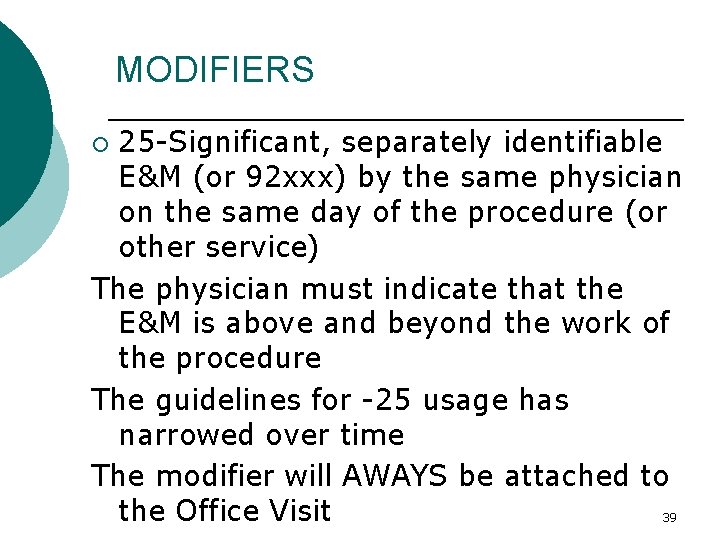
MODIFIERS 25 -Significant, separately identifiable E&M (or 92 xxx) by the same physician on the same day of the procedure (or other service) The physician must indicate that the E&M is above and beyond the work of the procedure The guidelines for -25 usage has narrowed over time The modifier will AWAYS be attached to the Office Visit 39 ¡
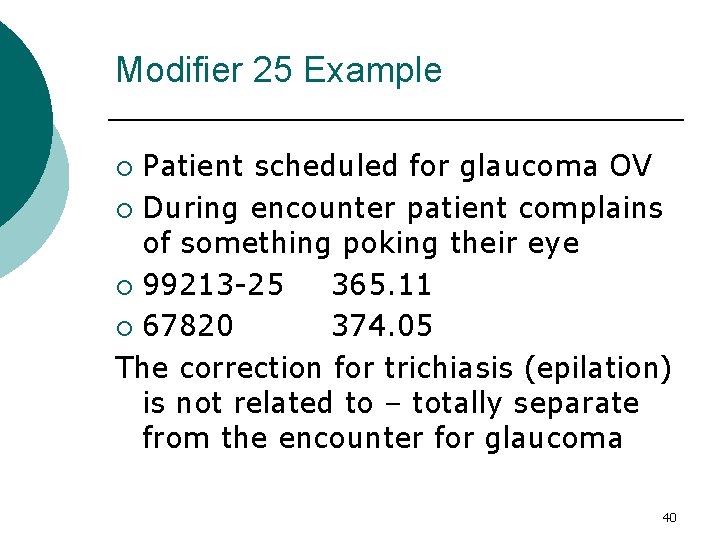
Modifier 25 Example Patient scheduled for glaucoma OV ¡ During encounter patient complains of something poking their eye ¡ 99213 -25 365. 11 ¡ 67820 374. 05 The correction for trichiasis (epilation) is not related to – totally separate from the encounter for glaucoma ¡ 40
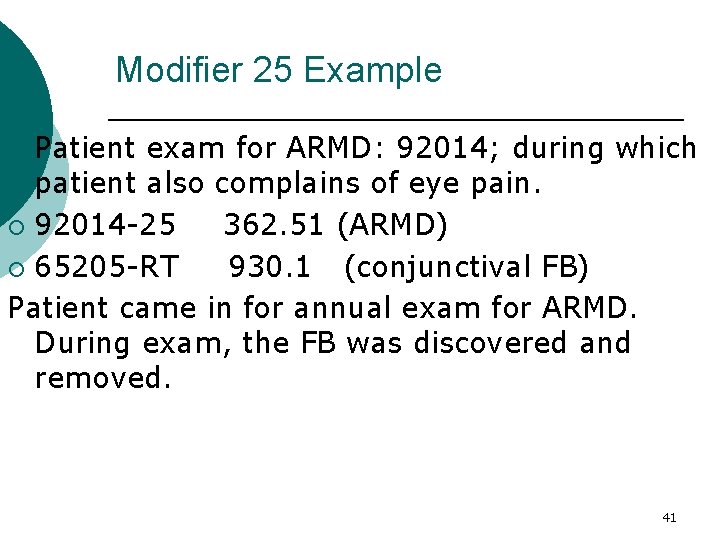
Modifier 25 Example Patient exam for ARMD: 92014; during which patient also complains of eye pain. ¡ 92014 -25 362. 51 (ARMD) ¡ 65205 -RT 930. 1 (conjunctival FB) Patient came in for annual exam for ARMD. During exam, the FB was discovered and removed. ¡ 41
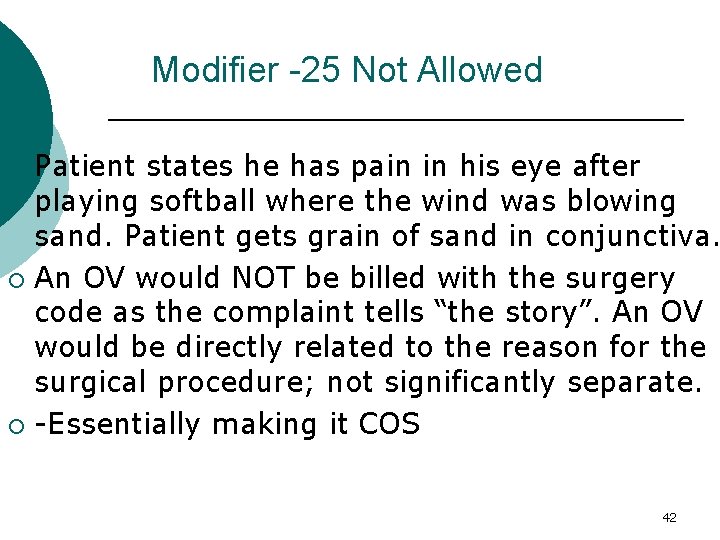
Modifier -25 Not Allowed Patient states he has pain in his eye after playing softball where the wind was blowing sand. Patient gets grain of sand in conjunctiva. ¡ An OV would NOT be billed with the surgery code as the complaint tells “the story”. An OV would be directly related to the reason for the surgical procedure; not significantly separate. ¡ -Essentially making it COS ¡ 42
Modifier 25 & 1 diagnosis If substantial, extra work was involved (above & beyond), an OV would be appropriate to submit with the surgery code. Documentation must clearly indicate the extra work ¡ Examples could include removal of multiple foreign bodies, difficulty with the patient, other complicating factors ¡ Be prepared to “defend” your claim, as it may be initially rejected ¡ 43
44
Modifier -26 & TC -26 Professional Component ¡ -TC Technical Component There are several ophthalmological services that have both a professional and a technical component. If the physician performs both elements, no modifier is used. However, if just one element is done, or if the service elements are performed on different days, then these modifiers are used. When another provider requests a test, you submit for the TC only & that provider will indicate the dx (at the DOS) 45 ¡
Modifier -26 Professional Component Patient needs to have an OCT performed, but your office does not have the machine. You have another provider do the scan and that scan is sent back to your provider to interpret. ¡ You submit only for the professional component-billing less than what the global fee would be ¡ *92133 -26 ¡ *92135 was replaced by 92133, or 92134 and is bilateral, not unilateral ¡ 46
Modifier -TC Another provider does not have a fundus camera and needs to have retinal photos performed on a patient; sends patient to you ¡ 92250 -TC (not all insurances consider 92250 bilateral) You only performed the technical component and so only submit the TC element. (The TC component has a higher allowable than the PC component) (WPS- 92250 -TC $49. 24 92250 -26 $23. 46) ¡ 47
Modifier -26 & TC Physician is out of the office the day visual fields are performed. The physician does the interpretation & report (I&R) when she returns. 03/10/13 92083 -TC $65. 00 03/17/13 92083 -26 $25. 00 These 2 billed amounts should equal the amount you would submit if both elements were performed at the same time. ¡ 48
Payment Modifiers When using multiple payment modifiers, there is a specific order to follow. ¡ 1 st list any modifier that would justify reporting two procedures together – such as 59(unbundle such as 92133, 92134 & 92250) ¡ Next, list any modifiers that affect payment – such as 50 – for example 92225, 92226 ¡ Then list any “informational” modifiers such as RT, LT that do NOT affect reimbursement, but provide more specific information ¡ 49
Modifier 22 – Increased Service ¡ Modifier 22: Increased procedural service requiring work substantially greater than typically required Ex: Removal of a high numbers of foreign bodies ¡ 65222 -22 -Rt ¡ Need to note “documentation available”* ¡ Patient records will most likely be requested ¡ WPS has a Modifier Documentation Form 50 ¡
Modifier 52 -Reduced Service Modifier -52 is used to reflect less than the usual amount of work performed. Visual field is performed on one eye only. This would be some reduced work. 92083 -52 (Do not submit ½ of your usual fee. There is a reduction in service, but the service and the I&R must be done) ¡ 51
52
Test Question Multi-Doctor Practice ¡ 03/01/13: Dr #1 saw patient for corneal ulcer (dx: 370. 00) ¡ 03/08/13: Dr #2(pt new to her) saw patient for follow-up AND removed corneal foreign body (dx: 930. 0) 9921 X-25 370. 00 65222 -Rt 930. 0 ¡ 53
NCCI Modifier Indicators National Correct Coding Initiative (NCCI) assigns modifier indicators that show what codes can be unbundled ¡ The modifier indicator “ 0” means you may NOT use any modifier to unbundle codes under any circumstances ¡ The “ 1” indicator allows the use of an appropriate modifier in some situations to unbundle the edit and receive payment for both codes (ex- 92133, OR 92134 & 92250) ¡ 54
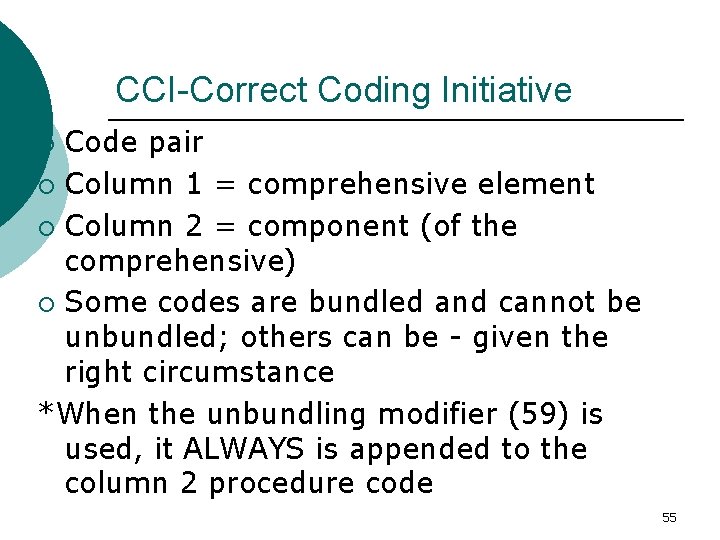
CCI-Correct Coding Initiative Code pair ¡ Column 1 = comprehensive element ¡ Column 2 = component (of the comprehensive) ¡ Some codes are bundled and cannot be unbundled; others can be - given the right circumstance *When the unbundling modifier (59) is used, it ALWAYS is appended to the column 2 procedure code ¡ 55
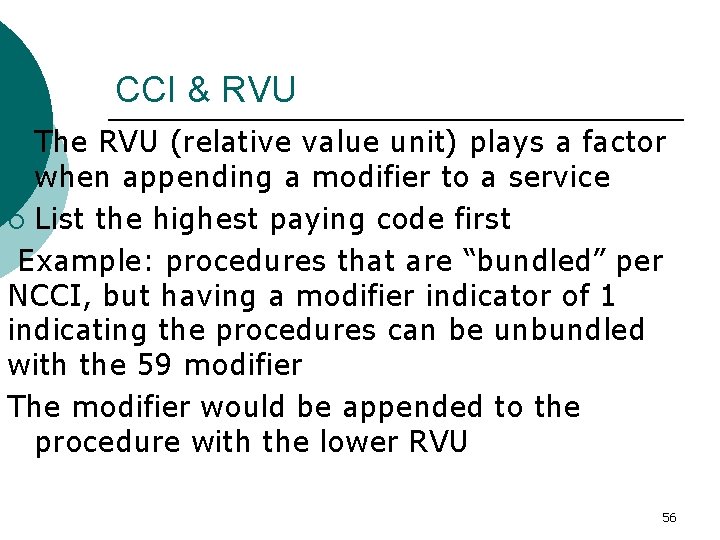
CCI & RVU The RVU (relative value unit) plays a factor when appending a modifier to a service ¡ List the highest paying code first Example: procedures that are “bundled” per NCCI, but having a modifier indicator of 1 indicating the procedures can be unbundled with the 59 modifier The modifier would be appended to the procedure with the lower RVU ¡ 56
Modifier 59 -Distinct Procedure Service ¡ Modifier -59 is also known as the “unbundling” code. The OIG looks at this modifier usage closely. Some codes are bundled per correct coding initiative (CCI)-but can be unbundled when appropriate. Documentation is very important to show need to unbundle. 57
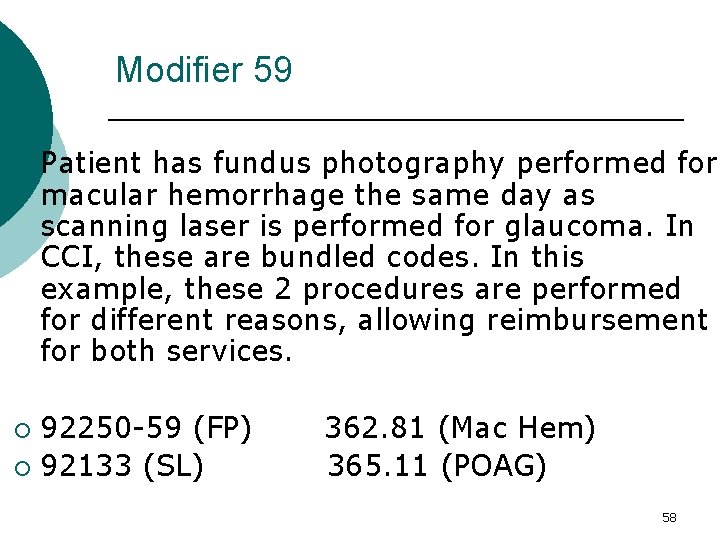
Modifier 59 ¡ Patient has fundus photography performed for macular hemorrhage the same day as scanning laser is performed for glaucoma. In CCI, these are bundled codes. In this example, these 2 procedures are performed for different reasons, allowing reimbursement for both services. 92250 -59 (FP) ¡ 92133 (SL) ¡ 362. 81 (Mac Hem) 365. 11 (POAG) 58
Modifier 79 -79 Unrelated procedure or service by the same physician during the post-op period ¡ Ex: Co-management of the 2 nd cataract surgery during the 90 days of the 1 st eye ¡ Ex: Epilation – 67820 performed during global ¡ ¡ Ophthalmological tests unrelated to the surgery performed during the global would not require the 79 modifier 59
Modifier 24 -Unrelated E&M or OV -24 Unrelated E&M Service by the same physician during a postop period ¡ (would also include 92 xxx procedures) ¡ Ex: During cataract comanagment global; the patient is seen for allergic conjunctivitis (372. 14) ¡ 60
Modifier 51 – Multiple surgeries WPS will apply the multiple surgery modifier which is seen on the RA ¡ Example: PPs (68761 -closure, lacrimal punta by plug) ¡ 68761 LT E 1 ¡ 68761 LT E 2 (51 -added by WPS) ¡ 68761 RT E 3 (51 added) ¡ 68761 RT E 4 (51 added) ¡ The 1 st line of svc was fully @ fee schedule ¡ Lines 2, 3, 4 were allowed @ 50% fee schedule 61 ¡
Modifier 99 -Multiple Modifiers The HCFA 1500 will accept 4 sets of modifiers; but you could use the -99 to reflect multiple modifiers ¡ Overflow modifier ¡ Ex: Co-mgmt, 2 nd eye during 1 st eye global ¡ 66984 -55 -99 ¡ In the narrative field you would detail the “rest of the picture” ie, 79, rt or lt ¡ 62

63
Modifier GW ¡ ¡ GW is the Hospice modifier. States that the service you’re providing/submitting is not related to Hospice care. (Often we find this out after the claim comes back denied on the remit) 92004 -GW 64
Modifier Q 6 -Locum Tenens -Q 6 Locum Tenens: Service furnished by a locum tenens physician. Used by a temporary fill-in physician. This cannot exceed beyond a continual 60 days. Some carriers require the NPI of the Locum Tenens doctor be included in box 23 of the HCFA 1500. It is also recommended that these claims be “kept track of” in case of an audit. ¡ 65
Q 6 Locum Tenens Append Q 6 to each procedure code (line of service) submitted ¡ Submit under regular physician’s name/NPI ¡ 66
Modifier GA ¡ GA indicates you have a signed waiver of liability. If the patient did NOT sign a waiver (usually involving the ABN or other waiver of liability) at the time of service - you CANNOT use the GA modifier. * *GA could be used in the case of a “valid” but unsigned ABN. Document who refused as well as being signed by the ABN presenter and a witness 67
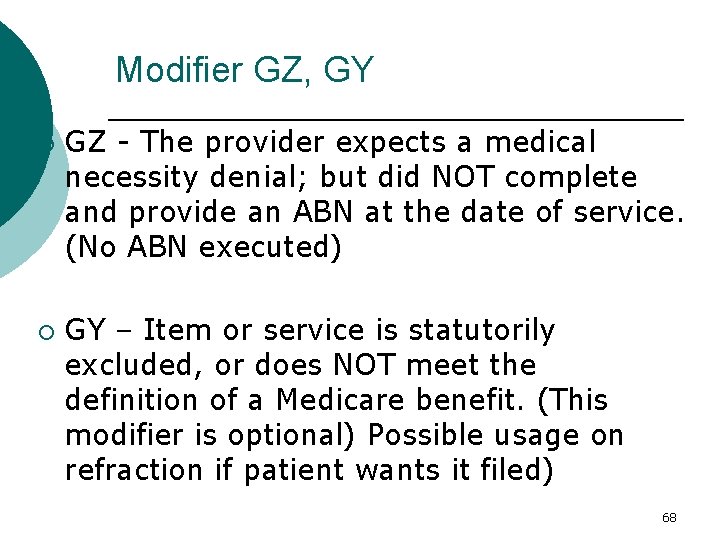
Modifier GZ, GY ¡ ¡ GZ - The provider expects a medical necessity denial; but did NOT complete and provide an ABN at the date of service. (No ABN executed) GY – Item or service is statutorily excluded, or does NOT meet the definition of a Medicare benefit. (This modifier is optional) Possible usage on refraction if patient wants it filed) 68
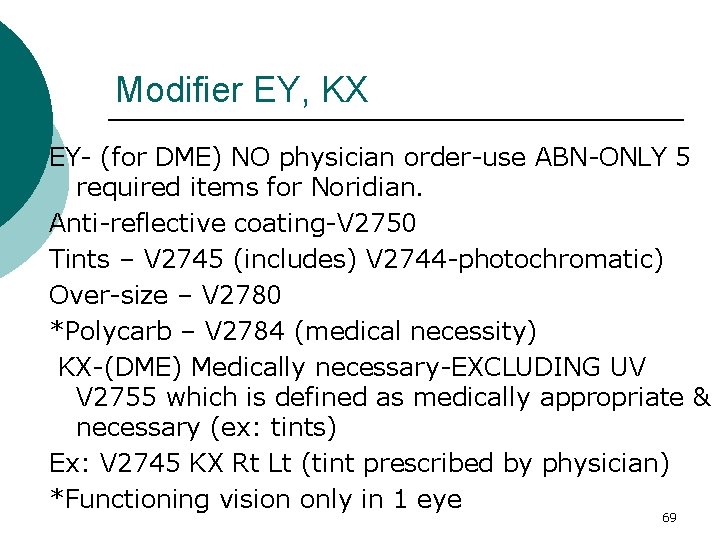
Modifier EY, KX EY- (for DME) NO physician order-use ABN-ONLY 5 required items for Noridian. Anti-reflective coating-V 2750 Tints – V 2745 (includes) V 2744 -photochromatic) Over-size – V 2780 *Polycarb – V 2784 (medical necessity) KX-(DME) Medically necessary-EXCLUDING UV V 2755 which is defined as medically appropriate & necessary (ex: tints) Ex: V 2745 KX Rt Lt (tint prescribed by physician) *Functioning vision only in 1 eye 69

70
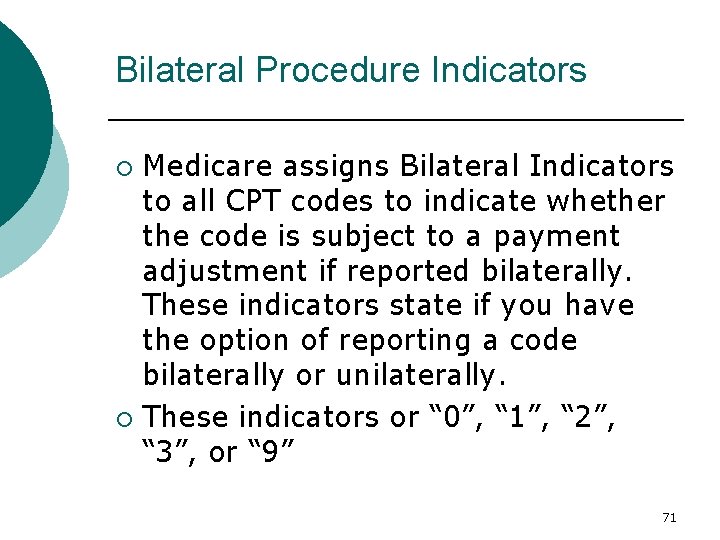
Bilateral Procedure Indicators Medicare assigns Bilateral Indicators to all CPT codes to indicate whether the code is subject to a payment adjustment if reported bilaterally. These indicators state if you have the option of reporting a code bilaterally or unilaterally. ¡ These indicators or “ 0”, “ 1”, “ 2”, “ 3”, or “ 9” ¡ 71
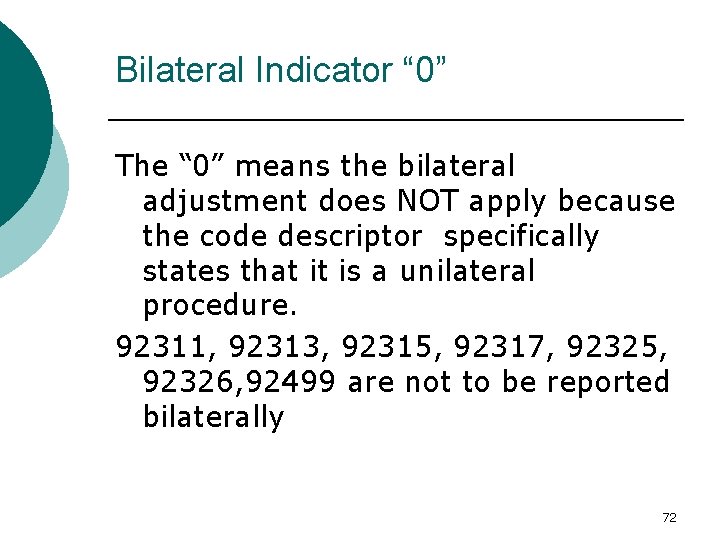
Bilateral Indicator “ 0” The “ 0” means the bilateral adjustment does NOT apply because the code descriptor specifically states that it is a unilateral procedure. 92311, 92313, 92315, 92317, 92325, 92326, 92499 are not to be reported bilaterally 72
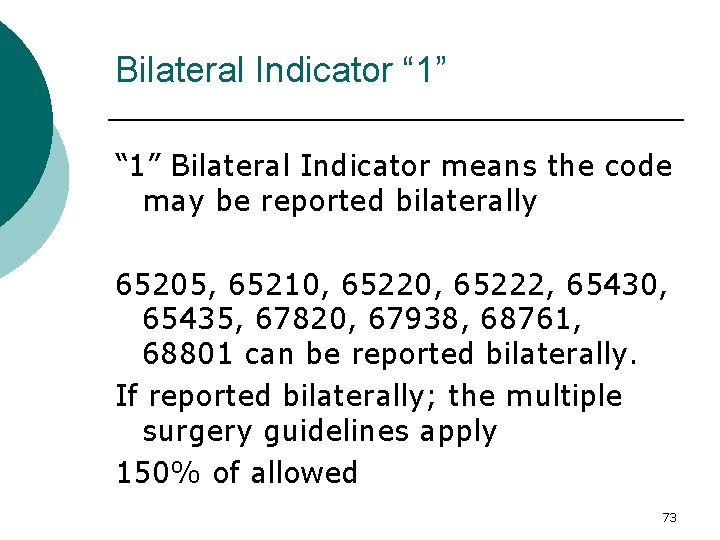
Bilateral Indicator “ 1” Bilateral Indicator means the code may be reported bilaterally 65205, 65210, 65222, 65430, 65435, 67820, 67938, 68761, 68801 can be reported bilaterally. If reported bilaterally; the multiple surgery guidelines apply 150% of allowed 73
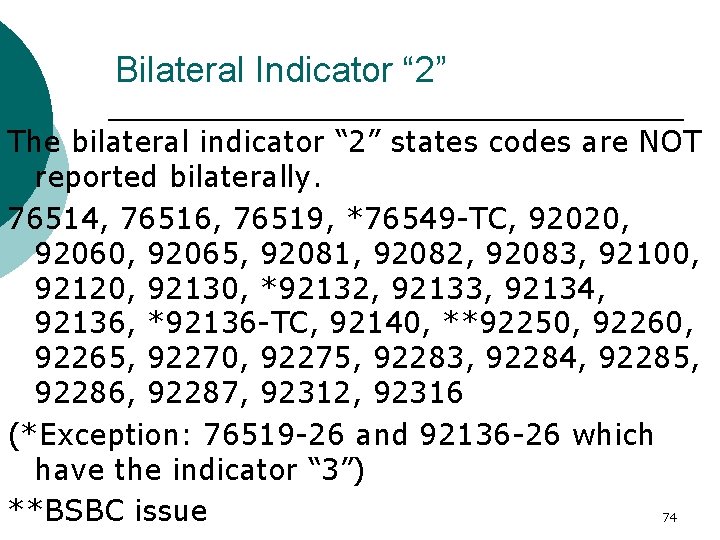
Bilateral Indicator “ 2” The bilateral indicator “ 2” states codes are NOT reported bilaterally. 76514, 76516, 76519, *76549 -TC, 92020, 92065, 92081, 92082, 92083, 92100, 92120, 92130, *92132, 92133, 92134, 92136, *92136 -TC, 92140, **92250, 92265, 92270, 92275, 92283, 92284, 92285, 92286, 92287, 92312, 92316 (*Exception: 76519 -26 and 92136 -26 which have the indicator “ 3”) **BSBC issue 74
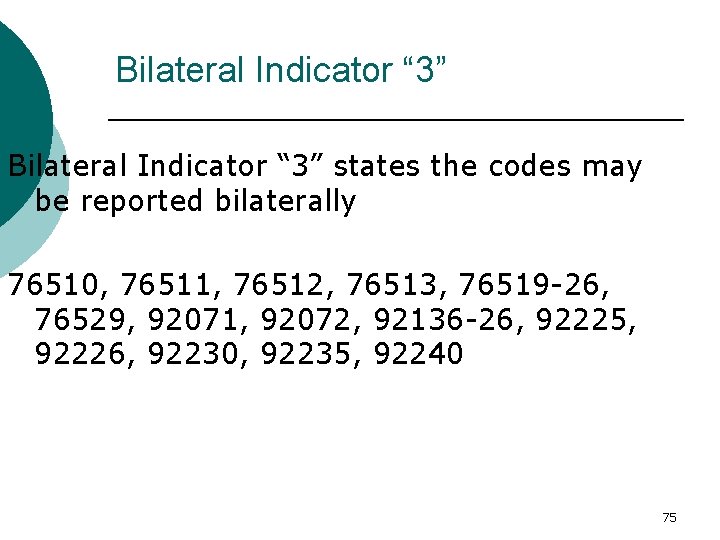
Bilateral Indicator “ 3” states the codes may be reported bilaterally 76510, 76511, 76512, 76513, 76519 -26, 76529, 92071, 92072, 92136 -26, 92225, 92226, 92230, 92235, 92240 75
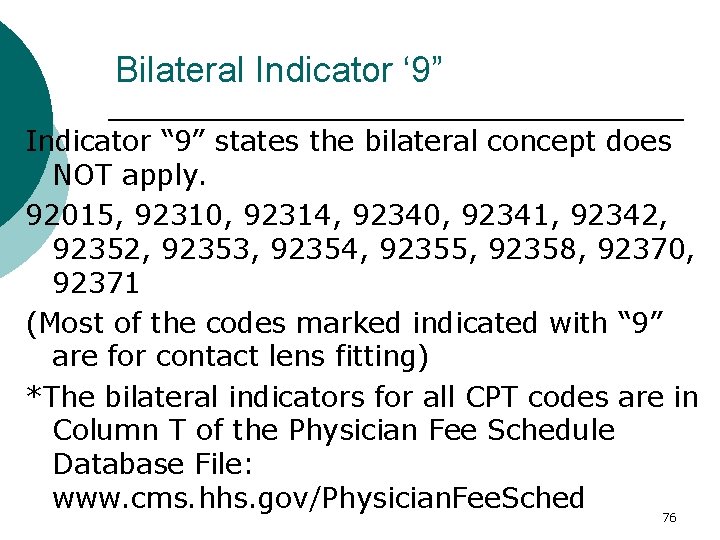
Bilateral Indicator ‘ 9” Indicator “ 9” states the bilateral concept does NOT apply. 92015, 92310, 92314, 92340, 92341, 92342, 92353, 92354, 92355, 92358, 92370, 92371 (Most of the codes marked indicated with “ 9” are for contact lens fitting) *The bilateral indicators for all CPT codes are in Column T of the Physician Fee Schedule Database File: www. cms. hhs. gov/Physician. Fee. Sched 76
77
Medicare Coverage Remember that Medicare coverage is dependent upon the medical necessity of the service. Coverage is based on the purpose of the encounter rather than the ultimate diagnosis. ¡ Medical Necessity drives the encounter, not the amount of documentation. ¡ The Medicare Part B deductible for 2014 is $147; no change from 2013 ¡ 78
LAW Providers are required by law to file Medicare claims, unless the provider opted out. ¡ If you opt out of Medicare, you will not see Medicare patients ¡ Exception: If a Medicare patient specifically states he/she does NOT want the claim filed to Medicare and is willing to pay U&C charge(s) out of pocket ¡ (this is according to the AOA coding experts) ¡ (our office will document and get a signature 79 even though not legally required) ¡
General Claim Guidelines Procedure code line items are matched with the appropriate diagnosis code (field 19 on the HCFA) with only one Dx per service line ¡ Often there will be multiple diagnosis codes appropriate to the overall encounter; the principle diagnosis code (reason for encounter) is to be listed 1 st. (Typically relates back to the CC (chief complaint) ¡ 80
Multiple E&M Service-Same Day ¡ ¡ Medicare allows for one E&M visit per day by the same provider or member of the same group, same specialty UNLESS…. .
Exception: Possible -25 Modifier If same day visits were unrelated and could NOT have been provided during the same encounter, both would (should) be allowed. Documentation must support the need. ¡ 2 nd service may deny requiring a redetermination ¡
Multiple Encounter, same day Patient 1 st encounter, AM, 92012 with Dx of 375. 15 -dry eye ¡ 2 nd encounter later same day got different onset episode of visual aura lasting 20 minutes. 99213 with Dx of 346. 80 ophthalmic migraine. ¡ Attach the 25 modifier to the 2 nd service. Unrelated to 1 st encounter and was not present at the time of the 1 st encounter ¡ In narrative field state “documentation 83 available upon request ¡
Corneal FB OU 65222 is unilateral, so for corneal FBs rt, lt, submit as 2 lines of service. ¡ 65222 Rt 930. 0 ¡ 65222 Lt 930. 0 ¡ Multiple surgery guidelines will apply (2 nd service will be allowed at 50 % of the allowable) ¡ 84
Foreign Bodies; Two Sites If a patient has foreign bodies, same eye, one in the conjunctiva and one in the cornea; both are eligible for reimbursement. These two surgery codes are not bundled as they involve different parts of the eye. 85
FBs – 2 sites 65222 (corneal FB removal) Rt 930. 0 ¡ 65210 (conjunctival FB removal) Rt 930. 1 The 2 nd surgery will be allowed at 50% ¡ *some carriers may still require the 59 modifier 86
Conjunctival Concretions Technically considered Foreign Bodies ¡ Dx: 372. 54 -conjunctival concretions ¡ 65210 – removal FB, external eye; conjunctival embedded (includes concretions), subconjunctival concretions ¡ Just because it’s coded FBR, do not state the service is due to an accident ¡ 87
88
Co-Management Modifier 55 Claims for co-management have had issues for an ongoing time. It is complicated by the fact that some carriers want certain information and others want different information. Also, the global period for major surgeries is not the same for all carriers. ¡ One of the most common problems is the relinquish date. (Remember, relinquish refers to the final date of the post-op care; 90 th day) ¡ 89
Case by Case Co-management should always be determined on a case by case basis, beginning with needs/wants of the patient. ¡ Should NOT be prearranged ¡ Medicare Law on co-management billing includes a written transfer of care agreement ¡ 90
Communication is Key Prior to surgery: ¡ -referral request form ¡ -pertinent patient notes ¡ -consent for co-management ¡ After surgery: ¡ -transfer of care ¡ -operative notes ¡ -post-operative notes ¡ 91
Post-Op Care WPS Medicare has a link that calculates the relinquish date: www. wpsmedicare. com/j 5 macpartb Resources-calculators ¡ -Fast & Easy 92
Post-Op Care Post-op begins the 1 st day after surgery-not the surgery date (even though the surgery date is the date of service) Some payers’ policies state the post-op count begins the day of surgery ¡ Keep in mind, carriers are not uniform in how they want these claims. Some carriers don’t want the relinquish date. They want date you accepted care and how many days of care. Others want the date you accept care and the relinquish date with no mention of # of days of care. 93
Post-Op Care Still other carriers like BCBSKS allow for only 42 days of post-op care. In the narrative field BCBSKS now also requires the accept care date and the relinquish date. Most all carriers want the DOS to be the surgery date. 94
Dry Eyes Patient complains of dry eyes, but the physician does NOT have clinical findings to support the dry eye diagnosis of 375. 15 Code per complaint which could be eye pain (379. 91), red eye (379. 93), or Epiphora (375. 20) ¡ 95
Scanning Laser 92135 was replaced with 2 new codes; 92133, 92134 ¡ {*92132 – Anterior – not payable by WPS } ¡ 92133 – Posterior, Optic Nerve ¡ 92134 – Posterior, Retina Unilateral or Bilateral, so NOT billable per eye. 92133, 92134 can NOT be billed together on the same date of service-regardless of the diagnosis *Draft Policy-now approved; effective date ? ¡ 96
CPT Whenever CPT states “unilateral or bilateral”, it effectively means already bilateral ¡ Can not submit per eye ¡ 97
Serial Tonometry - 92100 Serial Tonometry requires multiple pressure checks over the course of the day, not just a couple in an hour ¡ Normally performed because of serious IOP ¡ 98
Extended, Subsequent Opthalmoscopy 92225: Initial ophthalmoscopy (does require drawing) ¡ 92226: Subsequent-If patient is seen back for a repeat ophthalmoscopy with the same diagnosis, use 92226. ¡ (even if a year later) A different diagnosis is what determines initial or subsequent (Unilateral) ¡ 99
Epilation – 67820 is defined per eye, not per eyelid. ¡ 150% if reported bilaterally (multiple surgery guidelines) ¡ 67820 has been reported several different ways in the past. Per lash, per lid, etc 100
101
Drug Effects ¡ If you are monitoring a patient who, (for example) is currently using a high risk medication that affects the ocular system use the diagnosis V 58. 69 - long-term-current use of high risk medication. If the patient has completed the course of treatment for the drug, then use V 67. 51 -completion of treatment for high risk medication. 102
Prolonged Service 99354 Prolonged Service requires a minimally additional 30 minutes beyond what the service would normally be. It must be face to face with the physician. It is billed in addition to the E&M original encounter. 99213 99354 (99355 for each 30 minutes after 99354) Your documentation must support the need for the prolonged service. Record the face to face time. ¡ 103
Prolonged Service You do NOT have to bill the highest level of E&M to additionally use the prolonged service procedure code. ¡ The level of service for the encounter is based on history, exam, and medical decision making. ¡ 104

105
Time as Key Element Per CPT; when counseling and/or coordination of care DOMINATES more than 50% of the physician/patient and /or family encounter (face-to-face time) then time may be considered the key or controlling factor to qualify for a particular level of E&M service. ¡ Time must be documented. ¡ Document total time spent on encounter, time spent on counseling & coordination of care or %, and reason or topic of counseling Co. C ¡ 106
A-Scans 76519 Ophthalmic biometry by ultrasound echography, A-scan; with intraocular lens power calculation. ¡ The TC has modifier indicator 2 stating the code is inherently bilateral* ¡ The professional component (26) has modifier indicator 3 meaning the code is inherently unilateral ¡ 107
A-Scan When you report 76519 as a global code (without modifiers), you’re stating both the technical and professional components were performed. ¡ If you calculate IOL power in both eyes, code the TC & PC components separately: 76519 -TC for bilateral technical component 76519 -26 -50 for bilateral professional component (only the PC can be submitted with the 50 modifier) ¡ 108
Punctum Plugs 68761 – Closure of the lacrimal punctum; by plug, each ¡ 10 day global ¡ Same surgery code used for both temporary and permanent plugs ¡ Some carriers do not like modifier -51; making reporting more than 2 closures difficult. E codes to help define can be used. ¡ E 1 UL, E 2 LL, E 3 UR, E 4 LR ¡ 109
Punctum Plugs Supply as much information in narrative as possible ¡ E codes not universally accepted ¡ Most commonly the 2 inferior puncta are involved. Submit as 68761 -50 or 68761 Rt E 4 68761 Lt E 2 If the encounter is only for PPs, an office visit 110 can NOT be additionally submitted ¡
Punctum Plugs Submitting for each puncta as separate line item may simplify claim processing Medicare considers PP removal part of the global package-even though outside the 10 days. Option: Submit with the appropriate level E&M code using signs and symptoms 111
112
New Therapeutic Contact Lens Fitting Codes Effective January 1, 2012, 92070 was retired and replaced with 2 new codes, 92071 and 92072. ¡ These codes are unilateral ¡ (They have NOT been without issue) ¡ 92071 is the fitting of contact lens for treatment of ocular surface disease. – An example would be for corneal abrasions ¡ 92071 most nearly replaces 92070 ¡ 113
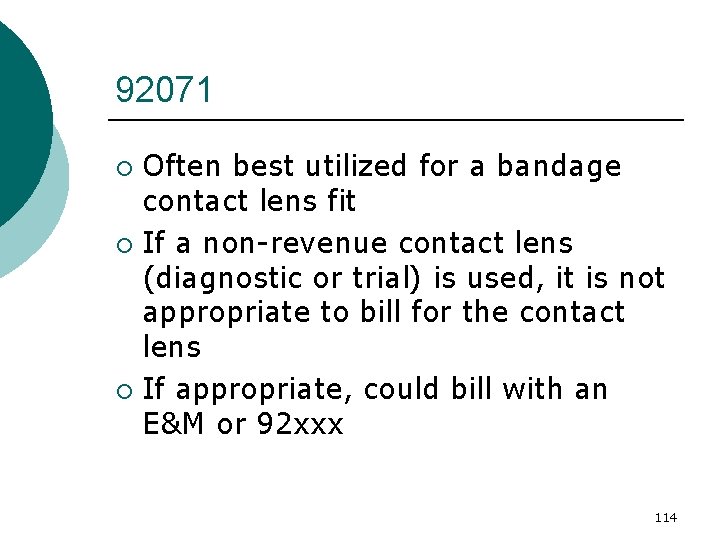
92071 Often best utilized for a bandage contact lens fit ¡ If a non-revenue contact lens (diagnostic or trial) is used, it is not appropriate to bill for the contact lens ¡ If appropriate, could bill with an E&M or 92 xxx ¡ 114
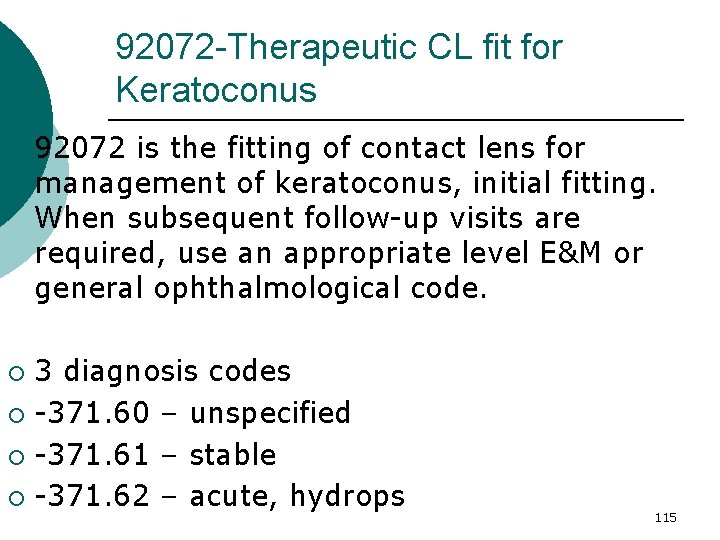
92072 -Therapeutic CL fit for Keratoconus ¡ 92072 is the fitting of contact lens for management of keratoconus, initial fitting. When subsequent follow-up visits are required, use an appropriate level E&M or general ophthalmological code. 3 diagnosis codes ¡ -371. 60 – unspecified ¡ -371. 61 – stable ¡ -371. 62 – acute, hydrops ¡ 115
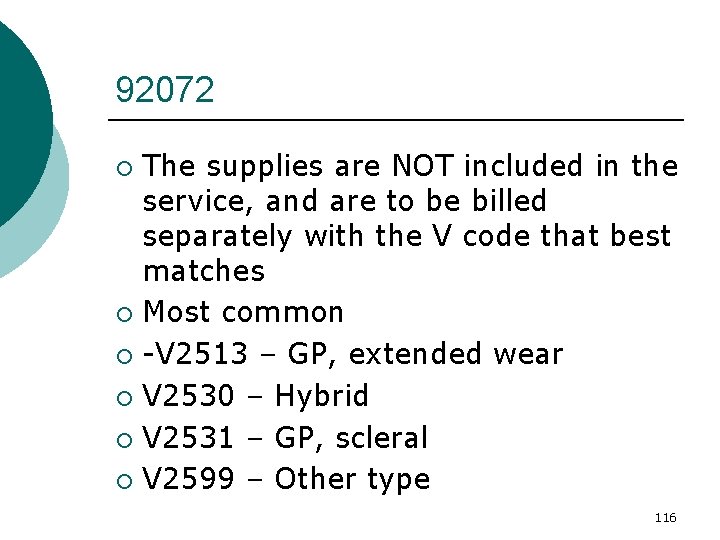
92072 The supplies are NOT included in the service, and are to be billed separately with the V code that best matches ¡ Most common ¡ -V 2513 – GP, extended wear ¡ V 2530 – Hybrid ¡ V 2531 – GP, scleral ¡ V 2599 – Other type ¡ 116
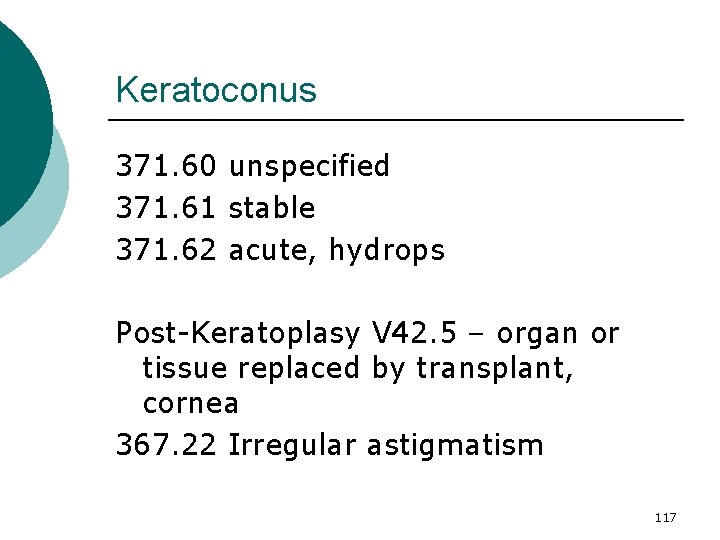
Keratoconus 371. 60 unspecified 371. 61 stable 371. 62 acute, hydrops Post-Keratoplasy V 42. 5 – organ or tissue replaced by transplant, cornea 367. 22 Irregular astigmatism 117

118
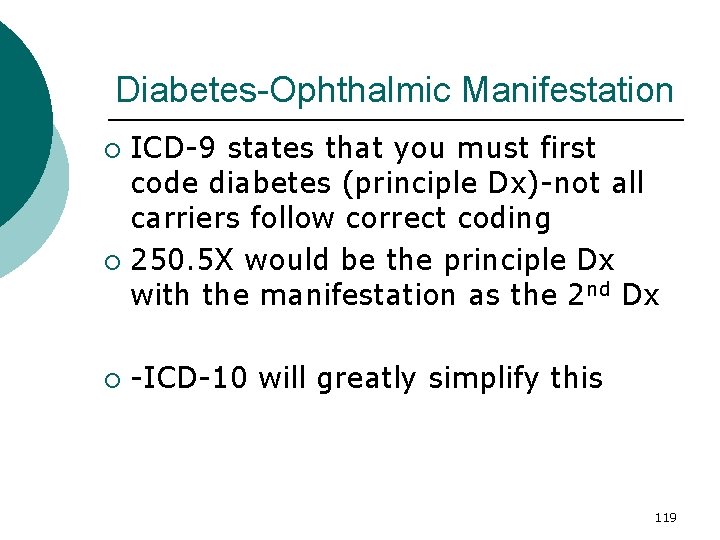
Diabetes-Ophthalmic Manifestation ICD-9 states that you must first code diabetes (principle Dx)-not all carriers follow correct coding ¡ 250. 5 X would be the principle Dx with the manifestation as the 2 nd Dx ¡ ¡ -ICD-10 will greatly simplify this 119
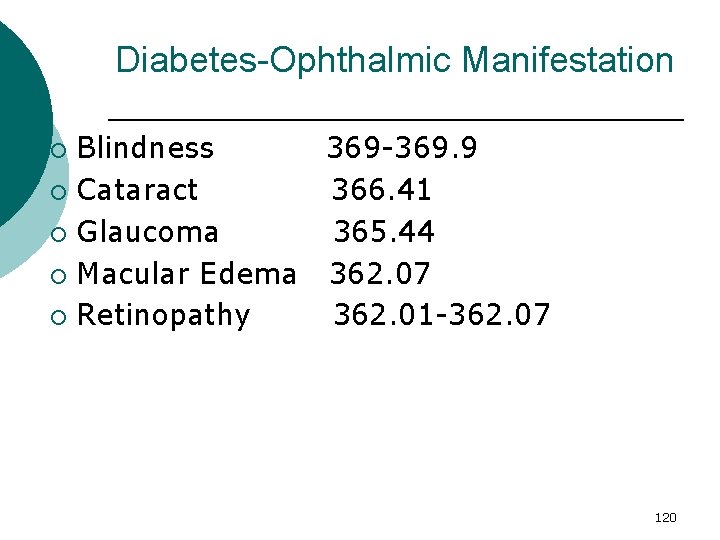
Diabetes-Ophthalmic Manifestation Blindness 369 -369. 9 ¡ Cataract 366. 41 ¡ Glaucoma 365. 44 ¡ Macular Edema 362. 07 ¡ Retinopathy 362. 01 -362. 07 ¡ 120
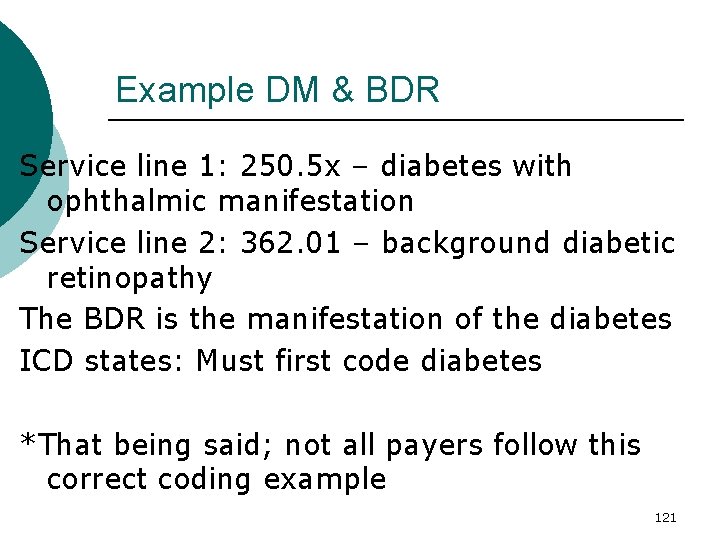
Example DM & BDR Service line 1: 250. 5 x – diabetes with ophthalmic manifestation Service line 2: 362. 01 – background diabetic retinopathy The BDR is the manifestation of the diabetes ICD states: Must first code diabetes *That being said; not all payers follow this correct coding example 121
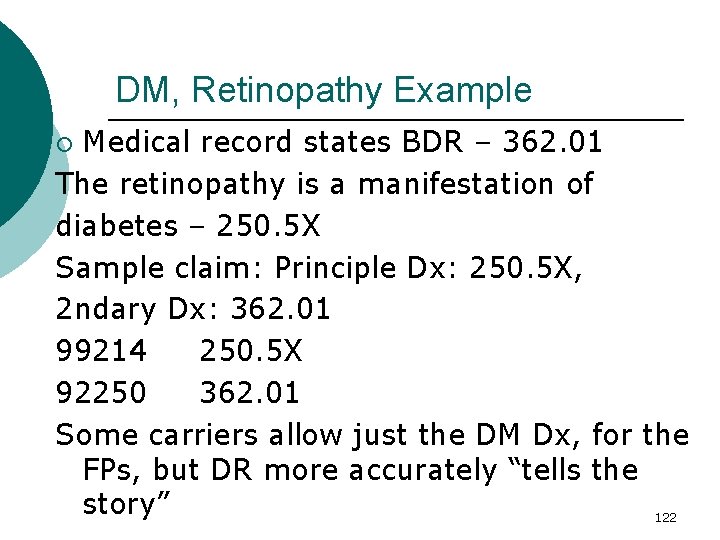
DM, Retinopathy Example Medical record states BDR – 362. 01 The retinopathy is a manifestation of diabetes – 250. 5 X Sample claim: Principle Dx: 250. 5 X, 2 ndary Dx: 362. 01 99214 250. 5 X 92250 362. 01 Some carriers allow just the DM Dx, for the FPs, but DR more accurately “tells the story” 122 ¡
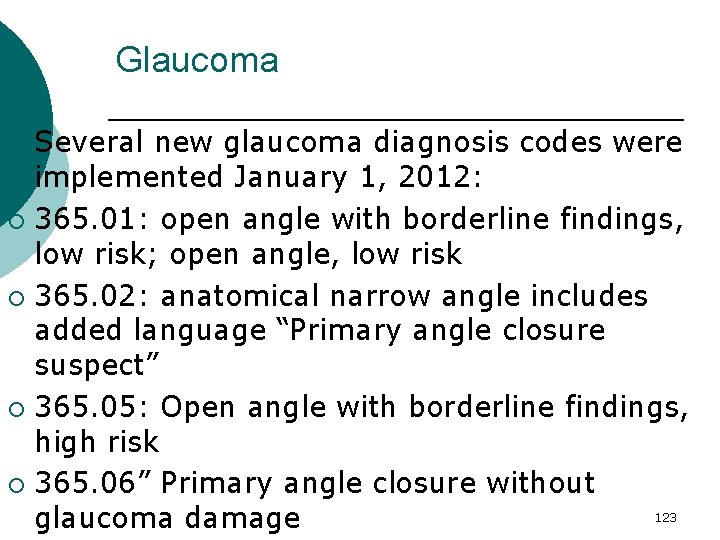
Glaucoma Several new glaucoma diagnosis codes were implemented January 1, 2012: ¡ 365. 01: open angle with borderline findings, low risk; open angle, low risk ¡ 365. 02: anatomical narrow angle includes added language “Primary angle closure suspect” ¡ 365. 05: Open angle with borderline findings, high risk ¡ 365. 06” Primary angle closure without 123 glaucoma damage ¡
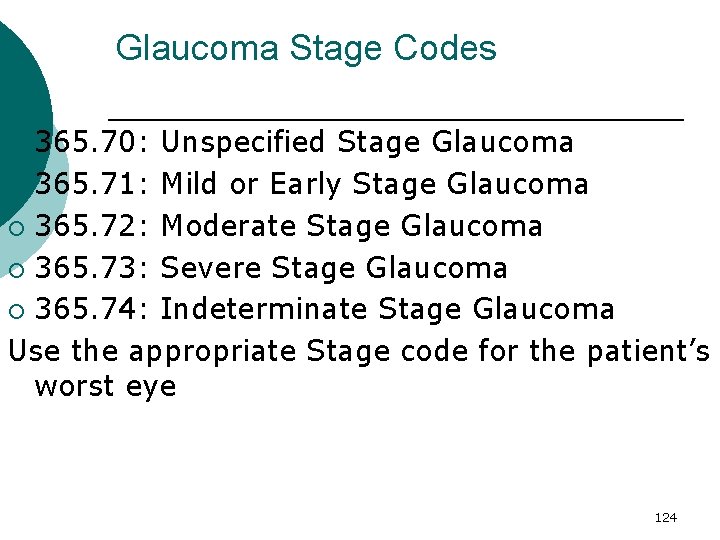
Glaucoma Stage Codes 365. 70: Unspecified Stage Glaucoma ¡ 365. 71: Mild or Early Stage Glaucoma ¡ 365. 72: Moderate Stage Glaucoma ¡ 365. 73: Severe Stage Glaucoma ¡ 365. 74: Indeterminate Stage Glaucoma Use the appropriate Stage code for the patient’s worst eye ¡ 124
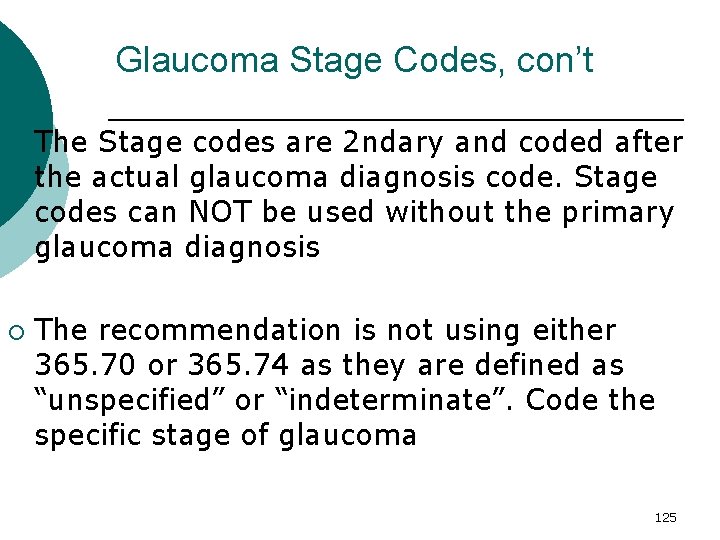
Glaucoma Stage Codes, con’t ¡ ¡ The Stage codes are 2 ndary and coded after the actual glaucoma diagnosis code. Stage codes can NOT be used without the primary glaucoma diagnosis The recommendation is not using either 365. 70 or 365. 74 as they are defined as “unspecified” or “indeterminate”. Code the specific stage of glaucoma 125
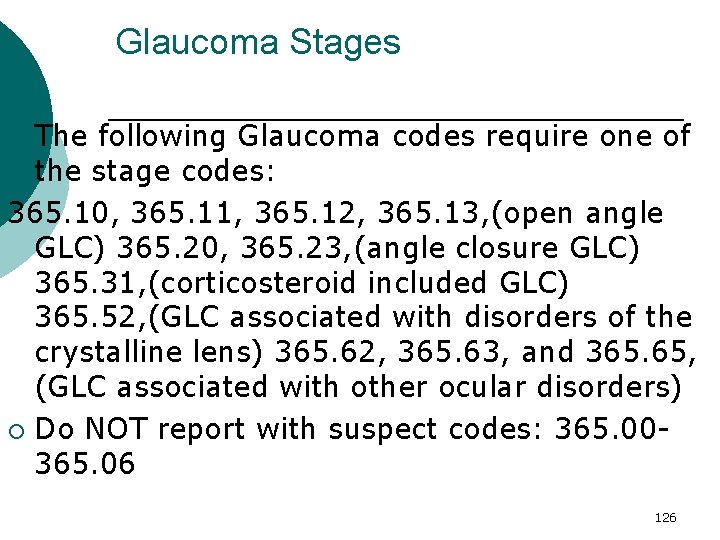
Glaucoma Stages The following Glaucoma codes require one of the stage codes: 365. 10, 365. 11, 365. 12, 365. 13, (open angle GLC) 365. 20, 365. 23, (angle closure GLC) 365. 31, (corticosteroid included GLC) 365. 52, (GLC associated with disorders of the crystalline lens) 365. 62, 365. 63, and 365. 65, (GLC associated with other ocular disorders) ¡ Do NOT report with suspect codes: 365. 00365. 06 ¡ 126
Glaucoma Screenings G 0117 High-risk patients, every 12 months Patients with a family history of glaucoma, diabetes mellitus, blacks age 50 and older, Hispanics age 65 and older *dilated eye exam with an IOP measurement, *direct ophthalmoscopy exam, or slit-lamp biomicroscopic exam *Must use diagnosis V 80. 1 ¡ 127
Glaucoma Screening VS OV ----SO---¡ Consider if submitting an E&M or 92 xxx exam code is more appropriate than G 0117 ¡ Other ophthalmological services such as VFs and scanning laser can NOT be submitted with G 0117, G 0118 – but are allowed with E&M or 92 xxx ophthalmological codes ¡ 128

129
S 0620, S 0621 (Just say ‘NO’) S 0620 -New Patient S 0621 -Established Patient Non-medical eye exam -Seeing some re-emergence Potential Risks-no accepted definition as to level of service 130
S 0620, S 0621 CPT has detailed written definitions for exam codes S 0 codes bundle refraction with the rest of an “undefined” exam Not in agreement or in compliance with HIPAA law 131
INSURANCE EQUITY STATUTE Many states have a law that requires insurance companies reimburse optometrists for services covered under their scope of practice ¡ Must be services that are covered under the insurance company’s policy ¡ Does not include ERISA plans as federal law preempts state law ¡ 132
Insurance Equity If an insurance company rejects a claim from an OD for a service that is covered under that company’s plan a letter should be sent to that company ¡ You will need to reference your state law/Statute # in your letter ¡ Contact your state organization for further information ¡ 133

Kansas Insurance Commissioner Google Kansas Insurance Commissioner ¡ www. ksinsurance. or Links, phone number, and address supplied ¡ 134
Per HIPAA: Claims submitted using the 3 nationally recognized criteria: CPT, ICD, and DGs (documentation guidelines) cannot be rejected Providers as well as insurance companies must follow these national standards (rules) Insist insurance companies recognize full scope of practice 135
Considerations: -Refraction (92015) is NOT content of service of the OV or any other service (separate code as of 1992) ¡ Typically, a re-pricer tries to negotiate a lower reimbursement to the provider ¡ Don’t sign a contract without having the fee schedule ¡ Have payers send you the current contract. Relate them you are reviewing the contract, including the fee schedule ¡ 136
Illegible Provider Signature? Log provider signature with date prior to requested documentation ¡ Printed name, then signature ¡ Will have for proof when documentation is requested ¡ 137
Turning Over Records Releasing a patient’s medical record is determined according to your state regulations. ¡ In many states, you can. NOT hold a patient’s medical record for ransom even if there is an old or large (or both) balance owed to the practice ¡ 138
Option Prescribers may require a patient to pay for the exam, fitting and evaluation before giving the patient a copy of contact lens prescription, but only if the prescriber also requires immediate payment from patients whose exams reveal no need for glasses, contact lenses, or other corrective eye care products. Proof of valid insurance coverage counts as payment for purposes of this requirement http: //business. ftc. gov/documents/bus 62 contact-lens-rule-guide-prescribers-and 139 sellers
Keeping Patient Records Most carriers have requirements as to how long you must keep medical records. ¡ Check with your carriers to find out those requirements. ¡ (For example, WPS Medicare says you must keep patient medical records for 6 years plus 3 months after Medicare has processed) ¡ 140
141
Medicare, Medicaid Overpayments Medicare and Medicaid overpayments must be returned/reported within 60 days - or face TRIPLE penalties. Not reporting/returning overpayments is a form of fraudulent billing. Per AOA NEWS May 24, 2010 142
143
ABN FORM ABN: Advance Beneficiary Notice of Noncoverage ¡ Used to indicate procedures/services/items believed not to be covered ¡ Must be date specific ¡ Never have the patient sign a blank ABN ¡ ¡ The ABN has had slight modifications. The current/required form is CMS-R-131 (03/11) 144
ABN ¡ The provider (or representative of) is required to fill out the notifier, patient name, identifier, service & why believed potential noncoverage and cost 145
ABN The patient will select option 1, 2, or 3 ¡ Option 1 says the patient informed of noncoverage, but still wants services/items submitted ¡ Option 2 says patient informed, items wanted, do NOT have to submit ¡ Option 3 says patient does not want items/services (option 3 is not likely to be applicable/used) The patient must sign & date prior to service ¡ 146
30 Supplier Standards 30 Supplier standards for DME claims ¡ Federal requirement – not an options ¡ Indicates the provider adheres to government standards, regulations ¡ The patient must sign and date ¡ Used at the time of order ¡ 147
Proof of Delivery-for Durable Medical Equipment (DME) Proof of Delivery (Item 12 on the 30 Supplier Standards) is used for DME claims ¡ Although not an individual form, this is a federal requirement ¡ The patient must sign and date when glasses or DME received ¡ Keep for 7 years ¡ The date signed & received (dispensed) is the service date for the materials (Medicare DME) ¡ 148
UPDATE – New CMS Claim Form CMS 1500 revised to Version 02/12 ¡ -could use effect January 6, 2014 ¡ -MANDATORY use April 1, 2014 ¡ Accomodate ICD-10 -CM ¡ Expands the number of possible diagnoses codes on a claim to 12; *using letters A-L as pointers – NOT numbers ¡ ¡ 149
CMS Form Qualifiers New qualifiers are used to indicate if the provider is ordering, referring, or supervising; revising field 17 – referring provider ¡ DN – Referring Provider ¡ DK – Ordering Provider ¡ DQ – Supervising Provider -The qualifier is entered to the left of the dotted vertical line on item 17 ¡ 150
UPDATES Beginning February 3, 2014, WPS Medicare (J 5 & J 8) has a single toll-free number to respond to Medicare needs ¡ J 5: 866 -518 -3285 ¡ J 8: 866 -234 -7331 ¡ -It will guide you to Customer Service, Appeals, Electronic Data Interchange (EDI), Reopenings, and Provider Enrollment ¡ -It will NOT include EFT, IVR, and Payment Recovery 151 ¡
UPDATE – New Category III CPT Code – 0341 T Pupillometry: 0341 T ¡ Quantitative pupillometry with interpretation and report, unilateral or bilateral ¡ There are hand held digital & standardized measures available (a millimeter ruler is not adequate) ¡ It is not in the 2014 CPT but still valid and will be in 2015 CPT ¡ Temporary Codes are the 1 st step toward a permanent code ¡ 152
CAUTION: Under-coding is just as bad as overcoding Could be viewed as a form of kickback 153

FINAL THOUGHTS We play a critical role within the dynamics of our offices We are not alone in our frustrations, confusions, challenges, and anxieties (even though these things may leave us delusional) Celebrate our victories and take pride in them Remember: “What lies behind us and what lies before us are small matters compared to what lies within us. ”-RW Emerson 154

155
- Slides: 155