
Codex Alimentarius basic principles Prof Elisaveta Stikova M
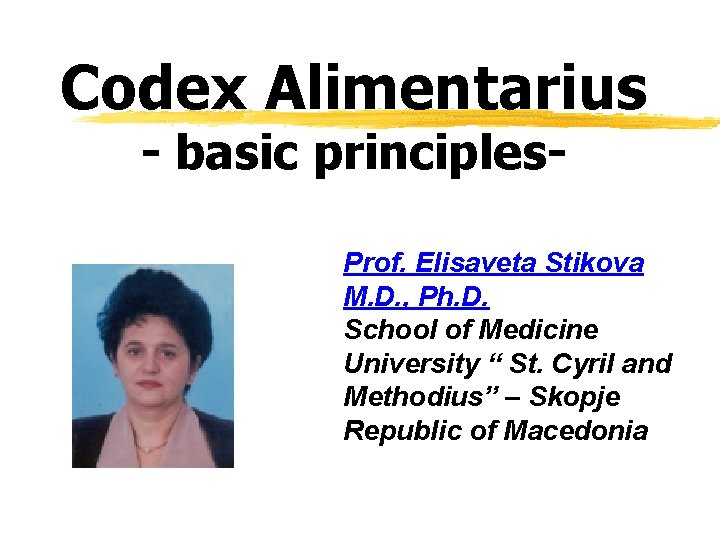
Codex Alimentarius - basic principles- Prof. Elisaveta Stikova M. D. , Ph. D. School of Medicine University “ St. Cyril and Methodius” – Skopje Republic of Macedonia
The FAO/WHO International Conference on Nutrition, 1992 Recognized that: zaccess to nutritionally adequate and safe food is a right of each individual, z. Food regulations… should fully take international standards of the Codex Alimentarius
Codex Alimentarius is: Latin term for “ Food Law” or “Food Code”
Codex Alimentarius Commission z. FAO in 1961 and WHO 1963 passed Resolution to establish the Codex Alimentarius Commission, z. Responsible for Joint FAO/WHO Food Standard Program.
Codex Objectives (1): z. To protect the health of consumers, z. To ensure fair practices in the food trade, z. To coordinate all work regarding food standards,
Codex Objectives (2): z. To determinate the priorities, z. To initiate the preparation of standards, z. To publish the standards.
Codex Alimentarius Commission – structure and management z. The Executive Committee, z. The Regional Coordinating Committees, z. The Secretariat of the Commission.

The Executive Committee z. Chairperson, z 3 Vice-Chairpersons, z 7 Regional Representatives, z 6 Regional Coordinators.
Regional Coordinating Committees: z 6 Regional Committees – for Africa, Asia, Europe, Latin America&Caribbean, North America & Southwest Pacific, Near East. z. Responsible for defining the problems and needs of the region z. Responsible for coordination of activities.

The Secretariat of the Commission: Responsible for: z. Formulation and development of FAO/ WHO standards, z. Administrative support to the Commission, z. Relations with the National Codex Contact Point.
Subsidiary bodies of the Codex Alimentarius Commission: z. Codex Committees: y. Codex committees for general principles, y. Committees for special types of foodstuff products. z. Ad-hoc Intergovernmental Special Work Groups.
Codex Committees on general issues (1) : 1. Codex Committee on General Principles, 2. Codex Committee on Food Labelling, 3. Codex Committee on Methods of Analysis and Sampling,
Codex Committees on general issues (2): 4. Codex Committee on Food Hygiene, 5. Codex Committee on Pesticide Residues, 6. Codex Committee on Food Additives and Contaminants,
Codex Committees on general issues (3): 7. Codex Committee on Import - Export Inspection and Certification systems, 8. Codex Committee on Nutrition and Foods for Special Dietary Uses, 9. Codex Committee on Residues of Veterinary Drugs in Foods,
Product Committees(1): 1. Codex Committee on Cocoa Products and Chocolates, 2. Codex Committee on Sugars, 3. Codex Committee on Pocessed Fruit and Vegetables, 4. Codex Committee on Fats and Oils,
Product Committees(2): 5. Codex Committee on Meat and Polutry Hygyene, 6. Codex Committee on Fish and Fishery products, 7. Codex Committee on Fresh Fruit and Vegetables,
Product Committees(3): 8. Codex Committee on Milk and Milk Products, 9. Codex Committee on Natural Mineral Waters, 10. Codex Committee on Vegetable Proteins, 11. Codex Committee on Cereals, Pulses and Legumes.
Ad-hoc Intergovernmental Codex Special Groups for: zbiotechnologically produced food, zanimal feeds, zfruit juices.
Codex Alimentarius Commision Highest priority: z. Formulation of commodity and general standards
Codex Standards include (1): z. Scope of the standard, z. Description of the standard, z. Basic structure and quality factors, z. Weights and measures, z. Labeling,
Codex Commodity Standards include (2): z. Contaminants, z. Hygiene, z. Food additives, z. Methods for analysis.
Structure and contents of Codex Alimentarius: z. Codex Alimentarius is composed of 14 volumes distributed in 17 books z. Each book (by group of products) contains standards, guidelines. . .
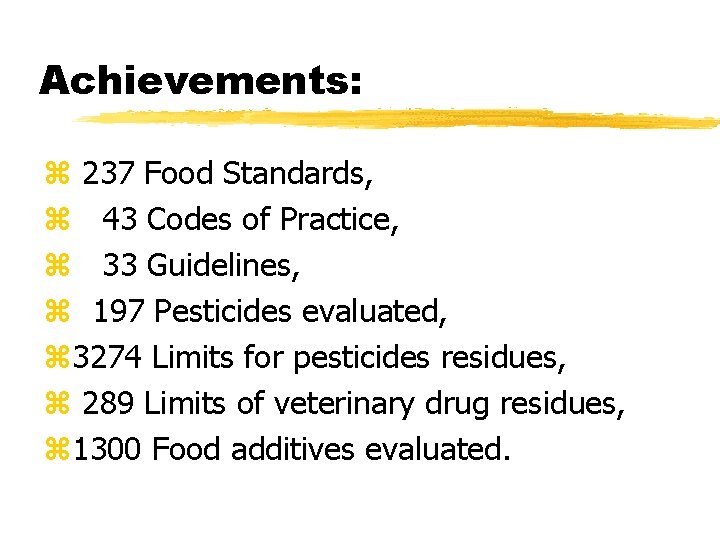
Achievements: z 237 Food Standards, z 43 Codes of Practice, z 33 Guidelines, z 197 Pesticides evaluated, z 3274 Limits for pesticides residues, z 289 Limits of veterinary drug residues, z 1300 Food additives evaluated.
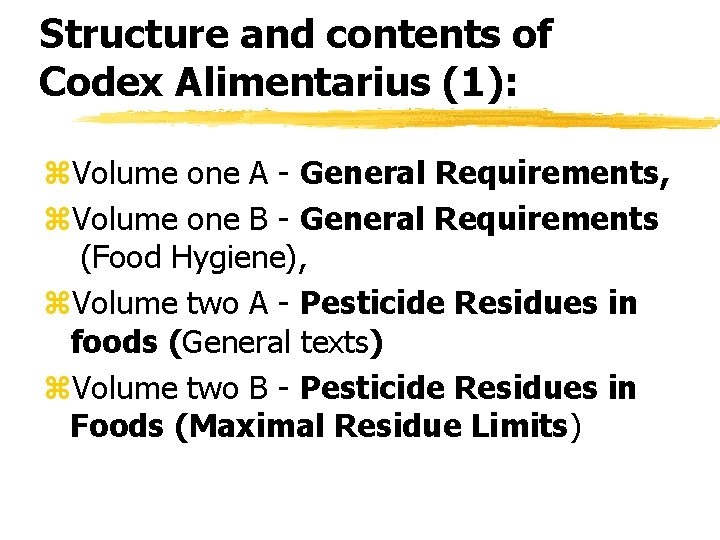
Structure and contents of Codex Alimentarius (1): z. Volume one A - General Requirements, z. Volume one B - General Requirements (Food Hygiene), z. Volume two A - Pesticide Residues in foods (General texts) z. Volume two B - Pesticide Residues in Foods (Maximal Residue Limits)
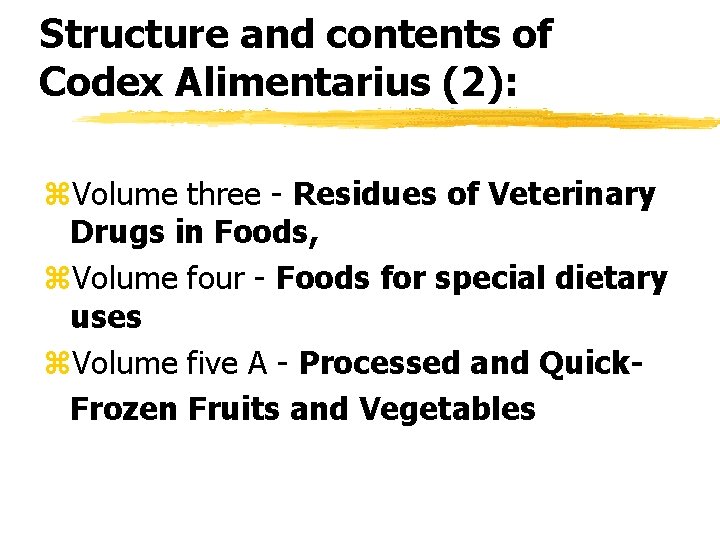
Structure and contents of Codex Alimentarius (2): z. Volume three - Residues of Veterinary Drugs in Foods, z. Volume four - Foods for special dietary uses z. Volume five A - Processed and Quick. Frozen Fruits and Vegetables
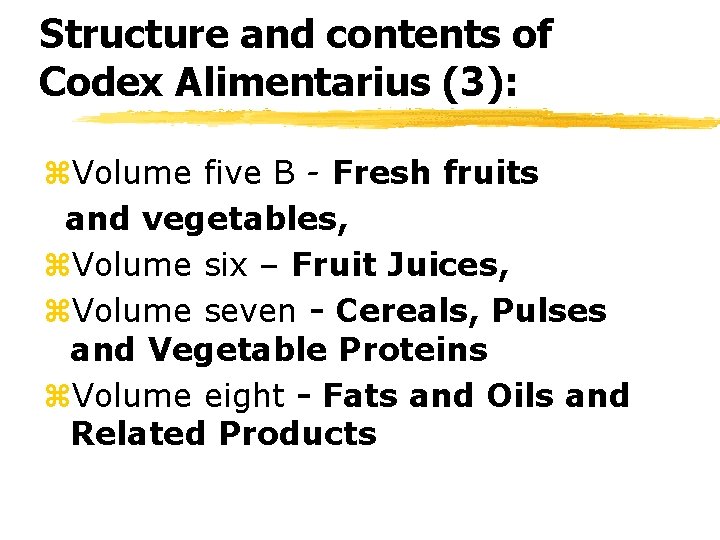
Structure and contents of Codex Alimentarius (3): z. Volume five B - Fresh fruits and vegetables, z. Volume six – Fruit Juices, z. Volume seven - Cereals, Pulses and Vegetable Proteins z. Volume eight - Fats and Oils and Related Products
Structure and contents of Codex Alimentarius (4): z. Volume nine - Fish and Fishery products, z. Volume ten – Meat and Meat Products; Soups and Broths, z. Volume eleven - Sugars, Cocoa Products and Chocolate and Miscellaneous Products,
Structure and contents of Codex Alimentarius (5): z. Volume twelve - Milk and Milk Products z. Volume thirteen - Methods of Analysis and Sampling z. Volume fourteen - Acceptances
Transparency of Codex Alimentarius: Information for all the standards, regulations, guides and other recommendations are available on the web page http: //www. codexalimentarius. net/
National Codex Contact Points function: z. Relation between the Secretariat and the member countries, z. Coordination of all relevant Codex activities in their own country, z. Acceptance of all final Codex – texts (standards, guidelines, advisory texts)
- Slides: 30