
Codes and Standards for ESS Relevance and Importance
- Slides: 15
Codes and Standards for ESS Relevance and Importance David R. Conover Pacific Northwest National Laboratory Support from DOE Office of Electricity Delivery & Energy Reliability Energy Storage Program IEEE PES January 23, 2018
Purpose and Expected Outcome Purpose Reinforce the relevance and continuing importance of ESS safety-related codes and standards (C/S) development and adoption in fostering successful expansion of energy storage technology development and deployment. Expected Outcome An understanding of the value of C/S and the foundation that exists through past and current efforts that will support future efforts. 2
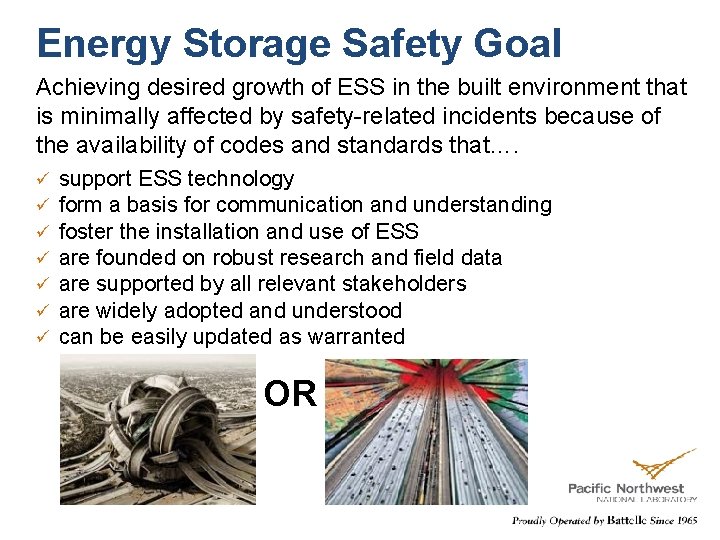
Energy Storage Safety Goal Achieving desired growth of ESS in the built environment that is minimally affected by safety-related incidents because of the availability of codes and standards that…. ü ü ü ü support ESS technology form a basis for communication and understanding foster the installation and use of ESS are founded on robust research and field data are supported by all relevant stakeholders are widely adopted and understood can be easily updated as warranted OR
Challenges Associated with ESS Development and Deployment The ever increasing number of ESS technologies and applications and ability of relevant stakeholders to ‘keep up’ Codes and standards provide a vehicle to uniformly document and validate ESS safety but can be in need of updating and enhancement Research and data to define what is and is not safe are needed to develop appropriate codes and standards All interested and affected parties may not recognize the importance of codes and standards or if they do may be reluctant to participate or collaborate with others When codes and standards are available they may not be adopted and applied in a timely manner Ensuring all stakeholders have the necessary training and resources to document, validate and ensure compliance 4
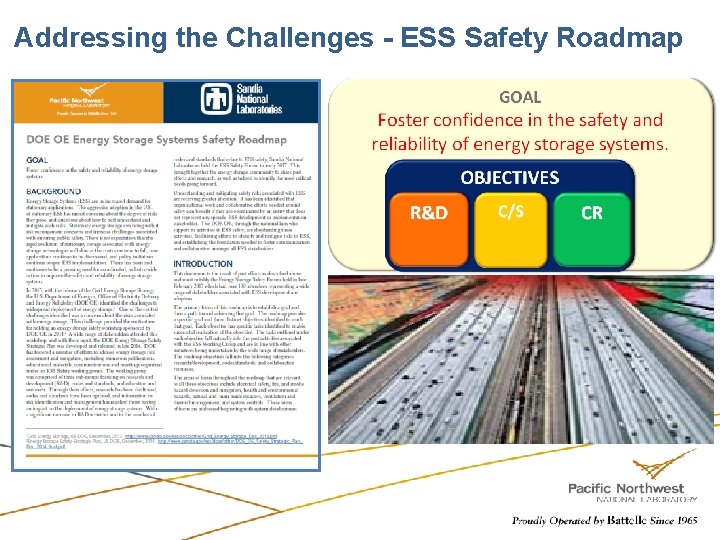
Addressing the Challenges - ESS Safety Roadmap
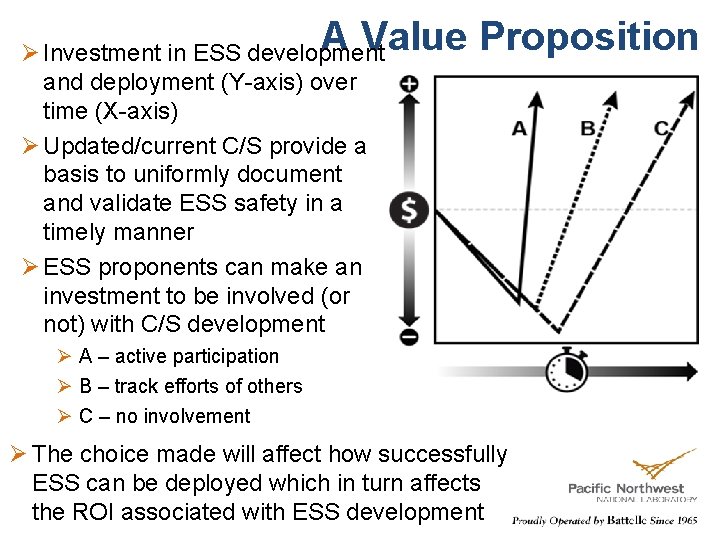
A Value Proposition Ø Investment in ESS development and deployment (Y-axis) over time (X-axis) Ø Updated/current C/S provide a basis to uniformly document and validate ESS safety in a timely manner Ø ESS proponents can make an investment to be involved (or not) with C/S development Ø A – active participation Ø B – track efforts of others Ø C – no involvement Ø The choice made will affect how successfully ESS can be deployed which in turn affects the ROI associated with ESS development
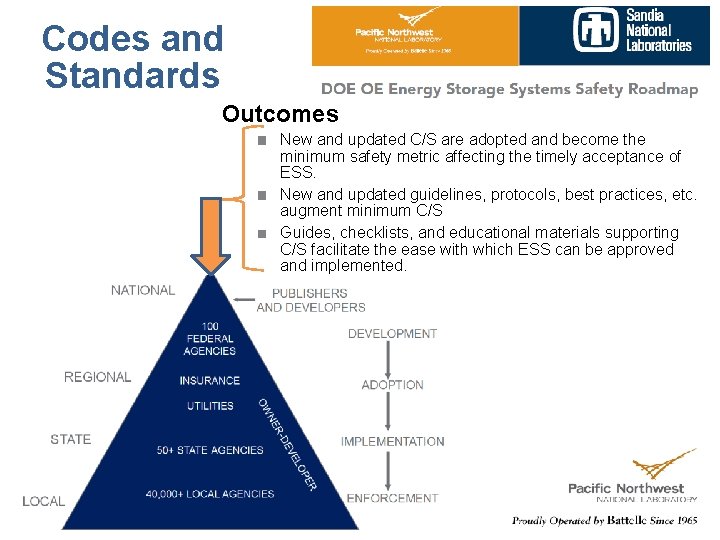
Codes and Standards Outcomes New and updated C/S are adopted and become the minimum safety metric affecting the timely acceptance of ESS. New and updated guidelines, protocols, best practices, etc. augment minimum C/S Guides, checklists, and educational materials supporting C/S facilitate the ease with which ESS can be approved and implemented.
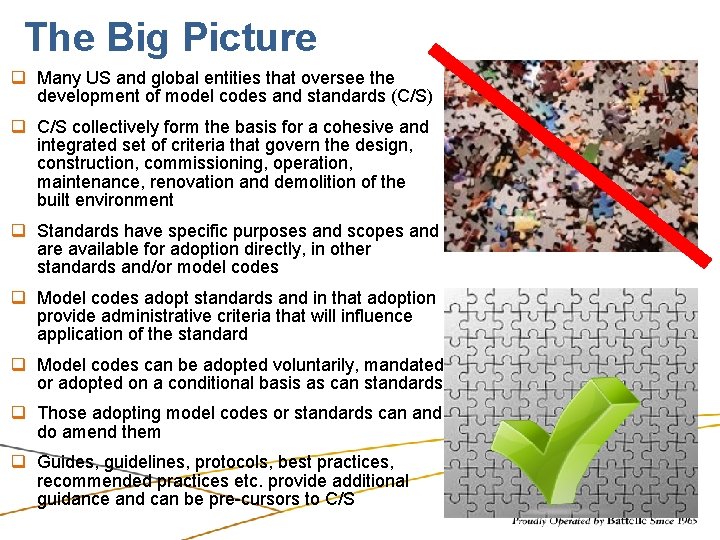
The Big Picture q Many US and global entities that oversee the development of model codes and standards (C/S) q C/S collectively form the basis for a cohesive and integrated set of criteria that govern the design, construction, commissioning, operation, maintenance, renovation and demolition of the built environment q Standards have specific purposes and scopes and are available for adoption directly, in other standards and/or model codes q Model codes adopt standards and in that adoption provide administrative criteria that will influence application of the standard q Model codes can be adopted voluntarily, mandated or adopted on a conditional basis as can standards q Those adopting model codes or standards can and do amend them q Guides, guidelines, protocols, best practices, recommended practices etc. provide additional guidance and can be pre-cursors to C/S
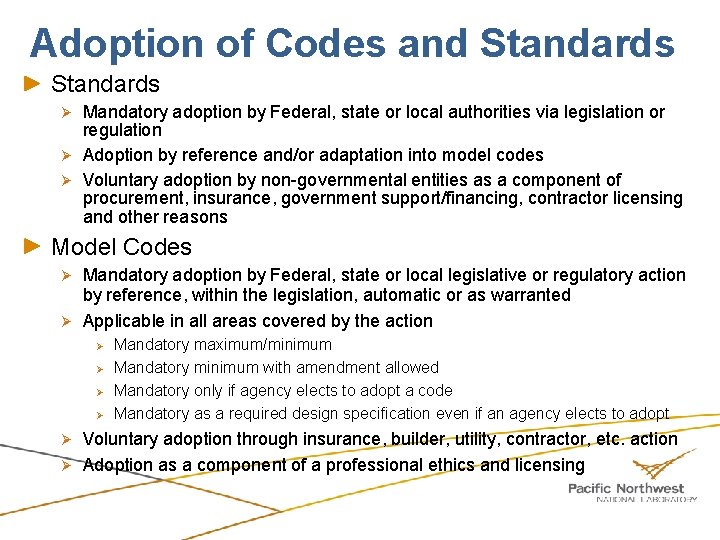
Adoption of Codes and Standards Mandatory adoption by Federal, state or local authorities via legislation or regulation Ø Adoption by reference and/or adaptation into model codes Ø Voluntary adoption by non-governmental entities as a component of procurement, insurance, government support/financing, contractor licensing and other reasons Ø Model Codes Mandatory adoption by Federal, state or local legislative or regulatory action by reference, within the legislation, automatic or as warranted Ø Applicable in all areas covered by the action Ø Ø Ø Mandatory maximum/minimum Mandatory minimum with amendment allowed Mandatory only if agency elects to adopt a code Mandatory as a required design specification even if an agency elects to adopt Voluntary adoption through insurance, builder, utility, contractor, etc. action Ø Adoption as a component of a professional ethics and licensing Ø
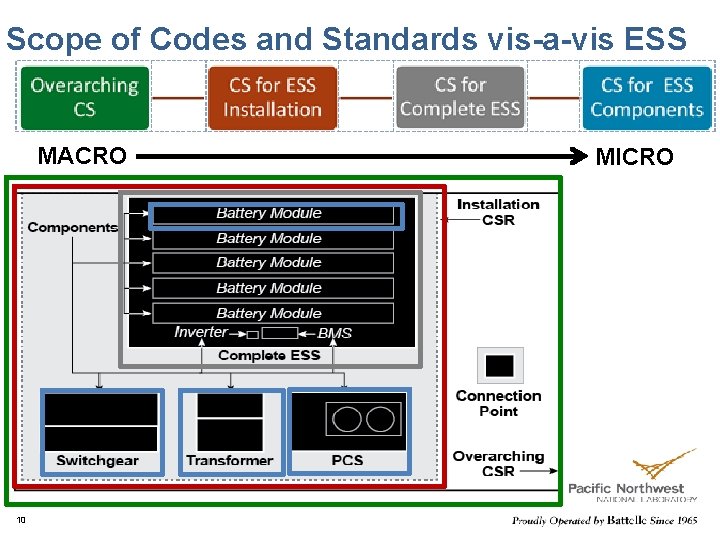
Scope of Codes and Standards vis-a-vis ESS MACRO 10 MICRO
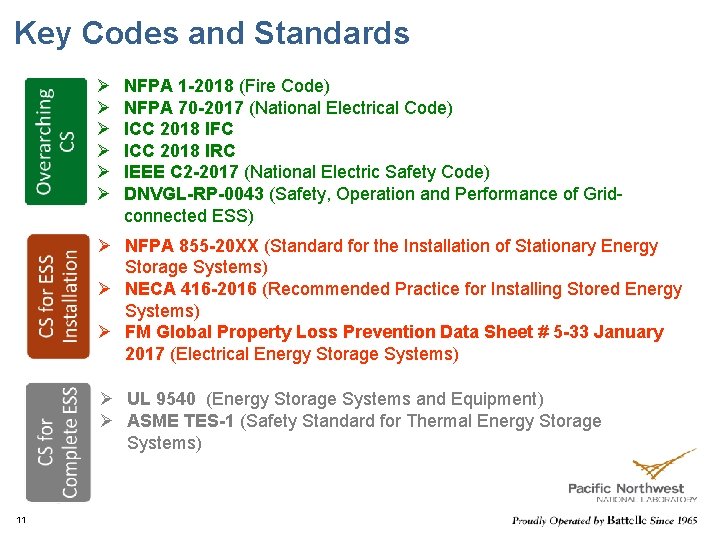
Key Codes and Standards Ø Ø Ø NFPA 1 -2018 (Fire Code) NFPA 70 -2017 (National Electrical Code) ICC 2018 IFC ICC 2018 IRC IEEE C 2 -2017 (National Electric Safety Code) DNVGL-RP-0043 (Safety, Operation and Performance of Gridconnected ESS) Ø NFPA 855 -20 XX (Standard for the Installation of Stationary Energy Storage Systems) Ø NECA 416 -2016 (Recommended Practice for Installing Stored Energy Systems) Ø FM Global Property Loss Prevention Data Sheet # 5 -33 January 2017 (Electrical Energy Storage Systems) Ø UL 9540 (Energy Storage Systems and Equipment) Ø ASME TES-1 (Safety Standard for Thermal Energy Storage Systems) 11
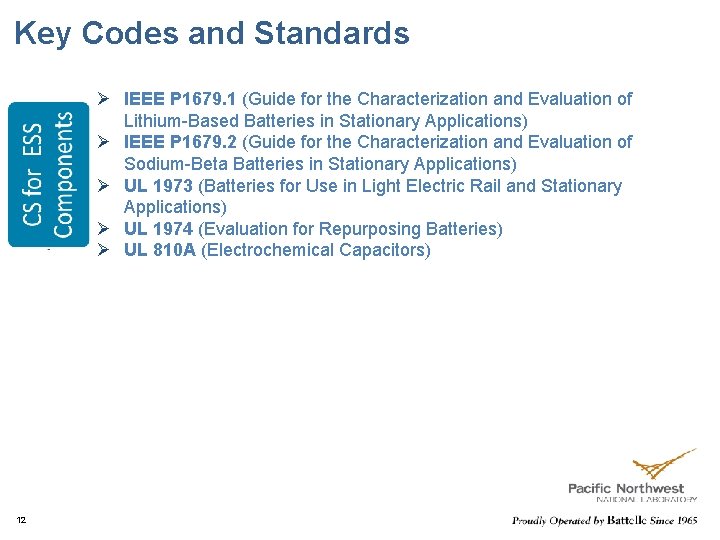
Key Codes and Standards Ø IEEE P 1679. 1 (Guide for the Characterization and Evaluation of Lithium-Based Batteries in Stationary Applications) Ø IEEE P 1679. 2 (Guide for the Characterization and Evaluation of Sodium-Beta Batteries in Stationary Applications) Ø UL 1973 (Batteries for Use in Light Electric Rail and Stationary Applications) Ø UL 1974 (Evaluation for Repurposing Batteries) Ø UL 810 A (Electrochemical Capacitors) 12
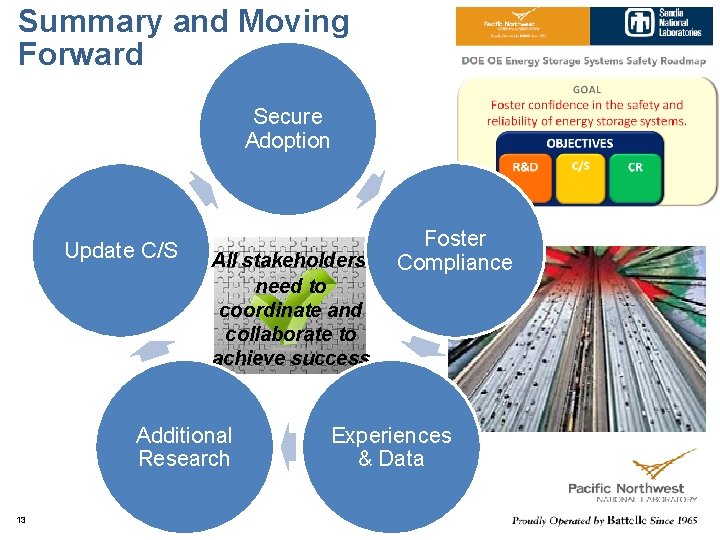
Summary and Moving Forward Secure Adoption Update C/S All stakeholders need to coordinate and collaborate to achieve success Additional Research 13 Foster Compliance Experiences & Data
Acknowledgement Dr. Imre Gyuk DOE-Office of Electricity Delivery and Energy Reliability 14
Q/A and Further Information David Conover PNNL david. conover@pnnl. gov https: //energystorage. pnnl. gov/ http: //www. sandia. gov/energystoragesafety/ 15 PNNL-SA-131213