
CODES AND STANDARDS FOR BUILDING ENVELOPE BARRIERS AND
CODES AND STANDARDS FOR BUILDING ENVELOPE BARRIERS AND FLASHINGS Tom Butt, FAIA, LEED AP/BD+C Interactive Resources 510/236 -7435 Tom. butt@intres. com D+D May 22, 2014 – Tom Butt 1
LEARNING OBJECTIVES • Become familiar with code requirements for water resistive barriers, air barriers, vapor retarders and flexible flashings. • Learn what industry standards apply to water resistive barriers, air barriers, vapor retarders and flexible flashings. • Learn what information is available to assist in the selection of water resistive barriers, air barriers, vapor retarders and flexible flashings. D+D May 22, 2014 – Tom Butt 2
Selection Challenges • Reliable comparable performance data of some generic and proprietary products challenging • Performance objectives unclear to designers and builders • Inconsistent, confusing and incomplete code requirements • Improper reference to and use of standards by manufacturers in product literature • Overlapping requirements D+D May 22, 2014 – Tom Butt 3
TYPES OF BARRIERS • • Water Resistive Barriers (WRB) Air Barriers Vapor Barriers (technically, Vapor Retarders) Flexible Flashings D+D May 22, 2014 – Tom Butt 4
CODES vs. STANDARDS • Building Codes (The Law) – Prescriptive requirements – Referenced standards (ASTM, etc. ) – Alternative materials, design and methods Acceptance Criteria (AC) and ICC-ES Evaluation Reports • Other Industry Standards (ASTM, AAMA, WDMA, CSA, NAFS, etc. ) D+D May 22, 2014 – Tom Butt 5
DEFINITION - WATER-RESISTIVE BARRIER (WRB) • 2012 IBC-IRC: A material behind an exterior wall covering that is intended to resist liquid water that has penetrated behind the exterior covering from further intruding into the exterior wall assembly • ASTM E 2556: a material that is intended to resist liquid water that has penetrated the cladding system. D+D May 22, 2014 – Tom Butt 6
REPRESENTATIVE TERMINOLOGY IN COMMON USE (OR MISUSE) • • • Building paper Tarpaper Felt Asphalt felt House wrap Building wrap Sheathing membrane Underlay for wall Underlayment • Weather resistant/resistive barrier • Water resistant/resistive barrie • Sheathing paper • Weather barrier • Vapor barrier • Water barrier • Moisture barrier D+D May 22, 2014 – Tom Butt 7
REPRESENTATIVE CODE TERMINOLOGY • Water resistive barrier (CBC IBC and IRC) • Wall Sheathing Paper and Sheathing, Membrane, Breather-Type (NBCC) • Underlay for wall (EU) D+D May 22, 2014 – Tom Butt 8
WRBs and DRAINAGE WALLS • Cladding provides substantial water barrier, but some water can be expected to penetrate through the cladding system • Typically includes a concealed water resistive barrier • Provides for dissipating water that circumvents cladding by: – Drainage – evaporation D+D May 22, 2014 – Tom Butt 9
EXAMPLES OF DRAINAGE WALLS • Masonry veneer (anchored) • Stucco/cement plaster (including adhered veneer) • Wood/wood shingles/wood composite siding • Fiber cement siding • Rainscreen systems • Some metal siding applications D+D May 22, 2014 – Tom Butt 10
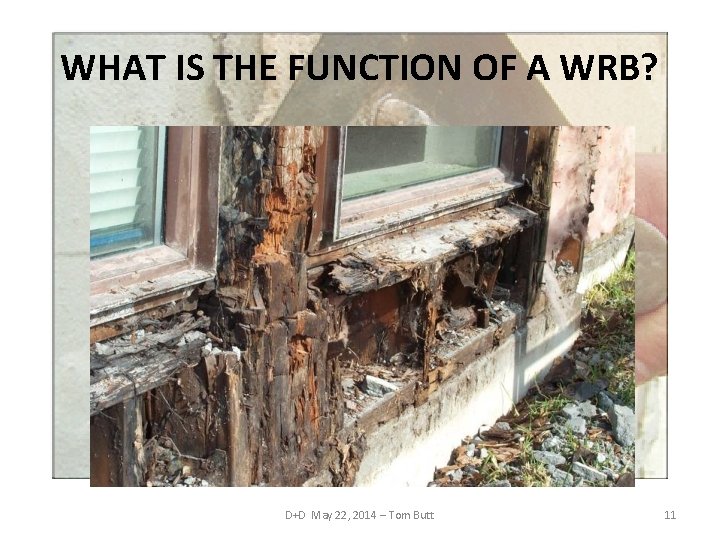
WHAT IS THE FUNCTION OF A WRB? D+D May 22, 2014 – Tom Butt 11
WATER RESISTANCE AND WATER VAPOR PERMEANCE • Liquid water resistance typically measured in units of pressure • US: lbf/in 2 (psi) or in. H 2 O • SI: Pa • Water Vapor Permeance typically measured in perms • US: 1 perm = grain/(ft 2 h)(in Hg) • SI: 1 perm = 5. 72 x 10 -8 g/(s m 2). D+D May 22, 2014 – Tom Butt 12
WATER RESISTANCE TESTS • AATCC Test Method 127 (hydrostatic pressure test) • ASTM D 779 (Currently withdrawn but being re -balloted as a vapor resistance standard) – Water Resistance of Paper, Paperboard and Other Sheet materials by the Dry Indicator Method (boat test) • CCMC Technical Guide for Sheathing, Membrane, Breather-Type, paragraph 6. 4. 5 (water ponding test) D+D May 22, 2014 – Tom Butt 13
ASTM D 779 - BOAT TEST (WATER OR VAPOR? ) • Water reacts with indicator dye on opposite side of sheet • Based on Federal Specification UU-P-31 b (March 3, 1949) incorporated into UU-B-790 a (February 5, 1968) • UBC Standard 14 -1 • ASTM D 779 Test Method for Water Resistance of Paper, paperboard and Other Sheet Materials by the Dry Indicator Method D+D May 22, 2014 – Tom Butt 14
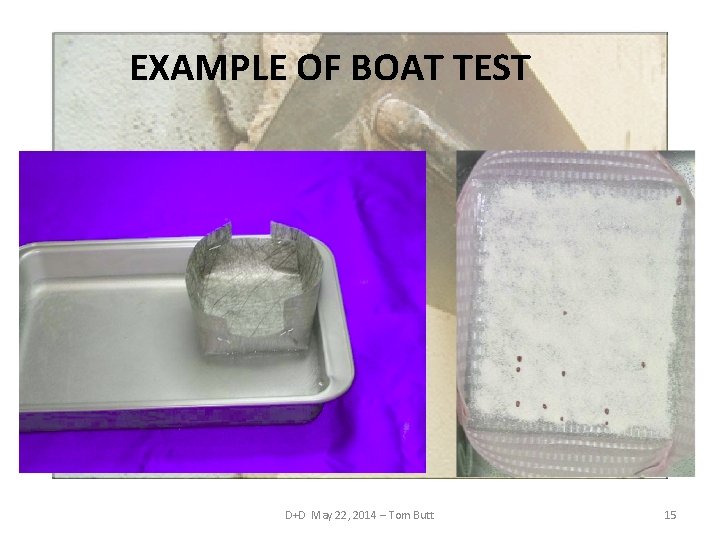
EXAMPLE OF BOAT TEST D+D May 22, 2014 – Tom Butt 15
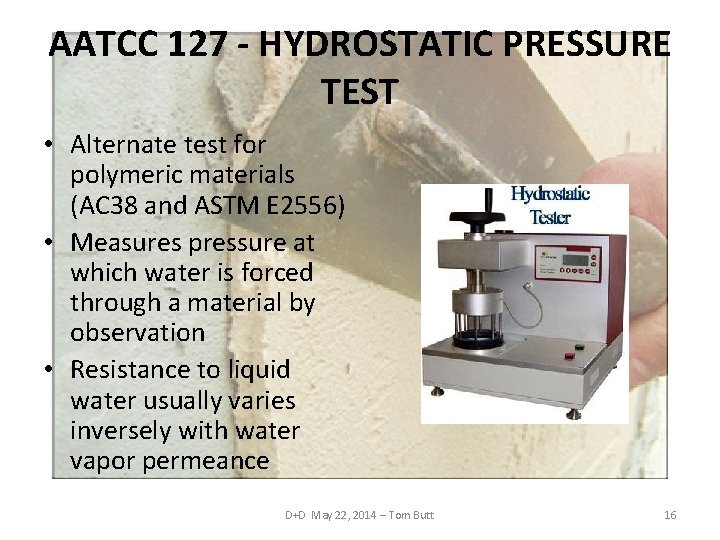
AATCC 127 - HYDROSTATIC PRESSURE TEST • Alternate test for polymeric materials (AC 38 and ASTM E 2556) • Measures pressure at which water is forced through a material by observation • Resistance to liquid water usually varies inversely with water vapor permeance D+D May 22, 2014 – Tom Butt 16
CCMC - WATER PONDING TEST • Pass-fail test • Cylindrical bowl of sample filled with 1 inch of water for two hours. • Pass = no seepage observed below the sample D+D May 22, 2014 – Tom Butt 17
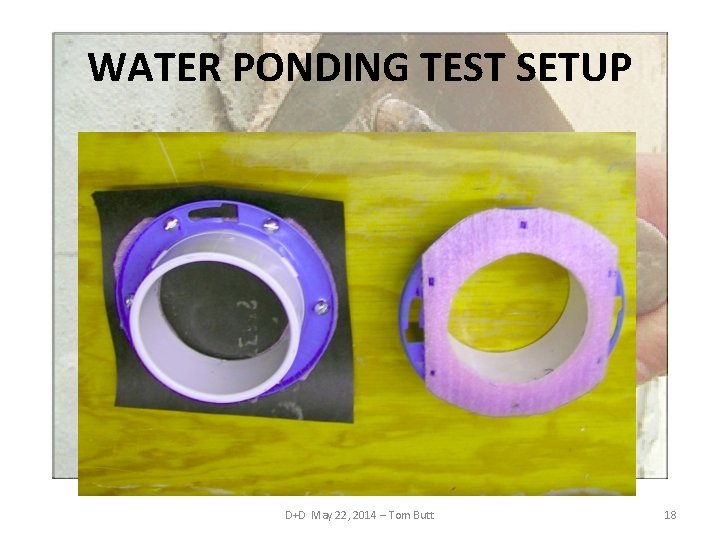
WATER PONDING TEST SETUP D+D May 22, 2014 – Tom Butt 18
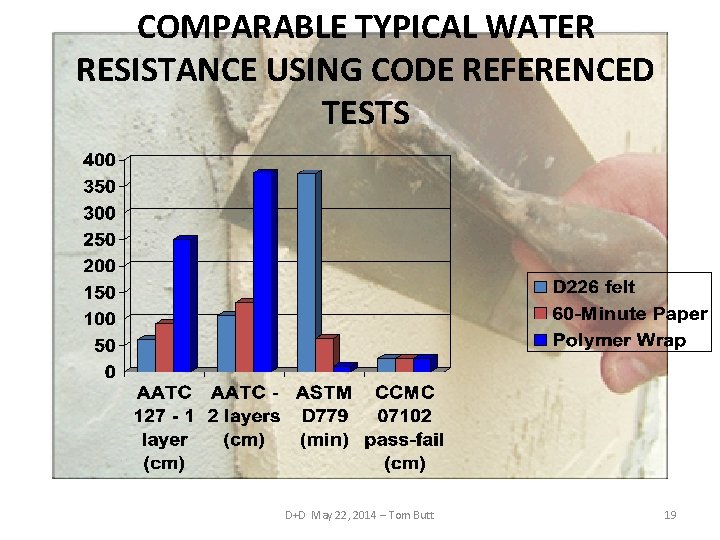
COMPARABLE TYPICAL WATER RESISTANCE USING CODE REFERENCED TESTS D+D May 22, 2014 – Tom Butt 19
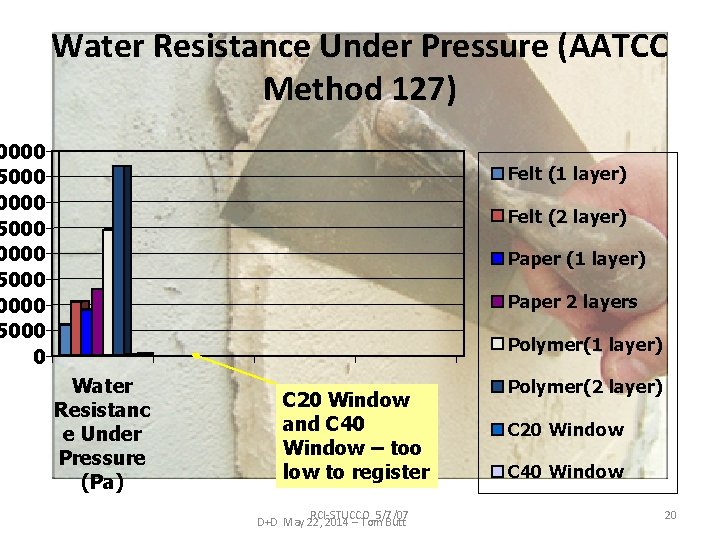
Water Resistance Under Pressure (AATCC Method 127) 0000 5000 0 Felt (1 layer) Felt (2 layer) Paper (1 layer) Paper 2 layers Polymer(1 layer) Water Resistanc e Under Pressure (Pa) C 20 Window and C 40 Window – too low to register RCI-STUCCO_5/7/07 D+D May 22, 2014 – Tom Butt Polymer(2 layer) C 20 Window C 40 Window 20
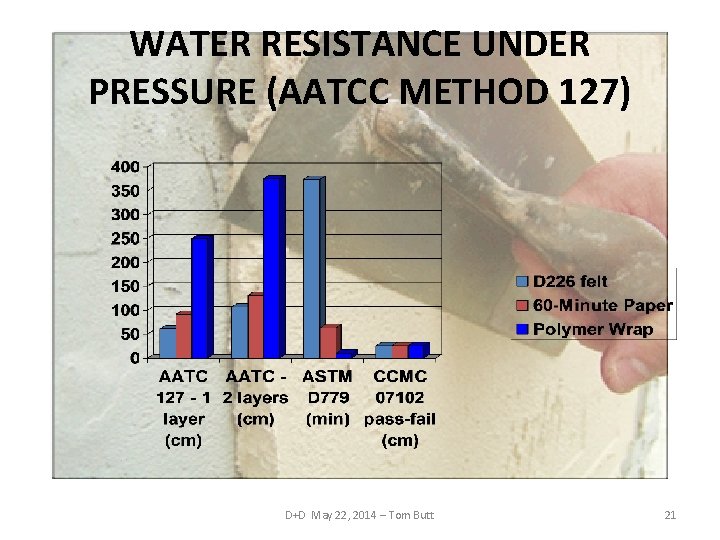
WATER RESISTANCE UNDER PRESSURE (AATCC METHOD 127) D+D May 22, 2014 – Tom Butt 21
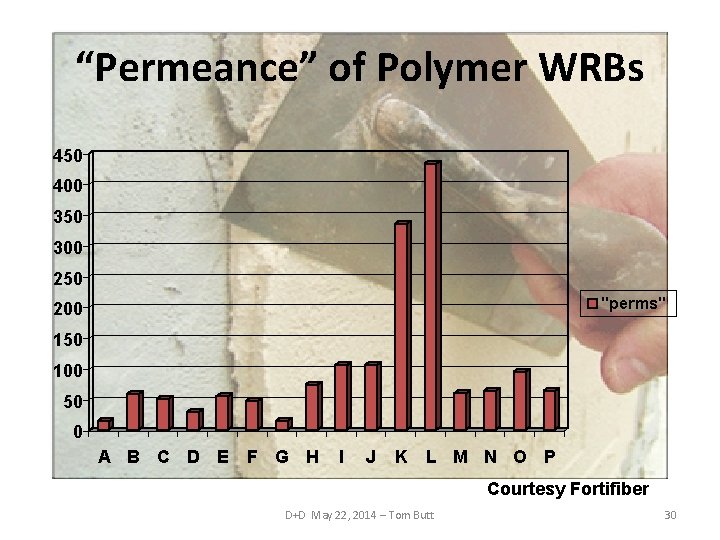
CODE REQUIREMENTS FOR PERMEANCE • IBC: >10 perms • IRC: >5 perms (same as ASTM D 2256) • NBCC: New: perms > 170 ng/(Pa·s m 2) and < 1400 ng/(Pa·s m 2) and Aged: > 2900 ng/(Pa·s m 2) D+D May 22, 2014 – Tom Butt 22
VAPOR PERMEANCE - ASTM E 96 –TEST METHODS FOR WATER VAPOR TRANSMISSION OF MATERIALS • Two basic methods (desiccant and water) and six variations (procedures A, B, BW, C, D and E) • “A permeance value obtained under one set of test conditions may not indicate the value under a different set of conditions. ” (E 96) D+D May 22, 2014 – Tom Butt 23
E 96 VAPOR TRANSMISSION TERMS • Permeance (g/Pa·s·m 2) is the accepted measure of vapor transmission of a building component acting as a vapor retarder. • Both AC 38 uses water vapor transmission (WVT) g/m 2 *24 h and ASTM E 2556 uses perms • NBCC uses permeance • Without additional information, permeance cannot be converted to WVT, or vice-versa D+D May 22, 2014 – Tom Butt 24
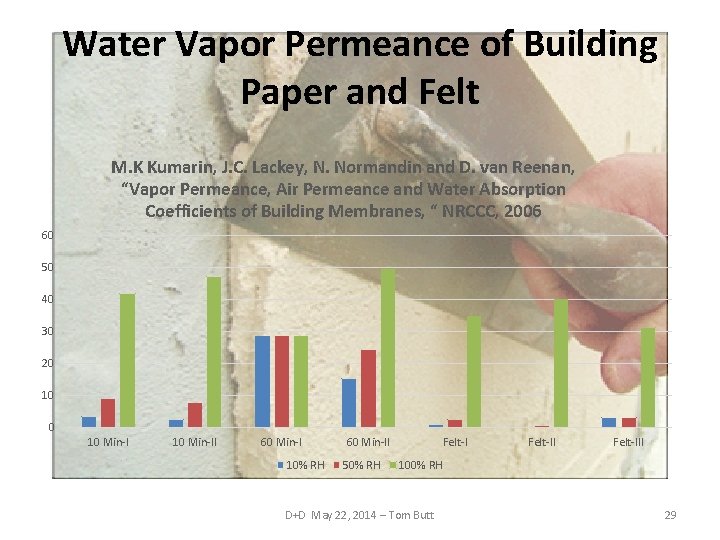
PUBLISHED TYPICAL PERMEANCE VALUES • Asphalt Saturated Felt (Treschel): q 5. 6 perms using E 96 Desiccant Method q 1. 0 perms using E 96 Water Method • “Breather Type Sheathing Paper” (building paper) CHMC Wood Frame Envelopes in Coastal Climate of British Columbia: q 2. 96 to 24. 39 perms D+D May 22, 2014 – Tom Butt 25
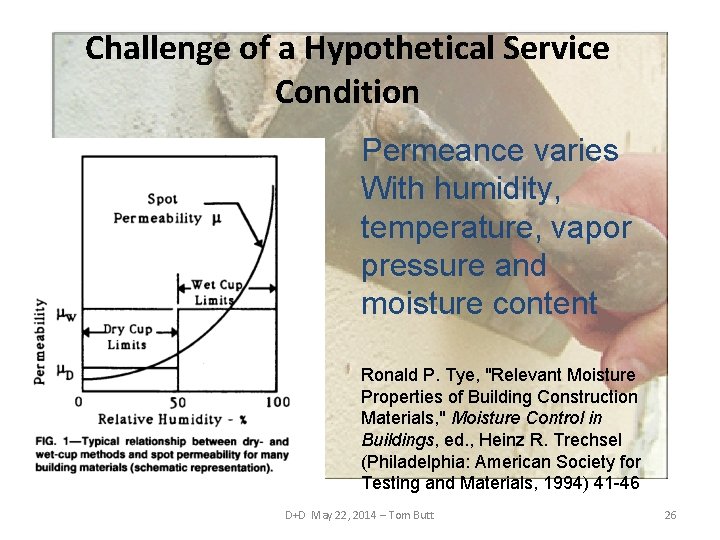
Challenge of a Hypothetical Service Condition Permeance varies With humidity, temperature, vapor pressure and moisture content Ronald P. Tye, "Relevant Moisture Properties of Building Construction Materials, " Moisture Control in Buildings, ed. , Heinz R. Trechsel (Philadelphia: American Society for Testing and Materials, 1994) 41 -46 D+D May 22, 2014 – Tom Butt 26
TYPES OF FLEXIBLE SHEET WRBS • Asphalt saturated organic felt • Asphalt saturated kraft paper • Polymeric Fabrics (polyolefin fibers or extruded polyethylene films) – • Spun-bonded – • Coated spun-bonded – • Perforated cross laminated D+D May 22, 2014 – Tom Butt 27
SHEET WRB STANDARDS • AC 38 - Water-resistive Barriers • ASTM E 2556 - Standard Specification for Vapor Permeable Flexible Sheet Water-Resistive Barriers Intended for Mechanical Attachment (ICC Chapter 25 in 2015 edition) D+D May 22, 2014 – Tom Butt 28
Water Vapor Permeance of Building Paper and Felt M. K Kumarin, J. C. Lackey, N. Normandin and D. van Reenan, “Vapor Permeance, Air Permeance and Water Absorption Coefficients of Building Membranes, “ NRCCC, 2006 60 50 40 30 20 10 Min-II 60 Min-I 10% RH 60 Min-II 50% RH Felt-III 100% RH D+D May 22, 2014 – Tom Butt 29
“Permeance” of Polymer WRBs 450 400 350 300 250 "perms" 200 150 100 50 0 A B C D E F G H I J K L M N O P Courtesy Fortifiber D+D May 22, 2014 – Tom Butt 30
Asphalt Saturated Kraft Paper 200 X D+D May 22, 2014 – Tom Butt 31
Asphalt Saturated Felt D+D May 22, 2014 – Tom Butt 32
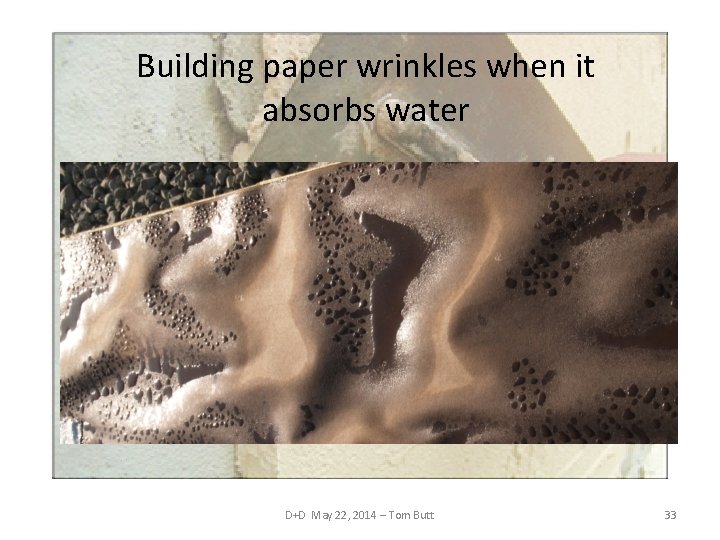
Building paper wrinkles when it absorbs water D+D May 22, 2014 – Tom Butt 33
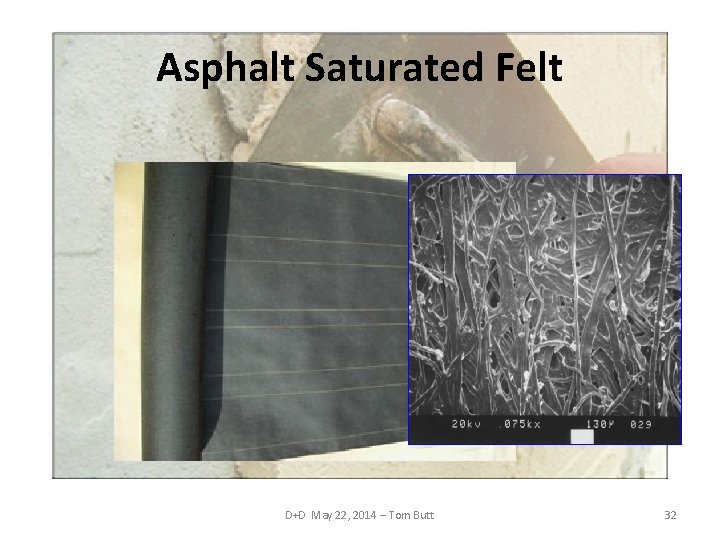
Potential Advantages of Asphalt Saturated Felt • Long history of successful use under normal exposure conditions • Conforms prescriptively to most codes • Low material cost • Long-term durability may be superior to paper-based WRBs (more asphalt) • Best “boat test” performance • Comparatively high permeance may promote drying in wall cavity RCI-STUCCO_5/7/07 34
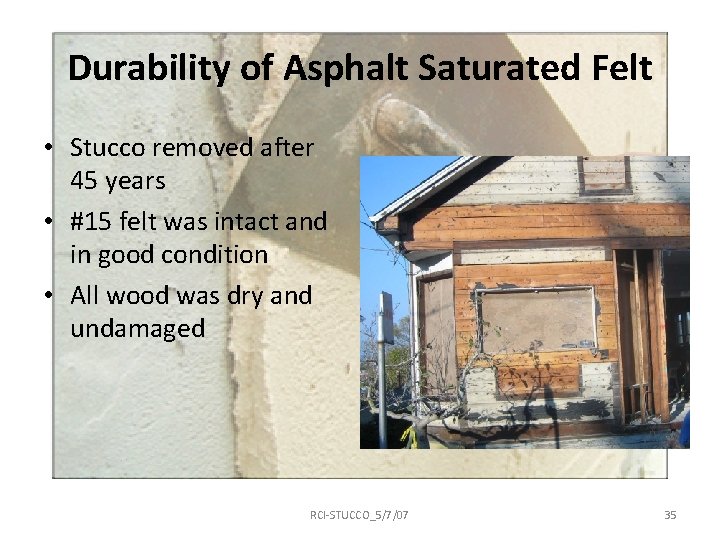
Durability of Asphalt Saturated Felt • Stucco removed after 45 years • #15 felt was intact and in good condition • All wood was dry and undamaged RCI-STUCCO_5/7/07 35
Potential Disadvantages of Asphalt Saturated Felt • Minimal performance data available for use as WRB • Comparatively high permeance may result in moisture transport into wall cavity • Low resistance to breaking and tearing • Vulnerable to deterioration after long-term exposure to water, especially when combined with UV • Surfactant exposure may degrade water resistance RCI-STUCCO_5/7/07 36
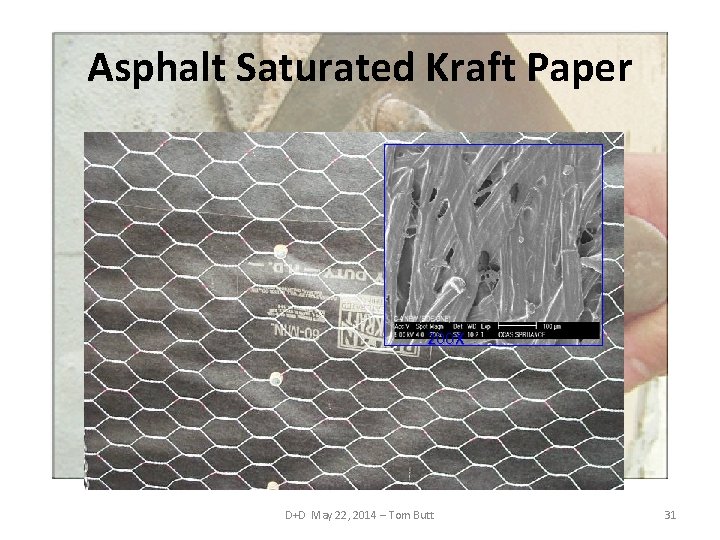
Potential Advantages of Asphalt Saturated Kraft Paper • Long history of successful use under normal exposure conditions • Prescriptively conforms to most codes • Low material cost • More performance data available than for felt • Better resistance to bending damage than felt, but tears easily • Comparatively lower permeance may result in less moisture transport into wall cavity RCI-STUCCO_5/7/07 37
Potential Disadvantages of Asphalt Saturated Kraft Paper • Low resistance to tearing • Decomposes after long-term exposure to water, especially when combined with UV • Surfactant exposure may degrade water resistance • Less asphalt compared to felt-based WRBs • Comparatively lower permeance may retard drying in wall cavity RCI-STUCCO_5/7/07 38
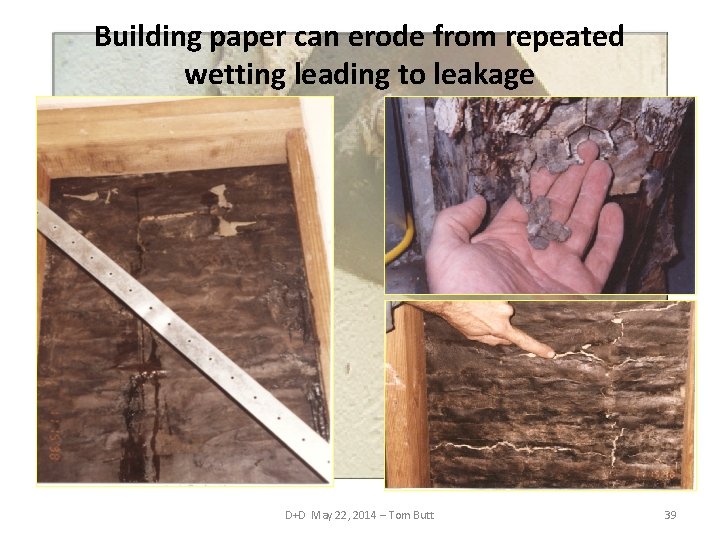
Building paper can erode from repeated wetting leading to leakage D+D May 22, 2014 – Tom Butt 39
Potential Advantages of Polymeric Sheets • High resistance to tearing and breaking • Large sheets with fewer lap joints • Remains durable after long-term water exposure • Air barrier functionality • High water vapor permeance allows drying by evaporation of wall cavity • High resistance to water under pressure D+D May 22, 2014 – Tom Butt 40
Potential Disadvantages of Polymeric Sheets Relatively expensive material cost UV sensitivity Sensitivity to surfactants Adhesion to cement plaster (stucco) may affect water resistance • Comparatively high permeance may result in moisture transport into wall cavity • May retain liquid water in wall cavities • • D+D May 22, 2014 – Tom Butt 41
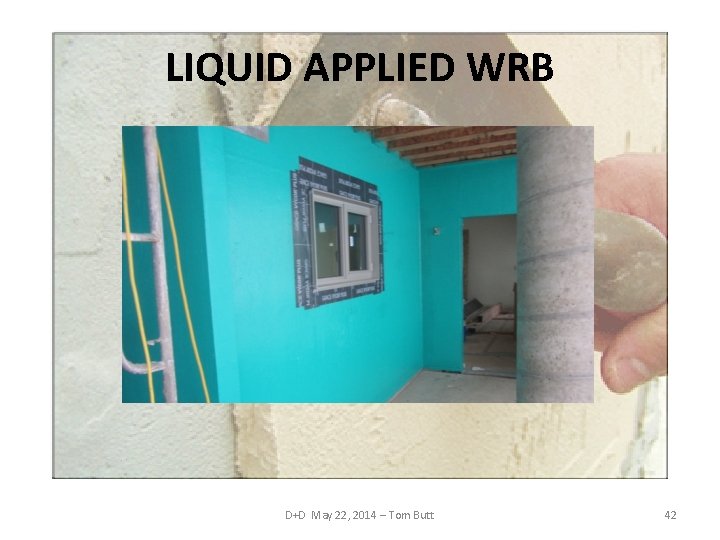
LIQUID APPLIED WRB D+D May 22, 2014 – Tom Butt 42
LIQUID APPLIED WRB STANDARDS • AC 209 - Trowel-, Spray- or Roller-applied Water-resistive Coatings Used as Weatherresistive Barriers over Exterior Cementitious Wall Coverings • ASTM E 2570 – Standard Test Methods for Evaluating Water Resistive Barrier (WRB) Coatings Used under Exterior Insulation and Finish Systems (Now in ICC, replaces AC 212) D+D May 22, 2014 – Tom Butt 43
LIQUID APPLIED WRBs • AC 209 - Trowel-, Spray- or Roller-applied Waterresistive Coatings Used as Weather-resistive Barriers over Exterior Cementitious Wall Coverings and AC 212 - Water-resistive Coatings Used as Water-resistive Barriers over Exterior Sheathing • Refers to AC 38 for Water vapor Permeance • Refers to AC 38 and ASTM E 331 – AC 209: 6. 24 PSF for 75 minutes – AC 212: 2. 86 PSF for 15 minutes D+D May 22, 2014 – Tom Butt 44
RIGID BOARD WRB STANDARD • AC 71 - Foam Plastic Sheathing Panels Used as Weather-resistive Barriers – Water Resistance: AATCC Test Method 127, 55 cm for 5 hours and ASTM E 331 at 6. 24 PSF for 2 hours • AC 382 - Laminated Fibrous Board Sheathing Material Used as a Water-resistive Barrier – Water Resistance: ASTM E 331 2. 86 PSF for 15 minutes and Hydrostatic Pressure Test, 550 mm for 5 hours D+D May 22, 2014 – Tom Butt 45
Board Products • Board products (i. e. , foam core board) D+D May 22, 2014 – Tom Butt 46
DEFINITION – AIR BARRIER • International Energy Conservation Code (IECC): Material(s) assembled and joined together to provide a barrier to air leakage through the building envelope. And air barrier may be a single material or a combination of materials. • Typical Standard: 0. 004 cfm/ft 2, under a pressure differential of 0. 3 in. w. g. (1. 57 psf) (0. 02 L/m 2 at 75 Pa), when tested in accordance with ASTM E 2178. D+D May 22, 2014 – Tom Butt 47
AIR BARRIER STANDARDS • ASTM E 283 -04(2012) Standard Test Method for Determining Rate of Air Leakage Through Exterior Windows, Curtain Walls, and Doors Under Specified Pressure Differences Across the Specimen • ASTM E 2178 -13 Standard Test Method for Air Permeance of Building Materials • ASTM E 2357 -11 Standard Test Method for Determining Air Leakage of Air Barrier Assemblies • ASTM E 1677 -11 Standard Specification for Air Barrier (AB) Material or System for Low-Rise Framed Building Walls • ASTM E 1680 -11 Standard Test Method for Rate of Air Leakage Through Exterior Metal Roof Panel Systems • WK 16958 - New Specification for Fluid-Applied Air Barrier Materials D+D May 22, 2014 – Tom Butt 48
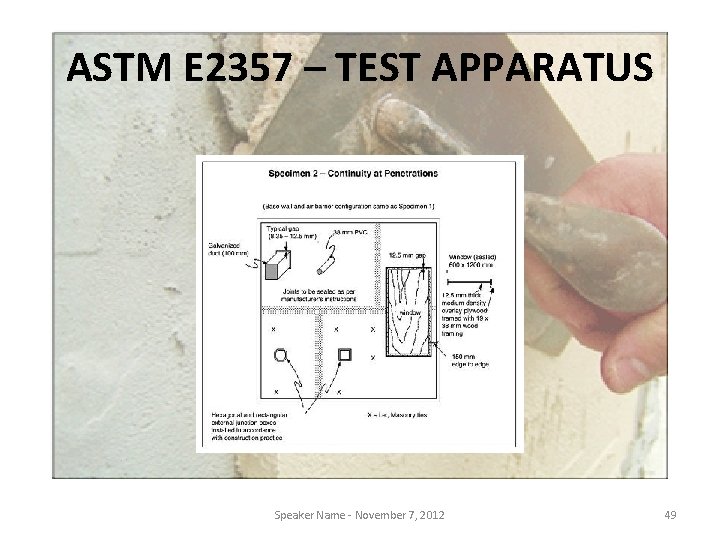
ASTM E 2357 – TEST APPARATUS Speaker Name - November 7, 2012 49
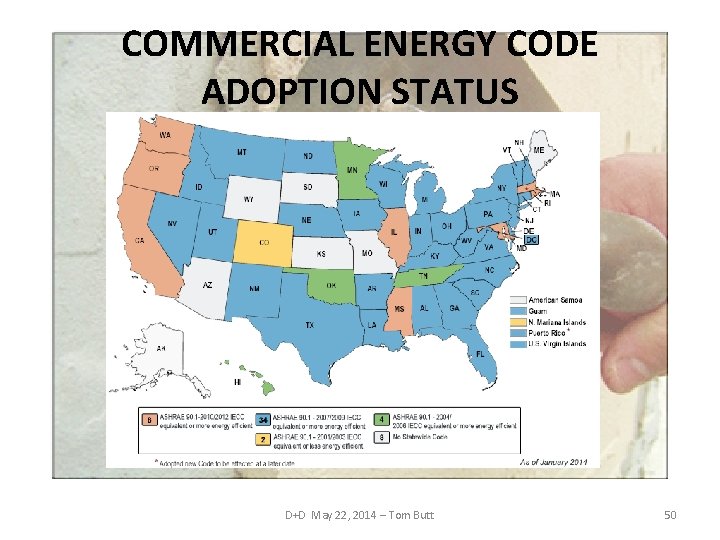
COMMERCIAL ENERGY CODE ADOPTION STATUS D+D May 22, 2014 – Tom Butt 50
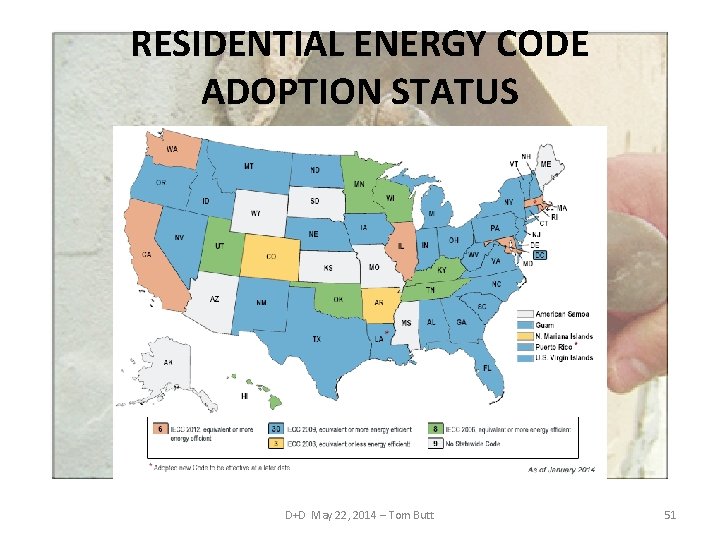
RESIDENTIAL ENERGY CODE ADOPTION STATUS D+D May 22, 2014 – Tom Butt 51
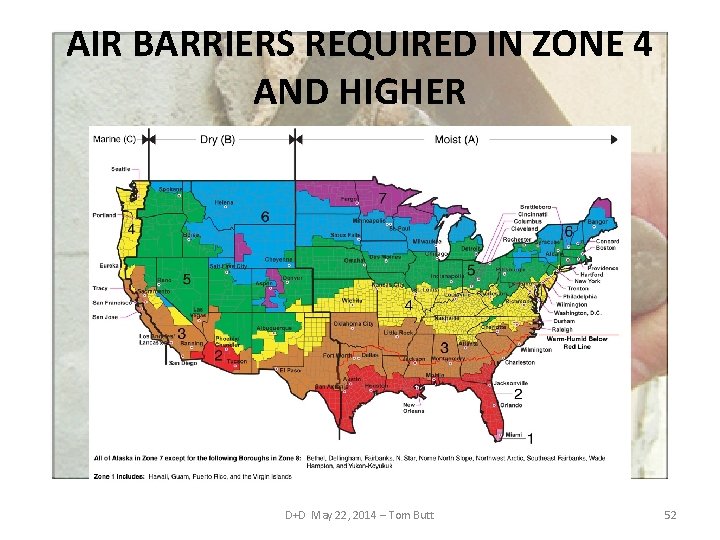
AIR BARRIERS REQUIRED IN ZONE 4 AND HIGHER D+D May 22, 2014 – Tom Butt 52
CALIFORNIA CODE EXCEPTIONS for AIR BARRIERS • • • • Plywood – min 3/8 inch thickness. Oriented strand board – min. 3/8 inch thickness. Extruded polystyrene insulation board – min. ½ inch thickness. Foil-back polyisocyanurate insulation board – min. ½ inch thickness. Closed cell spray foam with a minimum density of 2. 0 pcf and a min. 2. 0 inch thickness. Open sell spray foam with a density of no less than 0. 4 pcf and no greater than 1. 5 pcf, and a min. 5 ½ inch thickness. Exterior or interior gypsum board min. ½ inch thickness. Cement board – min. ½ inch thickness. Built up roofing membrane. Modified bitumen roofing membrane. Fully adhered single ply roofing membrane. A Portland cement or Portland sand parge, or a gypsum Fully grouted concrete block masonry Sheet steel or sheet aluminum. D+D May 22, 2014 – Tom Butt 53
DEFINITION - VAPOR RETARDER • IRC: A measure of the ability of a material or assembly to limit the amount of moisture that can pass through the material or assembly. Vapor retarder class shall be defined using the dessicant method with Procedure A of ASTM E 96 D+D May 22, 2014 – Tom Butt 54
VAPOR RETARDER CLASSES • Class I: 0. 1 perm or less (sheet polyethylene, non-peforated aluminum foil) • Class II: 0. 1 < perm < 1. 0 perm (kraft-faced fiberglass batts) • Class III: 1. 0 < perm < 10 perm (latex or enamel paint) D+D May 22, 2014 – Tom Butt 55
IBC VAPOR RETARDER REQUIREMENTS • Class I or II on interior side in Zones 5, 6, 7 8 and Marine 4 • Class II allowed in various conditions depending on ventilation and insulation type. D+D May 22, 2014 – Tom Butt 56
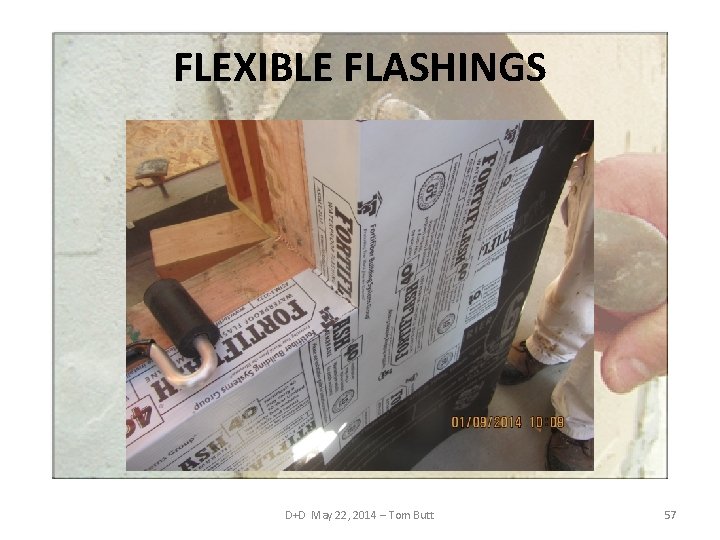
FLEXIBLE FLASHINGS D+D May 22, 2014 – Tom Butt 57
FLASHING • Typically not defined in codes • AC 148 Definition - Flashing: Sheet material, integrated with the water-resistive barrier that bridges and protects the joint (gap) between the window or door frame members and the adjacent construction for the purpose of preventing water penetration by draining water away from the window or door D+D May 22, 2014 – Tom Butt 58
FLASHING – ASTM DEFINITIONS • Flashing (ASTM E 2266) - a component or system typically composed of sheet material that is employed at interfaces between building components for the purpose of diverting water directly to the exterior or onto the weather-resistive barrier. • Flashing (ASTM E 2112) - sheet material that bridges and protects the joint (gap) between the window or door frame members and the adjacent construction for the purpose of preventing water penetration by draining water away from the window or door to the exterior. For further discussion, see Appendix D+D May 22, 2014 – Tom Butt 59
TYPES OF FLASHINGS – AC 148 DEFINITIONS • Self-Adhering Flashing - Flashing consisting of flexible facing materials coated completely or partially on at least one side with an adhesive material and which do not depend on mechanical fasteners for permanent attachment. • Mechanically Fastened Flashings – Flexible facing materials which depend on mechanical fasteners for permanent attachment D+D May 22, 2014 – Tom Butt 60
Definition - Self Adhering Flashings (AAMA 711) • Self Adhering Flashings - Flexible facing materials coated completely or partially on at least one side with an adhesive material and which do not depend on mechanical fasteners for permanent attachment. They are used to bridge the joint (gap) between fenestration framing members and the adjacent weather resistive barriers or sealed drainage plane material. The purpose of flashing is to drain water away from the fenestration product to the exterior. Self Adhering Flashings typically are currently sold in widths such as 4”, 6”, 9” etc. and come in a rolled form and have a release liner that is removed prior to application. D+D May 22, 2014 – Tom Butt 61
AAMA 711 FLEXIBLE FLASHING TYPES • Type A Products: Products that pass this specification without the use of a primer. – Level 1: For exposures up to 50 o C (122 o. F) – Level 1: For exposures up to 65 o C (149 o. F) – Level 1: For exposures up to 80 o C (176 o. F) D+D May 22, 2014 – Tom Butt 62
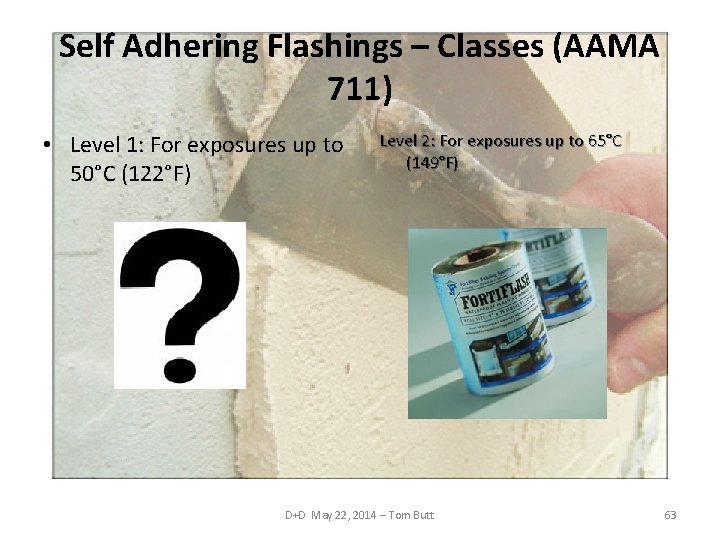
Self Adhering Flashings – Classes (AAMA 711) • Level 1: For exposures up to 50°C (122°F) Level 2: For exposures up to 65°C (149°F) D+D May 22, 2014 – Tom Butt 63
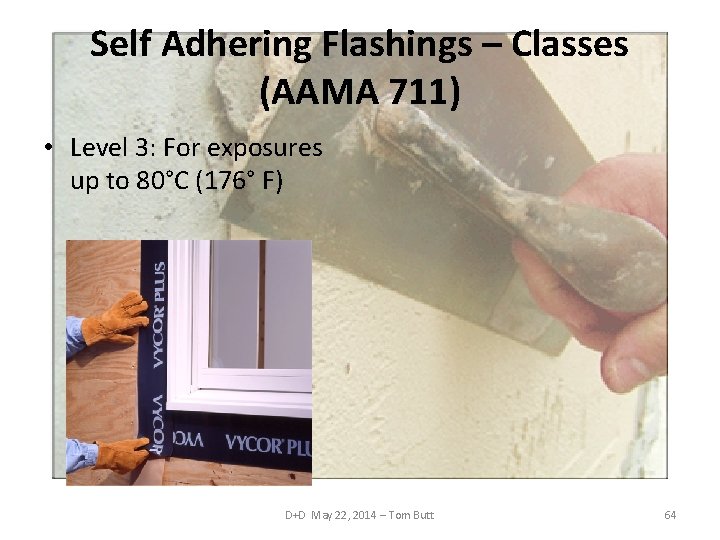
Self Adhering Flashings – Classes (AAMA 711) • Level 3: For exposures up to 80°C (176° F) D+D May 22, 2014 – Tom Butt 64
FLEXIBLE FLASHING STANDARDS • AC 148 Flexible Flashing Materials • AAMA 711 - Voluntary Specification for Self Adhering Flashing Used for Installation of Exterior Wall Fenestration Products • ASTM D 1970 - Standard Specification for Self. Adhering Polymer Modified Bituminous Sheet Materials Used as Steep Roofing Underlayment for Ice Dam Protection D+D May 22, 2014 – Tom Butt 65
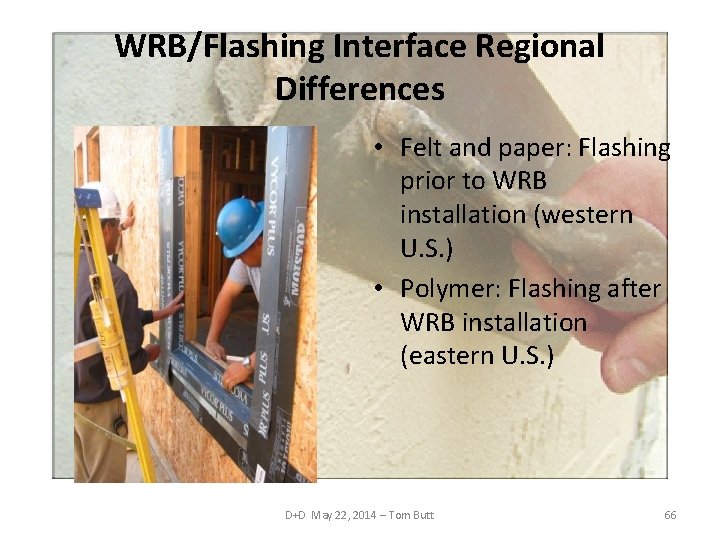
WRB/Flashing Interface Regional Differences • Felt and paper: Flashing prior to WRB installation (western U. S. ) • Polymer: Flashing after WRB installation (eastern U. S. ) D+D May 22, 2014 – Tom Butt 66
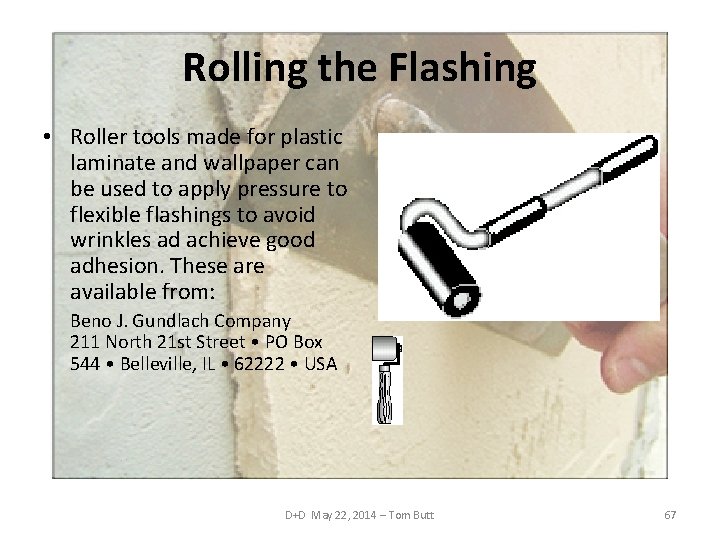
Rolling the Flashing • Roller tools made for plastic laminate and wallpaper can be used to apply pressure to flexible flashings to avoid wrinkles ad achieve good adhesion. These are available from: Beno J. Gundlach Company 211 North 21 st Street • PO Box 544 • Belleville, IL • 62222 • USA D+D May 22, 2014 – Tom Butt 67
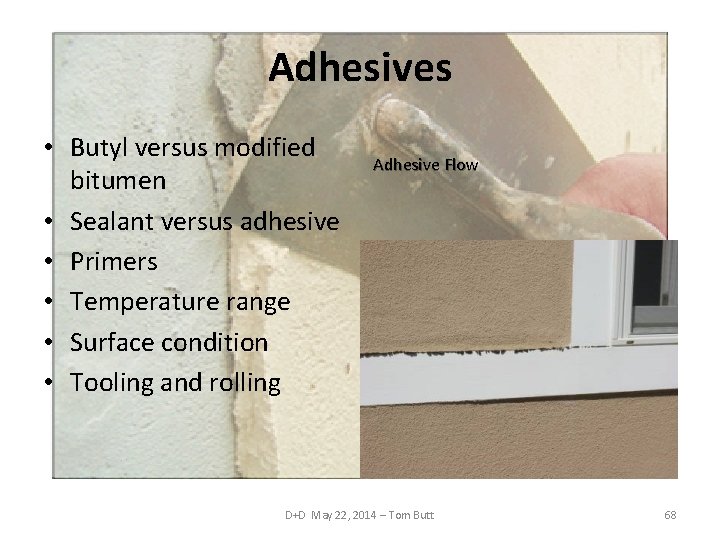
Adhesives • Butyl versus modified bitumen • Sealant versus adhesive • Primers • Temperature range • Surface condition • Tooling and rolling Adhesive Flow D+D May 22, 2014 – Tom Butt 68
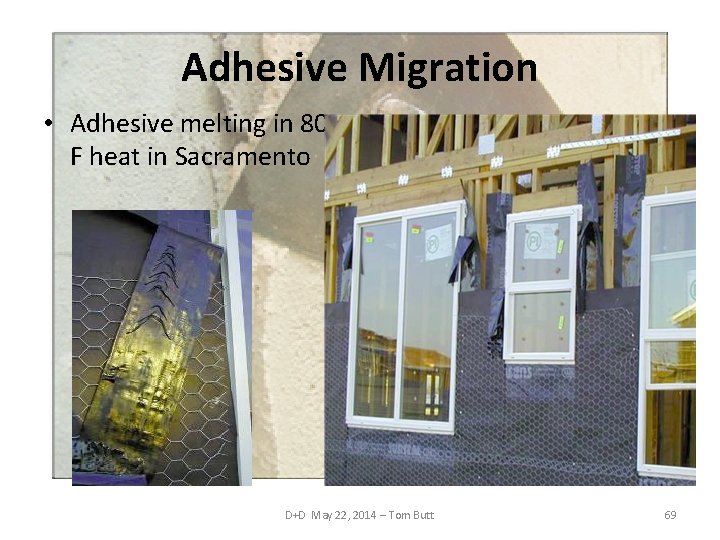
Adhesive Migration • Adhesive melting in 80 o F heat in Sacramento D+D May 22, 2014 – Tom Butt 69
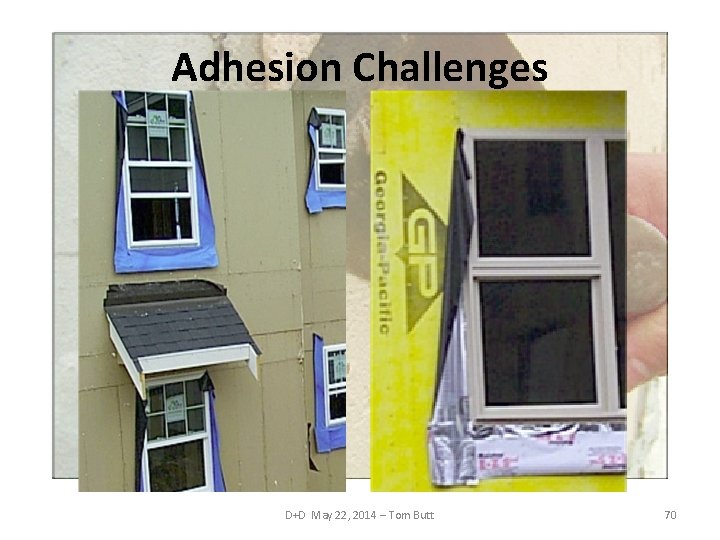
Adhesion Challenges D+D May 22, 2014 – Tom Butt 70
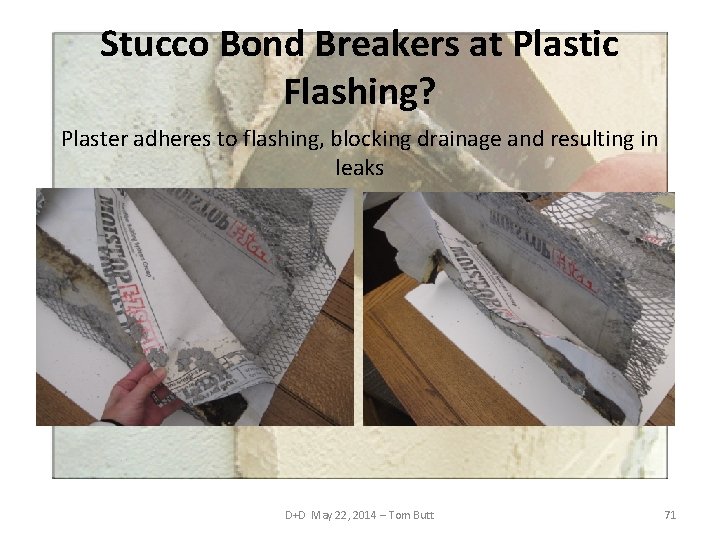
Stucco Bond Breakers at Plastic Flashing? Plaster adheres to flashing, blocking drainage and resulting in leaks D+D May 22, 2014 – Tom Butt 71
CONCLUSIONS • Complexity of complying with codes and standards and finding the optimum solution for building envelope thermal insulation, air resistance, water resistance and vapor permeance is beyond the capability of most building professionals. • I hope this helps D+D May 22, 2014 – Tom Butt 72
Questions? Tom Butt, FAIA Interactive Resources 510/236 -7435 Tom. butt@intres. com D+D May 22, 2014 73 – Tom Butt
- Slides: 73