
CODES AND CONVENTIONS APOCALYPSE BASED MOVIES THE FILMS
CODES AND CONVENTIONS APOCALYPSE BASED MOVIES
THE FILMS I'M COMPARING MAD MAX: FURY ROAD (2015) THREADS (1984) Fury Road is the 4 th instalment of the famous Mad Max series produced by George Miller, the universe of this film is based after a less traditional apocalypse in which society has collapsed from reasons other than a disaster of some kind. These films tend to be more high budget, high action films with a strong use of physical effects. Threads is a BAFTA award winning TV Drama set in Sheffield, in England. This film was produced by the BBC on a relatively low budget of £ 300, 000. This film is focused on a more gritty and realistic version of the apocalypse, and aims to show the viewers what would’ve happen if the Cold War went Nuclear. The film is less about the apocalypse itself and more about the build-up and the general public's reactions.
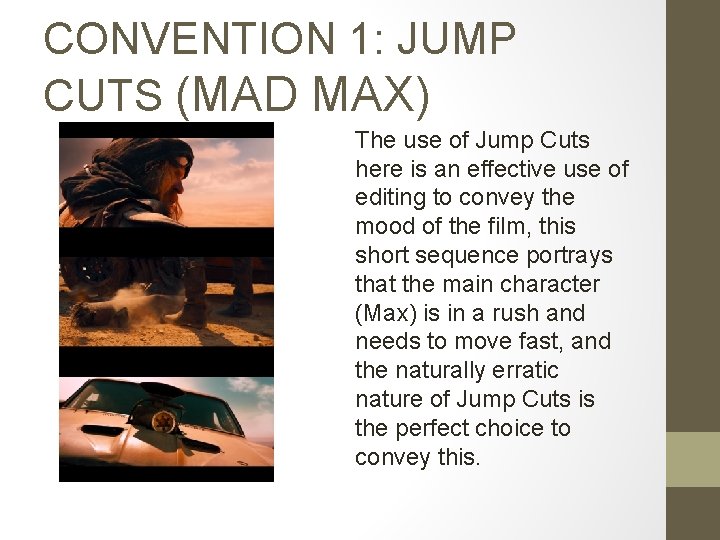
CONVENTION 1: JUMP CUTS (MAD MAX) The use of Jump Cuts here is an effective use of editing to convey the mood of the film, this short sequence portrays that the main character (Max) is in a rush and needs to move fast, and the naturally erratic nature of Jump Cuts is the perfect choice to convey this.
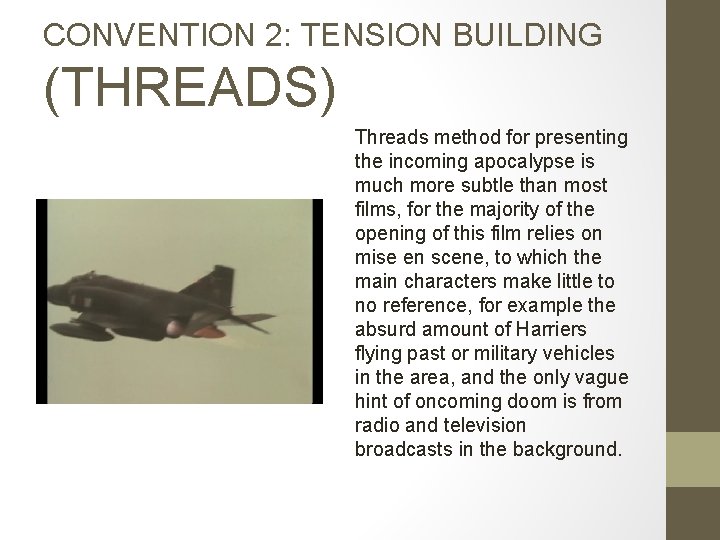
CONVENTION 2: TENSION BUILDING (THREADS) Threads method for presenting the incoming apocalypse is much more subtle than most films, for the majority of the opening of this film relies on mise en scene, to which the main characters make little to no reference, for example the absurd amount of Harriers flying past or military vehicles in the area, and the only vague hint of oncoming doom is from radio and television broadcasts in the background.
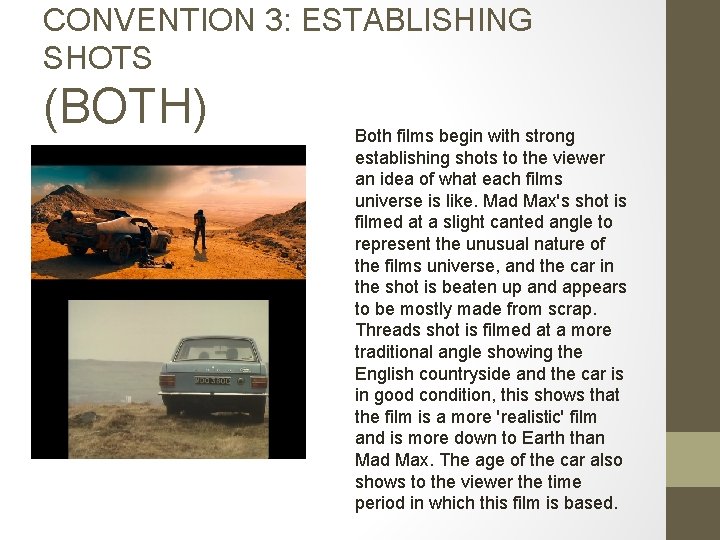
CONVENTION 3: ESTABLISHING SHOTS (BOTH) Both films begin with strong establishing shots to the viewer an idea of what each films universe is like. Mad Max's shot is filmed at a slight canted angle to represent the unusual nature of the films universe, and the car in the shot is beaten up and appears to be mostly made from scrap. Threads shot is filmed at a more traditional angle showing the English countryside and the car is in good condition, this shows that the film is a more 'realistic' film and is more down to Earth than Mad Max. The age of the car also shows to the viewer the time period in which this film is based.
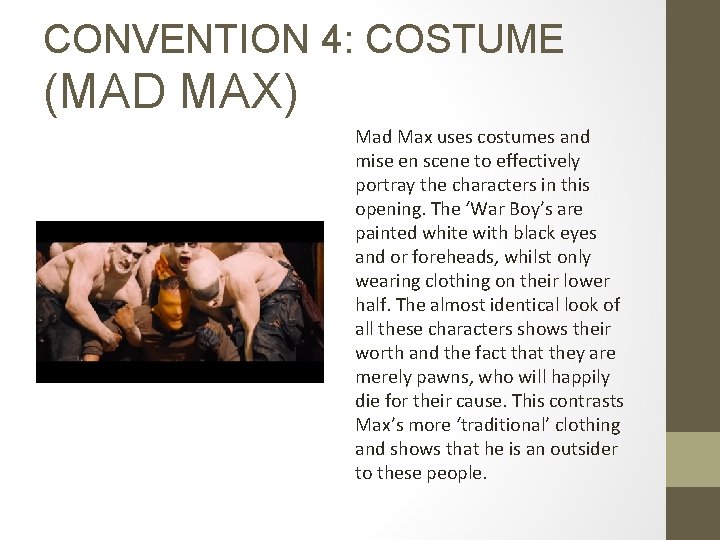
CONVENTION 4: COSTUME (MAD MAX) Mad Max uses costumes and mise en scene to effectively portray the characters in this opening. The ‘War Boy’s are painted white with black eyes and or foreheads, whilst only wearing clothing on their lower half. The almost identical look of all these characters shows their worth and the fact that they are merely pawns, who will happily die for their cause. This contrasts Max’s more ‘traditional’ clothing and shows that he is an outsider to these people.
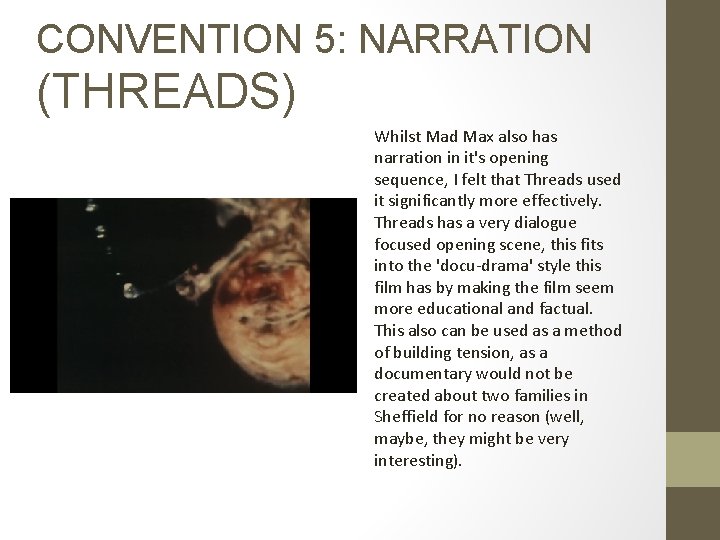
CONVENTION 5: NARRATION (THREADS) Whilst Mad Max also has narration in it's opening sequence, I felt that Threads used it significantly more effectively. Threads has a very dialogue focused opening scene, this fits into the 'docu-drama' style this film has by making the film seem more educational and factual. This also can be used as a method of building tension, as a documentary would not be created about two families in Sheffield for no reason (well, maybe, they might be very interesting).
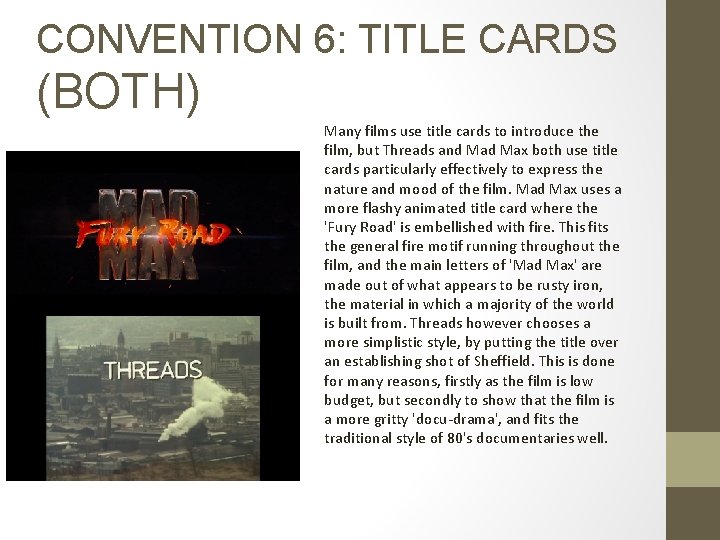
CONVENTION 6: TITLE CARDS (BOTH) Many films use title cards to introduce the film, but Threads and Max both use title cards particularly effectively to express the nature and mood of the film. Mad Max uses a more flashy animated title card where the 'Fury Road' is embellished with fire. This fits the general fire motif running throughout the film, and the main letters of 'Mad Max' are made out of what appears to be rusty iron, the material in which a majority of the world is built from. Threads however chooses a more simplistic style, by putting the title over an establishing shot of Sheffield. This is done for many reasons, firstly as the film is low budget, but secondly to show that the film is a more gritty 'docu-drama', and fits the traditional style of 80's documentaries well.
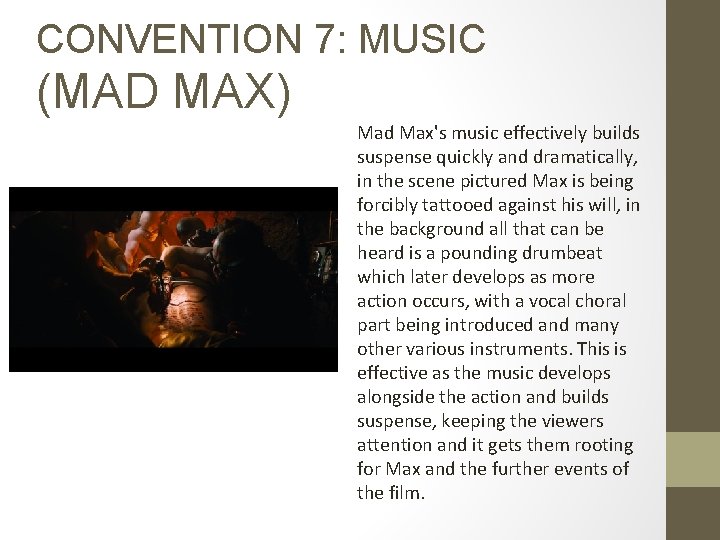
CONVENTION 7: MUSIC (MAD MAX) Mad Max's music effectively builds suspense quickly and dramatically, in the scene pictured Max is being forcibly tattooed against his will, in the background all that can be heard is a pounding drumbeat which later develops as more action occurs, with a vocal choral part being introduced and many other various instruments. This is effective as the music develops alongside the action and builds suspense, keeping the viewers attention and it gets them rooting for Max and the further events of the film.
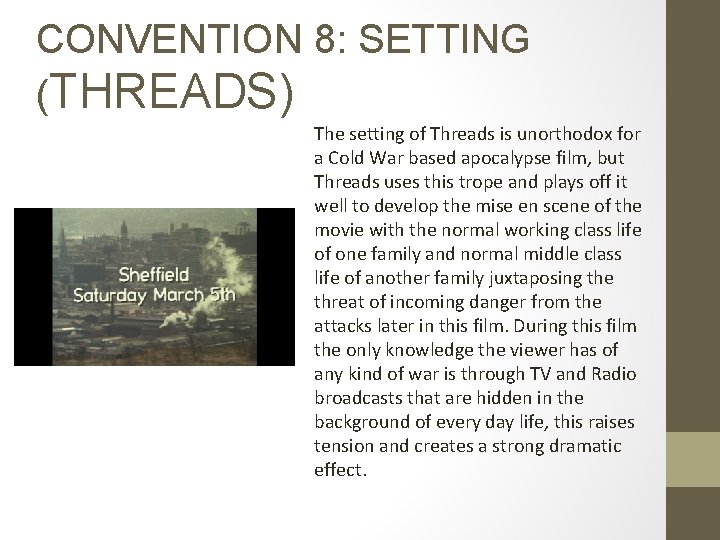
CONVENTION 8: SETTING (THREADS) The setting of Threads is unorthodox for a Cold War based apocalypse film, but Threads uses this trope and plays off it well to develop the mise en scene of the movie with the normal working class life of one family and normal middle class life of another family juxtaposing the threat of incoming danger from the attacks later in this film. During this film the only knowledge the viewer has of any kind of war is through TV and Radio broadcasts that are hidden in the background of every day life, this raises tension and creates a strong dramatic effect.
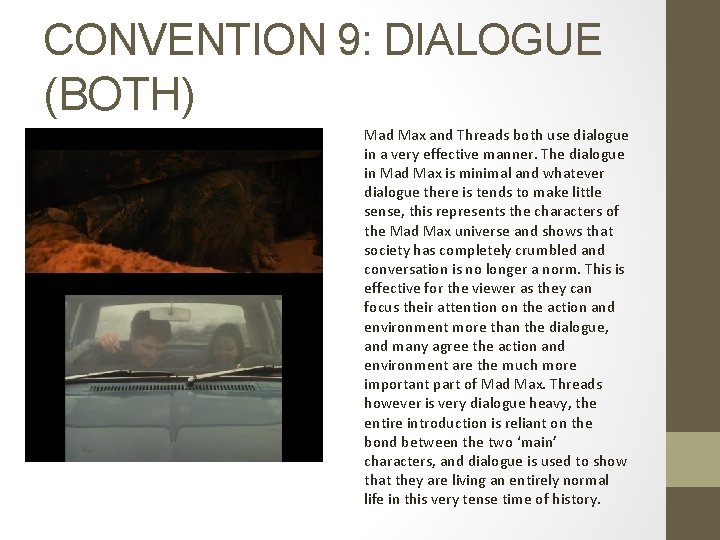
CONVENTION 9: DIALOGUE (BOTH) Mad Max and Threads both use dialogue in a very effective manner. The dialogue in Mad Max is minimal and whatever dialogue there is tends to make little sense, this represents the characters of the Mad Max universe and shows that society has completely crumbled and conversation is no longer a norm. This is effective for the viewer as they can focus their attention on the action and environment more than the dialogue, and many agree the action and environment are the much more important part of Mad Max. Threads however is very dialogue heavy, the entire introduction is reliant on the bond between the two ‘main’ characters, and dialogue is used to show that they are living an entirely normal life in this very tense time of history.
- Slides: 11