
Code Reuse Through Hierarchies You will learn about
Code Reuse Through Hierarchies You will learn about different ways of creating class hierarchies to better organize and group attributes and methods in order to facilitate code reuse
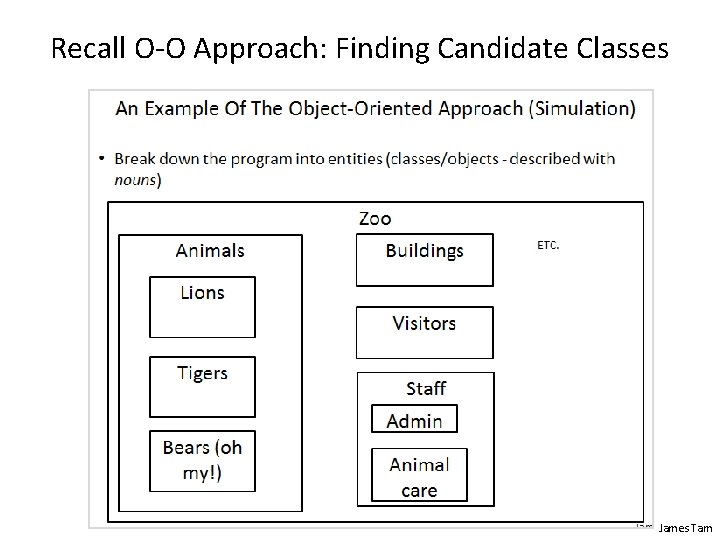
Recall O-O Approach: Finding Candidate Classes James Tam
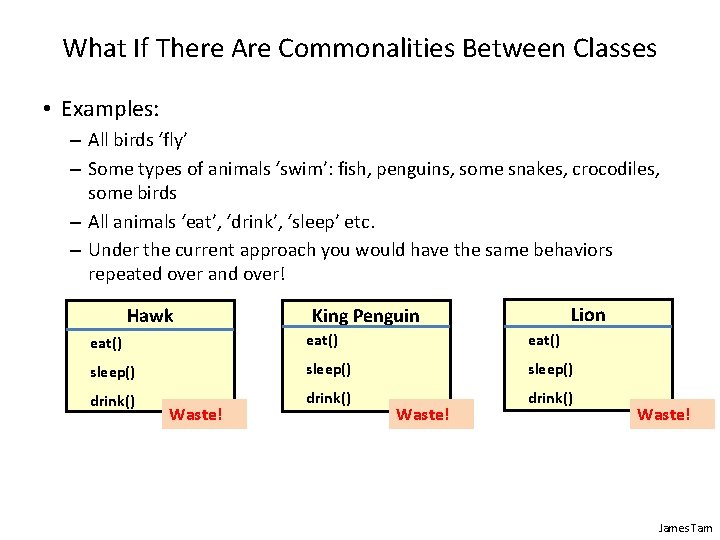
What If There Are Commonalities Between Classes • Examples: – All birds ‘fly’ – Some types of animals ‘swim’: fish, penguins, some snakes, crocodiles, some birds – All animals ‘eat’, ‘drink’, ‘sleep’ etc. – Under the current approach you would have the same behaviors repeated over and over! Hawk Lion King Penguin eat() sleep() drink() Waste! James Tam
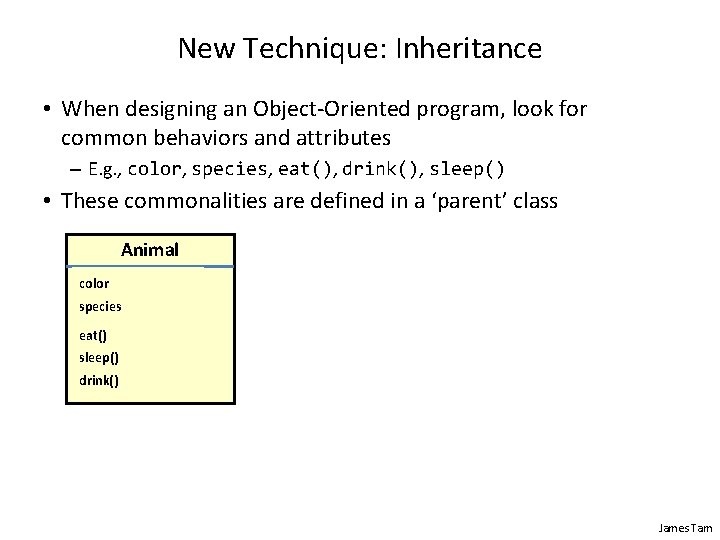
New Technique: Inheritance • When designing an Object-Oriented program, look for common behaviors and attributes – E. g. , color, species, eat(), drink(), sleep() • These commonalities are defined in a ‘parent’ class Animal color species eat() sleep() drink() James Tam

New Technique : Inheritance (2) • These commonalities are defined in a ‘parent’ class • As appropriate other ‘child’ classes will directly include or ‘inherit’ all the non-private attributes and behaviors of the parent class. – ‘Privates’ are still accessible through public methods. Animal color species eat() sleep() drink() Hawk King Penguin Lion James Tam

Defining A Class That Inherits From Another Format: public class <Name of child class> extends <Name of parent class> { // Definition of child class – only what is unique to // this class This means that a Lion } Example: public class Lion extends Animal { public void roar() { System. out. println("Rawr!"); } } object has all the capabilities of an Animal object The only attributes and methods that need to be specified are the ones unique to a lion
First Inheritance Example • Location of the full online example: /home/233/examples/hierarchies/1 basic. Example James Tam
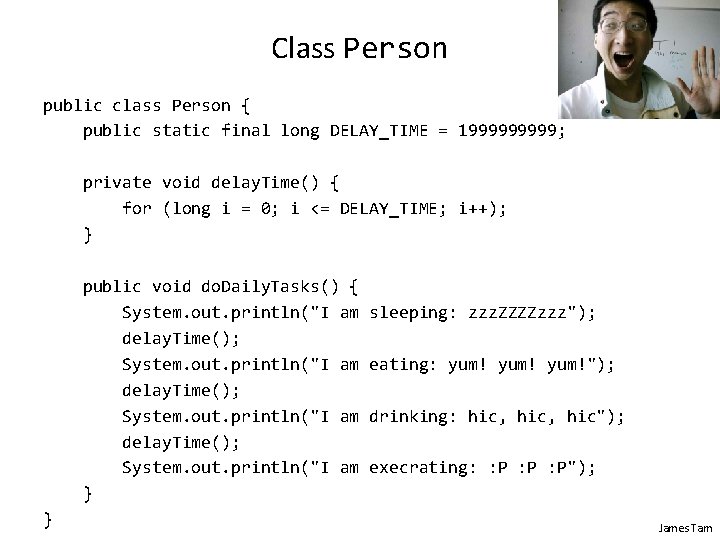
Class Person public class Person { public static final long DELAY_TIME = 199999; private void delay. Time() { for (long i = 0; i <= DELAY_TIME; i++); } public void do. Daily. Tasks() { System. out. println("I am delay. Time(); System. out. println("I am } } sleeping: zzz. ZZZZzzz"); eating: yum!"); drinking: hic, hic"); execrating: : P : P"); James Tam
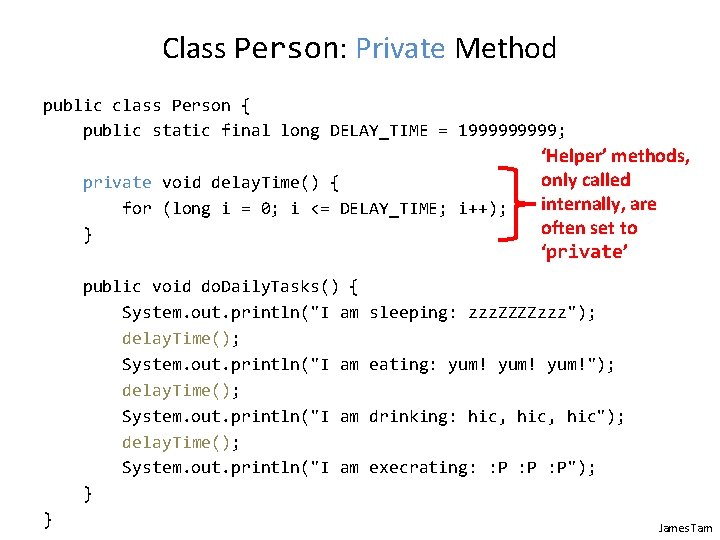
Class Person: Private Method public class Person { public static final long DELAY_TIME = 199999; private void delay. Time() { for (long i = 0; i <= DELAY_TIME; i++); } public void do. Daily. Tasks() { System. out. println("I am delay. Time(); System. out. println("I am } } ‘Helper’ methods, only called internally, are often set to ‘private’ sleeping: zzz. ZZZZzzz"); eating: yum!"); drinking: hic, hic"); execrating: : P : P"); James Tam
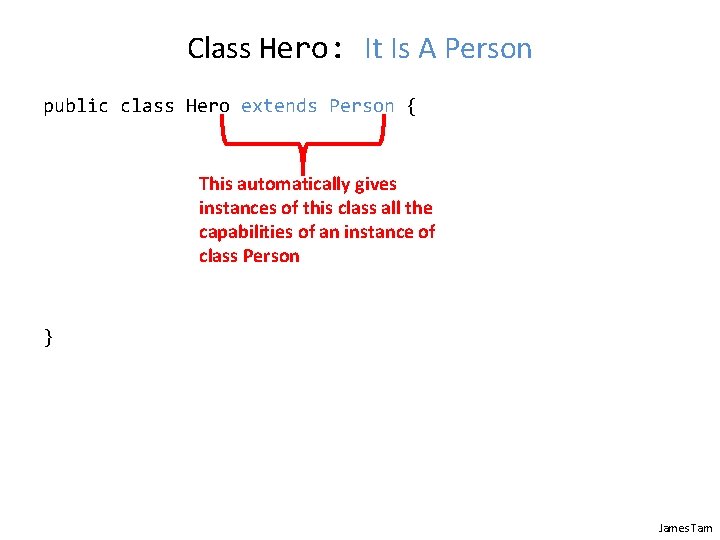
Class Hero: It Is A Person public class Hero extends Person { This automatically gives instances of this class all the capabilities of an instance of class Person } James Tam
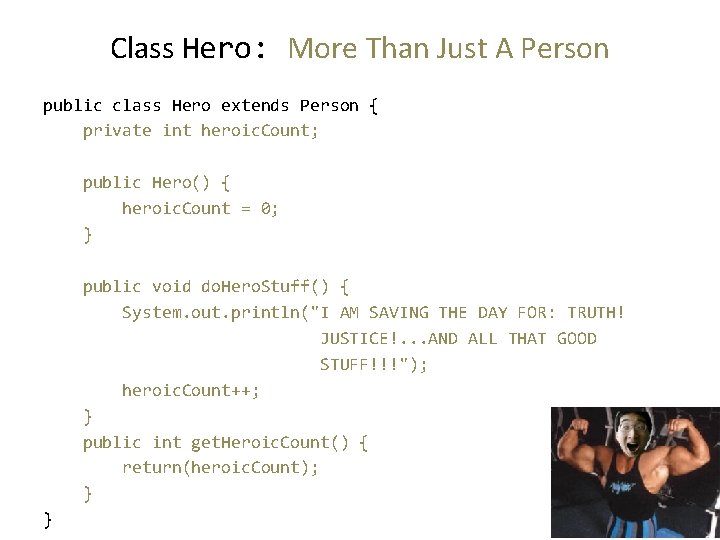
Class Hero: More Than Just A Person public class Hero extends Person { private int heroic. Count; public Hero() { heroic. Count = 0; } public void do. Hero. Stuff() { System. out. println("I AM SAVING THE DAY FOR: TRUTH! JUSTICE!. . . AND ALL THAT GOOD STUFF!!!"); heroic. Count++; } public int get. Heroic. Count() { return(heroic. Count); } } James Tam
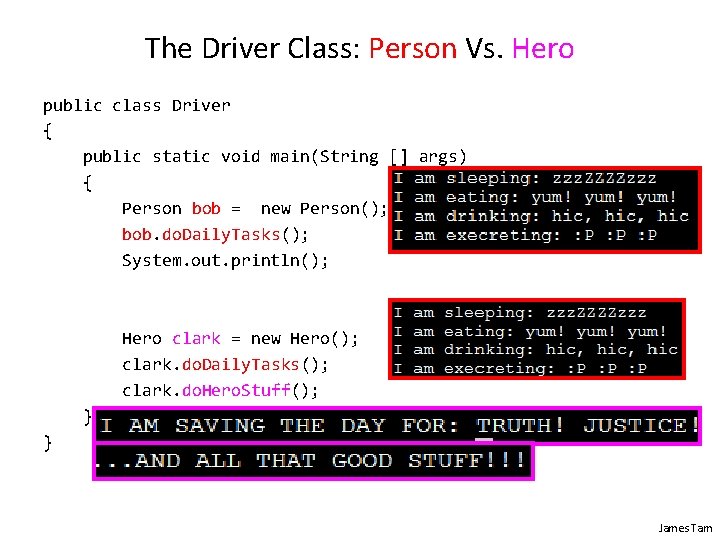
The Driver Class: Person Vs. Hero public class Driver { public static void main(String [] args) { Person bob = new Person(); bob. do. Daily. Tasks(); System. out. println(); Hero clark = new Hero(); clark. do. Daily. Tasks(); clark. do. Hero. Stuff(); } } James Tam

Benefit Of Employing Inheritance • Code reuse: – The common and accessible attributes and methods of the parent will automatically be available in all the children. Person +do. Daily. Tasks() Accountant Hero Teacher James Tam
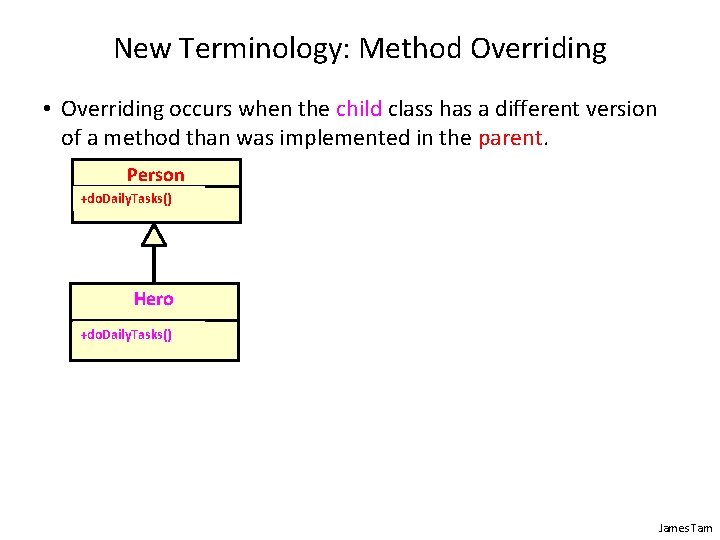
New Terminology: Method Overriding • Overriding occurs when the child class has a different version of a method than was implemented in the parent. Person +do. Daily. Tasks() Hero +do. Daily. Tasks() James Tam
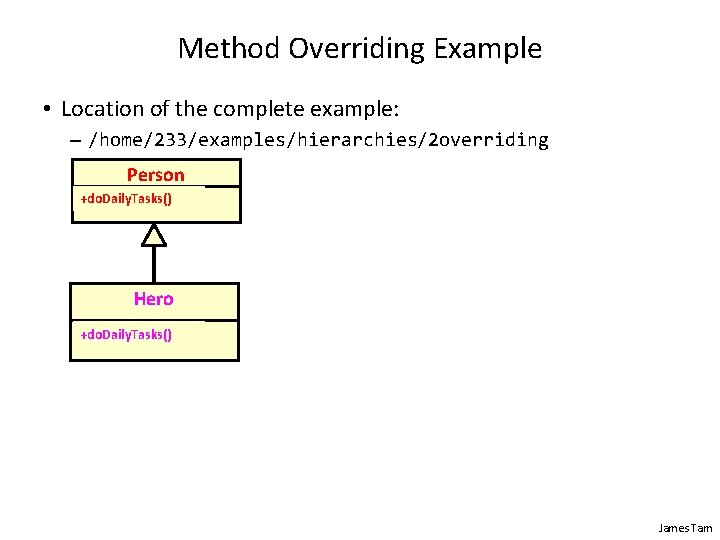
Method Overriding Example • Location of the complete example: – /home/233/examples/hierarchies/2 overriding Person +do. Daily. Tasks() Hero +do. Daily. Tasks() James Tam
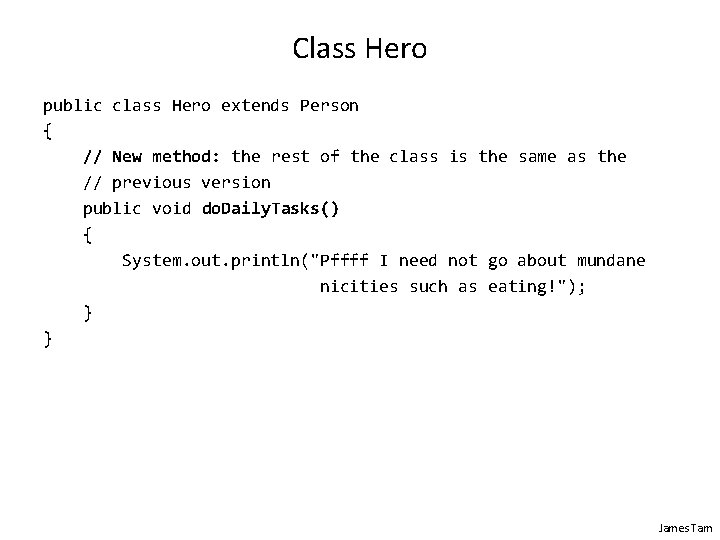
Class Hero public class Hero extends Person { // New method: the rest of the class is the same as the // previous version public void do. Daily. Tasks() { System. out. println("Pffff I need not go about mundane nicities such as eating!"); } } James Tam
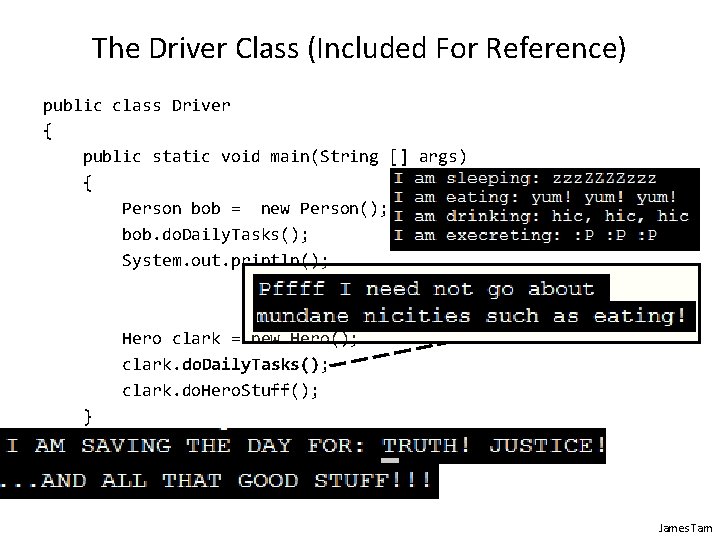
The Driver Class (Included For Reference) public class Driver { public static void main(String [] args) { Person bob = new Person(); bob. do. Daily. Tasks(); System. out. println(); Hero clark = new Hero(); clark. do. Daily. Tasks(); clark. do. Hero. Stuff(); } } James Tam
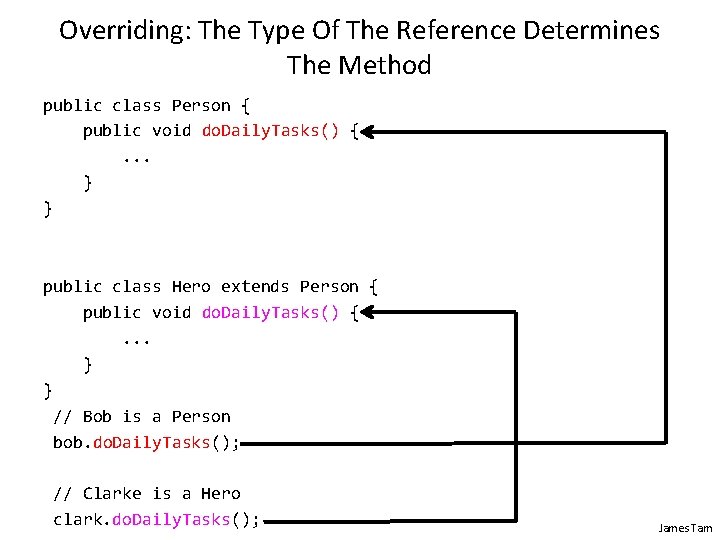
Overriding: The Type Of The Reference Determines The Method public class Person { public void do. Daily. Tasks() {. . . } } public class Hero extends Person { public void do. Daily. Tasks() {. . . } } // Bob is a Person bob. do. Daily. Tasks(); // Clarke is a Hero clark. do. Daily. Tasks(); James Tam
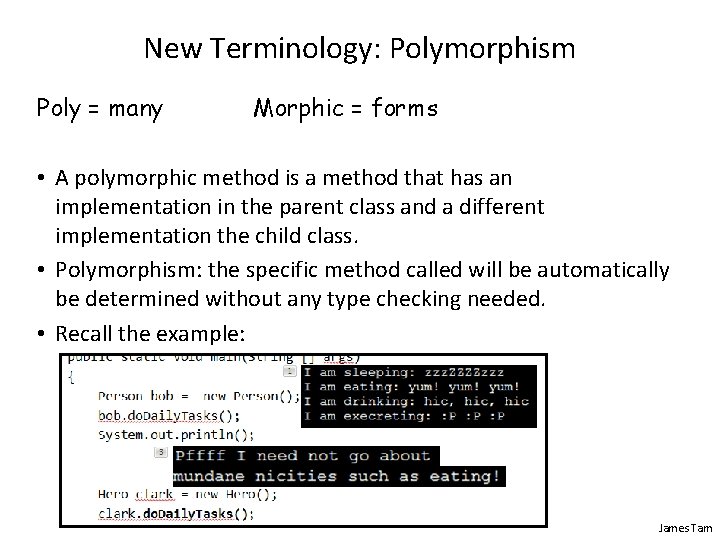
New Terminology: Polymorphism Poly = many Morphic = forms • A polymorphic method is a method that has an implementation in the parent class and a different implementation the child class. • Polymorphism: the specific method called will be automatically be determined without any type checking needed. • Recall the example: James Tam
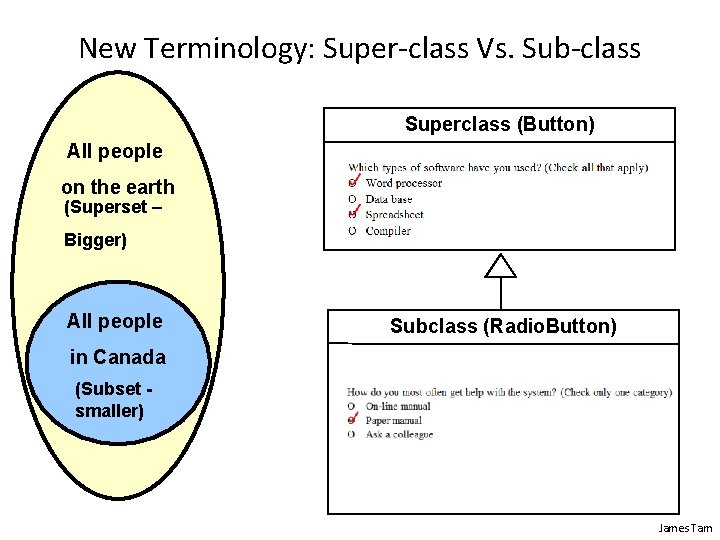
New Terminology: Super-class Vs. Sub-class Superclass (Button) All people on the earth (Superset – Bigger) All people Subclass (Radio. Button) in Canada (Subset smaller) James Tam
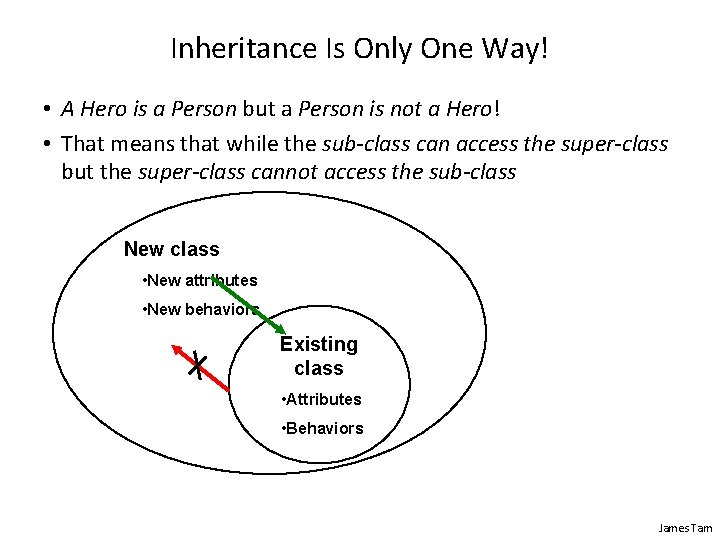
Inheritance Is Only One Way! • A Hero is a Person but a Person is not a Hero! • That means that while the sub-class can access the super-class but the super-class cannot access the sub-class New class • New attributes • New behaviors Existing class • Attributes • Behaviors James Tam
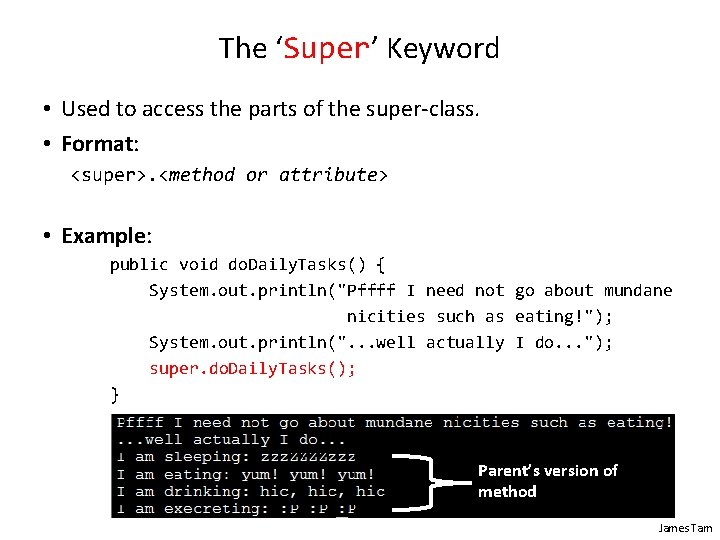
The ‘Super’ Keyword • Used to access the parts of the super-class. • Format: <super>. <method or attribute> • Example: public void do. Daily. Tasks() { System. out. println("Pffff I need not go about mundane nicities such as eating!"); System. out. println(". . . well actually I do. . . "); super. do. Daily. Tasks(); } Parent’s version of method James Tam
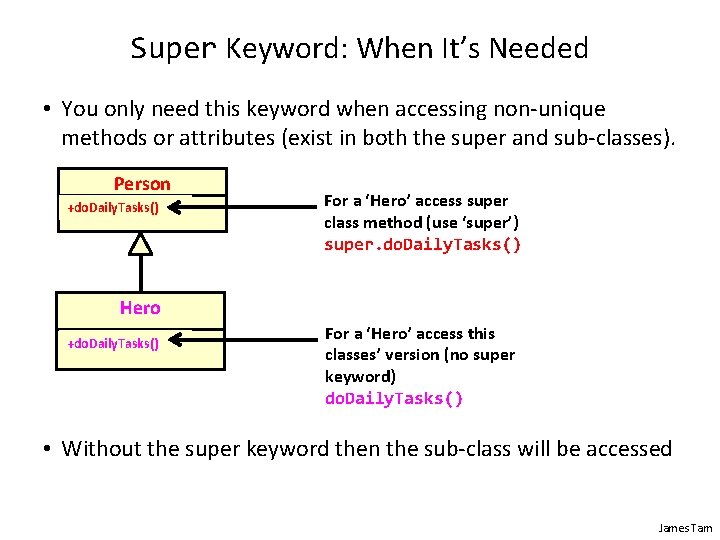
Super Keyword: When It’s Needed • You only need this keyword when accessing non-unique methods or attributes (exist in both the super and sub-classes). Person +do. Daily. Tasks() For a ‘Hero’ access super class method (use ‘super’) super. do. Daily. Tasks() Hero +do. Daily. Tasks() For a ‘Hero’ access this classes’ version (no super keyword) do. Daily. Tasks() • Without the super keyword then the sub-class will be accessed James Tam
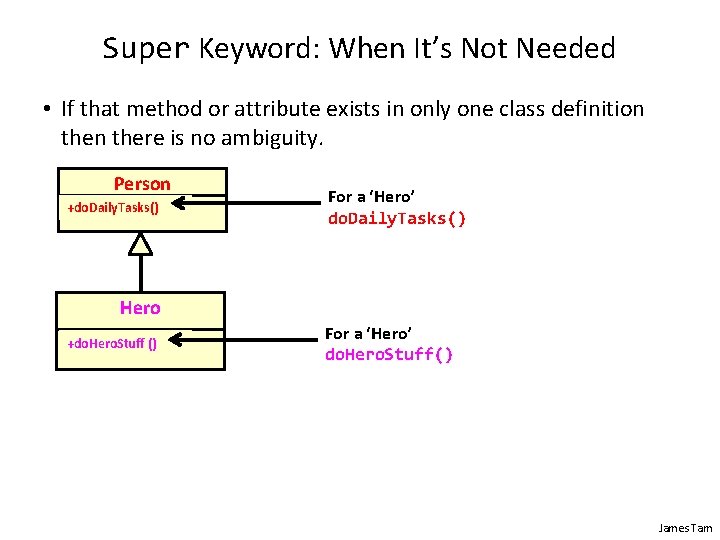
Super Keyword: When It’s Not Needed • If that method or attribute exists in only one class definition there is no ambiguity. Person +do. Daily. Tasks() For a ‘Hero’ do. Daily. Tasks() Hero +do. Hero. Stuff () For a ‘Hero’ do. Hero. Stuff() James Tam
Something Especially Good? • Note: There Is No Super In Java James Tam
Calling The Super Class Constructor: Just Super() • This results in a call to the super classes’ constructor • (Useful for initializing the attributes that are defined in the super class) James Tam
Calling The Super Class Constructor • Location of the full example: /home/233/examples/hierarchies/3 super. Constructors James Tam
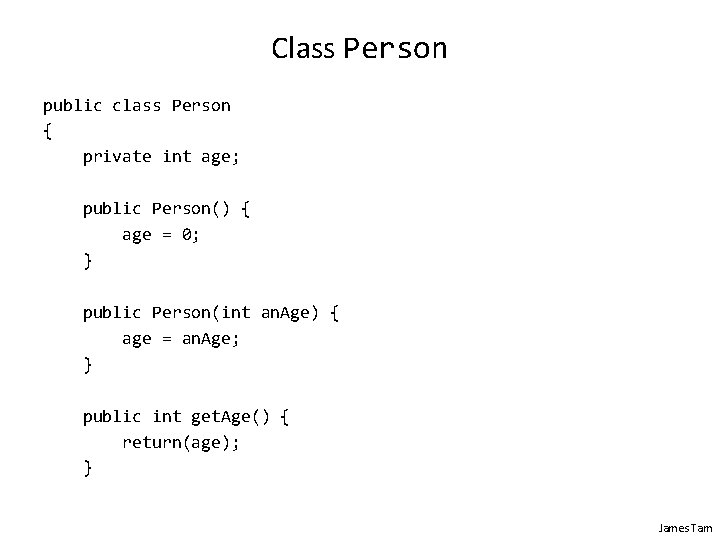
Class Person public class Person { private int age; public Person() { age = 0; } public Person(int an. Age) { age = an. Age; } public int get. Age() { return(age); } James Tam
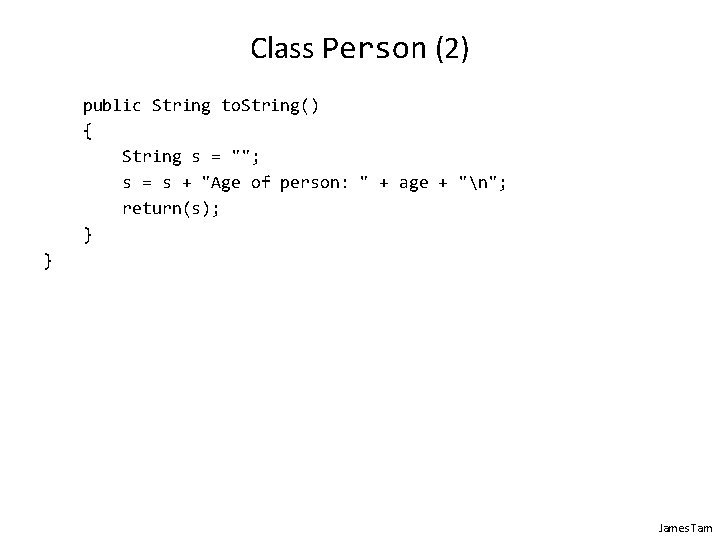
Class Person (2) public String to. String() { String s = ""; s = s + "Age of person: " + age + "n"; return(s); } } James Tam
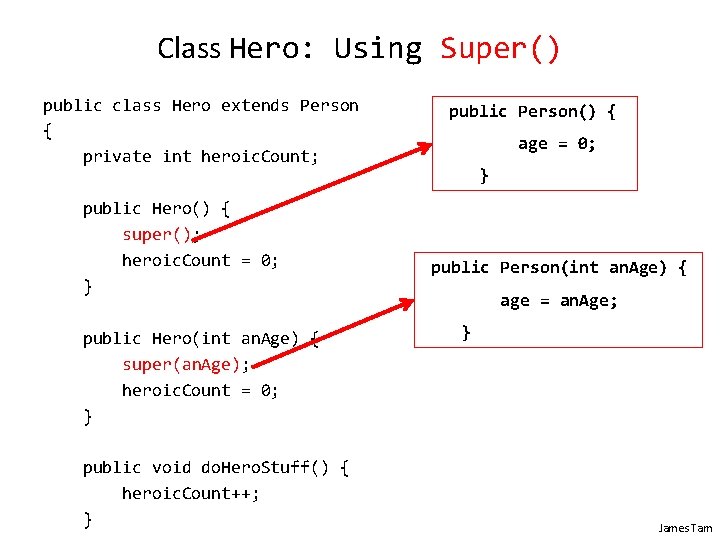
Class Hero: Using Super() public class Hero extends Person { private int heroic. Count; public Hero() { super(); heroic. Count = 0; } public Hero(int an. Age) { super(an. Age); heroic. Count = 0; } public void do. Hero. Stuff() { heroic. Count++; } public Person() { age = 0; } public Person(int an. Age) { age = an. Age; } James Tam
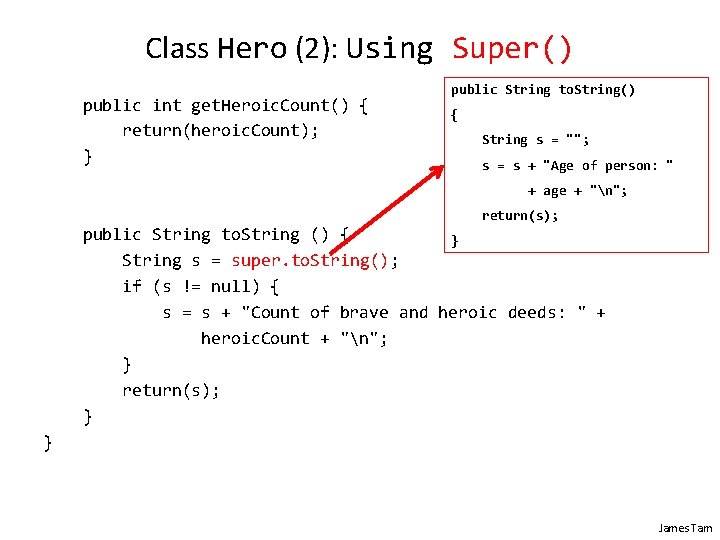
Class Hero (2): Using Super() public int get. Heroic. Count() { return(heroic. Count); } public String to. String() { String s = ""; s = s + "Age of person: " + age + "n"; return(s); public String to. String () { } String s = super. to. String(); if (s != null) { s = s + "Count of brave and heroic deeds: " + heroic. Count + "n"; } return(s); } } James Tam
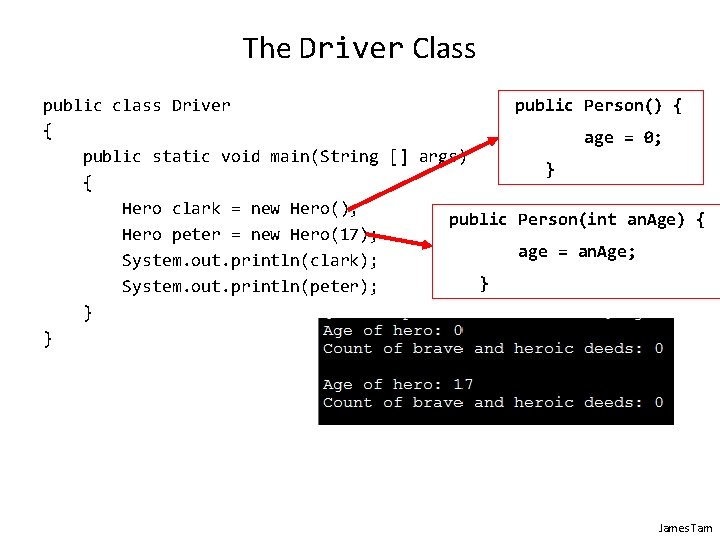
The Driver Class public Person() { public class Driver { age = 0; public static void main(String [] args) } { Hero clark = new Hero(); public Person(int an. Age) { Hero peter = new Hero(17); age = an. Age; System. out. println(clark); } System. out. println(peter); } } James Tam
Access Modifiers And Inheritance • Private ‘-‘: still works as-is, private attributes and methods can only be accessed within that classes’ methods. – Child classes, similar to other classes must access private attributes through public methods. • Public ‘+’: still works as-is, public attributes and methods can be accessed anywhere. • New level of access, Protected ‘#’: can access the method or attribute in the class or its sub-classes. James Tam
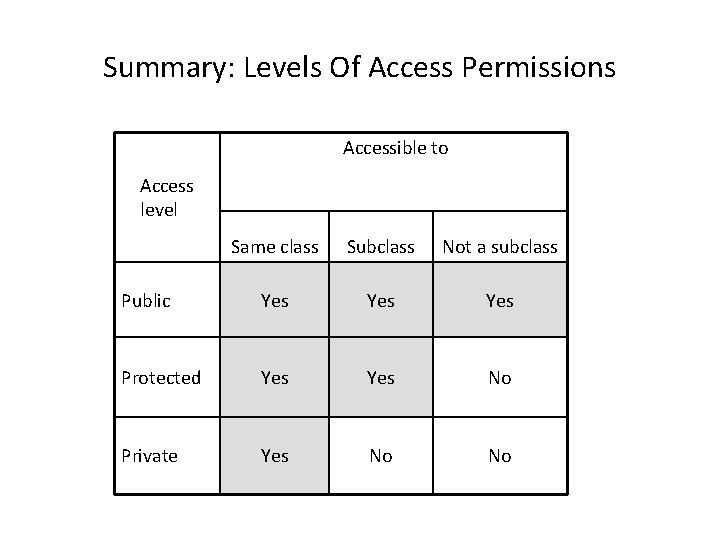
Summary: Levels Of Access Permissions Accessible to Access level Same class Subclass Not a subclass Public Yes Yes Protected Yes No Private Yes No No
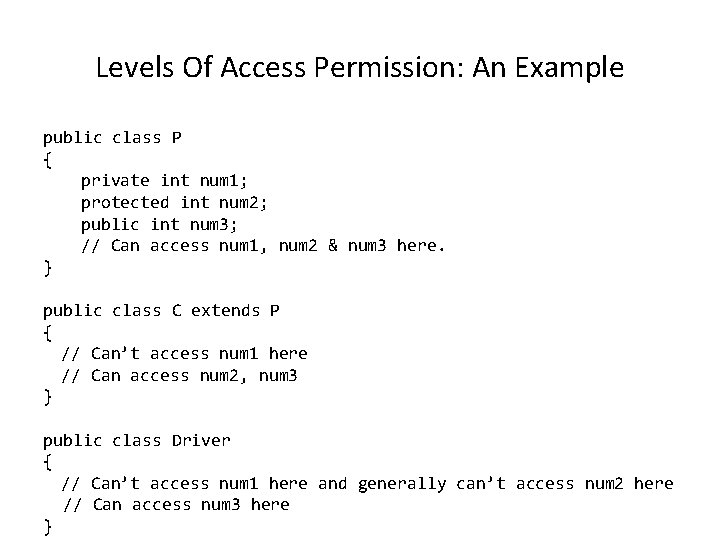
Levels Of Access Permission: An Example public class P { private int num 1; protected int num 2; public int num 3; // Can access num 1, num 2 & num 3 here. } public class C extends P { // Can’t access num 1 here // Can access num 2, num 3 } public class Driver { // Can’t access num 1 here and generally can’t access num 2 here // Can access num 3 here }
General Rules Of Thumb • Variable attributes should not have protected access but instead should be private. • Most methods should be public. • Methods that are used only by the parent and child classes should be made protected.
Updated Scoping Rules • When referring to an identifier in a method of a class 1. Look in the local memory space for that method 2. Look in the definition of the class 3. Look in the definition of the classes’ parent
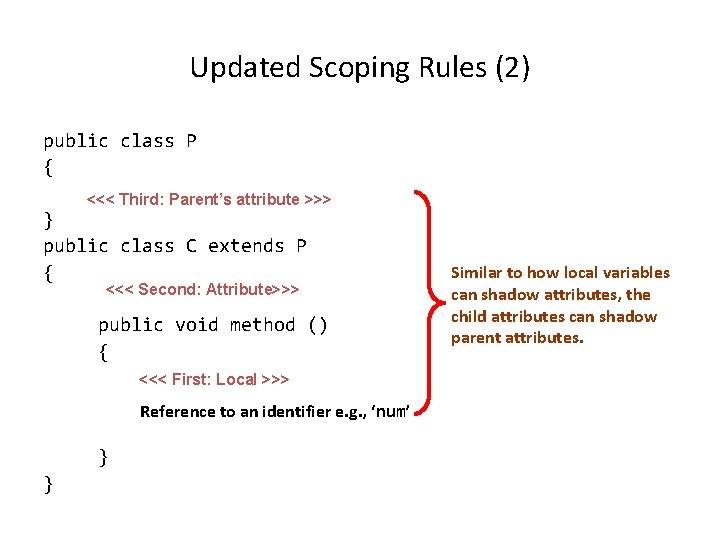
Updated Scoping Rules (2) public class P { <<< Third: Parent’s attribute >>> } public class C extends P { <<< Second: Attribute>>> public void method () { <<< First: Local >>> Reference to an identifier e. g. , ‘num’ } } Similar to how local variables can shadow attributes, the child attributes can shadow parent attributes.
Updated Scoping Rules: A Trace • Location of the full online example: /home/233/examples/hierarchies/4 scope James Tam
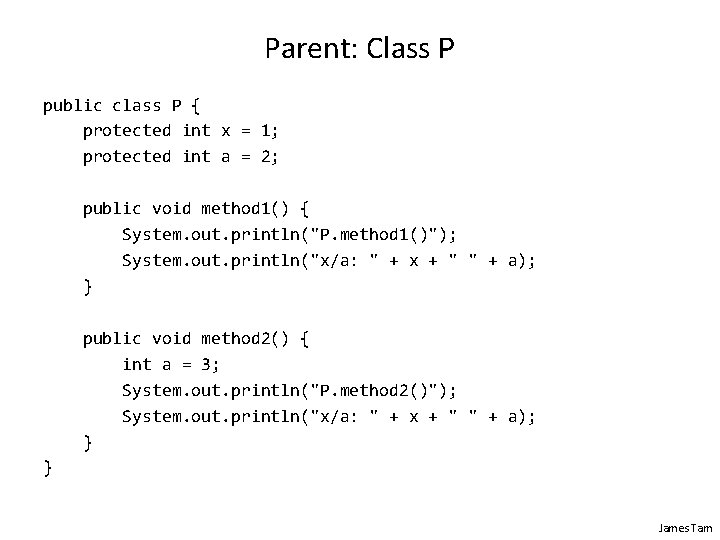
Parent: Class P public class P { protected int x = 1; protected int a = 2; public void method 1() { System. out. println("P. method 1()"); System. out. println("x/a: " + x + " " + a); } public void method 2() { int a = 3; System. out. println("P. method 2()"); System. out. println("x/a: " + x + " " + a); } } James Tam
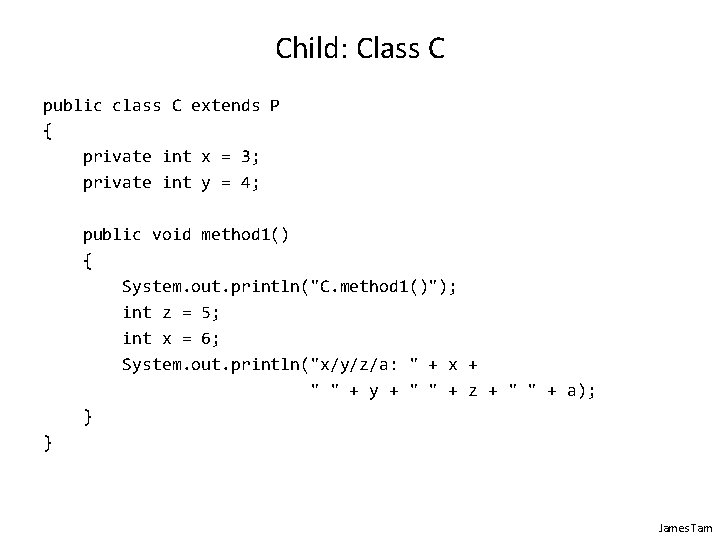
Child: Class C public class C extends P { private int x = 3; private int y = 4; public void method 1() { System. out. println("C. method 1()"); int z = 5; int x = 6; System. out. println("x/y/z/a: " + x + " " + y + " " + z + " " + a); } } James Tam
![The Driver Class public class Driver { public static void main(String [] args) {](http://slidetodoc.com/presentation_image_h2/08d1a4aea19795df2a93a6c287d524fe/image-42.jpg "The Driver Class public class Driver { public static void main(String [] args) {")
The Driver Class public class Driver { public static void main(String [] args) { // Case 1 P p = new P(); p. method 1(); // Case 2 p. method 2(); // Case 3 C c = new C(); c. method 1(); // Case 4 c. method 2(); } } James Tam
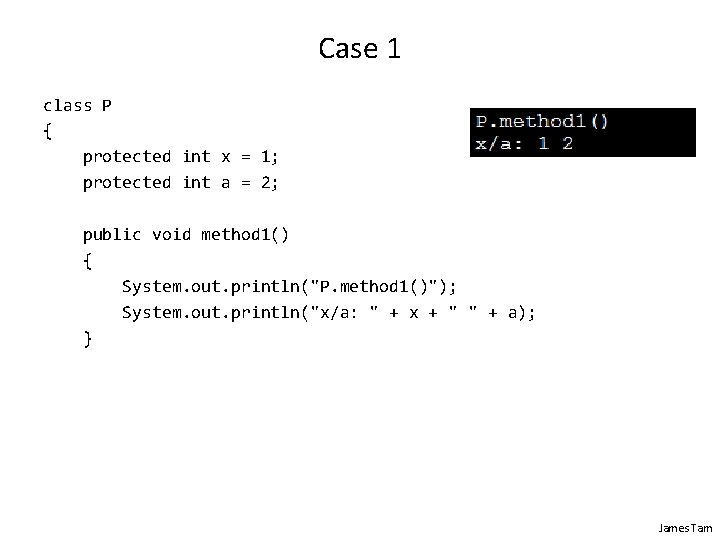
Case 1 class P { protected int x = 1; protected int a = 2; public void method 1() { System. out. println("P. method 1()"); System. out. println("x/a: " + x + " " + a); } James Tam
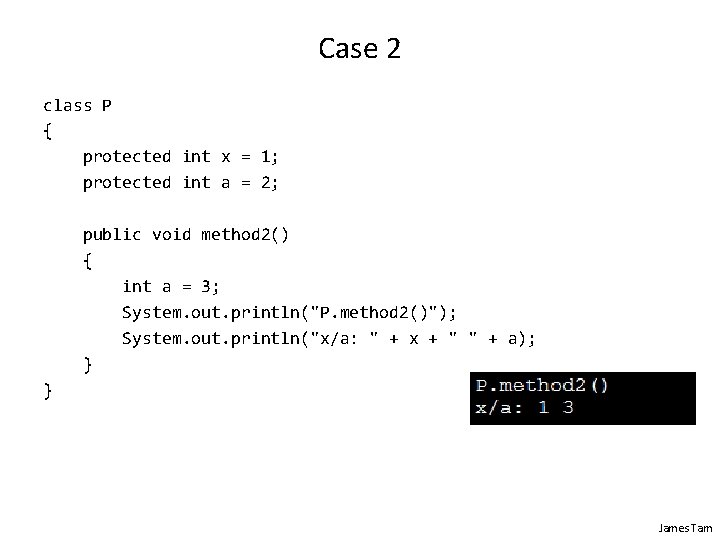
Case 2 class P { protected int x = 1; protected int a = 2; public void method 2() { int a = 3; System. out. println("P. method 2()"); System. out. println("x/a: " + x + " " + a); } } James Tam
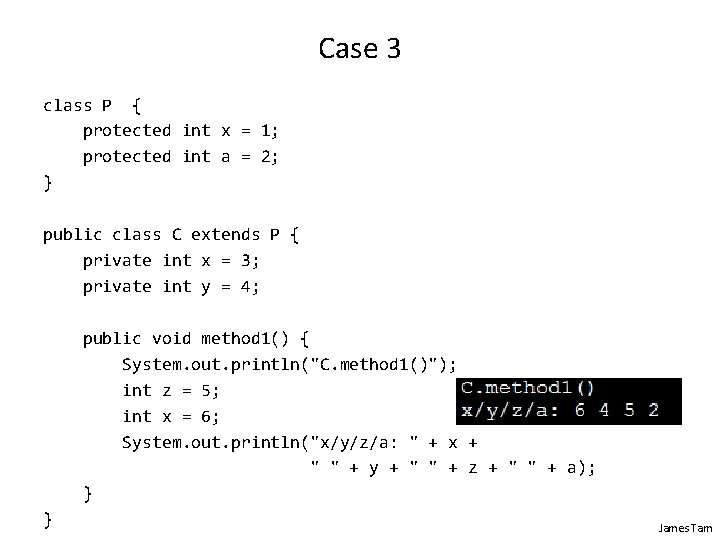
Case 3 class P { protected int x = 1; protected int a = 2; } public class C extends P { private int x = 3; private int y = 4; public void method 1() { System. out. println("C. method 1()"); int z = 5; int x = 6; System. out. println("x/y/z/a: " + x + " " + y + " " + z + " " + a); } } James Tam
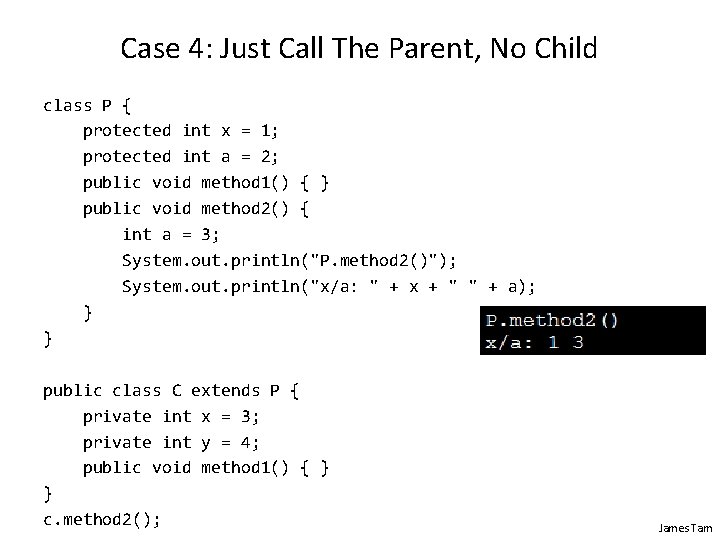
Case 4: Just Call The Parent, No Child class P { protected int x = 1; protected int a = 2; public void method 1() { } public void method 2() { int a = 3; System. out. println("P. method 2()"); System. out. println("x/a: " + x + " " + a); } } public class C extends P { private int x = 3; private int y = 4; public void method 1() { } } c. method 2(); James Tam
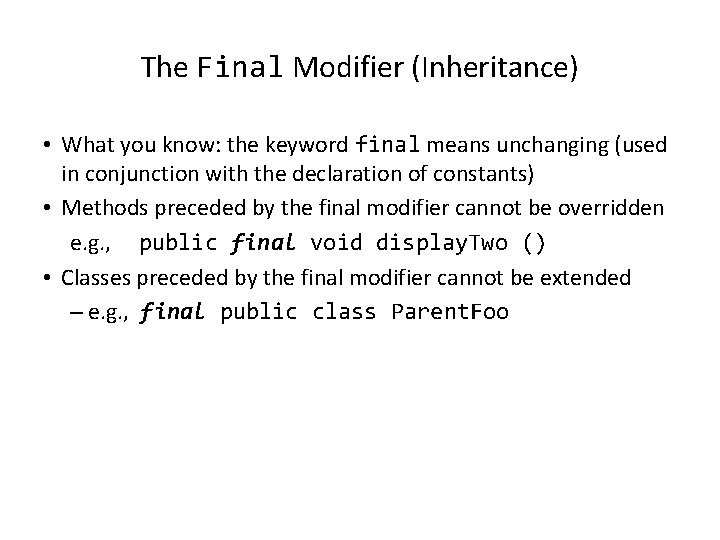
The Final Modifier (Inheritance) • What you know: the keyword final means unchanging (used in conjunction with the declaration of constants) • Methods preceded by the final modifier cannot be overridden e. g. , public final void display. Two () • Classes preceded by the final modifier cannot be extended – e. g. , final public class Parent. Foo
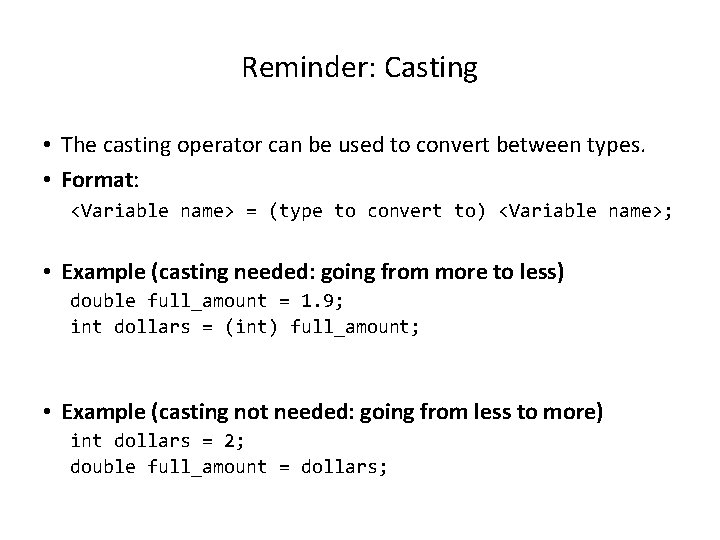
Reminder: Casting • The casting operator can be used to convert between types. • Format: <Variable name> = (type to convert to) <Variable name>; • Example (casting needed: going from more to less) double full_amount = 1. 9; int dollars = (int) full_amount; • Example (casting not needed: going from less to more) int dollars = 2; double full_amount = dollars;
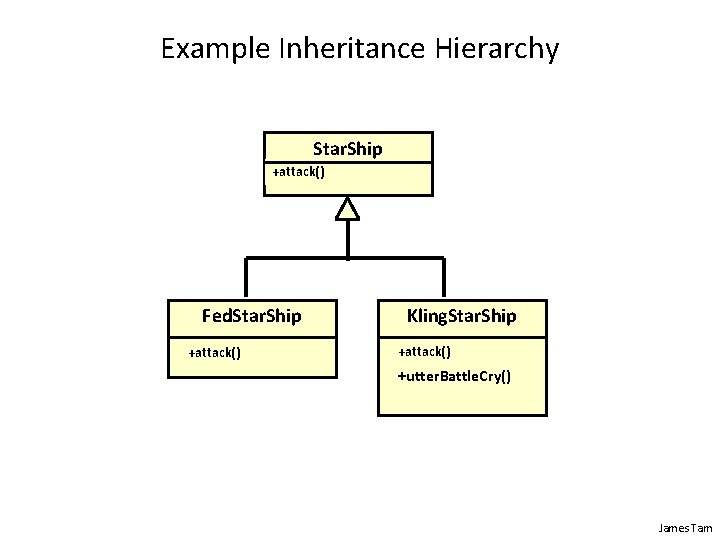
Example Inheritance Hierarchy Star. Ship +attack() Fed. Star. Ship +attack() Kling. Star. Ship +attack() +utter. Battle. Cry() James Tam
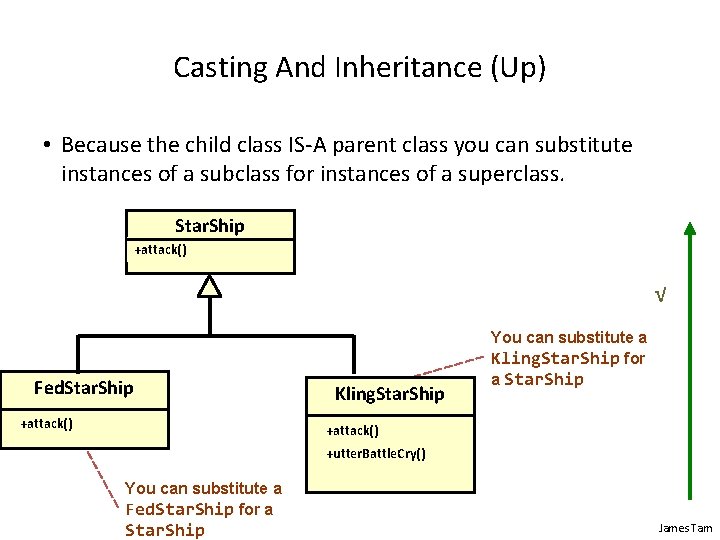
Casting And Inheritance (Up) • Because the child class IS-A parent class you can substitute instances of a subclass for instances of a superclass. Star. Ship +attack() √ Fed. Star. Ship +attack() Kling. Star. Ship You can substitute a Kling. Star. Ship for a Star. Ship +attack() +utter. Battle. Cry() You can substitute a Fed. Star. Ship for a Star. Ship James Tam
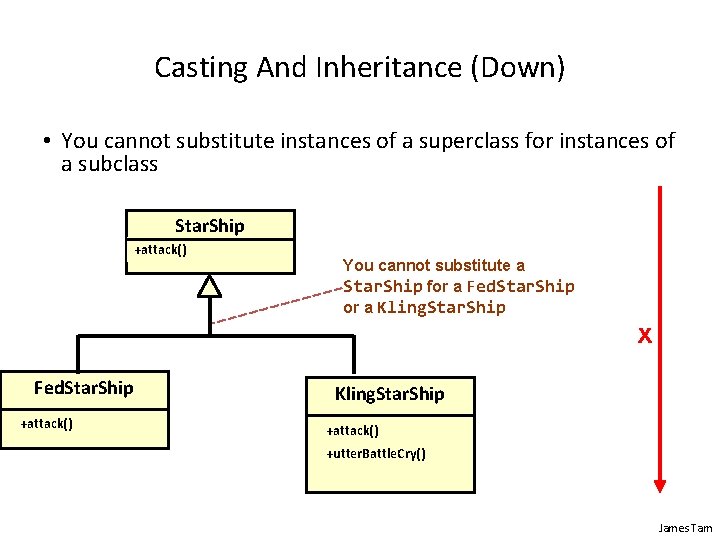
Casting And Inheritance (Down) • You cannot substitute instances of a superclass for instances of a subclass Star. Ship +attack() Fed. Star. Ship +attack() You cannot substitute a Star. Ship for a Fed. Star. Ship or a Kling. Star. Ship x Kling. Star. Ship +attack() +utter. Battle. Cry() James Tam
Reminder: Operations Depends On Type • Sometimes the same symbol performs different operations depending upon the type of the operands/inputs. • Example: int num 1 = 2; int num 2 = 3; num 1 = num 1 + num 2; Vs. String str = “foo” + “bar”; • Some operations won’t work on some types • Example: String str = 2 / 3; James Tam
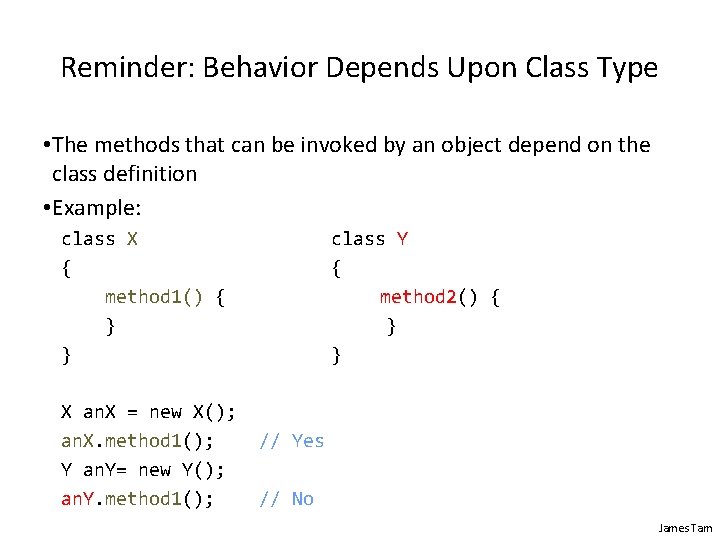
Reminder: Behavior Depends Upon Class Type • The methods that can be invoked by an object depend on the class definition • Example: class X { method 1() { } } X an. X = new X(); an. X. method 1(); Y an. Y= new Y(); an. Y. method 1(); class Y { method 2() { } } // Yes // No James Tam
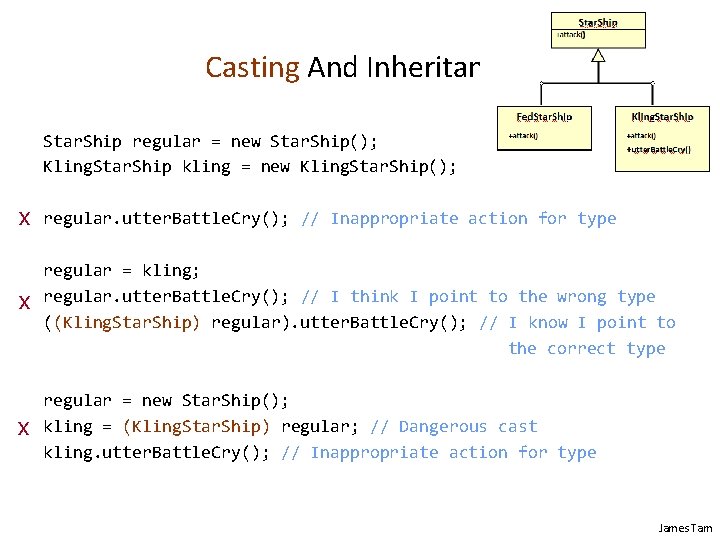
Casting And Inheritance Star. Ship regular = new Star. Ship(); Kling. Star. Ship kling = new Kling. Star. Ship(); x regular. utter. Battle. Cry(); // Inappropriate action for type x regular = kling; regular. utter. Battle. Cry(); // I think I point to the wrong type ((Kling. Star. Ship) regular). utter. Battle. Cry(); // I know I point to the correct type x regular = new Star. Ship(); kling = (Kling. Star. Ship) regular; // Dangerous cast kling. utter. Battle. Cry(); // Inappropriate action for type James Tam
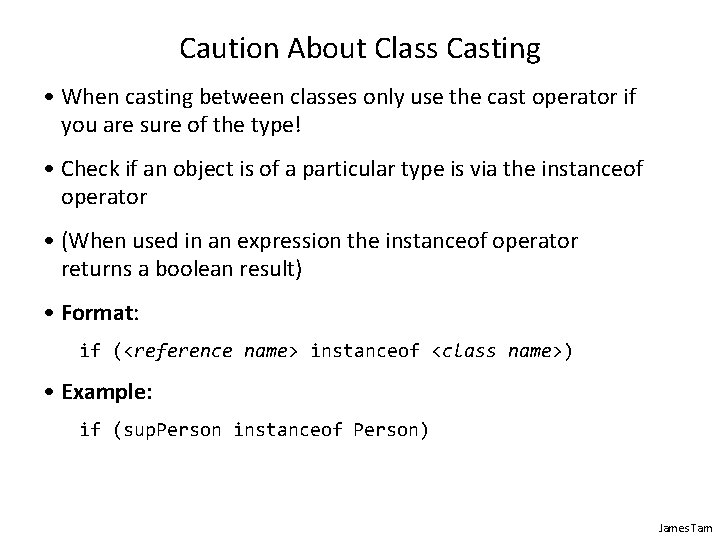
Caution About Class Casting • When casting between classes only use the cast operator if you are sure of the type! • Check if an object is of a particular type is via the instanceof operator • (When used in an expression the instanceof operator returns a boolean result) • Format: if (<reference name> instanceof <class name>) • Example: if (sup. Person instanceof Person) James Tam
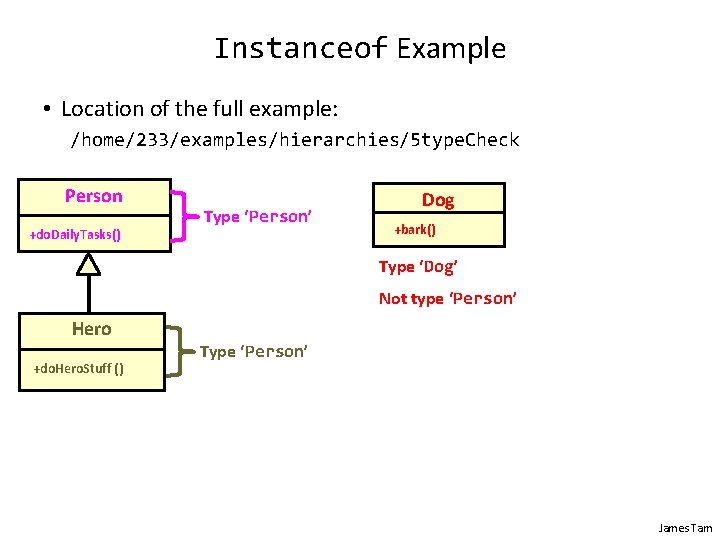
Instanceof Example • Location of the full example: /home/233/examples/hierarchies/5 type. Check Person +do. Daily. Tasks() Type ‘Person’ Dog +bark() Type ‘Dog’ Not type ‘Person’ Hero +do. Hero. Stuff () Type ‘Person’ James Tam
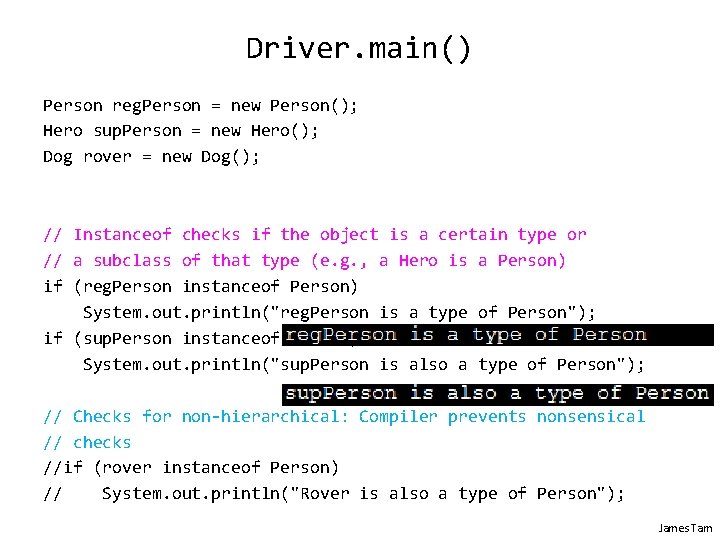
Driver. main() Person reg. Person = new Person(); Hero sup. Person = new Hero(); Dog rover = new Dog(); // Instanceof checks if the object is a certain type or // a subclass of that type (e. g. , a Hero is a Person) if (reg. Person instanceof Person) System. out. println("reg. Person is a type of Person"); if (sup. Person instanceof Person) System. out. println("sup. Person is also a type of Person"); // Checks for non-hierarchical: Compiler prevents nonsensical // checks //if (rover instanceof Person) // System. out. println("Rover is also a type of Person"); James Tam
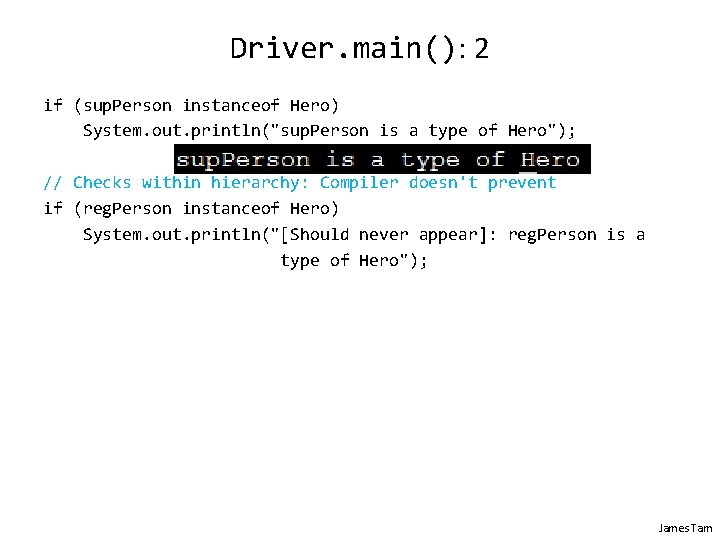
Driver. main(): 2 if (sup. Person instanceof Hero) System. out. println("sup. Person is a type of Hero"); // Checks within hierarchy: Compiler doesn't prevent if (reg. Person instanceof Hero) System. out. println("[Should never appear]: reg. Person is a type of Hero"); James Tam
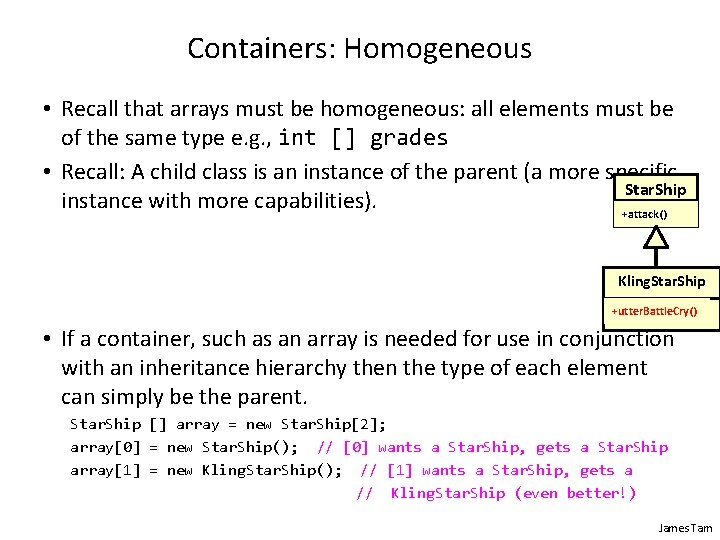
Containers: Homogeneous • Recall that arrays must be homogeneous: all elements must be of the same type e. g. , int [] grades • Recall: A child class is an instance of the parent (a more specific Star. Ship instance with more capabilities). +attack() Kling. Star. Ship +utter. Battle. Cry() • If a container, such as an array is needed for use in conjunction with an inheritance hierarchy then the type of each element can simply be the parent. Star. Ship [] array = new Star. Ship[2]; array[0] = new Star. Ship(); // [0] wants a Star. Ship, gets a Star. Ship array[1] = new Kling. Star. Ship(); // [1] wants a Star. Ship, gets a // Kling. Star. Ship (even better!) James Tam
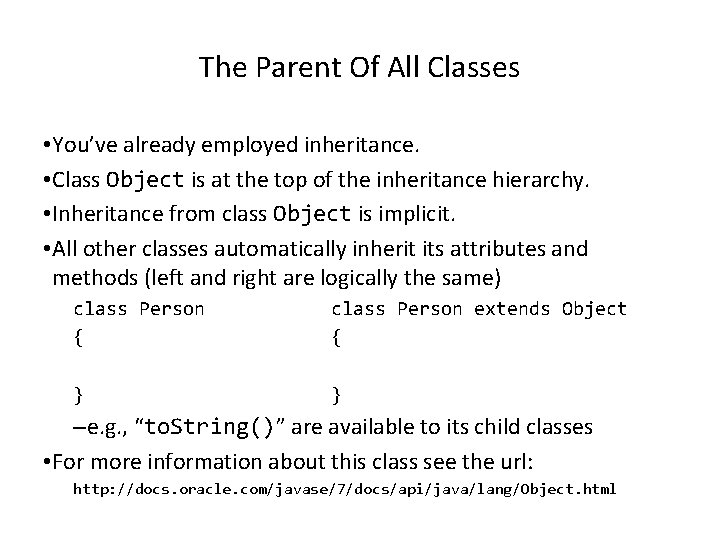
The Parent Of All Classes • You’ve already employed inheritance. • Class Object is at the top of the inheritance hierarchy. • Inheritance from class Object is implicit. • All other classes automatically inherit its attributes and methods (left and right are logically the same) class Person { class Person extends Object { } } –e. g. , “to. String()” are available to its child classes • For more information about this class see the url: http: //docs. oracle. com/javase/7/docs/api/java/lang/Object. html
The Parent Of All Classes (2) • This means that if you want to have an array that can contain any type of Java object then it can be an array of type Object. – Object [] array = new Object[SIZE]; • Built-in array-like classes such as class Vector (an array that ‘automatically’ resizes itself consists of an array attribute whose type is class Object) – For more information on class Vector: – http: //docs. oracle. com/javase/6/docs/api/java/util/Vector. html James Tam
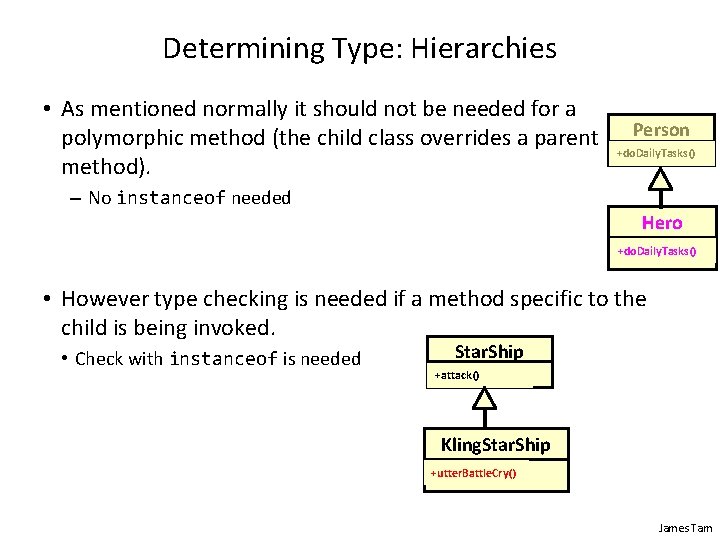
Determining Type: Hierarchies • As mentioned normally it should not be needed for a polymorphic method (the child class overrides a parent method). Person +do. Daily. Tasks() – No instanceof needed Hero +do. Daily. Tasks() • However type checking is needed if a method specific to the child is being invoked. • Check with instanceof is needed Star. Ship +attack() Kling. Star. Ship +utter. Battle. Cry() James Tam
Example: Containers With ‘Different’ Types • Location of the full example: – /home/233/examples/hierarchies/6 hierarchies. Containment James Tam
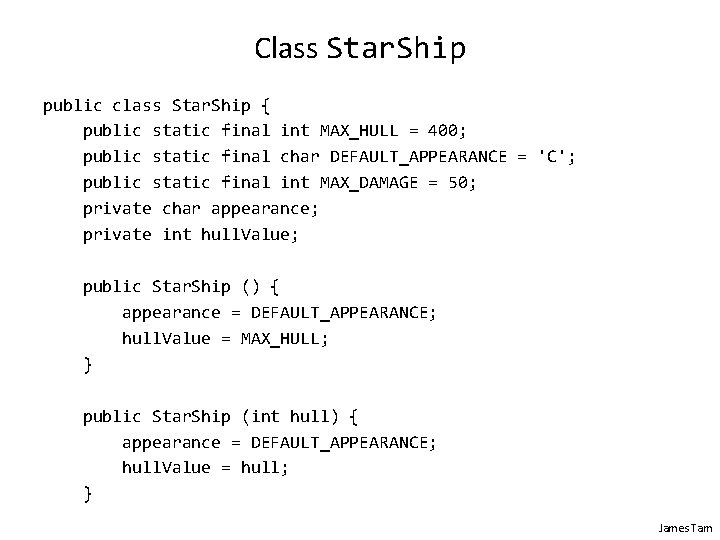
Class Star. Ship public class Star. Ship { public static final int MAX_HULL = 400; public static final char DEFAULT_APPEARANCE = 'C'; public static final int MAX_DAMAGE = 50; private char appearance; private int hull. Value; public Star. Ship () { appearance = DEFAULT_APPEARANCE; hull. Value = MAX_HULL; } public Star. Ship (int hull) { appearance = DEFAULT_APPEARANCE; hull. Value = hull; } James Tam
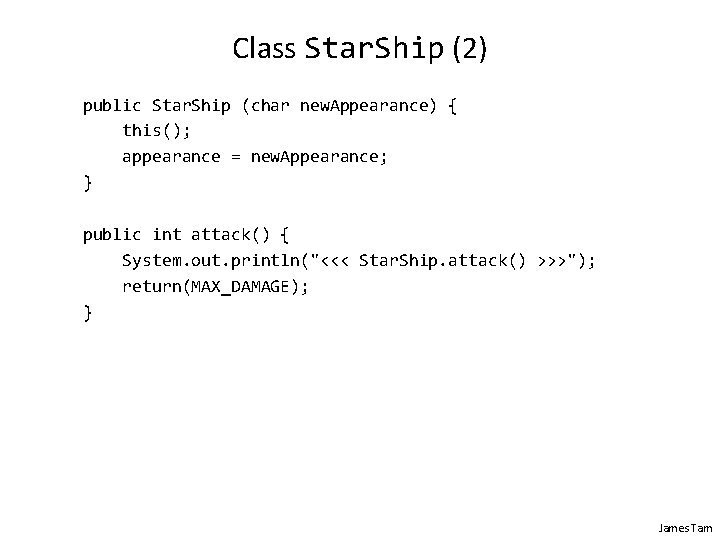
Class Star. Ship (2) public Star. Ship (char new. Appearance) { this(); appearance = new. Appearance; } public int attack() { System. out. println("<<< Star. Ship. attack() >>>"); return(MAX_DAMAGE); } James Tam
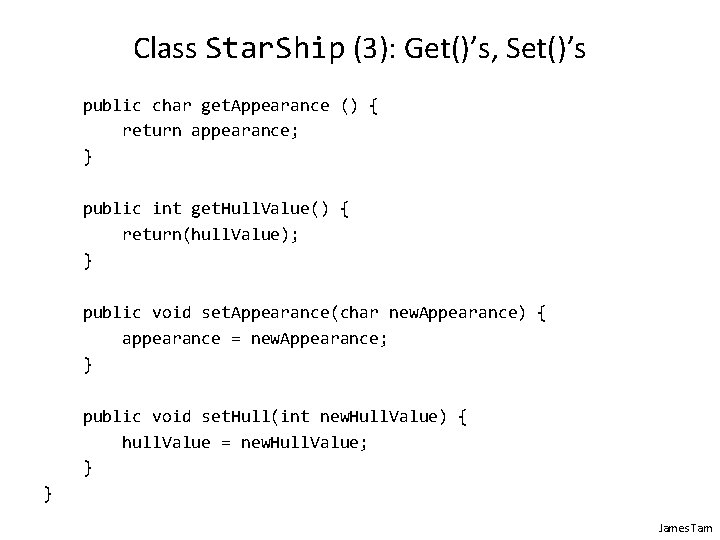
Class Star. Ship (3): Get()’s, Set()’s public char get. Appearance () { return appearance; } public int get. Hull. Value() { return(hull. Value); } public void set. Appearance(char new. Appearance) { appearance = new. Appearance; } public void set. Hull(int new. Hull. Value) { hull. Value = new. Hull. Value; } } James Tam
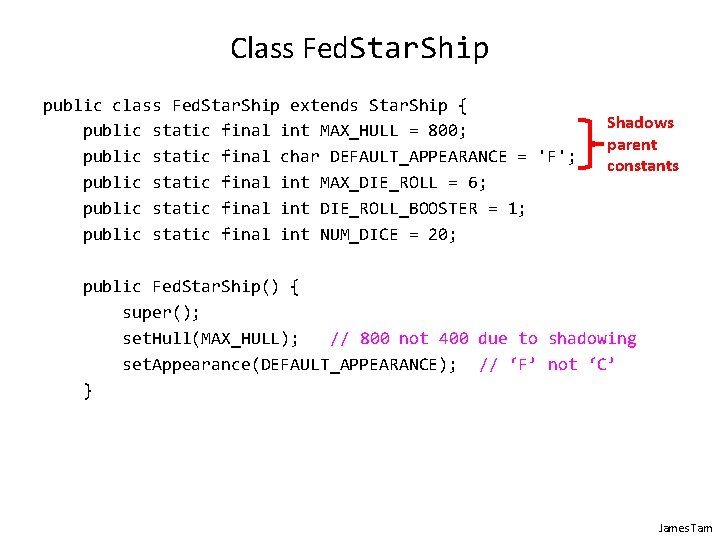
Class Fed. Star. Ship public class Fed. Star. Ship extends Star. Ship { public static final int MAX_HULL = 800; public static final char DEFAULT_APPEARANCE = 'F'; public static final int MAX_DIE_ROLL = 6; public static final int DIE_ROLL_BOOSTER = 1; public static final int NUM_DICE = 20; Shadows parent constants public Fed. Star. Ship() { super(); set. Hull(MAX_HULL); // 800 not 400 due to shadowing set. Appearance(DEFAULT_APPEARANCE); // ‘F’ not ‘C’ } James Tam
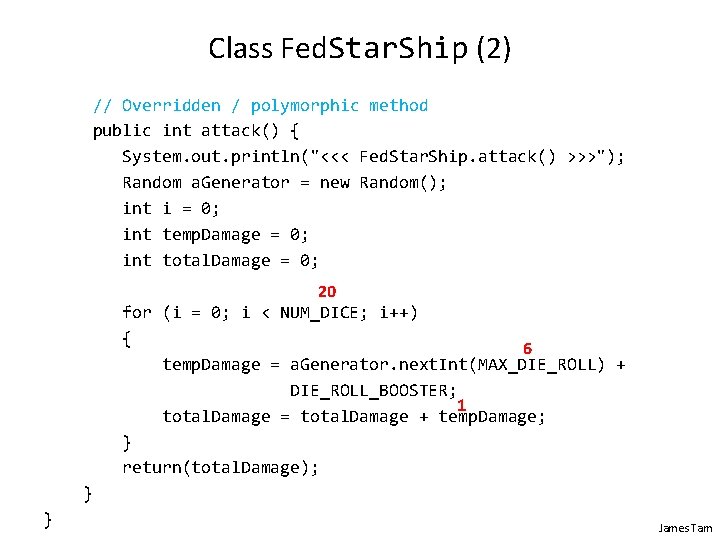
Class Fed. Star. Ship (2) // Overridden / polymorphic method public int attack() { System. out. println("<<< Fed. Star. Ship. attack() >>>"); Random a. Generator = new Random(); int i = 0; int temp. Damage = 0; int total. Damage = 0; 20 for (i = 0; i < NUM_DICE; i++) { 6 temp. Damage = a. Generator. next. Int(MAX_DIE_ROLL) + DIE_ROLL_BOOSTER; 1 total. Damage = total. Damage + temp. Damage; } return(total. Damage); } } James Tam
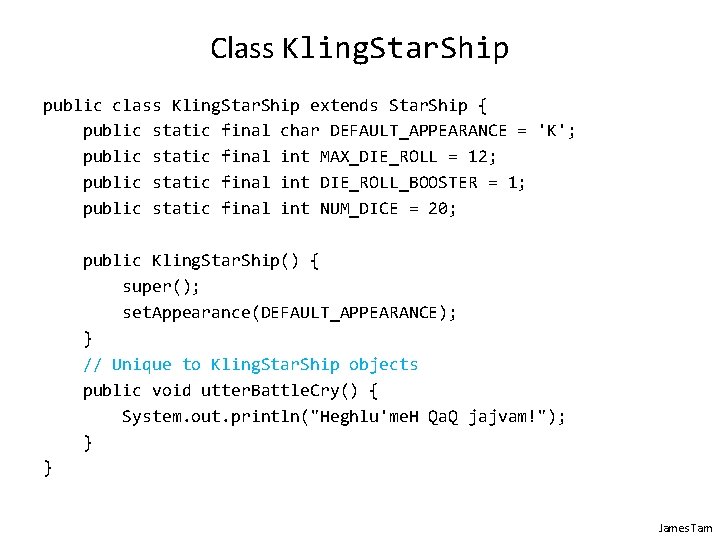
Class Kling. Star. Ship public class Kling. Star. Ship extends Star. Ship { public static final char DEFAULT_APPEARANCE = 'K'; public static final int MAX_DIE_ROLL = 12; public static final int DIE_ROLL_BOOSTER = 1; public static final int NUM_DICE = 20; public Kling. Star. Ship() { super(); set. Appearance(DEFAULT_APPEARANCE); } // Unique to Kling. Star. Ship objects public void utter. Battle. Cry() { System. out. println("Heghlu'me. H Qa. Q jajvam!"); } } James Tam
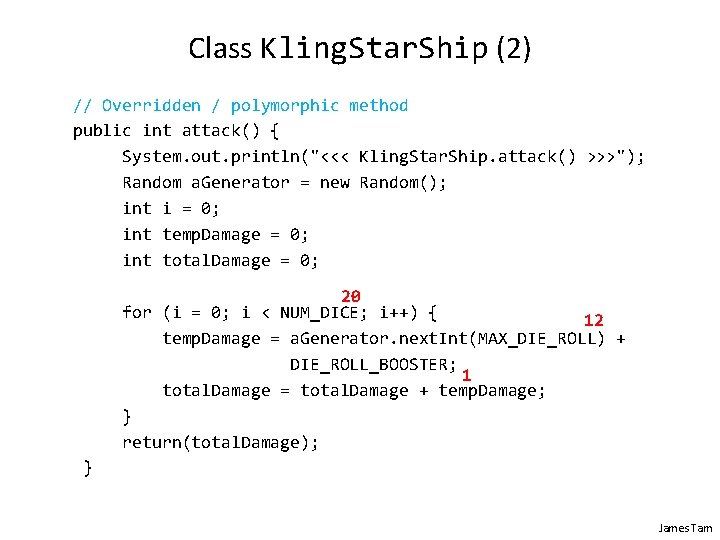
Class Kling. Star. Ship (2) // Overridden / polymorphic method public int attack() { System. out. println("<<< Kling. Star. Ship. attack() >>>"); Random a. Generator = new Random(); int i = 0; int temp. Damage = 0; int total. Damage = 0; 20 for (i = 0; i < NUM_DICE; i++) { 12 temp. Damage = a. Generator. next. Int(MAX_DIE_ROLL) + DIE_ROLL_BOOSTER; 1 total. Damage = total. Damage + temp. Damage; } return(total. Damage); } James Tam
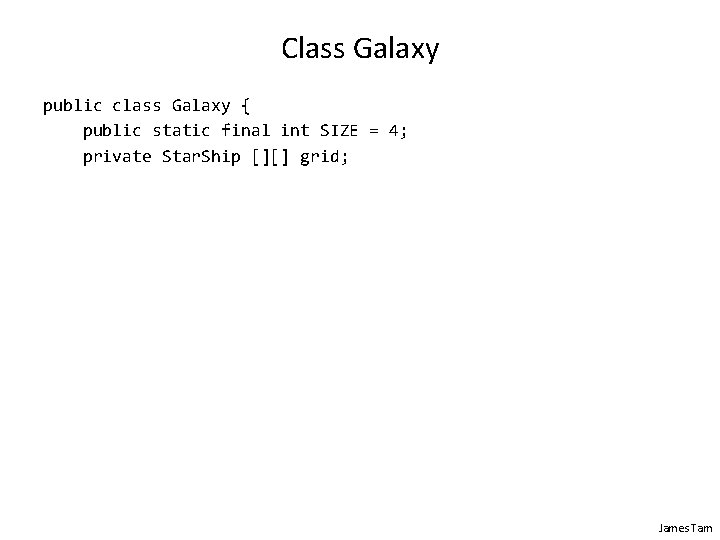
Class Galaxy public class Galaxy { public static final int SIZE = 4; private Star. Ship [][] grid; James Tam
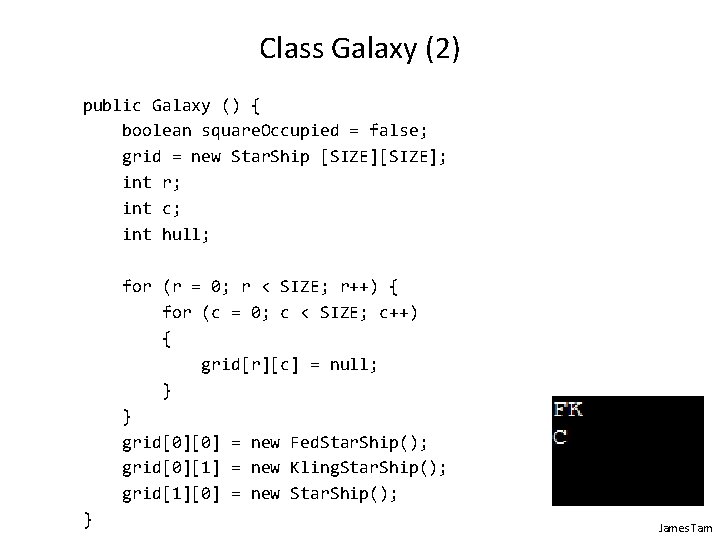
Class Galaxy (2) public Galaxy () { boolean square. Occupied = false; grid = new Star. Ship [SIZE]; int r; int c; int hull; for (r = 0; r < SIZE; r++) { for (c = 0; c < SIZE; c++) { grid[r][c] = null; } } grid[0][0] = new Fed. Star. Ship(); grid[0][1] = new Kling. Star. Ship(); grid[1][0] = new Star. Ship(); } James Tam
![Class Galaxy (3) public void run. Simulated. Attacks() { int damage; damage = grid[0][0].](http://slidetodoc.com/presentation_image_h2/08d1a4aea19795df2a93a6c287d524fe/image-73.jpg "Class Galaxy (3) public void run. Simulated. Attacks() { int damage; damage = grid[0][0].")
Class Galaxy (3) public void run. Simulated. Attacks() { int damage; damage = grid[0][0]. attack(); System. out. println("Fed ship attacks for: " + damage); System. out. println(); Type check not needed because: attack() method is overridden / polymorphic damage = grid[0][1]. attack(); System. out. println("Kling ship attacks for: " + damage); System. out. println(); damage = grid[1][0]. attack(); System. out. println("Old style ship attacks for: " + damage); System. out. println(); James Tam
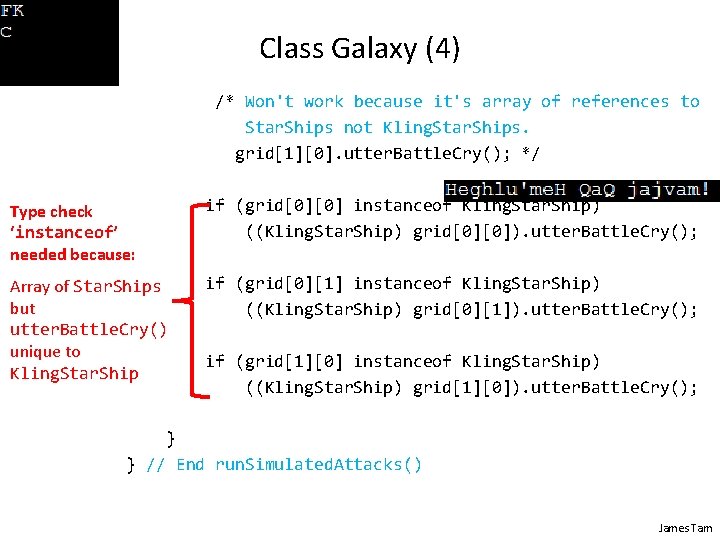
Class Galaxy (4) /* Won't work because it's array of references to Star. Ships not Kling. Star. Ships. grid[1][0]. utter. Battle. Cry(); */ Type check ‘instanceof’ needed because: if (grid[0][0] instanceof Kling. Star. Ship) ((Kling. Star. Ship) grid[0][0]). utter. Battle. Cry(); Array of Star. Ships but utter. Battle. Cry() unique to Kling. Star. Ship if (grid[0][1] instanceof Kling. Star. Ship) ((Kling. Star. Ship) grid[0][1]). utter. Battle. Cry(); if (grid[1][0] instanceof Kling. Star. Ship) ((Kling. Star. Ship) grid[1][0]). utter. Battle. Cry(); } } // End run. Simulated. Attacks() James Tam
![Driver Class: Space. Simulator public class Space. Simulator { public static void main(String []](http://slidetodoc.com/presentation_image_h2/08d1a4aea19795df2a93a6c287d524fe/image-75.jpg "Driver Class: Space. Simulator public class Space. Simulator { public static void main(String []")
Driver Class: Space. Simulator public class Space. Simulator { public static void main(String [] args) { Galaxy alpha = new Galaxy(); alpha. display(); alpha. run. Simulated. Attacks(); } } James Tam
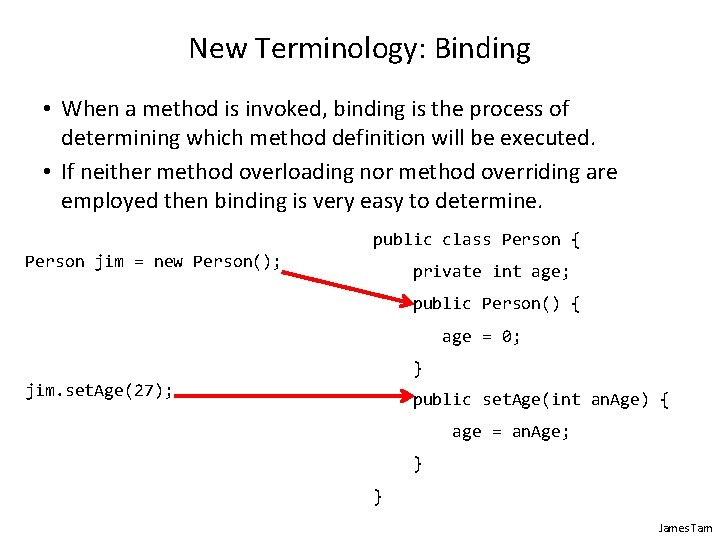
New Terminology: Binding • When a method is invoked, binding is the process of determining which method definition will be executed. • If neither method overloading nor method overriding are employed then binding is very easy to determine. public class Person { Person jim = new Person(); private int age; public Person() { age = 0; } jim. set. Age(27); public set. Age(int an. Age) { age = an. Age; } } James Tam
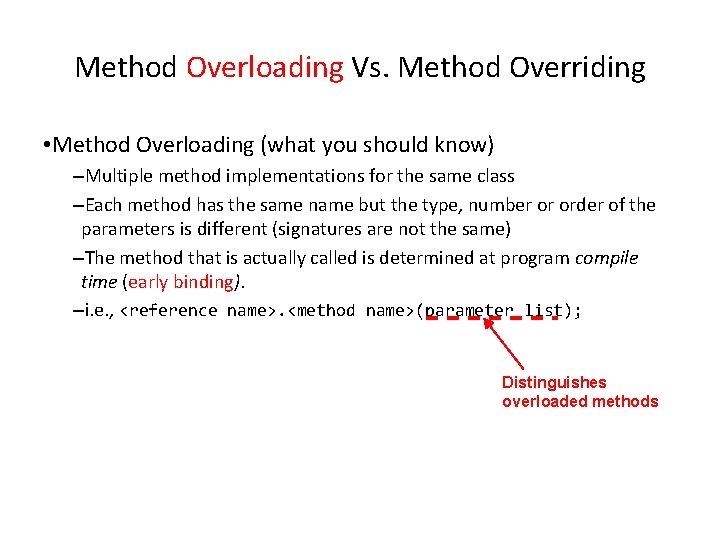
Method Overloading Vs. Method Overriding • Method Overloading (what you should know) –Multiple method implementations for the same class –Each method has the same name but the type, number or order of the parameters is different (signatures are not the same) –The method that is actually called is determined at program compile time (early binding). –i. e. , <reference name>. <method name>(parameter list); Distinguishes overloaded methods
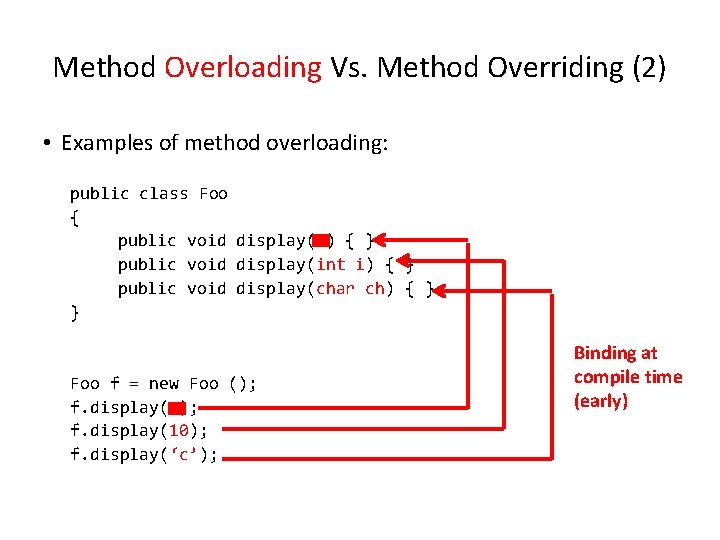
Method Overloading Vs. Method Overriding (2) • Examples of method overloading: public class Foo { public void display( ) { } public void display(int i) { } public void display(char ch) { } } Foo f = new Foo (); f. display(10); f. display(‘c’); Binding at compile time (early)
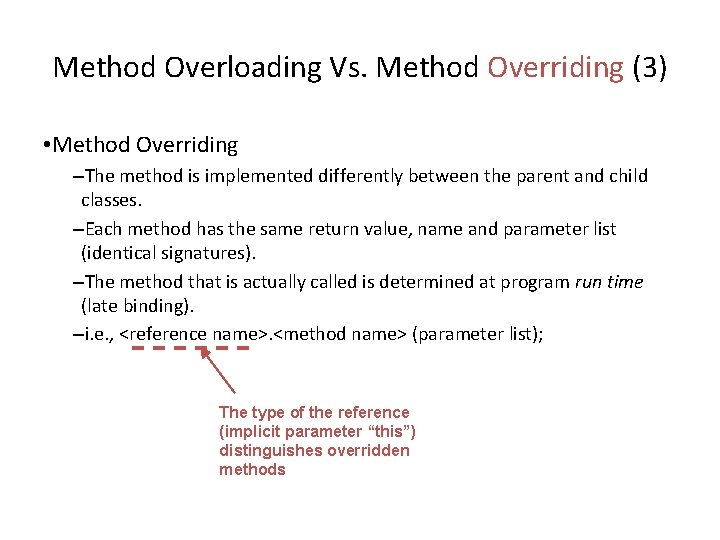
Method Overloading Vs. Method Overriding (3) • Method Overriding –The method is implemented differently between the parent and child classes. –Each method has the same return value, name and parameter list (identical signatures). –The method that is actually called is determined at program run time (late binding). –i. e. , <reference name>. <method name> (parameter list); The type of the reference (implicit parameter “this”) distinguishes overridden methods
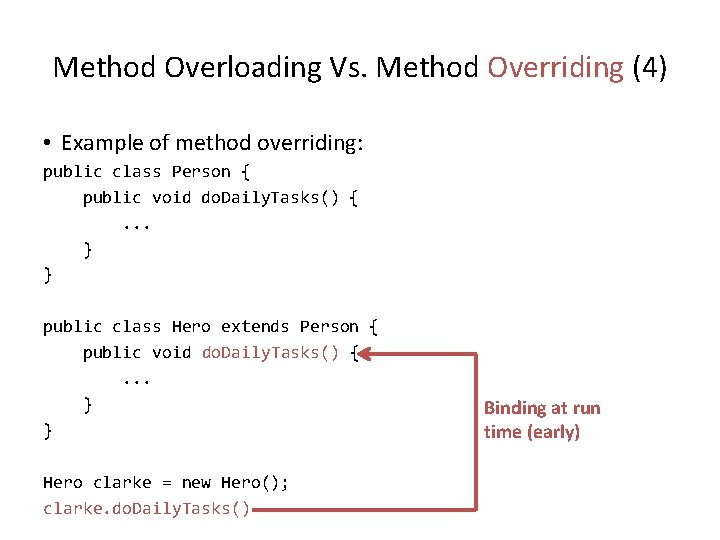
Method Overloading Vs. Method Overriding (4) • Example of method overriding: public class Person { public void do. Daily. Tasks() {. . . } } public class Hero extends Person { public void do. Daily. Tasks() {. . . } } Hero clarke = new Hero(); clarke. do. Daily. Tasks() Binding at run time (early)
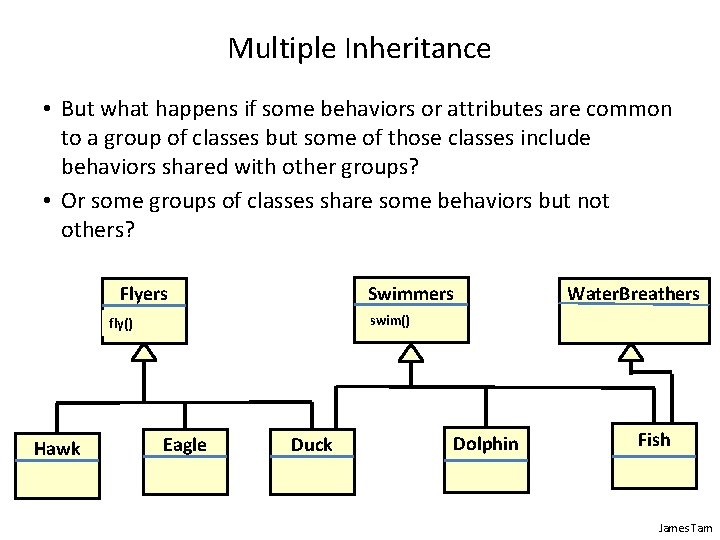
Multiple Inheritance • But what happens if some behaviors or attributes are common to a group of classes but some of those classes include behaviors shared with other groups? • Or some groups of classes share some behaviors but not others? Swimmers Flyers swim() fly() Hawk Water. Breathers Eagle Duck Dolphin Fish James Tam
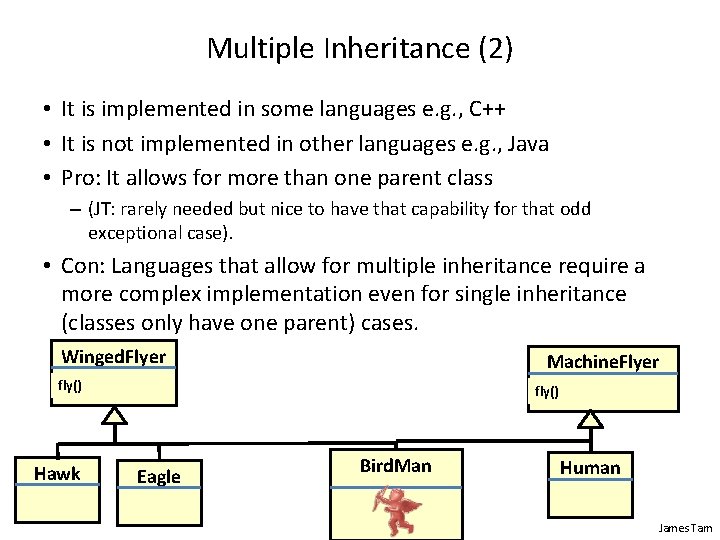
Multiple Inheritance (2) • It is implemented in some languages e. g. , C++ • It is not implemented in other languages e. g. , Java • Pro: It allows for more than one parent class – (JT: rarely needed but nice to have that capability for that odd exceptional case). • Con: Languages that allow for multiple inheritance require a more complex implementation even for single inheritance (classes only have one parent) cases. Winged. Flyer Machine. Flyer fly() Hawk fly() Eagle Bird. Man Human James Tam
Java Interfaces • Similar to a class • Provides a design guide rather than implementation details • Specifies what methods should be implemented but not how – An important design tool: Agreement for the interfaces should occur very early before program code has been written. – (Specify the signature of methods so each part of the project can proceed with minimal coupling between classes). – Changing the method body rather than the method signature won’t ‘break’ code. • It’s a design tool so they cannot be instantiated
Interfaces: Format for defining an interface public interface <name of interface> { constants methods to be implemented by the class that realizes this interface } Format for realizing / implementing the interface public class <name of class> implements <name of interface> { attributes methods actually implemented by this class }
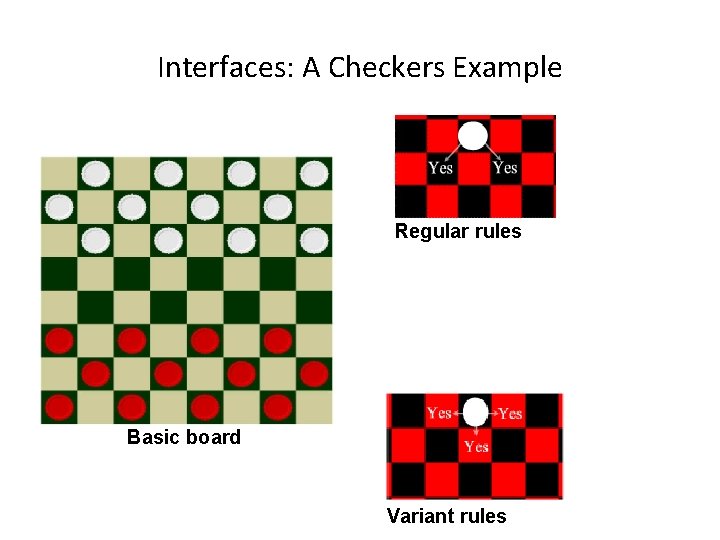
Interfaces: A Checkers Example Regular rules Basic board Variant rules
Interface Board public interface Board { public static final int SIZE = 8; public void display. Board(); public void initialize. Board(); public void move. Piece(); boolean move. Valid(int x. Source, int y. Source, int x. Destination, int y. Destination); . . . }
Class Regular. Board public class Regular. Board implements Board { public void display. Board() {. . . } public void initialize. Board() {. . . }
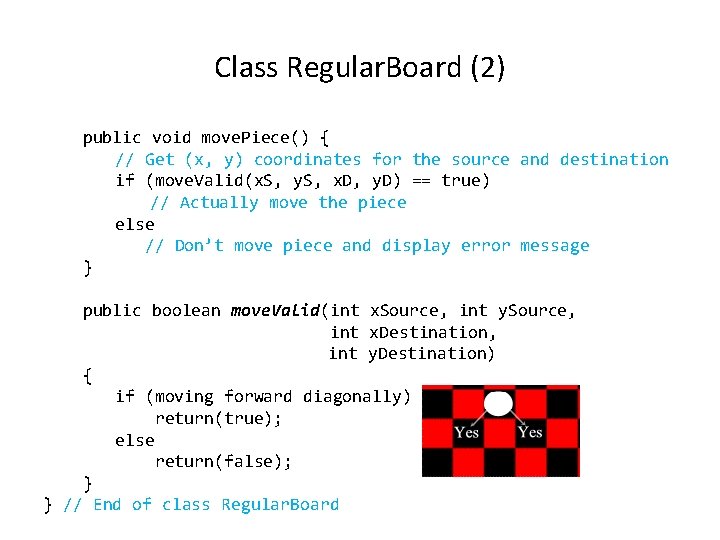
Class Regular. Board (2) public void move. Piece() { // Get (x, y) coordinates for the source and destination if (move. Valid(x. S, y. S, x. D, y. D) == true) // Actually move the piece else // Don’t move piece and display error message } public boolean move. Valid(int x. Source, int y. Source, int x. Destination, int y. Destination) { if (moving forward diagonally) return(true); else return(false); } } // End of class Regular. Board
Class Variant. Board public class Variant. Board implements Board { public void display. Board () {. . . } public void initialize. Board () {. . . }
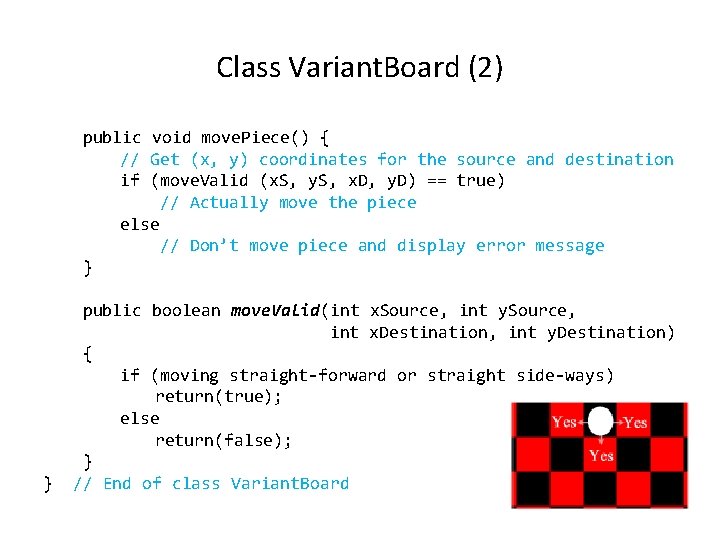
Class Variant. Board (2) public void move. Piece() { // Get (x, y) coordinates for the source and destination if (move. Valid (x. S, y. S, x. D, y. D) == true) // Actually move the piece else // Don’t move piece and display error message } } public boolean move. Valid(int x. Source, int y. Source, int x. Destination, int y. Destination) { if (moving straight-forward or straight side-ways) return(true); else return(false); } // End of class Variant. Board
Interfaces: Recapping The Example • Interface Board – No state (variable data) or behavior (body of the method is empty) – Specifies the behaviors that a board should exhibit e. g. , clear screen – This is done by listing the methods that must be implemented by classes that implement the interface. • Class Regular. Board and Variant. Board – Can have state and methods – They must implement all the methods specified by the interface ‘Board’ (but can also implement other methods too)
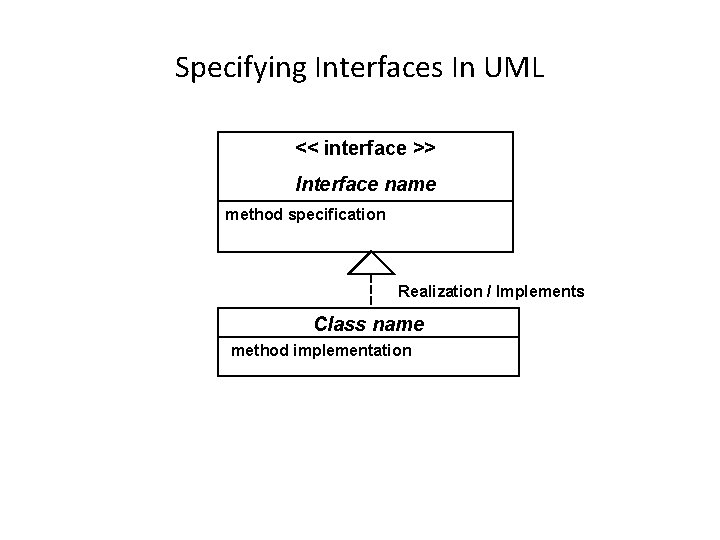
Specifying Interfaces In UML << interface >> Interface name method specification Realization / Implements Class name method implementation
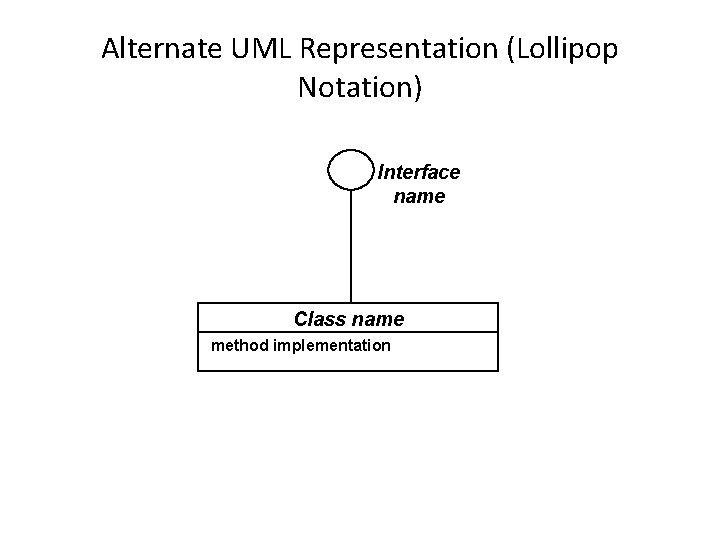
Alternate UML Representation (Lollipop Notation) Interface name Class name method implementation
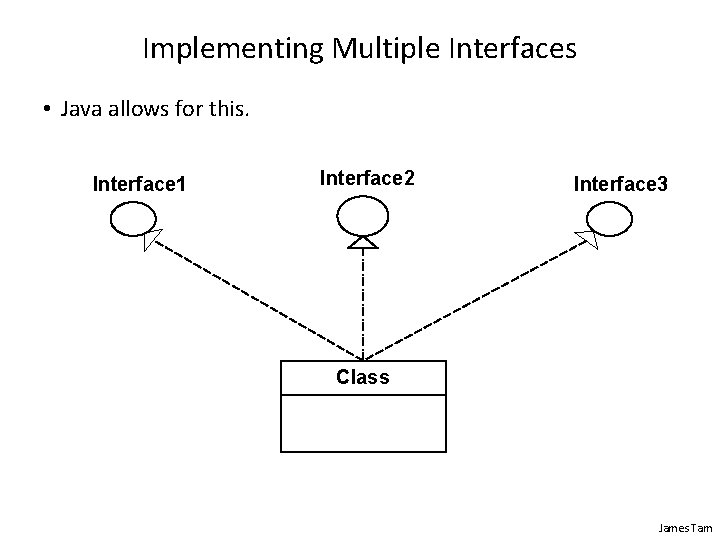
Implementing Multiple Interfaces • Java allows for this. Interface 1 Interface 2 Interface 3 Class James Tam
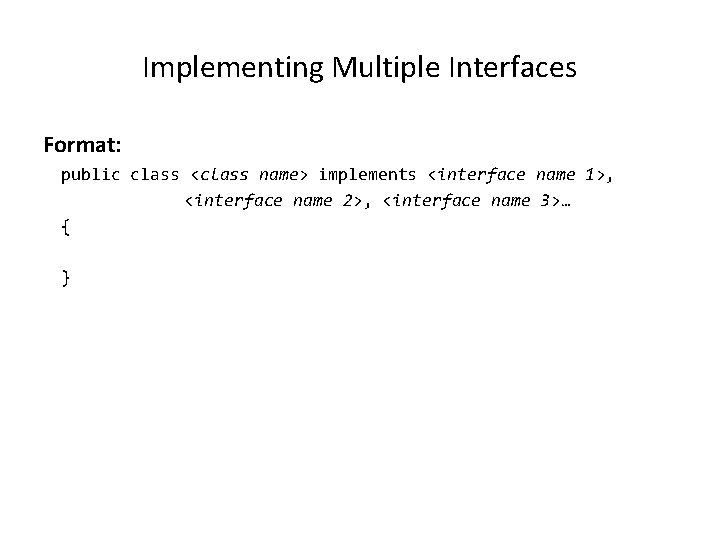
Implementing Multiple Interfaces Format: public class <class name> implements <interface name 1>, <interface name 2>, <interface name 3>… { }
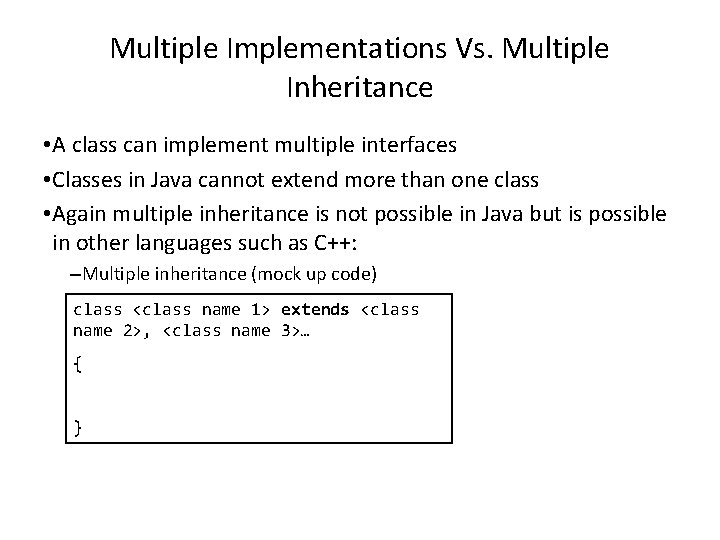
Multiple Implementations Vs. Multiple Inheritance • A class can implement multiple interfaces • Classes in Java cannot extend more than one class • Again multiple inheritance is not possible in Java but is possible in other languages such as C++: –Multiple inheritance (mock up code) class <class name 1> extends <class name 2>, <class name 3>… { }
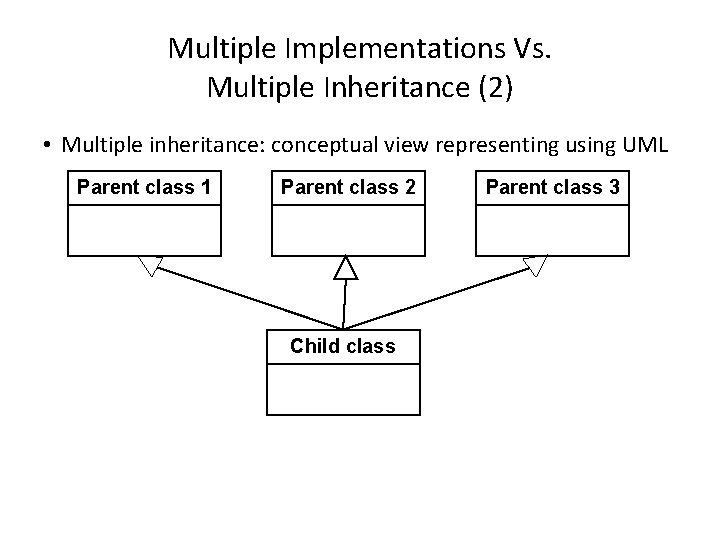
Multiple Implementations Vs. Multiple Inheritance (2) • Multiple inheritance: conceptual view representing using UML Parent class 1 Parent class 2 Child class Parent class 3
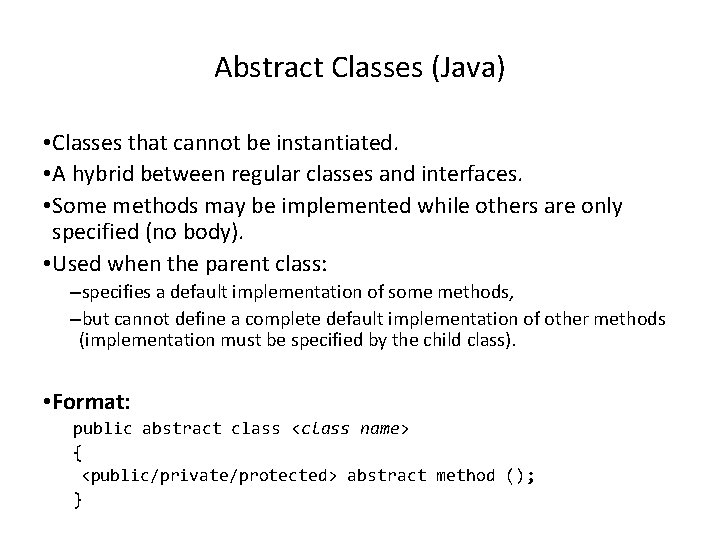
Abstract Classes (Java) • Classes that cannot be instantiated. • A hybrid between regular classes and interfaces. • Some methods may be implemented while others are only specified (no body). • Used when the parent class: –specifies a default implementation of some methods, –but cannot define a complete default implementation of other methods (implementation must be specified by the child class). • Format: public abstract class <class name> { <public/private/protected> abstract method (); }
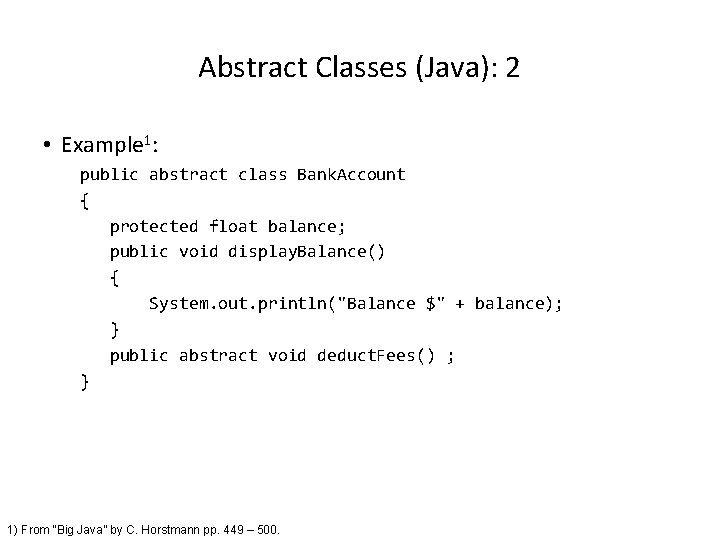
Abstract Classes (Java): 2 • Example 1: public abstract class Bank. Account { protected float balance; public void display. Balance() { System. out. println("Balance $" + balance); } public abstract void deduct. Fees() ; } 1) From “Big Java” by C. Horstmann pp. 449 – 500.
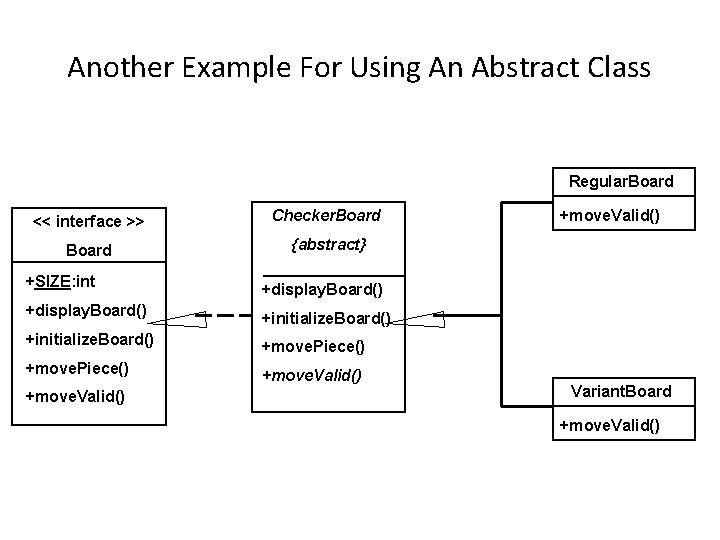
Another Example For Using An Abstract Class Regular. Board << interface >> Checker. Board {abstract} +SIZE: int +display. Board() +initialize. Board() +move. Piece() +move. Valid() Variant. Board +move. Valid()
You Should Now Know • What is inheritance, when to employ it, how to employ it in Java • How casting works within an inheritance hierarchy • When the instanceof operator should and should not be used to check for type in an inheritance hierarchy • What is the effect of the keyword "final" on inheritance relationships • What is method overriding • How does it differ from method overloading • What is polymorphism • What are the benefits of employing inheritance James Tam
You Should Now Know (2) • How does the ‘protected’ level of access permission work, how do private and public access permissions work with an inheritance hierarchy. – Under what situations should each level of permission be employed • Updated scoping rules (includes inheritance) and how shadowing works with an inheritance hierarchy • How the ‘super’ keyword works, when it is and is not needed • Class Object is the parent of all classes in Java – Capabilities inherited from the parent (if you refer to the API for class Object) • How homogeneous composite types (such as arrays) can appear to contain multiple types within one container James Tam
You Should Now Know (3) • What are interfaces/types – How do types differ from classes – How to implement and use interfaces in Java – When interfaces should be employed • What are abstract classes in Java and how do they differ from non-abstract classes and interfaces. – When to employ abstract classes vs. interfaces vs. ‘regular’ classes • How to read/write UML notations for inheritance and interfaces. • What is the difference between early and late binding • What is multiple inheritance – How does it differ from multiple implementations – What are its advantages and disadvantages James Tam
- Slides: 103