
Code Red Worm Propagation Modeling and Analysis Zou
![Two-Factor Model Math • d. I(t)/dt = β(t)[N - R(t) - I(t) - Q(t)]I(t)](https://slidetodoc.com/presentation_image_h/75fc882759df27940750db387be68c92/image-10.jpg "Two-Factor Model Math • d. I(t)/dt = β(t)[N - R(t) - I(t) - Q(t)]I(t)")
- Slides: 12
Code Red Worm Propagation Modeling and Analysis Zou, Gong, & Towsley Michael E. Locasto March 4, 2003 Paper # 46
Overview • Code Red incident data & impact • epidemiology models – traditional (biological) infection models – two-factor worm model • related work & questions – (Weaver & Sapphire)
Motivation • Internet great medium for spreading malicious code – Code Red & Co. renew interest in worm studies • Issues: – How to explain worm propagation curves? – What factors affect spreading behavior? – Can we generate a more accurate model?
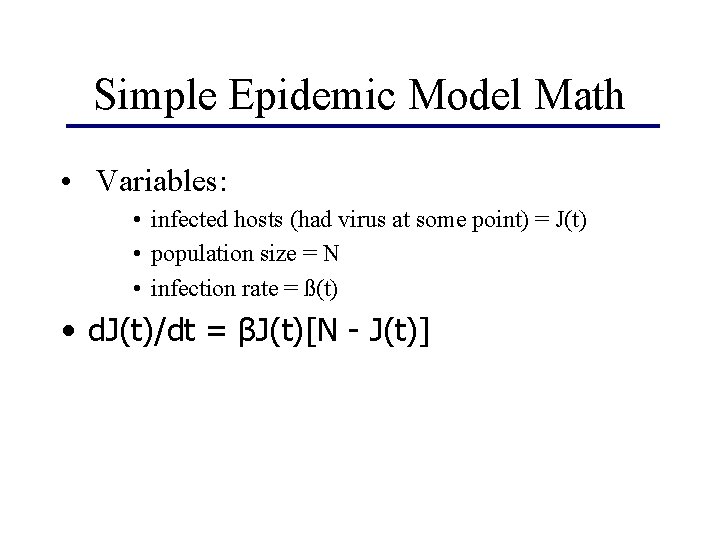
Epidemic Models • Deterministic vs. Stochastic – Simple epidemic model (paper #45) – general epidemic model (Kermack-Mckendrick add notion of removed hosts) • good baseline, need to be adjusted to explain Internet worm data • any model must be deterministic (b/c of scale)
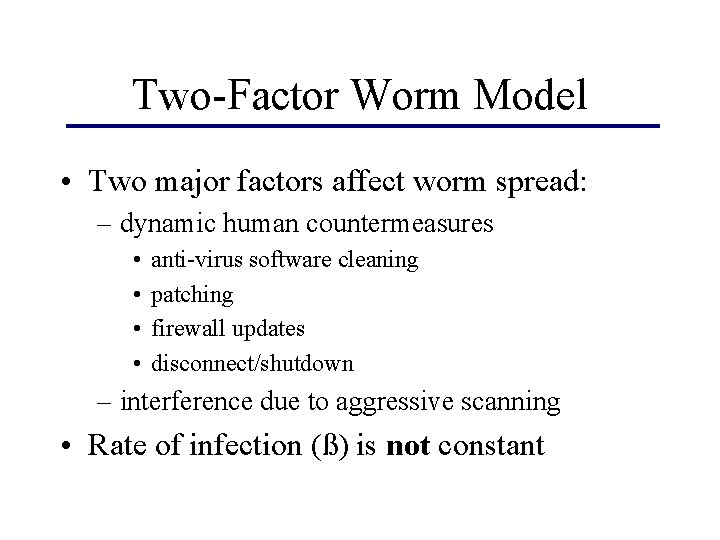
Two-Factor Worm Model • Two major factors affect worm spread: – dynamic human countermeasures • • anti-virus software cleaning patching firewall updates disconnect/shutdown – interference due to aggressive scanning • Rate of infection (ß) is not constant
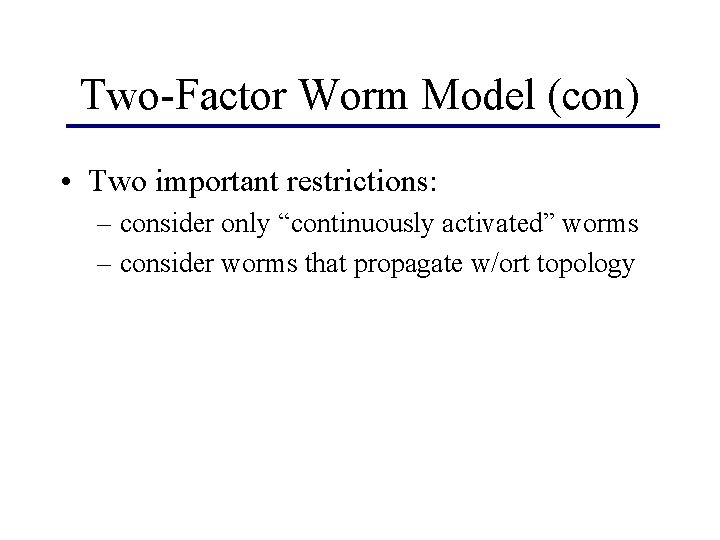
Two-Factor Worm Model (con) • Two important restrictions: – consider only “continuously activated” worms – consider worms that propagate w/ort topology
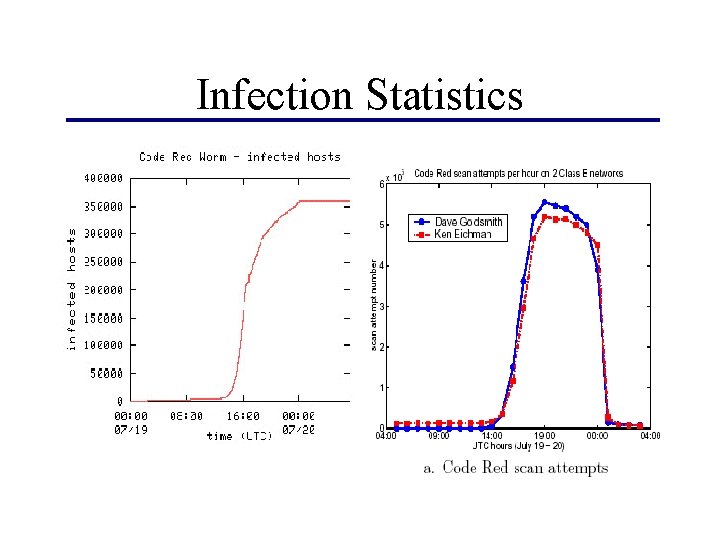
Infection Statistics
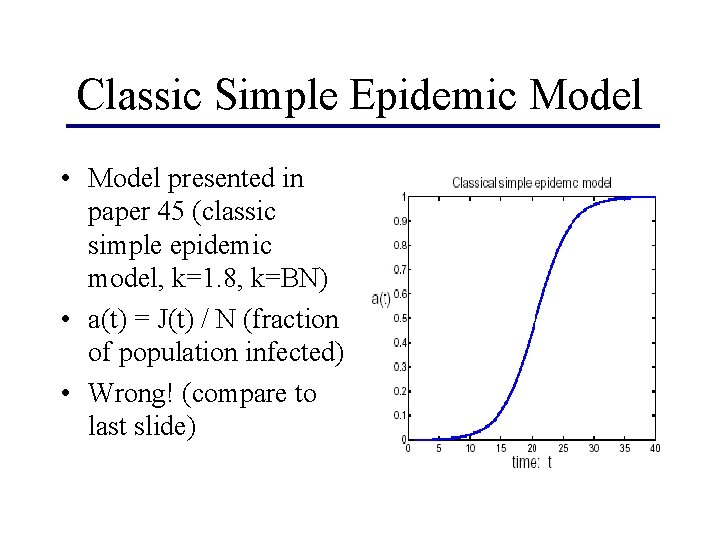
Classic Simple Epidemic Model • Model presented in paper 45 (classic simple epidemic model, k=1. 8, k=BN) • a(t) = J(t) / N (fraction of population infected) • Wrong! (compare to last slide)
Simple Epidemic Model Math • Variables: • infected hosts (had virus at some point) = J(t) • population size = N • infection rate = ß(t) • d. J(t)/dt = βJ(t)[N - J(t)]
Two-Factor Model Math • d. I(t)/dt = β(t)[N - R(t) - I(t) - Q(t)]I(t) d. R(t)/dt – – – – S(t) = susceptible hosts I(t) = infectious hosts R(t) = removed hosts from I population Q(t) = removed hosts from S population J(t) = I(t) + R(t) C(t) = R(t) + Q(t) J(t) = I(t) + R(t) N = population (I+R+Q+S)
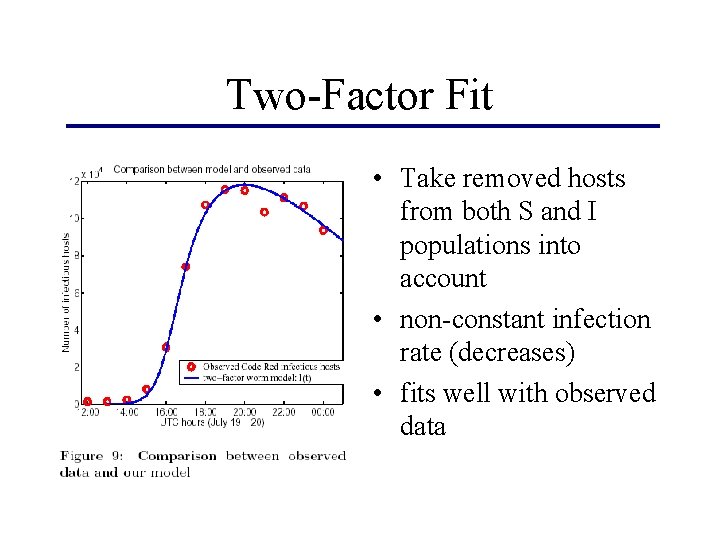
Two-Factor Fit • Take removed hosts from both S and I populations into account • non-constant infection rate (decreases) • fits well with observed data
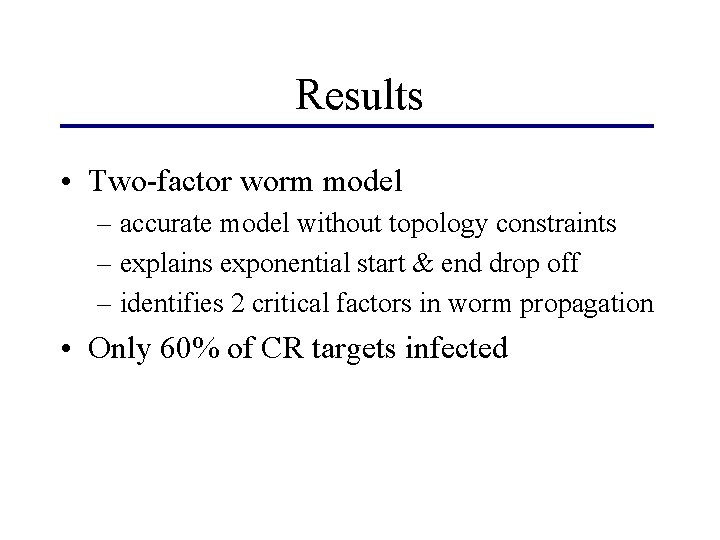
Results • Two-factor worm model – accurate model without topology constraints – explains exponential start & end drop off – identifies 2 critical factors in worm propagation • Only 60% of CR targets infected