
Code Optimization Potential Improvement Intermediate Form of the

- Slides: 25
Code Optimization
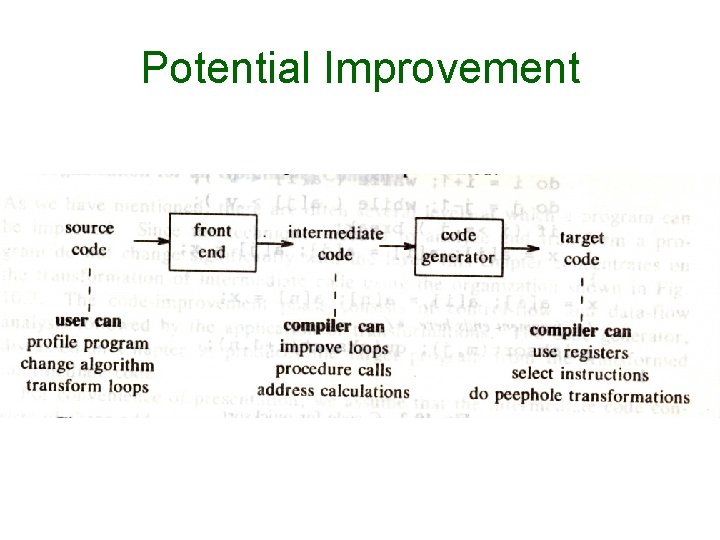
Potential Improvement
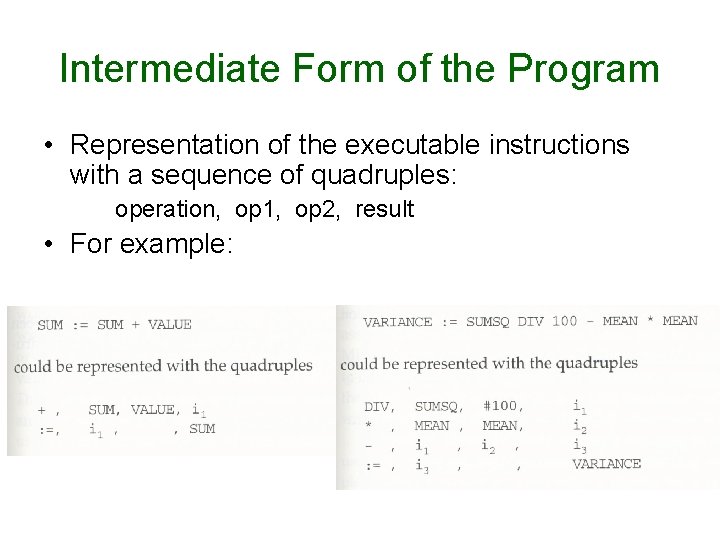
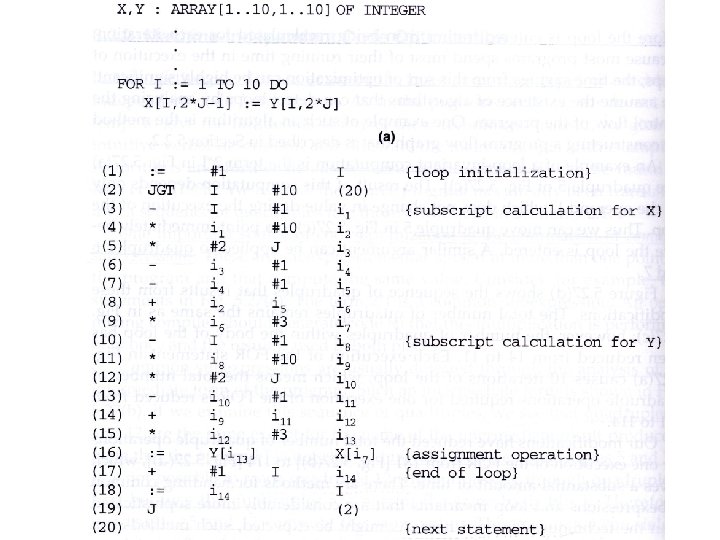
Intermediate Form of the Program • Representation of the executable instructions with a sequence of quadruples: operation, op 1, op 2, result • For example:
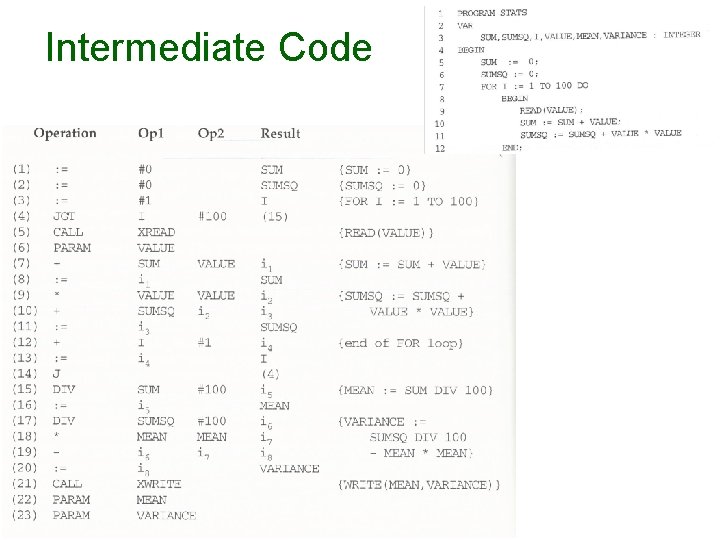
Intermediate Code
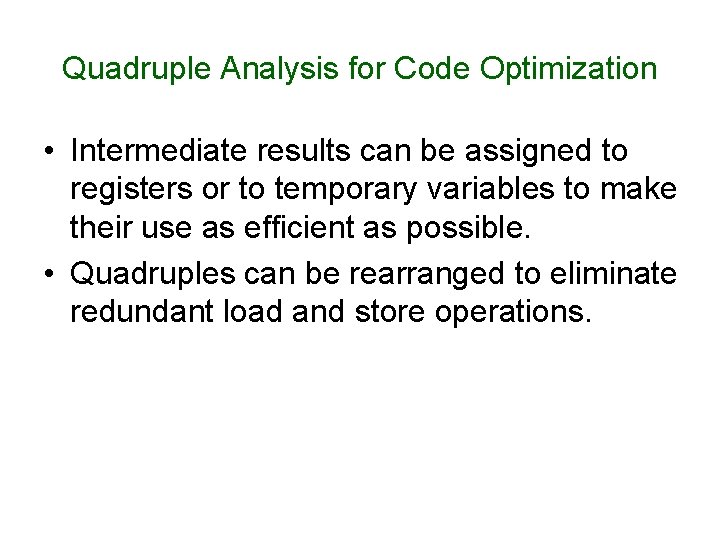
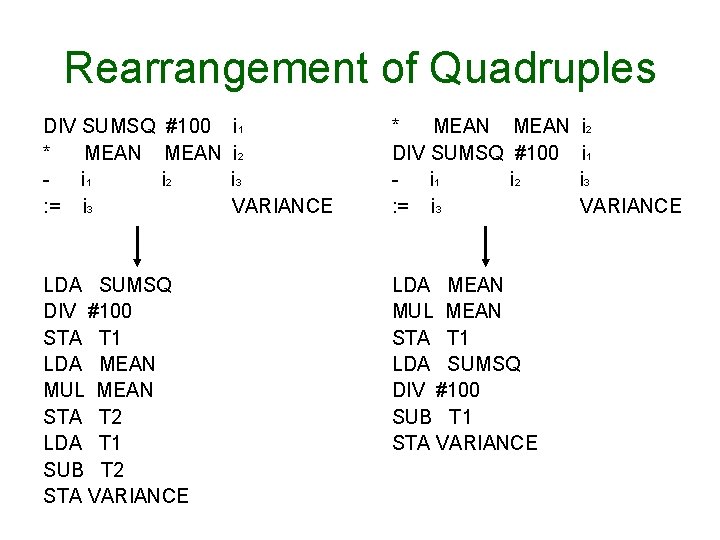
Quadruple Analysis for Code Optimization • Intermediate results can be assigned to registers or to temporary variables to make their use as efficient as possible. • Quadruples can be rearranged to eliminate redundant load and store operations.
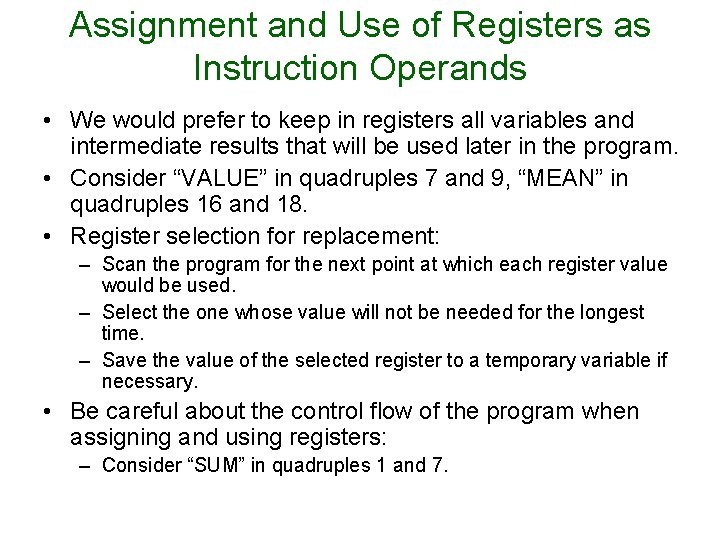
Assignment and Use of Registers as Instruction Operands • We would prefer to keep in registers all variables and intermediate results that will be used later in the program. • Consider “VALUE” in quadruples 7 and 9, “MEAN” in quadruples 16 and 18. • Register selection for replacement: – Scan the program for the next point at which each register value would be used. – Select the one whose value will not be needed for the longest time. – Save the value of the selected register to a temporary variable if necessary. • Be careful about the control flow of the program when assigning and using registers: – Consider “SUM” in quadruples 1 and 7.
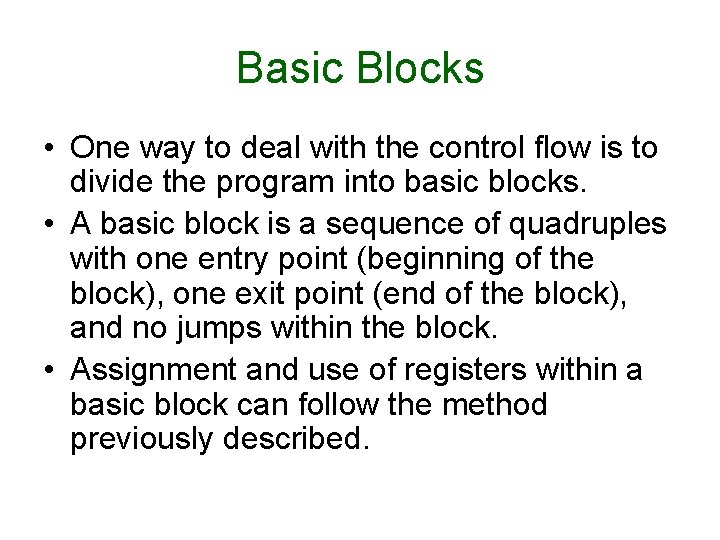
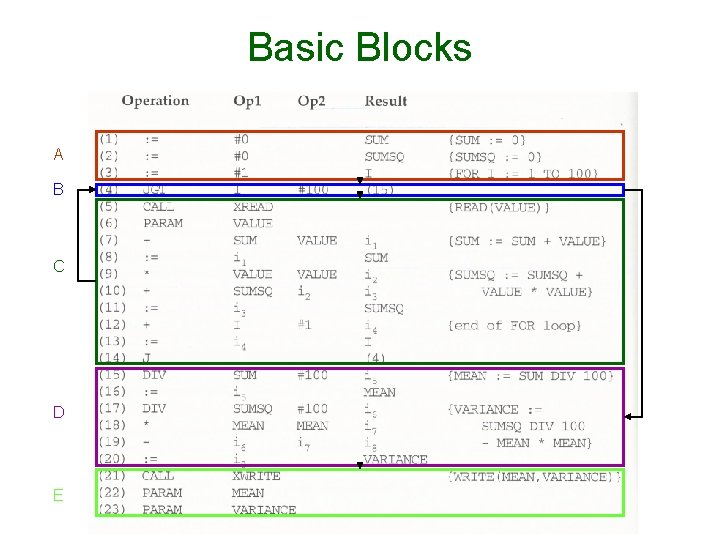
Basic Blocks • One way to deal with the control flow is to divide the program into basic blocks. • A basic block is a sequence of quadruples with one entry point (beginning of the block), one exit point (end of the block), and no jumps within the block. • Assignment and use of registers within a basic block can follow the method previously described.
Basic Blocks A B C D E
Rearrangement of Quadruples DIV SUMSQ #100 * MEAN i 1 i 2 : = i 3 LDA SUMSQ DIV #100 STA T 1 LDA MEAN MUL MEAN STA T 2 LDA T 1 SUB T 2 STA VARIANCE i 1 i 2 i 3 VARIANCE * MEAN i 2 DIV SUMSQ #100 i 1 i 2 i 3 : = i 3 VARIANCE LDA MEAN MUL MEAN STA T 1 LDA SUMSQ DIV #100 SUB T 1 STA VARIANCE
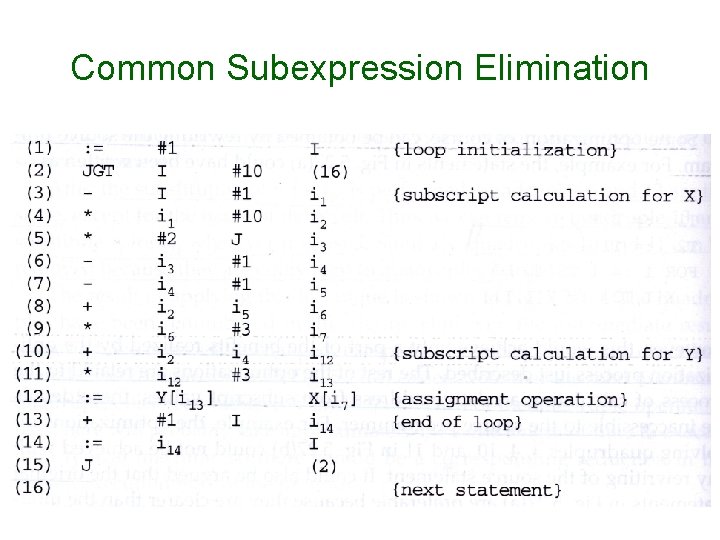
Common Subexpression Elimination
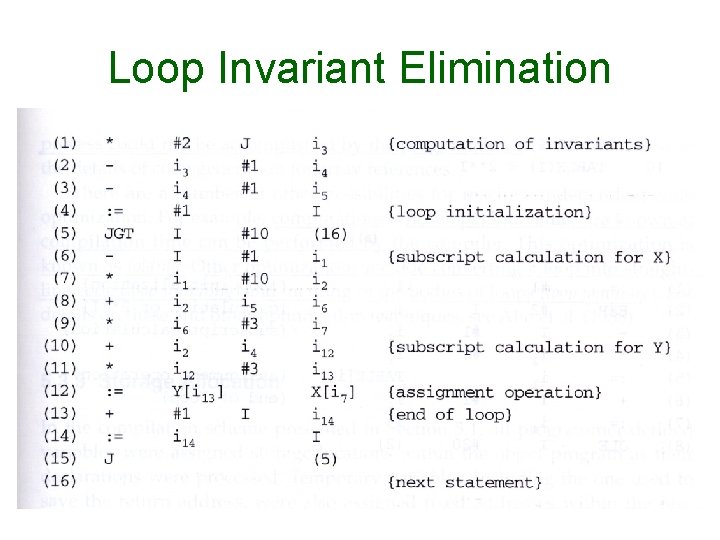
Loop Invariant Elimination
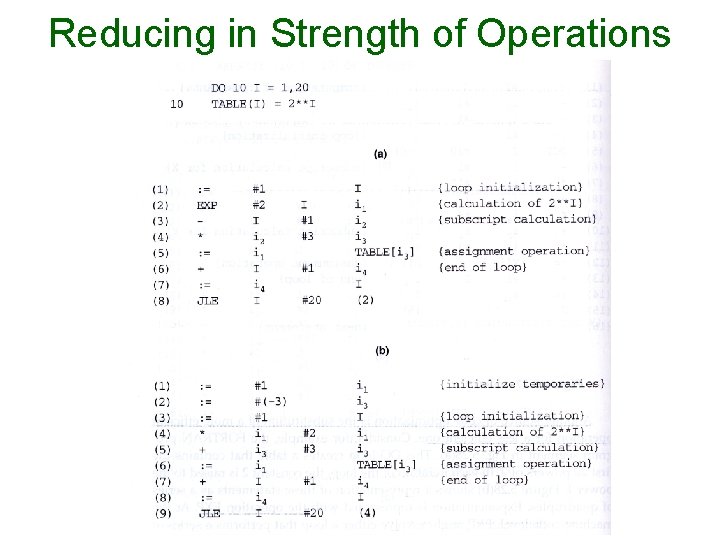
Reducing in Strength of Operations
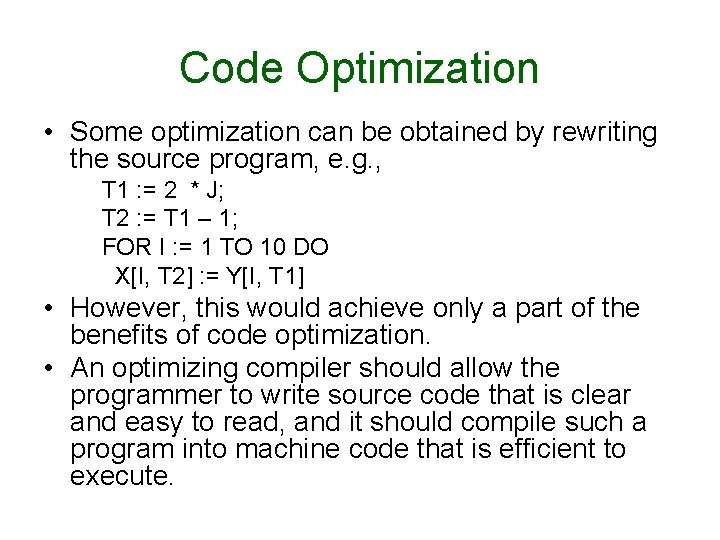
Code Optimization • Some optimization can be obtained by rewriting the source program, e. g. , T 1 : = 2 * J; T 2 : = T 1 – 1; FOR I : = 1 TO 10 DO X[I, T 2] : = Y[I, T 1] • However, this would achieve only a part of the benefits of code optimization. • An optimizing compiler should allow the programmer to write source code that is clear and easy to read, and it should compile such a program into machine code that is efficient to execute.
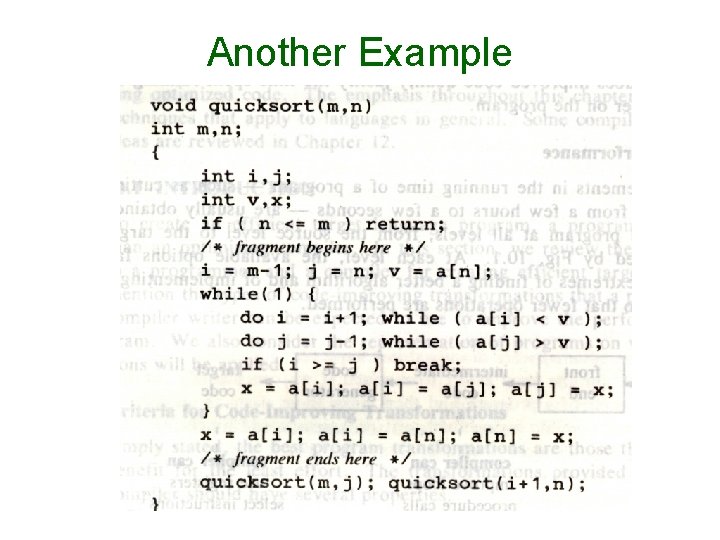
Another Example
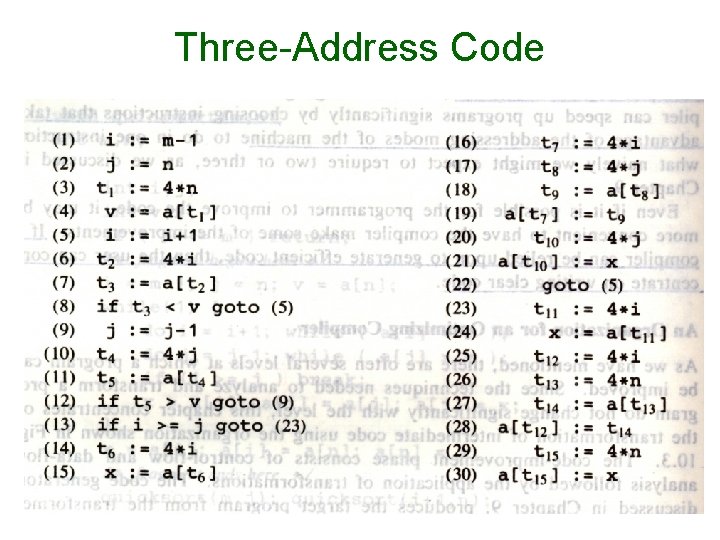
Three-Address Code
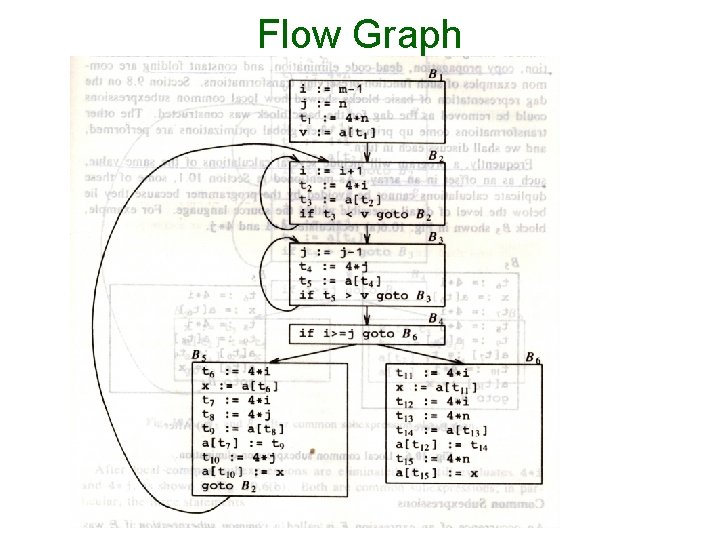
Flow Graph
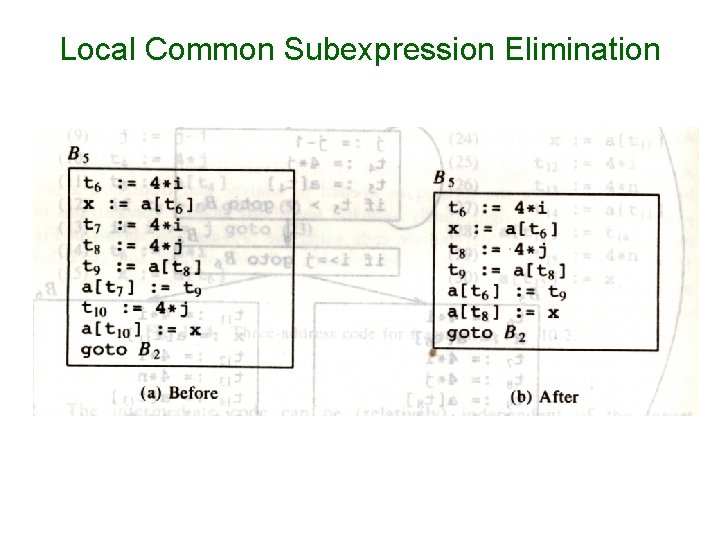
Local Common Subexpression Elimination
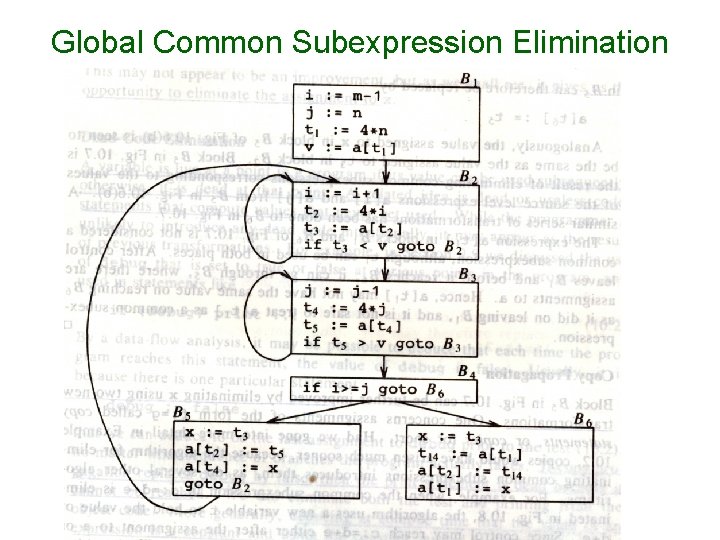
Global Common Subexpression Elimination
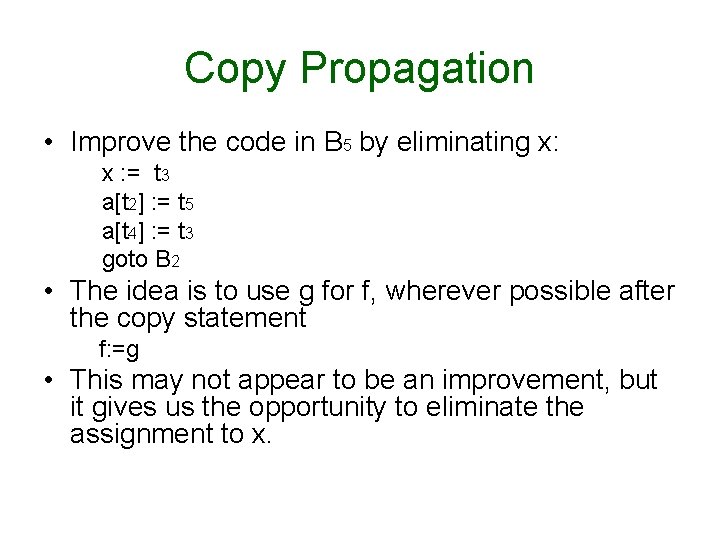
Copy Propagation • Improve the code in B 5 by eliminating x: x : = t 3 a[t 2] : = t 5 a[t 4] : = t 3 goto B 2 • The idea is to use g for f, wherever possible after the copy statement f: =g • This may not appear to be an improvement, but it gives us the opportunity to eliminate the assignment to x.
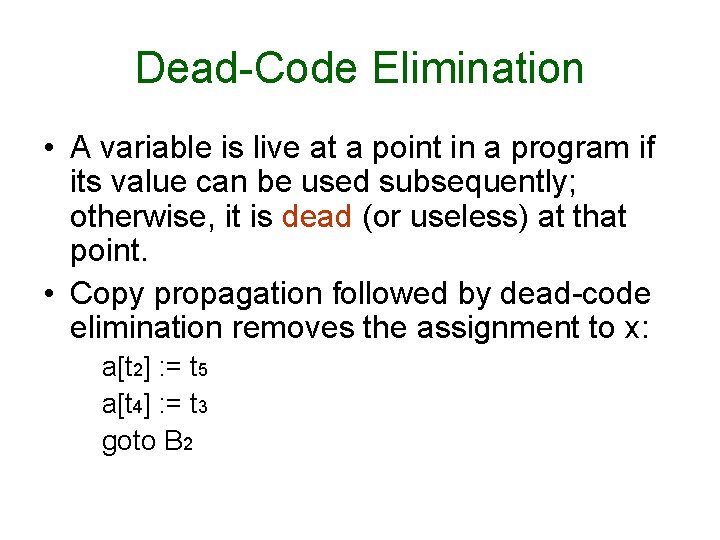
Dead-Code Elimination • A variable is live at a point in a program if its value can be used subsequently; otherwise, it is dead (or useless) at that point. • Copy propagation followed by dead-code elimination removes the assignment to x: a[t 2] : = t 5 a[t 4] : = t 3 goto B 2
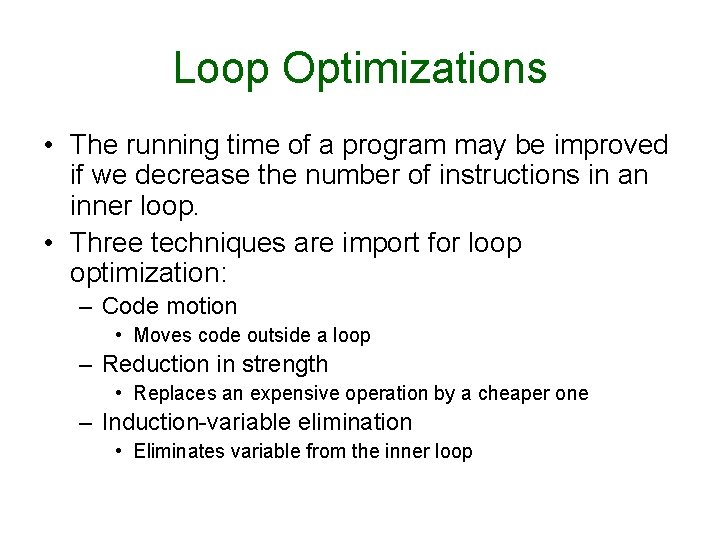
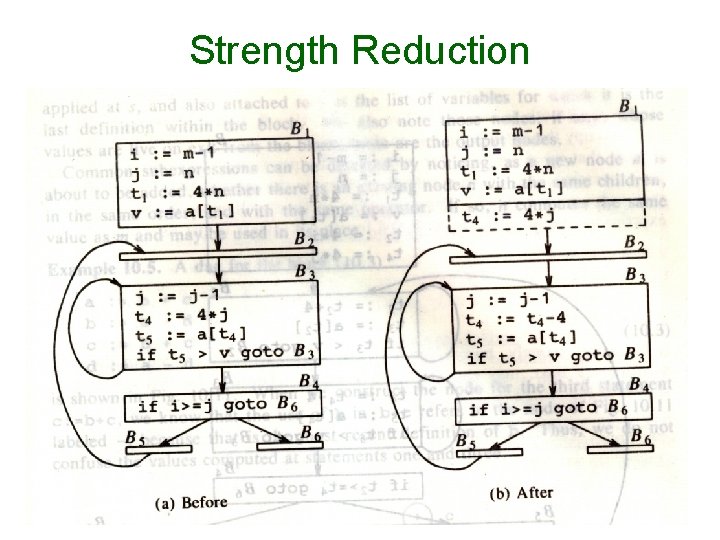
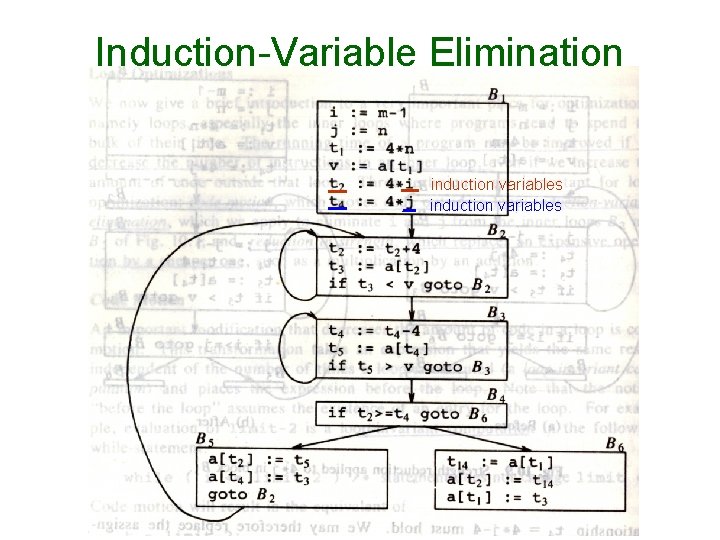
Loop Optimizations • The running time of a program may be improved if we decrease the number of instructions in an inner loop. • Three techniques are import for loop optimization: – Code motion • Moves code outside a loop – Reduction in strength • Replaces an expensive operation by a cheaper one – Induction-variable elimination • Eliminates variable from the inner loop
Strength Reduction
Induction-Variable Elimination induction variables
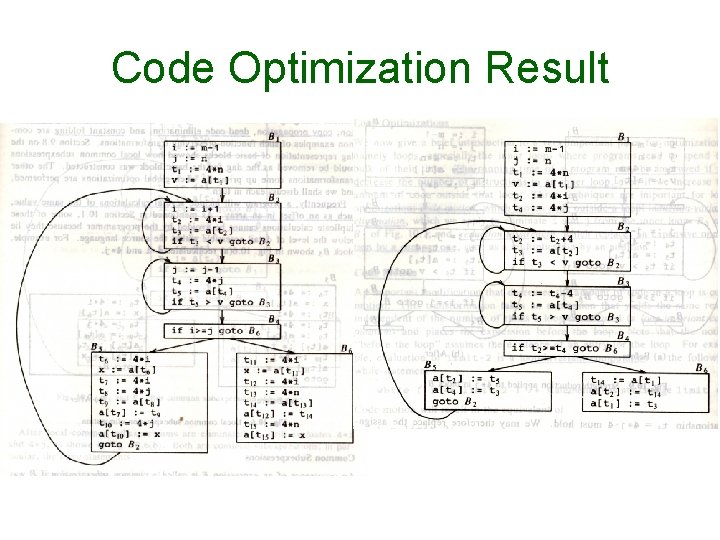
Code Optimization Result