
CODE OF ETHICS Haroon Tabraze FCA STRUCTURE OF
CODE OF ETHICS Haroon Tabraze, FCA
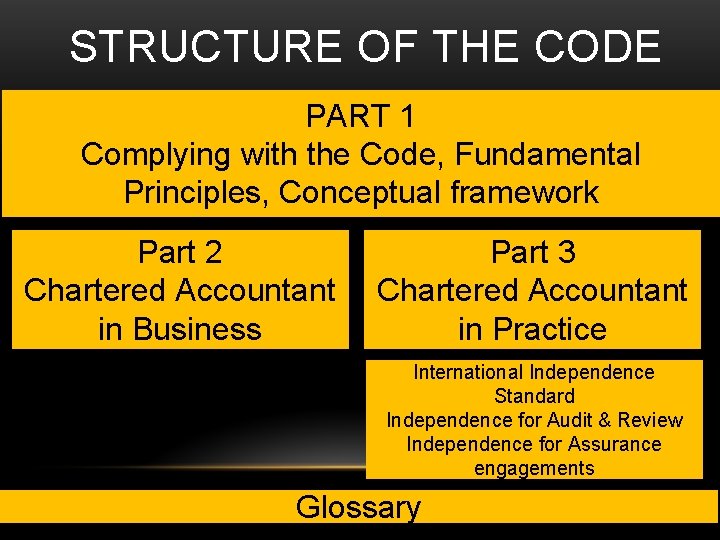
STRUCTURE OF THE CODE PART 1 Complying with the Code, Fundamental Principles, Conceptual framework Part 2 Chartered Accountant in Business Part 3 Chartered Accountant in Practice International Independence Standard Independence for Audit & Review Independence for Assurance engagements Glossary

COMPLYING WITH THE CODE • Letter R denotes requirement • Letter A provides context, explanations, suggestions R. A CA shall comply with the Code. Where laws or regulations preclude compliance, the laws and regulations prevail. R. A CA shall evaluate significance to any breach of Code that is identified, and: • Take action to address the breach satisfactorily • Determine whether to report the breach to relevant parties (professional or regulatory
FUNDAMENTAL PRINCIPLES R. A chartered accountant shall comply with each of the fundamental principles of ethics 1. Fundamental principles establish the standard of behavior expected from the CA. 2. Where CA face conflict in applying a fundamental principle with one or more other fundamental principles the CA may: • Consult within the firm • Those charged with governance • A professional body • A regulatory body • Legal Counsel
Integrity - to be straightforward and honest in all professional and business relationships. Integrity also implies fair dealing and truthfulness. A CA shall not knowingly be associated with: • Materially false or misleading information • Information furnished recklessly (willfully dangerous) • Omits or obscures information to make it misleading
Integrity Objectivity - to not allow bias, conflict of interest or undue influence of others to override professional or business judgments. Conflict of Interest is: • CA undertaking professional activity for more than one party whose interest conflict with each other
Integrity Profession al Objectivity Competenc e • Professional Competence and Due Care - to maintain professional knowledge and skill at the required level. • Competence requires (a) Attainment; and (b) Maintenance of professional competence. • To act diligently in accordance with applicable technical and professional standards. • Diligence means to be careful, thorough and timely.
Integrity Profession al Confidentia Objectivity Competenc lity e Confidentiality - to respect the confidentiality of information acquired as a result of professional and business relationships and, therefore, not disclose any such information to third parties without proper and specific authority, unless there is a legal or professional right or duty to disclose. Disclosure is required by law when: • Documents are required in the course of legal proceedings; or • There is a professional duty or right to disclose, when
Integrity Profession al Confidentia Objectivity Competenc lity e Professional Behavior - to comply with relevant laws and regulations and avoid any action that discredits the profession. A CA shall not engage in any business, occupation or activity that might impair the integrity, objectivity or reputation of the profession.
THE CONCEPTUAL FRAMEWORK Conceptual framework specifies an approach for a CA to: • Identify threats to compliance with fundamental principles • Evaluate threats identified • Address the threats by eliminating or reducing them to an acceptable level R. When dealing with ethical issue, the CA shall consider the context in which the issue has arisen.

EXERCISING PROFESSIONAL JUDGMENT Understand the known facts and circumstances and consider: • Potentially relevant information may be missing • Facts are inconsistent with each other • CA has sufficient expertise and experience to reach conclusion • CA’s own preconception or biases may be affecting the judgment • There may be more than one conclusions that could be reached by using the same information

THIRD PARTY TEST • The CA should reach the same conclusion that a reasonable third party would likely to reach by using the same information. • The third party may not be an accountant, but knowledgeable and experienced.
THREATS TO COMPLIANCE R. The CA shall identify threats to compliance with the fundamental principles • Threats may be created by a broad range of facts and circumstances. • It is not possible to define every situation that creates threats • A threat is at acceptable level when CA using third party test concludes that CA complies with fundamental principle • Threats may have quantitative or qualitative or both factors.
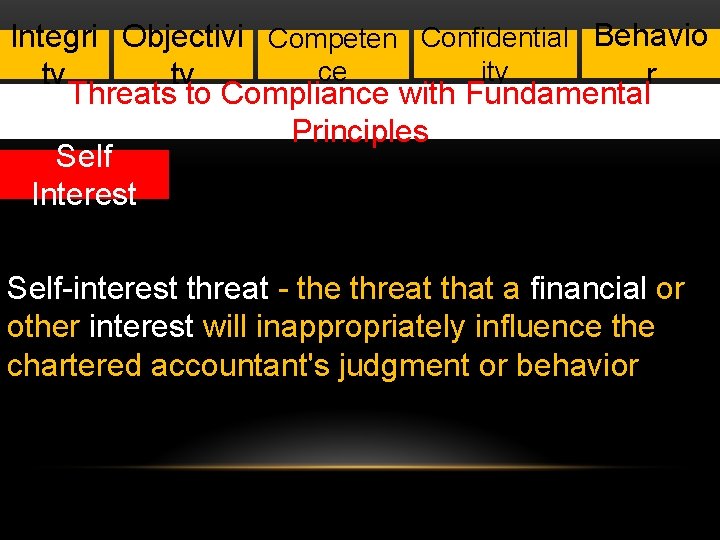
Integri Objectivi Competen Confidential Behavio ity ce r ty ty Threats to Compliance with Fundamental Principles Self Interest Self-interest threat - the threat that a financial or other interest will inappropriately influence the chartered accountant's judgment or behavior
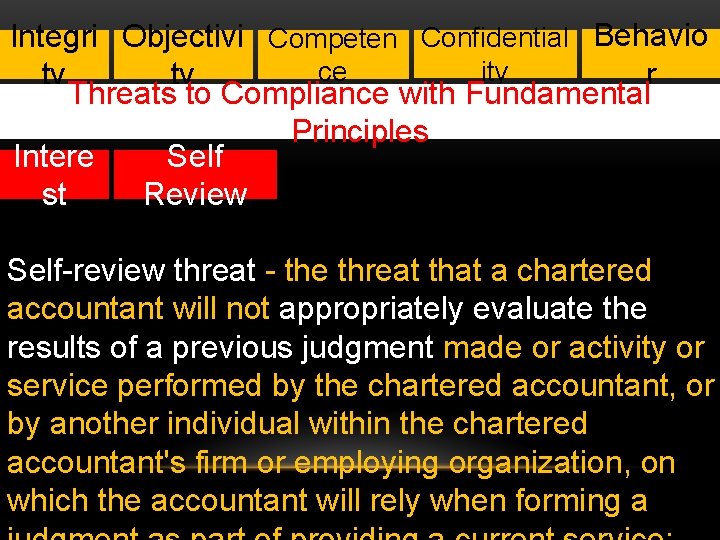
Integri Objectivi Competen Confidential Behavio ity ce r ty ty Threats to Compliance with Fundamental Principles Intere Self st Review Self-review threat - the threat that a chartered accountant will not appropriately evaluate the results of a previous judgment made or activity or service performed by the chartered accountant, or by another individual within the chartered accountant's firm or employing organization, on which the accountant will rely when forming a
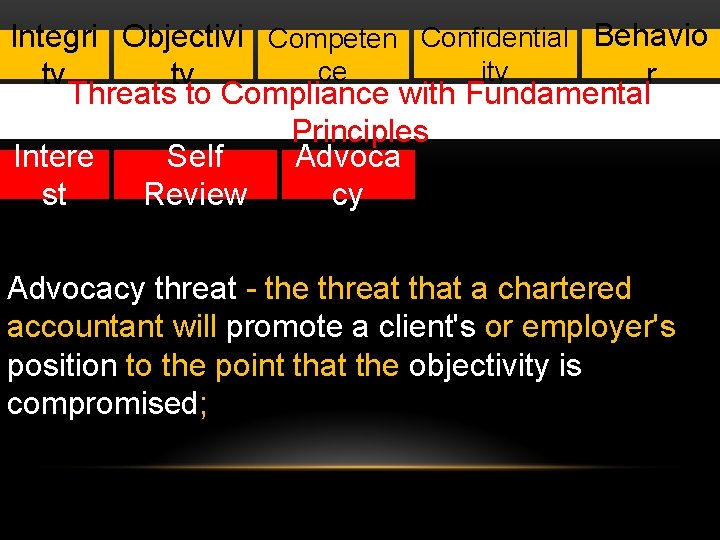
Integri Objectivi Competen Confidential Behavio ity ce r ty ty Threats to Compliance with Fundamental Principles Intere Self Advoca st Review cy Advocacy threat - the threat that a chartered accountant will promote a client's or employer's position to the point that the objectivity is compromised;
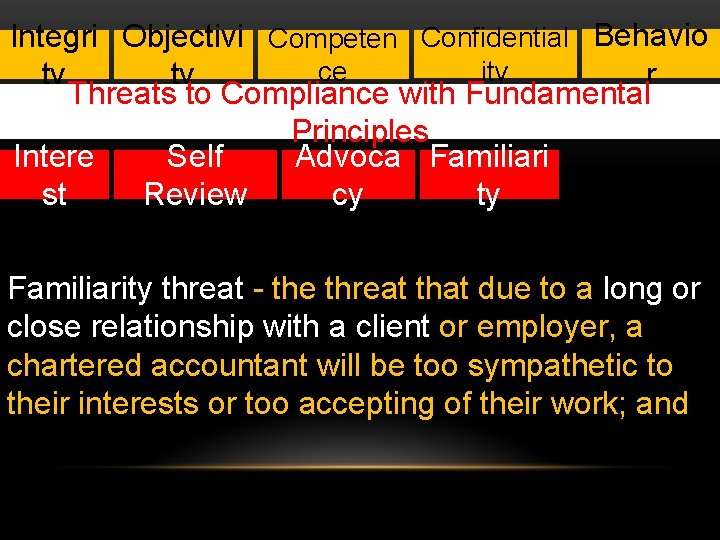
Integri Objectivi Competen Confidential Behavio ity ce r ty ty Threats to Compliance with Fundamental Principles Intere Self Advoca Familiari st Review cy ty Familiarity threat - the threat that due to a long or close relationship with a client or employer, a chartered accountant will be too sympathetic to their interests or too accepting of their work; and
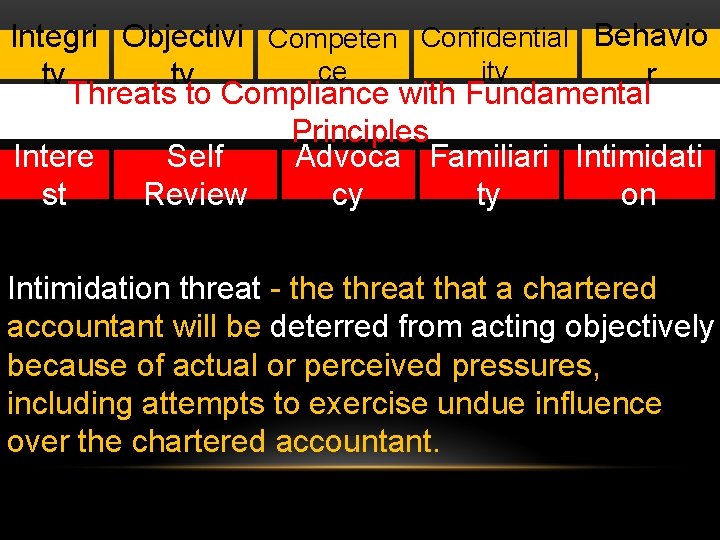
Integri Objectivi Competen Confidential Behavio ity ce r ty ty Threats to Compliance with Fundamental Principles Intere Self Advoca Familiari Intimidati st Review cy ty on Intimidation threat - the threat that a chartered accountant will be deterred from acting objectively because of actual or perceived pressures, including attempts to exercise undue influence over the chartered accountant.
A Chartered Accountant shall: (a) Identify threats to compliance with the fundamental principles; (b) Evaluate the significance of the threats identified; and (c) Apply safeguards, when necessary, to eliminate threats or reduce them to an acceptable level. Safeguards are necessary when the chartered accountant determines that the threats are not at a level at which a reasonable and informed third party would be likely to conclude,
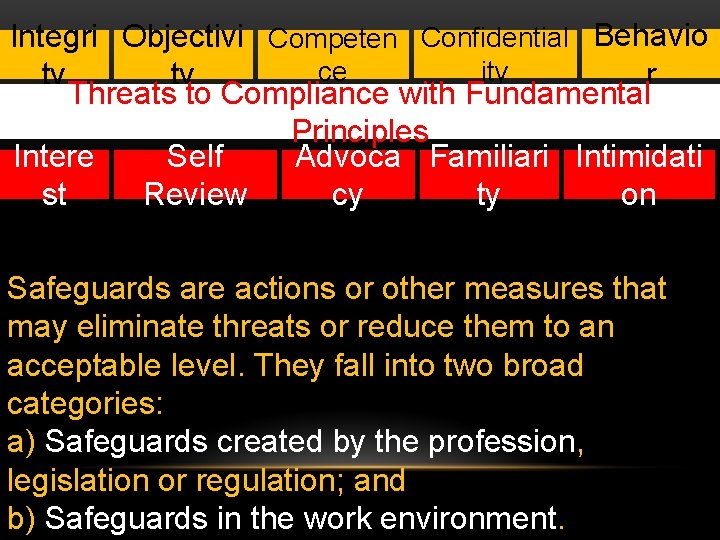
Integri Objectivi Competen Confidential Behavio ity ce r ty ty Threats to Compliance with Fundamental Principles Intere Self Advoca Familiari Intimidati st Review cy ty on Safeguards are actions or other measures that may eliminate threats or reduce them to an acceptable level. They fall into two broad categories: a) Safeguards created by the profession, legislation or regulation; and b) Safeguards in the work environment.
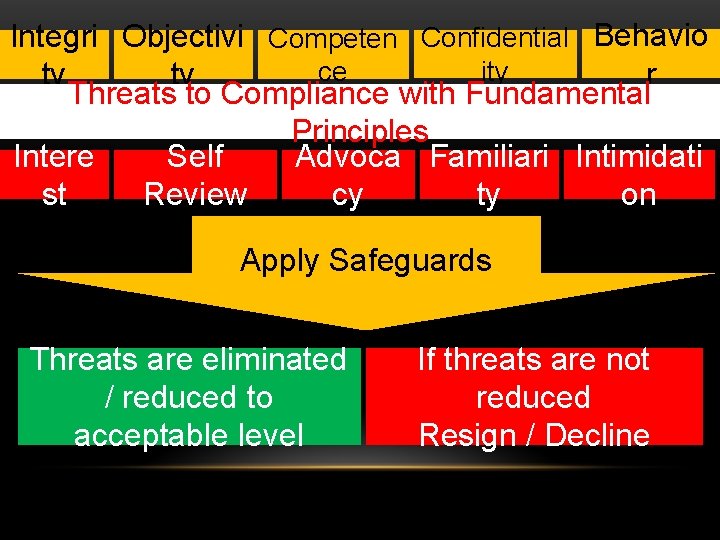
Integri Objectivi Competen Confidential Behavio ity ce r ty ty Threats to Compliance with Fundamental Principles Intere Self Advoca Familiari Intimidati st Review cy ty on Apply Safeguards Threats are eliminated / reduced to acceptable level If threats are not reduced Resign / Decline
A chartered accountant may encounter situations in which threats cannot be eliminated or reduced to an acceptable level, either because threat is too significant or because appropriate safeguards are not available or cannot be applied. In such situations, the chartered accountant shall decline or discontinue the specific professional activity or service involved or resigns from the engagement (or employment).
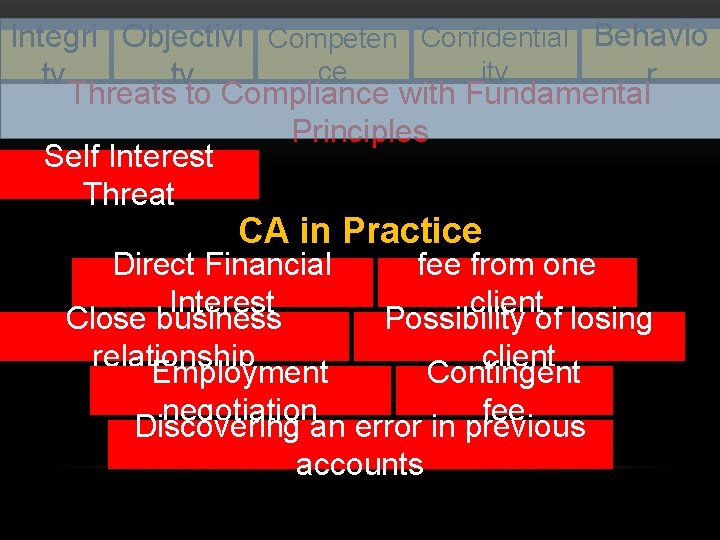
Integri Objectivi Competen Confidential Behavio ity ce r ty ty Threats to Compliance with Fundamental Principles Self Interest Threat CA in Practice Direct Financial Interest Close business fee from one client Possibility of losing relationship client Employment Contingent negotiation fee Discovering an error in previous accounts
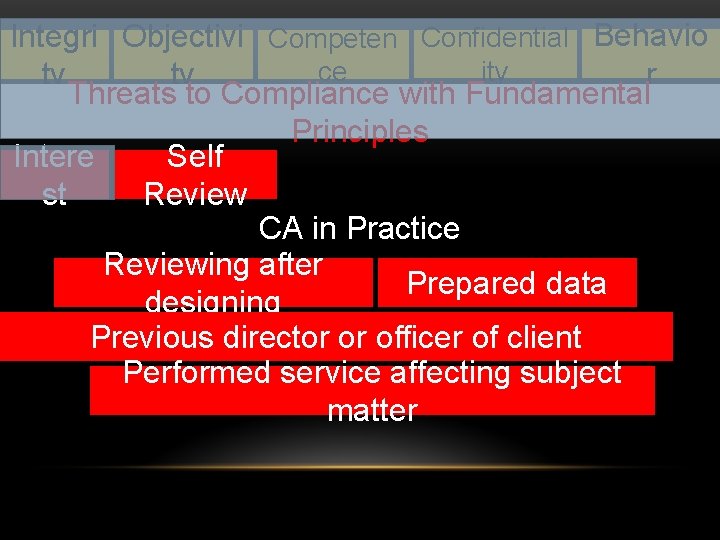
Integri Objectivi Competen Confidential Behavio ity ce r ty ty Threats to Compliance with Fundamental Principles Intere Self st Review CA in Practice Reviewing after Prepared data designing Previous director or officer of client Performed service affecting subject matter
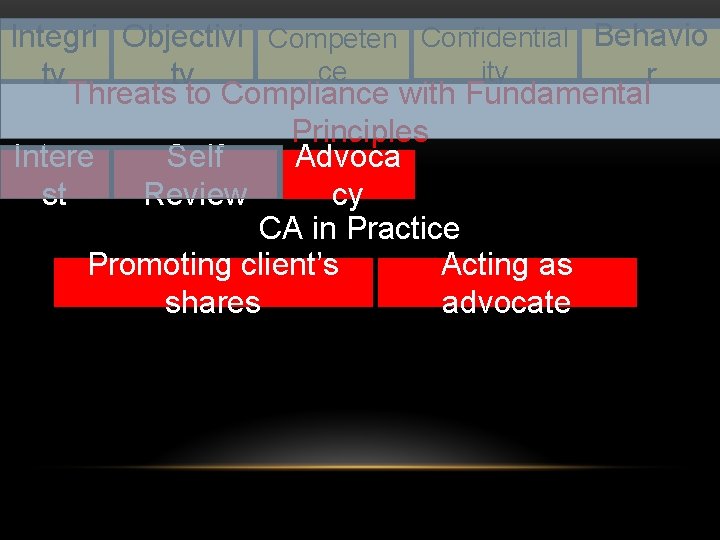
Integri Objectivi Competen Confidential Behavio ity ce r ty ty Threats to Compliance with Fundamental Principles Intere Self Advoca st Review cy CA in Practice Promoting client’s Acting as shares advocate
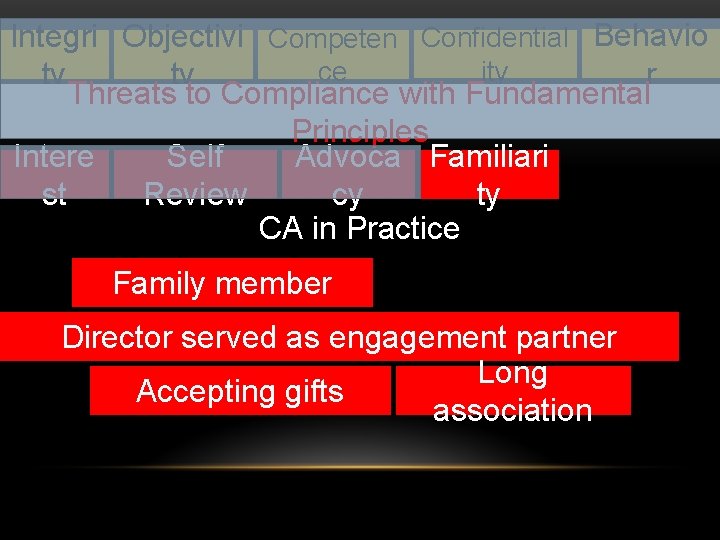
Integri Objectivi Competen Confidential Behavio ity ce r ty ty Threats to Compliance with Fundamental Principles Intere Self Advoca Familiari st Review cy ty CA in Practice Family member Director served as engagement partner Long Accepting gifts association
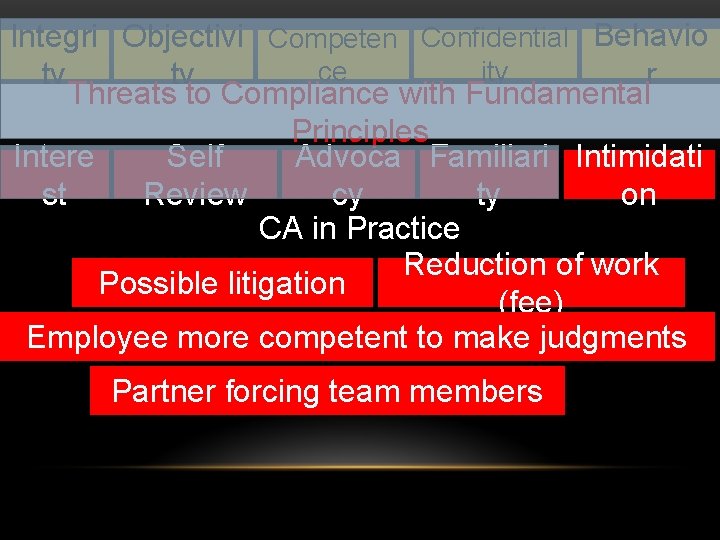
Integri Objectivi Competen Confidential Behavio ity ce r ty ty Threats to Compliance with Fundamental Principles Intere Self Advoca Familiari Intimidati st Review cy ty on CA in Practice Reduction of work Possible litigation (fee) Employee more competent to make judgments Partner forcing team members
REVISIONS TO PART-2 CA IN BUSINESS Section 250. Inducements including gifts and hospitality R. CA shall obtain understanding of laws (bribery or corruption) that may prohibit gifts R. CA shall not offer, or encourage others to offer a inducement that may be concluded improper in third party test R. CA shall not accept, or encourage others to accepts a inducement that may be concluded improper in third party test R. CA shall be alert to inducements offered to or
REVISIONS TO PART-2 CA IN BUSINESS Section 260. Responding to NOCLAR R. CA shall obtain understanding of laws relating to NOCLAR that may be different to provisions of the Code R. A (senior) CA shall discuss the matter with CA’s supervisor when there is suspicion of NOCLAR R. CA shall: • Communicate with those charged with governance • Comply with applicable laws and regulations
REVISIONS TO PART-2 CA IN BUSINESS Section 270. Pressure to breach the fundamental principles R. CA shall not allow pressure from others to breach the compliance with fundamental principles. Pressures may be: • from family member to act as vendor • To report misleading F/S to meet investor expectations • From elected officials on Public Sector accountants
REVISIONS TO PART-2 CA IN BUSINESS Other occupations in which CA’s can engage without Council Permission – dropped from the new code R. CA shall not allow pressure from others to breach the compliance with fundamental principles. Pressures may be: • from family member to act as vendor • To report misleading F/S to meet investor expectations • From elected officials on Public Sector accountants
PRACTICE Section 330. 3 (A 2 to A 4) Fee and other types of remuneration – dropped from the new code Replaced with provisions that consider lower fee charged as compared to the previous auditor could be considered as “undercutting”. Section 330. 4 (A 1 to A 4) relating to contingent fee – dropped from the new code Section 370 Public Notices, Announcements and communication • Undue publicity to be avoided • Advertising for solicitation is to be avoided
REVISIONS TO PART- 4 INDEPENDENCE STANDARDS Cooling off requirements key audit partners for PIE Cooling off requirement is: • For engagement partner – 5 years • For engagement quality control reviewer – 3 years • For other Key Audit Partner – 2 years ASEC recommended to adopt this requirement from periods beginning on or after 1 st January 2022
REVISIONS TO PART- 4 INDEPENDENCE STANDARDS Performance of accounting and bookkeeping services in emergency situations has been recommended to retain, as the prohibition has been removed from COCG Regulations 2017.
Conflict of interest • The chartered accountant undertakes a professional activity related to a particular matter for two or more parties whose interests with respect to that matter are in conflict; or • The interests of the chartered accountant with respect to a particular matter and the interests of a party for whom the chartered accountant undertakes a professional activity related to that matter are in conflict.
Conflict Resolution a) Gather Relevant facts; b) Identify Ethical issues involved; c) Identify Fundamental principles related to the matter in question; d) What are the Established internal procedures (norms or practices); and e) What are the Alternative courses of action. Having considered the relevant factors, a chartered accountant shall determine the appropriate course of action, weighing all possible course of action.
Conflict Resolution (…. Continued) A chartered accountant shall determine whether to consult with those charged with governance of the organization, such as the board of directors or the audit committee. It may be in the best interests of the chartered accountant to document the substance of the issue, the details of any discussions held, and the decisions made. If a significant conflict cannot be resolved, a chartered accountant may consider obtaining professional advice from the relevant professional body or from legal advisors.
Conflict Resolution (…. Continued 2…) If, after exhausting all relevant possibilities, the ethical conflict remains unresolved, a chartered accountant shall, where possible, refuse to remain associated with the matter creating the conflict. The chartered accountant shall determine whether, in the circumstances, it is appropriate to withdraw from the engagement team or specific assignment, or to resign altogether from the engagement, the firm or the employing organization.

Thank you
- Slides: 39