
Code of Conduct and Rules of Debate May
Code of Conduct and Rules of Debate – May 2019 Linda Torney, Acting Monitoring Officer Siȃn Millard, Oversight and Governance Manager
Aims and Outcomes of the Session Aims To help new Councillors: n n n understand the underlying principles of the Code of Conduct understand difference between a Disclosable Pecuniary Interest and a Private Interest identify what to think about when declaring interests understand expectations with regards gifts and hospitality feel confident in their understanding and application of the Rules of Debate
Code of Conduct 1. What’s in it? 2. When do I declare an interest?
Nolan Principles The Code is consistent with the Nolan Principles of Public Life: n n n n Selflessness Integrity Objectivity Accountability Openness Honesty Leadership
Code of Conduct § It provides for the registration and disclosure of pecuniary interests and other interests § Adoption or amendment of the Code must be by Full Council § Must have arrangements for dealing with complaints (there is a separate process for complaints handling)
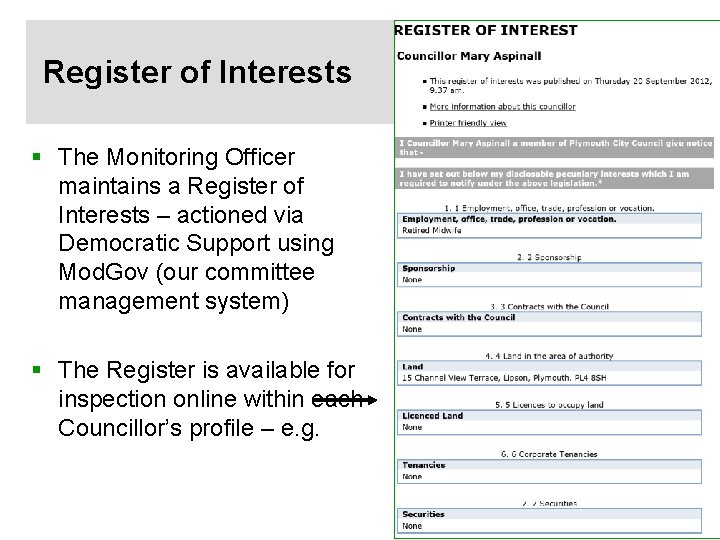
Register of Interests § The Monitoring Officer maintains a Register of Interests – actioned via Democratic Support using Mod. Gov (our committee management system) § The Register is available for inspection online within each Councillor’s profile – e. g.
Disclosable Pecuniary Interests (DPIs) § Must register DPIs within 28 days of taking office/any changes § DPIs are defined in Regulations and apply to: Member n Spouse or civil partner n Person Member lives with as if husband/wife/civil partner n § Must be aware of the interest! § Criminal offence to fail to disclose DPI without reasonable excuse or to provide false or misleading information or to be reckless as to accuracy
Criminal offence § Police can investigate § Prosecution only by Director of Public Prosecution § On conviction, a court may fine to Scale 5 (unlimited) and/or disqualify a Member from this or any authority for up to five years
Declaring DPIs § Member must declare DPI and leave the meeting room if s/he is aware that s/he has a DPI in any matter to be or being considered § Unless s/he has a dispensation…
Dispensations § Councillor’s allowances, expenses or insurance § Ceremonial honours given to councillors § Council Tax setting § School meals or school transport and travelling expenses if the councillor is the parent or guardian of a child in full time education unless the decision relates particularly to the school their child attends § School meals or school transport and travelling expenses if the councillor is a parent governor unless the decision relates particularly to the school of which they are a governor
Private Interests You have a private interest if the issue being discussed in the meeting affects the well being or finances of: § you, your family or your close associates § any organisation where you are a member or involved in its management § any organisation to which you have been appointed by the Council
Registration of Private Interests You must include in the Register: § any organisation where you are a member or involved in its management § any organisation to which you have been appointed by the Council
Declaring Private Interests When asked you must declare an interest and the nature of it at the start of the meeting. § you can stay, speak and vote (unless it’s a DPI) If you become aware of an interest during a meeting discussion, you must immediately declare it to the Chair. But, if the decision may advantage/disadvantage family members, close associates or an organisation where you have a private interest more than it will affect other people living or working in the ward discuss with the Monitoring Officer before the meeting (as there may be legal issues of bias)
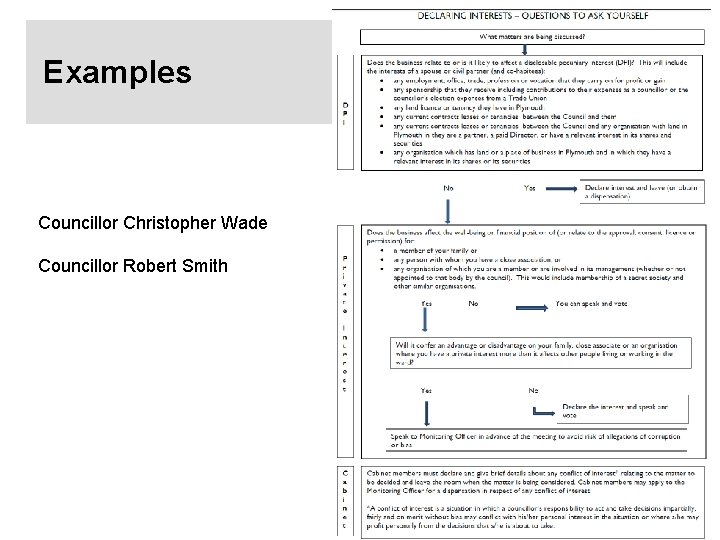
Examples Councillor Christopher Wade Councillor Robert Smith
Code of Conduct – any questions?
Gifts and Hospitality § Councillors (and officers) may find themselves offered gifts/hospitality during their time in office § If gift or hospitality received over the value of £ 25, provide within 28 days of receipt written notification of the details to the Monitoring Officer for entry into the Register of Gifts and Hospitality – open to public inspection; held by Democratic Support § Form available from Councillors’ Toolkit under ‘Useful documents’
Gifts and Hospitality – any questions?
Rules of Debate - introduction The Rules of Debate are designed to facilitate debate at Council and Committee meetings in an organised and orderly manner. What? § They are, in general, rules on what may be said, when, by whom and for how long Why? § Councillors have the freedom to contribute at Council and the committees on which they sit as members § This freedom is limited, however, by the necessity to maintain fairness, order and decorum when debate is
Who enforces the rules? § The Chair of the meeting (Lord Mayor in the case of Council) will: ensure the rules of debate are adhered to n make judgements on the rules (supported by officers where appropriate) n apply the sub-judice convention to debates and questioning (i. e. no referencing of active court cases) n monitor and where necessary challenge the civility of remarks n § The Chair has a duty to maintain the orderly conduct of debate by: challenging disorder when it arises and n by ruling on points of order raised by Members n
Motions § A motion is a proposal at a meeting that certain action is taken or certain views about a subject are expressed by the Council. § The purpose of a motion is to introduce new business. § A motion should be in positive language to avoid confusion when voting. § Motions require a simple majority vote. § A motion cannot be proposed when another motion is under consideration. § Any motion requires a seconder and can then be debated
Amendments to motions § Unless notice of the amendment is given, the Chair may require it to be written down. This is to ensure clarity of what is being proposed. § An amendment must be relevant to the motion and must be a proposal to refer a motion elsewhere or add, replace or leave out words, they must not negate the motion § Only one amendment may be moved and discussed at any one time. No further amendment may be moved until that amendment has been disposed of. § If an amendment is carried (i. e. voted on and approved by simple majority), the amended motion becomes the substantive motion.
Speeches – the rules § Speeches must be about the item being discussed. § No longer than five minutes, except that the mover of a motion may, with the consent of the Council, have one extension of a further period of five minutes. § Questions at Council are timed: one minute for a question n two minutes for an answer n one supplementary allowed n § You will be able to see your time limit on the screen § N. B. These rules for speeches are generally not applied at committees
Speeches – who makes them? § The Chair decides who has the right to speak during debate § Councillor’s can only speak one during debate on any motion (excepting person proposing can speak to sum up) § Raise hand to participate in proceedings – Deputy Lord Mayor keeps list of those wishing to speak and advises Lord Mayor on order § When called upon by the Lord Mayor, the Member must be in his or her designated place in order to be recognised and to speak § Any Member participating in debate must stand address the Lord Mayor Refer to follow Councillors as ‘Councillor…. . ’ not by first §
Points of order (Council) § A Councillor can make a point of order at any time § The Lord Mayor will hear a point of order immediately § A point of order must be about the law or Council procedures or rules being broken (per the Constitution) § The Councillor must say which law or procedures or rules are being broken and how § The Lord Mayor may seek independent advice when deciding a point of order § The Lord Mayor’s decision is final § Any Member making a point of order may not speak on the matter under discussion during the point of order
Intervention § A Member may ask a brief question in relation to the speaker’s statement if the speaker agrees (e. g. ‘Would Councillor Jones allow an intervention? ) § No other Members are allowed to speak § The question, if accepted, is not part of the original speaker’s time – the answer is § No supplementary questions are allowed
Rules of Debate – any questions?
- Slides: 26