
Code Level Reusable Software Components Lingrui Ouyang Background

Code Level Reusable Software Components Lingrui Ouyang
Background: Reuse advantages and failures • Advantages • Higher quality products • Less development time • Higher scheduling accuracy • Failures • Organizational impediments • Economic impediments • Administrative impediments
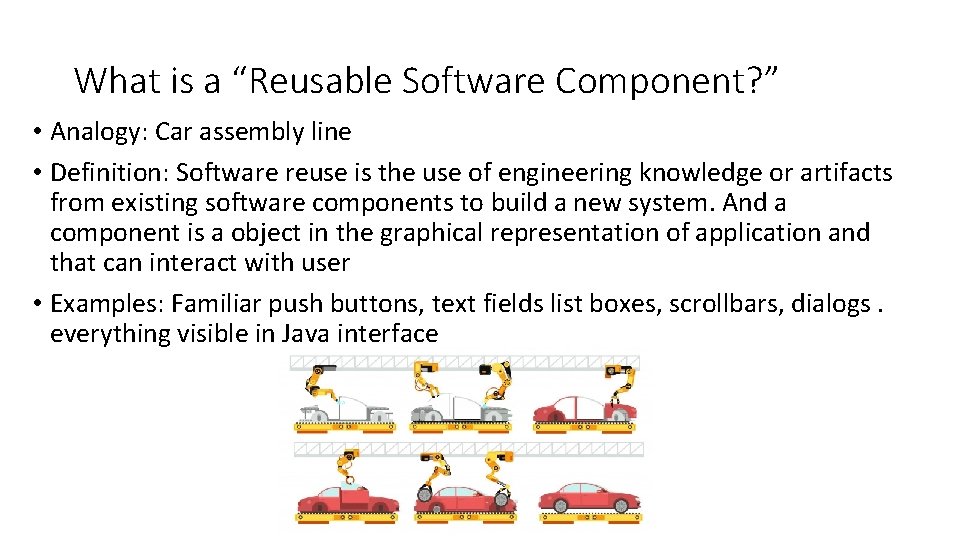
What is a “Reusable Software Component? ” • Analogy: Car assembly line • Definition: Software reuse is the use of engineering knowledge or artifacts from existing software components to build a new system. And a component is a object in the graphical representation of application and that can interact with user • Examples: Familiar push buttons, text fields list boxes, scrollbars, dialogs. everything visible in Java interface
Why Software Reuse? • Increased quality • High reliability • Long-term decreased costs
Why a component can be reused? • Use the component in its original from in multiple systems • Code samples are copied and pasted among systems • Extend component functionality as needed for individual systems • Embed or modify the code to a new method • Restrict component functionality as needed for independent systems • Reuse the binaries distributed on local or remote systems without distributing them
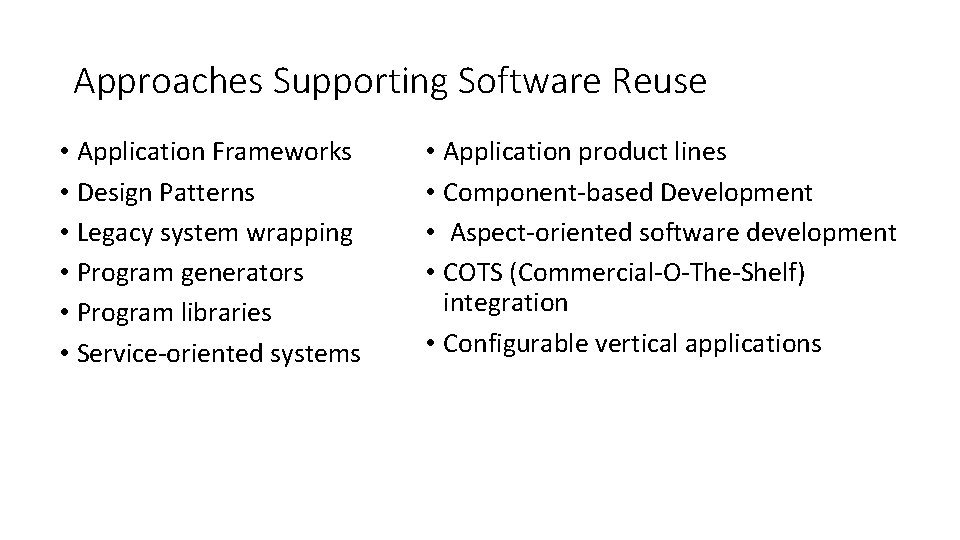
Approaches Supporting Software Reuse • Application Frameworks • Design Patterns • Legacy system wrapping • Program generators • Program libraries • Service-oriented systems • Application product lines • Component-based Development • Aspect-oriented software development • COTS (Commercial-O-The-Shelf) integration • Configurable vertical applications
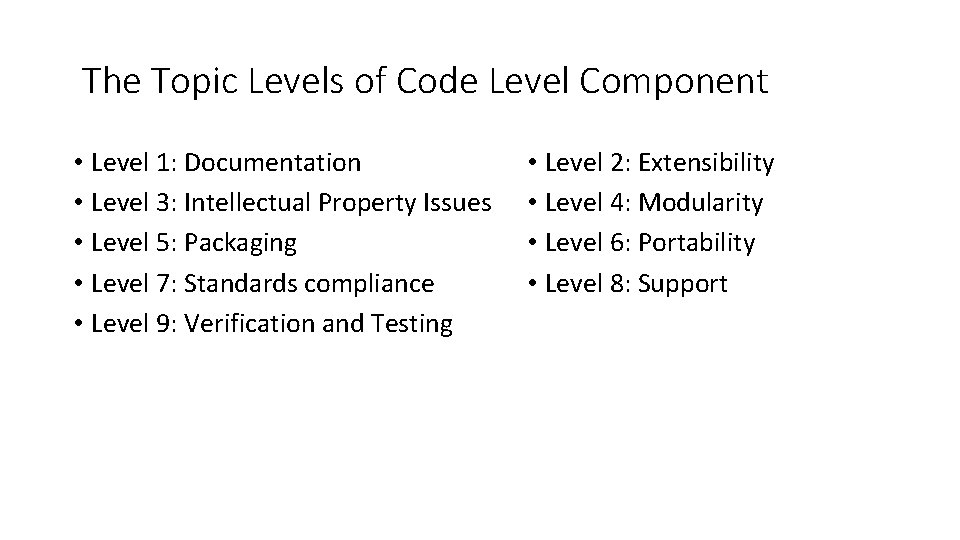
The Topic Levels of Code Level Component • Level 1: Documentation • Level 3: Intellectual Property Issues • Level 5: Packaging • Level 7: Standards compliance • Level 9: Verification and Testing • Level 2: Extensibility • Level 4: Modularity • Level 6: Portability • Level 8: Support
How to build Code Level Reusable Components • Class libraries • Function libraries • Design patterns • Framework Classes
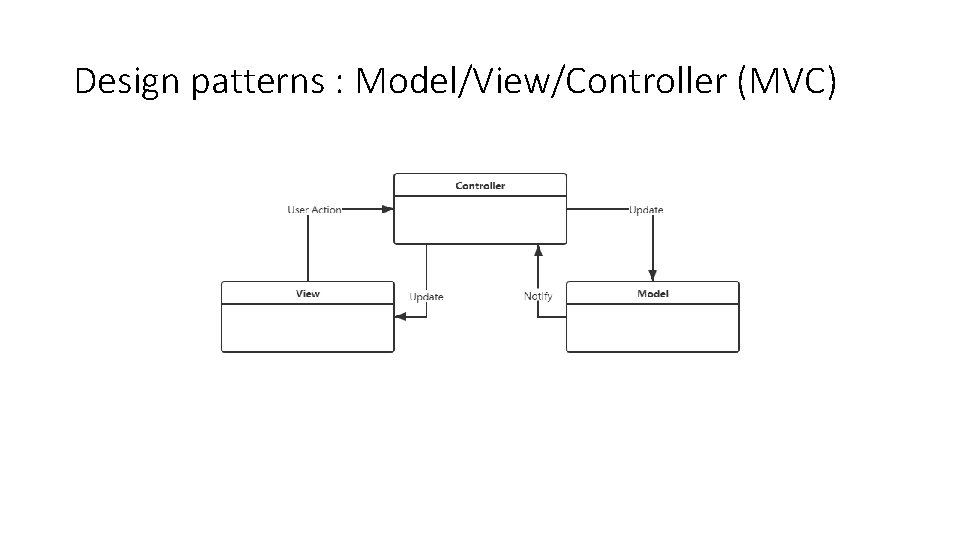
Design patterns : Model/View/Controller (MVC)
Conclusion and future work • Pros • Save time • Save money • Increase the reliability of resulting products • Cons • Attempt to reuse software that is not easily reusable can have the reverse effect • Future work • Digging deeper in using frameworks, the developers can devote more time in developing the software requirement, not in preparing the environment and tools of application development
Evaluation on this paper • Advantages • Many clear examples about the definition of software reuse and how the reusable components work • Transparent definition of how we evaluate the reusability of a software • Good analysis about the pros and cons of each approach to build reusable software • Disadvantages • Should use some graphs to illustrate the architecture of Framework Classes just like the Design patterns part • Should further explain the three major ways to reuse software, like how people extend the functions of components.
![References • [1] B. JALENDER, A. GOVARDHAN, and P. PREMCHAND. DESIGNING CODE LEVELREUSABLE SOFTWARECOMPONENTS,](http://slidetodoc.com/presentation_image_h2/50e81c747749258554c99279e4ad2560/image-12.jpg "References • [1] B. JALENDER, A. GOVARDHAN, and P. PREMCHAND. DESIGNING CODE LEVELREUSABLE SOFTWARECOMPONENTS,")
References • [1] B. JALENDER, A. GOVARDHAN, and P. PREMCHAND. DESIGNING CODE LEVELREUSABLE SOFTWARECOMPONENTS, International Journal of Software Engineering & Applications (IJSEA), Vol. 3, No. 1, January 2012, https: //www. academia. edu/35151812/DESIGNING_CODE_LEVEL_RE USABLE_SOFTWARE_COMPONENTS • [2] B. JALENDER, A. GOVARDHAN, and P. PREMCHAND. A PRAGMATIC APPROACH TO SOFTWARE REUSE, Journal of Theoretical and Applied Information Technology, https: //www. researchgate. net/publication/266287893_A_pragmatic _approach_to_software_reuse

Thanks for watching!
- Slides: 13