
Code Generation Strategies for Success San Diego NET

- Slides: 26
Code Generation Strategies for Success San Diego. NET Architecture SIG 7 -12 -2006 jacob. eggleston@yahoo. com http: //ch 3 etah. sf. net/docs. html Copyright 2004 - 2006 Jacob Eggleston
Reactions to code generation • Will it put programmers out of work? • Sounds too complicated • It’s a code smell Code generation is like ogres! Copyright 2004 - 2006 Jacob Eggleston
What is Code Generation, Really? • “Code that writes code” • Every-day Examples – Forms designer – XSD / Strongly-typed datasets – WSDL generators – Compilers • Your Own Personal Junior Programmer / Code Slave Copyright 2004 - 2006 Jacob Eggleston
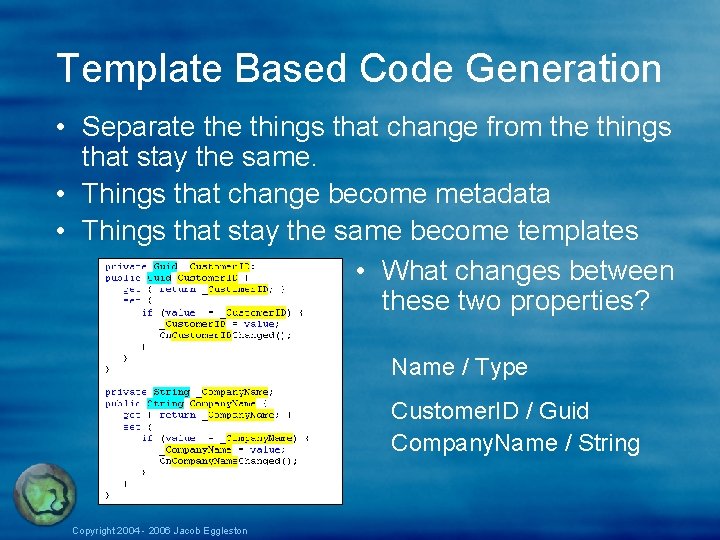
Template Based Code Generation • Separate things that change from the things that stay the same. • Things that change become metadata • Things that stay the same become templates • What changes between these two properties? Name / Type Customer. ID / Guid Company. Name / String Copyright 2004 - 2006 Jacob Eggleston
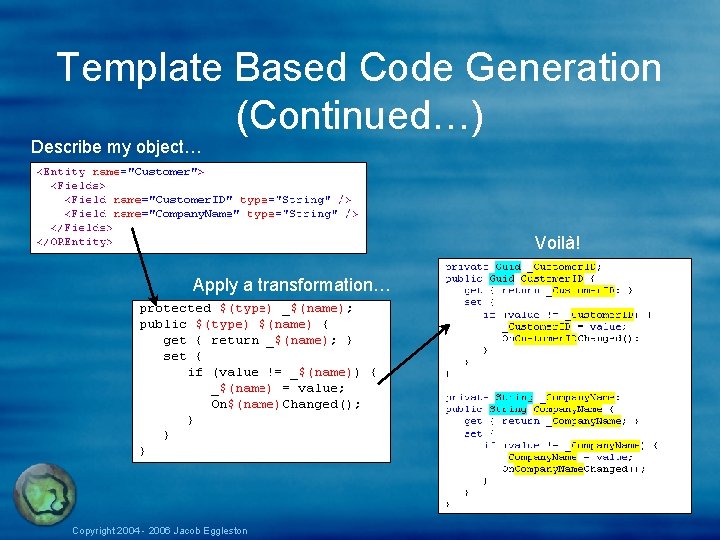
Template Based Code Generation (Continued…) Describe my object… Voilà! Apply a transformation… Copyright 2004 - 2006 Jacob Eggleston
Reasons For Failure • • • Vendor / framework lock-in (Lack of) Flexibility in code output (Lack of) Customization of generated code Non-active generation Results: Mountains of code to maintain by hand How did we get into this mess? !! Copyright 2004 - 2006 Jacob Eggleston
Principles for Success From “Code Generation in Microsoft. NET” by Kathleen Dollard 1. 2. 3. 4. 5. You control the process and templates You control the metadata Repeatable, one-click process Handcrafted code is protected Generated code is high quality Copyright 2004 - 2006 Jacob Eggleston
1. Process and Templates • Framework vendors can’t predict all your needs • Change happens – requirements, technologies – How do you handle edge cases, new artifacts, performance issues, design constraints, etc? • I don’t like template language lock-in either • You must be able to control and customize every aspect of code generation, from the metadata to the templates and everything in between. Copyright 2004 - 2006 Jacob Eggleston
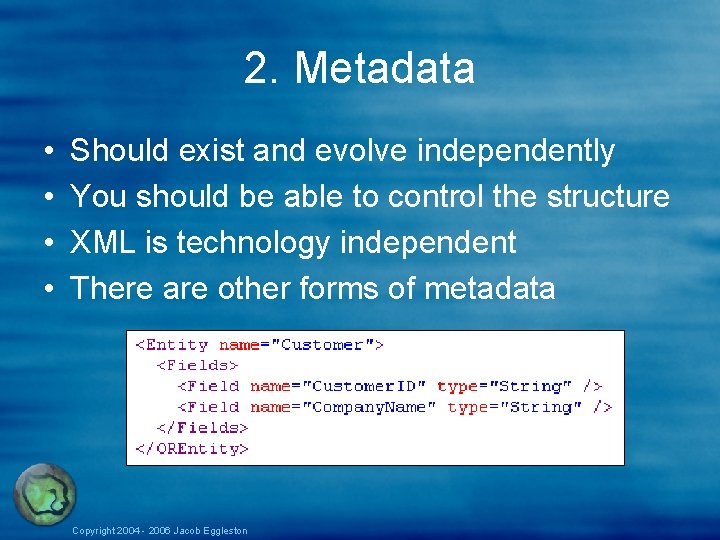
2. Metadata • • Should exist and evolve independently You should be able to control the structure XML is technology independent There are other forms of metadata Copyright 2004 - 2006 Jacob Eggleston
3. Repeatable Process • • Code generation MUST be “active” Can be part of the build process Vital to maintainability One click (Drop-dead simple - path of least resistance) • I’m lazy / scripting sucks! Copyright 2004 - 2006 Jacob Eggleston
4. Protect Handcrafted Code • Isolate “driving factors” – Using regions, partial classes, abstract classes, etc. • Content hashing – Warnings, humiliation not enough • It should be easy to evolve generated code and custom code independently, for the entire life of the project Copyright 2004 - 2006 Jacob Eggleston
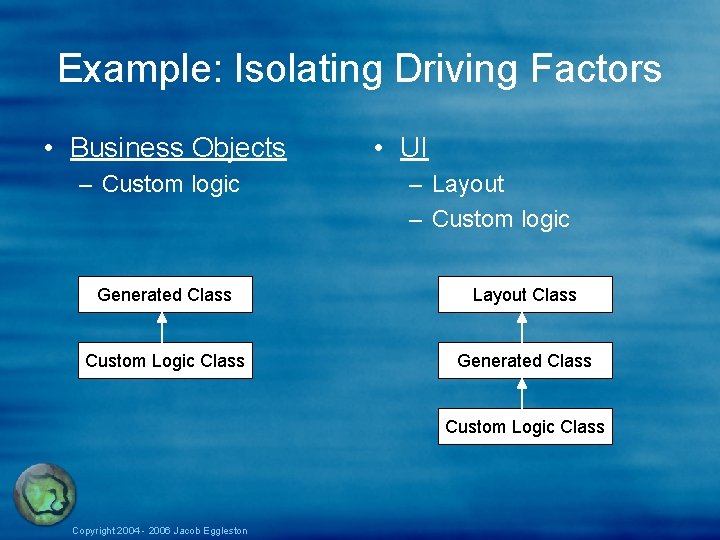
Example: Isolating Driving Factors • Business Objects – Custom logic • UI – Layout – Custom logic Generated Class Layout Class Custom Logic Class Generated Class Custom Logic Class Copyright 2004 - 2006 Jacob Eggleston
5. High Quality • • Should meet or exceed hand coding Start with hand coding and find patterns Templates can evolve – start simple Able to improve quality retroactively Copyright 2004 - 2006 Jacob Eggleston
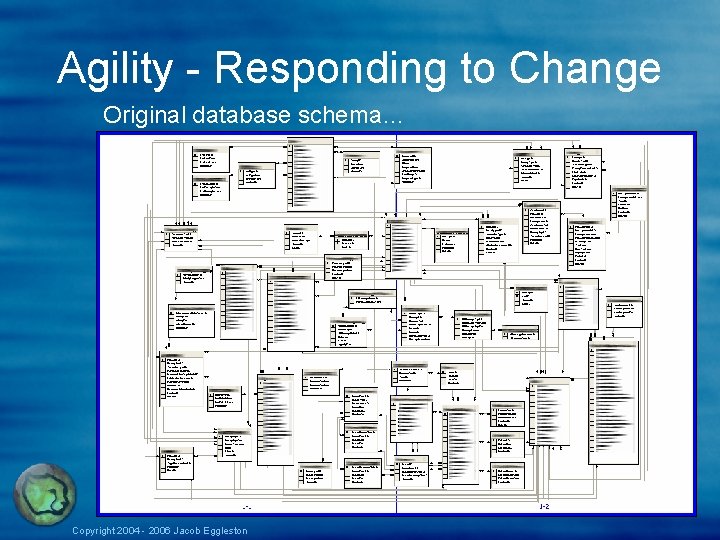
Agility - Responding to Change Original database schema… Copyright 2004 - 2006 Jacob Eggleston
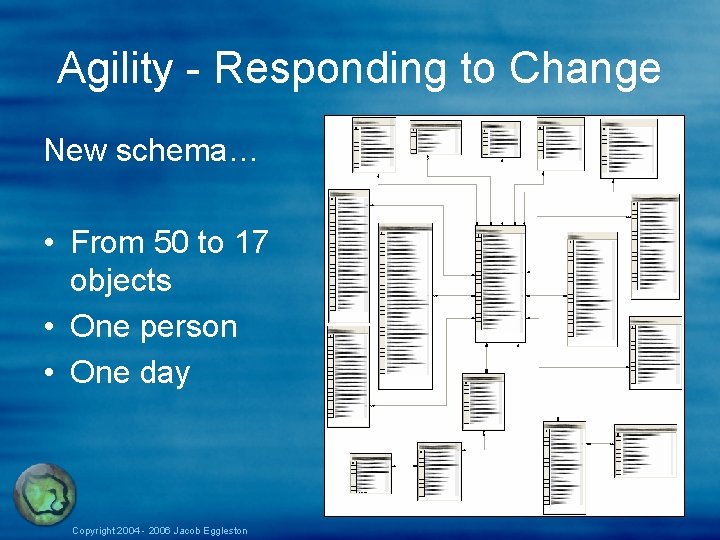
Agility - Responding to Change New schema… • From 50 to 17 objects • One person • One day Copyright 2004 - 2006 Jacob Eggleston
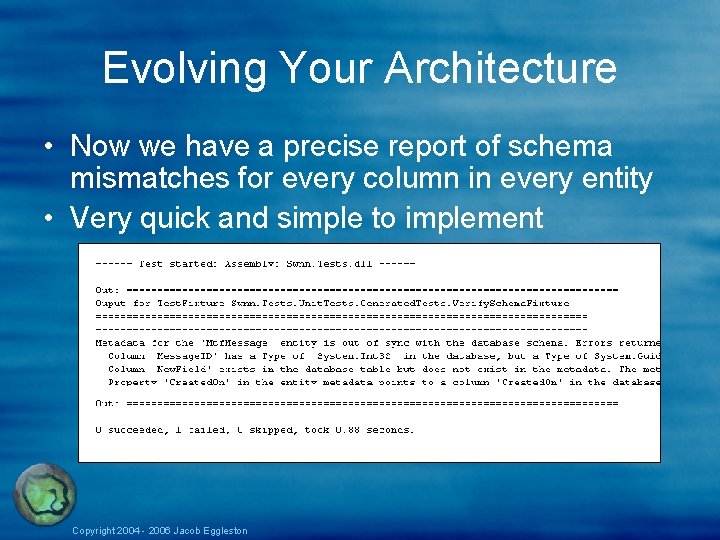
Evolving Your Architecture Example of creating new artifacts: • One of many cryptic exceptions that NHibernate throws: Operand type clash: uniqueidentifier is incompatible with int • Many times it doesn’t tell you which object or property is the problem • What to do? Copyright 2004 - 2006 Jacob Eggleston
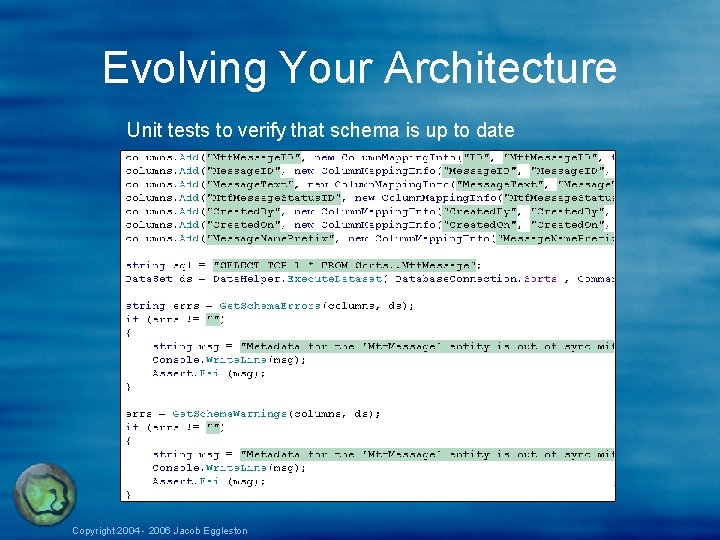
Evolving Your Architecture Unit tests to verify that schema is up to date Copyright 2004 - 2006 Jacob Eggleston
Evolving Your Architecture • Now we have a precise report of schema mismatches for every column in every entity • Very quick and simple to implement Copyright 2004 - 2006 Jacob Eggleston
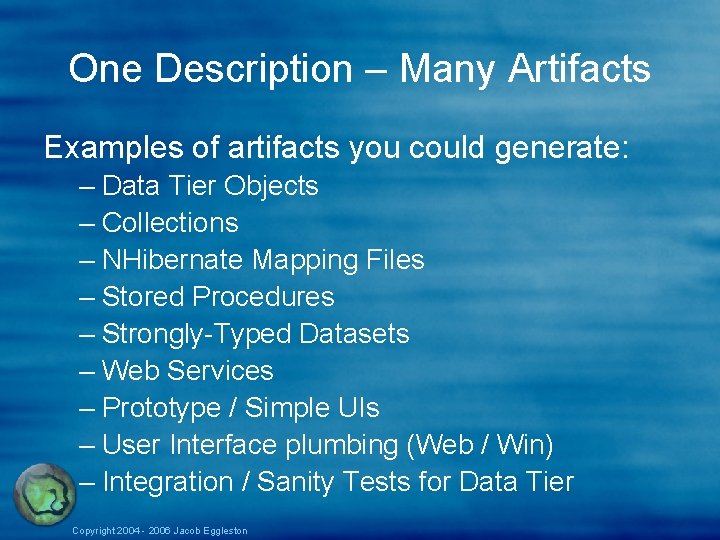
One Description – Many Artifacts Examples of artifacts you could generate: – Data Tier Objects – Collections – NHibernate Mapping Files – Stored Procedures – Strongly-Typed Datasets – Web Services – Prototype / Simple UIs – User Interface plumbing (Web / Win) – Integration / Sanity Tests for Data Tier Copyright 2004 - 2006 Jacob Eggleston
Code Generation Can… (when used correctly) • • Increase productivity Improve quality Improve consistency Cross pollination Improve maintainability Make users happier Solve world hunger (YMMV) Copyright 2004 - 2006 Jacob Eggleston
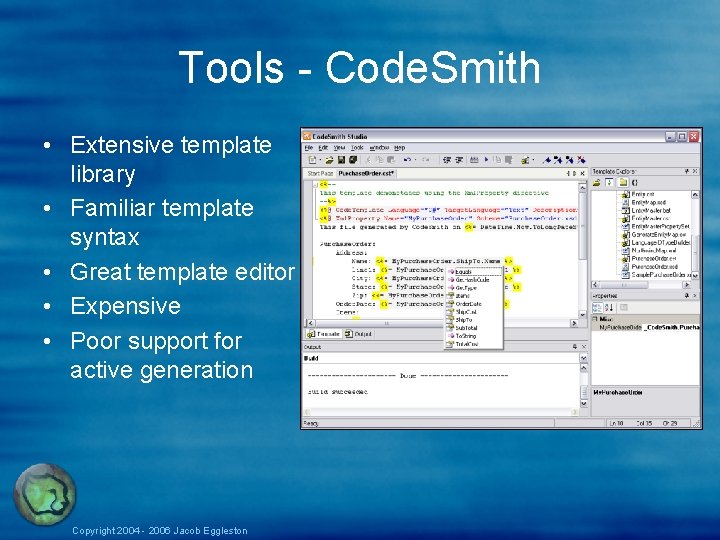
Tools - Code. Smith • Extensive template library • Familiar template syntax • Great template editor • Expensive • Poor support for active generation Copyright 2004 - 2006 Jacob Eggleston
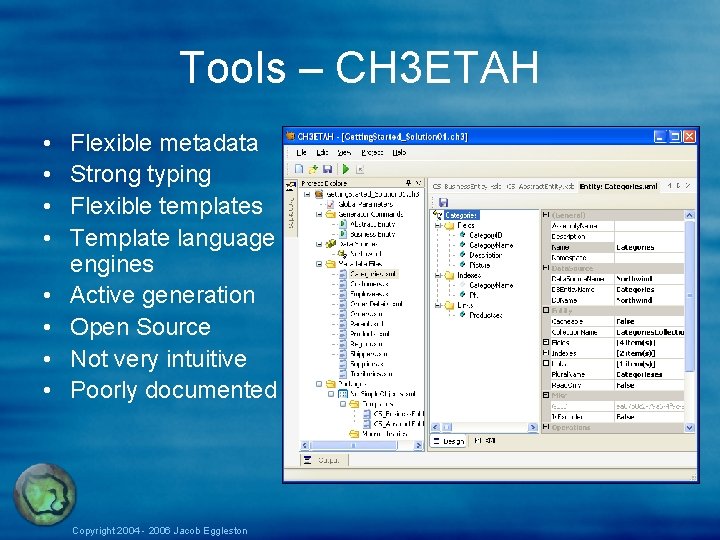
Tools – CH 3 ETAH • • Flexible metadata Strong typing Flexible templates Template language engines Active generation Open Source Not very intuitive Poorly documented Copyright 2004 - 2006 Jacob Eggleston
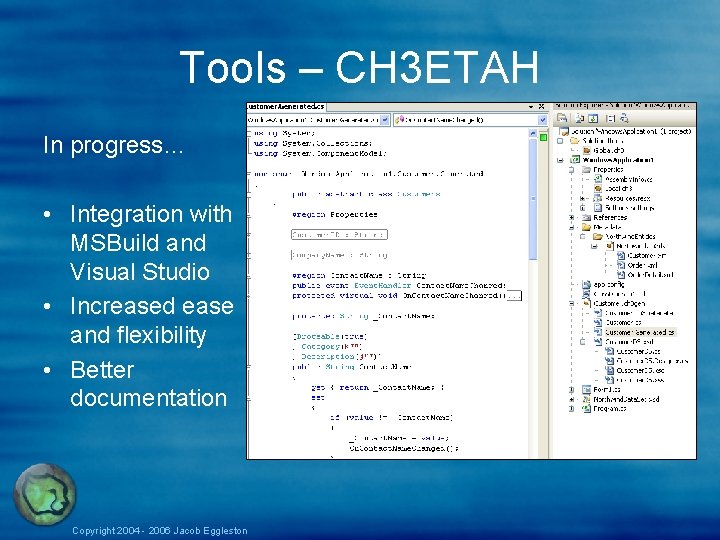
Tools – CH 3 ETAH In progress… • Integration with MSBuild and Visual Studio • Increased ease and flexibility • Better documentation Copyright 2004 - 2006 Jacob Eggleston
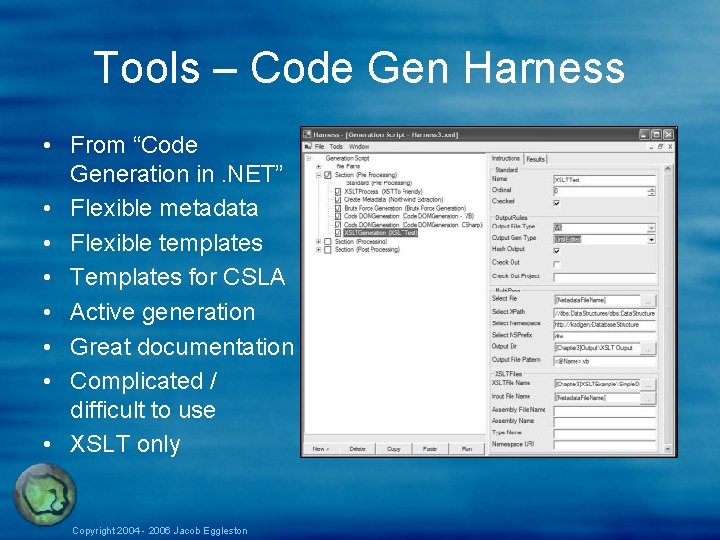
Tools – Code Gen Harness • From “Code Generation in. NET” • Flexible metadata • Flexible templates • Templates for CSLA • Active generation • Great documentation • Complicated / difficult to use • XSLT only Copyright 2004 - 2006 Jacob Eggleston
Tools - Summary • Code. Smith (www. codesmith. com) • CH 3 ETAH (ch 3 etah. sourceforge. net) • Generation harness from Kathleen Dollard’s book • Others (mostly template engines) Copyright 2004 - 2006 Jacob Eggleston
Resources • “Code Generation in Microsoft. NET” by Kathleen Dollard • “Code Generation in Action” by Jack Herrington • http: //www. codegeneration. net • This presentation / CH 3 ETAH tutorial: – http: //ch 3 etah. sf. net/docs. html Copyright 2004 - 2006 Jacob Eggleston