
Code Generation Introduction i0 while i 10 ai
![i=0 while (i < 10) { a[i] = 7*i+3 i=i+1} i = 0 LF](https://slidetodoc.com/presentation_image_h2/efe7ca856d06f3ac37336bbf7d2c216f/image-2.jpg "i=0 while (i < 10) { a[i] = 7*i+3 i=i+1} i = 0 LF")
![i=0 while (i < 10) { a[i] = 7*i+3 i=i+1} i = 0 LF](https://slidetodoc.com/presentation_image_h2/efe7ca856d06f3ac37336bbf7d2c216f/image-5.jpg "i=0 while (i < 10) { a[i] = 7*i+3 i=i+1} i = 0 LF")
![Stack Machine Simulator var code : Array[Instruction ] var pc : Int // program](https://slidetodoc.com/presentation_image_h2/efe7ca856d06f3ac37336bbf7d2c216f/image-17.jpg "Stack Machine Simulator var code : Array[Instruction ] var pc : Int // program")
![Printing Trees into Lists of Tokens def prefix(e : Expr) : List[Token] = e](https://slidetodoc.com/presentation_image_h2/efe7ca856d06f3ac37336bbf7d2c216f/image-32.jpg "Printing Trees into Lists of Tokens def prefix(e : Expr) : List[Token] = e")
![Why postfix? Can evaluate it using stack def post. Eval(env : Map[String, Int ],](https://slidetodoc.com/presentation_image_h2/efe7ca856d06f3ac37336bbf7d2c216f/image-37.jpg "Why postfix? Can evaluate it using stack def post. Eval(env : Map[String, Int ],")
![Evaluating Infix Needs Recursion The recursive interpreter: def infix. Eval(env : Map[String, Int], expr](https://slidetodoc.com/presentation_image_h2/efe7ca856d06f3ac37336bbf7d2c216f/image-38.jpg "Evaluating Infix Needs Recursion The recursive interpreter: def infix. Eval(env : Map[String, Int], expr")
![New correctness condition exec : Env x List[Bytecode] -> Int run : Env x](https://slidetodoc.com/presentation_image_h2/efe7ca856d06f3ac37336bbf7d2c216f/image-49.jpg "New correctness condition exec : Env x List[Bytecode] -> Int run : Env x")
![Proof of one case: run(T, C(e), S) == S: : : [I(T, e )]](https://slidetodoc.com/presentation_image_h2/efe7ca856d06f3ac37336bbf7d2c216f/image-50.jpg "Proof of one case: run(T, C(e), S) == S: : : [I(T, e )]")
- Slides: 50
Code Generation Introduction
i=0 while (i < 10) { a[i] = 7*i+3 i=i+1} i = 0 LF w h i l e lexer characters i = 0 while ( i < 10 ) words source code (e. g. Scala, Java, C) idea easy to write Compiler (scalac, gcc) type check optimizer assign i 0 while parser data-flow graphs < i assign + a[i] 3 * 7 i trees machine code (e. g. x 86, arm, JVM) efficient to execute 10 code gen mov R 1, #0 mov R 2, #40 mov R 3, #3 jmp +12 mov (a+R 1), R 3 add R 1, #4 add R 3, #7 cmp R 1, R 2 blt -16
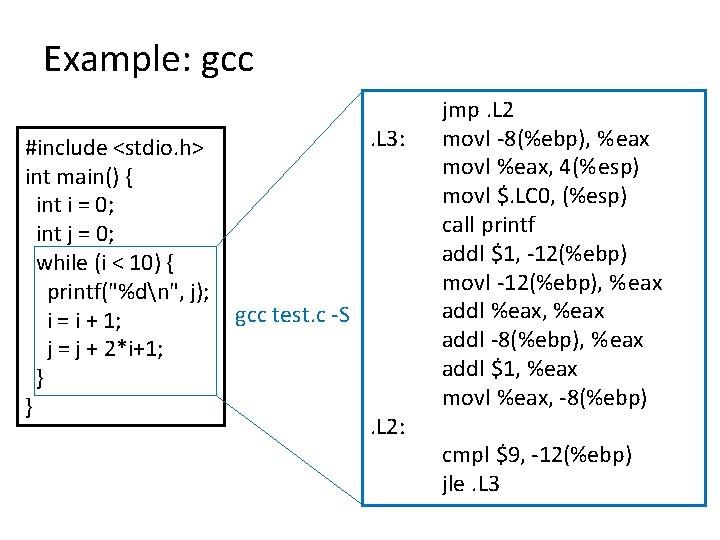
Example: gcc #include <stdio. h> int main() { int i = 0; int j = 0; while (i < 10) { printf("%dn", j); i = i + 1; j = j + 2*i+1; } } . L 3: gcc test. c -S . L 2: jmp. L 2 movl -8(%ebp), %eax movl %eax, 4(%esp) movl $. LC 0, (%esp) call printf addl $1, -12(%ebp) movl -12(%ebp), %eax addl %eax, %eax addl -8(%ebp), %eax addl $1, %eax movl %eax, -8(%ebp) cmpl $9, -12(%ebp) jle. L 3
LLVM: Another Interesting C Compiler
i=0 while (i < 10) { a[i] = 7*i+3 i=i+1} i = 0 LF w h i l e lexer characters i = 0 while ( i < 10 ) words Your Project source code simplified Java-like language Your Compiler assign i 0 while parser type check < i assign + a[i] 3 * 7 i trees Java Virtual Machine (JVM) Bytecode 10 code gen 21: iload_2 22: iconst_2 23: iload_1 24: imul 25: iadd 26: iconst_1 27: iadd 28: istore_2
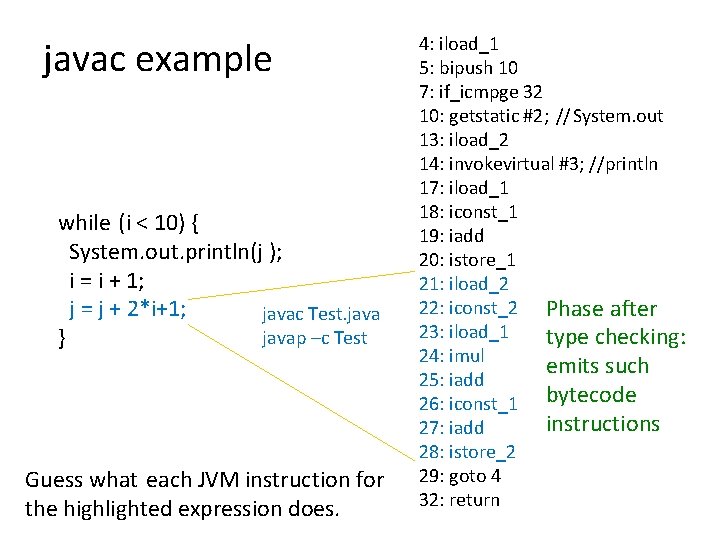
javac example while (i < 10) { System. out. println(j ); i = i + 1; j = j + 2*i+1; javac Test. javap –c Test } Guess what each JVM instruction for the highlighted expression does. 4: iload_1 5: bipush 10 7: if_icmpge 32 10: getstatic #2; //System. out 13: iload_2 14: invokevirtual #3; //println 17: iload_1 18: iconst_1 19: iadd 20: istore_1 21: iload_2 22: iconst_2 Phase after 23: iload_1 type checking: 24: imul emits such 25: iadd 26: iconst_1 bytecode instructions 27: iadd 28: istore_2 29: goto 4 32: return
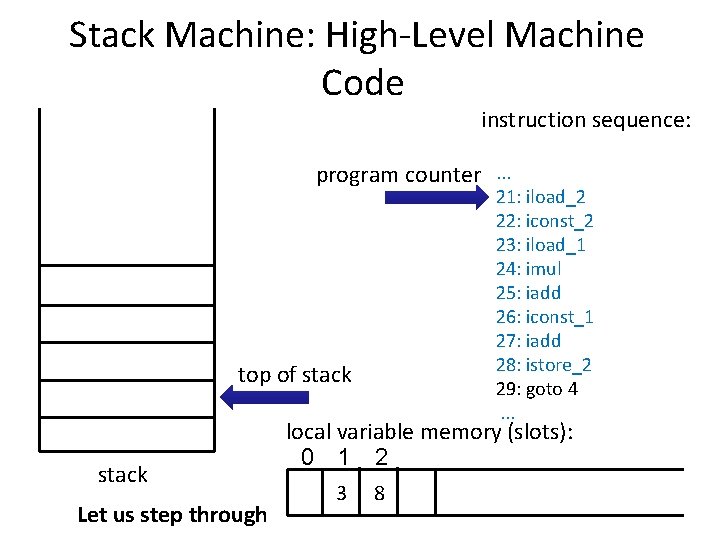
Stack Machine: High-Level Machine Code instruction sequence: program counter. . . 21: iload_2 22: iconst_2 23: iload_1 24: imul 25: iadd 26: iconst_1 27: iadd 28: istore_2 29: goto 4. . . top of stack Let us step through local variable memory (slots): 0 1 2 3 8
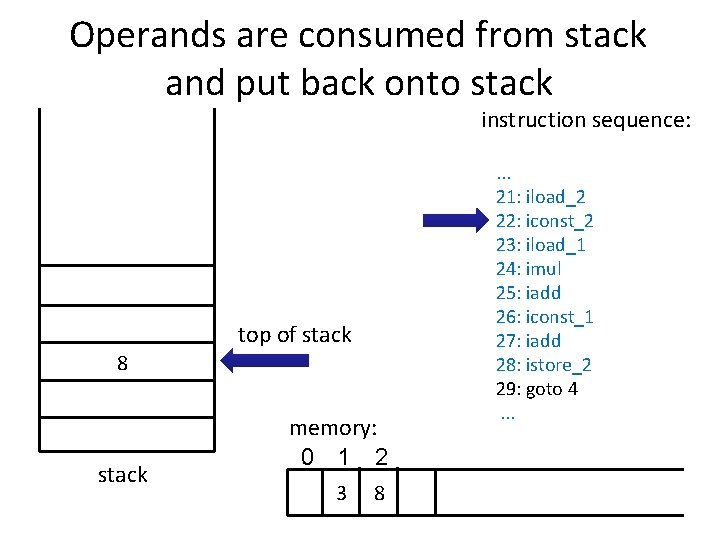
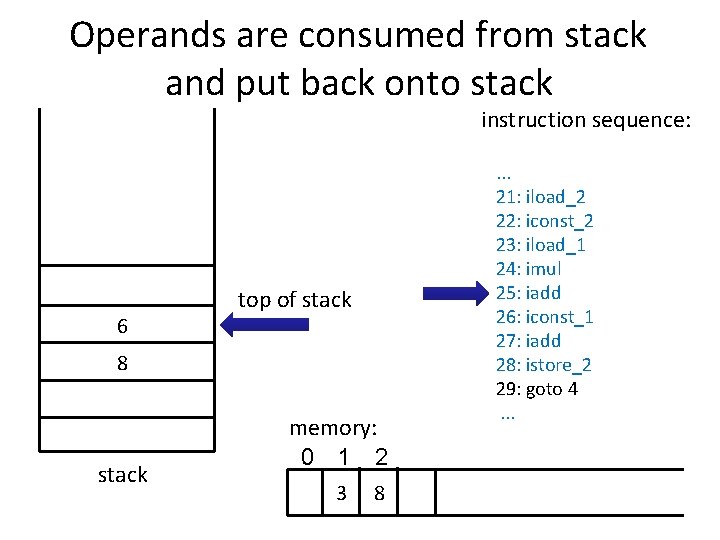
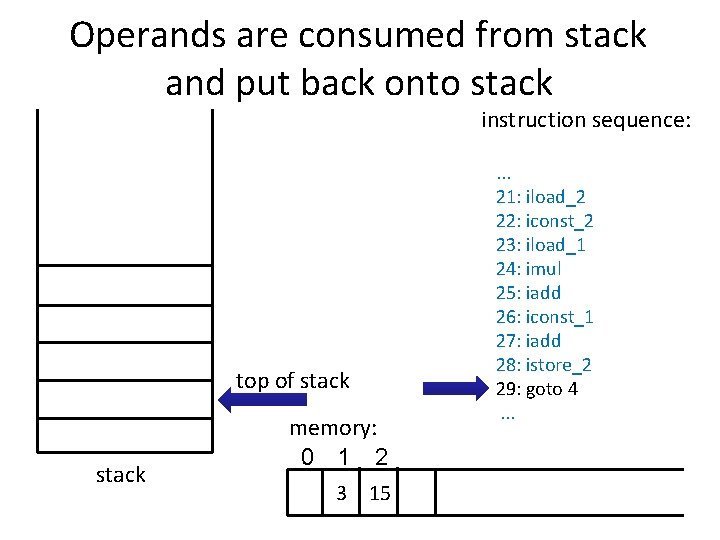
Operands are consumed from stack and put back onto stack instruction sequence: top of stack 8 stack memory: 0 1 2 3 8 . . . 21: iload_2 22: iconst_2 23: iload_1 24: imul 25: iadd 26: iconst_1 27: iadd 28: istore_2 29: goto 4. . .
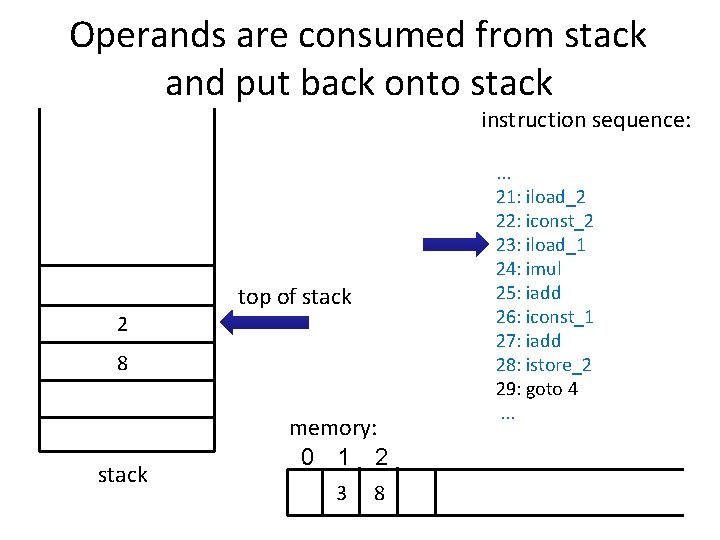
Operands are consumed from stack and put back onto stack instruction sequence: top of stack 2 8 stack memory: 0 1 2 3 8 . . . 21: iload_2 22: iconst_2 23: iload_1 24: imul 25: iadd 26: iconst_1 27: iadd 28: istore_2 29: goto 4. . .
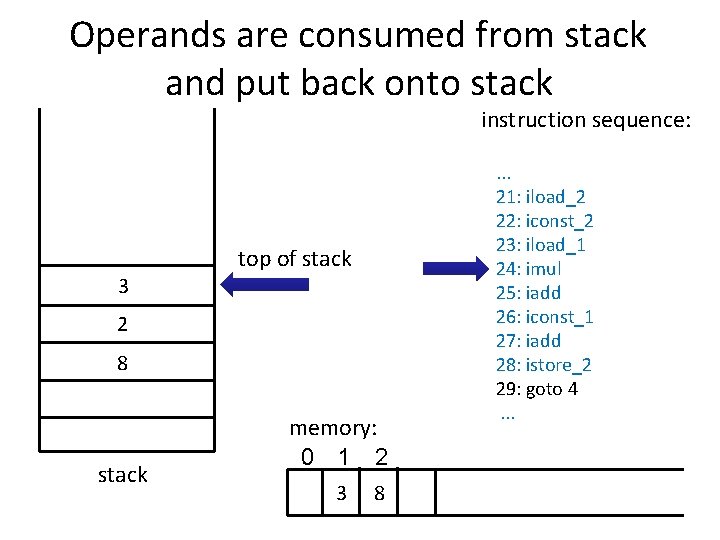
Operands are consumed from stack and put back onto stack instruction sequence: 3 top of stack 2 8 stack memory: 0 1 2 3 8 . . . 21: iload_2 22: iconst_2 23: iload_1 24: imul 25: iadd 26: iconst_1 27: iadd 28: istore_2 29: goto 4. . .
Operands are consumed from stack and put back onto stack instruction sequence: 6 top of stack 8 stack memory: 0 1 2 3 8 . . . 21: iload_2 22: iconst_2 23: iload_1 24: imul 25: iadd 26: iconst_1 27: iadd 28: istore_2 29: goto 4. . .
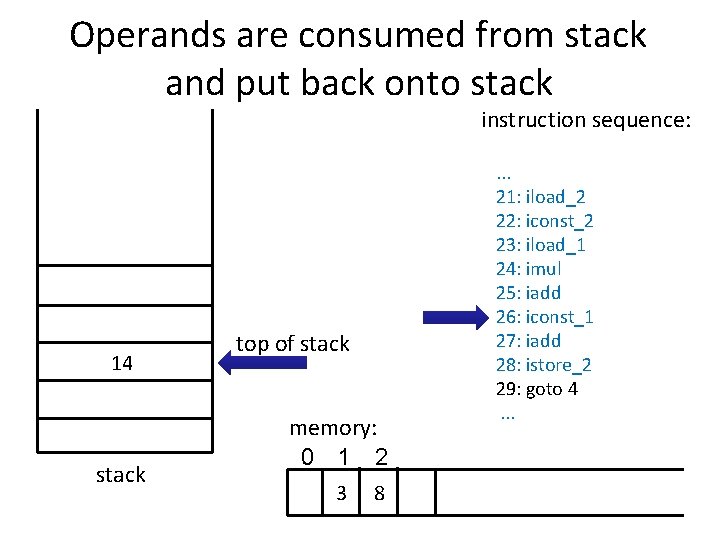
Operands are consumed from stack and put back onto stack instruction sequence: 14 stack top of stack memory: 0 1 2 3 8 . . . 21: iload_2 22: iconst_2 23: iload_1 24: imul 25: iadd 26: iconst_1 27: iadd 28: istore_2 29: goto 4. . .
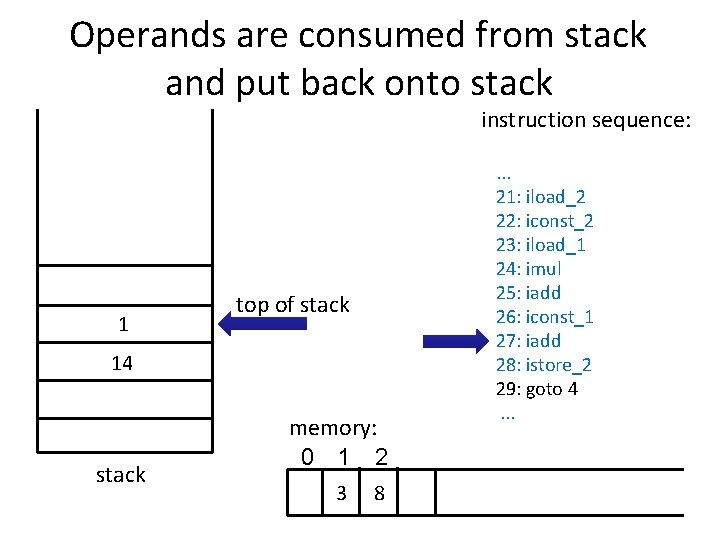
Operands are consumed from stack and put back onto stack instruction sequence: 1 top of stack 14 stack memory: 0 1 2 3 8 . . . 21: iload_2 22: iconst_2 23: iload_1 24: imul 25: iadd 26: iconst_1 27: iadd 28: istore_2 29: goto 4. . .
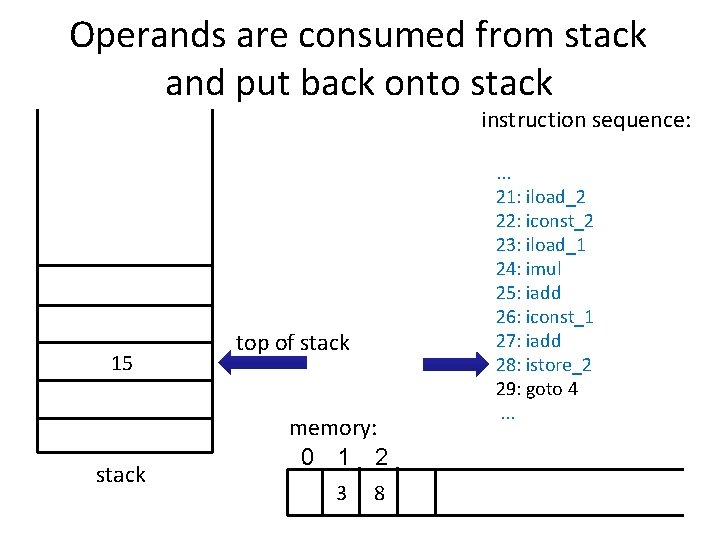
Operands are consumed from stack and put back onto stack instruction sequence: 15 stack top of stack memory: 0 1 2 3 8 . . . 21: iload_2 22: iconst_2 23: iload_1 24: imul 25: iadd 26: iconst_1 27: iadd 28: istore_2 29: goto 4. . .
Operands are consumed from stack and put back onto stack instruction sequence: top of stack memory: 0 1 2 3 15 . . . 21: iload_2 22: iconst_2 23: iload_1 24: imul 25: iadd 26: iconst_1 27: iadd 28: istore_2 29: goto 4. . .
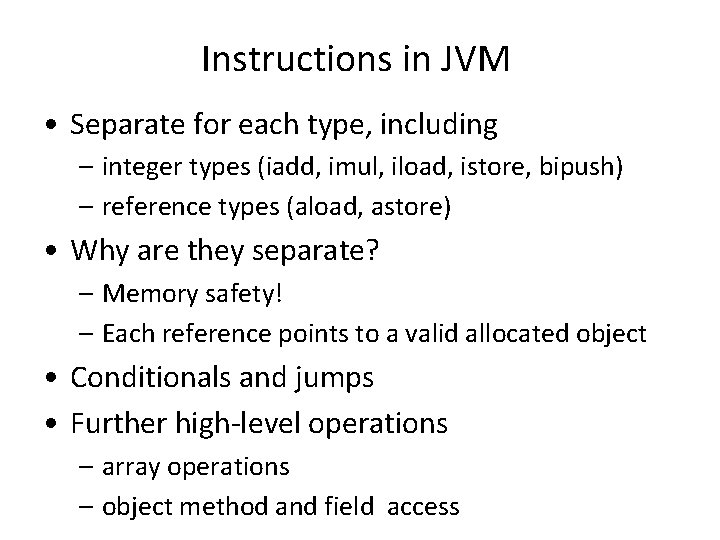
Instructions in JVM • Separate for each type, including – integer types (iadd, imul, iload, istore, bipush) – reference types (aload, astore) • Why are they separate? – Memory safety! – Each reference points to a valid allocated object • Conditionals and jumps • Further high-level operations – array operations – object method and field access
Stack Machine Simulator var code : Array[Instruction ] var pc : Int // program counter var local : Array[Int ] // for local variables var operand : Array[Int ] // operand stack var top : Int top 6 8 while (true) step def step = code(pc) match { case Iadd() => operand(top - 1) = operand(top - 1) + operand(top ) top = top - 1 // two consumed, one produced case Imul() => operand(top - 1) = operand(top - 1) * operand(top) top = top - 1 // two consumed, one produced stack
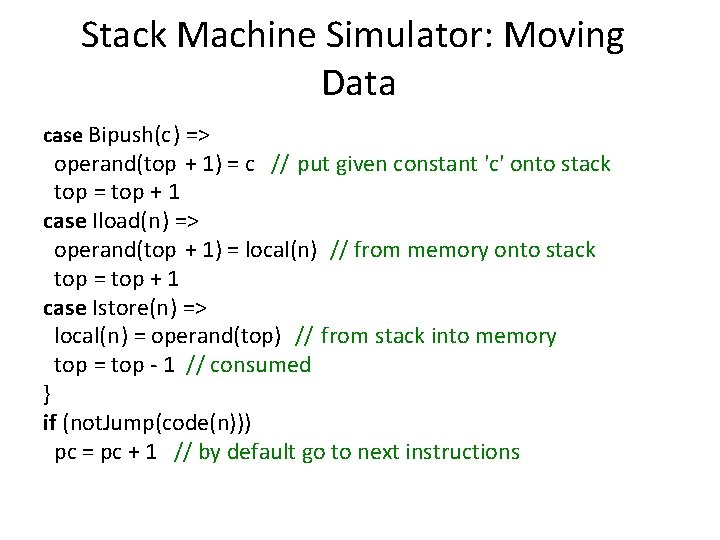
Stack Machine Simulator: Moving Data case Bipush(c) => operand(top + 1) = c // put given constant 'c' onto stack top = top + 1 case Iload(n) => operand(top + 1) = local(n) // from memory onto stack top = top + 1 case Istore(n) => local(n) = operand(top) // from stack into memory top = top - 1 // consumed } if (not. Jump(code(n))) pc = pc + 1 // by default go to next instructions
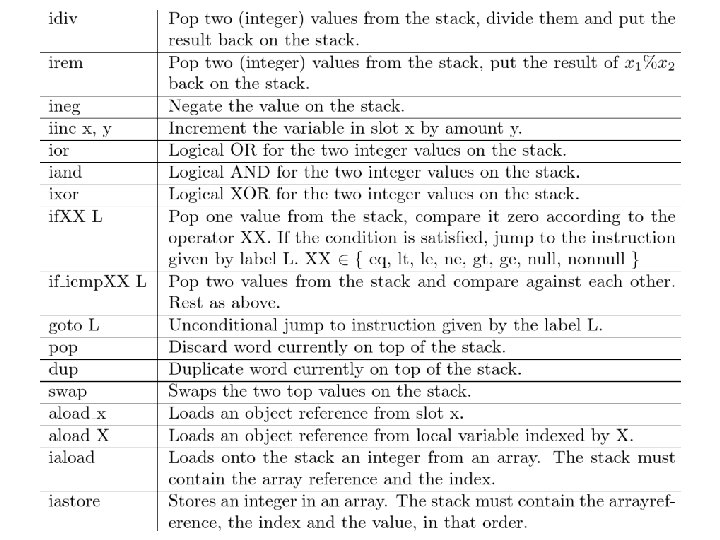
Actual Java Virtual Machine JVM Instruction Description from Java. Tech book Official documentation: http: //docs. oracle. com/javase/specs / http: // docs. oracle. com/javase/specs/jvms/se 7 /html/index. html Use: javac -g *. javap -c -l Class. Name to compile to explore
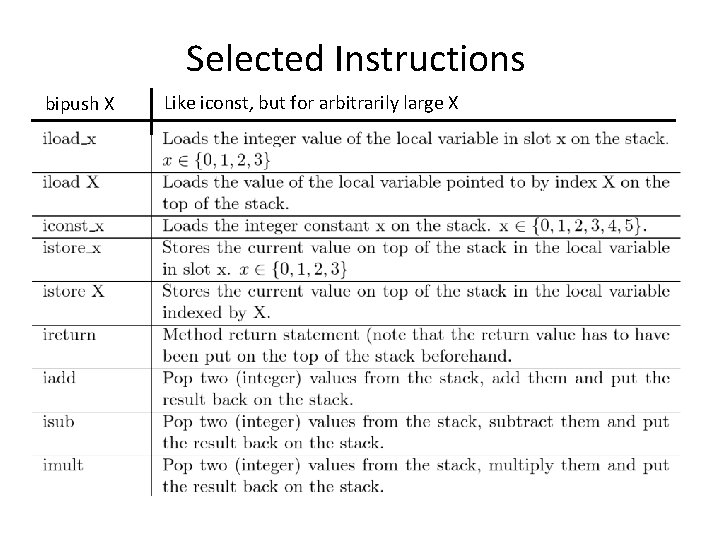
Selected Instructions bipush X Like iconst, but for arbitrarily large X
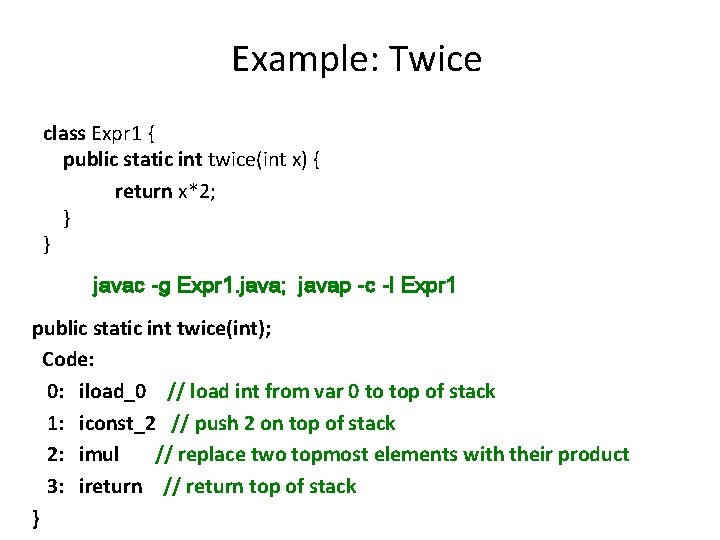
Example: Twice class Expr 1 { public static int twice(int x) { return x*2; } } javac -g Expr 1. java; javap -c -l Expr 1 public static int twice(int); Code: 0: iload_0 // load int from var 0 to top of stack 1: iconst_2 // push 2 on top of stack 2: imul // replace two topmost elements with their product 3: ireturn // return top of stack }
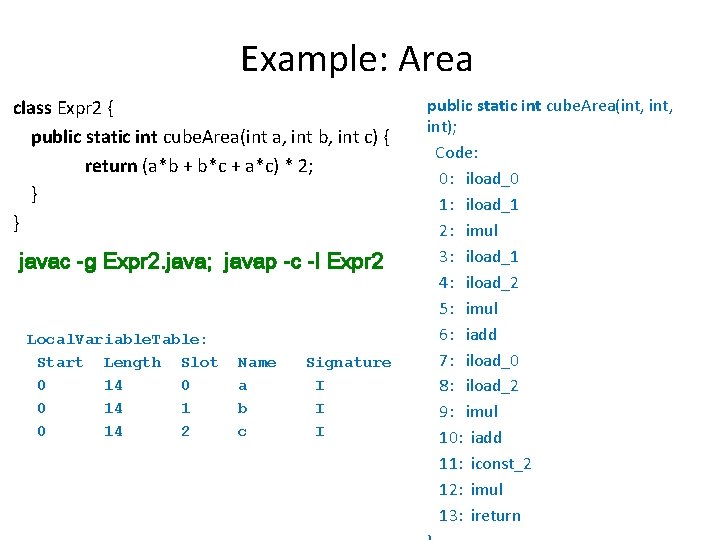
Example: Area class Expr 2 { public static int cube. Area(int a, int b, int c) { return (a*b + b*c + a*c) * 2; } } javac -g Expr 2. java; javap -c -l Expr 2 Local. Variable. Table: Start Length Slot 0 14 0 0 14 1 0 14 2 Name a b c Signature I I I public static int cube. Area(int, int); Code: 0: iload_0 1: iload_1 2: imul 3: iload_1 4: iload_2 5: imul 6: iadd 7: iload_0 8: iload_2 9: imul 10: iadd 11: iconst_2 12: imul 13: ireturn
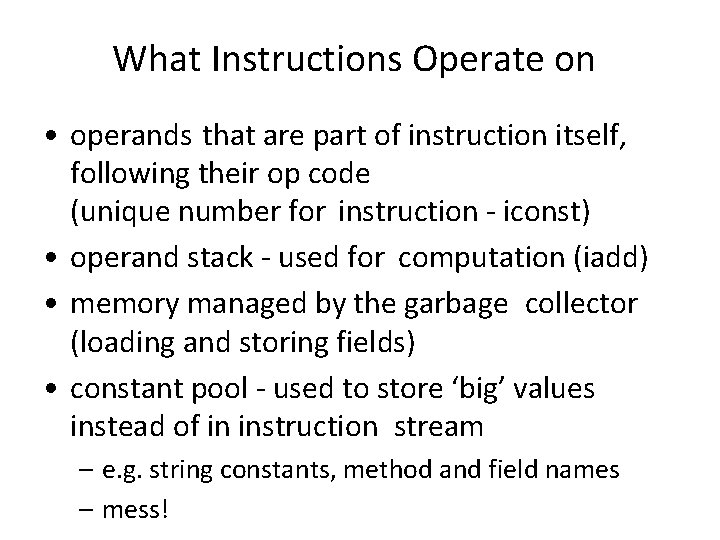
What Instructions Operate on • operands that are part of instruction itself, following their op code (unique number for instruction - iconst) • operand stack - used for computation (iadd) • memory managed by the garbage collector (loading and storing fields) • constant pool - used to store ‘big’ values instead of in instruction stream – e. g. string constants, method and field names – mess!
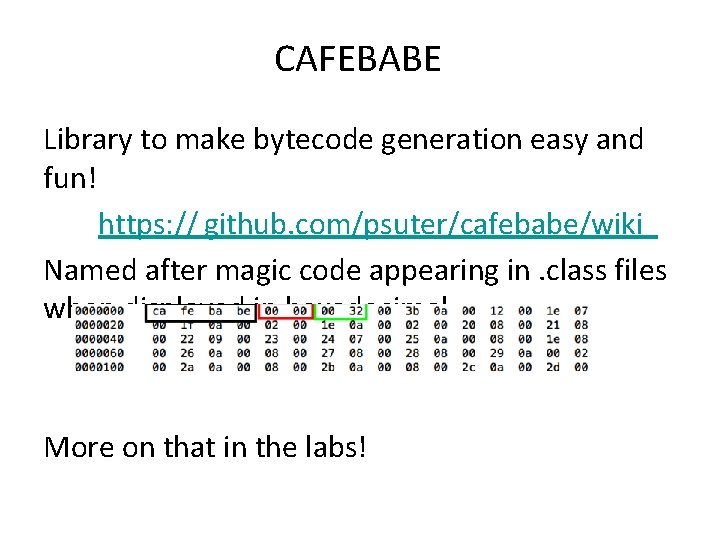
CAFEBABE Library to make bytecode generation easy and fun! https: // github. com/psuter/cafebabe/wiki Named after magic code appearing in. class files when displayed in hexadecimal: More on that in the labs!
Towards Compiling Expressions: Prefix, Infix, and Postfix Notation
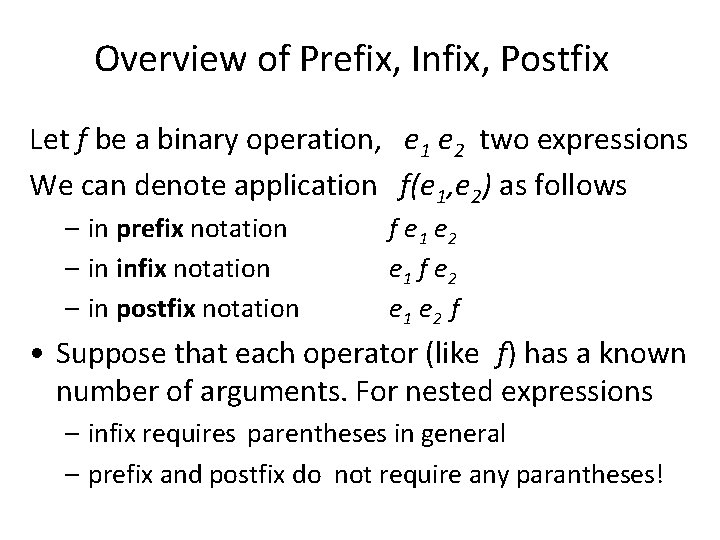
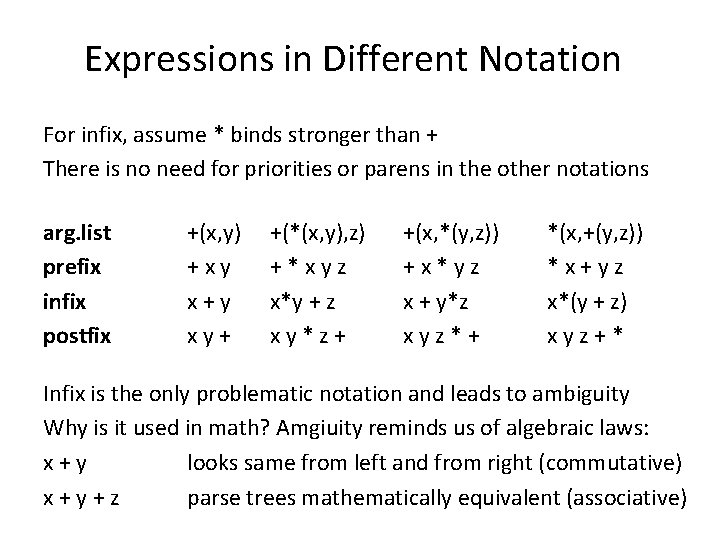
Overview of Prefix, Infix, Postfix Let f be a binary operation, e 1 e 2 two expressions We can denote application f(e 1, e 2) as follows – in prefix notation – in infix notation – in postfix notation f e 1 e 2 e 1 f e 2 e 1 e 2 f • Suppose that each operator (like f) has a known number of arguments. For nested expressions – infix requires parentheses in general – prefix and postfix do not require any parantheses!
Expressions in Different Notation For infix, assume * binds stronger than + There is no need for priorities or parens in the other notations arg. list prefix infix postfix +(x, y) +xy x+y xy+ +(*(x, y), z) +*xyz x*y + z xy*z+ +(x, *(y, z)) +x*yz x + y*z xyz*+ *(x, +(y, z)) *x+yz x*(y + z) xyz+* Infix is the only problematic notation and leads to ambiguity Why is it used in math? Amgiuity reminds us of algebraic laws: x+y looks same from left and from right (commutative) x+y+z parse trees mathematically equivalent (associative)
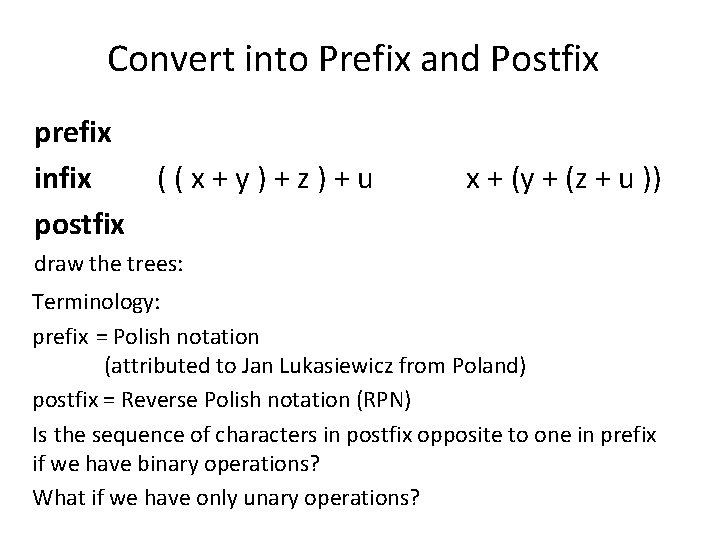
Convert into Prefix and Postfix prefix infix ((x+y)+z)+u postfix x + (y + (z + u )) draw the trees: Terminology: prefix = Polish notation (attributed to Jan Lukasiewicz from Poland) postfix = Reverse Polish notation (RPN) Is the sequence of characters in postfix opposite to one in prefix if we have binary operations? What if we have only unary operations?
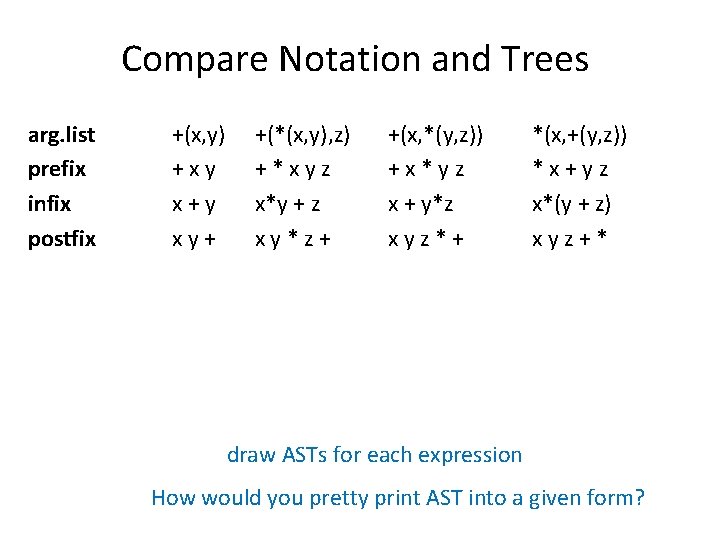
Compare Notation and Trees arg. list prefix infix postfix +(x, y) +xy x+y xy+ +(*(x, y), z) +*xyz x*y + z xy*z+ +(x, *(y, z)) +x*yz x + y*z xyz*+ *(x, +(y, z)) *x+yz x*(y + z) xyz+* draw ASTs for each expression How would you pretty print AST into a given form?
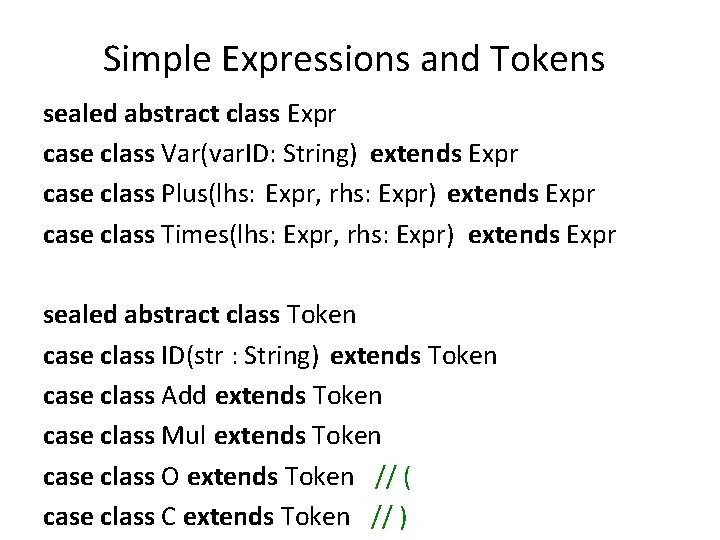
Simple Expressions and Tokens sealed abstract class Expr case class Var(var. ID: String) extends Expr case class Plus(lhs: Expr, rhs: Expr) extends Expr case class Times(lhs: Expr, rhs: Expr) extends Expr sealed abstract class Token case class ID(str : String) extends Token case class Add extends Token case class Mul extends Token case class O extends Token // ( case class C extends Token // )
Printing Trees into Lists of Tokens def prefix(e : Expr) : List[Token] = e match { case Var(id) => List(ID(id)) case Plus(e 1, e 2) => List(Add()) : : : prefix(e 1) : : : prefix(e 2) case Times(e 1, e 2) => List(Mul()) : : : prefix(e 1) : : : prefix(e 2) } def infix(e : Expr) : List[Token] = e match { // should emit parantheses! case Var(id) => List(ID(id)) case Plus(e 1, e 2) => List(O()): : : infix(e 1) : : : List(Add()) : : : infix(e 2) : : : List(C()) case Times(e 1, e 2) => List(O()): : : infix(e 1) : : : List(Mul()) : : : infix(e 2) : : : List(C()) } def postfix(e : Expr) : List[Token] = e match { case Var(id) => List(ID(id)) case Plus(e 1, e 2) => postfix(e 1) : : : postfix(e 2) : : : List(Add()) case Times(e 1, e 2) => postfix(e 1) : : : postfix(e 2) : : : List(Mul()) }
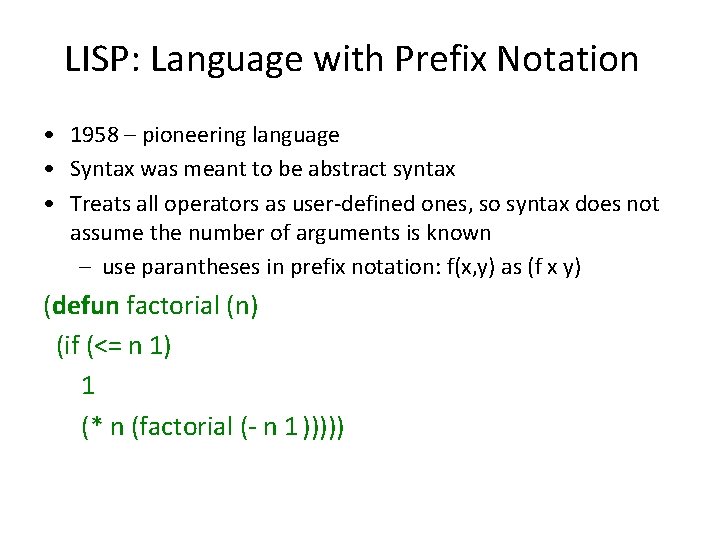
LISP: Language with Prefix Notation • 1958 – pioneering language • Syntax was meant to be abstract syntax • Treats all operators as user-defined ones, so syntax does not assume the number of arguments is known – use parantheses in prefix notation: f(x, y) as (f x y) (defun factorial (n) (if (<= n 1) 1 (* n (factorial (- n 1 )))))
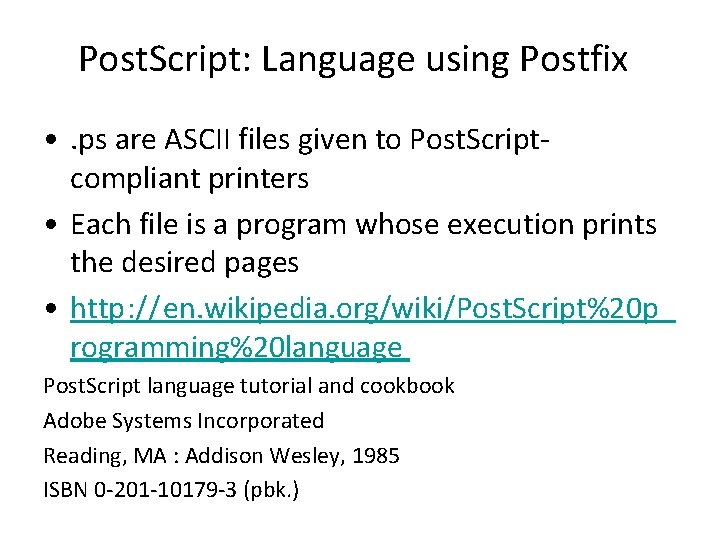
Post. Script: Language using Postfix • . ps are ASCII files given to Post. Scriptcompliant printers • Each file is a program whose execution prints the desired pages • http: //en. wikipedia. org/wiki/Post. Script%20 p rogramming%20 language Post. Script language tutorial and cookbook Adobe Systems Incorporated Reading, MA : Addison Wesley, 1985 ISBN 0 -201 -10179 -3 (pbk. )
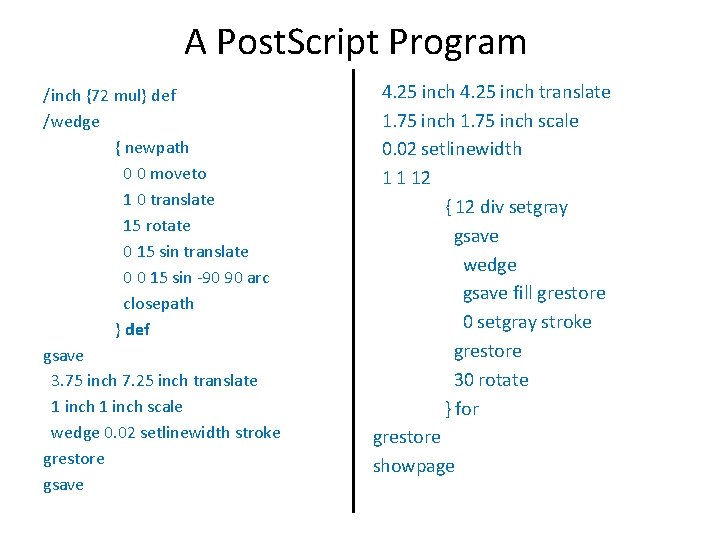
A Post. Script Program /inch {72 mul} def /wedge { newpath 0 0 moveto 1 0 translate 15 rotate 0 15 sin translate 0 0 15 sin -90 90 arc closepath } def gsave 3. 75 inch 7. 25 inch translate 1 inch scale wedge 0. 02 setlinewidth stroke grestore gsave 4. 25 inch translate 1. 75 inch scale 0. 02 setlinewidth 1 1 12 { 12 div setgray gsave wedge gsave fill grestore 0 setgray stroke grestore 30 rotate } for grestore showpage
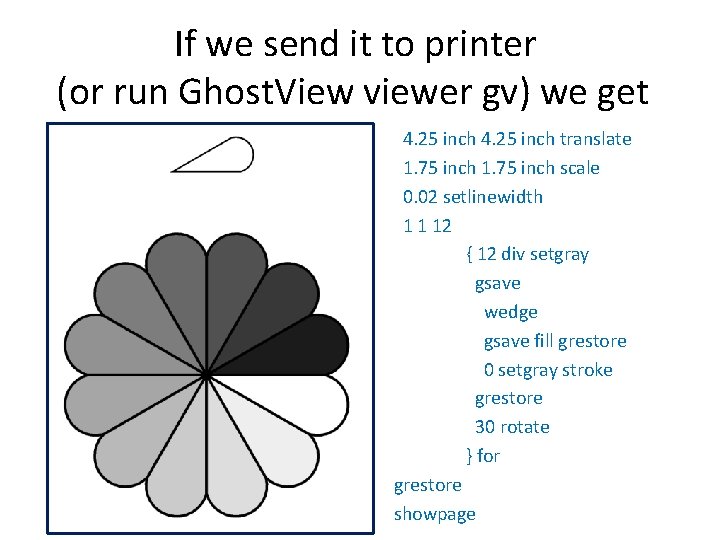
If we send it to printer (or run Ghost. View viewer gv) we get 4. 25 inch translate 1. 75 inch scale 0. 02 setlinewidth 1 1 12 { 12 div setgray gsave wedge gsave fill grestore 0 setgray stroke grestore 30 rotate } for grestore showpage
Why postfix? Can evaluate it using stack def post. Eval(env : Map[String, Int ], pexpr : Array[Token]) : Int = { // no recursion! var stack : Array[Int] = new Array[Int](512) var top : Int = 0; var pos : Int = 0 while (pos < pexpr. length) { pexpr(pos) match { case ID(v) => top = top + 1 stack(top ) = env(v) case Add() => stack(top - 1) = stack(top - 1) + stack(top) top = top - 1 case Mul() => stack(top - 1) = stack(top - 1) * stack(top) top = top - 1 } pos = pos + 1 } stack(top) x -> 3, y -> 4, z -> 5 infix: x*(y+z) postfix: x y z + * Run ‘postfix’ for this env
Evaluating Infix Needs Recursion The recursive interpreter: def infix. Eval(env : Map[String, Int], expr : Expr) : Int = expr match { case Var(id) => env(id) case Plus(e 1, e 2) => infix(env, e 1) + infix(env, e 2) case Times(e 1, e 2) => infix(env, e 1) * infix(env, e 2) } Maximal stack depth in interpreter = expression height
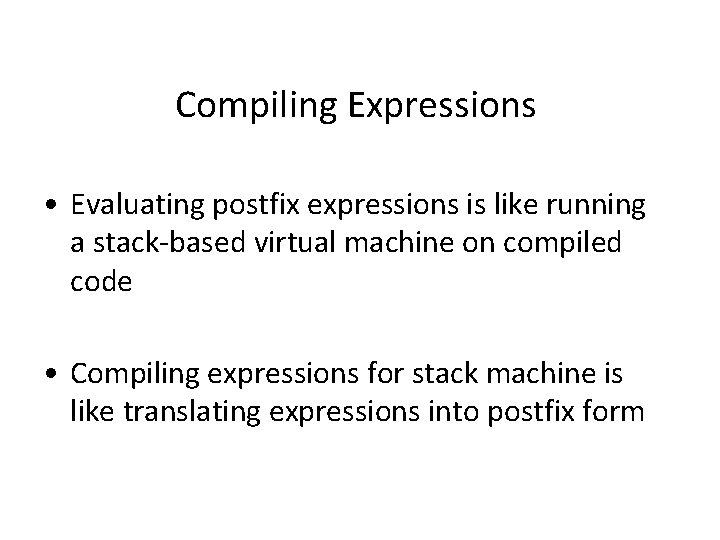
Compiling Expressions • Evaluating postfix expressions is like running a stack-based virtual machine on compiled code • Compiling expressions for stack machine is like translating expressions into postfix form
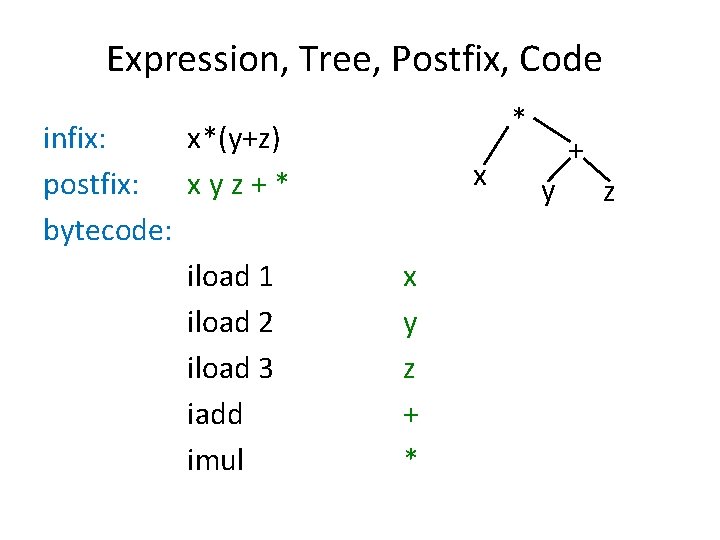
Expression, Tree, Postfix, Code infix: x*(y+z) postfix: x y z + * bytecode: iload 1 iload 2 iload 3 iadd imul * x x y z + * + y z
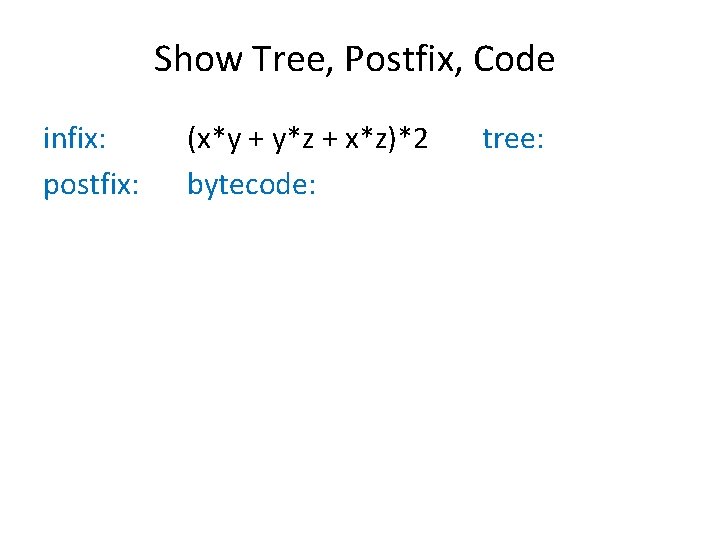
Show Tree, Postfix, Code infix: postfix: (x*y + y*z + x*z)*2 bytecode: tree:
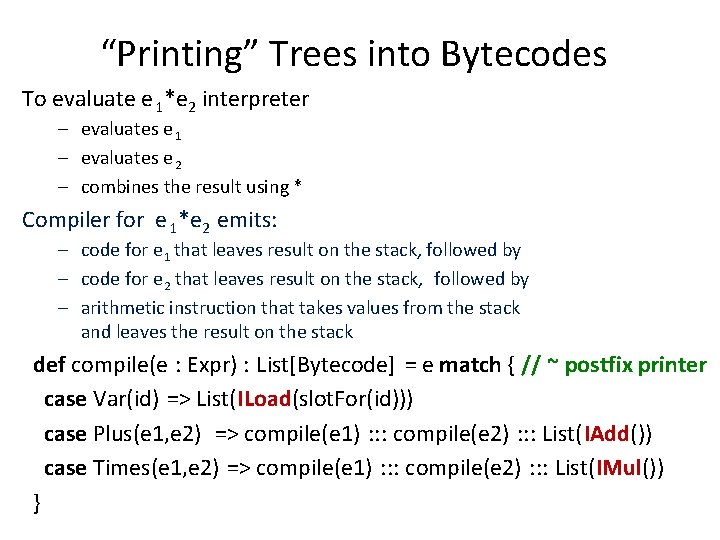
“Printing” Trees into Bytecodes To evaluate e 1*e 2 interpreter – evaluates e 1 – evaluates e 2 – combines the result using * Compiler for e 1*e 2 emits: – code for e 1 that leaves result on the stack, followed by – code for e 2 that leaves result on the stack, followed by – arithmetic instruction that takes values from the stack and leaves the result on the stack def compile(e : Expr) : List[Bytecode] = e match { // ~ postfix printer case Var(id) => List(ILoad(slot. For(id))) case Plus(e 1, e 2) => compile(e 1) : : : compile(e 2) : : : List(IAdd()) case Times(e 1, e 2) => compile(e 1) : : : compile(e 2) : : : List(IMul()) }
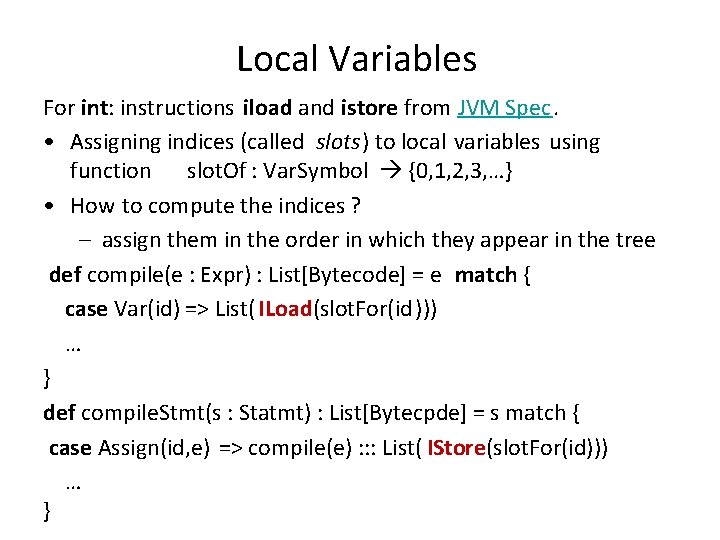
Local Variables For int: instructions iload and istore from JVM Spec. • Assigning indices (called slots) to local variables using function slot. Of : Var. Symbol {0, 1, 2, 3, …} • How to compute the indices ? – assign them in the order in which they appear in the tree def compile(e : Expr) : List[Bytecode] = e match { case Var(id) => List( ILoad(slot. For(id ))) … } def compile. Stmt(s : Statmt) : List[Bytecpde] = s match { case Assign(id, e) => compile(e) : : : List( IStore(slot. For(id))) … }
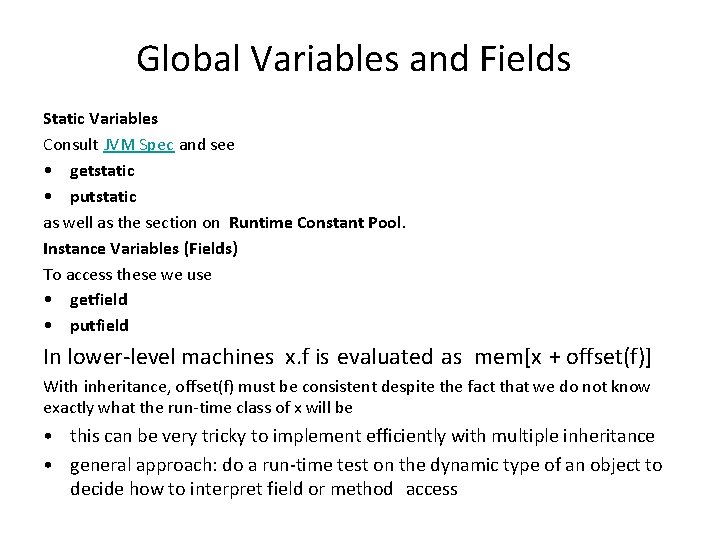
Global Variables and Fields Static Variables Consult JVM Spec and see • getstatic • putstatic as well as the section on Runtime Constant Pool. Instance Variables (Fields) To access these we use • getfield • putfield In lower-level machines x. f is evaluated as mem[x + offset(f)] With inheritance, offset(f) must be consistent despite the fact that we do not know exactly what the run-time class of x will be • this can be very tricky to implement efficiently with multiple inheritance • general approach: do a run-time test on the dynamic type of an object to decide how to interpret field or method access
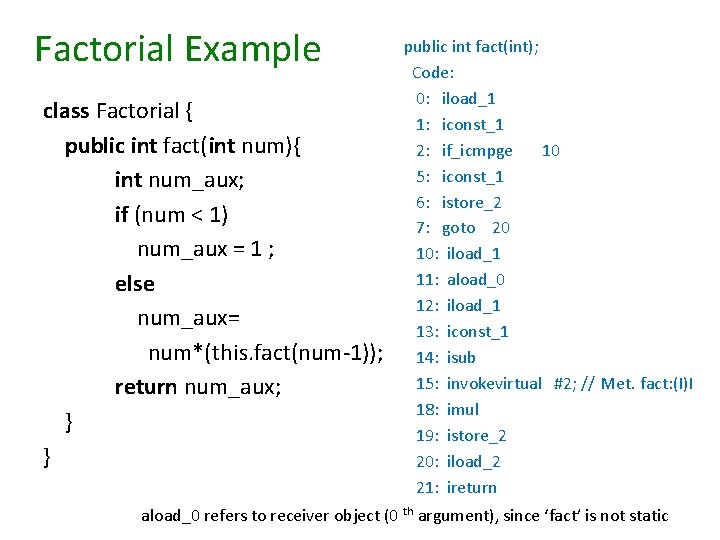
Factorial Example class Factorial { public int fact(int num){ int num_aux; if (num < 1) num_aux = 1 ; else num_aux= num*(this. fact(num-1)); return num_aux; } } public int fact(int); Code: 0: iload_1 1: iconst_1 2: if_icmpge 10 5: iconst_1 6: istore_2 7: goto 20 10: iload_1 11: aload_0 12: iload_1 13: iconst_1 14: isub 15: invokevirtual #2; // Met. fact: (I)I 18: imul 19: istore_2 20: iload_2 21: ireturn aload_0 refers to receiver object (0 th argument), since ‘fact’ is not static
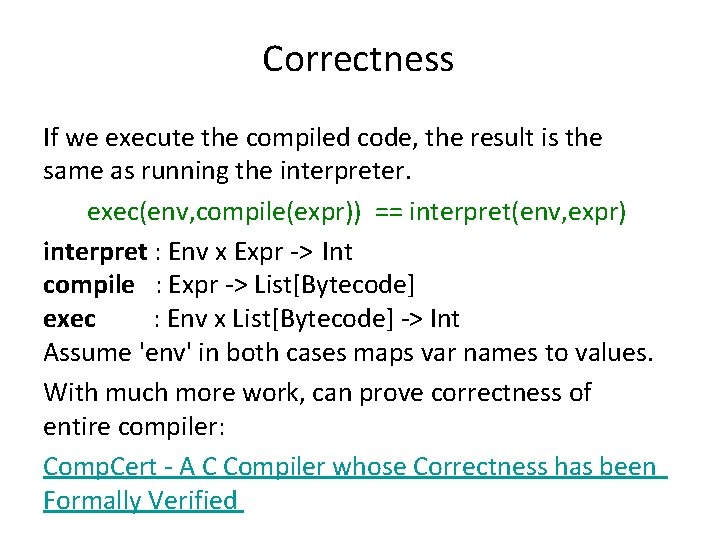
Correctness If we execute the compiled code, the result is the same as running the interpreter. exec(env, compile(expr)) == interpret(env, expr) interpret : Env x Expr -> Int compile : Expr -> List[Bytecode] exec : Env x List[Bytecode] -> Int Assume 'env' in both cases maps var names to values. With much more work, can prove correctness of entire compiler: Comp. Cert - A C Compiler whose Correctness has been Formally Verified
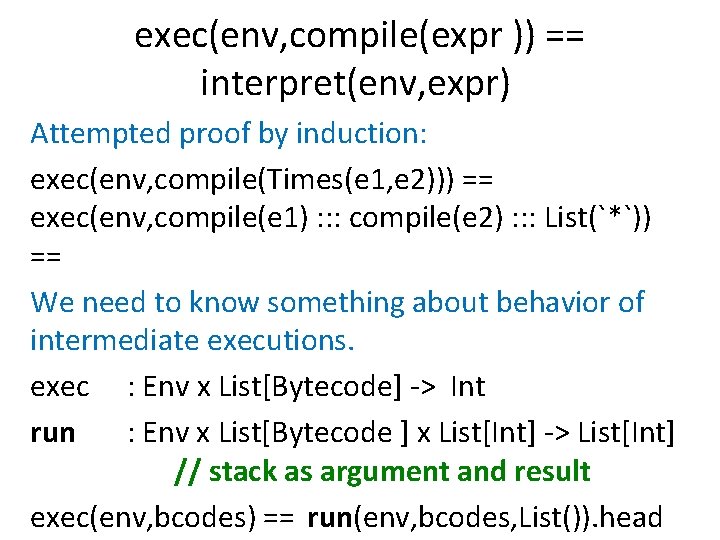
exec(env, compile(expr )) == interpret(env, expr) Attempted proof by induction: exec(env, compile(Times(e 1, e 2))) == exec(env, compile(e 1) : : : compile(e 2) : : : List(`*`)) == We need to know something about behavior of intermediate executions. exec : Env x List[Bytecode] -> Int run : Env x List[Bytecode ] x List[Int] -> List[Int] // stack as argument and result exec(env, bcodes) == run(env, bcodes, List()). head
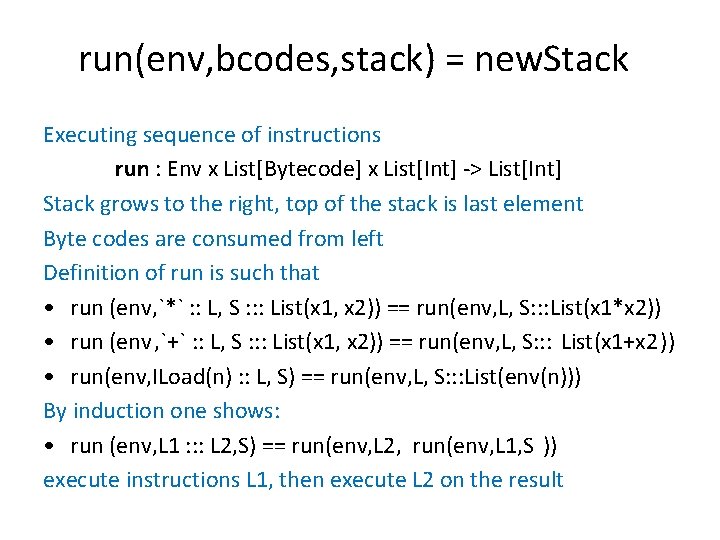
run(env, bcodes, stack) = new. Stack Executing sequence of instructions run : Env x List[Bytecode] x List[Int] -> List[Int] Stack grows to the right, top of the stack is last element Byte codes are consumed from left Definition of run is such that • run (env, `*` : : L, S : : : List(x 1, x 2)) == run(env, L, S: : : List(x 1*x 2)) • run (env, `+` : : L, S : : : List(x 1, x 2)) == run(env, L, S: : : List(x 1+x 2 )) • run(env, ILoad(n) : : L, S) == run(env, L, S: : : List(env(n))) By induction one shows: • run (env, L 1 : : : L 2, S) == run(env, L 2, run(env, L 1, S )) execute instructions L 1, then execute L 2 on the result
New correctness condition exec : Env x List[Bytecode] -> Int run : Env x List[Bytecode] x List[Int] -> List[Int] Old condition: exec(env, compile(expr )) == interpret(env, expr) New condition : run(env, compile(expr), S) == S: : : List(interpret(env, expr)) for short (T - table), [x] denotes List(x) run(T, C(e), S) == S: : : [I(T, e)]
Proof of one case: run(T, C(e), S) == S: : : [I(T, e )] run(T, C(Times(e 1, e 2)), S) == run(T, C(e 1): : : C(e 2): : : [`*`], S) == run(T, [`*`], run(T, e 2, run(T, e 1, S) )) == run(T, [`*`], run(T, e 2, S: : : [I(T, e 1)]) ) == run(T, [`*`], S: : : [I(T, e 1), I(T, e 2)]) == S: : : [I(T, e 1) * I(T, e 2)] == S: : : [I(T, Times(e 1, e 2)]