
Codan LBand Block Upconverter BUC System Hi Seas
Codan L-Band Block Upconverter (BUC) System Hi. Seas. Net Training Course SIO, August 2009

Codan L-Band Low Power Block Upconverter (LBUC) Technical Overview Main Components Low Power BUC (Block Upconverter) TRANSMIT LNB RECEIVE 2
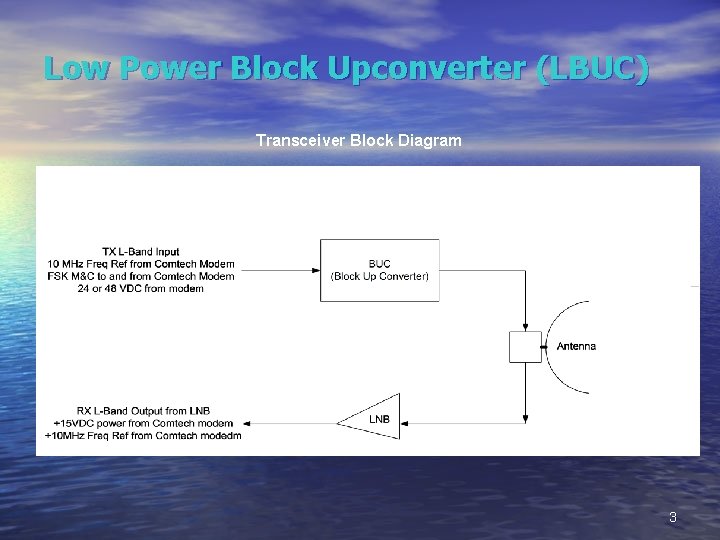
Low Power Block Upconverter (LBUC) Transceiver Block Diagram 3
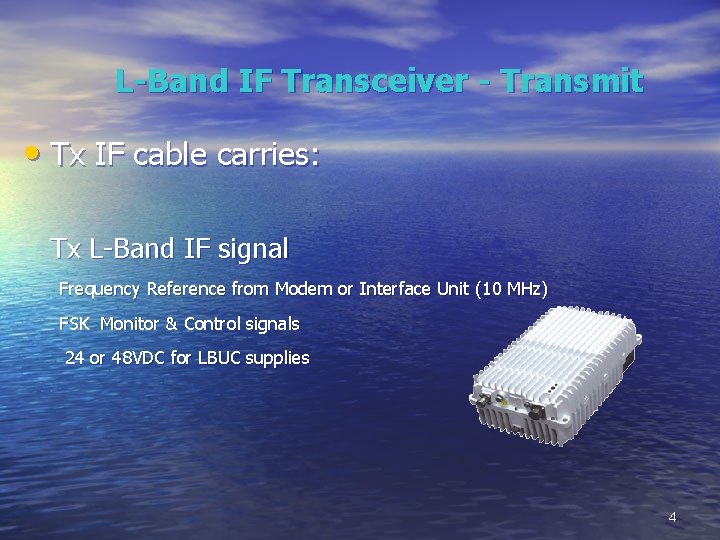
L-Band IF Transceiver - Transmit • Tx IF cable carries: Tx L-Band IF signal Frequency Reference from Modem or Interface Unit (10 MHz) FSK Monitor & Control signals 24 or 48 VDC for LBUC supplies 4
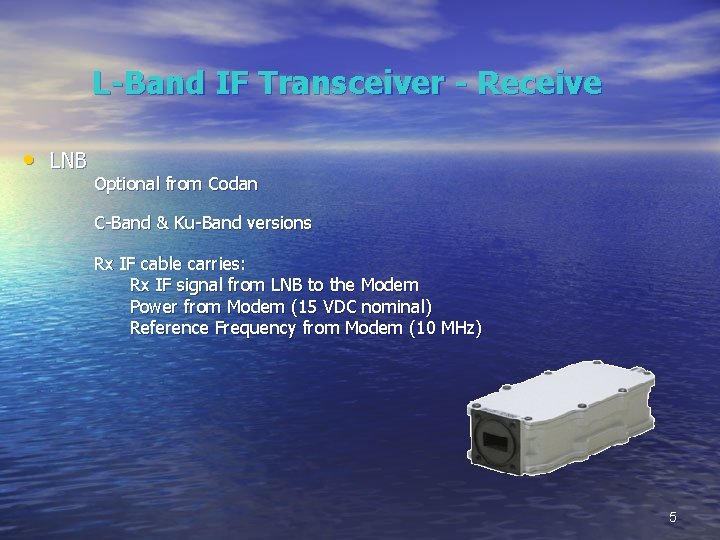
L-Band IF Transceiver - Receive • LNB Optional from Codan C-Band & Ku-Band versions Rx IF cable carries: Rx IF signal from LNB to the Modem Power from Modem (15 VDC nominal) Reference Frequency from Modem (10 MHz) 5

LNB Specifications • Frequency range Ku-Band 1 Band 2 Band 3 Ku-Band 60 d. B 10. 95 - 11. 70 GHz 11. 70 - 12. 20 GHz * 12. 25 - 12. 75 GHz • Gain • Noise temperature • Ku-Band NOTE: 75 K max Band 2, 11. 70 – 12. 20 GHz, is the Ku-Band frequency range used by 6 Hi. Seas. Net ships operating on Satmex 5, Beams 1 and 2
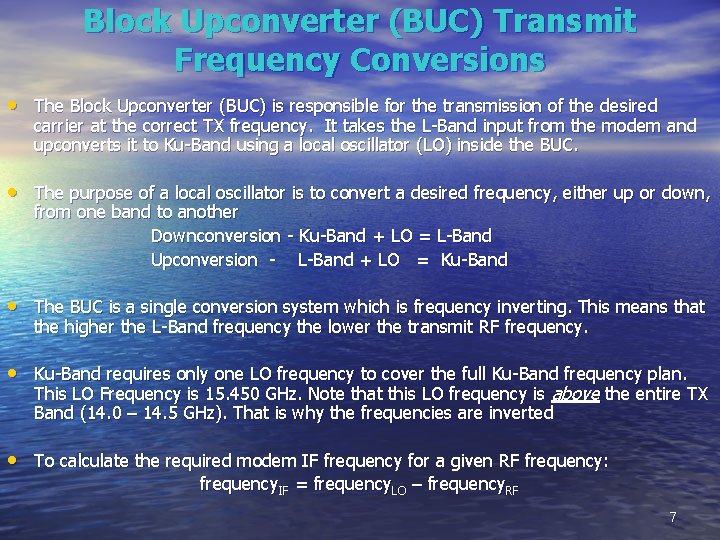
Block Upconverter (BUC) Transmit Frequency Conversions • The Block Upconverter (BUC) is responsible for the transmission of the desired carrier at the correct TX frequency. It takes the L-Band input from the modem and upconverts it to Ku-Band using a local oscillator (LO) inside the BUC. • The purpose of a local oscillator is to convert a desired frequency, either up or down, from one band to another Downconversion - Ku-Band + LO = L-Band Upconversion - L-Band + LO = Ku-Band • The BUC is a single conversion system which is frequency inverting. This means that the higher the L-Band frequency the lower the transmit RF frequency. • Ku-Band requires only one LO frequency to cover the full Ku-Band frequency plan. This LO Frequency is 15. 450 GHz. Note that this LO frequency is above the entire TX Band (14. 0 – 14. 5 GHz). That is why the frequencies are inverted • To calculate the required modem IF frequency for a given RF frequency: frequency. IF = frequency. LO – frequency. RF 7

BUC Frequency Plan (Ku-Band) • Ku-Band - LBUC • RF: 13750 - 14500 MHz • • (Extended TX Range) IF: 950 - 1700 MHz LO fixed at 15450 MHz 1700 MHz 14500 MHz Ku-Band - MBUC RF: 14000 - 14500 MHz (Standard TX Range) IF: 950 - 1450 MHz LO fixed at 15450 MHz 14500 MHz 1450 MHz 14000 MHz 950 MHz IF input 14000 MHz RF output 13750 MHz RF output 8
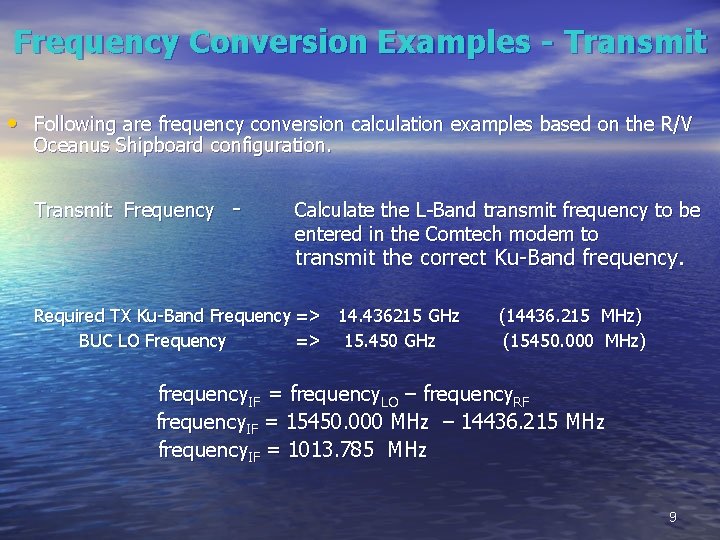
Frequency Conversion Examples - Transmit • Following are frequency conversion calculation examples based on the R/V Oceanus Shipboard configuration. Transmit Frequency - Calculate the L-Band transmit frequency to be entered in the Comtech modem to transmit the correct Ku-Band frequency. Required TX Ku-Band Frequency => 14. 436215 GHz BUC LO Frequency => 15. 450 GHz (14436. 215 MHz) (15450. 000 MHz) frequency. IF = frequency. LO – frequency. RF frequency. IF = 15450. 000 MHz – 14436. 215 MHz frequency. IF = 1013. 785 MHz 9
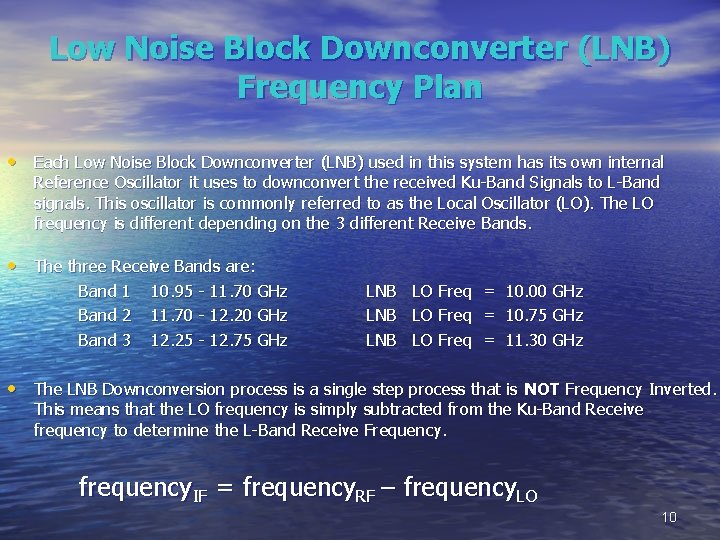
Low Noise Block Downconverter (LNB) Frequency Plan • Each Low Noise Block Downconverter (LNB) used in this system has its own internal Reference Oscillator it uses to downconvert the received Ku-Band Signals to L-Band signals. This oscillator is commonly referred to as the Local Oscillator (LO). The LO frequency is different depending on the 3 different Receive Bands. • The three Receive Bands are: Band 1 Band 2 Band 3 10. 95 - 11. 70 GHz 11. 70 - 12. 20 GHz 12. 25 - 12. 75 GHz LNB LO Freq = 10. 00 GHz LNB LO Freq = 10. 75 GHz LNB LO Freq = 11. 30 GHz • The LNB Downconversion process is a single step process that is NOT Frequency Inverted. This means that the LO frequency is simply subtracted from the Ku-Band Receive frequency to determine the L-Band Receive Frequency. frequency. IF = frequency. RF – frequency. LO 10
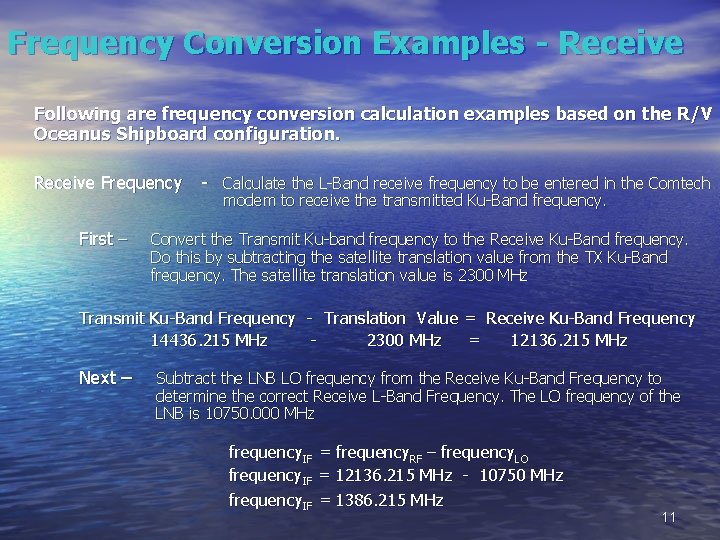
Frequency Conversion Examples - Receive Following are frequency conversion calculation examples based on the R/V Oceanus Shipboard configuration. Receive Frequency - Calculate the L-Band receive frequency to be entered in the Comtech modem to receive the transmitted Ku-Band frequency. First – Convert the Transmit Ku-band frequency to the Receive Ku-Band frequency. Do this by subtracting the satellite translation value from the TX Ku-Band frequency. The satellite translation value is 2300 MHz Transmit Ku-Band Frequency - Translation Value = Receive Ku-Band Frequency 14436. 215 MHz 2300 MHz = 12136. 215 MHz Next – Subtract the LNB LO frequency from the Receive Ku-Band Frequency to determine the correct Receive L-Band Frequency. The LO frequency of the LNB is 10750. 000 MHz frequency. IF = frequency. RF – frequency. LO frequency. IF = 12136. 215 MHz - 10750 MHz frequency. IF = 1386. 215 MHz 11

BUC Indicators/Alarms • There are three LEDs on the BUC – PWR (Power) Green – Indicating Power present – Tx (Transmit) Yellow – Indicates BUC RF PA is ON – FLT (Fault) Red – Two possible states: On – steady Flash – two flashes every second 12
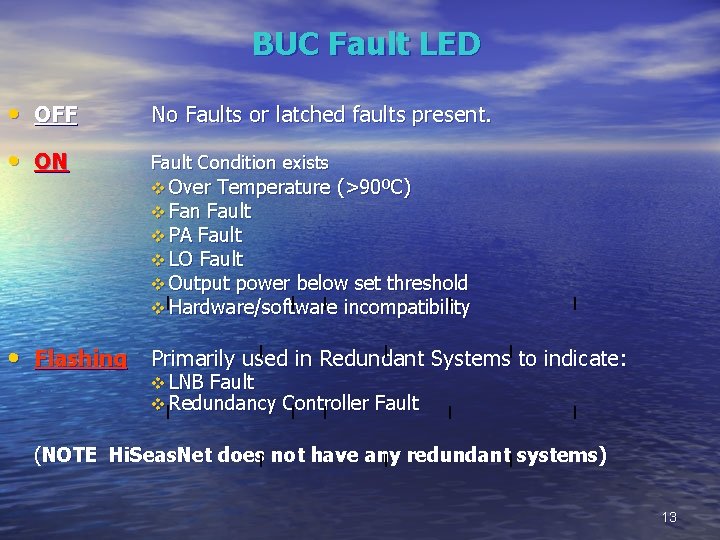
BUC Fault LED • OFF No Faults or latched faults present. • ON Fault Condition exists v Over Temperature (>90ºC) v Fan Fault v PA Fault v LO Fault v Output power below set threshold v Hardware/software incompatibility • Flashing Primarily used in Redundant Systems to indicate: v LNB Fault v Redundancy Controller Fault (NOTE Hi. Seas. Net does not have any redundant systems) 13
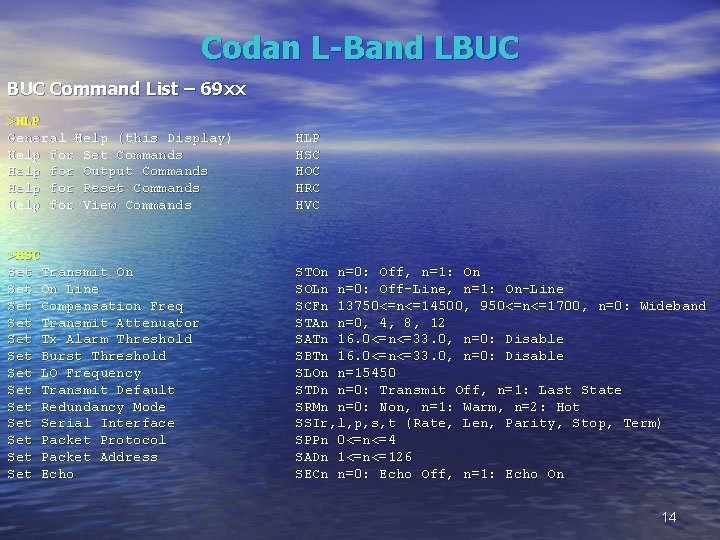
Codan L-Band LBUC Command List – 69 xx >HLP General Help (this Display) Help for Set Commands Help for Output Commands Help for Reset Commands Help for View Commands HLP HSC HOC HRC HVC >HSC Set Transmit On Set On Line Set Compensation Freq Set Transmit Attenuator Set Tx Alarm Threshold Set Burst Threshold Set LO Frequency Set Transmit Default Set Redundancy Mode Set Serial Interface Set Packet Protocol Set Packet Address Set Echo STOn n=0: Off, n=1: On SOLn n=0: Off-Line, n=1: On-Line SCFn 13750<=n<=14500, 950<=n<=1700, n=0: Wideband STAn n=0, 4, 8, 12 SATn 16. 0<=n<=33. 0, n=0: Disable SBTn 16. 0<=n<=33. 0, n=0: Disable SLOn n=15450 STDn n=0: Transmit Off, n=1: Last State SRMn n=0: Non, n=1: Warm, n=2: Hot SSIr, l, p, s, t (Rate, Len, Parity, Stop, Term) SPPn 0<=n<=4 SADn 1<=n<=126 SECn n=0: Echo Off, n=1: Echo On 14
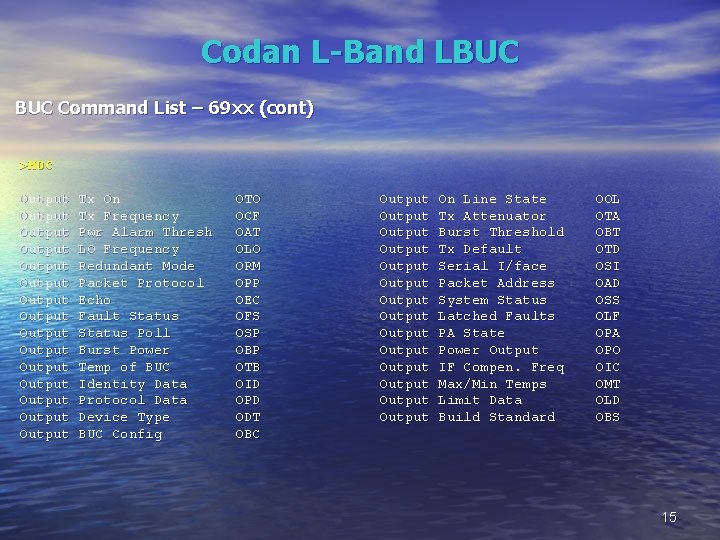
Codan L-Band LBUC Command List – 69 xx (cont) >HOC Output Output Output Output Tx On Tx Frequency Pwr Alarm Thresh LO Frequency Redundant Mode Packet Protocol Echo Fault Status Poll Burst Power Temp of BUC Identity Data Protocol Data Device Type BUC Config OTO OCF OAT OLO ORM OPP OEC OFS OSP OBP OTB OID OPD ODT OBC Output Output Output Output On Line State Tx Attenuator Burst Threshold Tx Default Serial I/face Packet Address System Status Latched Faults PA State Power Output IF Compen. Freq Max/Min Temps Limit Data Build Standard OOL OTA OBT OTD OSI OAD OSS OLF OPA OPO OIC OMT OLD OBS 15
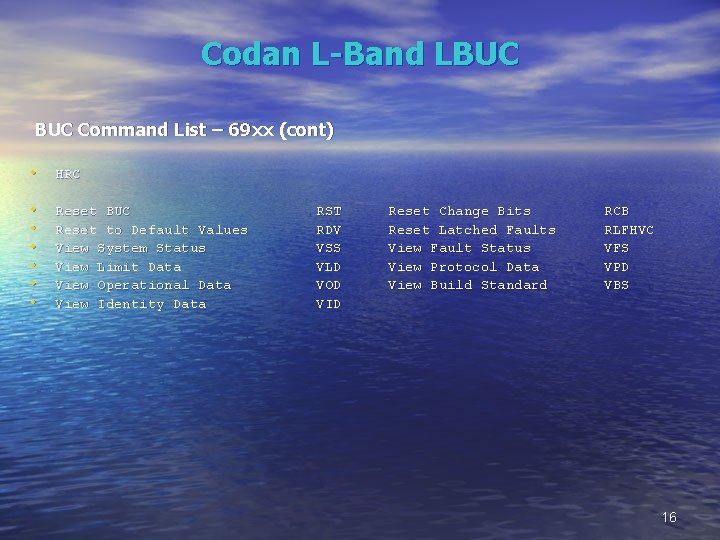
Codan L-Band LBUC Command List – 69 xx (cont) • HRC • • • Reset BUC Reset to Default Values View System Status View Limit Data View Operational Data View Identity Data RST RDV VSS VLD VOD VID Reset Change Bits Reset Latched Faults View Fault Status View Protocol Data View Build Standard RCB RLFHVC VFS VPD VBS 16
- Slides: 16