
Cockpit Display of Traffic Information CDTI Enhanced Flight
- Slides: 21
Cockpit Display of Traffic Information (CDTI) Enhanced Flight Rules (CEFR) Randall Bone October 7, 2003 © 2003 The MITRE Corporation. All Rights Reserved.
Overview • Review of Cockpit Display of Traffic Information (CDTI) and CDTI Enhanced Flight Rules (CEFR) • CEFR during Visual Approaches Example • CEFR Purpose • Simulations – Objectives – Overview – Results • Status 2 © 2003 The MITRE Corporation. All Rights Reserved.
Acronyms • • • 3 ASAS – Airborne Separation Assurance Systems ATC – Air Traffic Control CDTI – Cockpit Display of Traffic Information CEFR – CDTI Enhanced Flight Rules IFR – Instrument Flight Rules IMC – Instrument Meteorological Conditions MVA – Minimum Vectoring Altitude OSED – Operational Service and Environment Description UPS – United Parcel Service VFR – Visual Flight Rules VMC – Visual Meteorological Conditions © 2003 The MITRE Corporation. All Rights Reserved.
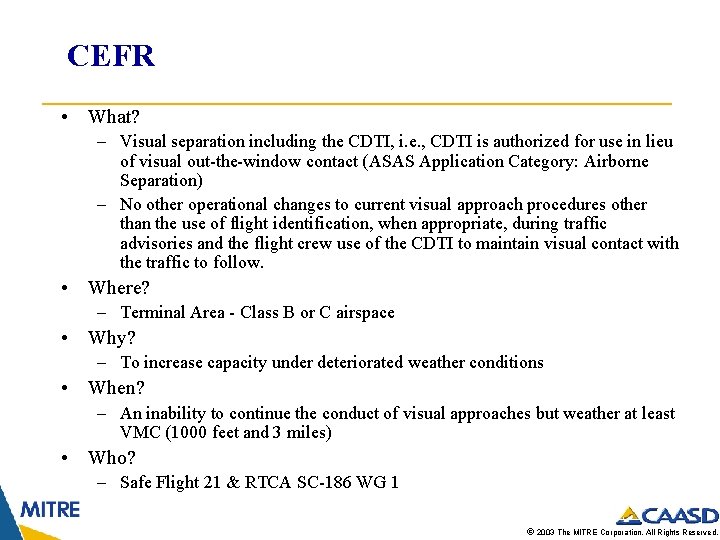
CEFR • What? – Visual separation including the CDTI, i. e. , CDTI is authorized for use in lieu of visual out-the-window contact (ASAS Application Category: Airborne Separation) – No other operational changes to current visual approach procedures other than the use of flight identification, when appropriate, during traffic advisories and the flight crew use of the CDTI to maintain visual contact with the traffic to follow. • Where? – Terminal Area - Class B or C airspace • Why? – To increase capacity under deteriorated weather conditions • When? – An inability to continue the conduct of visual approaches but weather at least VMC (1000 feet and 3 miles) • Who? – Safe Flight 21 & RTCA SC-186 WG 1 © 2003 The MITRE Corporation. All Rights Reserved.
Visual Separation • Visual separation can be applied by ATC to separate aircraft by a pilot who sees the other aircraft involved • Traffic advisories are issued by ATC to the pilot who must search for the traffic, acquire the traffic, and accept responsibility for maintaining separation from that aircraft • Pilot acceptance of visual separation includes: – Maintaining constant visual surveillance; – Maneuvering the aircraft as necessary to avoid the other aircraft or to maintain in-trail separation; – Avoiding wake; – Not passing the other aircraft until it is no longer a factor ; and – Promptly notifying ATC if visual contact with the other aircraft is lost • Pilot acceptance of visual separation relieves the controller of separation responsibility for that particular aircraft and allows for more flexible operations 5 © 2003 The MITRE Corporation. All Rights Reserved.
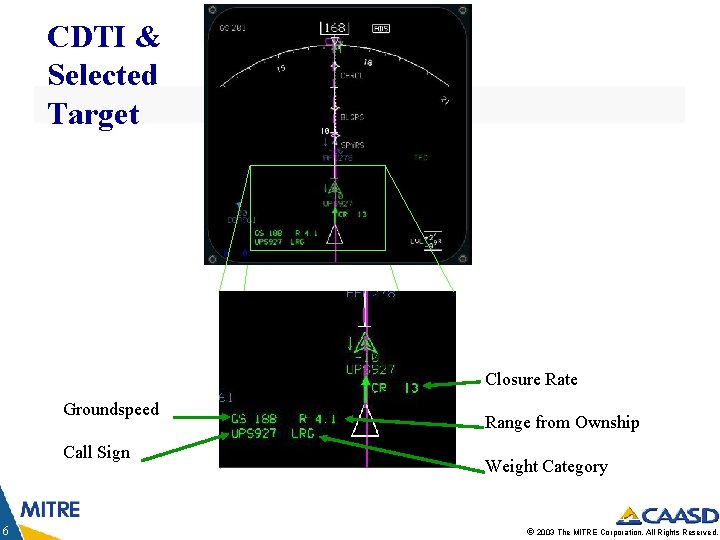
CDTI & Selected Target Closure Rate Groundspeed Call Sign 6 Range from Ownship Weight Category © 2003 The MITRE Corporation. All Rights Reserved.
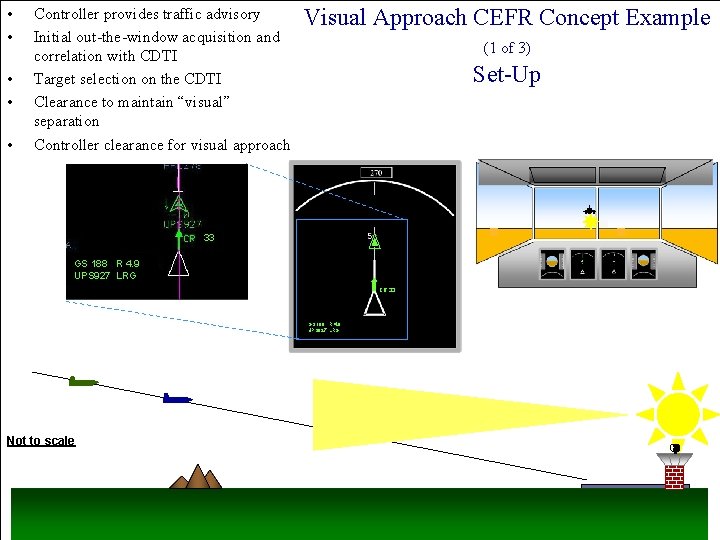
• • • Controller provides traffic advisory Initial out-the-window acquisition and correlation with CDTI Target selection on the CDTI Clearance to maintain “visual” separation Controller clearance for visual approach Visual Approach CEFR Concept Example (1 of 3) Set-Up . . 33 GS GS 188 RR 4. 9 UPS 927 LRG CR 33 GS 188 R 4. 9 UPS 927 LRG Not to scale 7 © 2003 The MITRE Corporation. All Rights Reserved.
Call Sign Use • Louisville Approach: “Abaco 235, Louisville Approach, traffic 12 o’clock, 6 miles, southbound, Boeing 737, 4000. ” • Abaco 235: “Louisville, Abaco 235, Defiant one twelve is in sight. ” • Louisville Approach: “Abaco 235, maintain visual separation from that traffic. ” 8 © 2003 The MITRE Corporation. All Rights Reserved.
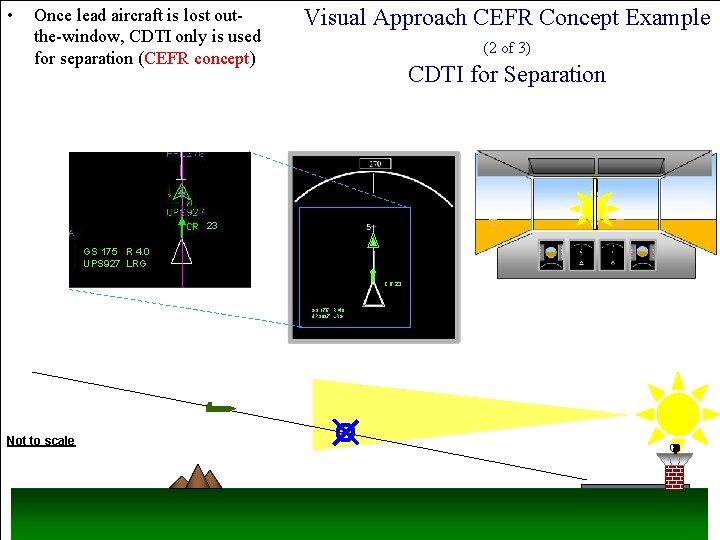
• Once lead aircraft is lost outthe-window, CDTI only is used for separation (CEFR concept) Visual Approach CEFR Concept Example (2 of 3) CDTI for Separation . . 23 GS 175 R 4. 0 UPS 927 LRG CR 23 GS 175 R 4. 0 UPS 927 LRG Not to scale 9 © 2003 The MITRE Corporation. All Rights Reserved.
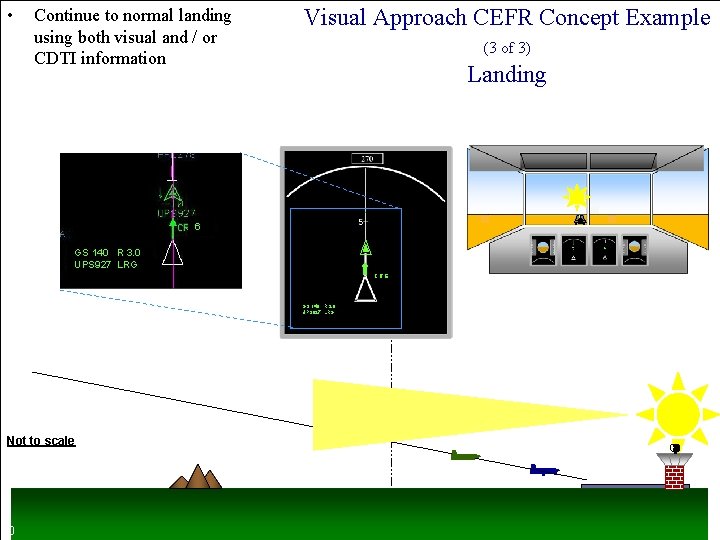
• Continue to normal landing using both visual and / or CDTI information Visual Approach CEFR Concept Example (3 of 3) Landing . . 6 GS 140 R 3. 0 UPS 927 LRG CR 6 GS 140 R 3. 0 UPS 927 LRG Reacquisition Not to scale 10 © 2003 The MITRE Corporation. All Rights Reserved.
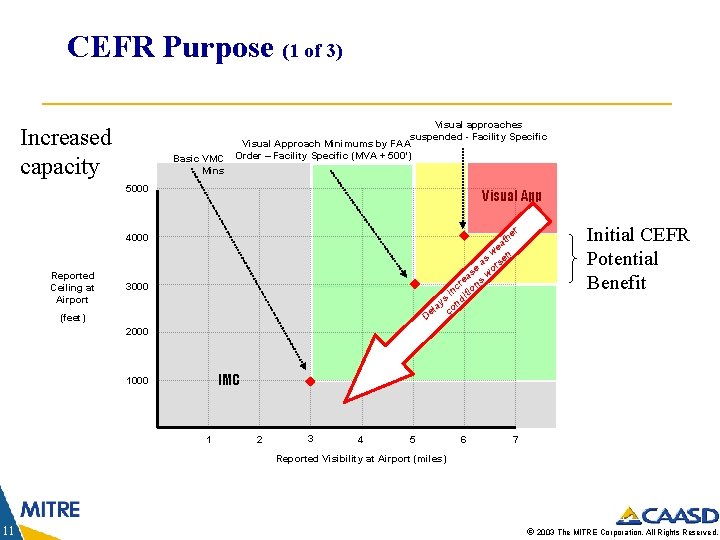
CEFR Purpose (1 of 3) Increased capacity Basic VMC Mins Visual approaches suspended - Facility Specific Visual Approach Minimums by FAA Order – Facility Specific (MVA + 500’) 5000 Visual App er th a e w n s a se e or s w a re ns c in tio s ndi y a el co 4000 Reported Ceiling at Airport 3000 Initial CEFR Potential Benefit D (feet) 2000 IMC 1000 1 2 3 4 5 6 7 Reported Visibility at Airport (miles) 11 © 2003 The MITRE Corporation. All Rights Reserved.
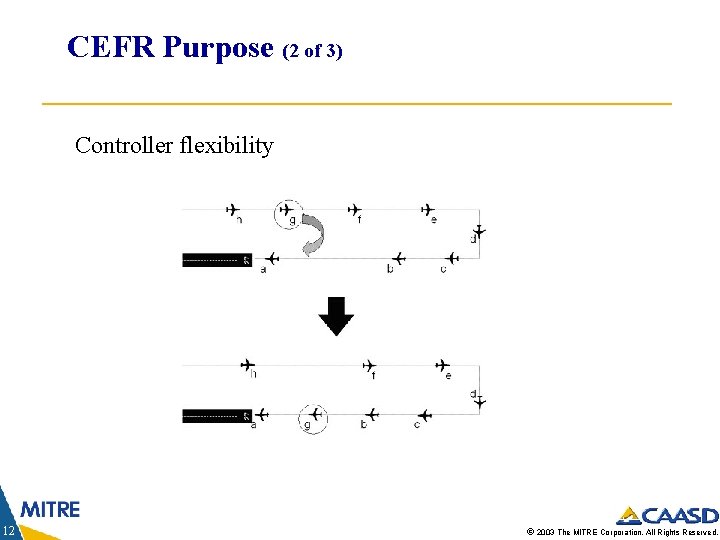
CEFR Purpose (2 of 3) Controller flexibility 12 © 2003 The MITRE Corporation. All Rights Reserved.
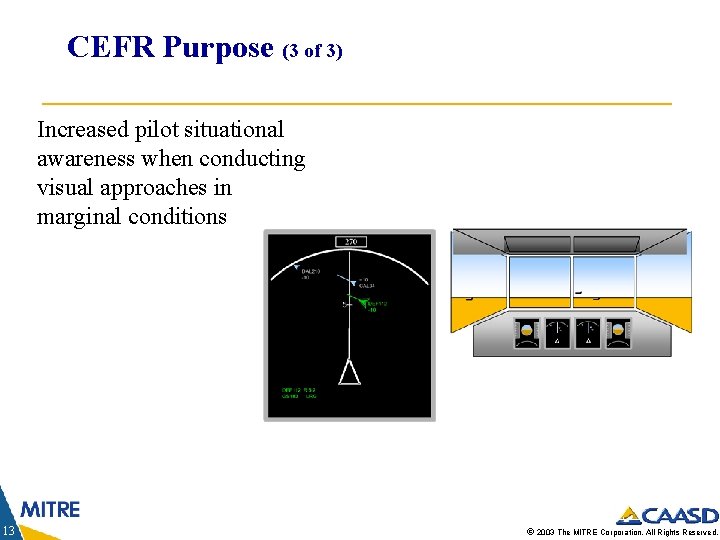
CEFR Purpose (3 of 3) Increased pilot situational awareness when conducting visual approaches in marginal conditions 13 © 2003 The MITRE Corporation. All Rights Reserved.
Simulations 14 © 2003 The MITRE Corporation. All Rights Reserved.
Development Objectives • Develop the CEFR application description – ~ Operational Service and Environment Description (OSED) – Participation by pilot & controller unions, certification and flight standards authorities, other FAA offices, etc. • Evaluate the CEFR concept in simulation addressing pilot and controller operational issues • Provide data and analysis of results to support decision on next development stage 15 © 2003 The MITRE Corporation. All Rights Reserved.
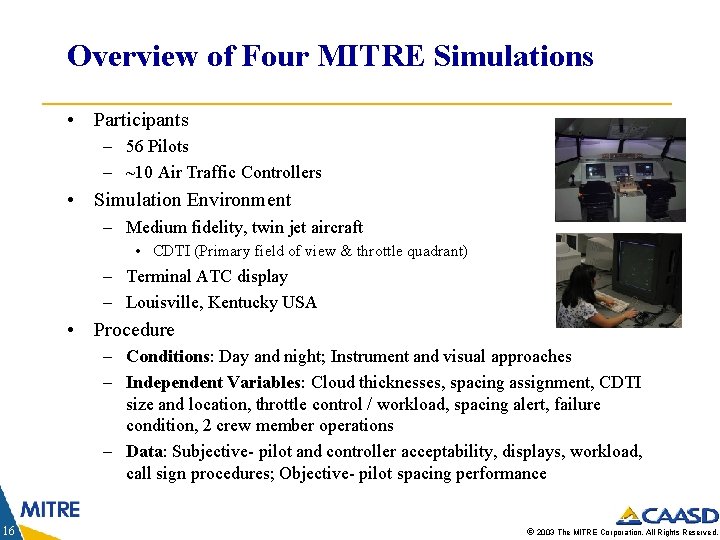
Overview of Four MITRE Simulations • Participants – 56 Pilots – ~10 Air Traffic Controllers • Simulation Environment – Medium fidelity, twin jet aircraft • CDTI (Primary field of view & throttle quadrant) – Terminal ATC display – Louisville, Kentucky USA • Procedure – Conditions: Day and night; Instrument and visual approaches – Independent Variables: Cloud thicknesses, spacing assignment, CDTI size and location, throttle control / workload, spacing alert, failure condition, 2 crew member operations – Data: Subjective- pilot and controller acceptability, displays, workload, call sign procedures; Objective- pilot spacing performance 16 © 2003 The MITRE Corporation. All Rights Reserved.
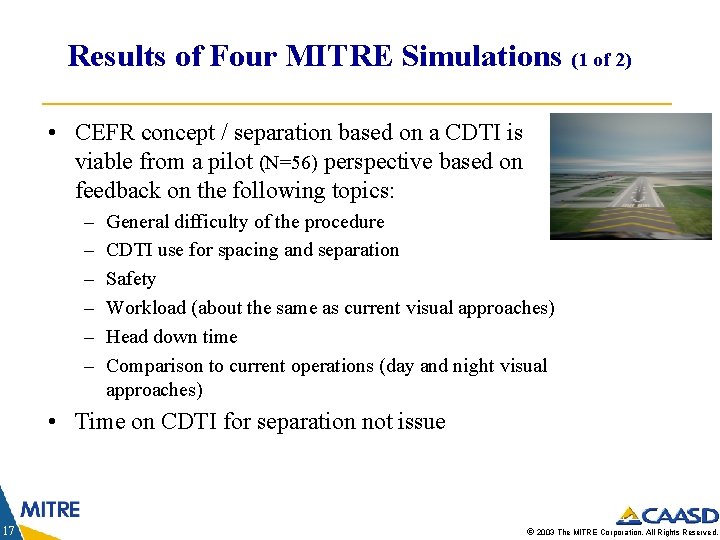
Results of Four MITRE Simulations (1 of 2) • CEFR concept / separation based on a CDTI is viable from a pilot (N=56) perspective based on feedback on the following topics: – – – General difficulty of the procedure CDTI use for spacing and separation Safety Workload (about the same as current visual approaches) Head down time Comparison to current operations (day and night visual approaches) • Time on CDTI for separation not issue 17 © 2003 The MITRE Corporation. All Rights Reserved.
Results of Four MITRE Simulations (2 of 2) • No difficulty with aggressive slow-downs of lead aircraft • Able to handle data degradation of lead aircraft on CDTI • Throttle console CDTI implementation is acceptable and did not show performance difference • Willing (and able) to perform with either autothrottles or manual throttle control • Call sign use could have potential • Visual approach operations likely to be the initial application of CEFR • ATC continues to play key role 18 © 2003 The MITRE Corporation. All Rights Reserved.
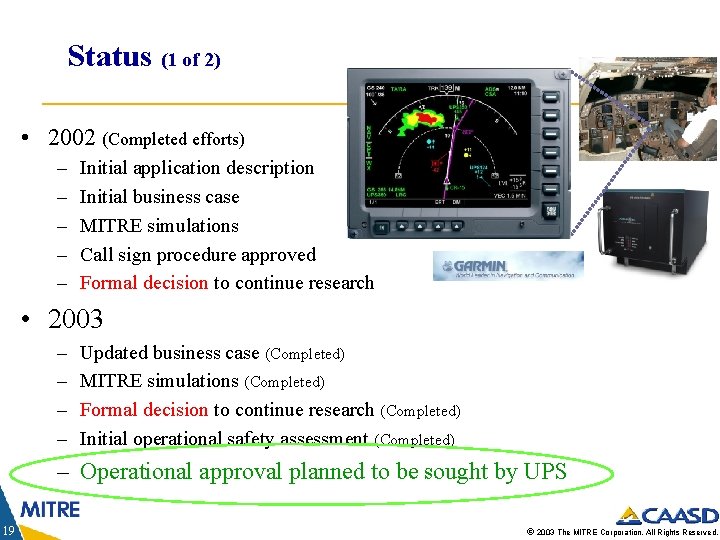
Status (1 of 2) • 2002 (Completed efforts) – – – Initial application description Initial business case MITRE simulations Call sign procedure approved Formal decision to continue research • 2003 – – Updated business case (Completed) MITRE simulations (Completed) Formal decision to continue research (Completed) Initial operational safety assessment (Completed) – Operational approval planned to be sought by UPS 19 © 2003 The MITRE Corporation. All Rights Reserved.
Status (2 of 2) • Acceptability – Operation – Acceptable concept – Cost benefit – Benefit exists but must consider other operational enhancements – Technical – AT 2000 meets software requirement (Level C) – Stakeholder Buy-In – FAA Flight Standards as well as controller and pilot unions support continued research 20 © 2003 The MITRE Corporation. All Rights Reserved.
Further Information • For further information on the concept or the simulations, contact: – Randy Bone – bone@MITRE. org – John Marksteiner, FAA Safe Flight 21 john. marksteiner@faa. gov 21 © 2003 The MITRE Corporation. All Rights Reserved.