
Cocaine CHEMICAL BONDING Chemical bonds in matter Holding
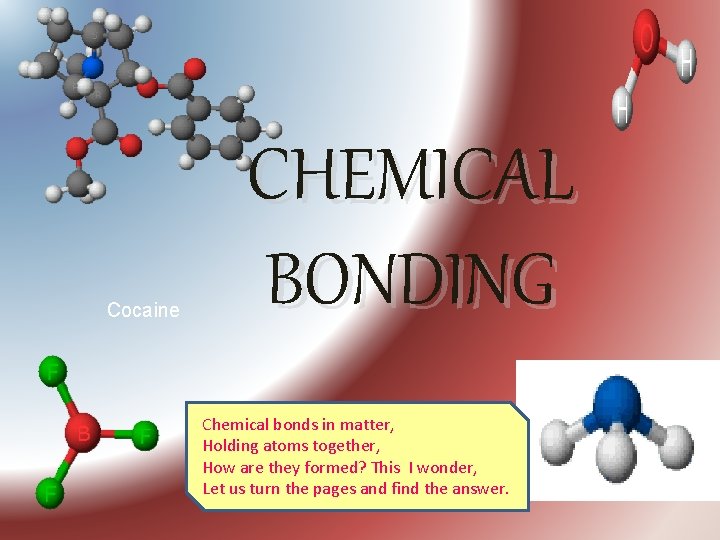
Cocaine CHEMICAL BONDING Chemical bonds in matter, Holding atoms together, How are they formed? This I wonder, Let us turn the pages and find the answer.
By the end of this chapter, you should be able to : Ø understand the formation of compounds Ø synthesis ideas on the formation of ionic bonds Ø synthesis ideas on the formation of covalent bonds Ø analyze properties of ionic and covalent compounds
Take note on: ü Formation of Compounds ü Ionic Bonds ü Covalent Bonds ü The Properties of Ionic and Covalent Compounds ü Practices
Electron Distribution in Molecules G. N. Lewis 1875 - 1946 • Electron distribution is depicted with Lewis (electron dot) structures • This is how you decide how many atoms will bond covalently! (In ionic bonds, it was decided with charges)
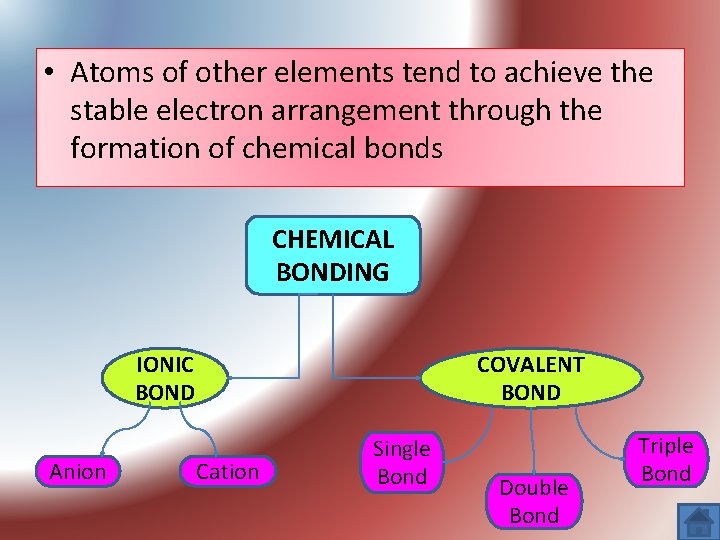
• Atoms of other elements tend to achieve the stable electron arrangement through the formation of chemical bonds CHEMICAL BONDING IONIC BOND Anion COVALENT BOND Cation Single Bond Double Bond Triple Bond
Ionic Bond • Between atoms of metals and nonmetals with very different electronegativity • Bond formed by transfer of electrons • Produce charged ions all states. Conductors and have high melting point. • Examples; Na. Cl, Ca. Cl 2, K 2 O
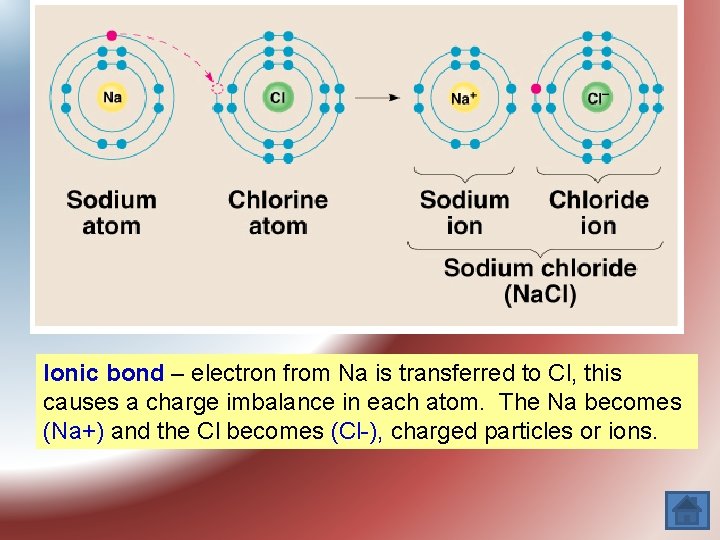
Ionic bond – electron from Na is transferred to Cl, this causes a charge imbalance in each atom. The Na becomes (Na+) and the Cl becomes (Cl-), charged particles or ions.
Covalent Bond • Between nonmetallic elements of similar electronegativity. • Formed by sharing electron pairs • Stable non-ionizing particles, they are not conductors at any state • Examples; O 2, C 2 H 6, H 2 O, Si. C
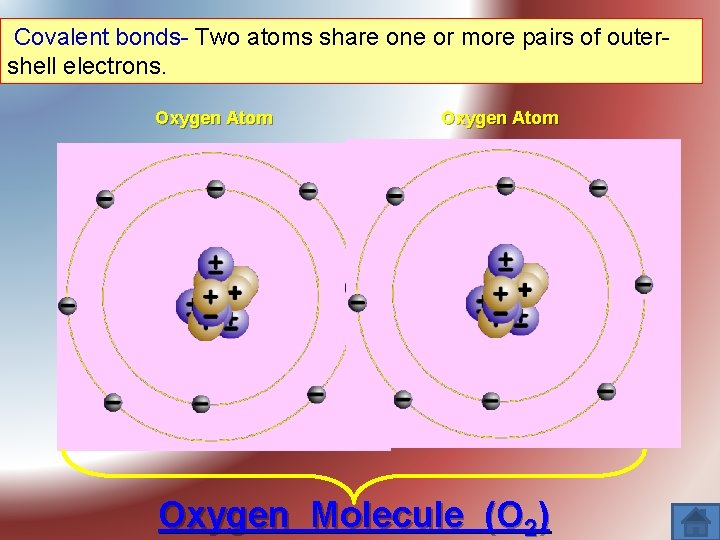
Covalent bonds- Two atoms share one or more pairs of outershell electrons. Oxygen Atom Oxygen Molecule (O 2)
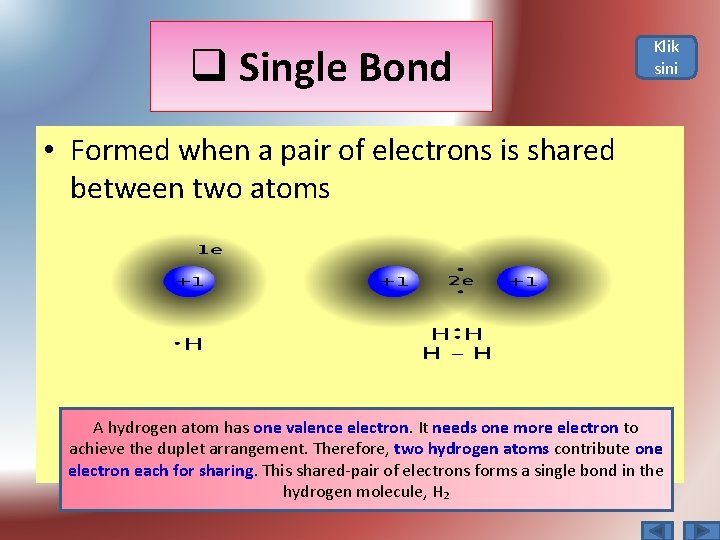
q Single Bond Klik sini • Formed when a pair of electrons is shared between two atoms A hydrogen atom has one valence electron. It needs one more electron to achieve the duplet arrangement. Therefore, two hydrogen atoms contribute one electron each for sharing. This shared-pair of electrons forms a single bond in the hydrogen molecule, H₂
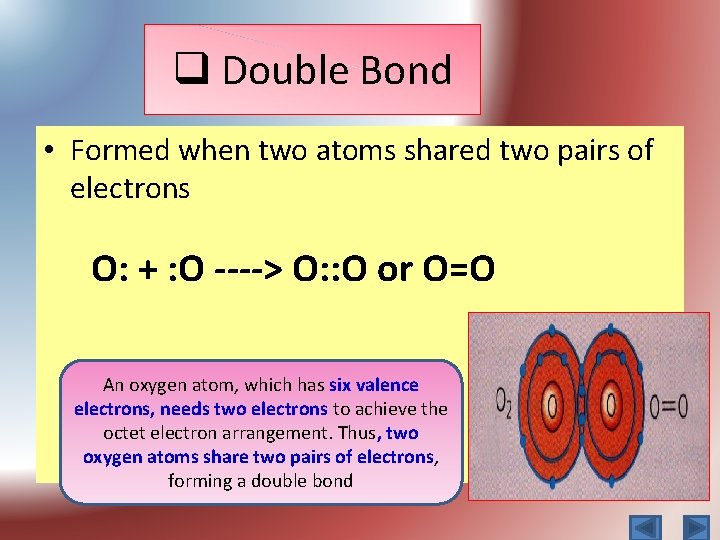
q Double Bond • Formed when two atoms shared two pairs of electrons O: + : O ----> O: : O or O=O An oxygen atom, which has six valence electrons, needs two electrons to achieve the octet electron arrangement. Thus, two oxygen atoms share two pairs of electrons, forming a double bond

q Triple Bond • Formed when three pairs of electrons are shared between two atoms Each nitrogen atom has the electron arrangement of 2. 5. It needs three more electrons to attain the octet electron arrangement. Therefore, they share three pairs of electrons to form a nitrogen molecule, N₂
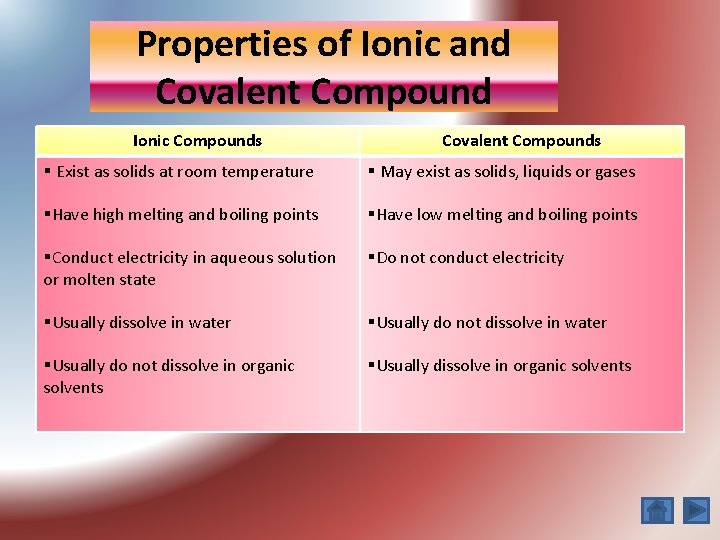
Properties of Ionic and Covalent Compound Ionic Compounds Covalent Compounds § Exist as solids at room temperature § May exist as solids, liquids or gases §Have high melting and boiling points §Have low melting and boiling points §Conduct electricity in aqueous solution or molten state §Do not conduct electricity §Usually dissolve in water §Usually do not dissolve in organic solvents §Usually dissolve in organic solvents
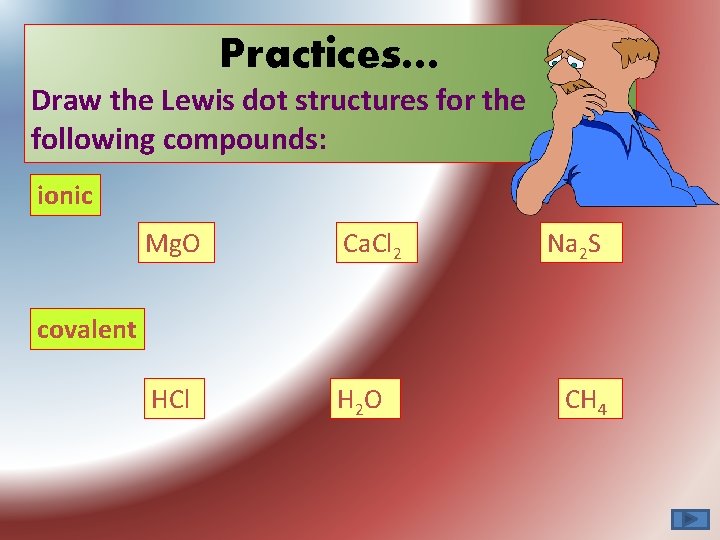
Practices… Draw the Lewis dot structures for the following compounds: ionic Mg. O Ca. Cl 2 HCl H 2 O Na 2 S covalent CH 4

For the next class, please read on topic electrochemistry…. Thank You…
- Slides: 15