
COBOL Kav Shrestha Outline Introduction History Features COBOL
COBOL - Kav Shrestha
Outline � Introduction � History � Features � COBOL Usage � Characteristics � Structure of COBOL Programs � COBOL Divisions � Data Items � Variable Declaration � Selection in COBOL � Iteration in COBOL � Object Oriented COBOL 2
Introduction � Acronym for Common Business Oriented Language � Third Generation programming language and one of the oldest programming language still in use � Used primarily in business, finance and administrative systems for companies and governments � COBOL is designed for developing business, typically file-oriented applications � Not designed for writing system programs 3
History • • • Initially created in 1959 by The Short Range Committee Developed also in 1959 by the a group called Conference on Data Systems Languages (CODASYL) COBOL was one of the earliest high-level programming language The first produced version of COBOL was COBOL 60 Since then different versions such as COBOL-68, 74, 85 including COBOL 2002 have been produced 4
Features of COBOL � The original version of COBOL did not support local variables, recursion, dynamic memory allocation or structured programming constructs � COBOL applications are often very large. Many COBOL applications consist of more than 1 million lines of code � COBOL applications are very long lived as it cannot be simply discarded when some new programming language or technology appears 5
Features Contd. . � COBOL programs dominated the year 2000 problem. � 12 million COBOL applications vs 375, 000 C and C++ applications in the US alone. � The reason was that when programmers were writing COBOL applications 20 years ago, they didn’t anticipate it lasting into the new millennium 6
COBOL Usage • • • COBOL programs are used globally in military and government agencies In 1997, the Gartner Group ( an information and technology research and advisory firm) reported that 80% of the world’s business ran on COBOL with over 200 billion lines of code in existence and an estimated 5 billion new lines of code each year The Gartner Group estimated for 2002 that there were about two million COBOL programmers world-wide compared to one million Java and C++ programmers each Over 95% of finance-insurance data is processed with COBOL. In 2006, IBM announced a $100 million Mainframe Simplification program as a means to shorten deployment cycles for its System z mainframes and help developers with diverse technical backgrounds deal with COBOL 7
Characteristics that contribute to COBOL’s success � One of the design goals for COBOL was to make it possible for non-programmers such as supervisors, managers, etc to read and understand COBOL code. � COBOL contains English like structural elements as verbs, clauses, sentences, sections, etc. � COBOL is a simple language with no pointers, no user defined functions. � Cobol is well suited to its targeted problem domain of business computing 8
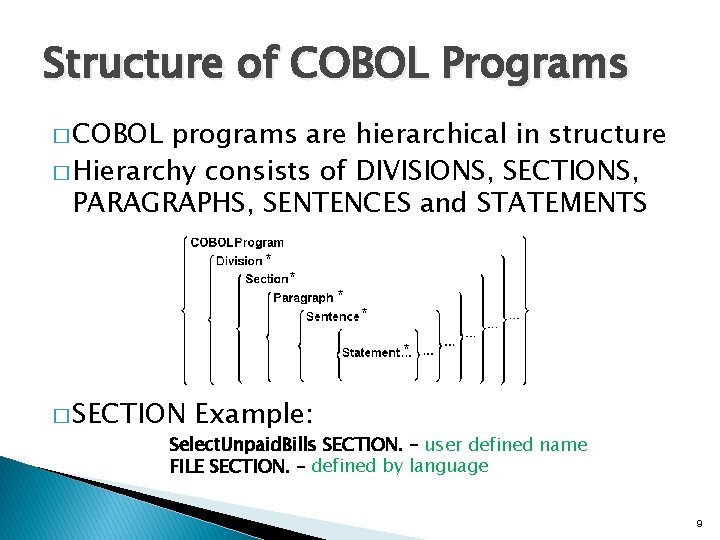
Structure of COBOL Programs � COBOL programs are hierarchical in structure � Hierarchy consists of DIVISIONS, SECTIONS, PARAGRAPHS, SENTENCES and STATEMENTS * * * � SECTION Example: Select. Unpaid. Bills SECTION. – user defined name FILE SECTION. – defined by language 9
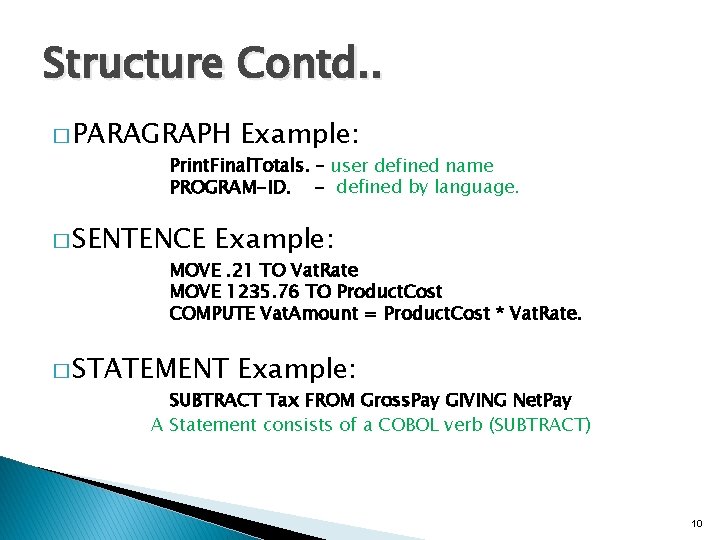
Structure Contd. . � PARAGRAPH Example: Print. Final. Totals. – user defined name PROGRAM-ID. - defined by language. � SENTENCE Example: MOVE. 21 TO Vat. Rate MOVE 1235. 76 TO Product. Cost COMPUTE Vat. Amount = Product. Cost * Vat. Rate. � STATEMENT Example: SUBTRACT Tax FROM Gross. Pay GIVING Net. Pay A Statement consists of a COBOL verb (SUBTRACT) 10
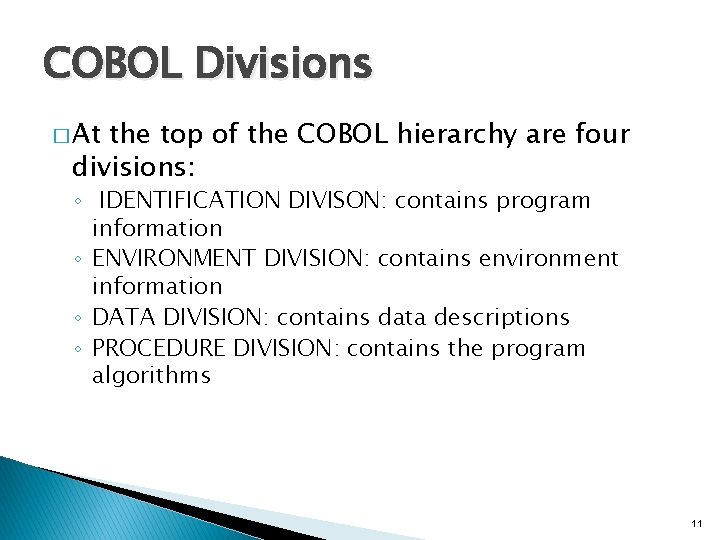
COBOL Divisions � At the top of the COBOL hierarchy are four divisions: ◦ IDENTIFICATION DIVISON: contains program information ◦ ENVIRONMENT DIVISION: contains environment information ◦ DATA DIVISION: contains data descriptions ◦ PROCEDURE DIVISION: contains the program algorithms 11
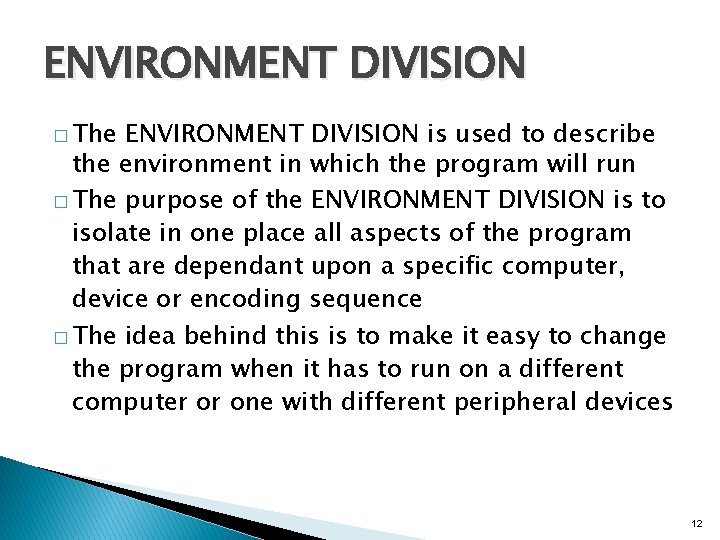
ENVIRONMENT DIVISION � The ENVIRONMENT DIVISION is used to describe the environment in which the program will run � The purpose of the ENVIRONMENT DIVISION is to isolate in one place all aspects of the program that are dependant upon a specific computer, device or encoding sequence � The idea behind this is to make it easy to change the program when it has to run on a different computer or one with different peripheral devices 12
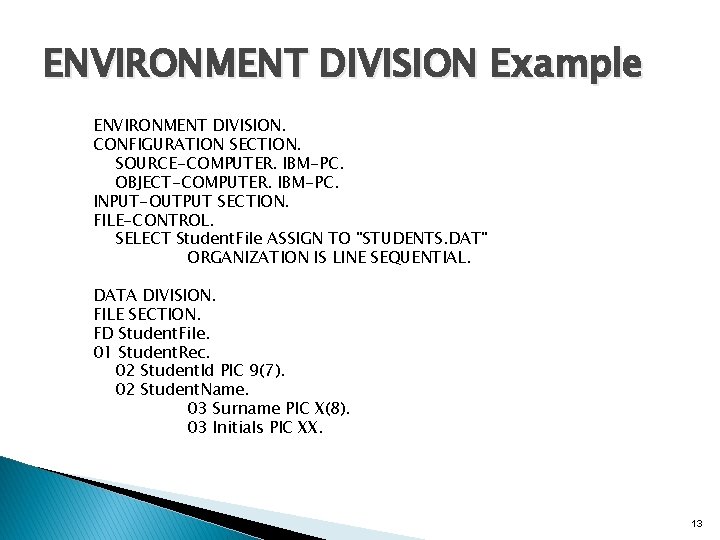
ENVIRONMENT DIVISION Example ENVIRONMENT DIVISION. CONFIGURATION SECTION. SOURCE-COMPUTER. IBM-PC. OBJECT-COMPUTER. IBM-PC. INPUT-OUTPUT SECTION. FILE-CONTROL. SELECT Student. File ASSIGN TO "STUDENTS. DAT" ORGANIZATION IS LINE SEQUENTIAL. DATA DIVISION. FILE SECTION. FD Student. File. 01 Student. Rec. 02 Student. Id PIC 9(7). 02 Student. Name. 03 Surname PIC X(8). 03 Initials PIC XX. 13
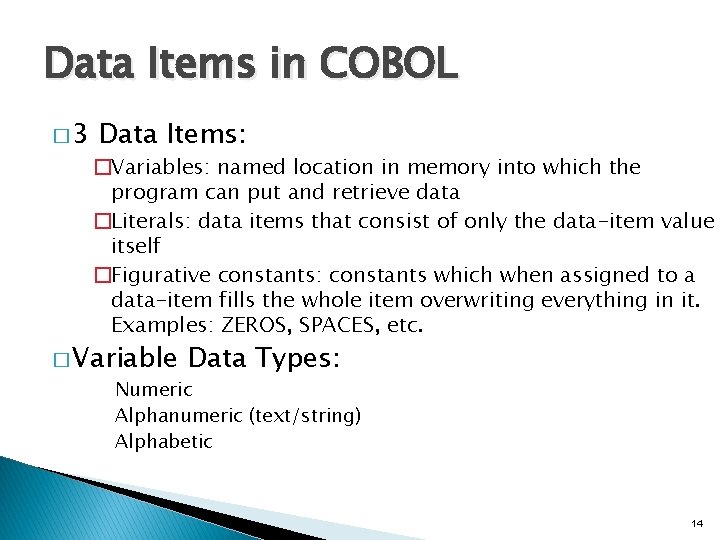
Data Items in COBOL � 3 Data Items: �Variables: named location in memory into which the program can put and retrieve data �Literals: data items that consist of only the data-item value itself �Figurative constants: constants which when assigned to a data-item fills the whole item overwriting everything in it. Examples: ZEROS, SPACES, etc. � Variable Data Types: Numeric Alphanumeric (text/string) Alphabetic 14
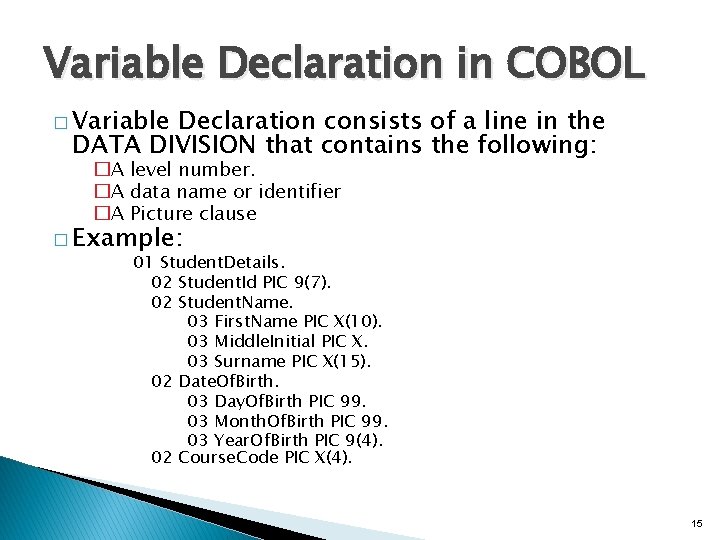
Variable Declaration in COBOL � Variable Declaration consists of a line in the DATA DIVISION that contains the following: �A level number. �A data name or identifier �A Picture clause � Example: 01 Student. Details. 02 Student. Id PIC 9(7). 02 Student. Name. 03 First. Name PIC X(10). 03 Middle. Initial PIC X. 03 Surname PIC X(15). 02 Date. Of. Birth. 03 Day. Of. Birth PIC 99. 03 Month. Of. Birth PIC 99. 03 Year. Of. Birth PIC 9(4). 02 Course. Code PIC X(4). 15
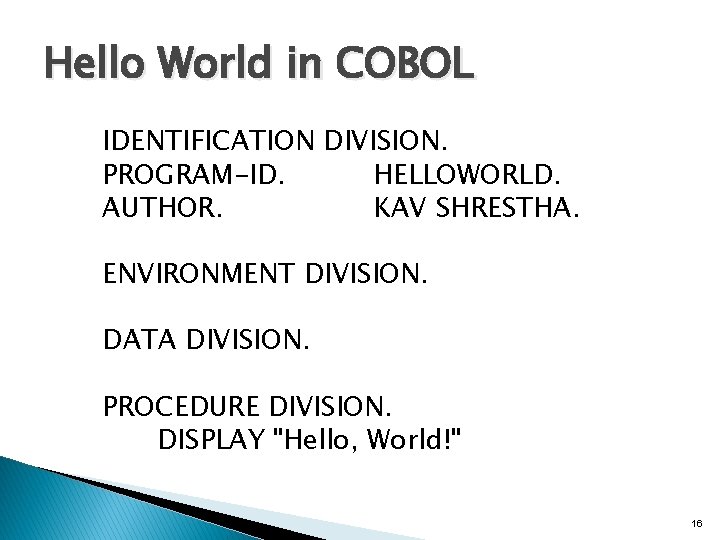
Hello World in COBOL IDENTIFICATION DIVISION. PROGRAM-ID. HELLOWORLD. AUTHOR. KAV SHRESTHA. ENVIRONMENT DIVISION. DATA DIVISION. PROCEDURE DIVISION. DISPLAY "Hello, World!" 16
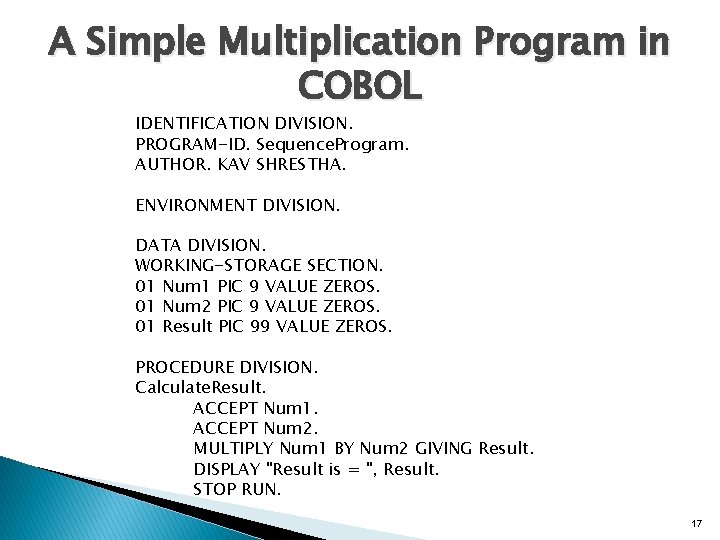
A Simple Multiplication Program in COBOL IDENTIFICATION DIVISION. PROGRAM-ID. Sequence. Program. AUTHOR. KAV SHRESTHA. ENVIRONMENT DIVISION. DATA DIVISION. WORKING-STORAGE SECTION. 01 Num 1 PIC 9 VALUE ZEROS. 01 Num 2 PIC 9 VALUE ZEROS. 01 Result PIC 99 VALUE ZEROS. PROCEDURE DIVISION. Calculate. Result. ACCEPT Num 1. ACCEPT Num 2. MULTIPLY Num 1 BY Num 2 GIVING Result. DISPLAY "Result is = ", Result. STOP RUN. 17
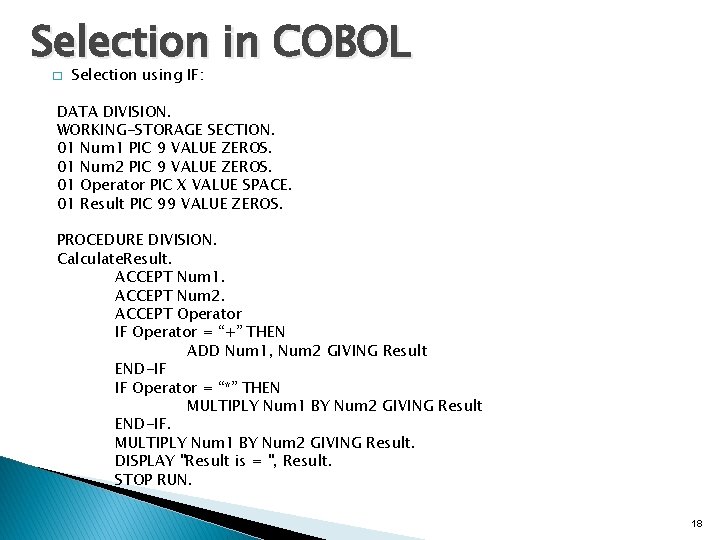
Selection in COBOL � Selection using IF: DATA DIVISION. WORKING-STORAGE SECTION. 01 Num 1 PIC 9 VALUE ZEROS. 01 Num 2 PIC 9 VALUE ZEROS. 01 Operator PIC X VALUE SPACE. 01 Result PIC 99 VALUE ZEROS. PROCEDURE DIVISION. Calculate. Result. ACCEPT Num 1. ACCEPT Num 2. ACCEPT Operator IF Operator = “+” THEN ADD Num 1, Num 2 GIVING Result END-IF IF Operator = “*” THEN MULTIPLY Num 1 BY Num 2 GIVING Result END-IF. MULTIPLY Num 1 BY Num 2 GIVING Result. DISPLAY "Result is = ", Result. STOP RUN. 18
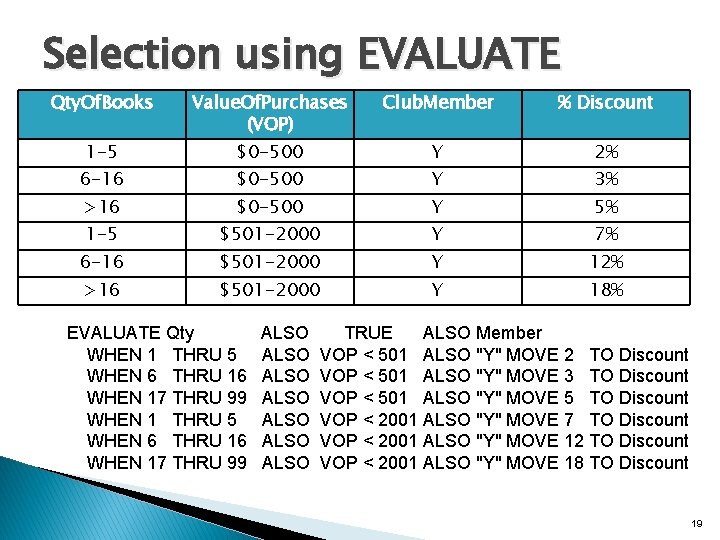
Selection using EVALUATE Qty. Of. Books 1 -5 6 -16 >16 Value. Of. Purchases (VOP) Club. Member % Discount $0 -500 Y 2% Y 5% 1 -5 $501 -2000 >16 $501 -2000 6 -16 $501 -2000 EVALUATE Qty WHEN 1 THRU 5 WHEN 6 THRU 16 WHEN 17 THRU 99 ALSO ALSO Y Y Y 3% 7% 12% 18% TRUE ALSO Member VOP < 501 ALSO "Y" MOVE 2 TO Discount VOP < 501 ALSO "Y" MOVE 3 TO Discount VOP < 501 ALSO "Y" MOVE 5 TO Discount VOP < 2001 ALSO "Y" MOVE 7 TO Discount VOP < 2001 ALSO "Y" MOVE 12 TO Discount VOP < 2001 ALSO "Y" MOVE 18 TO Discount 19
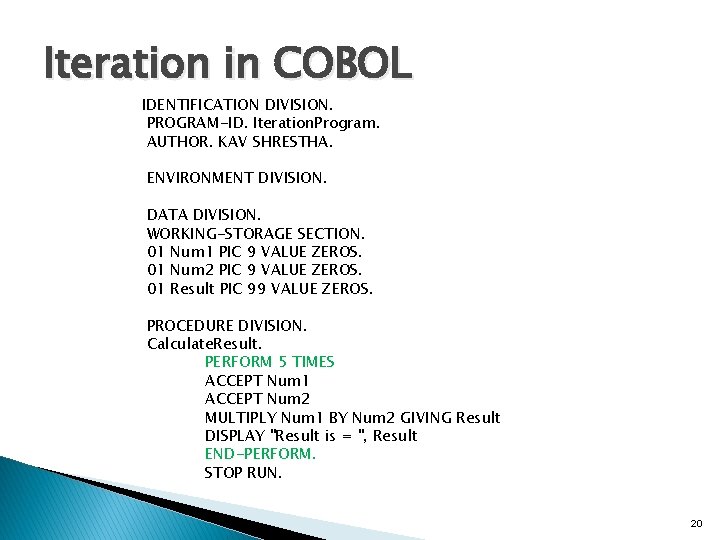
Iteration in COBOL IDENTIFICATION DIVISION. PROGRAM-ID. Iteration. Program. AUTHOR. KAV SHRESTHA. ENVIRONMENT DIVISION. DATA DIVISION. WORKING-STORAGE SECTION. 01 Num 1 PIC 9 VALUE ZEROS. 01 Num 2 PIC 9 VALUE ZEROS. 01 Result PIC 99 VALUE ZEROS. PROCEDURE DIVISION. Calculate. Result. PERFORM 5 TIMES ACCEPT Num 1 ACCEPT Num 2 MULTIPLY Num 1 BY Num 2 GIVING Result DISPLAY "Result is = ", Result END-PERFORM. STOP RUN. 20
Object Oriented COBOL � COBOL used to be a simple language with limited scope of function but Object Oriented COBOL includes new features: ◦ ◦ ◦ User Defined Functions Object Orientation Multiple Currency Symbols Dynamic Memory Allocation (pointers) Binary and Floating Point Data Types User Defined Data Types 21
OO COBOL Contd. . � IDENTIFICATION DIVISION Instead of a PROGRAM-ID, a class definition has a CLASS-ID, followed by the name of the class: CLASS-ID. Foobar INHERITS SOMObject. � ENVIRONMENT � DIVISION In the CONFIGURATION section, a special REPOSITORY paragraph must declare each of the base classes and any other classes used by the methods. Optionally, it may also declare the class being defined: REPOSITORY. CLASS SOMObject IS 'SOMObject' CLASS Foobar IS 'Foobar' CLASS Barfoo IS 'Barfoo‘ PROCEDURE DIVISION The PROCEDURE DIVISION consists entirely of method definitions, one after another. 22
References � www. wikipedia. org � The University of Limerick Computer Science and Information Systems website: http: //www. csis. ul. ie/cobol/Course/Default. htm � http: //www. kimsoft. com/api- cobol/mis 210 l 1 a. htm 23
Questions? ? 24
- Slides: 24