
COBOL Dahwi Kim Donny Brown Joshua Cobos What
COBOL Dahwi Kim Donny Brown Joshua Cobos
What is COBOL? COBOL is a high-level programming language first developed by the CODASYL Committee (Conference on Data Systems Languages) in 1959. The word COBOL is an acronym that stands for COmmon Business Oriented Language. COBOL is designed for developing business, typically file-oriented, applications. It is not designed for writing systems programs. You would not develop an operating system or a compiler using COBOL.
How is it used? For over four decades COBOL has been the dominant programming language in the business computing domain COBOL applications are also very long-lived. A software application consisting of some millions of lines of COBOL code cannot simply be discarded when some new programming language or technology appears. COBOL applications often run in critical areas of business. For instance, over 95% of finance–insurance data is processed with COBOL applications often deal with enormous volumes of data. Single production files and databases measured in terabytes are not uncommon.
History of COBOL was originally designed in 1959 by CODASYL, based on the language FLOW-MATIC. Because of this, several design similarities exist between FLOW-MATIC and COBOL, such as their english-like syntax and defined Input and Output Files. It was standardized in 1968, and has since been through a total of four revisions, with the most recent one in 2014.
Characteristics There are some major characteristics to COBOL. Below are those characteristics and the following slides are their descriptions. They were able to make COBOL a success and allow it to use a lot of data ● ● Self-documenting Simple Non-proprietary (portable) Maintainable
Self-Documenting An advantage for COBOL is that it is easy to understand, especially when used by many supervisors or managers in the business work field. With most program languages, as it gets older it becomes more difficult to read it. Self-documenting in COBOL allowed it to be readable to many people even as the code gets older.
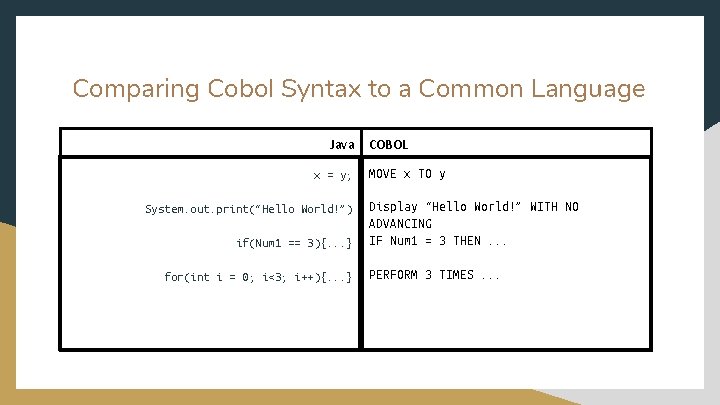
Comparing Cobol Syntax to a Common Language Java x = y; System. out. print(“Hello World!”) if(Num 1 == 3){. . . } for(int i = 0; i<3; i++){. . . } COBOL MOVE x TO y Display “Hello World!” WITH NO ADVANCING IF Num 1 = 3 THEN. . . PERFORM 3 TIMES. . .
Simple By saying COBOL is simple, we are saying that it has no defined types, no user defined functions, no pointers, and it has a limited scope of function. It has a simple straightforward programming style. It was because of this that most business programmers targeted COBOL. Most COBOL programs complexity follow business rules than algorithms and data structures. However, when algorithms are needed, they use simple words such as SORT or SEARCH
Non-proprietary The wonderful things about COBOL is that it does not belong to any specific vendor. The reason is because the vendor is independent (ANSI COBOL) and they have non-vendor type syntax or semantic language standards. It can be ported on every major computer platforms.
Maintainable In large part due to COBOL’s high readability and long history of use, systems written in COBOL are often easier to maintain than some other language. Though this factor has decayed somewhat as COBOL fell off in popularity and there are less COBOL programmers in the modern day, it’s still in large part true. Said maintainability is also aided by its rigid hierarchical structures.
Reference http: //www. csis. ul. ie/cobol/course/COBOLIntro. htm https: //www. tutorialspoint. com/cobol_overview. htm
- Slides: 11