
COBAND Project for Cosmic Background Neutrino Decay Search
COBAND Project for Cosmic Background Neutrino Decay Search and Rocket Experiment Design 2017 Sep. 26 th Takashi Iida (Univ. of Tsukuba) for COBAND collaboration
Contents • Neutrino decay • Cosmic neutrino background • COBAND experiment overview • Optical system design • Experiment schedule • Summary g n i n or m !! d e o n o G eryo ev
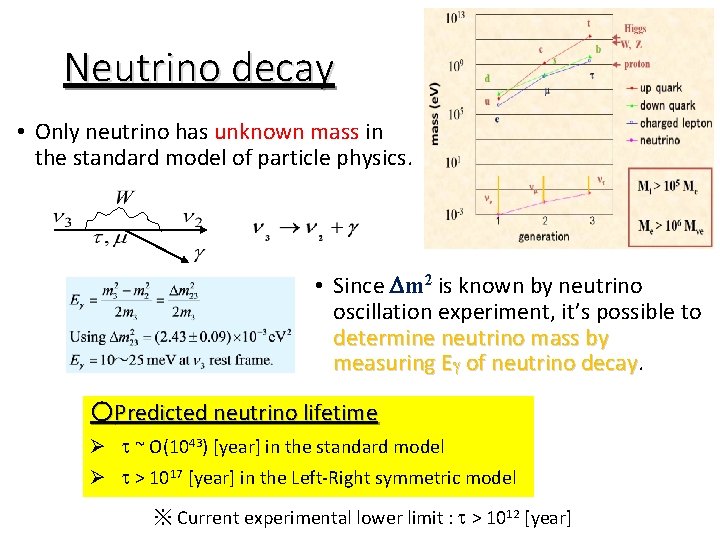
Neutrino decay • Only neutrino has unknown mass in the standard model of particle physics. • Since m 2 is known by neutrino oscillation experiment, it’s possible to determine neutrino mass by measuring E of neutrino decay ○Predicted neutrino lifetime Ø t ~ O(1043) [year] in the standard model Ø t > 1017 [year] in the Left-Right symmetric model ※ Current experimental lower limit : t > 1012 [year]
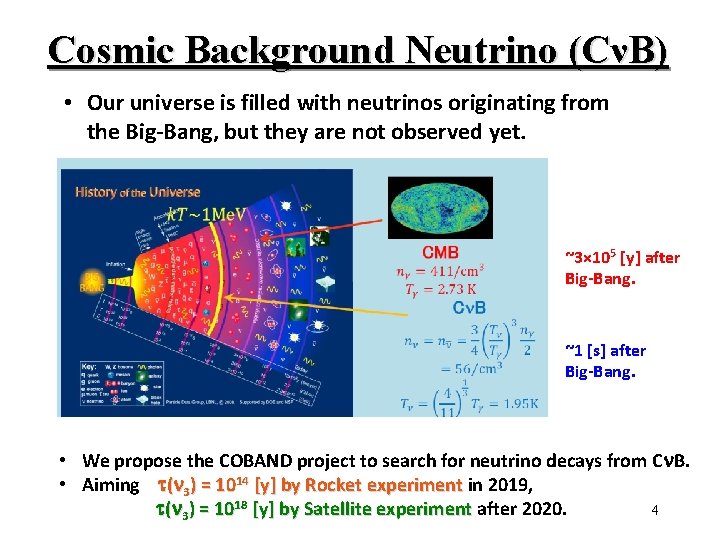
Cosmic Background Neutrino (CνB) • Our universe is filled with neutrinos originating from the Big-Bang, but they are not observed yet. ~3× 10⁵ [y] after Big-Bang. ~1 [s] after Big-Bang. • We propose the COBAND project to search for neutrino decays from C B. • Aiming t( 3) = 1014 [y] by Rocket experiment in 2019, t( 3) = 1018 [y] by Satellite experiment after 2020. 4
COBAND collaboration S. -H. Kim, Y. Takeuchi, T. Iida, K. Takemasa, K. Nagata, C. Asano, S. Yagi, R. Wakasa (U of Tsukuba), H. Ikeda, T. Wada, K. Nagase (ISAS/JAXA), S. Matsuura (Kwansei gakuin U), Y. Arai, I. Kurachi, M. Hazumi (KEK), T. Yoshida, T. Nakamura, M. Sakai, W. Nishimura (U of Fukui), S. Mima, K. Kiuchi (RIKEN), H. Ishino, A. Kibayashi (Okayama U), Y. Kato (Kindai U), G. Fujii, S. Shiki, M. Ukibe, M. Ohkubo (AIST), S. Kawahito (Shizuoka U), E. Ramberg, P. Rubinov, D. Sergatskov (FNAL), S. -B. Kim (Seoul National U) COBAND collaboration 5
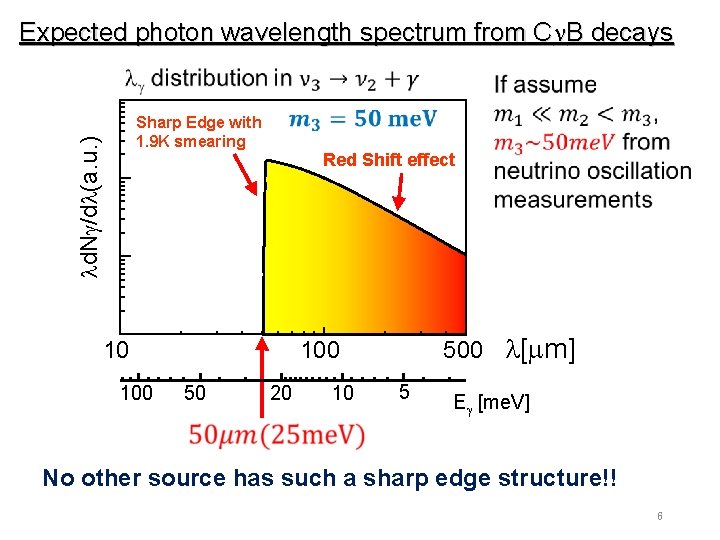
Expected photon wavelength spectrum from C B decays d. N /d (a. u. ) Sharp Edge with 1. 9 K smearing Red Shift effect 10 100 500 [ m] 100 50 20 10 5 E [me. V] No other source has such a sharp edge structure!! 6
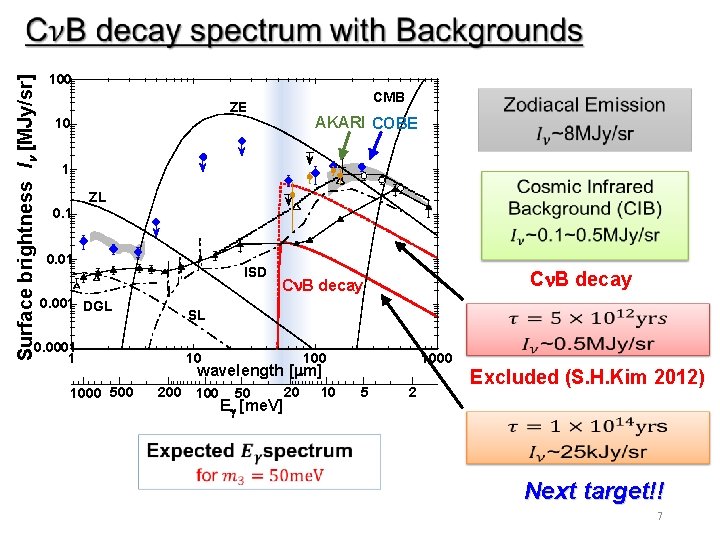
Surface brightness I [MJy/sr] 100 CMB ZE AKARI COBE 10 1 ZL 0. 1 0. 01 ISD 0. 001 DGL C B decay SL 0. 0001 1 10 100 wavelength [ m] 200 1000 500 100 50 E [me. V] 20 10 5 2 Excluded (S. H. Kim 2012) Next target!! 7
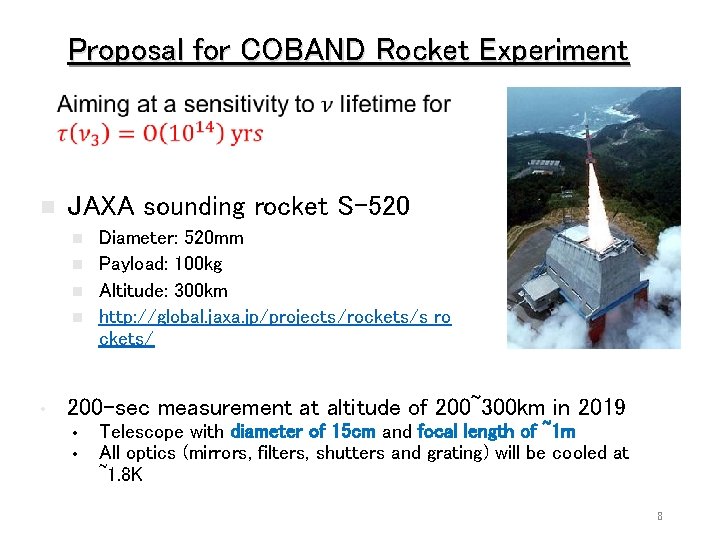
Proposal for COBAND Rocket Experiment n JAXA sounding rocket S-520 n n • Diameter: 520 mm Payload: 100 kg Altitude: 300 km http: //global. jaxa. jp/projects/rockets/s_ro ckets/ 200 -sec measurement at altitude of 200~300 km in 2019 • • Telescope with diameter of 15 cm and focal length of ~1 m All optics (mirrors, filters, shutters and grating) will be cooled at ~1. 8 K 8
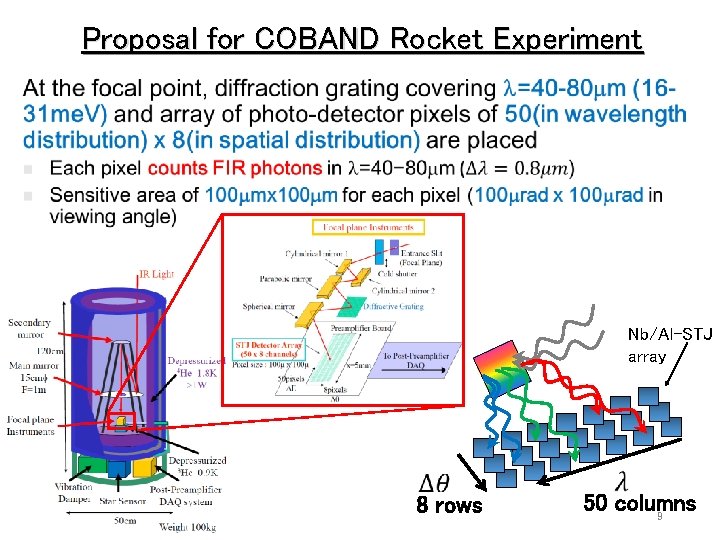
Proposal for COBAND Rocket Experiment Nb/Al-STJ array 8 rows 50 columns 9
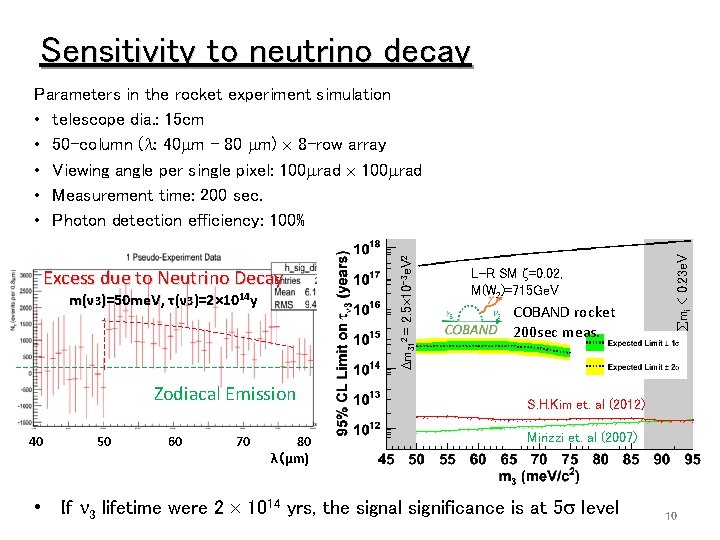
Sensitivity to neutrino decay m(ν 3)=50 me. V, τ(ν 3)=2× 10¹⁴ y Zodiacal Emission 40 50 60 70 80 λ(μm) L-R SM =0. 02, M(W 2)=715 Ge. V COBAND rocket 200 sec meas. mi < 0. 23 e. V Excess due to Neutrino Decay m 312 = 2. 5 10 -3 e. V 2 Parameters in the rocket experiment simulation • telescope dia. : 15 cm • 50 -column ( : 40 m – 80 m) 8 -row array • Viewing angle per single pixel: 100 rad • Measurement time: 200 sec. • Photon detection efficiency: 100% S. H. Kim et. al (2012) Mirizzi et. al (2007) • If 3 lifetime were 2 1014 yrs, the signal significance is at 5 level 10
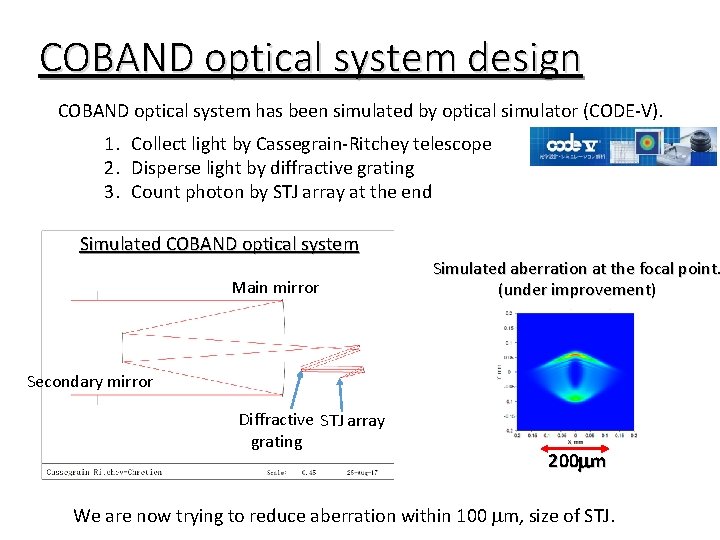
COBAND optical system design COBAND optical system has been simulated by optical simulator (CODE-V). 1. Collect light by Cassegrain-Ritchey telescope 2. Disperse light by diffractive grating 3. Count photon by STJ array at the end Simulated COBAND optical system Main mirror Simulated aberration at the focal point. (under improvement) Secondary mirror Diffractive STJ array grating 200 m We are now trying to reduce aberration within 100 m, size of STJ.
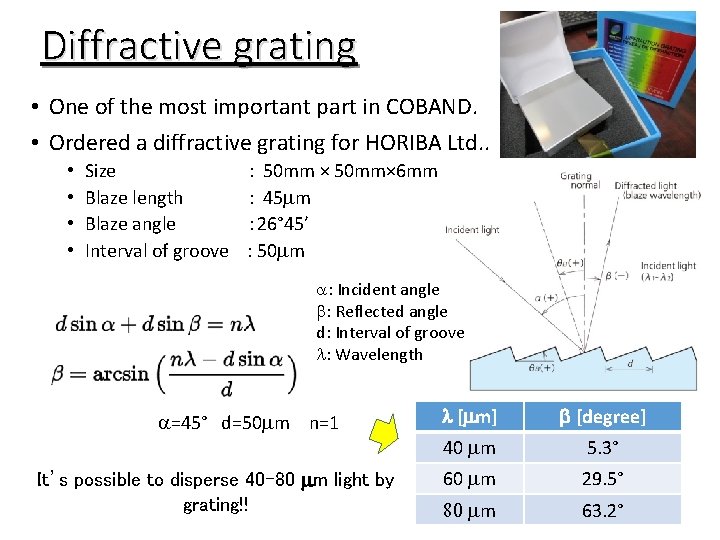
Diffractive grating • One of the most important part in COBAND. • Ordered a diffractive grating for HORIBA Ltd. . • • Size Blaze length Blaze angle Interval of groove : 50 mm × 50 mm× 6 mm : 45 m : 26° 45′ : 50 m a: Incident angle b: Reflected angle d: Interval of groove : Wavelength a=45° d=50 m n=1 It’s possible to disperse 40 -80 m light by grating!! l [ m] b [degree] 40 m 5. 3° 60 m 29. 5° 80 m 63. 2°
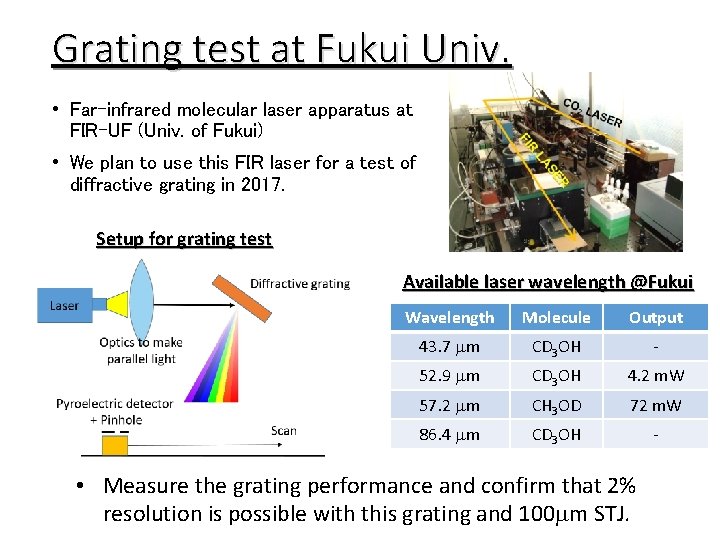
Grating test at Fukui Univ. • Far-infrared molecular laser apparatus at FIR-UF (Univ. of Fukui) • We plan to use this FIR laser for a test of diffractive grating in 2017. Setup for grating test Available laser wavelength @Fukui Wavelength Molecule Output 43. 7 m CD 3 OH - 52. 9 m CD 3 OH 4. 2 m. W 57. 2 m CH 3 OD 72 m. W 86. 4 m CD 3 OH - • Measure the grating performance and confirm that 2% resolution is possible with this grating and 100 m STJ.
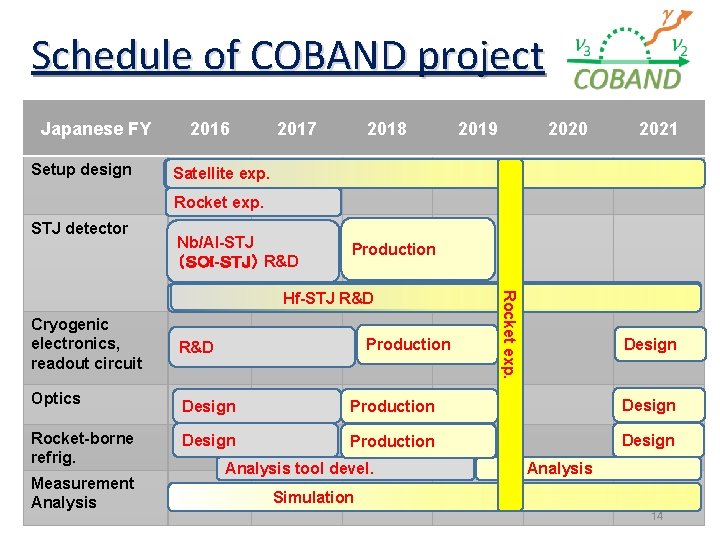
Schedule of COBAND project Japanese FY Setup design 2016 2017 2018 2019 2020 2021 Satellite exp. Rocket exp. STJ detector Production Hf-STJ R&D Nb/Al-STJ設計・開発 Production R&D Rocket exp. Cryogenic electronics, readout circuit Nb/Al-STJ (SOI-STJ) R&D Design Optics Design Production Design Rocket-borne refrig. Design Production Design Measurement Analysis tool devel. Analysis Simulation 14
Summary • We propose the COBAND experiment which searches for cosmic background neutrino decay. • Aiming t( 3) = 1014 [y] by Rocket experiment in 2019, t( 3) = 1018 [y] by Satellite experiment after 2020. ※ Current experimental upper limit : t > 1012 [year] • Now we are developing the system with Nb/Al-STJ by AIST and diffractive grating in order to measure the spectrum for 40 – 80 m region. • Performance of the system will be tested using FIRlaser @Fukui and we feedback the result to the detector design. Everything will be ready by early 2019!!
Backup Thank you everyone!!
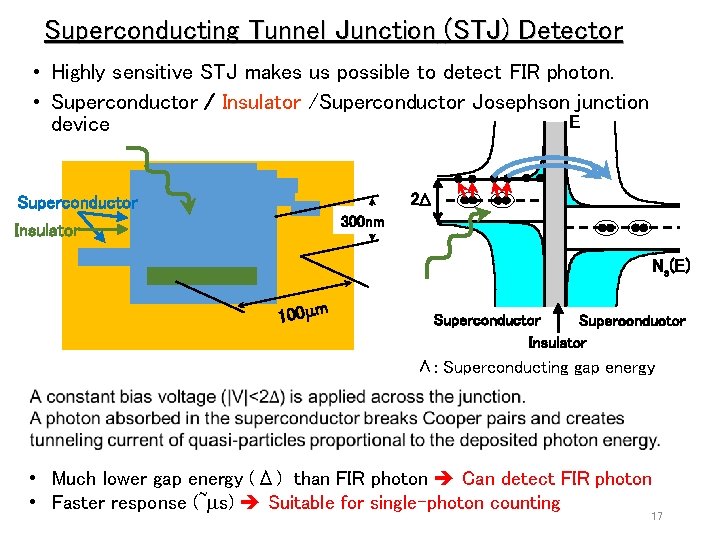
Superconducting Tunnel Junction (STJ) Detector • Highly sensitive STJ makes us possible to detect FIR photon. • Superconductor / Insulator /Superconductor Josephson junction E device 2 Superconductor 300 nm Insulator Ns(E) 100 m Superconductor Insulator Δ: Superconducting gap energy • Much lower gap energy (Δ) than FIR photon Can detect FIR photon • Faster response (~ s) Suitable for single-photon counting 17
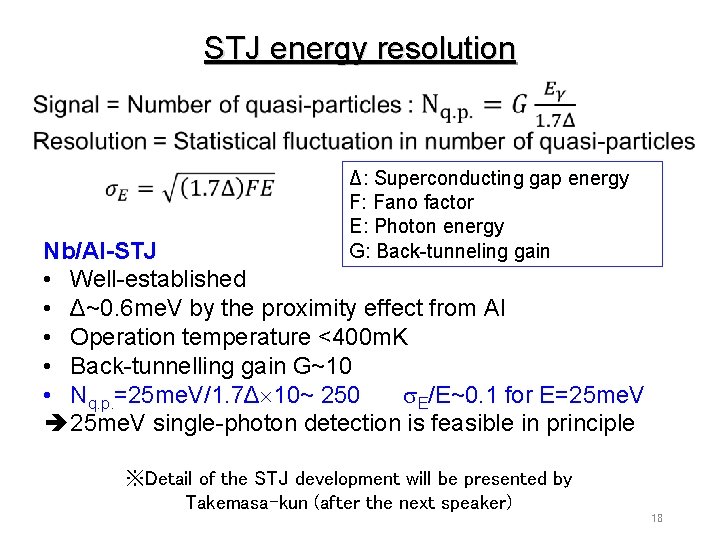
STJ energy resolution Δ: Superconducting gap energy F: Fano factor E: Photon energy G: Back-tunneling gain Nb/Al-STJ • Well-established • Δ~0. 6 me. V by the proximity effect from Al • Operation temperature <400 m. K • Back-tunnelling gain G~10 • Nq. p. =25 me. V/1. 7Δ 10~ 250 E/E~0. 1 for E=25 me. V single-photon detection is feasible in principle ※Detail of the STJ development will be presented by Takemasa-kun (after the next speaker) 18

- Slides: 19