
Coaxial cylinders method Consider laminar flow of an
- Slides: 9
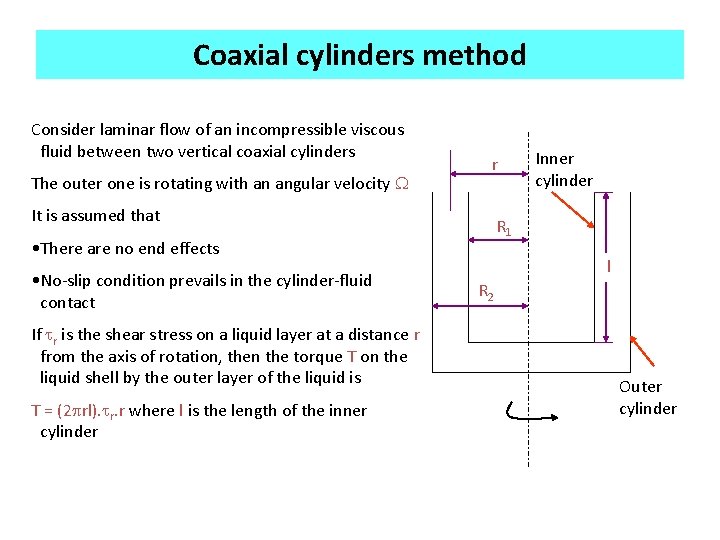
Coaxial cylinders method Consider laminar flow of an incompressible viscous fluid between two vertical coaxial cylinders The outer one is rotating with an angular velocity W r It is assumed that R 1 • There are no end effects • No-slip condition prevails in the cylinder-fluid contact If tr is the shear stress on a liquid layer at a distance r from the axis of rotation, then the torque T on the liquid shell by the outer layer of the liquid is T = (2 prl). tr. r where l is the length of the inner cylinder Inner cylinder l R 2 Outer cylinder
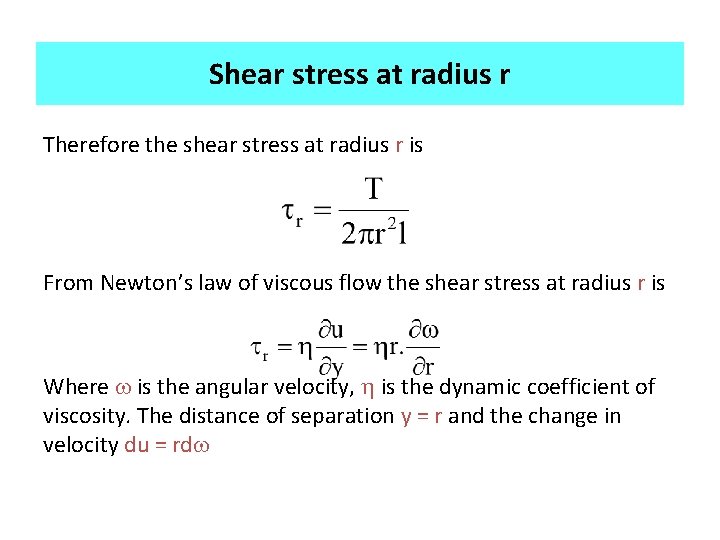
Shear stress at radius r Therefore the shear stress at radius r is From Newton’s law of viscous flow the shear stress at radius r is Where w is the angular velocity, h is the dynamic coefficient of viscosity. The distance of separation y = r and the change in velocity du = rdw
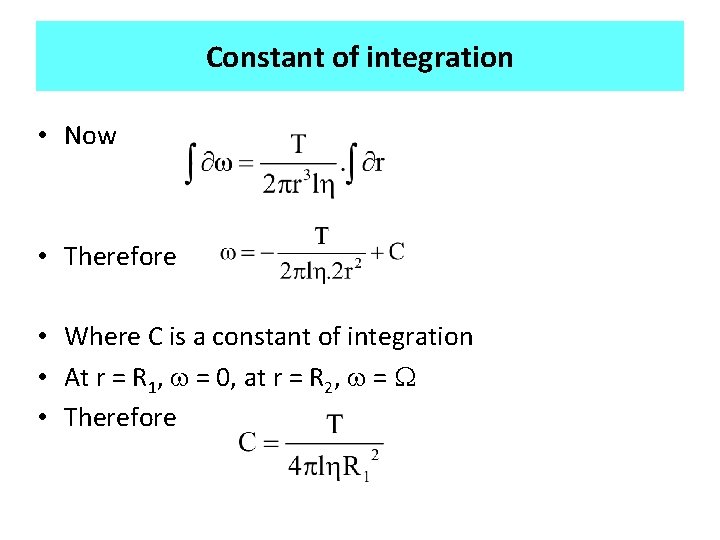
Constant of integration • Now • Therefore • Where C is a constant of integration • At r = R 1, w = 0, at r = R 2, w = W • Therefore
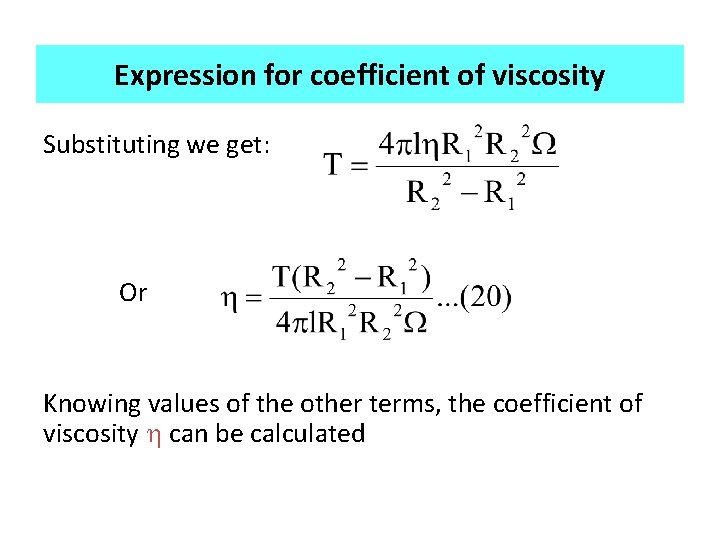
Expression for coefficient of viscosity Substituting we get: Or Knowing values of the other terms, the coefficient of viscosity h can be calculated
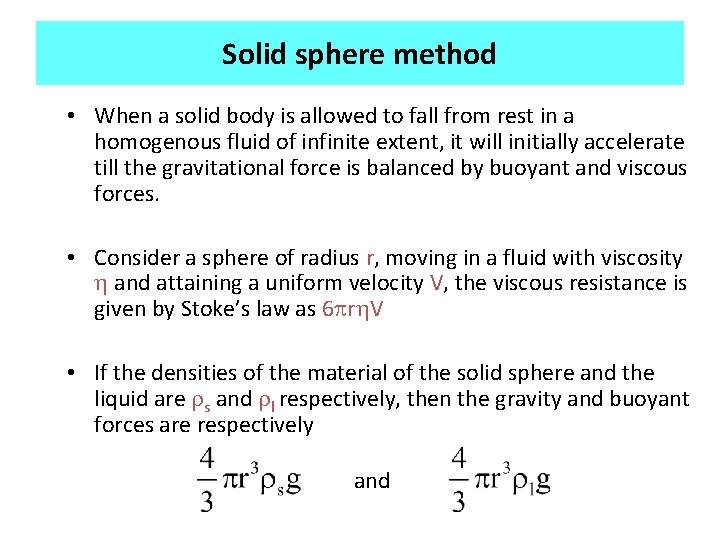
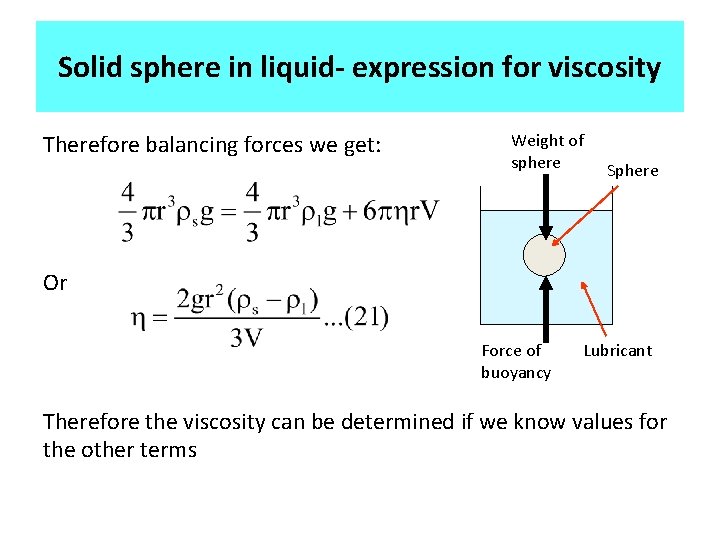
Solid sphere method • When a solid body is allowed to fall from rest in a homogenous fluid of infinite extent, it will initially accelerate till the gravitational force is balanced by buoyant and viscous forces. • Consider a sphere of radius r, moving in a fluid with viscosity h and attaining a uniform velocity V, the viscous resistance is given by Stoke’s law as 6 prh. V • If the densities of the material of the solid sphere and the liquid are rs and rl respectively, then the gravity and buoyant forces are respectively and
Solid sphere in liquid- expression for viscosity Therefore balancing forces we get: Weight of sphere Sphere Or Force of buoyancy Lubricant Therefore the viscosity can be determined if we know values for the other terms
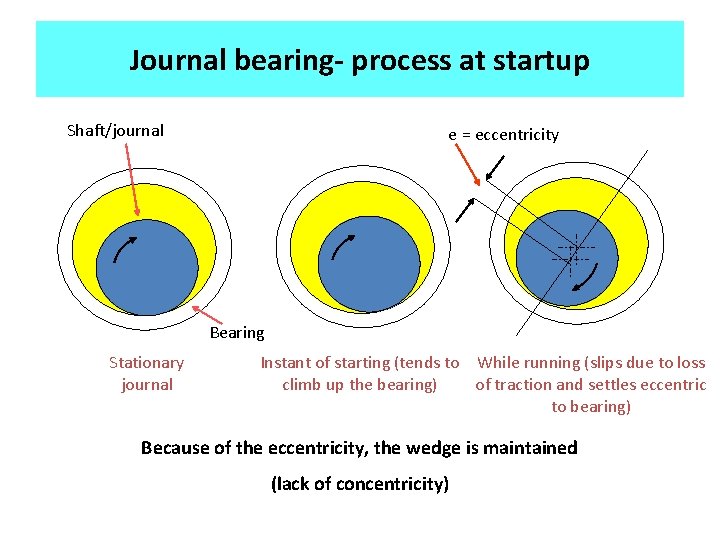
Journal bearing- process at startup Shaft/journal e = eccentricity Bearing Stationary journal Instant of starting (tends to While running (slips due to loss climb up the bearing) of traction and settles eccentric to bearing) Because of the eccentricity, the wedge is maintained (lack of concentricity)
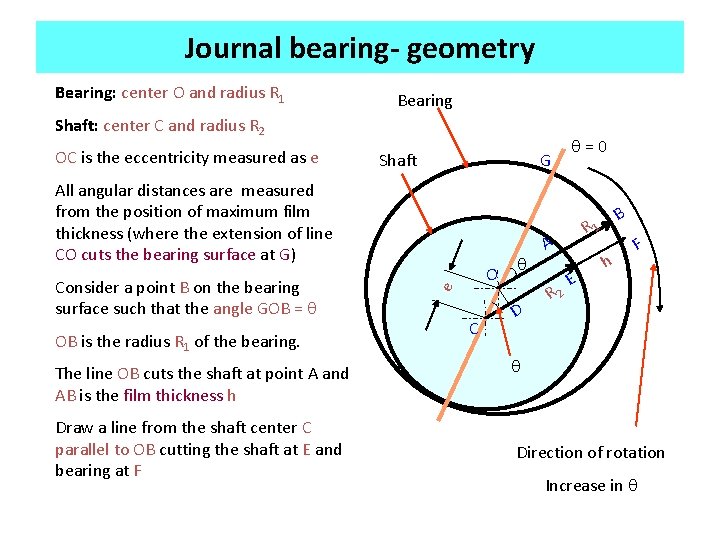
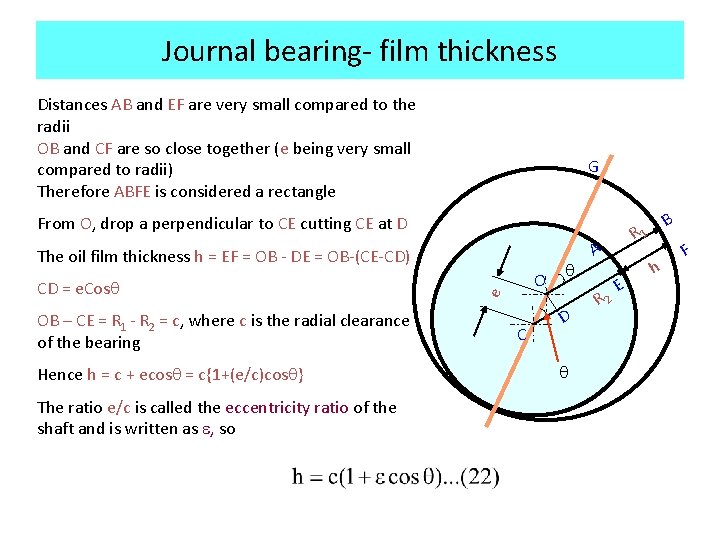
Journal bearing- geometry Bearing: center O and radius R 1 Bearing Shaft: center C and radius R 2 OC is the eccentricity measured as e Shaft G All angular distances are measured from the position of maximum film thickness (where the extension of line CO cuts the bearing surface at G) OB is the radius R 1 of the bearing. The line OB cuts the shaft at point A and AB is the film thickness h Draw a line from the shaft center C parallel to OB cutting the shaft at E and bearing at F q e Consider a point B on the bearing surface such that the angle GOB = q O C D q=0 A R 2 B R 1 E h F q Direction of rotation Increase in q
Journal bearing- film thickness Distances AB and EF are very small compared to the radii OB and CF are so close together (e being very small compared to radii) Therefore ABFE is considered a rectangle G From O, drop a perpendicular to CE cutting CE at D The oil film thickness h = EF = OB - DE = OB-(CE-CD) OB – CE = R 1 - R 2 = c, where c is the radial clearance of the bearing Hence h = c + ecosq = c{1+(e/c)cosq} The ratio e/c is called the eccentricity ratio of the shaft and is written as e, so q e CD = e. Cosq O C D q A R 2 B R 1 E h F