
Coaxial Cables A coaxial cable consists of two
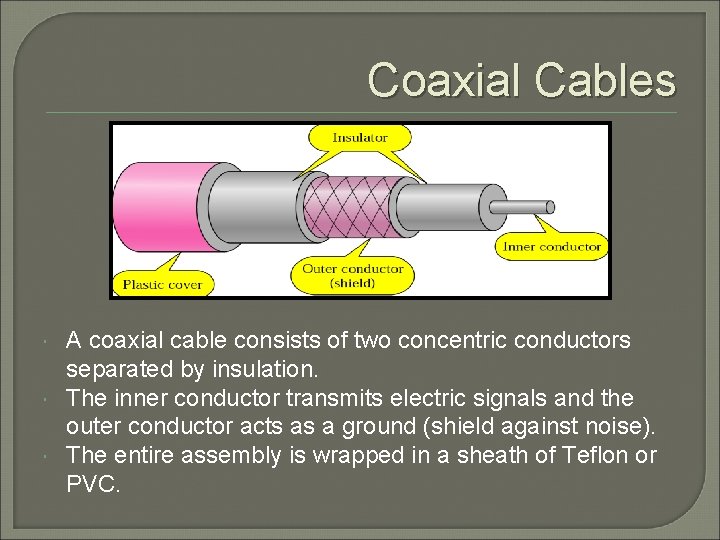
Coaxial Cables A coaxial cable consists of two concentric conductors separated by insulation. The inner conductor transmits electric signals and the outer conductor acts as a ground (shield against noise). The entire assembly is wrapped in a sheath of Teflon or PVC.
Coaxial Cables The conductor used in coaxial cables is copper wire. It is used for both the inner and outer conductors. Because the signal is transmitted over the surface of the inner copper wire, increasing the cross-section of the inner copper will increases the amount of signal that can be transmitted by the cable. A thicker coaxial cable therefore can transmit more data than a thinner one.
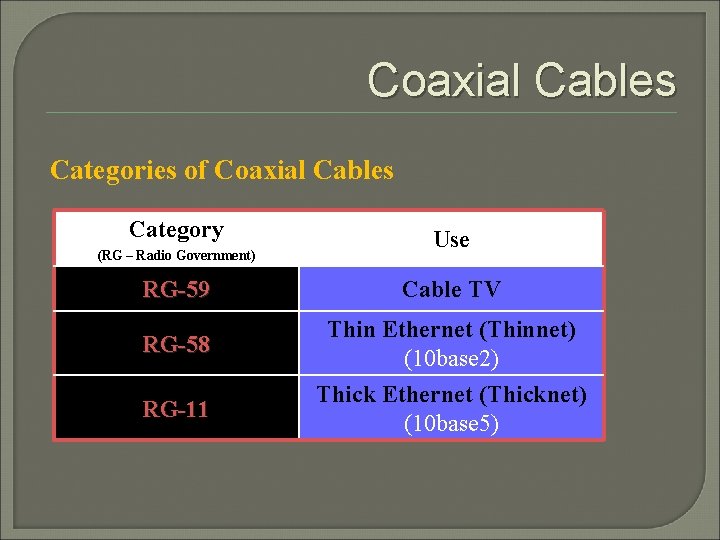
Coaxial Cables Categories of Coaxial Cables Category (RG – Radio Government) Use RG-59 Cable TV RG-58 Thin Ethernet (Thinnet) (10 base 2) RG-11 Thick Ethernet (Thicknet) (10 base 5)
Coaxial Cables The commonly used coaxial cables are: • 10 base 2 (thinnet): Supports a data-transfer rate of 10 Mbps and can transmit signals without attenuation over a distance of 185 meters. • 10 base 5 (thicknet): supports a data-transfer rate of 10 Mbps over a distance of 500 meters.
Thicknet Thicknet is a heavy-gauge coaxial cable that is fairly inflexible. Installation of thicknet are declining but can still be found in certain settings such as in manufacturing companies. Thicknet coaxial cable is well shielded and therefore doesn’t suffer as much from interference as thinnet cable (a manufacturing environment with a lot of machinery in use can produce potential interference problems when cabling runs close to large electrical devices).
Thinnet (RG-58 coaxial cable) was the cable of choice at one time because of its relative ease of installation and its low cost. Thinnet LANs employ a bus topology, where a T-connector is attached to each computer’s network card. The computers are then chained together using appropriate lengths of cable. Thinnet installations require that each end of the network be terminated, and terminators are placed on the downside T-connector of computers that reside on either end of the network.
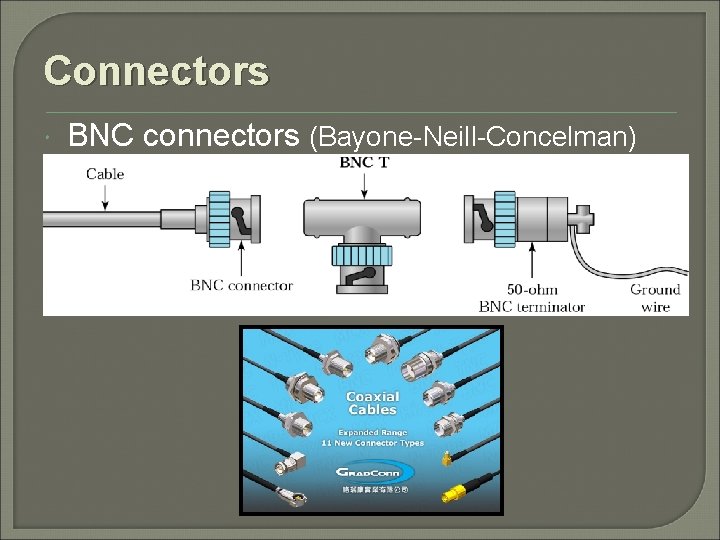
Connectors BNC connectors (Bayone-Neill-Concelman)
Coaxial Cables The advantage of coaxial cables is: • They support high bandwidths • Can transmit signals up to 10 kilometers. The disadvantage of coaxial cables is: • They support only the bus topology. • They do not support star topology, which is the most common topology used in LAN.
- Slides: 8