
Coasts Revision Processes Weathering Key Term is insitu
- Slides: 4
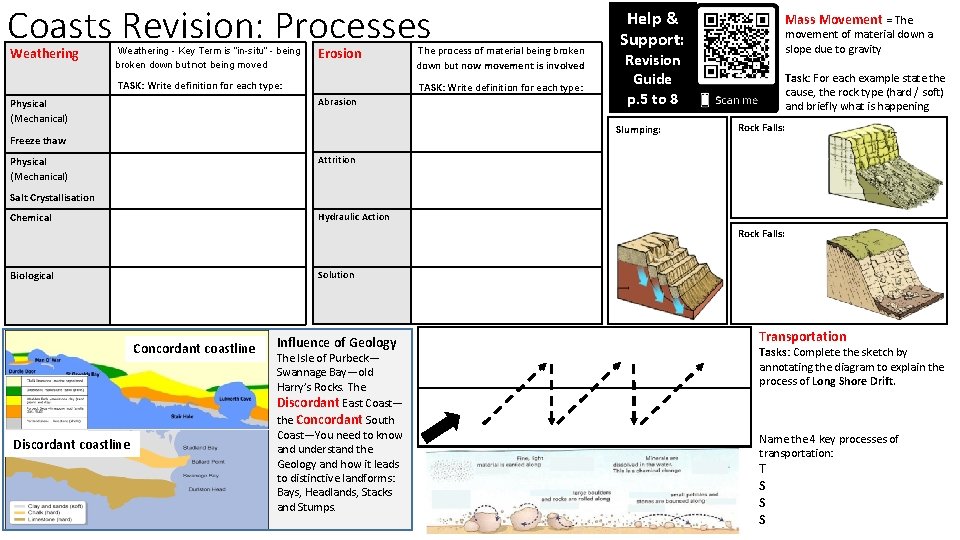
Coasts Revision: Processes Weathering - Key Term is “in-situ” - being broken down but not being moved Erosion TASK: Write definition for each type: Physical (Mechanical) Freeze thaw Abrasion Attrition Mass Movement = The movement of material down a slope due to gravity Revision Guide p. 5 to 8 Slumping: Task: For each example state the cause, the rock type (hard / soft) and briefly what is happening Rock Falls: Salt Crystallisation Biological TASK: Write definition for each type: Physical (Mechanical) Chemical The process of material being broken down but now movement is involved Help & Support: Hydraulic Action Solution Rock Falls: Concordant coastline Discordant coastline Influence of Geology The Isle of Purbeck— Swannage Bay—old Harry’s Rocks. The Discordant East Coast— the Concordant South Coast—You need to know and understand the Geology and how it leads to distinctive landforms: Bays, Headlands, Stacks and Stumps. Transportation Tasks: Complete the sketch by annotating the diagram to explain the process of Long Shore Drift. Name the 4 key processes of transportation: T S S S
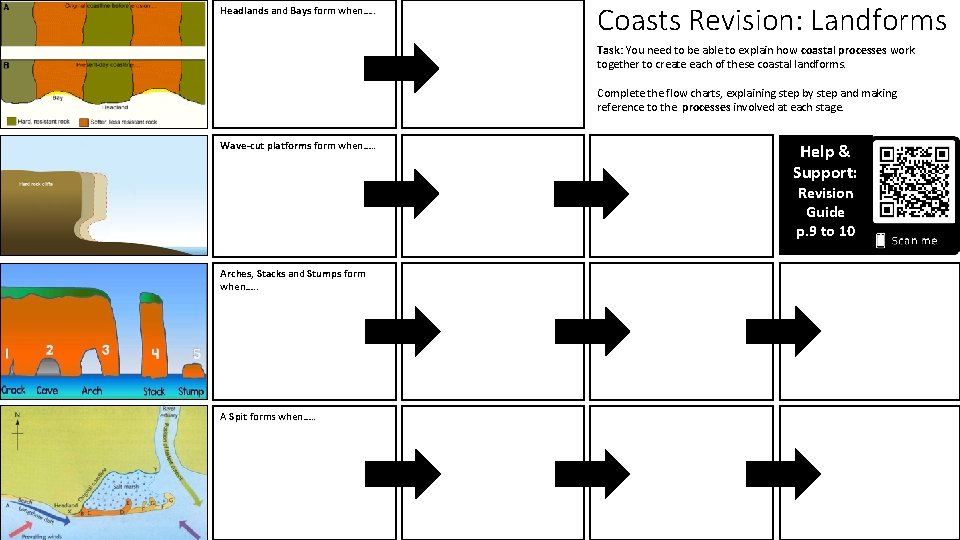
Headlands and Bays form when…. . Coasts Revision: Landforms Task: You need to be able to explain how coastal processes work together to create each of these coastal landforms. Complete the flow charts, explaining step by step and making reference to the processes involved at each stage. Wave-cut platforms form when…. . Help & Support: Revision Guide p. 9 to 10 Arches, Stacks and Stumps form when…. . A Spit forms when…. .
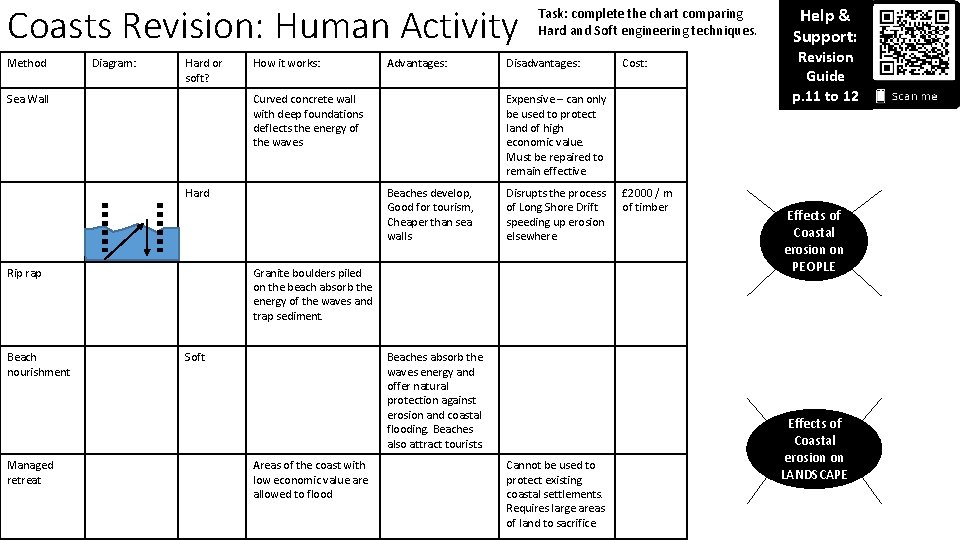
Coasts Revision: Human Activity Method Diagram: Hard or soft? Sea Wall How it works: Curved concrete wall with deep foundations deflects the energy of the waves Hard Rip rap Beach nourishment Managed retreat Advantages: Task: complete the chart comparing Hard and Soft engineering techniques. Disadvantages: Expensive – can only be used to protect land of high economic value. Must be repaired to remain effective Beaches develop, Good for tourism, Cheaper than sea walls Disrupts the process of Long Shore Drift speeding up erosion elsewhere Granite boulders piled on the beach absorb the energy of the waves and trap sediment. Soft Beaches absorb the waves energy and offer natural protection against erosion and coastal flooding. Beaches also attract tourists. Areas of the coast with low economic value are allowed to flood Cost: Cannot be used to protect existing coastal settlements. Requires large areas of land to sacrifice. £ 2000 / m of timber Help & Support: Revision Guide p. 11 to 12 Effects of Coastal erosion on PEOPLE Effects of Coastal erosion on LANDSCAPE
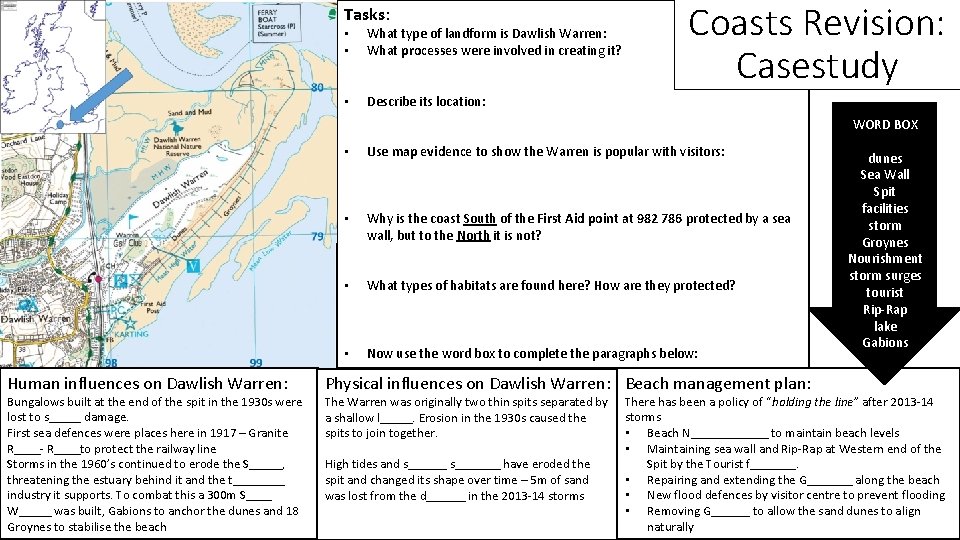
Tasks: • • What type of landform is Dawlish Warren: What processes were involved in creating it? • Describe its location: Coasts Revision: Casestudy WORD BOX Human influences on Dawlish Warren: Bungalows built at the end of the spit in the 1930 s were lost to s_____ damage. First sea defences were places here in 1917 – Granite R____- R____to protect the railway line Storms in the 1960’s continued to erode the S_____, threatening the estuary behind it and the t____ industry it supports. To combat this a 300 m S____ W_____ was built, Gabions to anchor the dunes and 18 Groynes to stabilise the beach • Use map evidence to show the Warren is popular with visitors: • Why is the coast South of the First Aid point at 982 786 protected by a sea wall, but to the North it is not? • What types of habitats are found here? How are they protected? • Now use the word box to complete the paragraphs below: Physical influences on Dawlish Warren: Beach management plan: The Warren was originally two thin spits separated by a shallow l_____. Erosion in the 1930 s caused the spits to join together. High tides and s_______ have eroded the spit and changed its shape over time – 5 m of sand was lost from the d______ in the 2013 -14 storms dunes Sea Wall Spit facilities storm Groynes Nourishment storm surges tourist Rip-Rap lake Gabions There has been a policy of “holding the line” after 2013 -14 storms • Beach N______ to maintain beach levels • Maintaining sea wall and Rip-Rap at Western end of the Spit by the Tourist f_______. • Repairing and extending the G_______ along the beach • New flood defences by visitor centre to prevent flooding • Removing G______ to allow the sand dunes to align naturally