
Coastlines Factors influencing the shape of coastlines Factors




- Slides: 18
Coastlines Factors influencing the shape of coastlines
Factors influencing the shape of coastlines Tectonic plate movements Shifts in climate patterns & sea level change Movement of sediments and water (e. g. waves, currents)
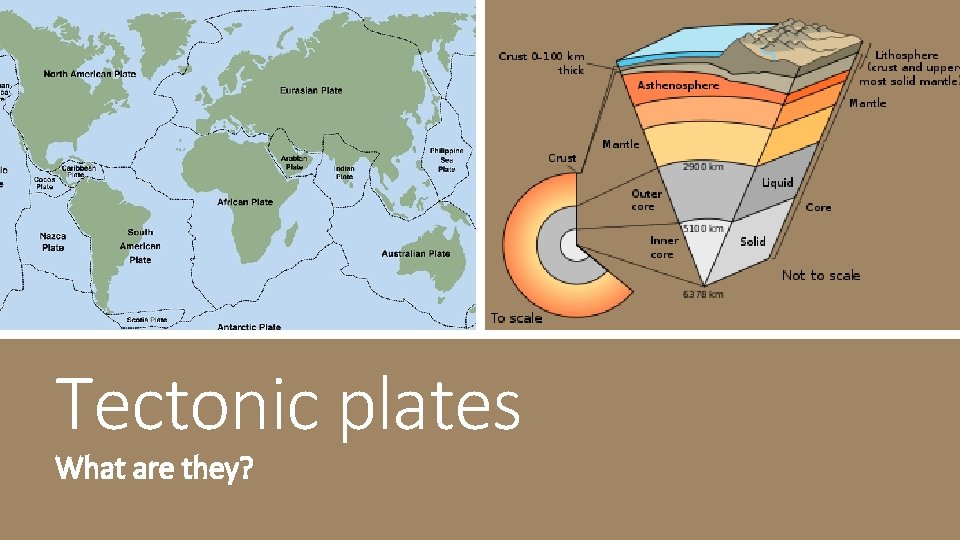
Tectonic plates What are they?
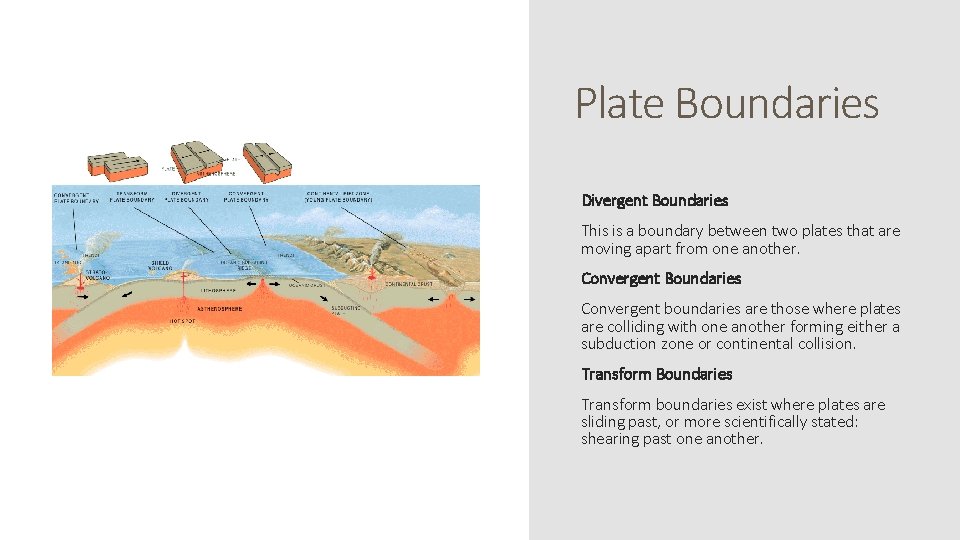
Plate Boundaries Divergent Boundaries This is a boundary between two plates that are moving apart from one another. Convergent Boundaries Convergent boundaries are those where plates are colliding with one another forming either a subduction zone or continental collision. Transform Boundaries Transform boundaries exist where plates are sliding past, or more scientifically stated: shearing past one another.
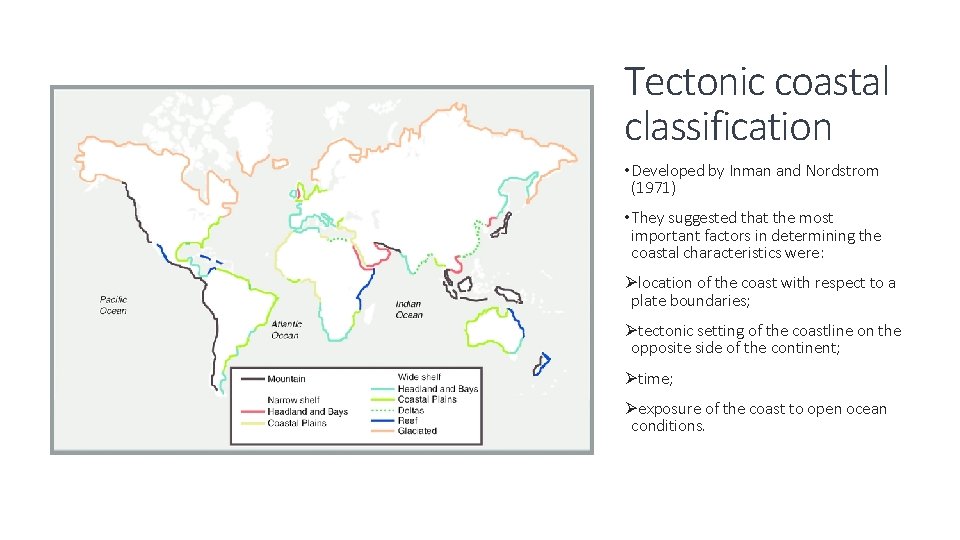
Tectonic coastal classification • Developed by Inman and Nordstrom (1971) • They suggested that the most important factors in determining the coastal characteristics were: Ølocation of the coast with respect to a plate boundaries; Øtectonic setting of the coastline on the opposite side of the continent; Øtime; Øexposure of the coast to open ocean conditions.
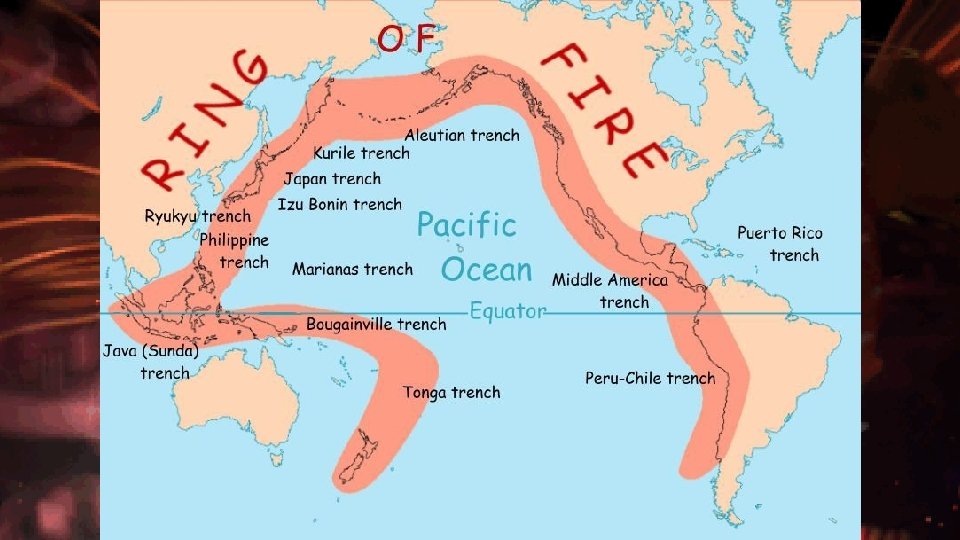
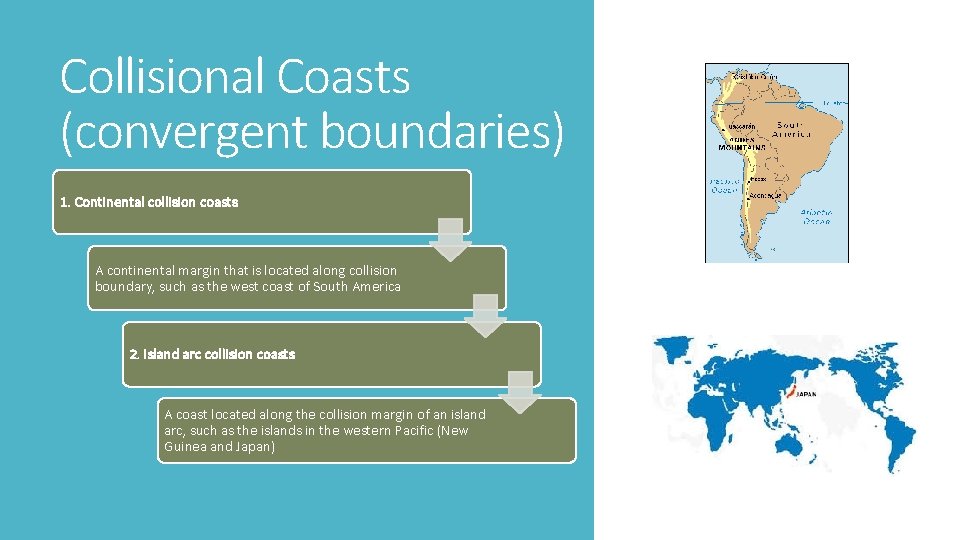
Collisional Coasts (convergent boundaries) 1. Continental collision coasts A continental margin that is located along collision boundary, such as the west coast of South America 2. Island arc collision coasts A coast located along the collision margin of an island arc, such as the islands in the western Pacific (New Guinea and Japan)
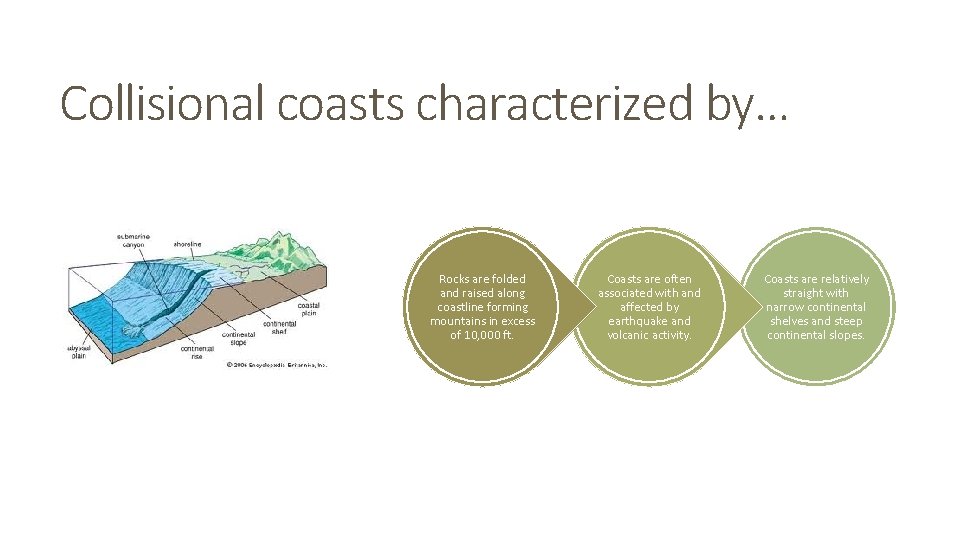
Collisional coasts characterized by… Rocks are folded and raised along coastline forming mountains in excess of 10, 000 ft. Coasts are often associated with and affected by earthquake and volcanic activity. Coasts are relatively straight with narrow continental shelves and steep continental slopes.
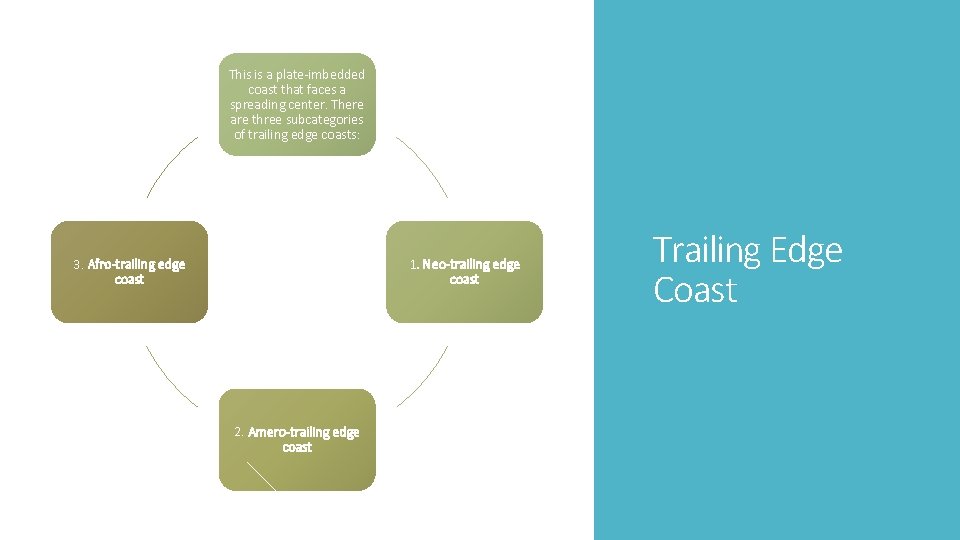
This is a plate-imbedded coast that faces a spreading center. There are three subcategories of trailing edge coasts: 3. Afro-trailing edge coast 1. Neo-trailing edge coast 2. Amero-trailing edge coast Trailing Edge Coast
Neo-trailing edge coast Coastline developed along the margin of a newly rifting landmass (Red Sea + Gulf of California) Characteristics: Immature coast Volcanism and seismic activity commonly present Topography adjacent to the coast is typically rugged (cliffs, mountains, plateaus) Lack continental shelves (not enough time for depositional features to form)
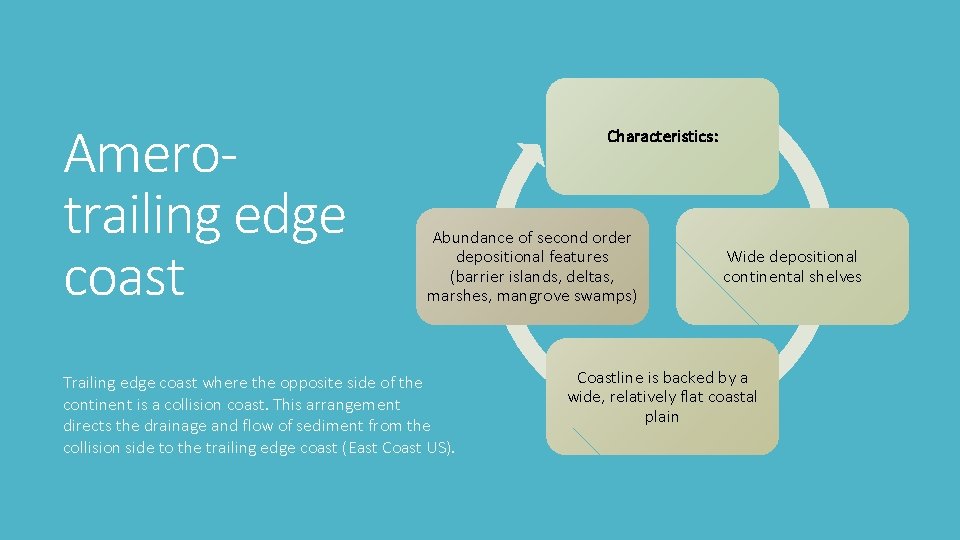
Amerotrailing edge coast Characteristics: Abundance of second order depositional features (barrier islands, deltas, marshes, mangrove swamps) Trailing edge coast where the opposite side of the continent is a collision coast. This arrangement directs the drainage and flow of sediment from the collision side to the trailing edge coast (East Coast US). Wide depositional continental shelves Coastline is backed by a wide, relatively flat coastal plain
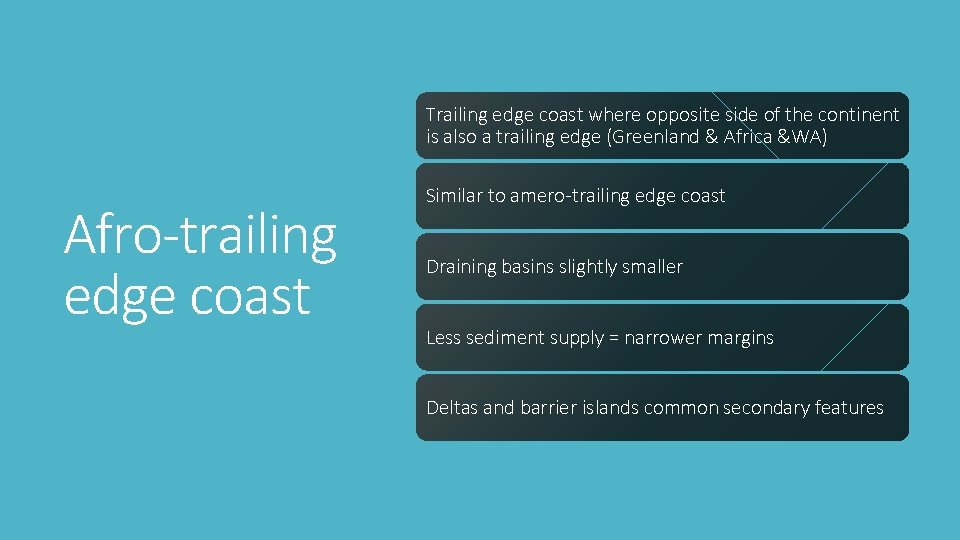
Trailing edge coast where opposite side of the continent is also a trailing edge (Greenland & Africa &WA) Afro-trailing edge coast Similar to amero-trailing edge coast Draining basins slightly smaller Less sediment supply = narrower margins Deltas and barrier islands common secondary features
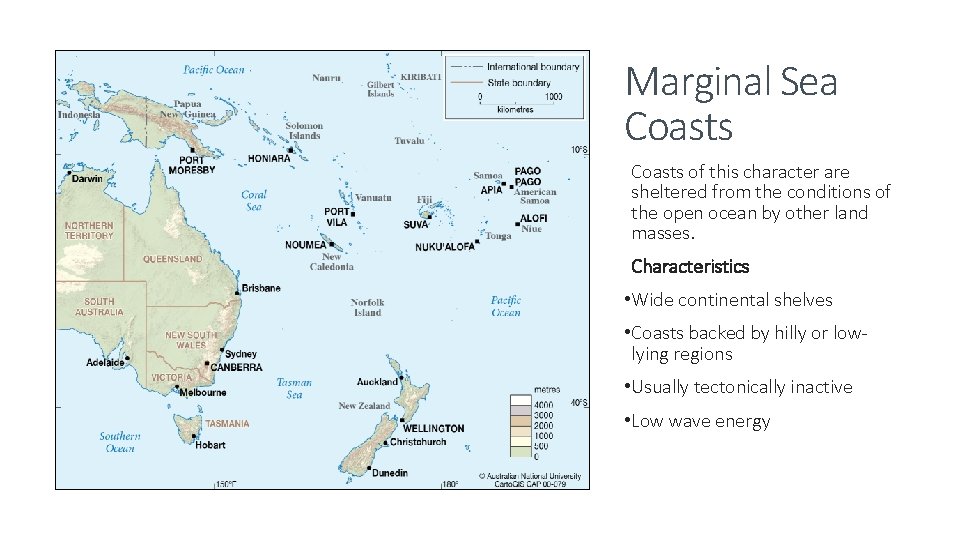
Marginal Sea Coasts of this character are sheltered from the conditions of the open ocean by other land masses. Characteristics • Wide continental shelves • Coasts backed by hilly or lowlying regions • Usually tectonically inactive • Low wave energy
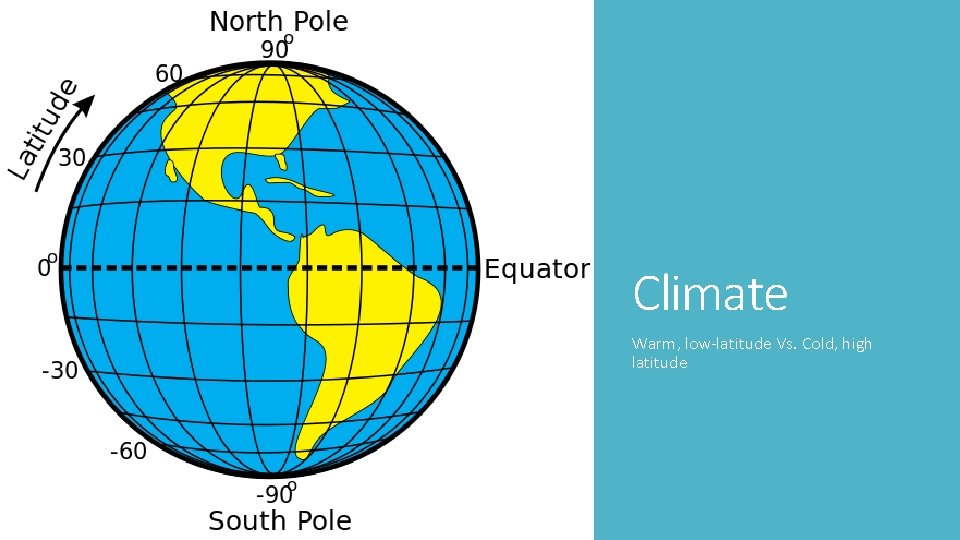
Climate Warm, low-latitude Vs. Cold, high latitude
Weathering Physical and Chemical
Storms
Sediment Supply