
Coastal Processes and Hazards Outline Why is this









- Slides: 41
Coastal Processes and Hazards
Outline • • • Why is this important? Definitions How waves work Interaction at shoreline Importance of beaches Human impacts on beaches
Why is this important? • 70% of Earth’s surface is water – Means a lot of coastlines • In U. S. - 30 coastal states – Projection by 2010 75% of population will live within 75 km of coastline – 1, 358 people/coastal mile – High concentration of people and property!
Possible Hazards • Already covered – Hurricanes, tsunami, nor’easters • Discuss today – Waves, tides, erosion, sea level rise
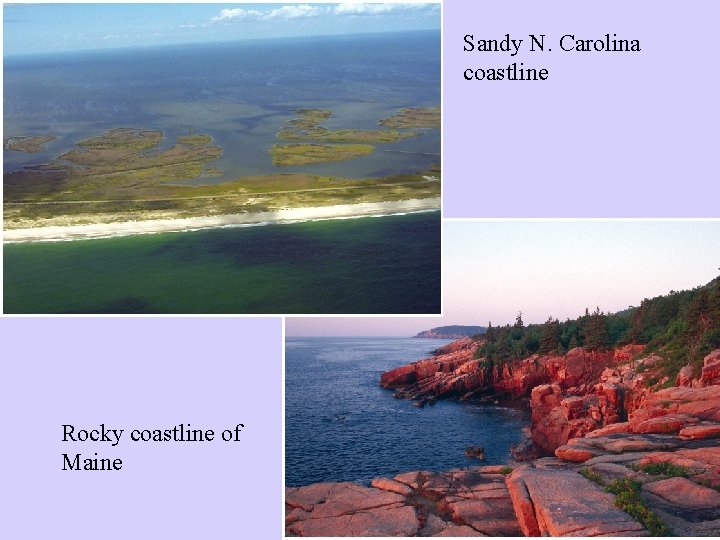
Coastlines • Regions where land meets sea • Can be of different forms – Long sandy beaches – Rocky cliffs – Coral reefs
Sandy N. Carolina coastline Rocky coastline of Maine
Waves and Tides • Key forces that act to alter coastlines • Important for erosion, moving material along coast
How waves work • Caused by wind blowing over water surface – Transfer energy from air to water • 5 -20 km/hr breeze: small (< 1 cm high) ripples • 30+ km/hr: full size waves
Wave height • Depends on – Wind speed – Direction of wind blowing – Length of water over which wind is blowing – Consistency of wind direction
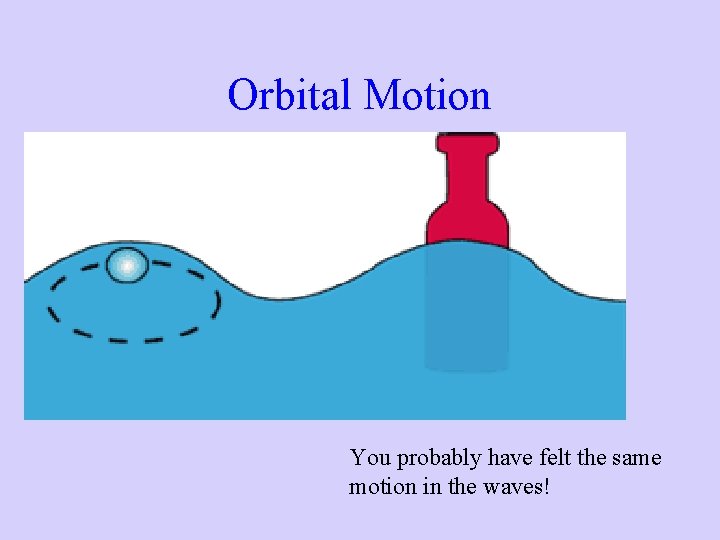
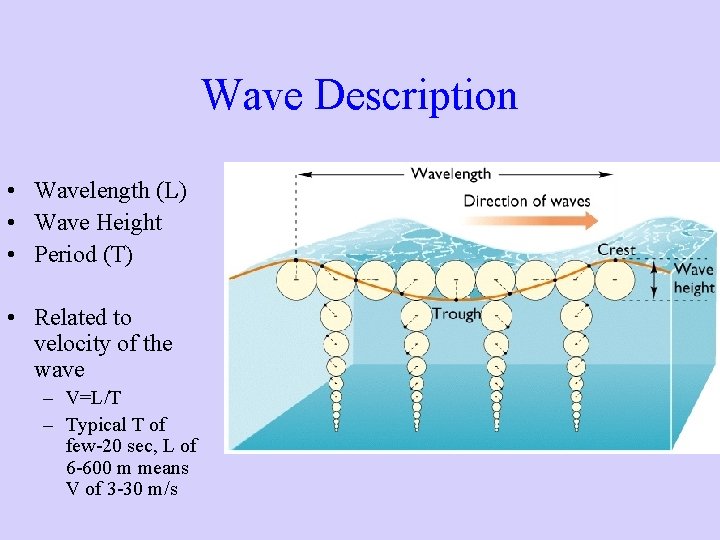
What is Water Doing? • Particle of water rotates in place with circular orbit – Orbit decreases in size with depth
Orbital Motion You probably have felt the same motion in the waves!
Wave Description • Wavelength (L) • Wave Height • Period (T) • Related to velocity of the wave – V=L/T – Typical T of few-20 sec, L of 6 -600 m means V of 3 -30 m/s
Swells • Interference of many sets of waves – Usually related to storms, multiple storms • Occasionally constructive interference occurs – Produce very large waves (rouge waves) – Can sink ships, may impact shorelines
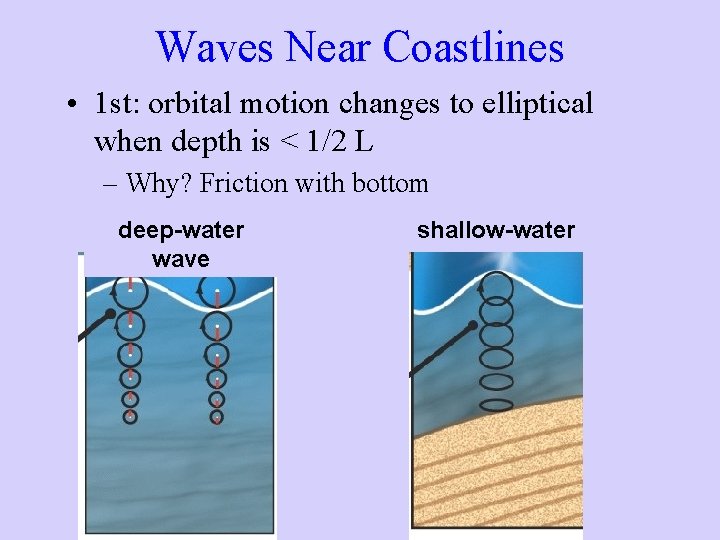
Waves Near Coastlines • 1 st: orbital motion changes to elliptical when depth is < 1/2 L – Why? Friction with bottom deep-water wave shallow-water wave
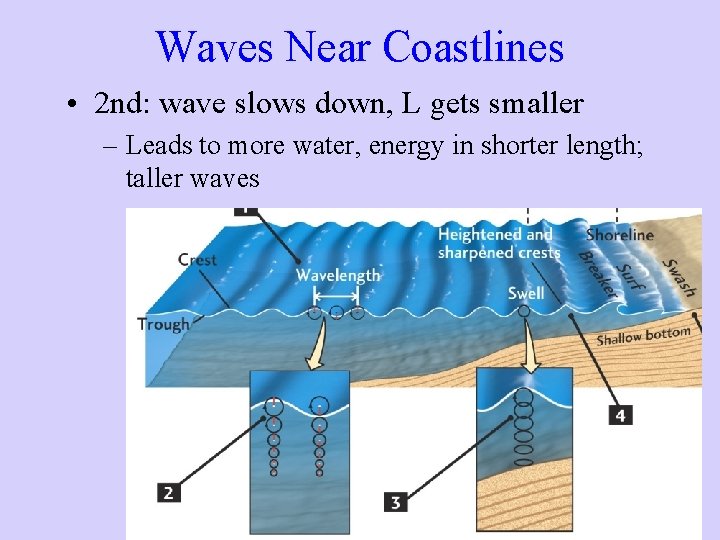
Waves Near Coastlines • 2 nd: wave slows down, L gets smaller – Leads to more water, energy in shorter length; taller waves
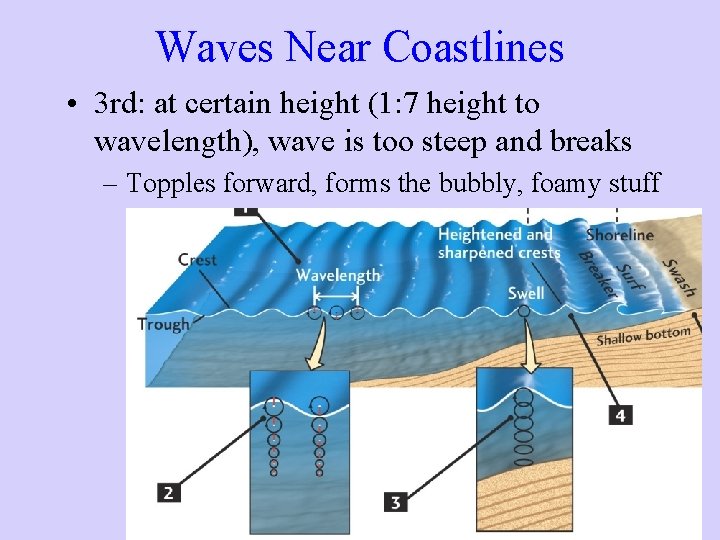
Waves Near Coastlines • 3 rd: at certain height (1: 7 height to wavelength), wave is too steep and breaks – Topples forward, forms the bubbly, foamy stuff
Slope of Near-shore • Impacts wave breaks • If gently sloping bottom, waves break farther from shore • If steeply sloping bottom, waves break closer to shore • Rocky cliffs: break directly on rocks with large force
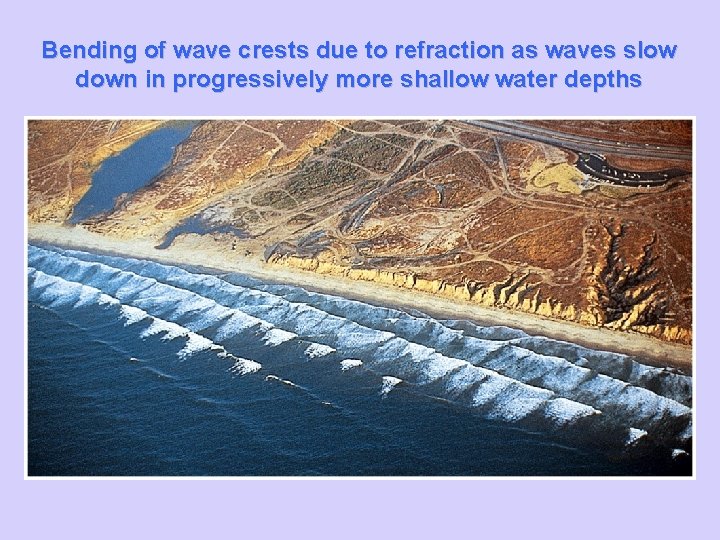
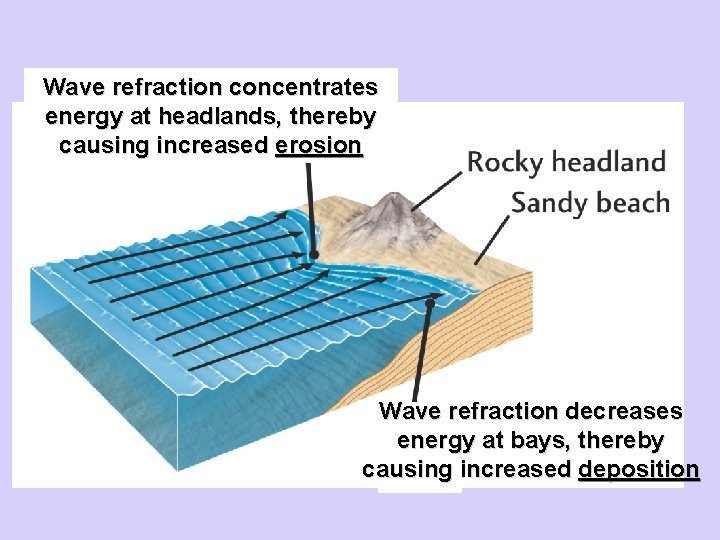
Wave Refraction • As waves get closer to shore, they bend to a direction roughly parallel to shore – Wave refraction, similar to light • Important for areas with bays and headlands – Headlands: water depth shallows quickly, waves slow and converge at this point – Bays: water in center is deeper, area is more protected
Bending of wave crests due to refraction as waves slow down in progressively more shallow water depths
Wave refraction concentrates energy at headlands, thereby causing increased erosion Wave refraction decreases energy at bays, thereby causing increased deposition
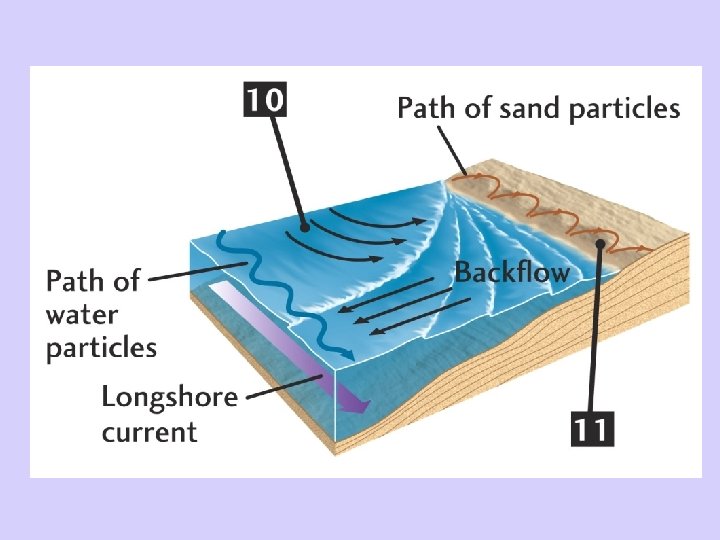
Longshore Drift • Waves arrive at small angle to shore, go up on beach at an angle – Moves sand grains (and people) at an angle • Very efficient at transporting sand to/from beaches
Beach • Shoreline made of sand/pebbles • Important for recreation, housing • Also as a natural barrier to absorb energy in breaking waves • Various beach processes affect how much beach is present during the year
General Beach Cycle • Summer – Generally fewer storms, lower wind speeds, waves with shorter L and height – Act to push offshore sand onshore, build wide, sandy beaches
• Summer beach near San Diego, CA
• Winter beach (same one) near San Diego, CA Note sandy beach is gone, due to large storm waves
General Beach Cycle • Winter – More energetic storms, waves erode beach sand, carry offshore – With less sand, energetic waves can attack coastal features such as roads, houses
Human Impacts • Humans like to live near the beach! – Nice climate – Great views – Additional food sources • Want to minimize risk from big waves, hurricanes, erosion of cliffs and beaches
Human Impacts • In order to mitigate hazards, we build – Seawalls – Dams – Groins – Jetties • Structures have multiple impacts
Dams • Dam rivers that add water, sand into ocean • Many built to provide freshwater reservoirs for coastal communities • Problem: sand in rivers adds to beach development. By cutting off this supply, adds to problem of shrinking beaches
Seawalls/Cliff Protection • Build structure for protection of beach or cliff – Changes beach dynamics • What happens? – Ocean waves break on wall because beach narrows – Steepens slope offshore, leads to larger waves – Can over time erode seawall or undercut base
Seawalls can cause beaches to disappear, construction of new seawalls over time Also, reduce attractiveness of coastline, property values
Seawall, coastal GA
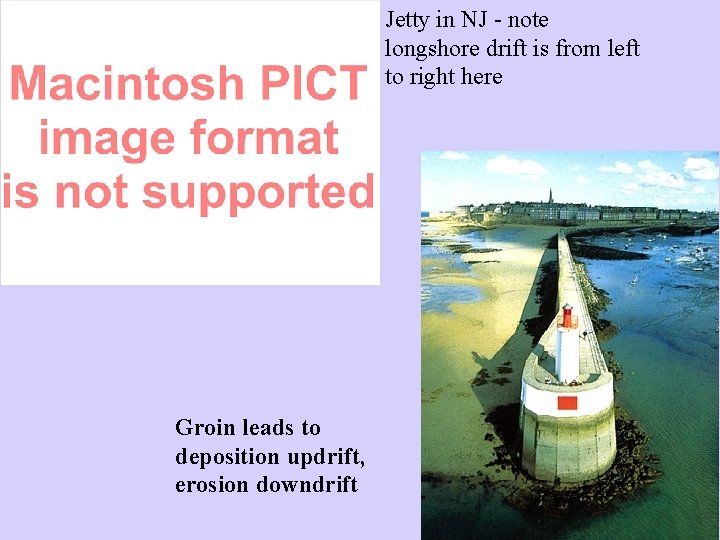
Groins and Jetties • Elongate mass (usually rock or concrete) built perpendicular to shoreline – Purpose: keep sand on the beach • Problem: longshore drift still occurs – Leads to deposition on 1 side, erosion on other side
Jetty in NJ - note longshore drift is from left to right here Groin leads to deposition updrift, erosion downdrift
Beach Replenishment • Actively transporting sand onto a beach – Usually pump it from offshore • Can be very expensive ($millions/mile of beach) • May have to be repeated every year • Examples: Waikiki, HI; Miami, FL
1981 Miami Beach
Next Time • Stream/River Processes