
COASTAL FISHERIES PROGRAMME OUTLINE Coastal Fisheries programme CFP
- Slides: 46
COASTAL FISHERIES PROGRAMME
OUTLINE Coastal Fisheries programme (CFP) goal CFP structure Budget and donors Coastal Fisheries Science and Management (Ian Bertram) • Aquaculture (Robert Jimmy) • Nearshore Fisheries Development (Michel Blanc) • •
Coastal Fisheries Programme CFP Goal (FAME Strategic Plan 2013 -2016) “Coastal fisheries, nearshore fisheries and aquaculture in Pacific Island countries and territories are managed and developed sustainably”
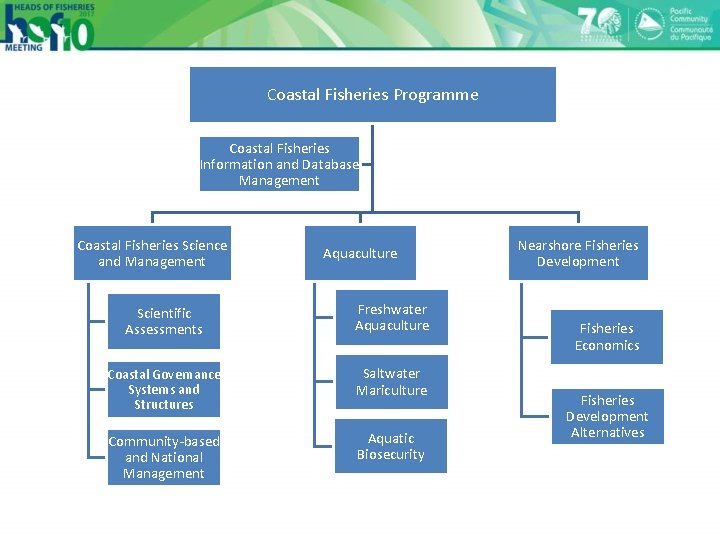
Coastal Fisheries Programme Coastal Fisheries Information and Database Management Coastal Fisheries Science and Management Aquaculture Scientific Assessments Freshwater Aquaculture Coastal Governance Systems and Structures Saltwater Mariculture Community-based and National Management Aquatic Biosecurity Nearshore Fisheries Development Fisheries Economics Fisheries Development Alternatives
Coastal Fisheries Programme • Improving service delivery for PICTs through – Working closer with other CROP and Int. agencies – Working with and through NGOs – Working across SPC Divisions for holistic approach • Major cross-cutting themes – Capacity development – Gender, youth and human rights (governance and aquaculture) – Community-based approaches where possible /practical – Food security and small-scale livelihoods – Climate change adaptation • 2017 projected budget approximately 6 million CFP units (around Euro 5 million)
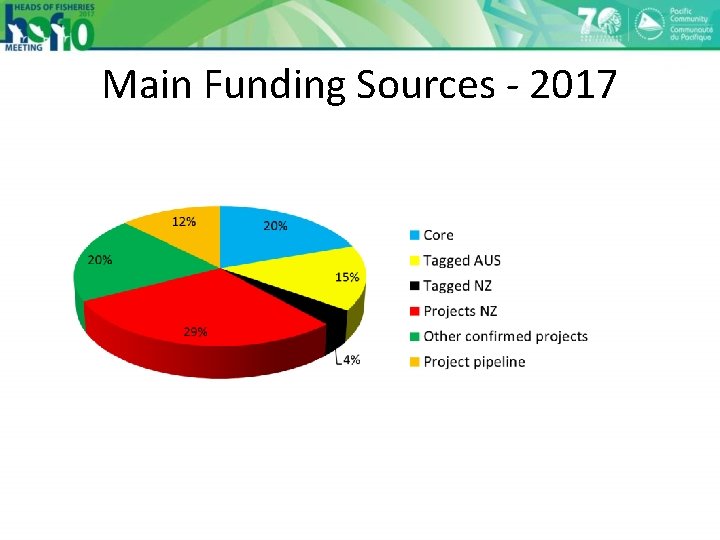
Main Funding Sources - 2017
Donor Partners • Australia (DFAT and ACIAR) • Conservation International / ADB • European Union • FAO • FFA / World Bank • French Pacific Fund • Germany / Kf. W • New Caledonia • New Zealand • World. Fish
Coastal Fisheries Science and Management Marie-Therese Bui, Section Administration Brad Moore, Pauline Bosserelle, Navneel Singh: Coastal Fisheries Science Jason Raubani, Ian Freeman, Ariella D’Andrea: Management and Governance Franck Magron: Information Manager for CFP Ian Bertram: Science and management Advisor
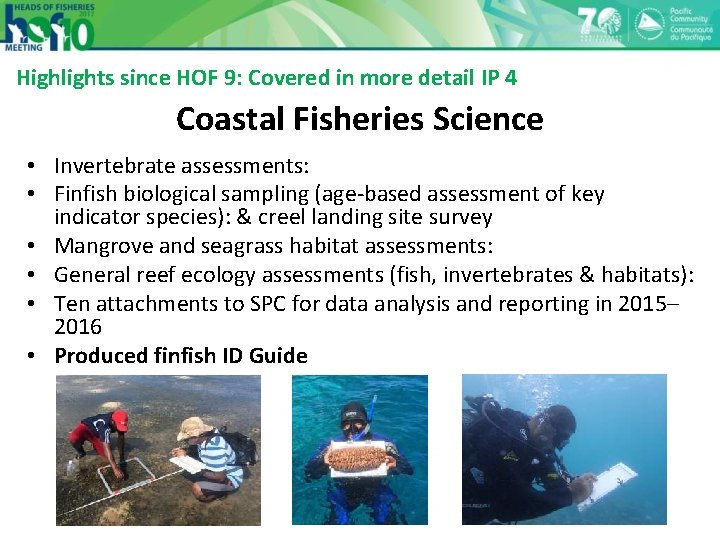
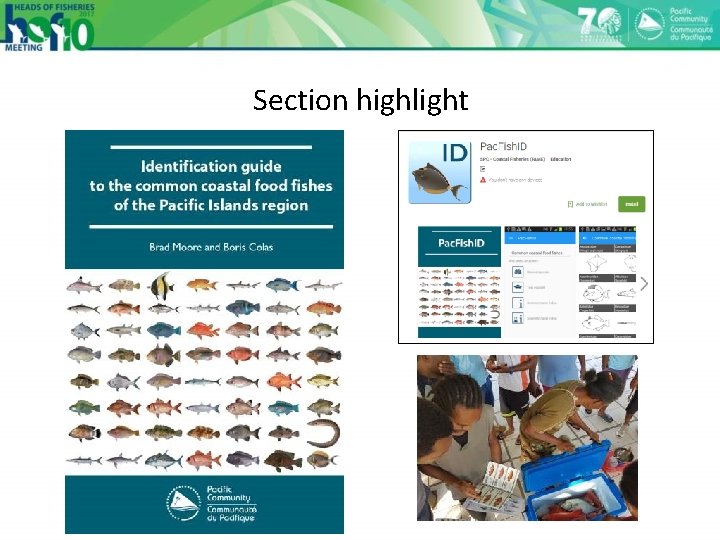
Highlights since HOF 9: Covered in more detail IP 4 Coastal Fisheries Science • Invertebrate assessments: • Finfish biological sampling (age-based assessment of key indicator species): & creel landing site survey • Mangrove and seagrass habitat assessments: • General reef ecology assessments (fish, invertebrates & habitats): • Ten attachments to SPC for data analysis and reporting in 2015– 2016 • Produced finfish ID Guide
Section highlight
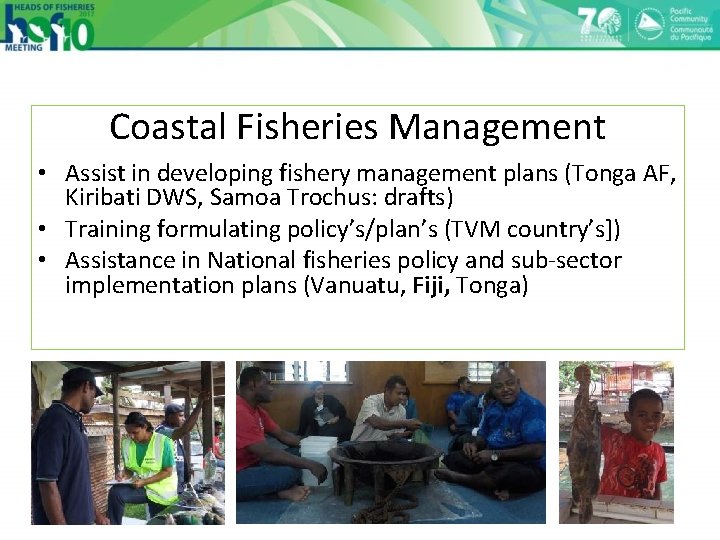
Coastal Fisheries Management. • Assist in developing fishery management plans (Tonga AF, Kiribati DWS, Samoa Trochus: drafts) • Training formulating policy’s/plan’s (TVM country’s]) • Assistance in National fisheries policy and sub-sector implementation plans (Vanuatu, Fiji, Tonga)
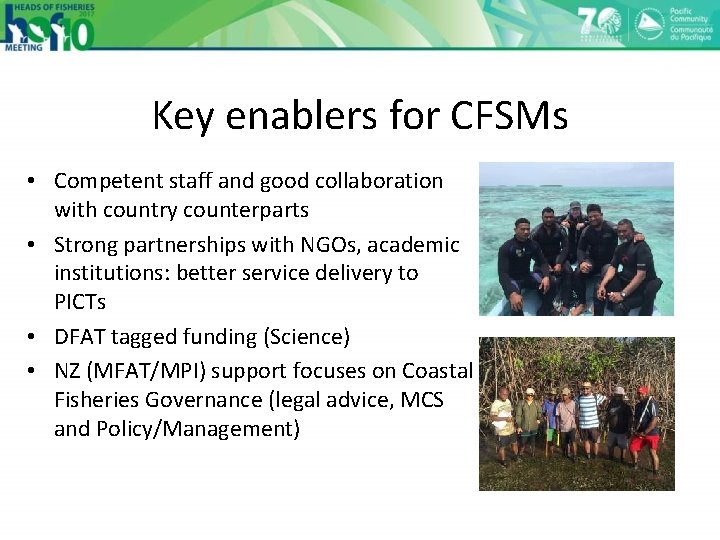
Key enablers for CFSMs • Competent staff and good collaboration with country counterparts • Strong partnerships with NGOs, academic institutions: better service delivery to PICTs • DFAT tagged funding (Science) • NZ (MFAT/MPI) support focuses on Coastal Fisheries Governance (legal advice, MCS and Policy/Management)
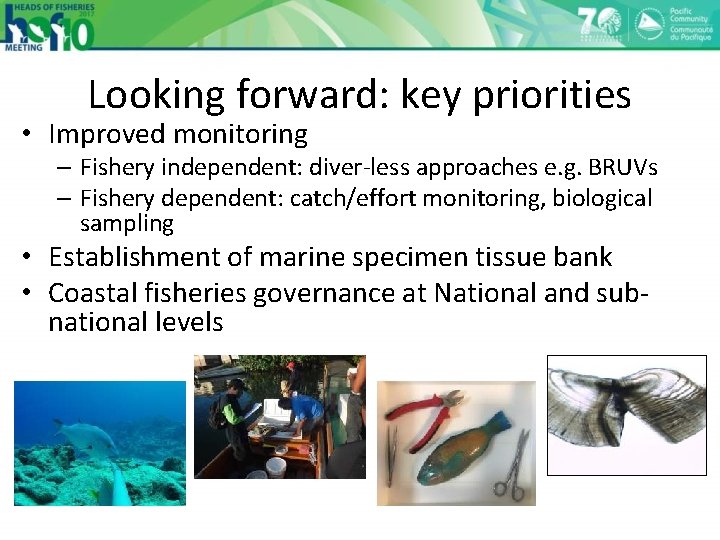
Looking forward: key priorities • Improved monitoring – Fishery independent: diver-less approaches e. g. BRUVs – Fishery dependent: catch/effort monitoring, biological sampling • Establishment of marine specimen tissue bank • Coastal fisheries governance at National and subnational levels
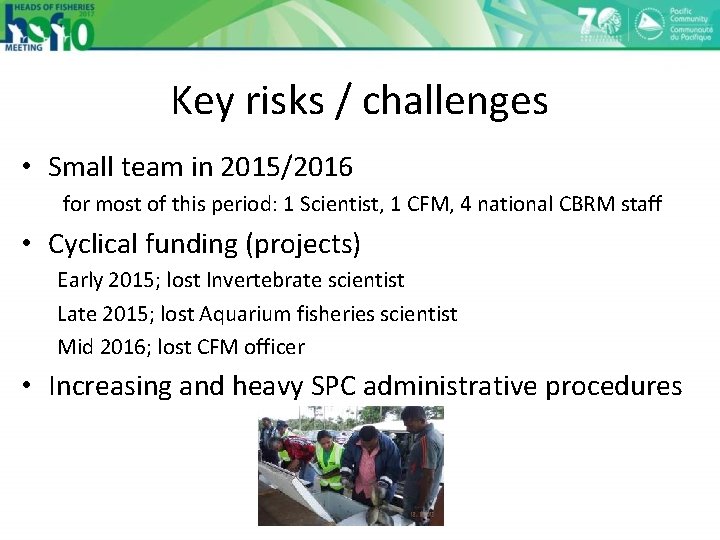
Key risks / challenges • Small team in 2015/2016 for most of this period: 1 Scientist, 1 CFM, 4 national CBRM staff • Cyclical funding (projects) Early 2015; lost Invertebrate scientist Late 2015; lost Aquarium fisheries scientist Mid 2016; lost CFM officer • Increasing and heavy SPC administrative procedures
Key risks / challenges • Takes time to get comments from some counterparts • Delays in national approval process for policies, plans & implementation • Small fisheries agencies (few staff doing many tasks, spread to thin)
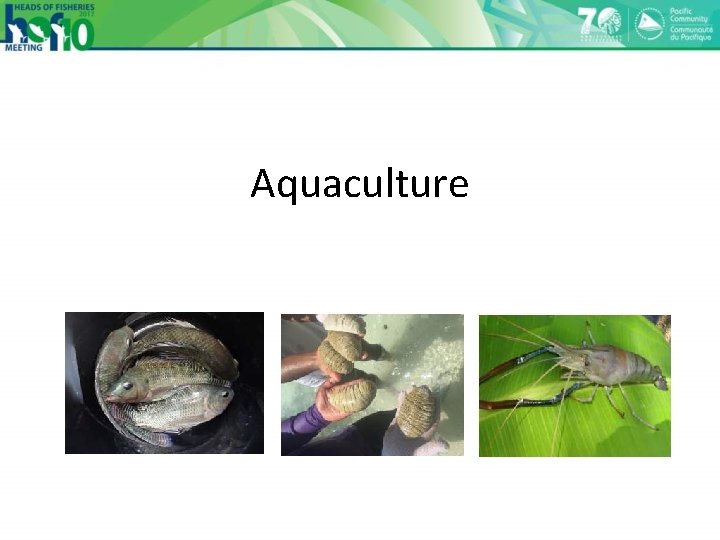
Aquaculture
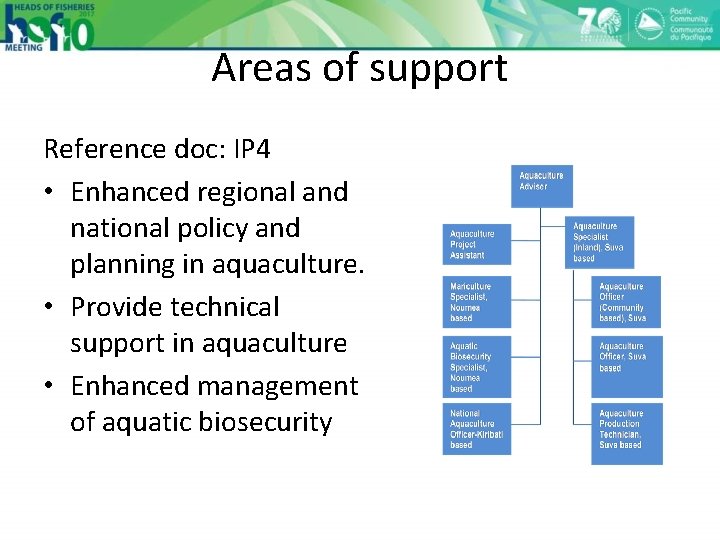
Areas of support Reference doc: IP 4 • Enhanced regional and national policy and planning in aquaculture. • Provide technical support in aquaculture • Enhanced management of aquatic biosecurity
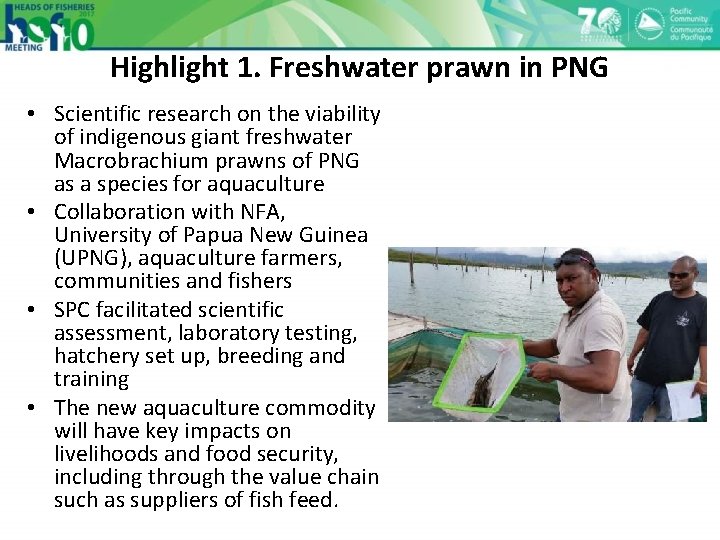
Highlight 1. Freshwater prawn in PNG • Scientific research on the viability of indigenous giant freshwater Macrobrachium prawns of PNG as a species for aquaculture • Collaboration with NFA, University of Papua New Guinea (UPNG), aquaculture farmers, communities and fishers • SPC facilitated scientific assessment, laboratory testing, hatchery set up, breeding and training • The new aquaculture commodity will have key impacts on livelihoods and food security, including through the value chain such as suppliers of fish feed.
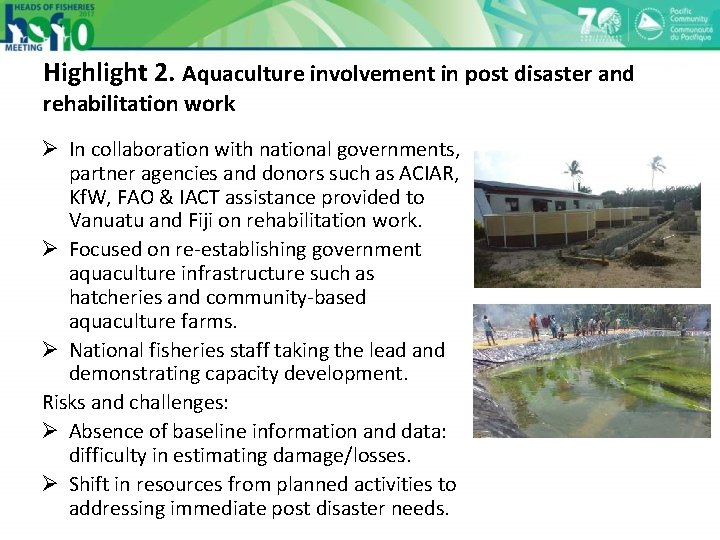
Highlight 2. Aquaculture involvement in post disaster and rehabilitation work Ø In collaboration with national governments, partner agencies and donors such as ACIAR, Kf. W, FAO & IACT assistance provided to Vanuatu and Fiji on rehabilitation work. Ø Focused on re-establishing government aquaculture infrastructure such as hatcheries and community-based aquaculture farms. Ø National fisheries staff taking the lead and demonstrating capacity development. Risks and challenges: Ø Absence of baseline information and data: difficulty in estimating damage/losses. Ø Shift in resources from planned activities to addressing immediate post disaster needs.
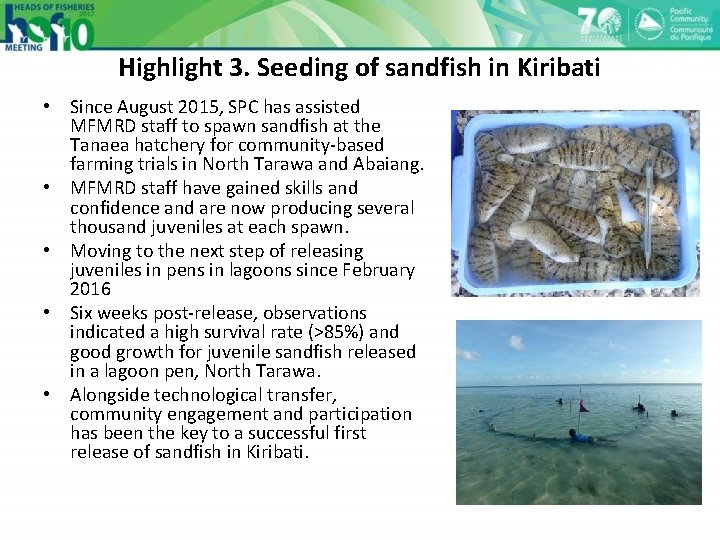
Highlight 3. Seeding of sandfish in Kiribati • Since August 2015, SPC has assisted MFMRD staff to spawn sandfish at the Tanaea hatchery for community-based farming trials in North Tarawa and Abaiang. • MFMRD staff have gained skills and confidence and are now producing several thousand juveniles at each spawn. • Moving to the next step of releasing juveniles in pens in lagoons since February 2016 • Six weeks post-release, observations indicated a high survival rate (>85%) and good growth for juvenile sandfish released in a lagoon pen, North Tarawa. • Alongside technological transfer, community engagement and participation has been the key to a successful first release of sandfish in Kiribati.
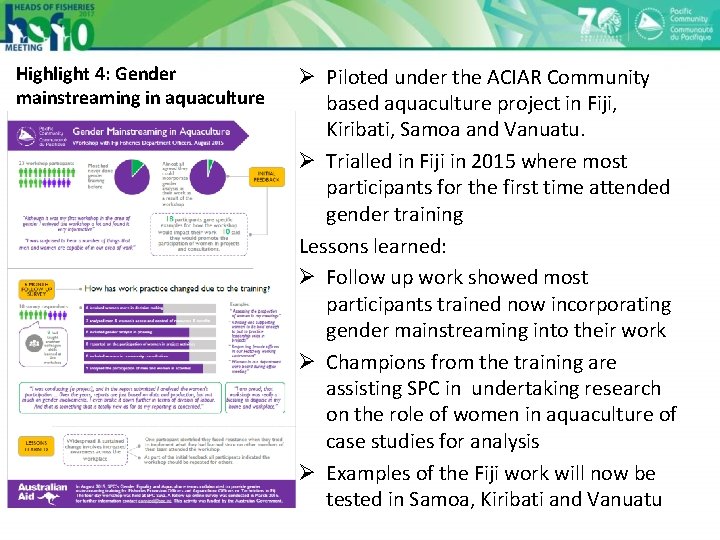
Highlight 4: Gender mainstreaming in aquaculture Ø Piloted under the ACIAR Community based aquaculture project in Fiji, Kiribati, Samoa and Vanuatu. Ø Trialled in Fiji in 2015 where most participants for the first time attended gender training Lessons learned: Ø Follow up work showed most participants trained now incorporating gender mainstreaming into their work Ø Champions from the training are assisting SPC in undertaking research on the role of women in aquaculture of case studies for analysis Ø Examples of the Fiji work will now be tested in Samoa, Kiribati and Vanuatu
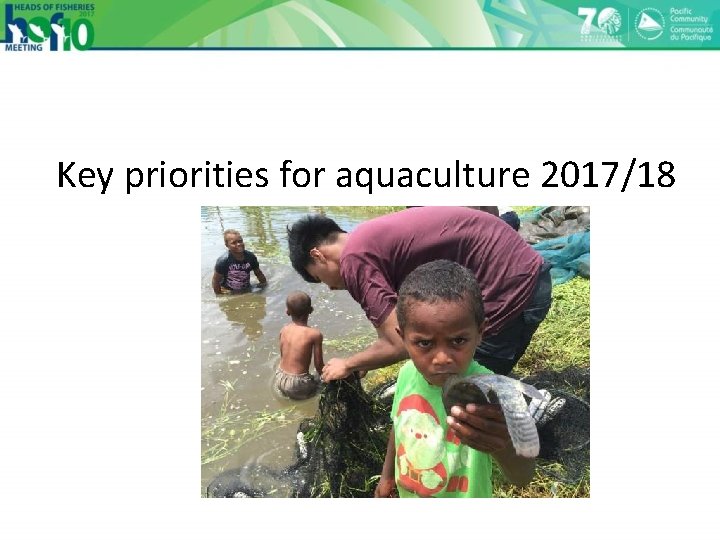
Key priorities for aquaculture 2017/18
Improved regional and national capacity for aquaculture policy, planning • Strengthening areas of aquaculture policy such as national aquaculture development plans, aquaculture legislation and MCS……. MFAT projects. • Develop code of practice for aquaculture- trialling out by focusing on national specific as case study for a harmonised regional code of practice. • Strengthening aquaculture planning through risk assessment and business investment planning…. . in collaboration with FAO. • Provide opportunities for short-term national training attachments.
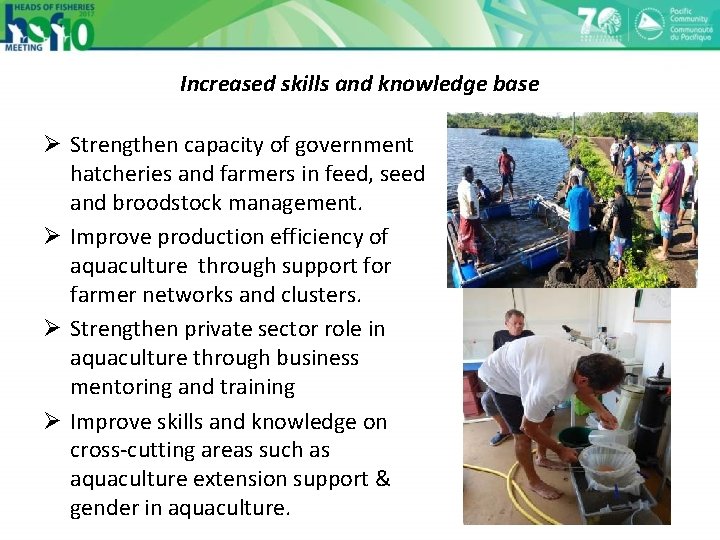
Increased skills and knowledge base Ø Strengthen capacity of government hatcheries and farmers in feed, seed and broodstock management. Ø Improve production efficiency of aquaculture through support for farmer networks and clusters. Ø Strengthen private sector role in aquaculture through business mentoring and training Ø Improve skills and knowledge on cross-cutting areas such as aquaculture extension support & gender in aquaculture.
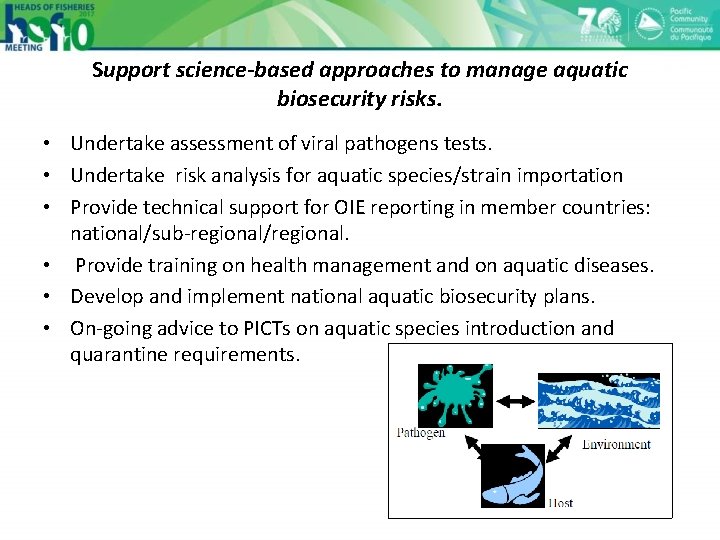
Support science-based approaches to manage aquatic biosecurity risks. • Undertake assessment of viral pathogens tests. • Undertake risk analysis for aquatic species/strain importation • Provide technical support for OIE reporting in member countries: national/sub-regional/regional. • Provide training on health management and on aquatic diseases. • Develop and implement national aquatic biosecurity plans. • On-going advice to PICTs on aquatic species introduction and quarantine requirements.
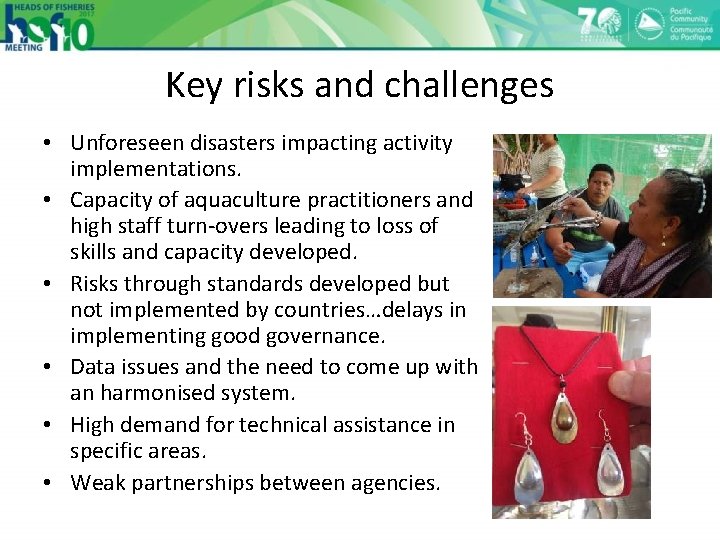
Key risks and challenges • Unforeseen disasters impacting activity implementations. • Capacity of aquaculture practitioners and high staff turn-overs leading to loss of skills and capacity developed. • Risks through standards developed but not implemented by countries…delays in implementing good governance. • Data issues and the need to come up with an harmonised system. • High demand for technical assistance in specific areas. • Weak partnerships between agencies.
Nearshore Fisheries Development Seya Brighton, Administration Assistant/NFDS William Sokimi, Fisheries Development Officer Dr Philip James, Fisheries Economist Michel Blanc, Fisheries Development Adviser
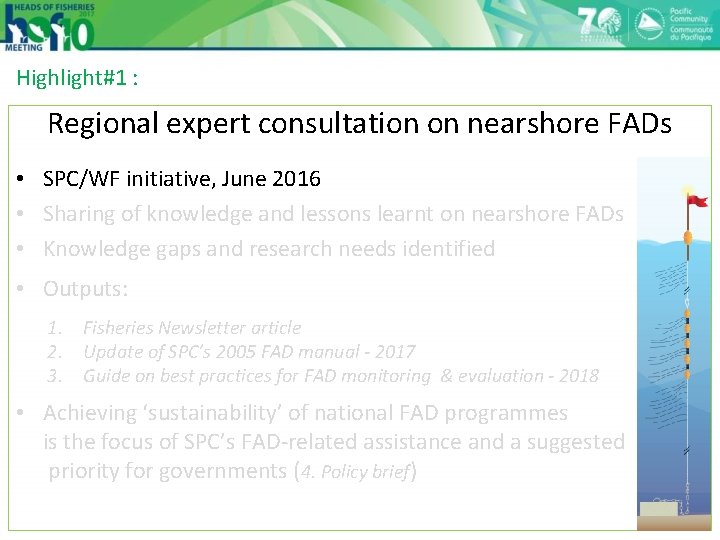
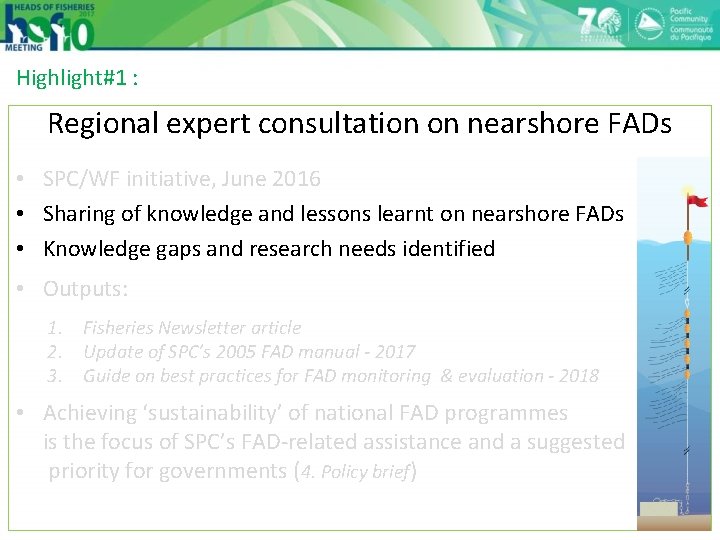
Highlight#1 : Regional expert consultation on nearshore FADs. • SPC/WF initiative, June 2016 • Sharing of knowledge and lessons learnt on nearshore FADs • Knowledge gaps and research needs identified • Outputs: 1. Fisheries Newsletter article 2. Update of SPC’s 2005 FAD manual - 2017 3. Guide on best practices for FAD monitoring & evaluation - 2018 • Achieving ‘sustainability’ of national FAD programmes is the focus of SPC’s FAD-related assistance and a suggested priority for governments (4. Policy brief)
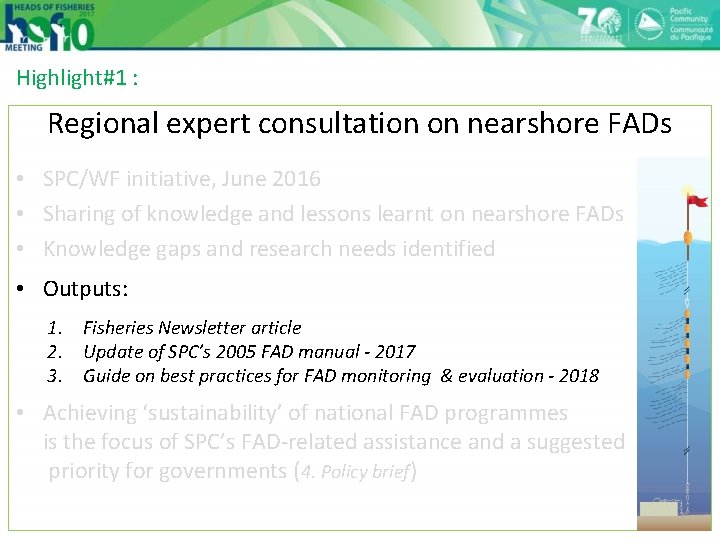
Highlight#1 : Regional expert consultation on nearshore FADs. • SPC/WF initiative, June 2016 • Sharing of knowledge and lessons learnt on nearshore FADs • Knowledge gaps and research needs identified • Outputs: 1. Fisheries Newsletter article 2. Update of SPC’s 2005 FAD manual - 2017 3. Guide on best practices for FAD monitoring & evaluation - 2018 • Achieving ‘sustainability’ of national FAD programmes is the focus of SPC’s FAD-related assistance and a suggested priority for governments (4. Policy brief)
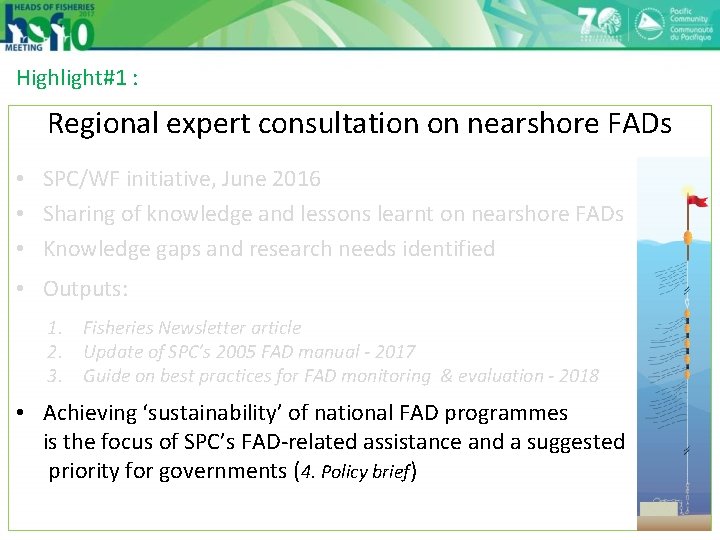
Highlight#1 : Regional expert consultation on nearshore FADs. • SPC/WF initiative, June 2016 • Sharing of knowledge and lessons learnt on nearshore FADs • Knowledge gaps and research needs identified • Outputs: 1. Fisheries Newsletter article 2. Update of SPC’s 2005 FAD manual - 2017 3. Guide on best practices for FAD monitoring & evaluation - 2018 • Achieving ‘sustainability’ of national FAD programmes is the focus of SPC’s FAD-related assistance and a suggested priority for governments (4. Policy brief)
Highlight#1 : Regional expert consultation on nearshore FADs. • SPC/WF initiative, June 2016 • Sharing of knowledge and lessons learnt on nearshore FADs • Knowledge gaps and research needs identified • Outputs: 1. Fisheries Newsletter article 2. Update of SPC’s 2005 FAD manual - 2017 3. Guide on best practices for FAD monitoring & evaluation - 2018 • Achieving ‘sustainability’ of national FAD programmes is the focus of SPC’s FAD-related assistance and a suggested priority for governments (4. Policy brief)
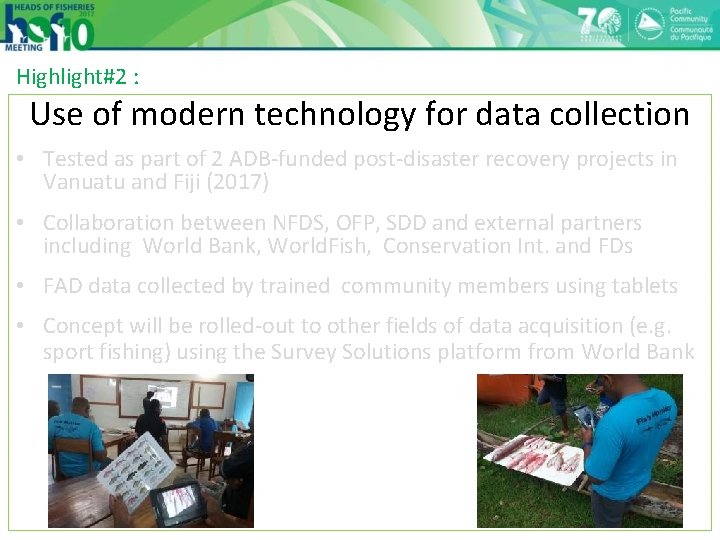
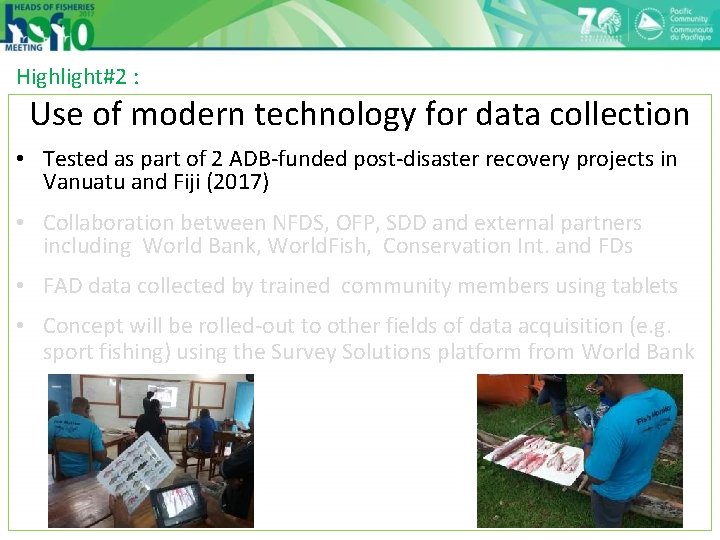
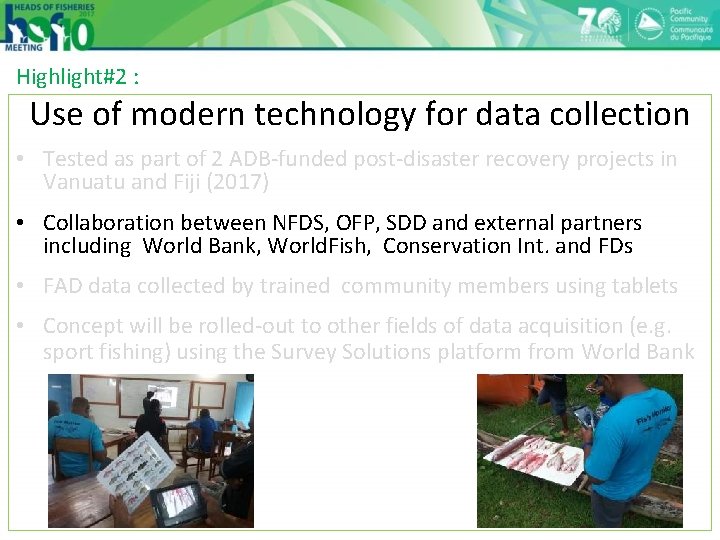
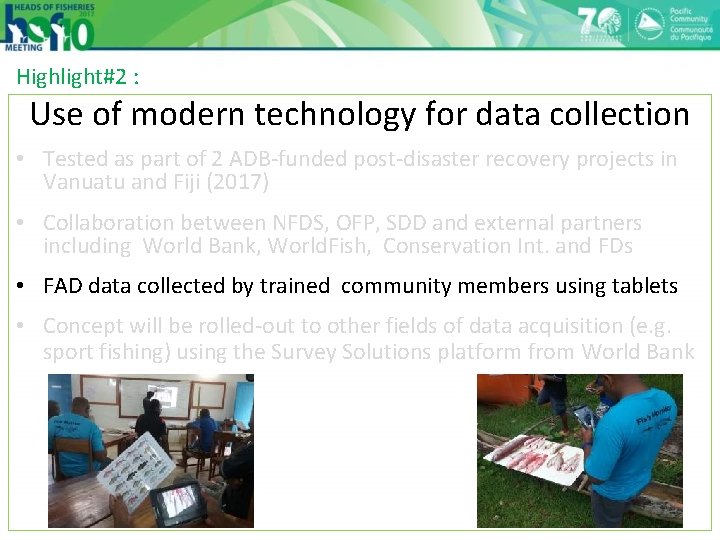
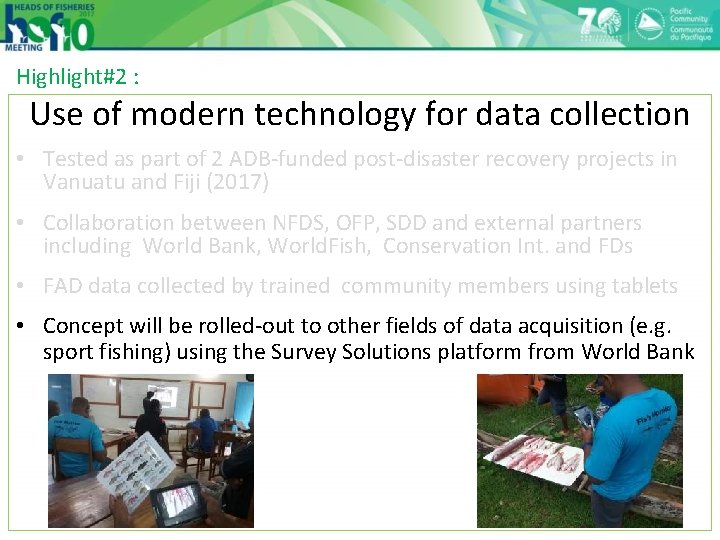
Highlight#2 : Use of modern technology for data collection • Tested as part of 2 ADB-funded post-disaster recovery projects in Vanuatu and Fiji (2017) • Collaboration between NFDS, OFP, SDD and external partners including World Bank, World. Fish, Conservation Int. and FDs • FAD data collected by trained community members using tablets • Concept will be rolled-out to other fields of data acquisition (e. g. sport fishing) using the Survey Solutions platform from World Bank
Highlight#2 : Use of modern technology for data collection • Tested as part of 2 ADB-funded post-disaster recovery projects in Vanuatu and Fiji (2017) • Collaboration between NFDS, OFP, SDD and external partners including World Bank, World. Fish, Conservation Int. and FDs • FAD data collected by trained community members using tablets • Concept will be rolled-out to other fields of data acquisition (e. g. sport fishing) using the Survey Solutions platform from World Bank
Highlight#2 : Use of modern technology for data collection • Tested as part of 2 ADB-funded post-disaster recovery projects in Vanuatu and Fiji (2017) • Collaboration between NFDS, OFP, SDD and external partners including World Bank, World. Fish, Conservation Int. and FDs • FAD data collected by trained community members using tablets • Concept will be rolled-out to other fields of data acquisition (e. g. sport fishing) using the Survey Solutions platform from World Bank
Highlight#2 : Use of modern technology for data collection • Tested as part of 2 ADB-funded post-disaster recovery projects in Vanuatu and Fiji (2017) • Collaboration between NFDS, OFP, SDD and external partners including World Bank, World. Fish, Conservation Int. and FDs • FAD data collected by trained community members using tablets • Concept will be rolled-out to other fields of data acquisition (e. g. sport fishing) using the Survey Solutions platform from World Bank
Highlight#2 : Use of modern technology for data collection • Tested as part of 2 ADB-funded post-disaster recovery projects in Vanuatu and Fiji (2017) • Collaboration between NFDS, OFP, SDD and external partners including World Bank, World. Fish, Conservation Int. and FDs • FAD data collected by trained community members using tablets • Concept will be rolled-out to other fields of data acquisition (e. g. sport fishing) using the Survey Solutions platform from World Bank
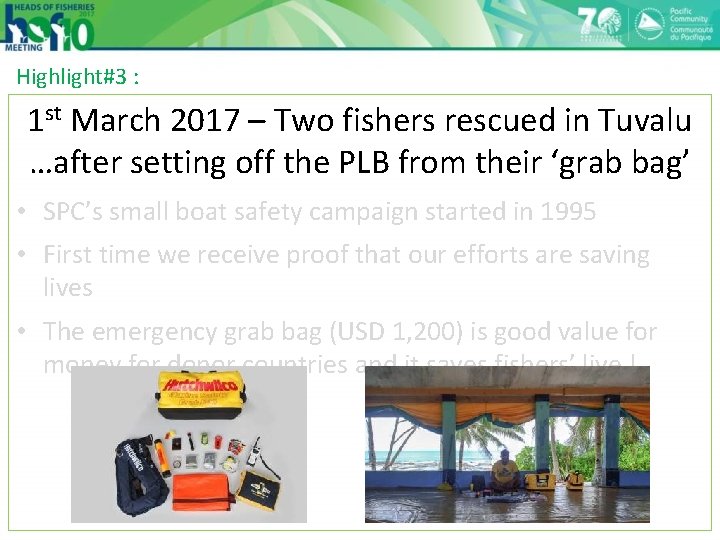
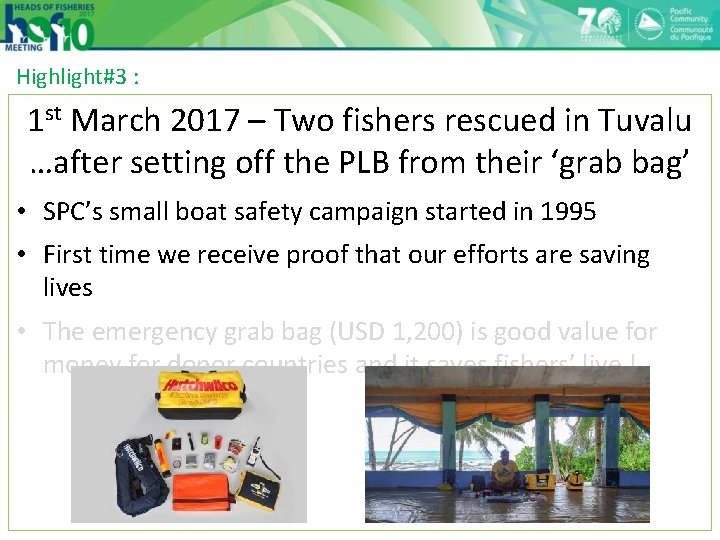
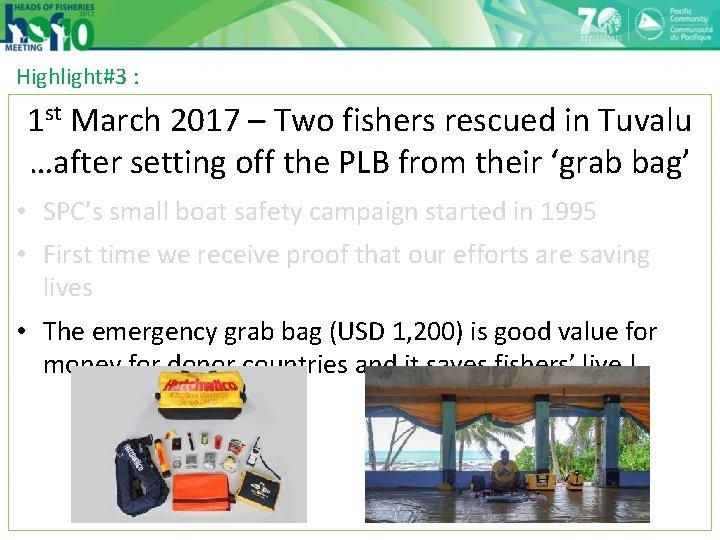
Highlight#3 : 1 st March 2017 – Two fishers rescued in Tuvalu …after setting off the PLB from their ‘grab bag’ • SPC’s small boat safety campaign started in 1995 • First time we receive proof that our efforts are saving lives • The emergency grab bag (USD 1, 200) is good value for money for donor countries and it saves fishers’ live !
Highlight#3 : 1 st March 2017 – Two fishers rescued in Tuvalu …after setting off the PLB from their ‘grab bag’ • SPC’s small boat safety campaign started in 1995 • First time we receive proof that our efforts are saving lives • The emergency grab bag (USD 1, 200) is good value for money for donor countries and it saves fishers’ live !
Highlight#3 : 1 st March 2017 – Two fishers rescued in Tuvalu …after setting off the PLB from their ‘grab bag’ • SPC’s small boat safety campaign started in 1995 • First time we receive proof that our efforts are saving lives • The emergency grab bag (USD 1, 200) is good value for money for donor countries and it saves fishers’ live !
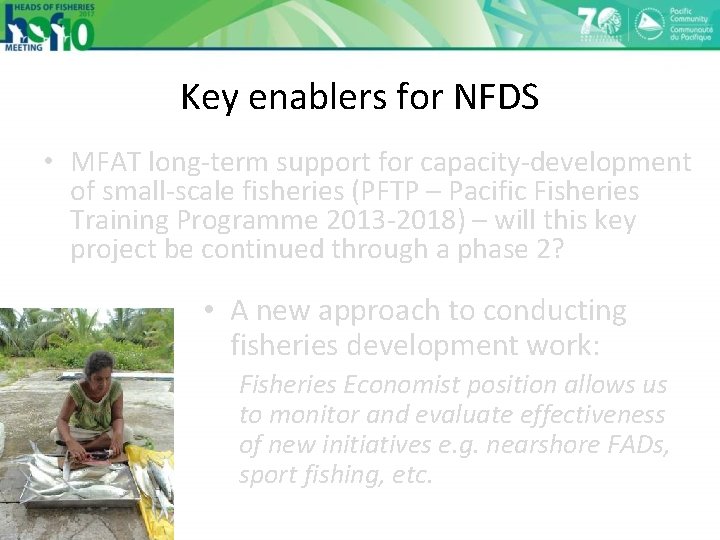
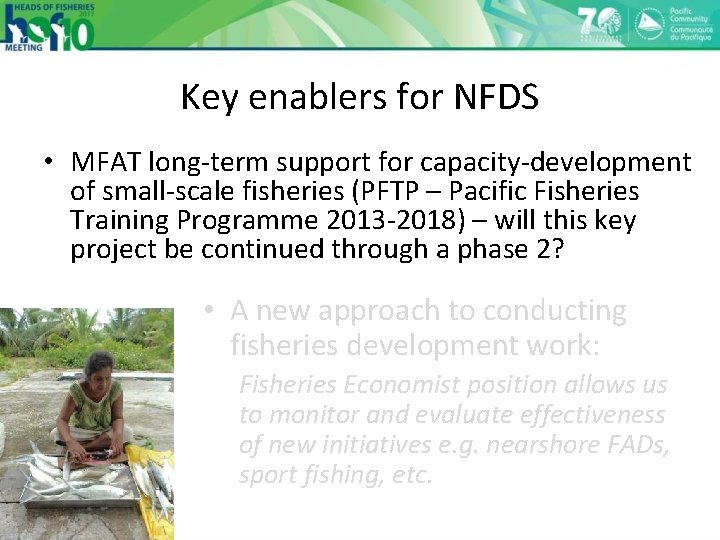
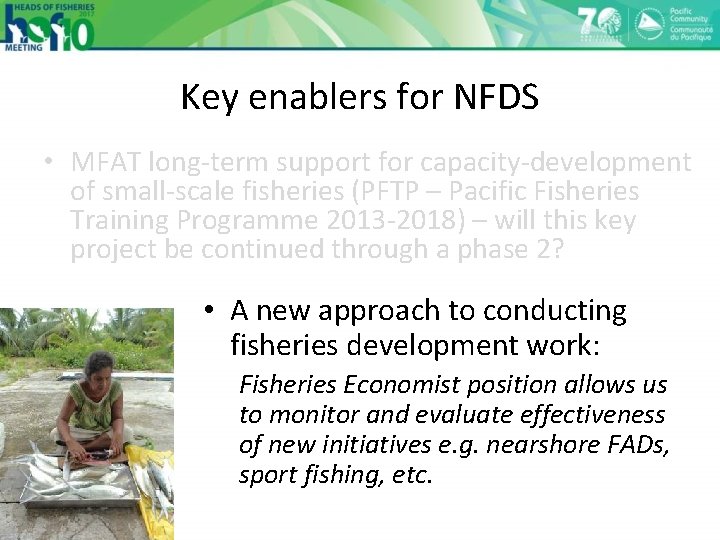
Key enablers for NFDS • MFAT long-term support for capacity-development of small-scale fisheries (PFTP – Pacific Fisheries Training Programme 2013 -2018) – will this key project be continued through a phase 2? • A new approach to conducting fisheries development work: Fisheries Economist position allows us to monitor and evaluate effectiveness of new initiatives e. g. nearshore FADs, sport fishing, etc.
Key enablers for NFDS • MFAT long-term support for capacity-development of small-scale fisheries (PFTP – Pacific Fisheries Training Programme 2013 -2018) – will this key project be continued through a phase 2? • A new approach to conducting fisheries development work: Fisheries Economist position allows us to monitor and evaluate effectiveness of new initiatives e. g. nearshore FADs, sport fishing, etc.
Key enablers for NFDS • MFAT long-term support for capacity-development of small-scale fisheries (PFTP – Pacific Fisheries Training Programme 2013 -2018) – will this key project be continued through a phase 2? • A new approach to conducting fisheries development work: Fisheries Economist position allows us to monitor and evaluate effectiveness of new initiatives e. g. nearshore FADs, sport fishing, etc.
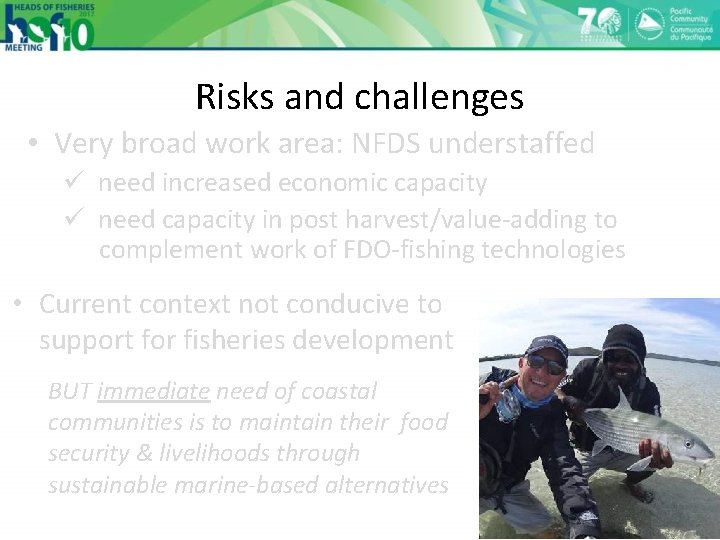
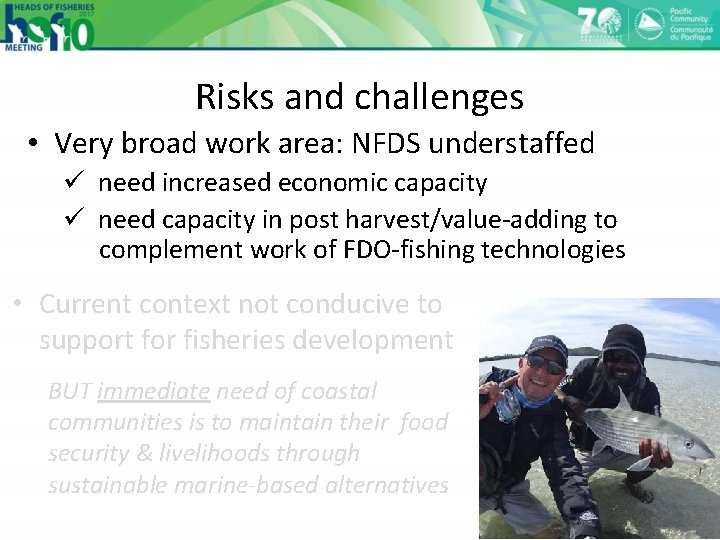
Risks and challenges • Very broad work area: NFDS understaffed ü need increased economic capacity ü need capacity in post harvest/value-adding to complement work of FDO-fishing technologies • Current context not conducive to support for fisheries development BUT immediate need of coastal communities is to maintain their food security & livelihoods through sustainable marine-based alternatives
Risks and challenges • Very broad work area: NFDS understaffed ü need increased economic capacity ü need capacity in post harvest/value-adding to complement work of FDO-fishing technologies • Current context not conducive to support for fisheries development BUT immediate need of coastal communities is to maintain their food security & livelihoods through sustainable marine-based alternatives
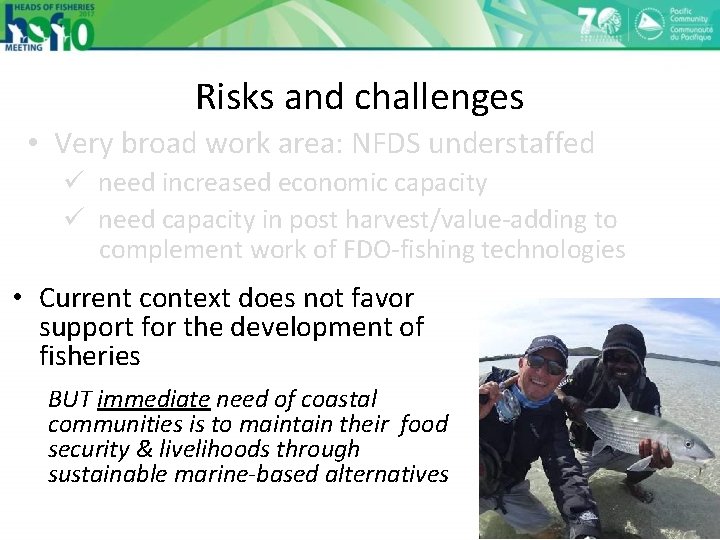
Risks and challenges • Very broad work area: NFDS understaffed ü need increased economic capacity ü need capacity in post harvest/value-adding to complement work of FDO-fishing technologies • Current context does not favor support for the development of fisheries BUT immediate need of coastal communities is to maintain their food security & livelihoods through sustainable marine-based alternatives
Thank you for your attention The CFP team welcomes your comments and questions