
Coastal Field Data Collection Program New coastal knowledge
- Slides: 7
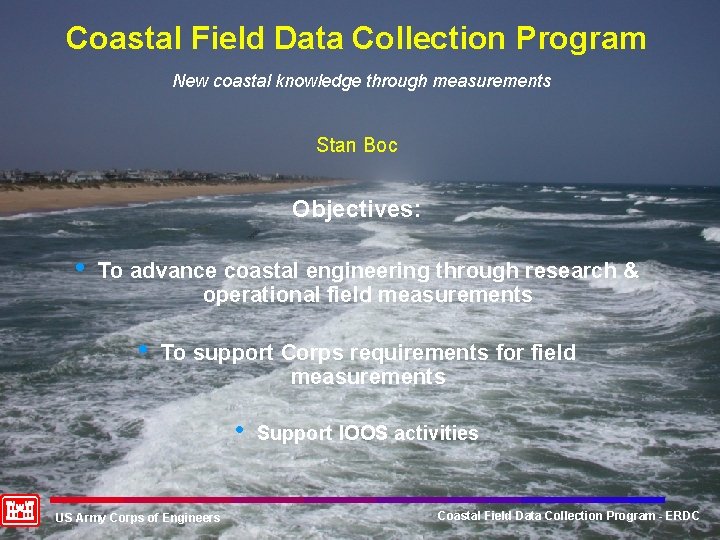
Coastal Field Data Collection Program New coastal knowledge through measurements Stan Boc Objectives: • To advance coastal engineering through research & operational field measurements • To support Corps requirements for field measurements • USUS Army Corps of of Engineers Support IOOS activities Coastal Field Data Collection Program - ERDC
CFDC Program: Coordination • Coordinated Effort to Develop/Implement a National Waves Program that responds to COE requirements • Real-Time Observations • Hindcasts (Great Lakes, Atlantic, Gulf, Pacific) • Forecasts • Integrated Program of Work Units • FWG/FRF – wave measurements (Supports WIS, COE, others) • WIS – hindcast historic wave data requires FWG/FRF measurements • FWG (CDIP)– example wave forecasts, southern CA • FRF – full range of long-term observations, test site • SCBPS/PILOT – integrate wave obs, modeling, beach response • Part of National Ocean Observing Effort US Army Corps of Engineers Coastal Field Data Collection Program - ERDC
National Ocean Observing Program • Major effort underway for Global Ocean Observing System (GOOS) • National Integrated Ocean Observing System (IOOS) • National Ocean Partnership Program (NOPP) leading effort – COE & 13 agencies involved • USACE is signature member of Ocean. US • Funded through Agency Budget Processes US Army Corps of Engineers Coastal Field Data Collection Program - ERDC
USACE Observing Goals • Expand Field Wave Gauging program • Internally and through partnerships; sites of opportunity • • • Respond to field observation needs of RSM Support District Needs for data USACE benefits by Ocean. US participation: • • • leverage the Corps program for more observations Identify and fill gaps Standardized data distribution/processing Access to more data types (other than waves) Concentrate on our interests (waves, currents, water levels) US Army Corps of Engineers Coastal Field Data Collection Program - ERDC
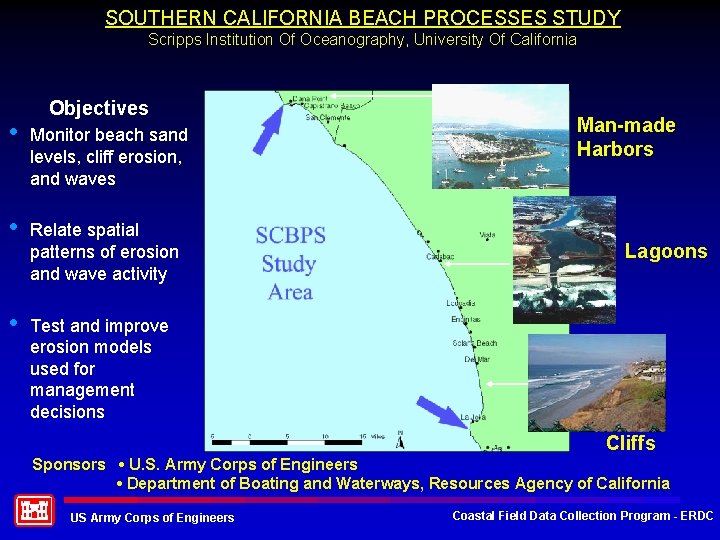
SOUTHERN CALIFORNIA BEACH PROCESSES STUDY Scripps Institution Of Oceanography, University Of California Objectives • Monitor beach sand levels, cliff erosion, and waves • Relate spatial patterns of erosion and wave activity • Test and improve erosion models used for management decisions Man-made Harbors Lagoons Cliffs Sponsors • U. S. Army Corps of Engineers • Department of Boating and Waterways, Resources Agency of California US Army Corps of Engineers Coastal Field Data Collection Program - ERDC
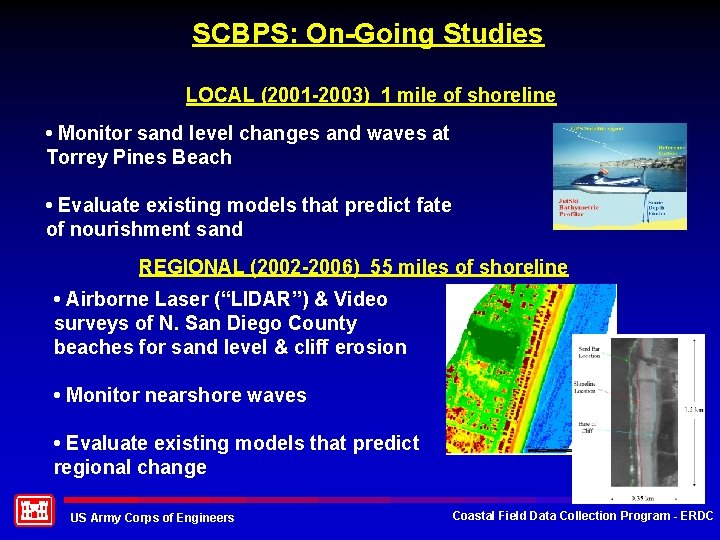
SCBPS: On-Going Studies LOCAL (2001 -2003) 1 mile of shoreline • Monitor sand level changes and waves at Torrey Pines Beach • Evaluate existing models that predict fate of nourishment sand REGIONAL (2002 -2006) 55 miles of shoreline • Airborne Laser (“LIDAR”) & Video surveys of N. San Diego County beaches for sand level & cliff erosion • Monitor nearshore waves • Evaluate existing models that predict regional change US Army Corps of Engineers Coastal Field Data Collection Program - ERDC
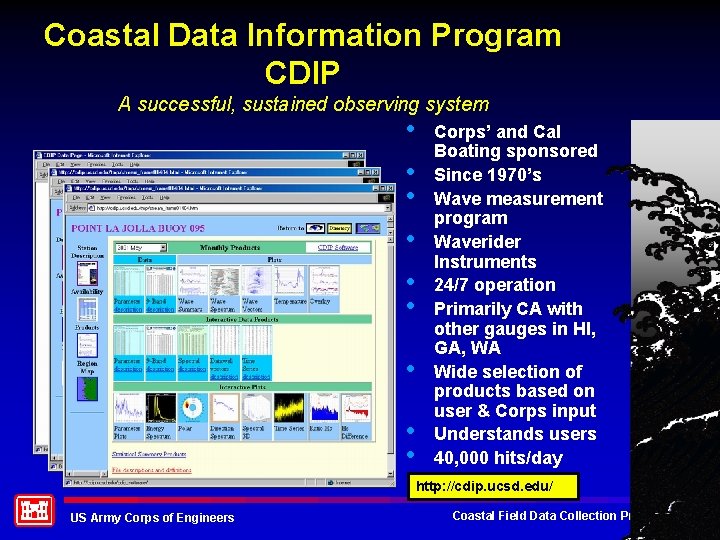
Coastal Data Information Program CDIP A successful, sustained observing system • • • Corps’ and Cal Boating sponsored Since 1970’s Wave measurement program Waverider Instruments 24/7 operation Primarily CA with other gauges in HI, GA, WA Wide selection of products based on user & Corps input Understands users 40, 000 hits/day http: //cdip. ucsd. edu/ US Army Corps of Engineers Coastal Field Data Collection Program - ERDC