
Coastal Ecosystem Valuation A Sequential Decision Support System
- Slides: 20
Coastal Ecosystem Valuation: A Sequential Decision Support System Tiziana Luisetti, R. Kerry Turner, Sian Morse-Jones, and Brendan Fisher CSERGE, School of Environmental Sciences, University of East Anglia ESRC Seminar Series - York 13 th January 2009
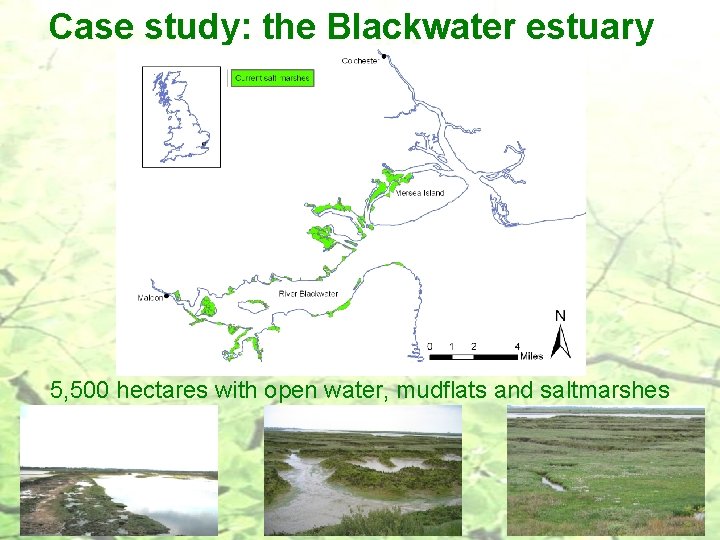
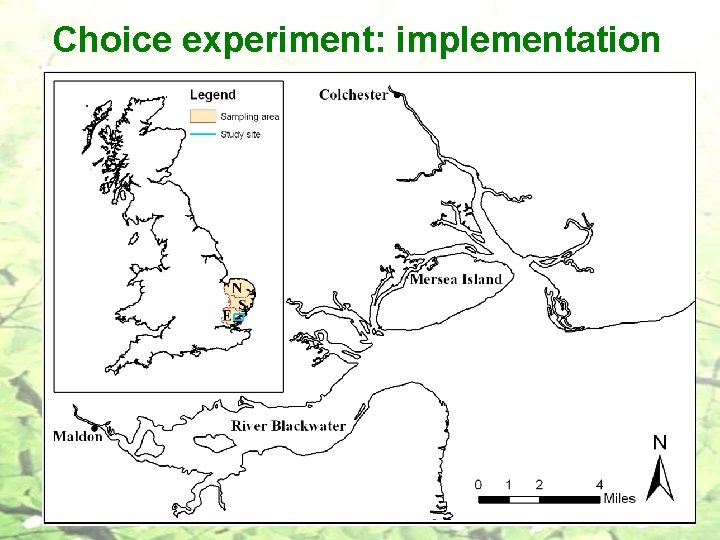
Case study: the Blackwater estuary 5, 500 hectares with open water, mudflats and saltmarshes
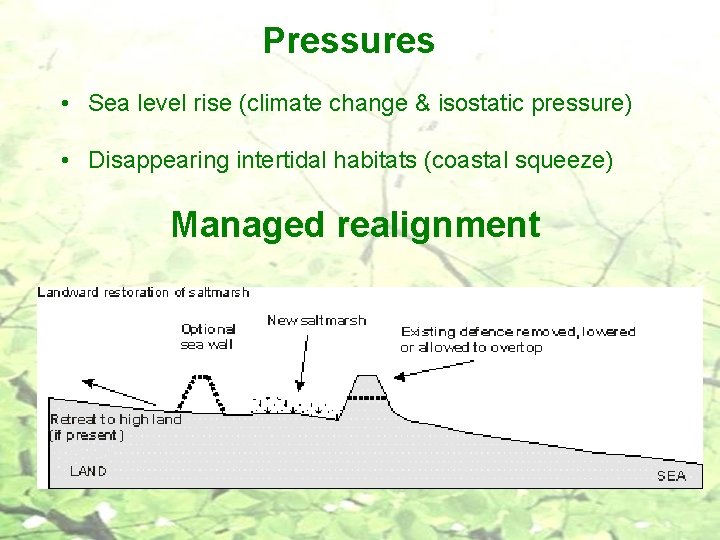
Pressures • Sea level rise (climate change & isostatic pressure) • Disappearing intertidal habitats (coastal squeeze) Managed realignment
Ecosystem services approach
Blackwater ecosystem services
Potential benefits and their valuation Ø Flood defence cost savings Ø Maintenance cost (km/yr) Ø Carbon storage Ø Damage cost avoided Ø Fisheries production Ø Market analysis Ø Amenity, recreation and biodiversity (composite environmental benefit) Ø Stated preference techniques (choice experiment)
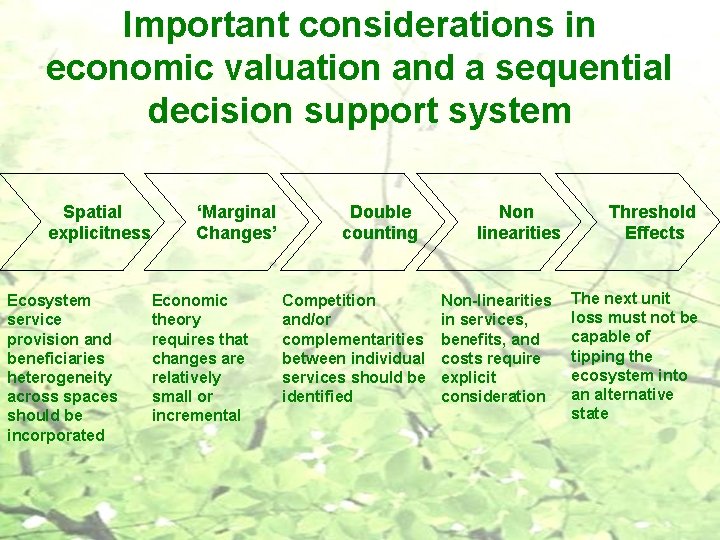
Important considerations in economic valuation and a sequential decision support system Spatial explicitness Ecosystem service provision and beneficiaries heterogeneity across spaces should be incorporated ‘Marginal Changes’ Economic theory requires that changes are relatively small or incremental Double counting Competition and/or complementarities between individual services should be identified Non linearities Non-linearities in services, benefits, and costs require explicit consideration Threshold Effects The next unit loss must not be capable of tipping the ecosystem into an alternative state
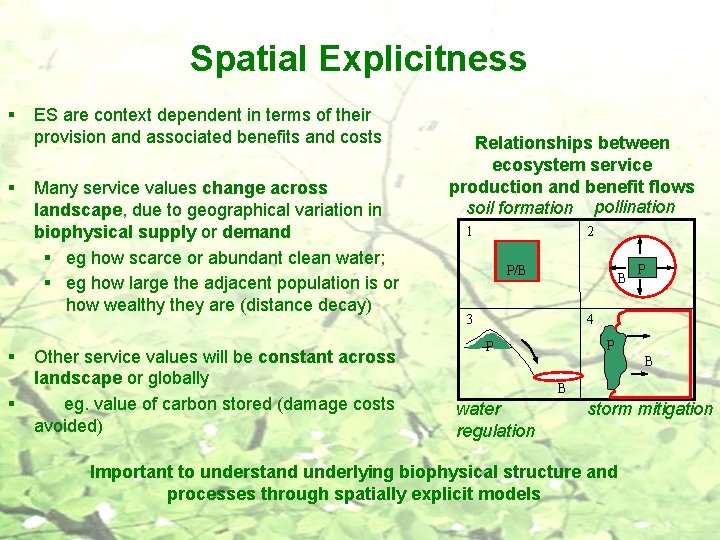
Spatial Explicitness § § ES are context dependent in terms of their provision and associated benefits and costs Many service values change across landscape, due to geographical variation in biophysical supply or demand § eg how scarce or abundant clean water; § eg how large the adjacent population is or how wealthy they are (distance decay) Other service values will be constant across landscape or globally eg. value of carbon stored (damage costs avoided) Relationships between ecosystem service production and benefit flows soil formation pollination 1 2 P/B B 3 P 4 P P B B water regulation storm mitigation Important to understand underlying biophysical structure and processes through spatially explicit models
Marginality Relatively small, incremental changes rather than large state changing impacts In practise can be confusing to apply - scientific uncertainty & thresholds Since ES cross scales (local, regional, global), it requires consideration of scale of policy decision Think about “next unit” in terms of geographic extent a policy decision could encompass (see Fisher et al) The Blackwater estuary provides ecosystem services across scales: § § § Local - flood protection; amenity and recreation Regional – fish production Global – carbon storage; biodiversity
Double counting Occurs where: • COMPETING services are valued separately AND the values aggregated; • Or, where an intermediate service is first valued separately, but ALSO subsequently through contribution to final service benefit Very few examples directly seek to address the DC issue: § Turner et al (2007): treat environmental benefits provided by creation of inter-tidal habitats as composite value i. e. nutrient storage function incorporated as an intermediate service to final benefit of enhanced amenity and recreational quality §The Blackwater case study (Luisetti et al 2008) use a composite value (composite environmental benefit) obtained with a specific on site value investigation
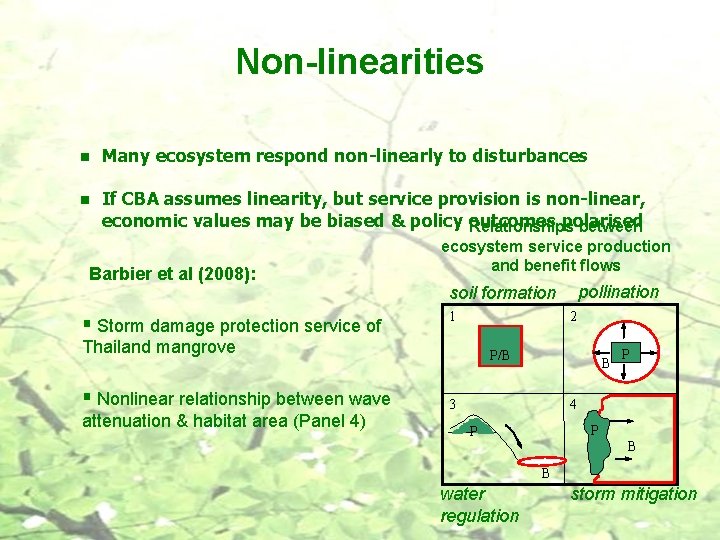
Non-linearities n Many ecosystem respond non-linearly to disturbances n If CBA assumes linearity, but service provision is non-linear, economic values may be biased & policy outcomes polarised Relationships between Barbier et al (2008): § Storm damage protection service of ecosystem service production and benefit flows 1 2 Thailand mangrove § Nonlinear relationship between wave attenuation & habitat area (Panel 4) pollination soil formation P/B B 3 P 4 P P B B water regulation storm mitigation
Threshold Effects § Threshold effects refer to the point at which an ecosystem may change abruptly into an alternative steady state § For marginality to hold, ‘next unit’ should not tip system over a threshold or safe minimum standard (SMS) § It is not always clear when the threshold is reached - requires expert input Often acknowledged in literature but rarely explicitly incorporated
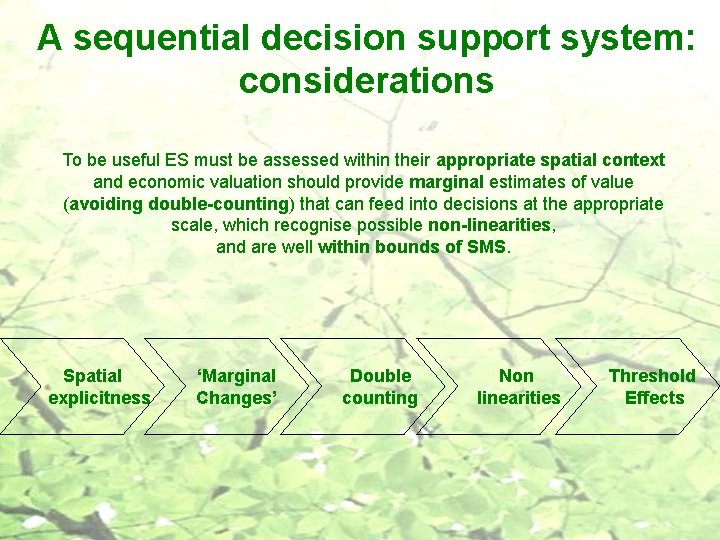
A sequential decision support system: considerations To be useful ES must be assessed within their appropriate spatial context and economic valuation should provide marginal estimates of value (avoiding double-counting) that can feed into decisions at the appropriate scale, which recognise possible non-linearities, and are well within bounds of SMS. Spatial explicitness ‘Marginal Changes’ Double counting Non linearities Threshold Effects
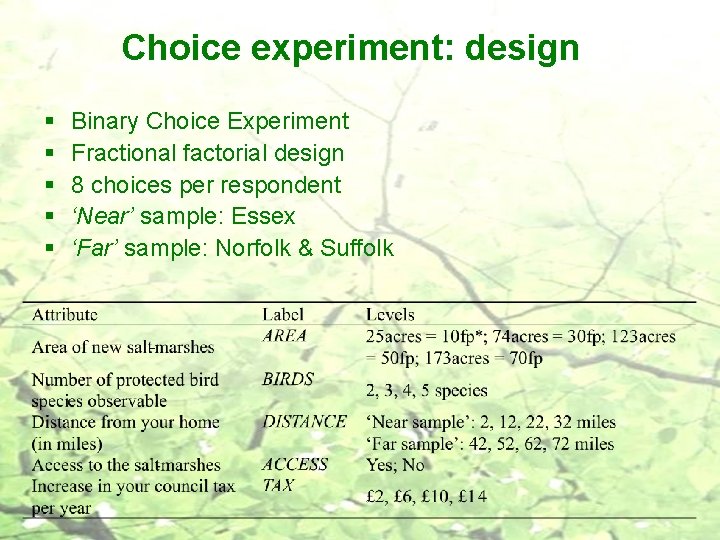
Choice experiment: design § § § Binary Choice Experiment Fractional factorial design 8 choices per respondent ‘Near’ sample: Essex ‘Far’ sample: Norfolk & Suffolk
Choice experiment: implementation
Choice experiment: implementation
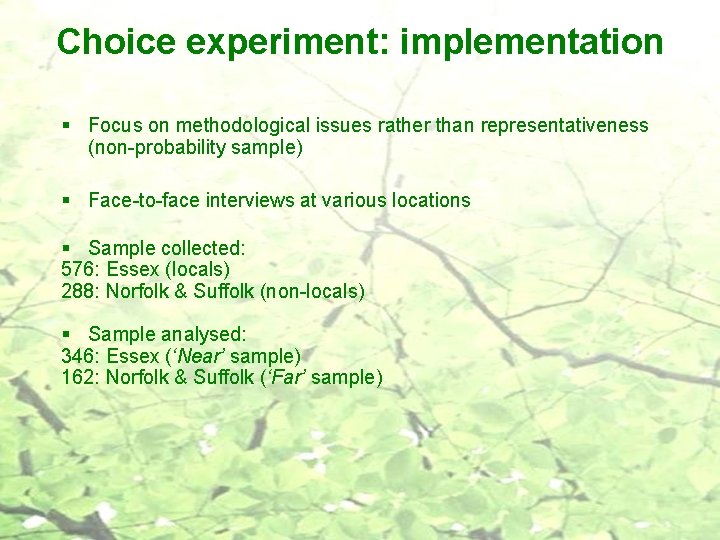
Choice experiment: implementation § Focus on methodological issues rather than representativeness (non-probability sample) § Face-to-face interviews at various locations § Sample collected: 576: Essex (locals) 288: Norfolk & Suffolk (non-locals) § Sample analysed: 346: Essex (‘Near’ sample) 162: Norfolk & Suffolk (‘Far’ sample)
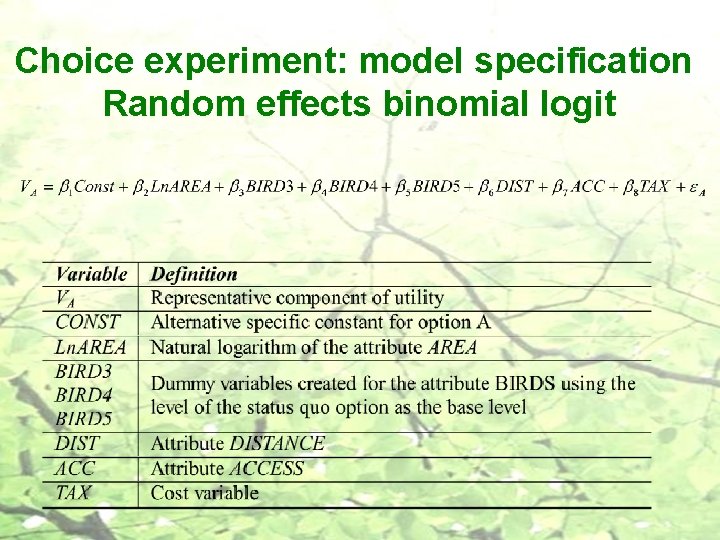
Choice experiment: model specification Random effects binomial logit
‘Near’ sample results
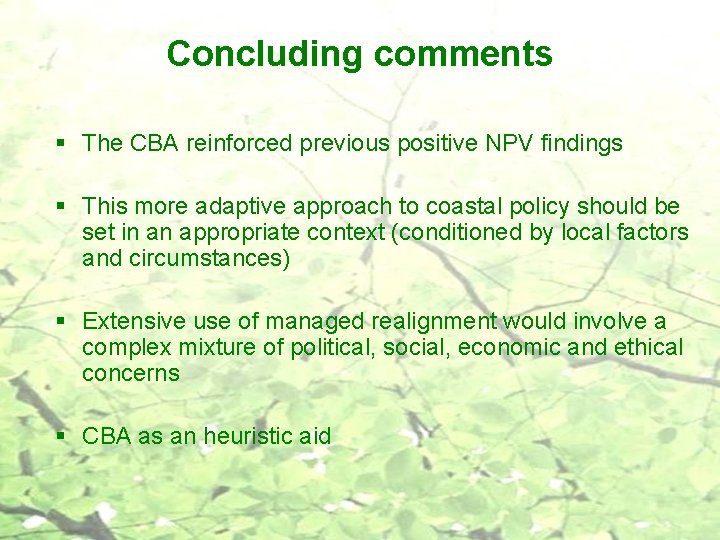
Concluding comments § The CBA reinforced previous positive NPV findings § This more adaptive approach to coastal policy should be set in an appropriate context (conditioned by local factors and circumstances) § Extensive use of managed realignment would involve a complex mixture of political, social, economic and ethical concerns § CBA as an heuristic aid