
Coast Salish Introduction to Design Elements Source Perpetual

- Slides: 14
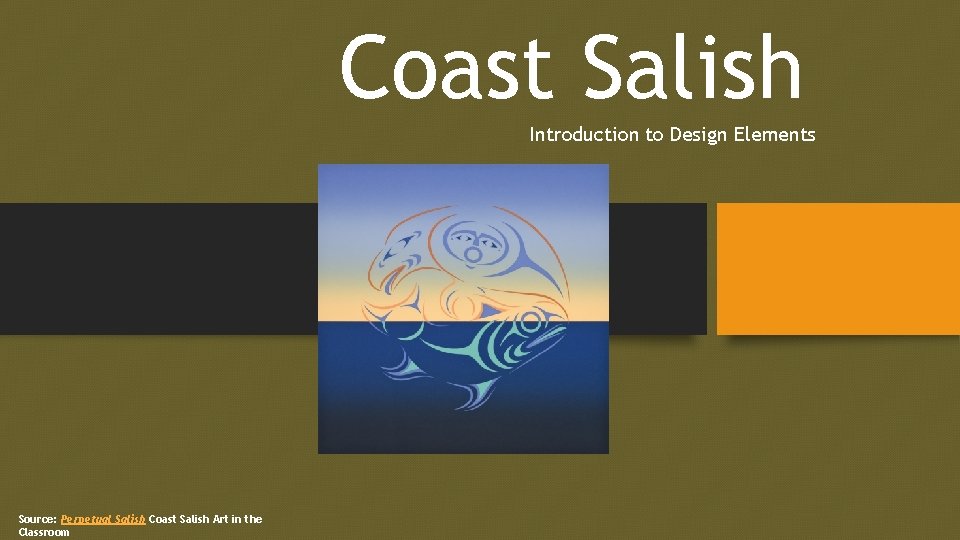
Coast Salish Introduction to Design Elements Source: Perpetual Salish Coast Salish Art in the Classroom
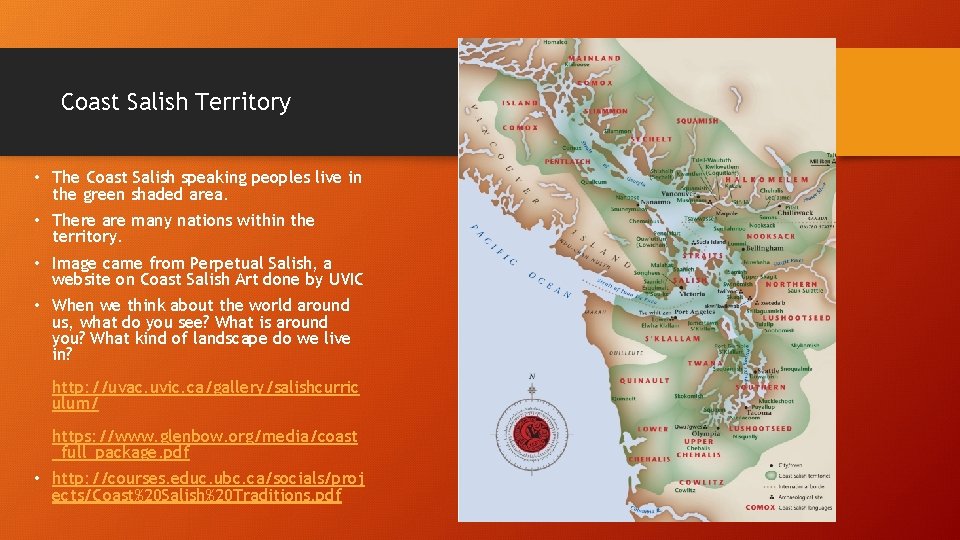
Coast Salish Territory • The Coast Salish speaking peoples live in the green shaded area. • There are many nations within the territory. • Image came from Perpetual Salish, a website on Coast Salish Art done by UVIC • When we think about the world around us, what do you see? What is around you? What kind of landscape do we live in? http: //uvac. uvic. ca/gallery/salishcurric ulum/ https: //www. glenbow. org/media/coast _full_package. pdf • http: //courses. educ. ubc. ca/socials/proj ects/Coast%20 Salish%20 Traditions. pdf
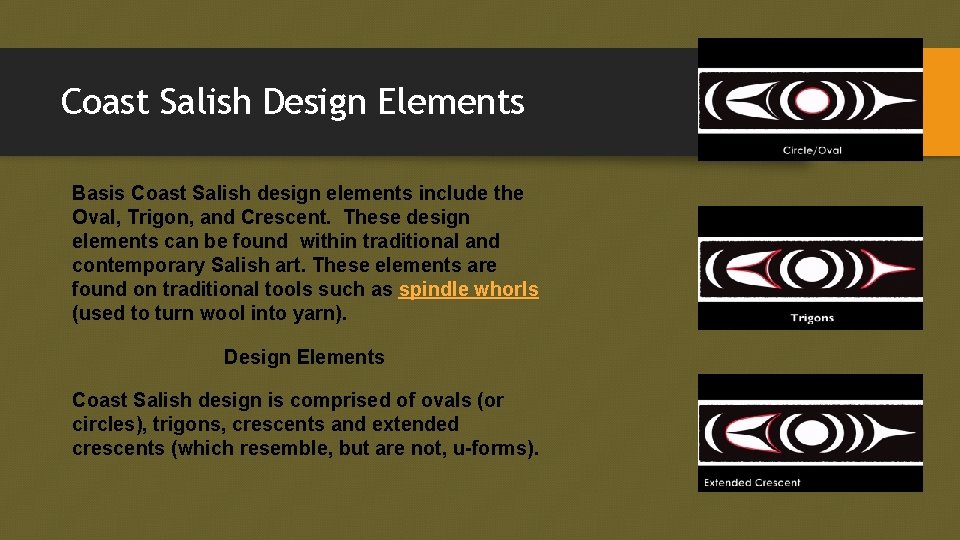
Coast Salish Design Elements Basis Coast Salish design elements include the Oval, Trigon, and Crescent. These design elements can be found within traditional and contemporary Salish art. These elements are found on traditional tools such as spindle whorls (used to turn wool into yarn). Design Elements Coast Salish design is comprised of ovals (or circles), trigons, crescents and extended crescents (which resemble, but are not, u-forms).
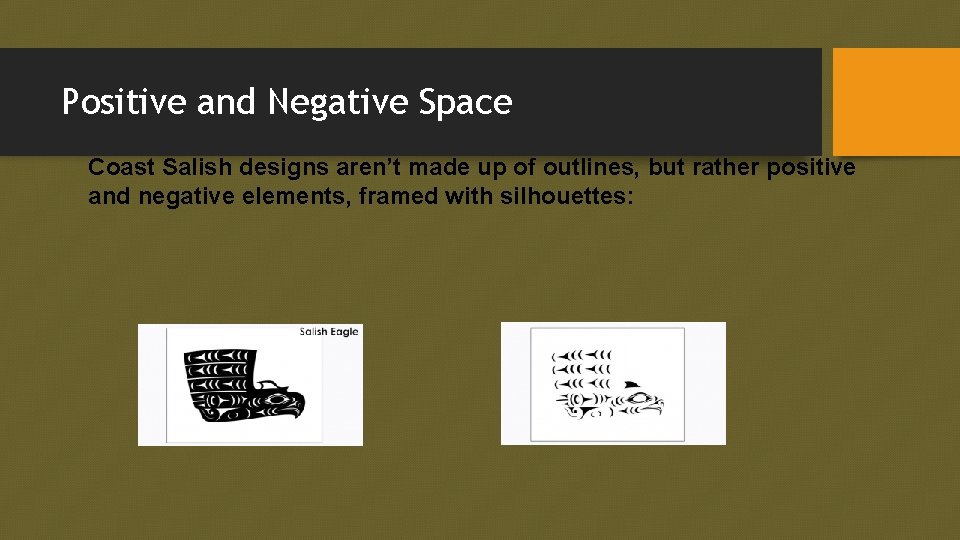
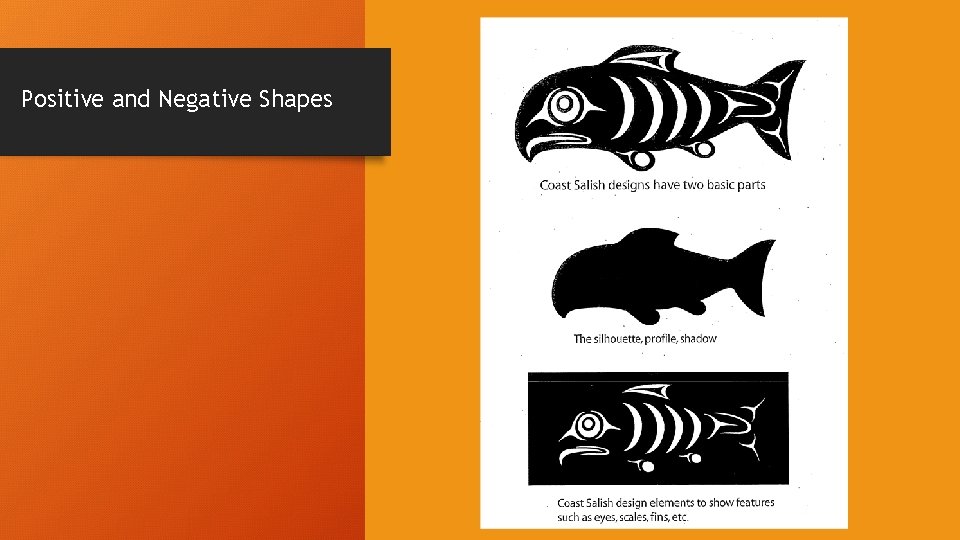
Positive and Negative Space Coast Salish designs aren’t made up of outlines, but rather positive and negative elements, framed with silhouettes:
Positive and Negative Shapes
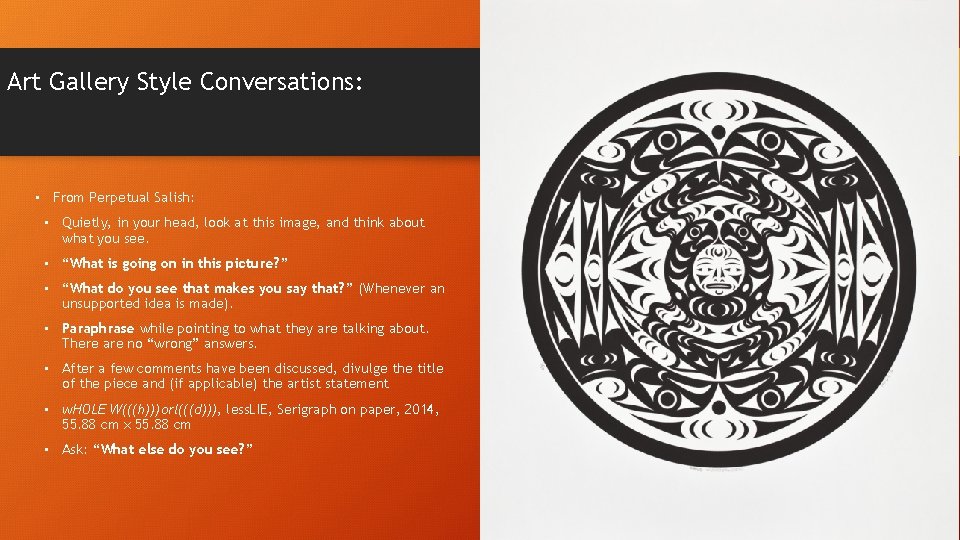
Art Gallery Style Conversations: • From Perpetual Salish: • Quietly, in your head, look at this image, and think about what you see. • “What is going on in this picture? ” • “What do you see that makes you say that? ” (Whenever an unsupported idea is made). • Paraphrase while pointing to what they are talking about. There are no “wrong” answers. • After a few comments have been discussed, divulge the title of the piece and (if applicable) the artist statement • w. HOLE W(((h)))orl(((d))), less. LIE, Serigraph on paper, 2014, 55. 88 cm x 55. 88 cm • Ask: “What else do you see? ”
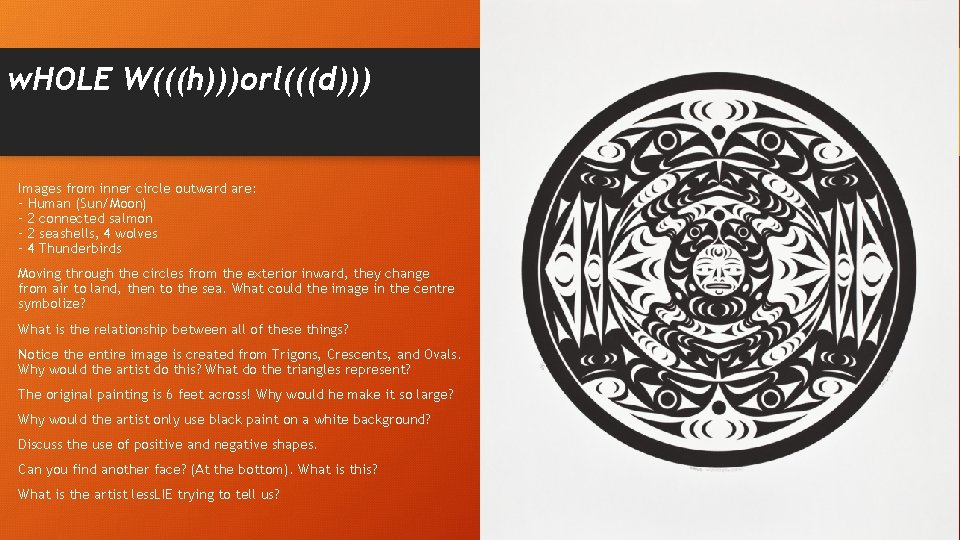
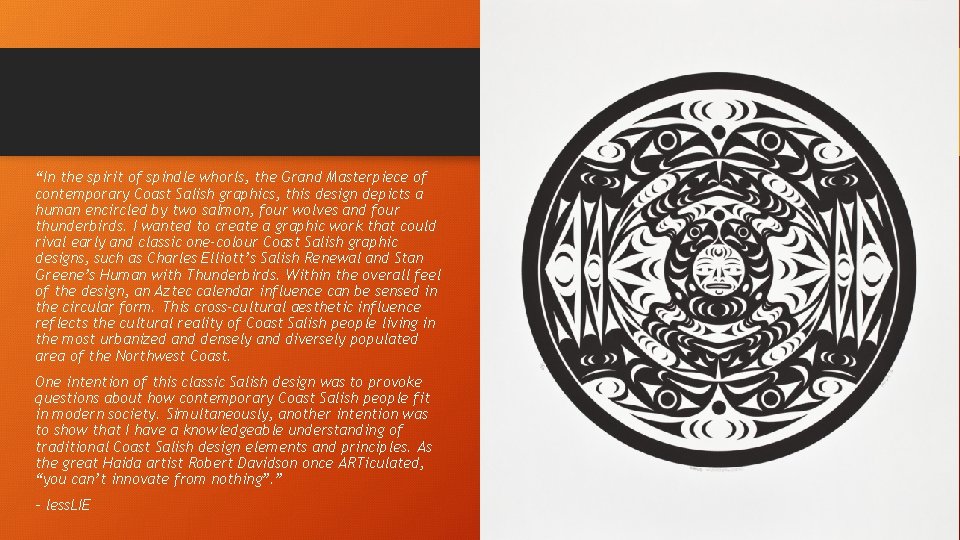
w. HOLE W(((h)))orl(((d))) Images from inner circle outward are: – Human (Sun/Moon) – 2 connected salmon – 2 seashells, 4 wolves – 4 Thunderbirds Moving through the circles from the exterior inward, they change from air to land, then to the sea. What could the image in the centre symbolize? What is the relationship between all of these things? Notice the entire image is created from Trigons, Crescents, and Ovals. Why would the artist do this? What do the triangles represent? The original painting is 6 feet across! Why would he make it so large? Why would the artist only use black paint on a white background? Discuss the use of positive and negative shapes. Can you find another face? (At the bottom). What is this? What is the artist less. LIE trying to tell us?
“In the spirit of spindle whorls, the Grand Masterpiece of contemporary Coast Salish graphics, this design depicts a human encircled by two salmon, four wolves and four thunderbirds. I wanted to create a graphic work that could rival early and classic one-colour Coast Salish graphic designs, such as Charles Elliott’s Salish Renewal and Stan Greene’s Human with Thunderbirds. Within the overall feel of the design, an Aztec calendar influence can be sensed in the circular form. This cross-cultural aesthetic influence reflects the cultural reality of Coast Salish people living in the most urbanized and densely and diversely populated area of the Northwest Coast. One intention of this classic Salish design was to provoke questions about how contemporary Coast Salish people fit in modern society. Simultaneously, another intention was to show that I have a knowledgeable understanding of traditional Coast Salish design elements and principles. As the great Haida artist Robert Davidson once ARTiculated, “you can’t innovate from nothing”. ” – less. LIE
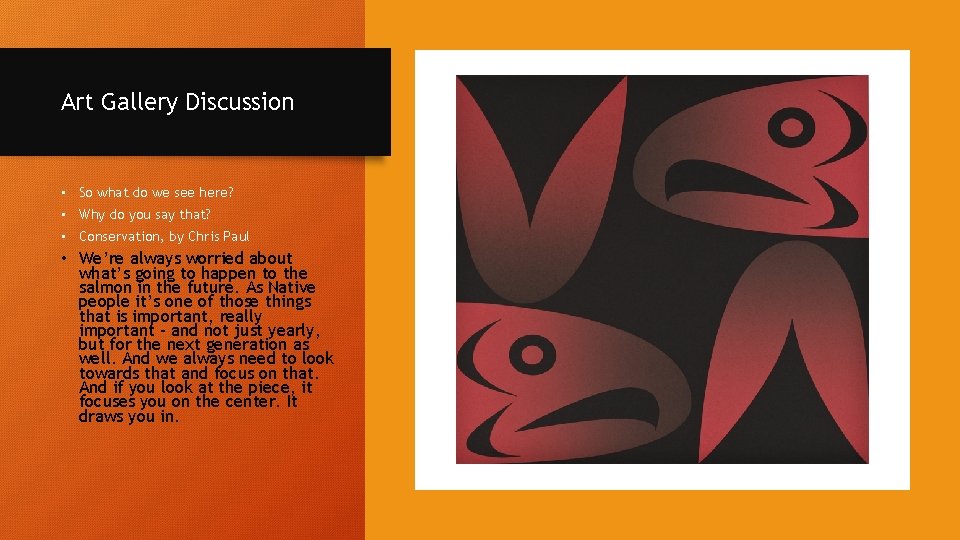
Art Gallery Discussion • So what do we see here? • Why do you say that? • Conservation, by Chris Paul • We’re always worried about what’s going to happen to the salmon in the future. As Native people it’s one of those things that is important, really important – and not just yearly, but for the next generation as well. And we always need to look towards that and focus on that. And if you look at the piece, it focuses you on the center. It draws you in.
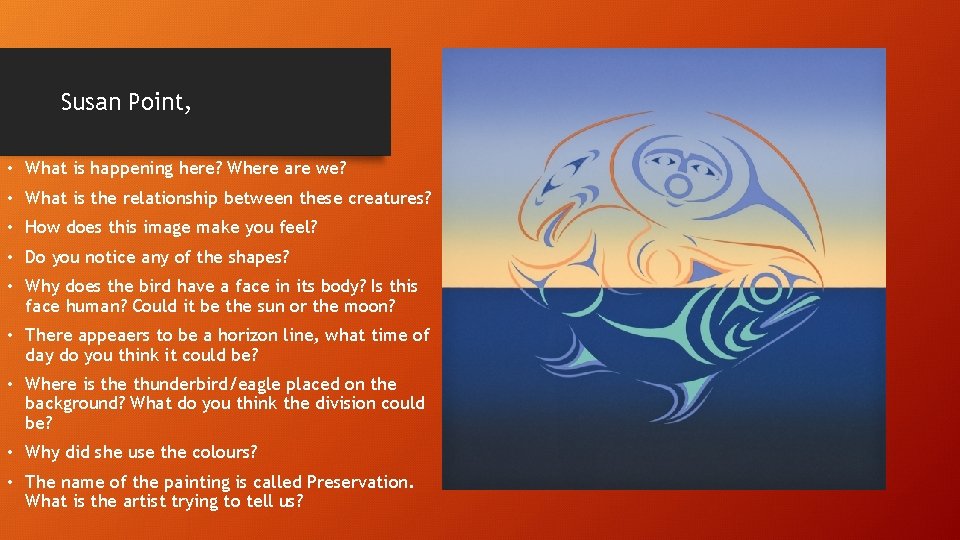
Susan Point, • What is happening here? Where are we? • What is the relationship between these creatures? • How does this image make you feel? • Do you notice any of the shapes? • Why does the bird have a face in its body? Is this face human? Could it be the sun or the moon? • There appeaers to be a horizon line, what time of day do you think it could be? • Where is the thunderbird/eagle placed on the background? What do you think the division could be? • Why did she use the colours? • The name of the painting is called Preservation. What is the artist trying to tell us?
Coast Salish Art Discussion • Do you see anything different? Preservation, Susan Point, Serigraph on paper, 1996, 80. 0 cm x 81. 28 cm
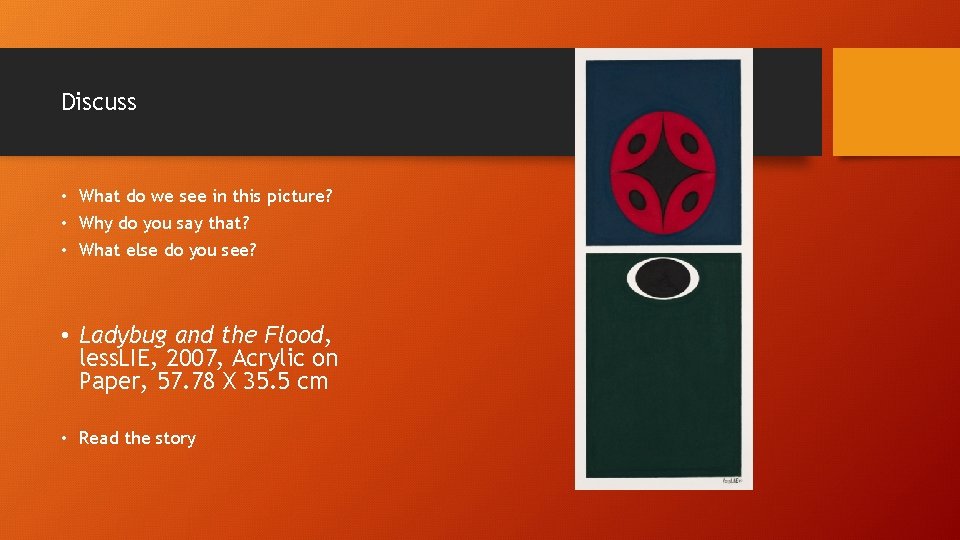
Discuss • What do we see in this picture? • Why do you say that? • What else do you see? • Ladybug and the Flood, less. LIE, 2007, Acrylic on Paper, 57. 78 X 35. 5 cm • Read the story
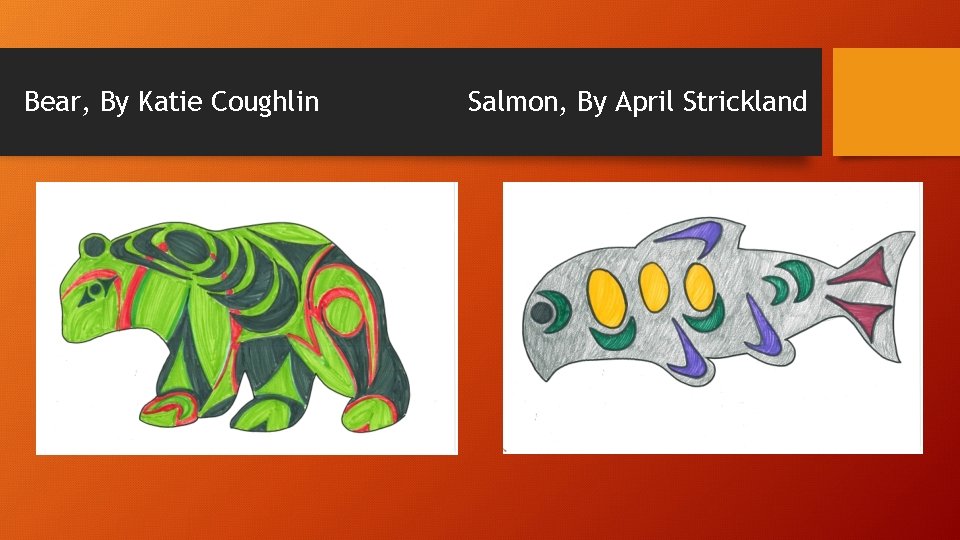
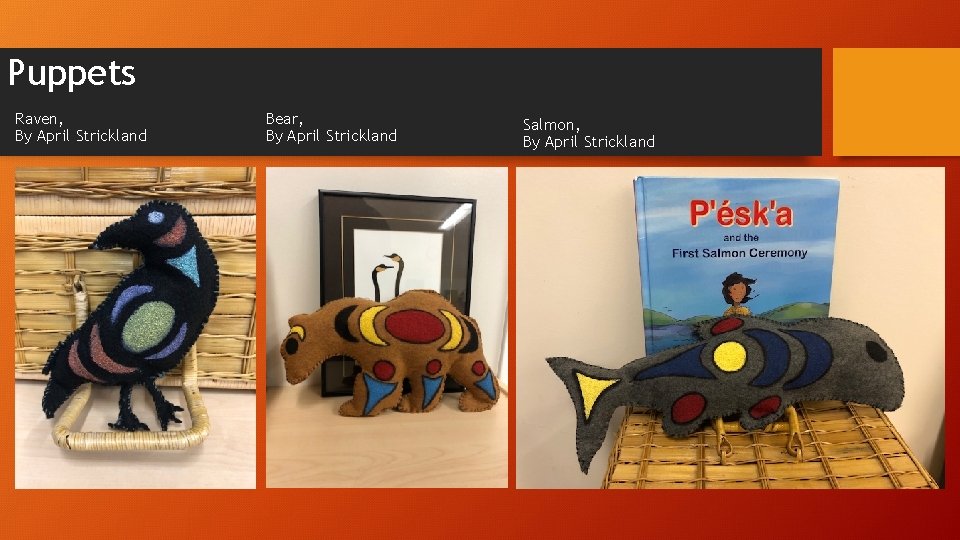
Bear, By Katie Coughlin Salmon, By April Strickland
Puppets Raven, By April Strickland Bear, By April Strickland Salmon, By April Strickland