
Coarsegrain modeling of lipid membranes Mario Orsi University
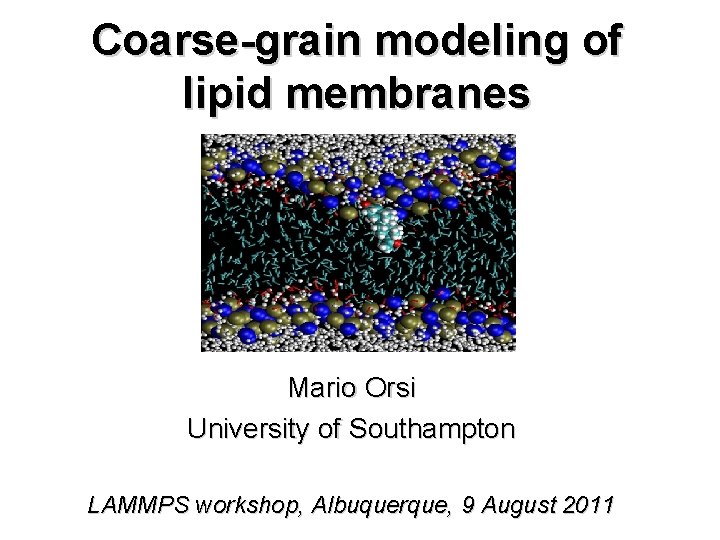
Coarse-grain modeling of lipid membranes Mario Orsi University of Southampton LAMMPS workshop, Albuquerque, 9 August 2011
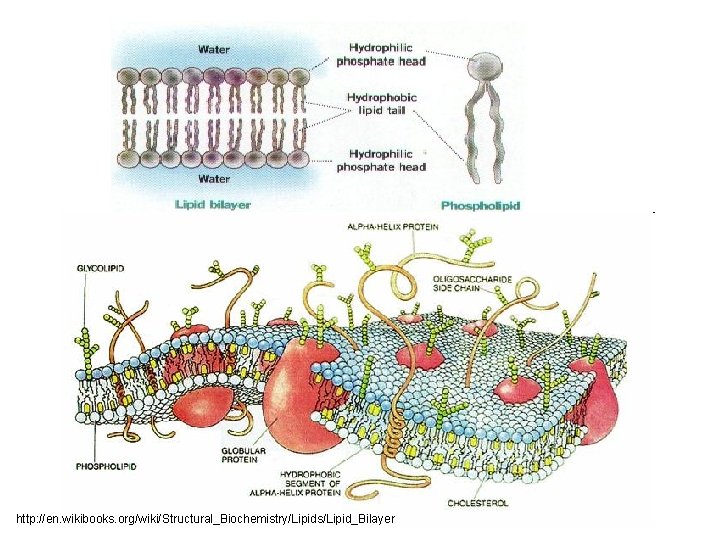
http: //en. wikibooks. org/wiki/Structural_Biochemistry/Lipids/Lipid_Bilayer
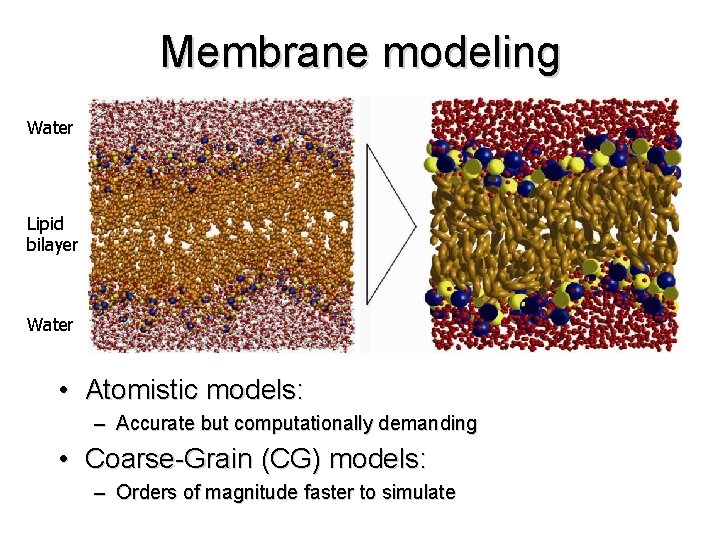
Membrane modeling Water Lipid bilayer Water • Atomistic models: – Accurate but computationally demanding • Coarse-Grain (CG) models: – Orders of magnitude faster to simulate
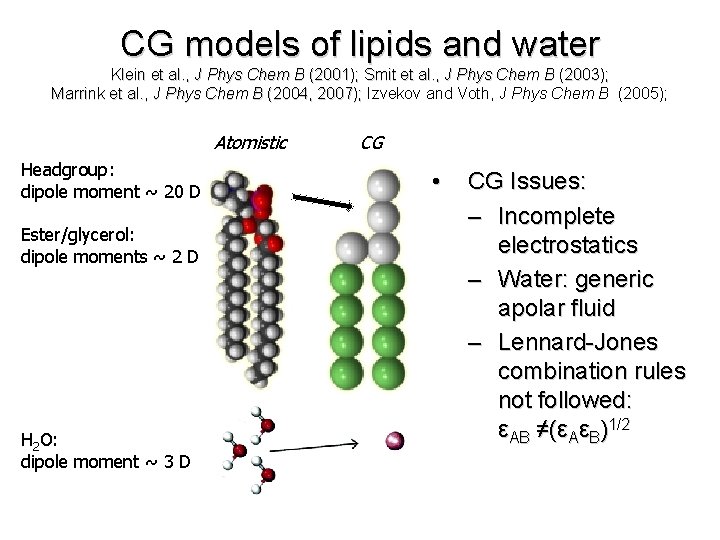
CG models of lipids and water Klein et al. , J Phys Chem B (2001); Smit et al. , J Phys Chem B (2003); Marrink et al. , J Phys Chem B (2004, 2007); Izvekov and Voth, J Phys Chem B (2005); Atomistic Headgroup: dipole moment ~ 20 D Ester/glycerol: dipole moments ~ 2 D H 2 O: dipole moment ~ 3 D CG • CG Issues: – Incomplete electrostatics – Water: generic apolar fluid – Lennard-Jones combination rules not followed: εAB ≠(εAεB)1/2
![Our CG model [Orsi et al, J Phys Chem B, 2008] • • •](http://slidetodoc.com/presentation_image_h/d3d0d11f6a6fa76c0550523c45382e6c/image-5.jpg "Our CG model [Orsi et al, J Phys Chem B, 2008] • • •")
Our CG model [Orsi et al, J Phys Chem B, 2008] • • • Explicit electrostatics, relative dielectric constant r=1 – Lipid: charges for headgroup and dipoles for glycerol/ester – Water: 1 -site “SSD” dipolar model [Liu & Ichiye, J Phys Chem, 1996] Tails: anisotropic “liquid-crystal” potential [Gay and Berne, J Chem Phys, 1981] Bespoke MD code developed in-house
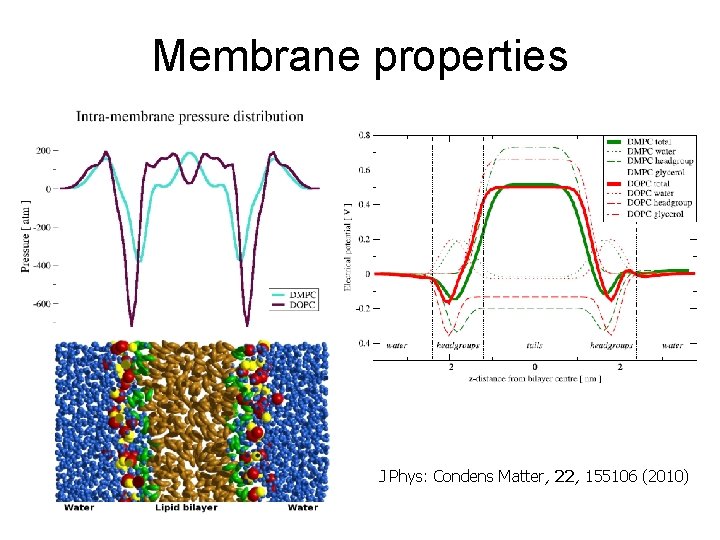
Membrane properties J Phys: Condens Matter, 22, 155106 (2010)
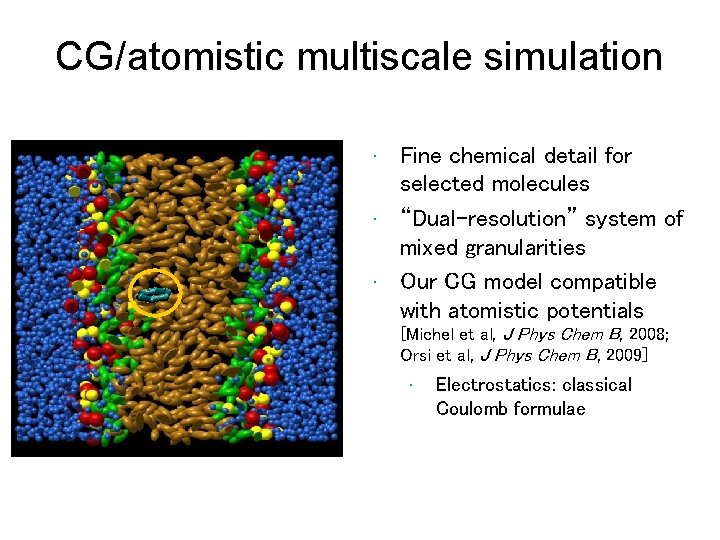
CG/atomistic multiscale simulation Fine chemical detail for selected molecules • “Dual-resolution” system of mixed granularities • Our CG model compatible with atomistic potentials • [Michel et al, J Phys Chem B, 2008; Orsi et al, J Phys Chem B, 2009] • Electrostatics: classical Coulomb formulae
![“Dual-resolution” systems Drugs & hormones [Soft Matter, 6, 3797 (2010)] Antimicrobial compounds [J R](http://slidetodoc.com/presentation_image_h/d3d0d11f6a6fa76c0550523c45382e6c/image-8.jpg "“Dual-resolution” systems Drugs & hormones [Soft Matter, 6, 3797 (2010)] Antimicrobial compounds [J R")
“Dual-resolution” systems Drugs & hormones [Soft Matter, 6, 3797 (2010)] Antimicrobial compounds [J R Soc Interface, 8, 826 (2011)]
Limitations of our methodology Force field • Gay-Berne potential (ellipsoidal tails) – Unrealistic interdigitation when simulating solid (“gel”) bilayer phases Software • Our bespoke code – Not parallel – Not very flexible • Using LAMMPS instead? Not straightforward: – No SSD water – Straight cutoff for dipoles is problematic
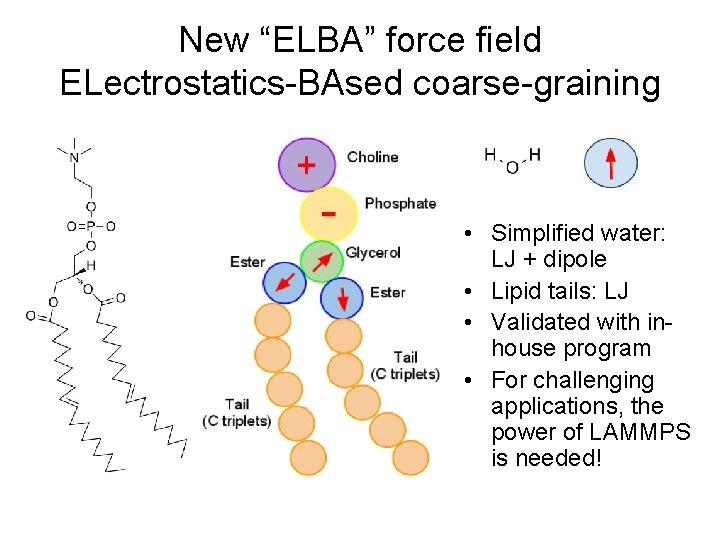
New “ELBA” force field ELectrostatics-BAsed coarse-graining • Simplified water: LJ + dipole • Lipid tails: LJ • Validated with inhouse program • For challenging applications, the power of LAMMPS is needed!
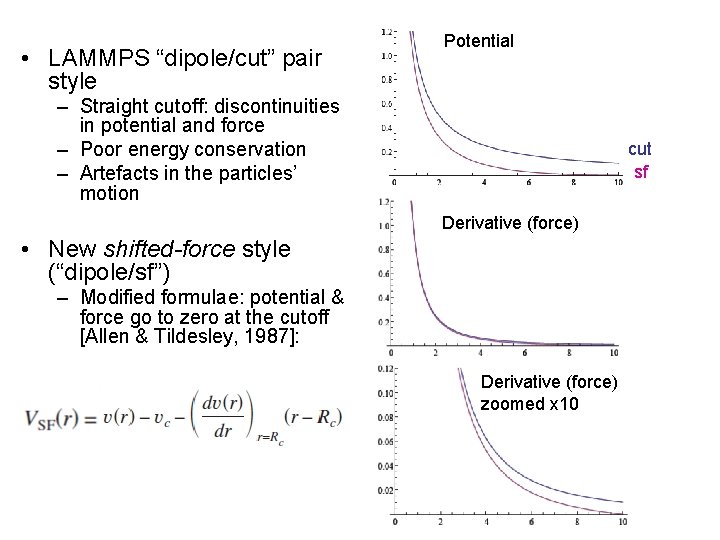
• LAMMPS “dipole/cut” pair style Potential – Straight cutoff: discontinuities in potential and force – Poor energy conservation – Artefacts in the particles’ motion Energy cut sf Derivative (force) Force • New shifted-force style (“dipole/sf”) – Modified formulae: potential & force go to zero at the cutoff [Allen & Tildesley, 1987]: Derivative (force) x 10 Force zoomed x 10
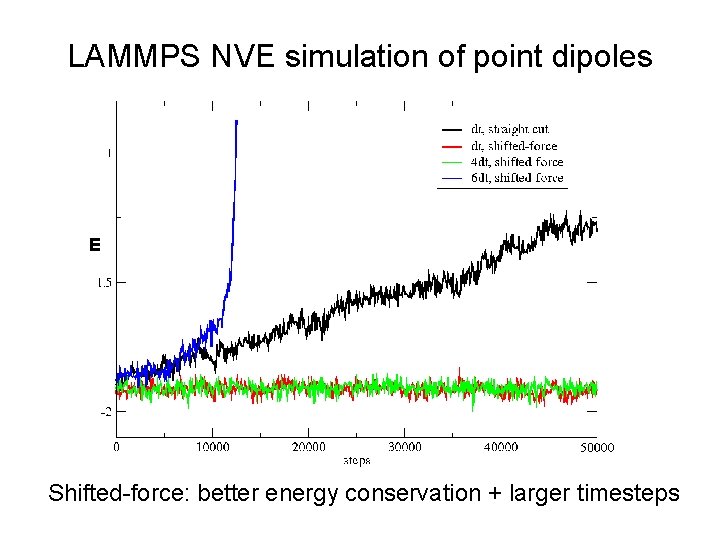
LAMMPS NVE simulation of point dipoles E Shifted-force: better energy conservation + larger timesteps
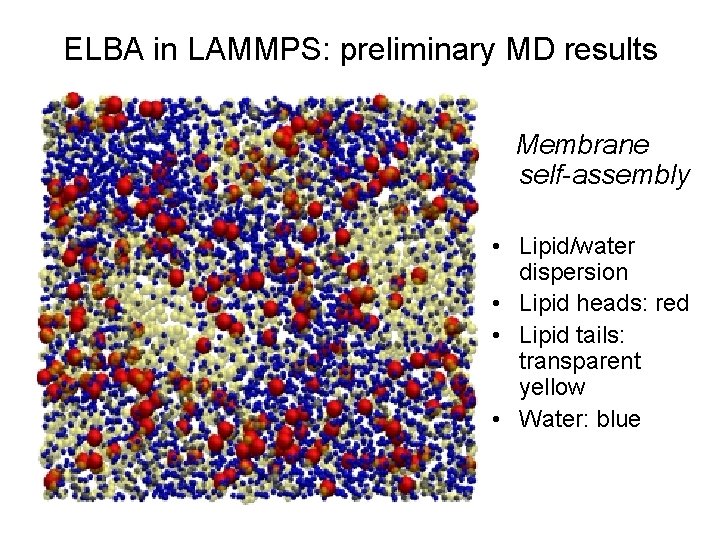
ELBA in LAMMPS: preliminary MD results Membrane self-assembly • Lipid/water dispersion • Lipid heads: red • Lipid tails: transparent yellow • Water: blue
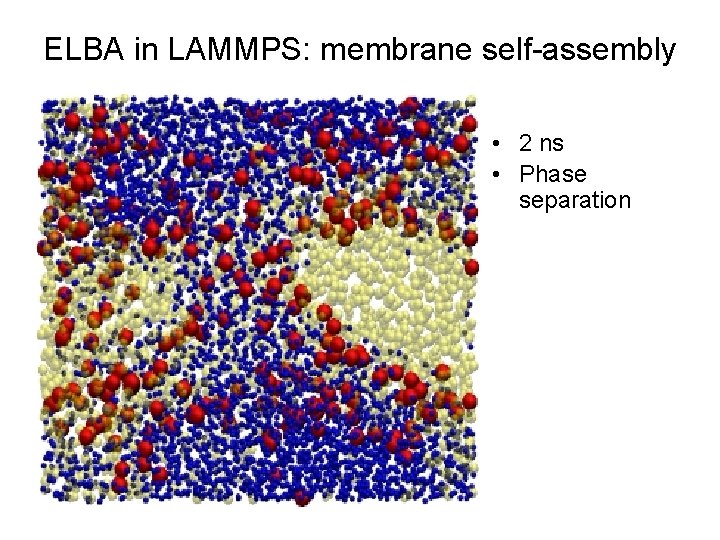
ELBA in LAMMPS: membrane self-assembly • 2 ns • Phase separation
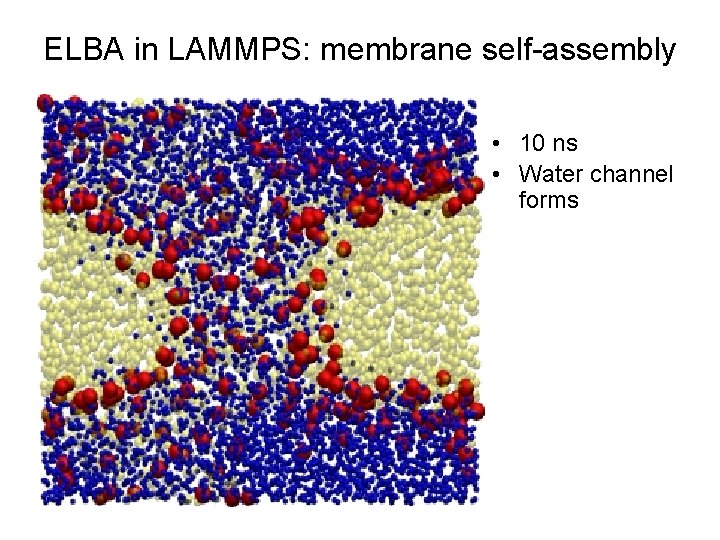
ELBA in LAMMPS: membrane self-assembly • 10 ns • Water channel forms
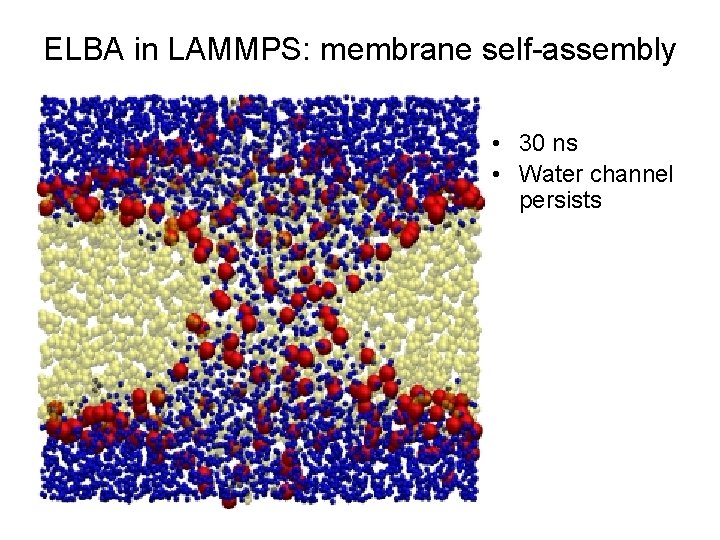
ELBA in LAMMPS: membrane self-assembly • 30 ns • Water channel persists
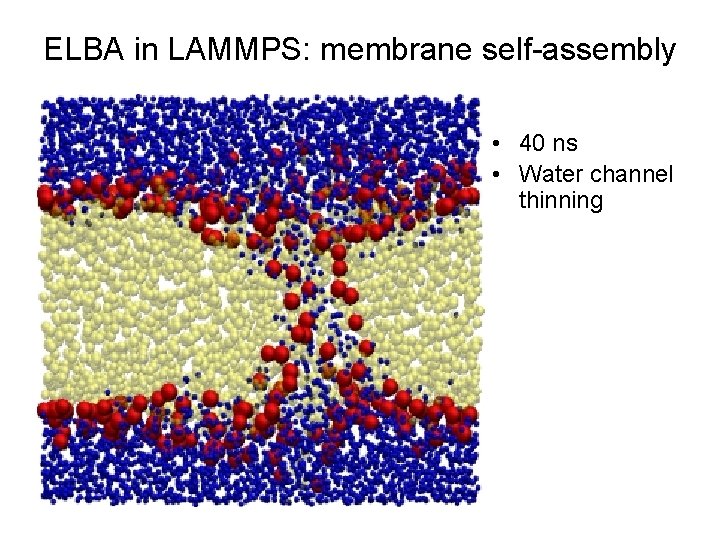
ELBA in LAMMPS: membrane self-assembly • 40 ns • Water channel thinning
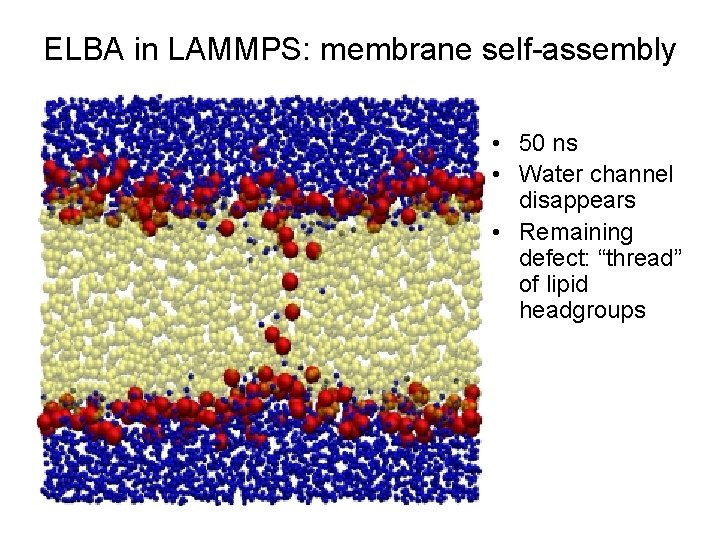
ELBA in LAMMPS: membrane self-assembly • 50 ns • Water channel disappears • Remaining defect: “thread” of lipid headgroups
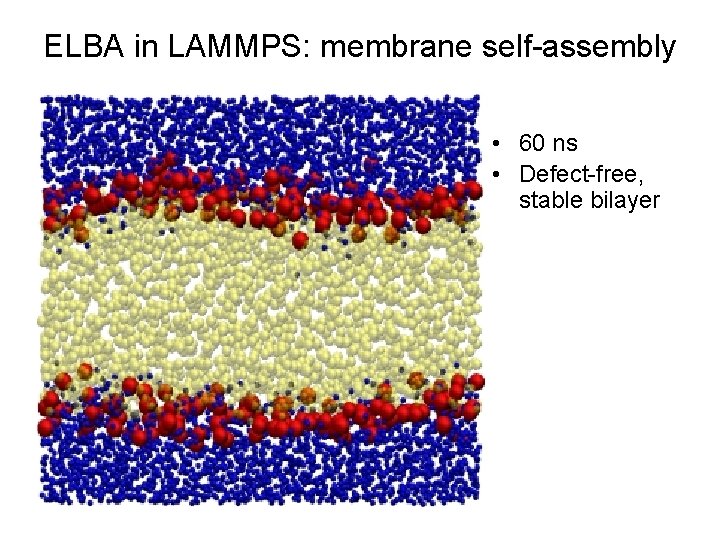
ELBA in LAMMPS: membrane self-assembly • 60 ns • Defect-free, stable bilayer
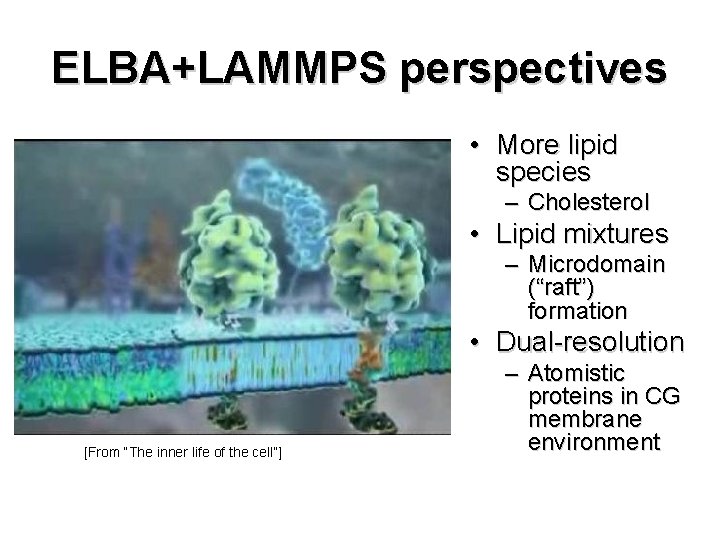
ELBA+LAMMPS perspectives • More lipid species – Cholesterol • Lipid mixtures – Microdomain (“raft”) formation • Dual-resolution [From “The inner life of the cell”] – Atomistic proteins in CG membrane environment

Acknowledgements • Jonathan Essex • Julien Michel (University of Edinburgh) • • Wendy Sanderson Massimo Noro • Funding: – UK taxpayers – J&J – Unilever
- Slides: 21