
Coal Plants with Carbon Capture and Utilization Potential
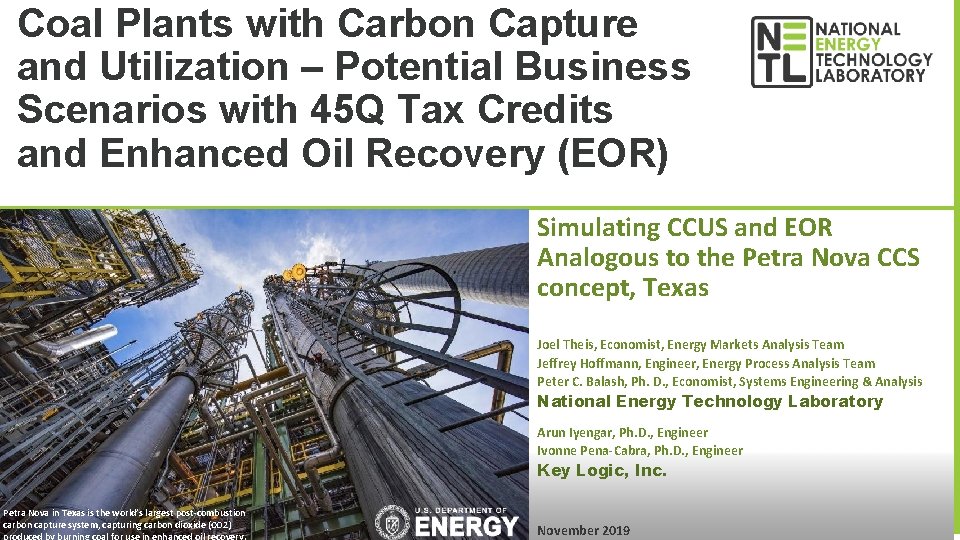
Coal Plants with Carbon Capture and Utilization – Potential Business Scenarios with 45 Q Tax Credits and Enhanced Oil Recovery (EOR) Simulating CCUS and EOR Analogous to the Petra Nova CCS concept, Texas Joel Theis, Economist, Energy Markets Analysis Team Jeffrey Hoffmann, Engineer, Energy Process Analysis Team Peter C. Balash, Ph. D. , Economist, Systems Engineering & Analysis National Energy Technology Laboratory Arun Iyengar, Ph. D. , Engineer Ivonne Pena-Cabra, Ph. D. , Engineer Key Logic, Inc. Petra Nova in Texas is the world’s largest post-combustion carbon capture system, capturing carbon dioxide (CO 2) November 2019
Overview • Purpose: Present a method of evaluating coal power plants with carbon capture resembling Petra Nova that could participate in CO 2 markets for enhanced oil recovery (EOR). • What does this mean? • Coal power plants that are operating and can continue to sell power to the grid with an addition of a carbon capture (CC) system operated post-combustion – retrofitting. • The CC system requires an additional power plant, a combustion turbine (CT) plant that provides power and steam. • The CC system qualifies for 45 Q tax credits for the captured CO 2. • The CC system sells the captured CO 2 in the EOR market. • For natural gas prices lower than $3. 50/MMBtu, preliminary results show that EOR and 45 Q make the coal capture system economically viable. • More plants and locations will be investigated for carbon capture, utilization and storage (CCUS) business opportunities. 2
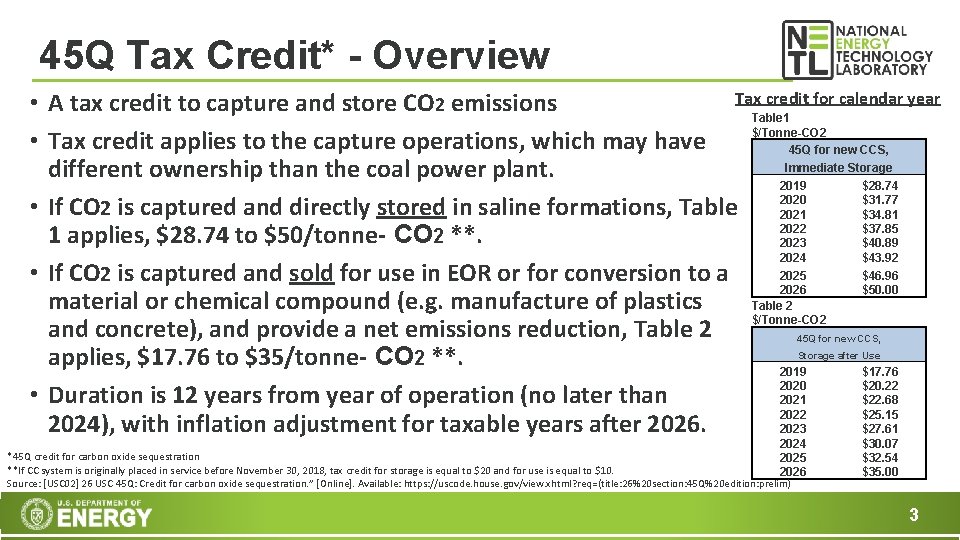
45 Q Tax Credit* - Overview Tax credit for calendar year • A tax credit to capture and store CO 2 emissions Table 1 $/Tonne-CO 2 • Tax credit applies to the capture operations, which may have 45 Q for new CCS, Immediate Storage different ownership than the coal power plant. 2019 $28. 74 $31. 77 • If CO 2 is captured and directly stored in saline formations, Table 2020 2021 $34. 81 2022 $37. 85 1 applies, $28. 74 to $50/tonne- CO 2 **. 2023 $40. 89 2024 $43. 92 2025 $46. 96 • If CO 2 is captured and sold for use in EOR or for conversion to a 2026 $50. 00 material or chemical compound (e. g. manufacture of plastics Table 2 $/Tonne-CO 2 and concrete), and provide a net emissions reduction, Table 2 applies, $17. 76 to $35/tonne- CO 2 **. 2019 $17. 76 2020 $20. 22 • Duration is 12 years from year of operation (no later than 2021 $22. 68 2022 $25. 15 2024), with inflation adjustment for taxable years after 2026. 2023 $27. 61 45 Q for new CCS, Storage after Use 2024 2025 2026 *45 Q credit for carbon oxide sequestration **If CC system is originally placed in service before November 30, 2018, tax credit for storage is equal to $20 and for use is equal to $10. Source: [USC 02] 26 USC 45 Q: Credit for carbon oxide sequestration. ” [Online]. Available: https: //uscode. house. gov/view. xhtml? req=(title: 26%20 section: 45 Q%20 edition: prelim) $30. 07 $32. 54 $35. 00 3
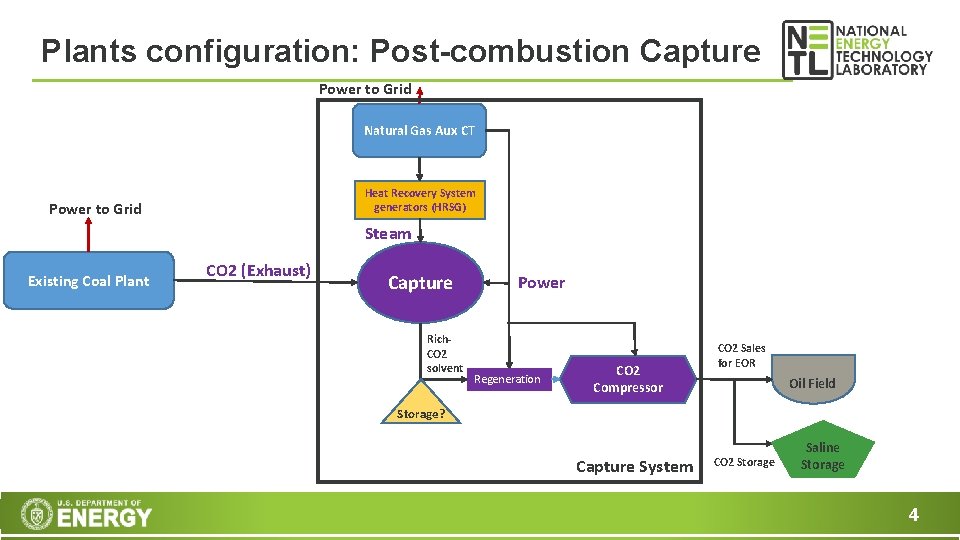
Plants configuration: Post-combustion Capture Power to Grid Natural Gas Aux CT Heat Recovery System generators (HRSG) Power to Grid Steam Existing Coal Plant CO 2 (Exhaust) Capture Rich. CO 2 solvent Power Regeneration CO 2 Compressor CO 2 Sales for EOR Oil Field Storage? Capture System CO 2 Storage Saline Storage 4
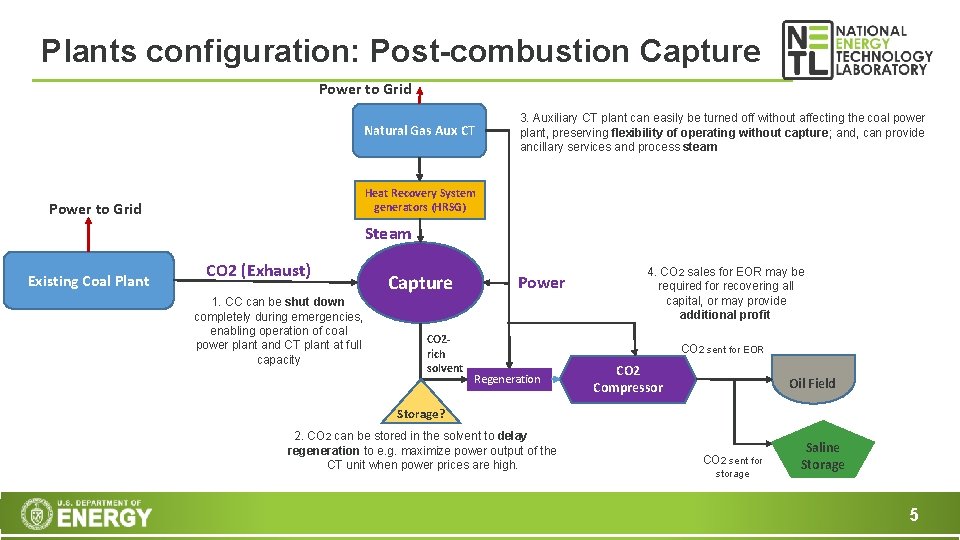
Plants configuration: Post-combustion Capture Power to Grid Natural Gas Aux CT 3. Auxiliary CT plant can easily be turned off without affecting the coal power plant, preserving flexibility of operating without capture; and, can provide ancillary services and process steam Heat Recovery System generators (HRSG) Power to Grid Steam Existing Coal Plant CO 2 (Exhaust) 1. CC can be shut down completely during emergencies, enabling operation of coal power plant and CT plant at full capacity Capture CO 2 rich solvent Power 4. CO 2 sales for EOR may be required for recovering all capital, or may provide additional profit CO 2 sent for EOR Regeneration CO 2 Compressor Oil Field Storage? 2. CO 2 can be stored in the solvent to delay regeneration to e. g. maximize power output of the CT unit when power prices are high. CO 2 sent for storage Saline Storage 5

Modeling Approaches Linear Model A linear model that generically models the economics of the capture system, based on the capacity required from an auxiliary plant (e. g. a CT) to supply power and steam to a specific size coal plant. • Economic viability and break-even period were evaluated for different scenarios CT Auxiliary Plant COAL Main Plant Revenues 1. Power and steam sales 1. Power sales – dispatch impacted by NG prices 2. 45 Q tax credit 3. CO 2 sales for EOR 4. Ancillary services Same Owner 6
Linear model results • EOR revenue for CO 2 is needed in addition to the 45 Q tax credit when NG prices are below ~$3. 50/MMBtu. • Results showed that EOR and 45 Q incentivize the plant to run as baseload 7
Modeling Approaches Production-cost model The linear model was extended to a production-cost model. The coal power plants were set in baseload operation. The goal was to obtain more realistic representation of the economic dispatch. • Promod™, a security constrained economic dispatch (SCED) model using data for the PJM, MISO, and SPP RTO regions. A detailed cash flow model was applied to the production cost model results for the capture plant to evaluate IRR and break-even periods • No costs associated with the transport of the CO 2, e. g. pipeline construction, pipeline operation, or other costs associated to the take of CO 2 by the EOR field • Full recovery of capital costs for the CT and the CFPCC is included in the full cash flow for this business operation, targeting IRRs at 10 -12% pre-tax for equity holders. 8

Production-cost model results • Promod™ results with cash flow model suggest that the coal power plant with CC should operate at full load as much as possible to obtain the most revenue from MWh sales, CO 2 sales, and 45 Q tax incentive. • The IRR* depends on fuel prices, electricity market region and plant operating characteristics. In the presence of 45 Q, the minimum CO 2 price received by the capture plant to reach economic viability is between $5/tonne and $20/tonne • $35 (45 Q) + $5 -$20/tonne makes capture system economic viable • Capacity payments also drive viability. *Economic viability = 10 -12% return on assets 9
Future Fossil with CCUS Studies We can further investigate: • Specific plants and locations for CCUS business opportunities. • Partial capture configurations and flexible operations. • Impacts of plant efficiency across the load range. • Retrofitting for saline storage under 45 Q. • Sensitivity analyses for prices for CO 2, fuels, and market prices (capacity, energy, and ancillary services). • Timing of retrofitting with capture system 1. • Hybrid system operations. 1. This will involve optimization using a resource planning/capacity expansion model. 10
Opportunities for Flexibility We model baseload operation, however flexibility can be achieved through different modes of operation of the CT for load following as follows: • Exhaust gas venting to partially or completely bypass capture system to accommodate additional demand. • Solvent storage provides the most flexibility while having the ability to maintain the instantaneous CO 2 capture rate above 90 percent. • Solvent regeneration can be deferred to lower-demand times to defer high steam needs and CO 2 compressor load. • Auxiliary CT: quick shut-down and black-start capabilities that only affect the capture system may provide service in low-demand high-demand cases All 4 Options enable freeing up CT capacity for sales to the grid. 11

For More Information contact: Joel Theis Economist, Energy Markets Analysis Team Joel. Theis@netl. doe. gov 412 -386 -7333 National Energy Technology Laboratory and Arun Iyengar, Ph. D. , Engineer Arun. Iyengar@netl. doe. gov; 412 -386 -5860 Ivonne Pena-Cabra, Ph. D. , Engineer Ivonne. Pena-Cabra@netl. doe. gov 412 -386 -4654 Key Logic, Inc.
- Slides: 12