
Coal Outlook 2020 An Industry on the brink
Coal Outlook 2020 An Industry on the brink Dennis Wamsted/Seth Feaster 4/28/2020
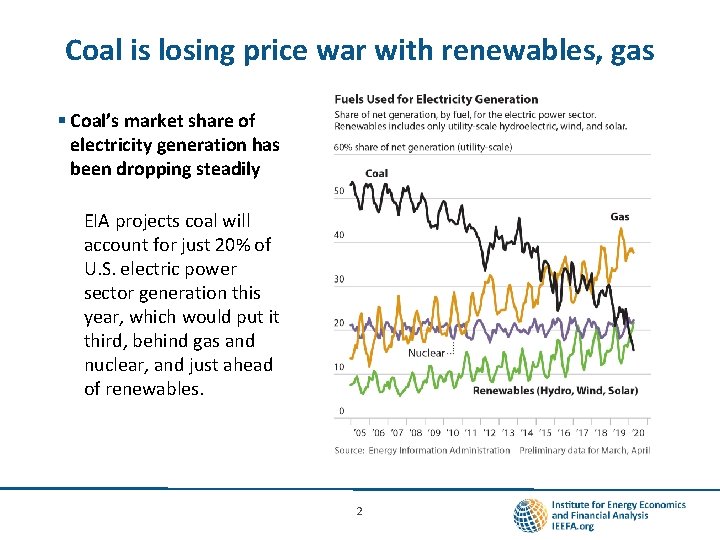
Coal is losing price war with renewables, gas § Coal’s market share of electricity generation has been dropping steadily EIA projects coal will account for just 20% of U. S. electric power sector generation this year, which would put it third, behind gas and nuclear, and just ahead of renewables. 2
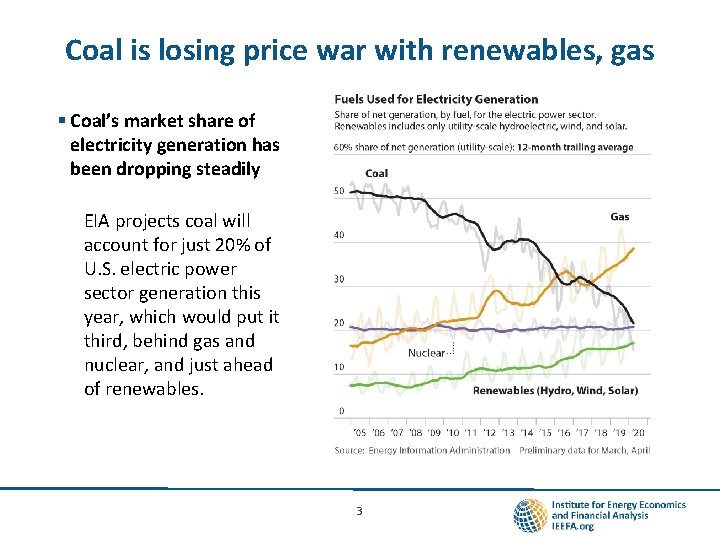
Coal is losing price war with renewables, gas § Coal’s market share of electricity generation has been dropping steadily EIA projects coal will account for just 20% of U. S. electric power sector generation this year, which would put it third, behind gas and nuclear, and just ahead of renewables. 3
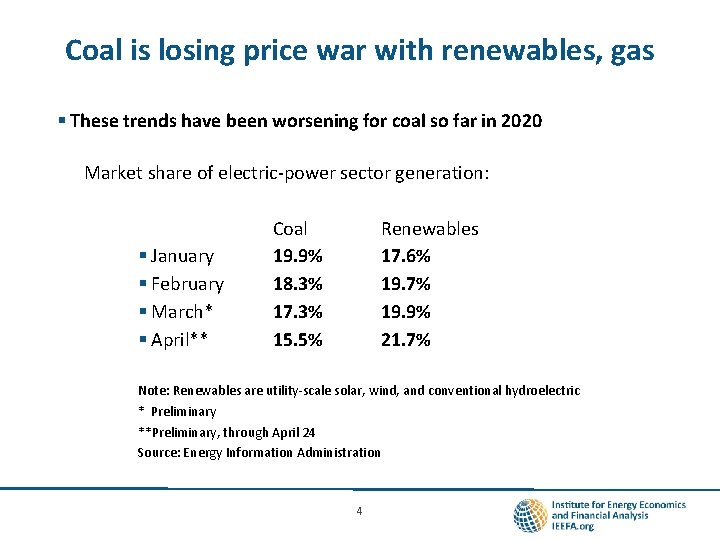
Coal is losing price war with renewables, gas § These trends have been worsening for coal so far in 2020 Market share of electric-power sector generation: § January § February § March* § April** Coal 19. 9% 18. 3% 17. 3% 15. 5% Renewables 17. 6% 19. 7% 19. 9% 21. 7% Note: Renewables are utility-scale solar, wind, and conventional hydroelectric * Preliminary **Preliminary, through April 24 Source: Energy Information Administration 4
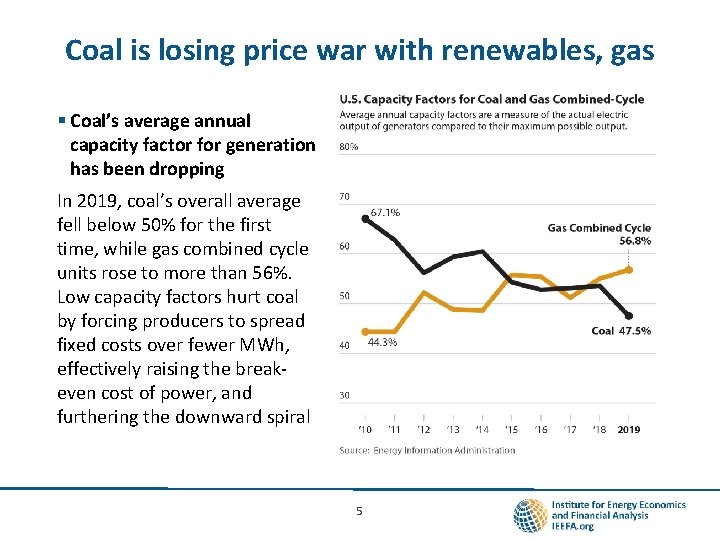
Coal is losing price war with renewables, gas § Coal’s average annual capacity factor for generation has been dropping In 2019, coal’s overall average fell below 50% for the first time, while gas combined cycle units rose to more than 56%. Low capacity factors hurt coal by forcing producers to spread fixed costs over fewer MWh, effectively raising the breakeven cost of power, and furthering the downward spiral 5
Coal’s economic woes: They said it, not us “The coal-fired unit is no longer economical for customers, and FPL is currently evaluating options to retire its 76% ownership in the plant. ” — FPL spokesman Chris Mc. Grath discussing the Florida utility’s plan to sell/retire its share of Unit 4 at Georgia Power’s Scherer generation station, the nation’s largest coal plant “On an actual cost basis, we are losing money relative to the market [at Coal Creek]. ” — Jon Brekke, vice president and chief power-supply officer for Great River, on the co-op’s ongoing review of the 1, 146 MW plant in North Dakota “What’s encouraging about it is that very, very low cost of new renewables that are coming online. They’re coming in at costs well below the variable operating costs of our fossil fuel units. ” — Tri-State CEO Duane Highley explaining the co-op’s decision to exit coal generation by 2030, starting with the 2020 retirement of the 253 MW Escalante power plant in New Mexico 6

They said it, not us -- continued Retiring Merom Generating Station in 2023 will save “members an estimated $700 million over the next two decades. ” — Hoosier Energy announcing its plan in January to close the 1, 070 MW unit “The economics of the whole power business have changed so much that generating power by coal is just not the cheapest way to go, by a long shot. Coal is just too expensive right now to be a viable generating source anymore. ” Doug Childs, CEO of the Utilities District of Western Indiana Rural Electric Co-Op, on Hoosier Energy’s decision to retire the Merom Generation Station 7
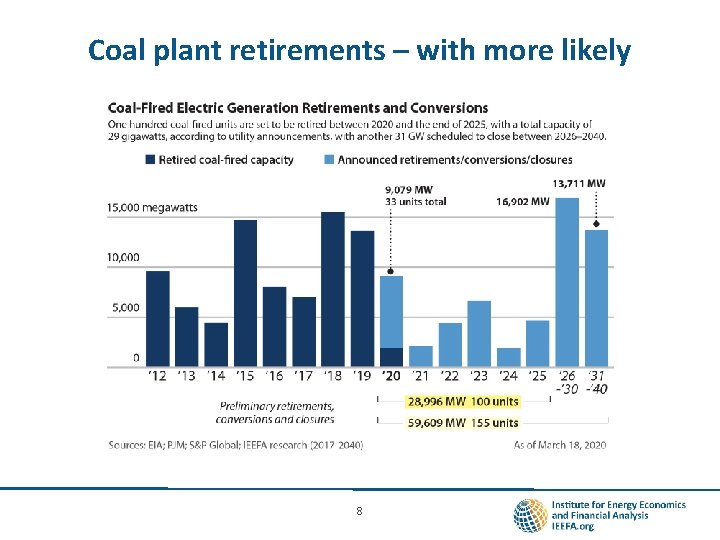
Coal plant retirements – with more likely 8
Coal’s economic woes – Part 2 Recent bankruptcy filing by 700 -megawatt Longview coal-fired power plant near Morgantown, WV, is a telling example § Nine-year-old plant is one of the newest and most efficient in the U. S. and located near its coal supplier, keeping transportation costs down § Posted an average capacity factor of 83% from 2016 -2019 § And yet, it still couldn’t make any money in the PJM market § Power prices in PJM have fallen to around $15/MWh this month compared to $28/MWh a year ago, in part due to coronavirus Ø Profitable companies don’t file for bankruptcy due to only one month’s worth of losses Ø The plant’s problems clearly show coal’s growing inability to provide economically competitive power 9
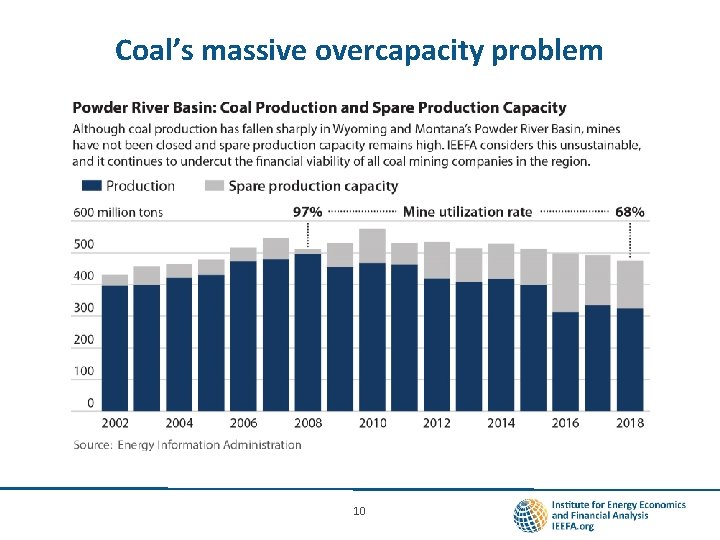
Coal’s massive overcapacity problem 10
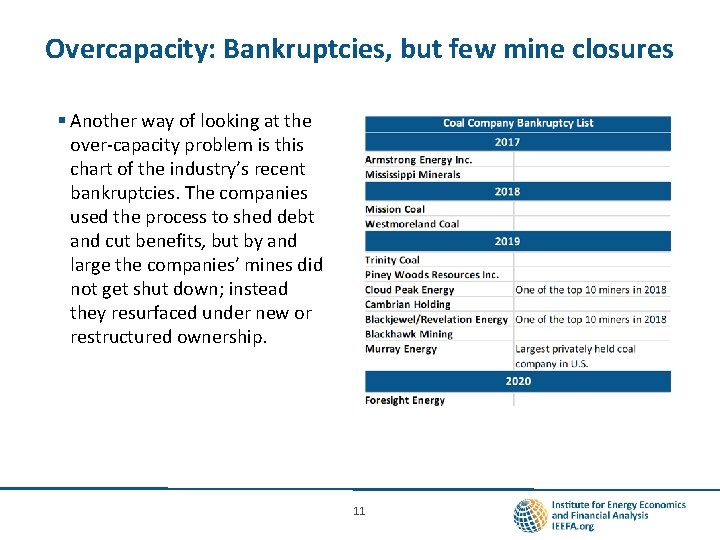
Overcapacity: Bankruptcies, but few mine closures § Another way of looking at the over-capacity problem is this chart of the industry’s recent bankruptcies. The companies used the process to shed debt and cut benefits, but by and large the companies’ mines did not get shut down; instead they resurfaced under new or restructured ownership. 11
Overcapacity is not sustainable § Industry executives clearly must know there is too much productive capacity across the coal industry, but most won’t say it. § However, Alliance Resource Partners has been willing to break the silence. During the company’s 2019 earnings call in January, CEO Joseph Craft noted: “Additional supply rationalization is necessary to correct the continuing oversupply situation. [Alliance] anticipates that much of this market correction will occur this year, making 2020 an inflection point for domestic thermal coal producers. ” 12
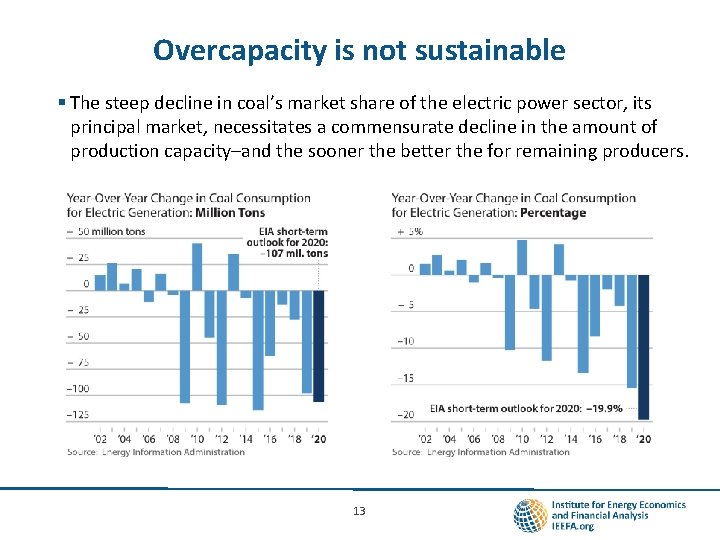
Overcapacity is not sustainable § The steep decline in coal’s market share of the electric power sector, its principal market, necessitates a commensurate decline in the amount of production capacity–and the sooner the better the for remaining producers. 13
U. S. coal’s ESG issues are real – and growing § Until recently, U. S. coal companies could largely skirt the rise of ESG demands worldwide—unlike their European counterparts, which have been hit with serious pressures for reform in the past several years. § But that is quickly beginning to change: § Four major U. S. insurance companies – Chubb, Axis Capital, The Hartford and Liberty Mutual -- have adopted restrictions on their coal business activities in the past year § Blackrock is targeting companies getting more than 25% of their revenues from thermal coal activities (announced in January) § Moody’s assessment about climate and coal-related stranded asset risks facing the insurance industry (March) § Citigroup will exit thermal coal mining activities by 2030 (announced in April) 14
Coal ESG issues – part 2 § Andy Eidson, CFO of Contura Energy addressed the rising impact of ESG issues in February: “When you look at the broader insurance markets, whether it’s federal black lung, whether it’s workers’ compensation, even as simple as property and casualty insurance, the coal stigma is increasing the rate per thousand on any policy. It’s really creating a lot of cost pressure across the board. ” § Ben Nelson, a senior Moody’s coal analyst was even more blunt: ESG issues are “like an anaconda, slowly strangling its prey. You see that this is starting to squeeze the industry. ” 15

IEEFA’s Divestment Tracker: 2020 16
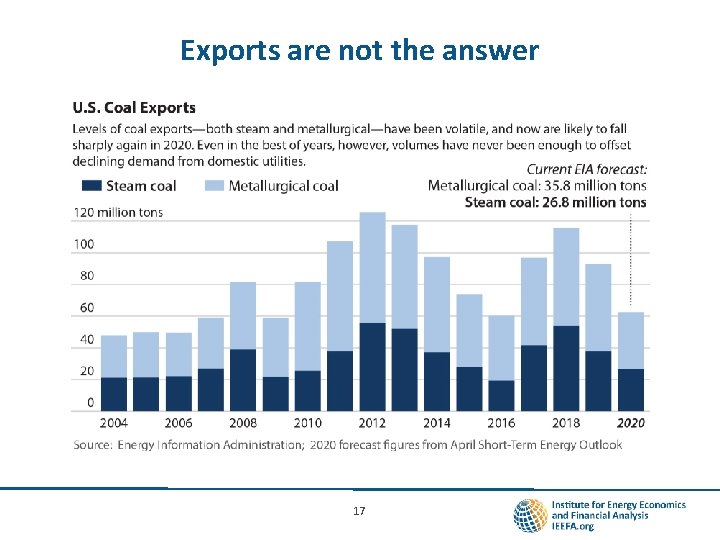
Exports are not the answer 17
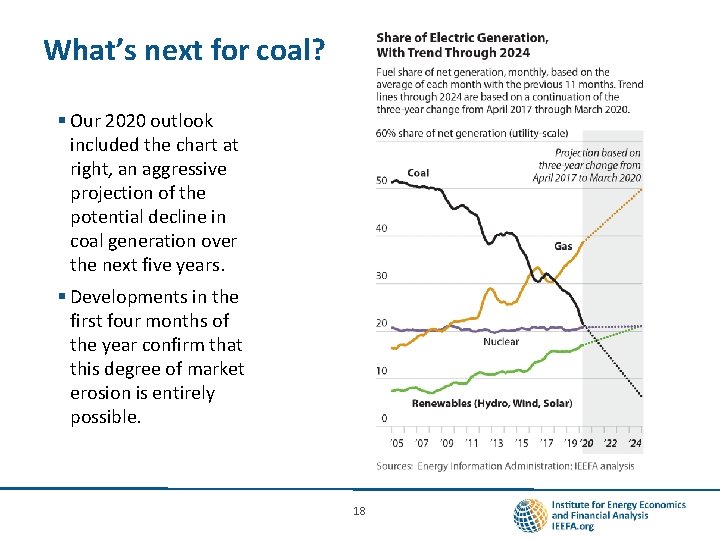
What’s next for coal? § Our 2020 outlook included the chart at right, an aggressive projection of the potential decline in coal generation over the next five years. § Developments in the first four months of the year confirm that this degree of market erosion is entirely possible. 18
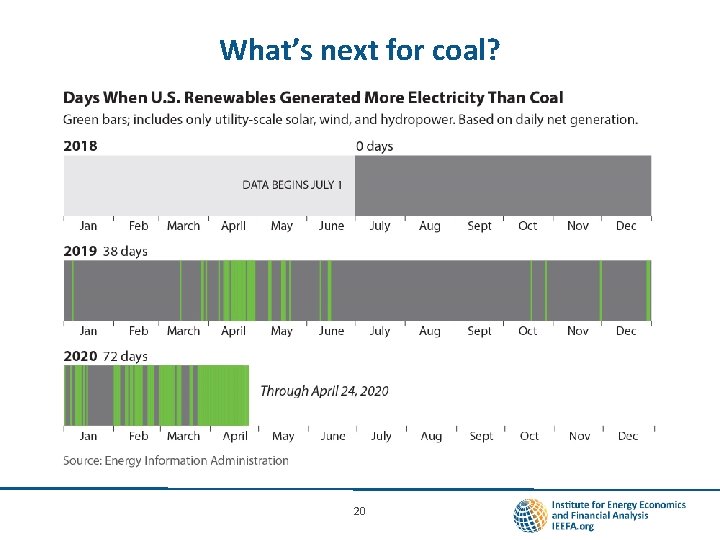
What’s next for coal? § Coal is now generally the last resource dispatched Major implications for the coal’s economic competitiveness, forcing generators to spread their fixed costs over a smaller amount of production, thereby raising costs and furthering coal’s downward spiral. 19
What’s next for coal? 20
What’s next for coal? § Generation statistics from April are telling: EIA shows 227, 600 MW of installed coal capacity at end of January; at 100% capacity, coal would produce 227, 600 MW each hour § For the first 15 days of the month, coal has only topped the 70, 000 MW level 10 times, meaning the top capacity factor for the coal sector overall has been just 30. 7% § Conversely, during that same two weeks, coal generation has been below 50, 000 MW during 94 hourly periods, an effective capacity figure of less than 22% § For comparison, in April 2019, coal never generated less than 53, 000 MW in an hour 21
QUESTIONS? IEEFA’s 2020 Coal Outlook can be found at: § https: //ieefa. org/wp-content/uploads/2020/03/US-Coal-Outlook 2020_March-2020. pdf § Directory of “ 100 and Counting” financial institutions, insurers and asset managers that have restricted coal investments: https: //ieefa. org/finance-exiting-coal/ Author contact information: § Dennis Wamsted / dwamsted@ieefa. org / (703) 862 -9324 § Seth Feaster / swfeaster@ieefa. org / (917) 670 -4025 22
- Slides: 22