
Coaching for Behavioural Competencies Introductions Name Role and
Coaching for Behavioural Competencies
Introductions • Name • Role and tenure • Who is the best coach you’ve ever had? 2
Objectives • Understand the principles of assessing behavioural competencies • Prepare to use the Behavioural Competency Assessment Questionnaire (BCAQ) and hold a coaching discussion with a direct report 3
Agenda 1 Assessing behavioural competencies 2 Coaching for behavioural competencies 3 Development planning 4 Next steps 4
Assessing behavioural competencies
Discussion What challenges do you anticipate in assessing and calibrating against behavioural competencies? 6
The BCAQ is an assessment tool to help individuals understand their behavioural competency strengths and areas for development, and define a specific path for their development. Page 7
Principles of behavioural competency assessment • Use the Behavioural Competency Assessment Questionnaire (BCAQ) to assess direct reports • Assessment must be based on actual behaviour • In some situations if you are unsure, you may want to ask the individual you are assessing what his/her intent was at the time of the behaviour • Base assessments on consistent behavioural patterns, not one-off examples (i. e. , what behaviour does the individual typically demonstrate at least 75% of the time? ) • Gather information/perspectives from a variety of sources 8
Things to consider when assessing others • Does the individual: – Have the opportunity to demonstrate these behaviours on a regular basis? – Demonstrate the behaviours consistently (i. e. , most of the time when the opportunity arises)? – Get good results when he or she demonstrates these behaviours? • Can you think of several examples when the individual demonstrated these behaviours in the last 12 months? 9
Evaluation pitfalls • Halo Effect • Stereotyping • Central Tendency • Recency Effect • Length of Service Bias • Initial Impression • Lack of documentation 10
Assessing others – key points As you select your ratings, keep the following in mind: • The level that pertains to the individual’s role is the expected level of performance • When looking at the expected level, the idea is to determine whether the individual demonstrates the essence of the behaviours on a regular basis – Some behaviours may not be applicable to the individual being assessed; therefore, not all of the behaviours need to be demonstrated to justify a competency rating • Rate the highest level that the individual demonstrates consistently • Rate the “rule” rather than the exception • Think of several recent and specific examples to support your assessment 11
Exercise: Assessing a direct report 1. Think about one of your direct reports. 2. Using the BCAQ, review each competency and identify the level where you feel the individual consistently demonstrates the behaviours associated with that level and all of the levels that precede it. 3. Provide behavioural evidence to support your assessment in the space provided. 12

Identifying behavioural competency strengths and gaps If the individual is… Then… § Consistently demonstrating the behaviours (i. e. , ≥ 75% of the time) at the level reflective of their role § the individual is on target – this is a competency strength § Consistently demonstrating the behaviours below the level reflective of their role § the individual is below target – this is a competency gap § Consistently demonstrating the behaviours above the level reflective of their role § individual is above target – this is a competency strength 13
Coaching for behavioural competencies
In your role as leader, you will need to provide support, development and coaching to your direct reports around the behavioural competencies. The next section of the workshop is about equipping you with the skills and tools to do this. Page 15
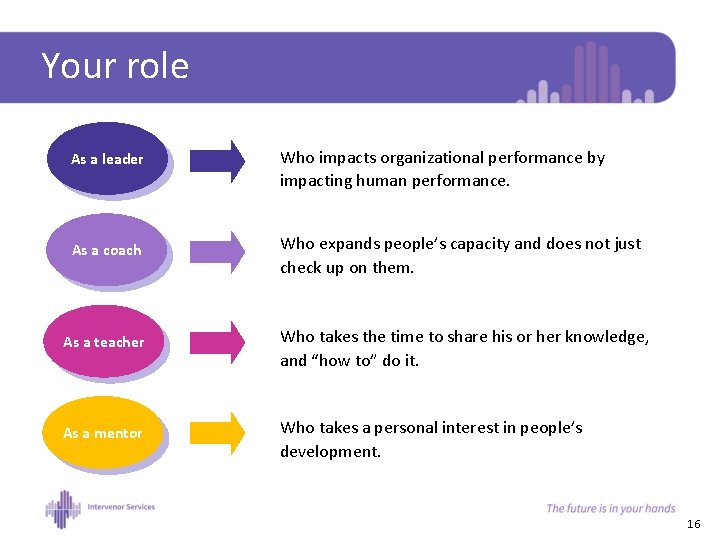
Your role As a leader Who impacts organizational performance by impacting human performance. As a coach Who expands people’s capacity and does not just check up on them. As a teacher Who takes the time to share his or her knowledge, and “how to” do it. As a mentor Who takes a personal interest in people’s development. 16
Coaching is… § A genuine intent to foster the long-term learning and development of others § A practice and a way of “being” that brings out the best in the coachee § About discovering and transforming behaviours that limit performance or potential § About moving forward Keep in mind … “We are generally the better persuaded by the reasons we discover ourselves than by those given to us by others. ” - Blaise Pascal French Mathematician, Physicist (1623 -1662) 17
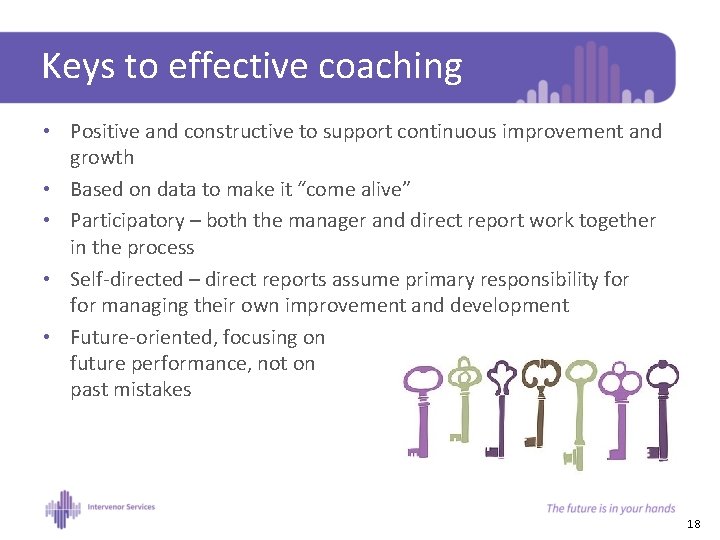
Keys to effective coaching • Positive and constructive to support continuous improvement and growth • Based on data to make it “come alive” • Participatory – both the manager and direct report work together in the process • Self-directed – direct reports assume primary responsibility for managing their own improvement and development • Future-oriented, focusing on future performance, not on past mistakes 18
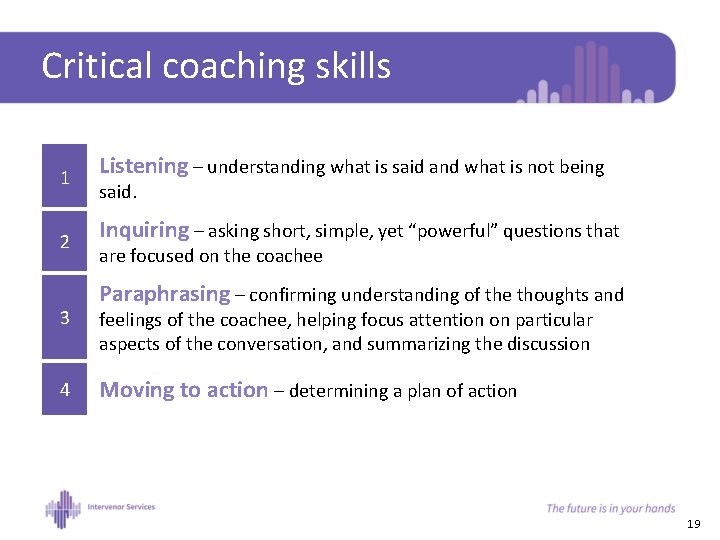
Critical coaching skills 1 Listening – understanding what is said and what is not being 2 Inquiring – asking short, simple, yet “powerful” questions that 3 4 said. are focused on the coachee Paraphrasing – confirming understanding of the thoughts and feelings of the coachee, helping focus attention on particular aspects of the conversation, and summarizing the discussion Moving to action – determining a plan of action 19
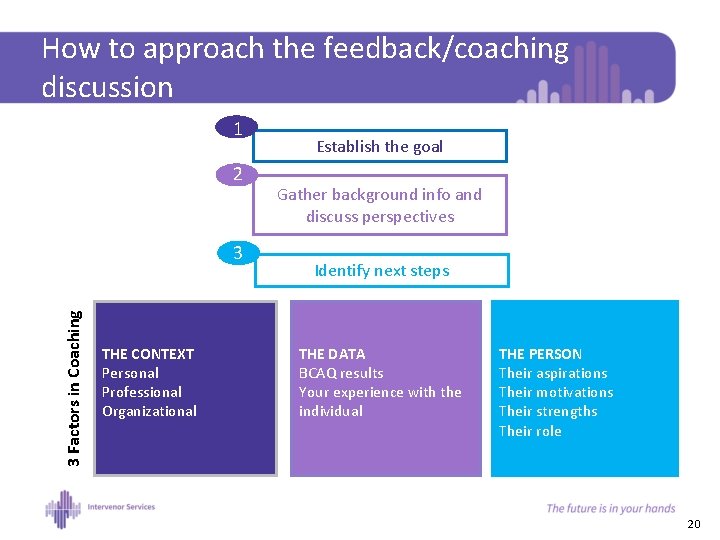
How to approach the feedback/coaching discussion 1 2 3 Factors in Coaching 3 THE CONTEXT Personal Professional Organizational Establish the goal Gather background info and discuss perspectives Identify next steps THE DATA BCAQ results Your experience with the individual THE PERSON Their aspirations Their motivations Their strengths Their role 20
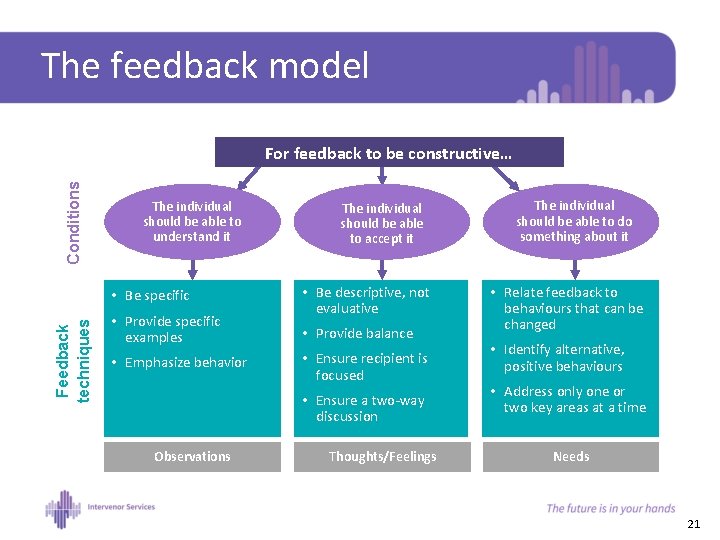
The feedback model Conditions For feedback to be constructive… The individual should be able to understand it Feedback techniques • Be specific • Provide specific examples • Emphasize behavior The individual should be able to accept it • Be descriptive, not evaluative • Provide balance • Ensure recipient is focused • Ensure a two-way discussion Observations Thoughts/Feelings The individual should be able to do something about it • Relate feedback to behaviours that can be changed • Identify alternative, positive behaviours • Address only one or two key areas at a time Needs 21
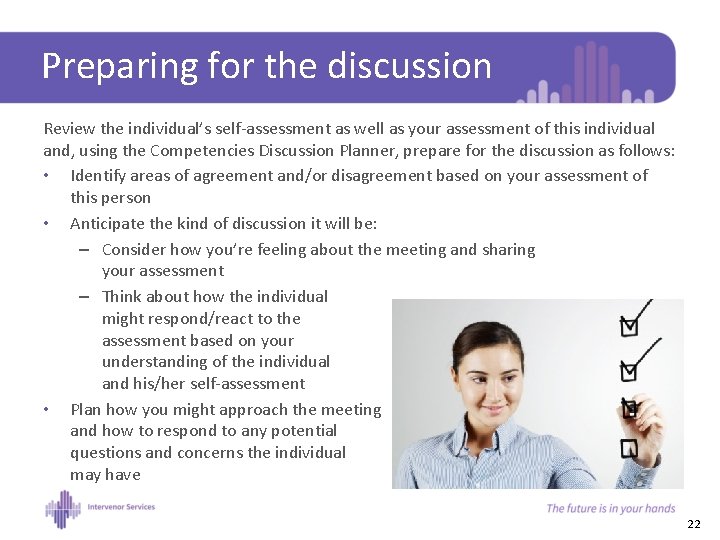
Preparing for the discussion Review the individual’s self-assessment as well as your assessment of this individual and, using the Competencies Discussion Planner, prepare for the discussion as follows: • Identify areas of agreement and/or disagreement based on your assessment of this person • Anticipate the kind of discussion it will be: – Consider how you’re feeling about the meeting and sharing your assessment – Think about how the individual might respond/react to the assessment based on your understanding of the individual and his/her self-assessment • Plan how you might approach the meeting and how to respond to any potential questions and concerns the individual may have 22
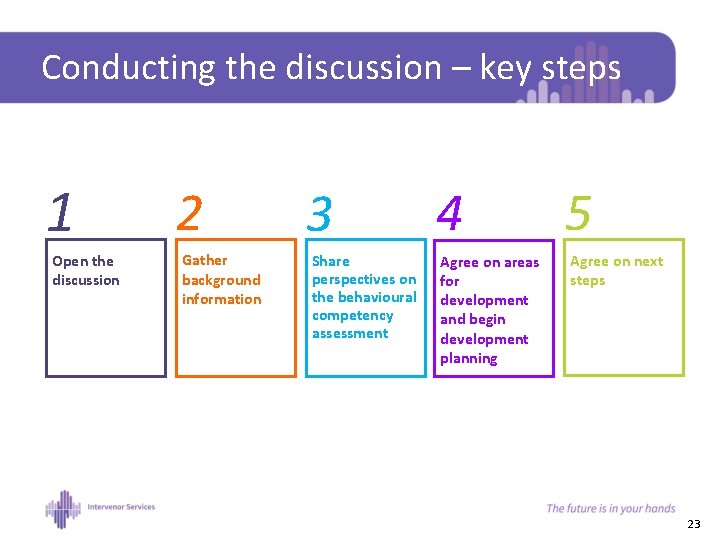
Conducting the discussion – key steps 1 Open the discussion 2 Gather background information 3 Share perspectives on the behavioural competency assessment 4 Agree on areas for development and begin development planning 5 Agree on next steps 23
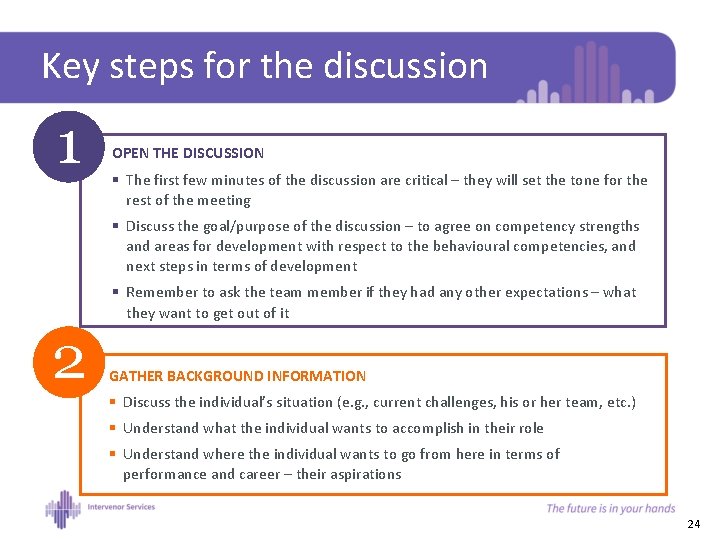
Key steps for the discussion 1 OPEN THE DISCUSSION § The first few minutes of the discussion are critical – they will set the tone for the rest of the meeting § Discuss the goal/purpose of the discussion – to agree on competency strengths and areas for development with respect to the behavioural competencies, and next steps in terms of development § Remember to ask the team member if they had any other expectations – what they want to get out of it 2 GATHER BACKGROUND INFORMATION § Discuss the individual’s situation (e. g. , current challenges, his or her team, etc. ) § Understand what the individual wants to accomplish in their role § Understand where the individual wants to go from here in terms of performance and career – their aspirations 24
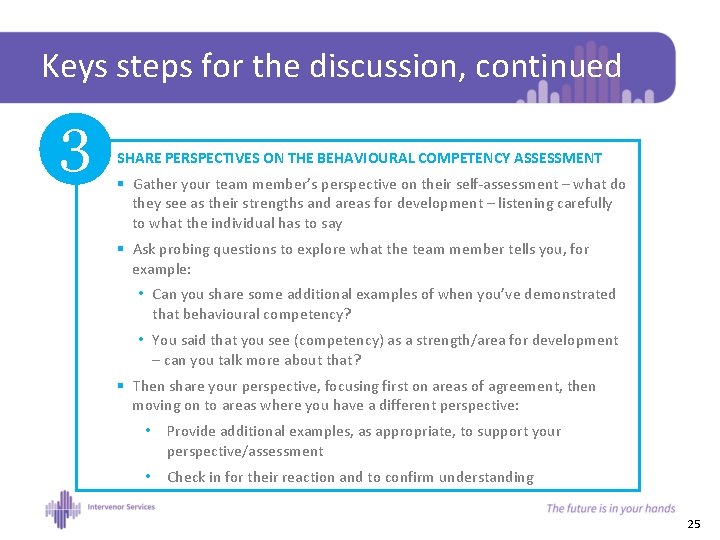
Keys steps for the discussion, continued 3 SHARE PERSPECTIVES ON THE BEHAVIOURAL COMPETENCY ASSESSMENT § Gather your team member’s perspective on their self-assessment – what do they see as their strengths and areas for development – listening carefully to what the individual has to say § Ask probing questions to explore what the team member tells you, for example: • Can you share some additional examples of when you’ve demonstrated that behavioural competency? • You said that you see (competency) as a strength/area for development – can you talk more about that? § Then share your perspective, focusing first on areas of agreement, then moving on to areas where you have a different perspective: • Provide additional examples, as appropriate, to support your perspective/assessment • Check in for their reaction and to confirm understanding 25 25
Feedback challenges What challenges do you anticipate in your feedback discussions with your team members? 26
Managing feedback challenges • • • Anticipate where the differences may occur In the coaching meeting, clearly identify the differences Be open to new information Listen carefully and reflect the individual’s feelings Find common ground to build upon Avoid being defensive “Weaknesses are almost always simply an overuse of a strength. ” 27
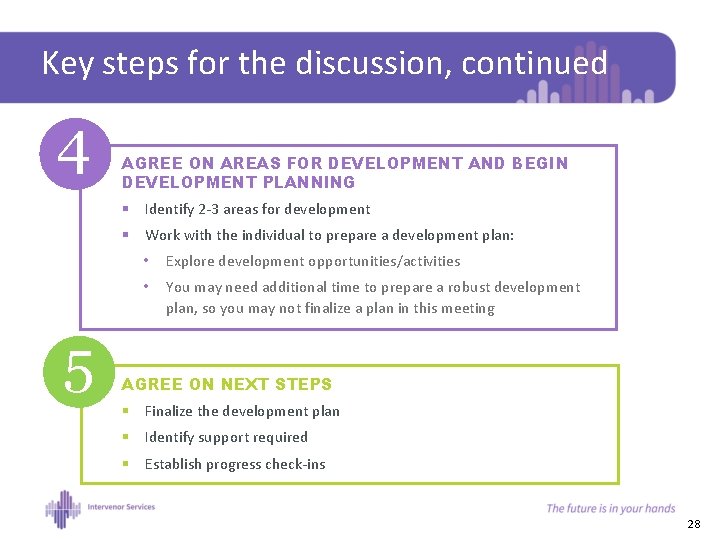
Key steps for the discussion, continued 4 AGREE ON AREAS FOR DEVELOPMENT AND BEGIN DEVELOPMENT PLANNING § Identify 2 -3 areas for development § Work with the individual to prepare a development plan: 5 • Explore development opportunities/activities • You may need additional time to prepare a robust development plan, so you may not finalize a plan in this meeting AGREE ON NEXT STEPS § Finalize the development plan § Identify support required § Establish progress check-ins 28
Exercise: Coaching discussion role plays Individually: 1. Refer to the BCAQ that you completed earlier on one of your direct reports. 2. Using the Competencies Discussion Planner, prepare a few notes about this individual to give to your partner (who will role play the individual), and identify two competencies you would like to discuss with this individual: • One that is a strength • One that is an area for development With your partner: 1. Brief your partner on the individual, sharing your notes. 2. Take turns role playing the coaching discussion to come to agreement on the behavioural competency ratings. You will have 10 minutes to conduct each role play. Following each role play, discuss what went well and what you could have done differently as the manager. 29
Development planning
Principles of behavioural competency development A person must have: • A reason to change • Data about self • A personal development plan • Time and practice • Ongoing support from manager (as well as tolerance for missteps/mistakes) 31
Good development plans are… • Jointly developed by the manager and direct report • Include, where possible, on-the-job experiences as this is where the greatest learning typically takes place • Specific, detailing support required, if any, and target completion dates • Focused, selecting no more than 2 -3 behavioural competencies for development, and approximately development activities for each behavioural competency • Implemented by the direct report with regular follow-up discussions between the manager and direct report to discuss progress 32
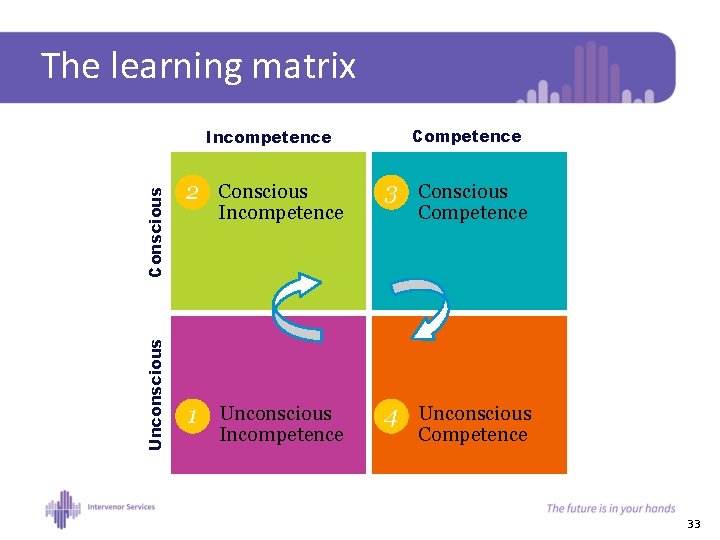
The learning matrix Unconscious Conscious Incompetence Competence 22. Conscious 33. Conscious 11. Unconscious 44. Unconscious Incompetence Competence 33
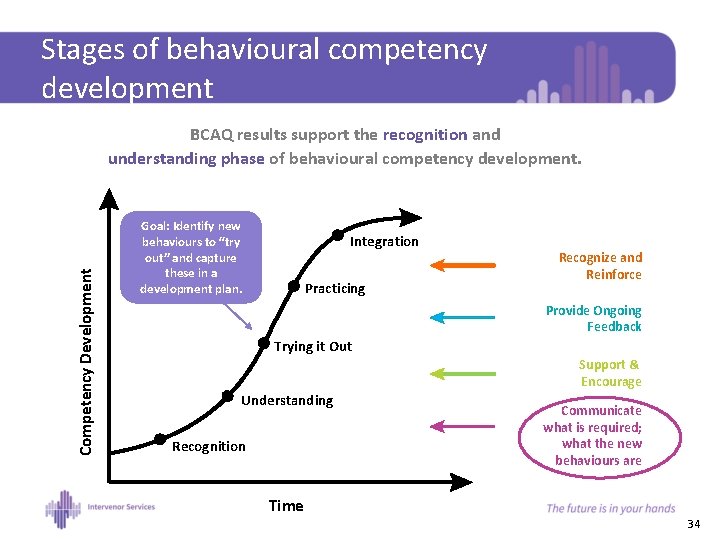
Stages of behavioural competency development Competency Development BCAQ results support the recognition and understanding phase of behavioural competency development. Goal: Identify new behaviours to “try out” and capture these in a development plan. Integration Practicing Recognize and Reinforce Provide Ongoing Feedback Trying it Out Support & Encourage Understanding Recognition Communicate what is required; what the new behaviours are Time 34
In summary Your role as leader is to: • Support your team members in their development • Provide coaching and mentoring • Look for on-the-job activities where they can practice and hone their behavioural competencies • Gather behavioural evidence on each team member to help raise awareness with respect to the competency levels they are demonstrating, and provide feedback on a regular, just-intime basis 35
Questions? 36
- Slides: 36