
Coaching Counts Practices to Sustain AND Enhance PBISMTSS
Coaching Counts! Practices to Sustain AND Enhance PBIS/MTSS Implementation Shelee King George & Shirley Cutshall May 23, 2018
Entry Activity Reflect on a time when you received effective coaching and the process used by your “coach”. Use sticky notes to jot down key thoughts regarding: Who was person (characteristics, NOT name); When did this occur in your development; What skills did you observe in process; How did it feel to you; and Why do you believe this was successful coaching?
Your Learning Today Knew New Renew
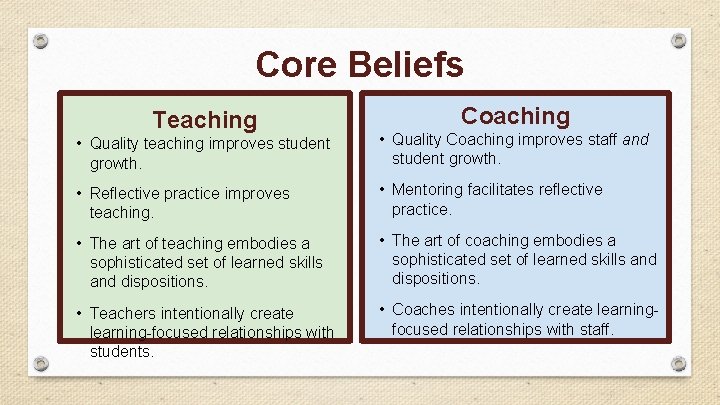
Core Beliefs Teaching Coaching • Quality teaching improves student growth. • Quality Coaching improves staff and student growth. • Reflective practice improves teaching. • Mentoring facilitates reflective practice. • The art of teaching embodies a sophisticated set of learned skills and dispositions. • The art of coaching embodies a sophisticated set of learned skills and dispositions. • Teachers intentionally create learning-focused relationships with students. • Coaches intentionally create learningfocused relationships with staff.
Agenda & Focus for Coaching Counts! Opening Activity Coaching Beliefs Coaching Tools Sustainability Action Planning
Coaching Tools Listening Paraphrasing Questioning Stances Learning-Focused Conversations
Listening Attending fully is the key. Read Pages 35 -36 (Mentoring Matters by Laura Lipton and Bruce Wellman) A word, a phrase or a sentence that resonates with you.
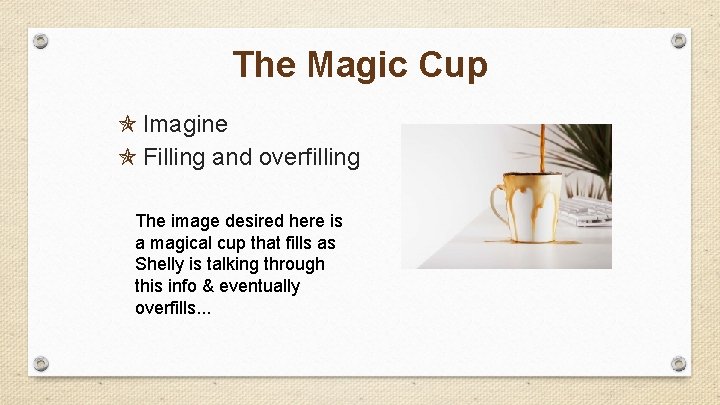
The Magic Cup Imagine Filling and overfilling The image desired here is a magical cup that fills as Shelly is talking through this info & eventually overfills. . .
Just Listen Activity A-B Partners A: For 1 minute, talk about a challenge you are facing with PBIS implementation B: Just listen Switch roles Reflection
Roadblocks to Listening Competing thoughts on call waiting “I” listening Personal referencing (Me too) Personal curiosity (Questions to satisfy your own needs) Personal Certainty (Your solution to the problem)
Reflection Journal #1 What is the value of listening when assuming the role of a coach? Which roadblocks might be the most difficult to overcome for you?
Coaching Tools Listening Paraphrasing Questioning Stances Learning-Focused Conversations
Paraphrasing is… • A way to create a space and place for thinking and reflection. • Shorter than the original telling. • In your own words. Paraphrasing is not… • NOT “I” listening. • NOT “Parrot-phrasing”. • NOT listening to respond or give advice.
Paraphrasing Skill Paraphrasing signals our full attention Validates the speaker Creates an invitation for questions Labels the content of the speaker Connects the emotion to the speaker Frames a logical level for holding the content
Three Types of Paraphrasing Three Intentions Acknowledging and Clarifying Identify and calibrate content and emotions • You’re noticing that… Summarizing and Organizing Useful when lots of information • So there seems to be two key issues here. . . Shifting Level of Abstraction Leads to new discoveries • So one of your beliefs is. . .
Language Plural Form reduces anxiety over judgement Goals not goal, hunches not hunch Creates choice and emotional safety Exploratory Language increases possibilty thinking Some not the Might not could Seems not is What not why
Just Listen Again A-B Partners Focus on Listening then Paraphrasing after one minute Paraphrasing Sentence Stems P-Q Card
Reflection Journal #2 Considering the value of paraphrasing, which type of paraphrasing will be the easiest? Which will be the most challenging?
Coaching Tools Listening Paraphrasing Questioning Stances Learning-Focused Conversations
Questioning Two purposes Self… clarifying questions Speaker… probing questions Inviting thinking with clarifying questions Tell me more about Opens thinking Plural language Probing Questions invite discovery
Probing Questions Real–You don’t know the answer to it. Honest–No advice hiding as a question (Have you thought about. . . ? ) Open-ended–Requires more than a yes/no reply Prompts for thinking–Not descriptive, research, or retell (What happened? What did they do? ); but higher level instead (What were you noticing? What options were you considering? ) P Q Chart
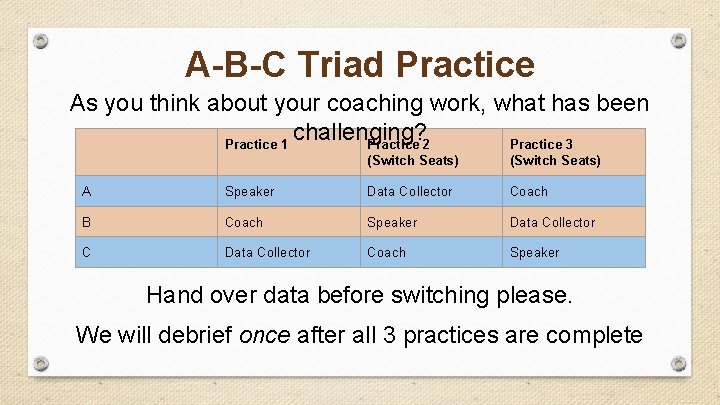
A-B-C Triad Practice As you think about your coaching work, what has been challenging? Practice 1 Practice 2 Practice 3 (Switch Seats) A Speaker Data Collector Coach B Coach Speaker Data Collector Coach Speaker Hand over data before switching please. We will debrief once after all 3 practices are complete
Reflection Journal #3 What situations tend to lure you into advice giving? What tools might you use as you coach teacherthinking?
Coaching Tools Listening Paraphrasing Questioning Stances Learning-Focused Conversations
Stances Coaching Roles: WHAT we do = Provide support, create challenge, facilitate professional vision Stances: HOW we do it = Consult, collaborate, coach
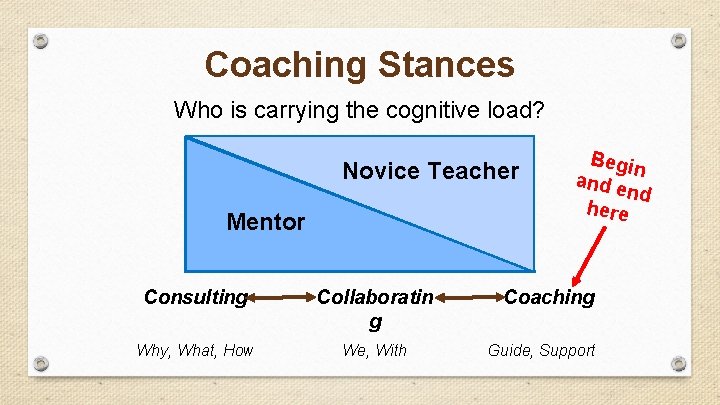
Coaching Stances Who is carrying the cognitive load? Novice Teacher Mentor Consulting Collaboratin g Why, What, How We, With Begin and e nd here Coaching Guide, Support
Jigsaw Reading Pages 22, 24, 26 Mentoring Matters (Lipton, Wellman) 1= P 22 Consulting 2=P 24 Collaborating 3= P 25 -26 Coaching
Stance Activity Create an example for each of the stances related to PBIS Share out
Working Lunch Partners get 4 colored cards. Create a scenario that addresses a PBIS challenge Write the scenario on a card Create a response representing each of 3 stances One response per card Perform Partners choose a color set not their own Partner and act this scenario & each response The audience guesses the stance used in each
Coaching Tools Listening Paraphrasing Questioning Stances Learning-Focused Conversations
Learning-Focused Conversations Supports thinking Replaces advice with attention Paraphrase to reflect thinking Question to extend, deepen, shift thinking As a result, the problem solving shifts to the speaker
Replacing Advice with Attention Say more about that. Interesting… what’s your hunch? What are you noticing about that? What makes that really important to you? [When the person answers, ask it again…]
Practice Speaker – Begin with “Something has me stuck at work right now is…” Listener – Replace advice with attention Say more about that. Interesting… what’s your hunch? What are you noticing about that? What makes that important to you?
Reflection Journal #4 As you think about PBIS fidelity implementation at your school, what do you want to remember about mentor stances and learning-focused conversations?
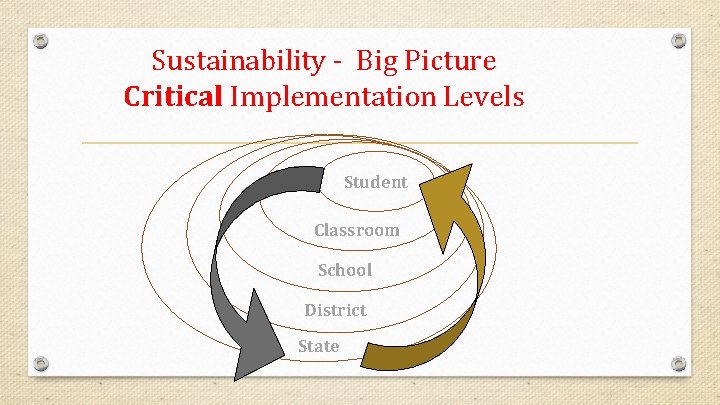
Sustainability - Big Picture Critical Implementation Levels Student Classroom School District State
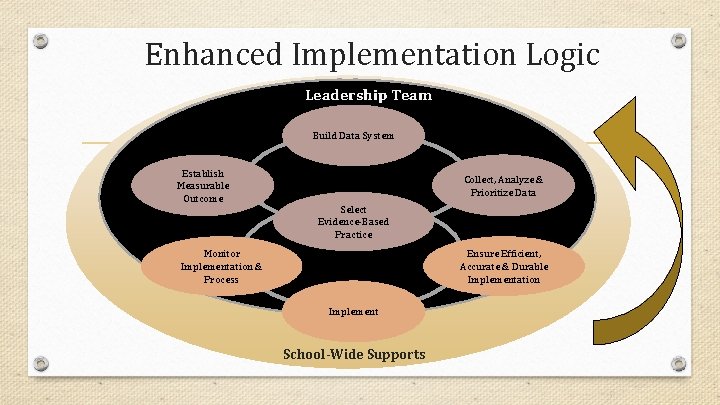
Enhanced Implementation Logic Leadership Team Build Data System Establish Measurable Outcome Collect, Analyze & Prioritize Data Select Evidence-Based Practice Monitor Implementation & Process Ensure Efficient, Accurate & Durable Implementation Implement School-Wide Supports
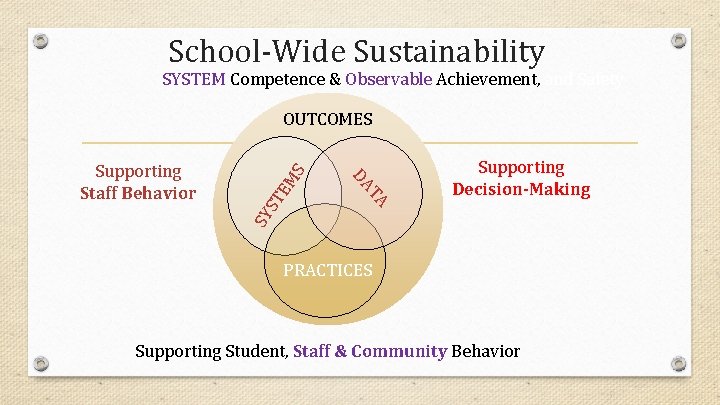
School-Wide Sustainability SYSTEM Competence & Observable Achievement, and Safety EM SY ST TA DA Supporting Staff Behavior S OUTCOMES Supporting Decision-Making PRACTICES Supporting Student, Staff & Community Behavior
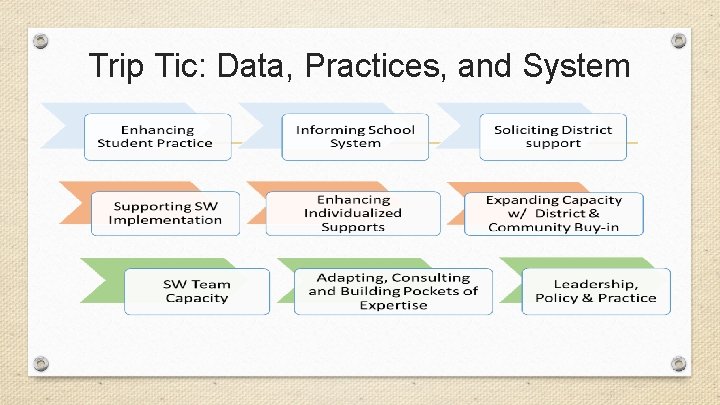
Trip Tic: Data, Practices, and System
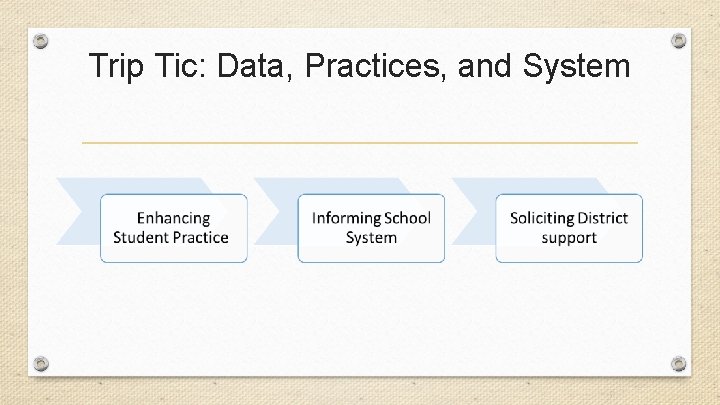
Trip Tic: Data, Practices, and System
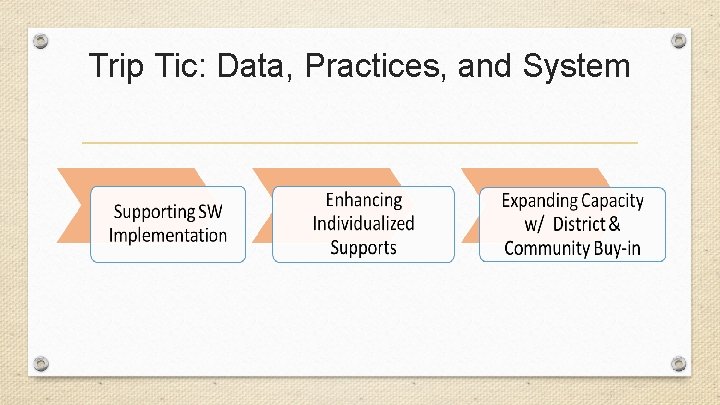
Trip Tic: Data, Practices, and System
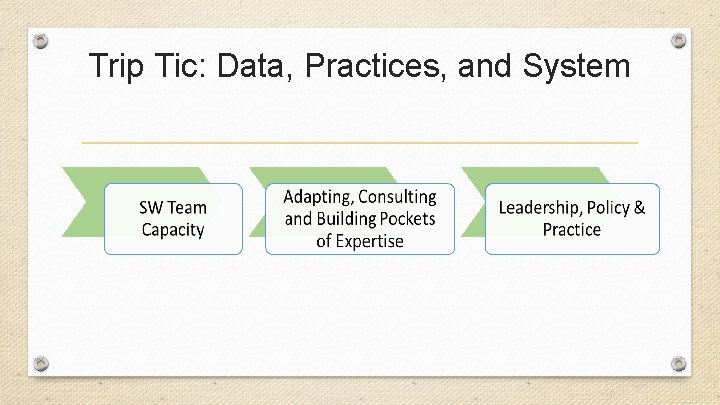
Trip Tic: Data, Practices, and System
BUILDING BLOCKS: Coaching Mastery Check & Planning • Using your Coaching Mastery sheet, highlight the skill areas that you have MASTERED (this is your hands-on Trip Tic); • Review Reflection Journal from today and identify key areas of personal growth; then, • Reframe to a PROBLEM OF PRACTICE, which you and partners will process through A-B-C protocol.
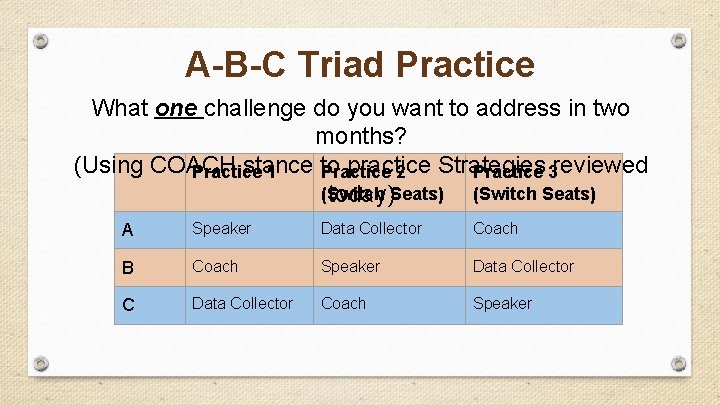
A-B-C Triad Practice What one challenge do you want to address in two months? (Using COACH stance to practice Strategies Practice 1 Practice 2 Practice 3 reviewed (Switch today)Seats) (Switch Seats) A Speaker Data Collector Coach B Coach Speaker Data Collector Coach Speaker
Debrief & Culminating Document Triad: what did you observe as similiarities in 1) problem of practice, and strategies most utilized in A-B-C protocol. Large group report-out (observe & record pattern)
Now What? ü Create document template or email, reflect on where you are now in your practice, then elaborate to 3 prompts at right ü Share privately to Shirley’s email: scutshall@nwesd. org In your coaching practice, what key areas do you want to target for change? List Steps to ensure you follow through with change and timeline. How will you measure your success of action?
Take Care of YOU so you can take care of OTHERS 1. Me First: Prioritize & limit time… not quality 2. Assess Status: Know where you are and where others need to go 3. Time Management: Build their network by connecting and encouraging 4. Silo Feelings: Shelter & Share as appropriate 5. Positive Focus: INTENT is positive & learning profound when positivity prevails. 6. Centered: Be in the NOW
Resources ❖PBIS. org ➢Research ➢Strategies ➢Tools ❖IRIS center ➢Training for Classroom management & behavior integrated w/ theory & research ❖NWPBIS ➢Papers, Power. Points, Tools ❖ Others…
Coach Cohort III – EOY Report ❖Remember to provide PBIS Sustainability Plan: Building Team Cohort VI To Shirley --- scutshall@nwesd. org Before you depart for Summer BREAK, or no later than June 30, 2018!!
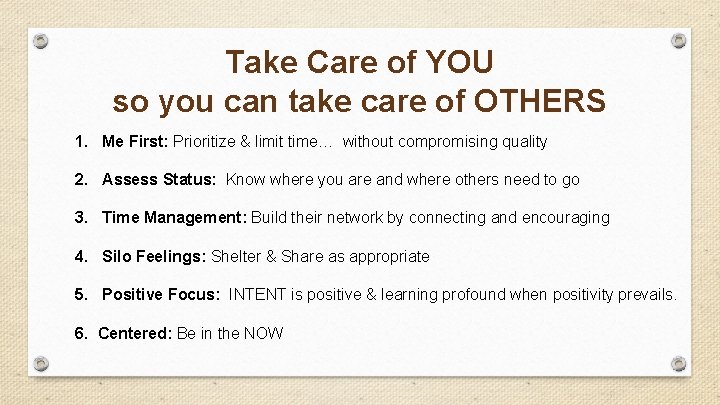
Take Care of YOU so you can take care of OTHERS 1. Me First: Prioritize & limit time… without compromising quality 2. Assess Status: Know where you are and where others need to go 3. Time Management: Build their network by connecting and encouraging 4. Silo Feelings: Shelter & Share as appropriate 5. Positive Focus: INTENT is positive & learning profound when positivity prevails. 6. Centered: Be in the NOW
"The meaning of life is to find your gift. The purpose of life is to give it away. " ~Pablo Picasso
- Slides: 50