
Coaching Children and Young People sports coach UK
- Slides: 12
Coaching Children and Young People sports coach UK Develop Your Coaching Workshop
Workshop outcomes By the end of the workshop, coaches should be able to: • establish safe and effective coaching environments to meet the needs of children and young people • describe the LTAD model • identify the critical periods of trainability within the LTAD model • describe the acquisition of skills as children develop • modify coaching to meet the needs of children and young people OHT 1 Coaching Children and Young People
Information required • Social/psychological factors – motivation, needs, ambitions, attitudes, behaviour • Physical factors – ability, fitness, stage of physical development • Skill factors – stage of motor development, information processing OHT 2 Coaching Children and Young People
Principles of coaching children and young people • Make it fun • Avoid specialising too early • Put performer first OHT 3 Coaching Children and Young People
Principles of LTAD • Athlete-centred • Promote long-term participation • Maximise full potential OHT 4 Coaching Children and Young People
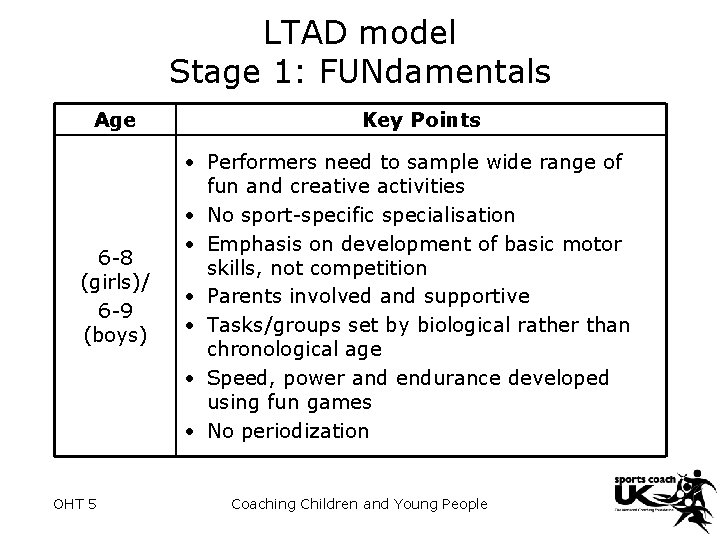
LTAD model Stage 1: FUNdamentals Age 6 -8 (girls)/ 6 -9 (boys) OHT 5 Key Points • Performers need to sample wide range of fun and creative activities • No sport-specific specialisation • Emphasis on development of basic motor skills, not competition • Parents involved and supportive • Tasks/groups set by biological rather than chronological age • Speed, power and endurance developed using fun games • No periodization Coaching Children and Young People
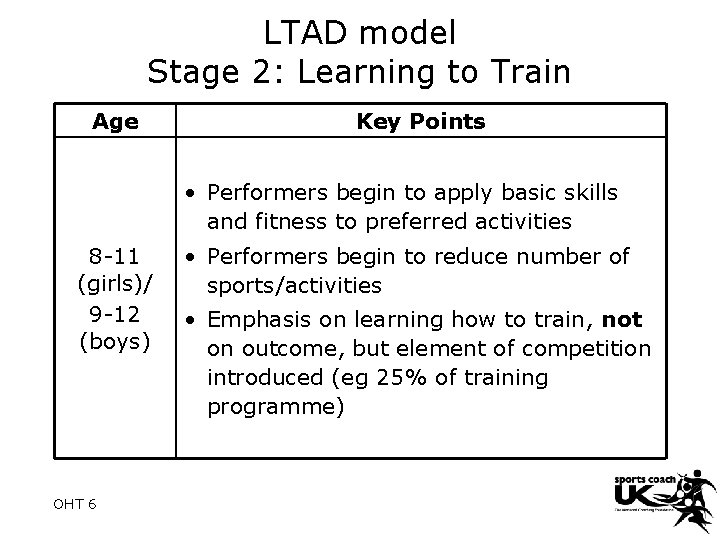
LTAD model Stage 2: Learning to Train Age Key Points • Performers begin to apply basic skills and fitness to preferred activities 8 -11 (girls)/ 9 -12 (boys) OHT 6 • Performers begin to reduce number of sports/activities • Emphasis on learning how to train, not on outcome, but element of competition introduced (eg 25% of training programme)
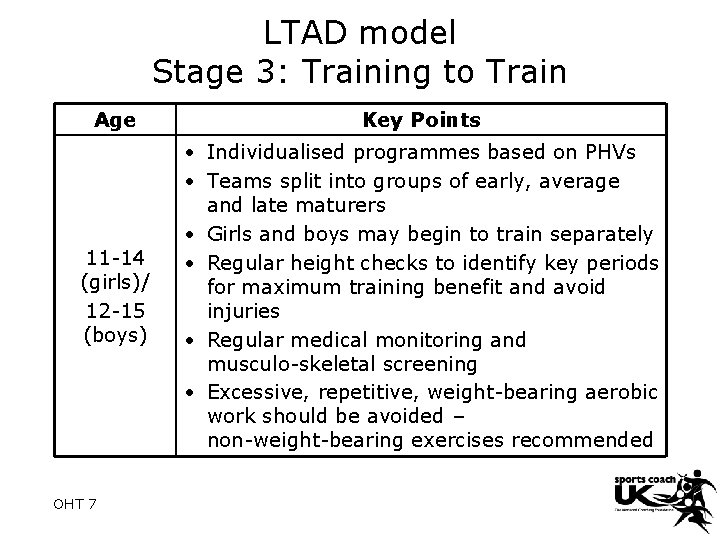
LTAD model Stage 3: Training to Train Age Key Points 11 -14 (girls)/ 12 -15 (boys) • Individualised programmes based on PHVs • Teams split into groups of early, average and late maturers • Girls and boys may begin to train separately • Regular height checks to identify key periods for maximum training benefit and avoid injuries • Regular medical monitoring and musculo-skeletal screening • Excessive, repetitive, weight-bearing aerobic work should be avoided – non-weight-bearing exercises recommended OHT 7
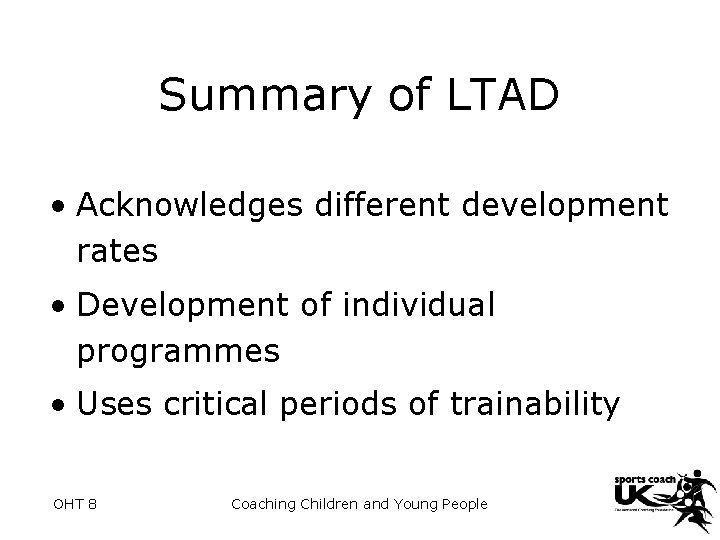
Summary of LTAD • Acknowledges different development rates • Development of individual programmes • Uses critical periods of trainability OHT 8 Coaching Children and Young People
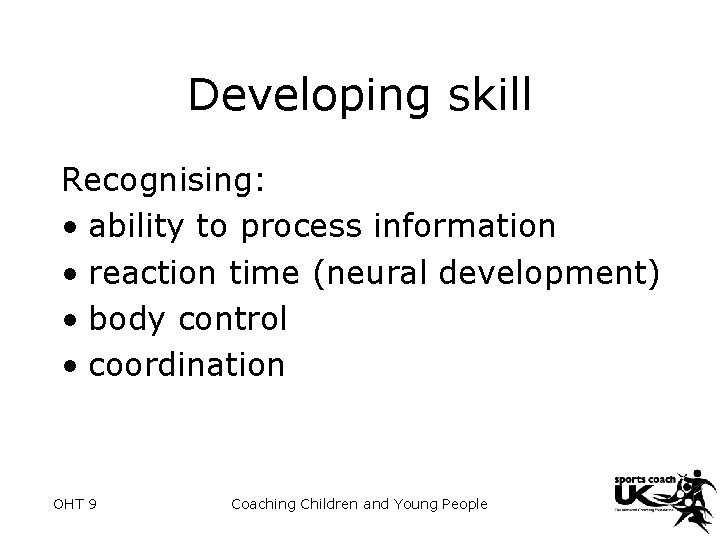
Developing skill Recognising: • ability to process information • reaction time (neural development) • body control • coordination OHT 9 Coaching Children and Young People
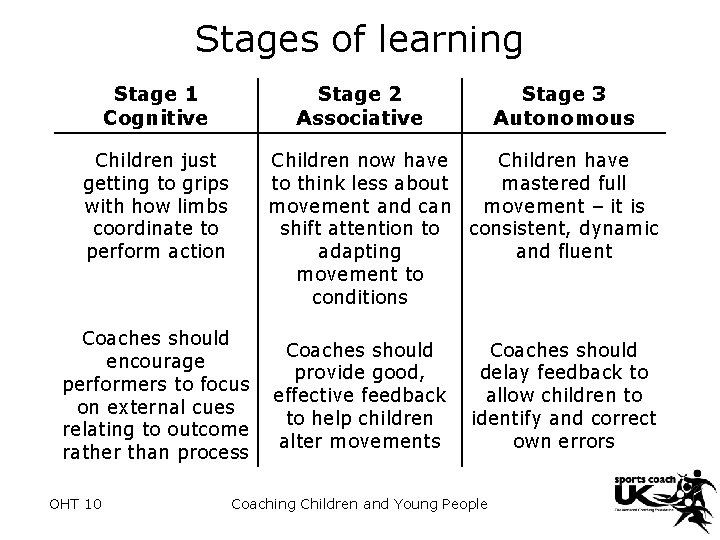
Stages of learning Stage 1 Cognitive Stage 2 Associative Children just getting to grips with how limbs coordinate to perform action Children now have Children have to think less about mastered full movement and can movement – it is shift attention to consistent, dynamic adapting and fluent movement to conditions Coaches should encourage performers to focus on external cues relating to outcome rather than process OHT 10 Stage 3 Autonomous Coaches should provide good, effective feedback to help children alter movements Coaches should delay feedback to allow children to identify and correct own errors Coaching Children and Young People
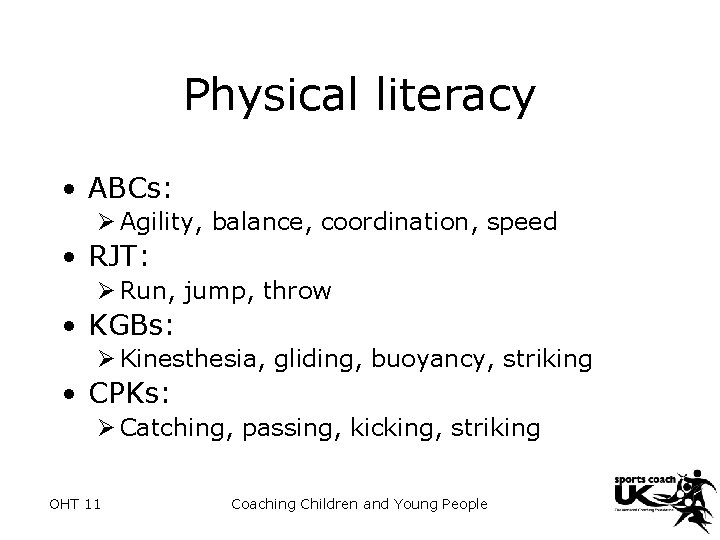
Physical literacy • ABCs: Ø Agility, balance, coordination, speed • RJT: Ø Run, jump, throw • KGBs: Ø Kinesthesia, gliding, buoyancy, striking • CPKs: Ø Catching, passing, kicking, striking OHT 11 Coaching Children and Young People