
Coaching and Mentoring Your totem goes here you

- Slides: 20
Coaching and Mentoring Your totem goes here, you may use a build if you desire Your name goes here Your course position goes here NE-II-177
Learning Objectives As a result of this session, you will: Understand the different roles of coaching and mentoring. Describe ways in which the skills of coaching and mentoring can be used to lead teams and individuals. NE-II-159 2
NE-II-159 3
NE-II-159 4
Responsibilities of Leadership People look up to us Responsible: NE-II-159 to listen to them to pay attention to them to understand their wants and needs to convey our values through our actions to live by the standards that we expect others to uphold 5
Responsibilities of Leadership You need to understand the situation before you can make the right choices. We often feel the need to fill a leadership void - to jump in immediately and take charge of a situation before we understand what's really going on or what sort of leadership the people involved really need. To lead well, invest energy in listening so that we can assess the situation, figure out what is really missing or needed by this person or team, and then figure out how to fulfill the need. NE-II-159 6
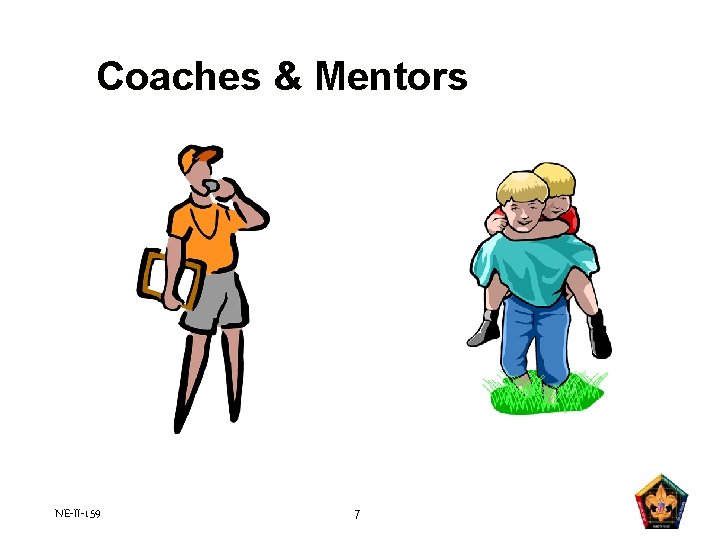
Coaches & Mentors NE-II-159 7
Coaches & Coaching A Coach is an individual who develops skills and capabilities in another person/group of people Coaching is a leadership behavior & skill. It can take the form of discussion, lecture, critique, guided practice It is generally ongoing as a youth or team progresses It is often a “formalized relationship” or teaching/learning process The key concept is “letting go” and “enabling success” As capabilities grow, a coach may become a mentor to facilitate continued growth of an individual or in the NE-II-159 “Delegating” stage stand 8 aside as a team resource.
Mentors & Mentoring A mentor is an experienced Scout or adult leader who becomes a trusted guide and counselor of a less experienced individual This trusting and caring relationship normally extends beyond Scouting skills into values, beliefs and feelings A mentor may be assigned but often this relationship occurs naturally and is fostered between the individuals involved. NE-II-159 9
What Do Coaches Do? Provide task direction and vision Provide skill instruction Build team and individual capabilities Provide resources Facilitate external relationships for individuals and teams Transfer responsibilities for success to the team Support the growth and progress of individuals NE-II-159 in the program 10
Tips on Being a Good Coach Listen Supply energy Provide focus Provide information Influence, don't control Recognize team and individual success Recognize what's right versus what's wrong Value differences Evolve and grow with the team's life cycle NE-II-159 11
What Do Mentors Do? Advise, support, and/or provide guidance on subjects that a young person may find difficult to discuss with other leaders or peers Help a mentored person develop an understanding of the unit environment and “culture” and the practicalities of life in the unit Instill attitudes, “social intelligence”, and values embracing Scouting Provide trusted counsel and a broader perspective on Scouting and personal issues NE-II-159 12
Tips on Being a Good Mentor Provide a safe, non-threatening environment in which a person can ask difficult or sensitive questions. Keep confidences. Build trust early Be a good listener Share personal experiences that address the issues a mentored person is facing Make suggestions on specific Scouting problems Make suggestions on what it takes to get things accomplished NE-II-159 13
Coaching/Mentoring Role Play Tom R. Sage: Venturing Legend Setup NE-II-159
Coaching/Mentoring Role Play Tom R. Sage: Venturing Legend Role Play NE-II-159
Coaching/Mentoring Role Play Tom R. Sage: Venturing Legend Reflection NE-II-159
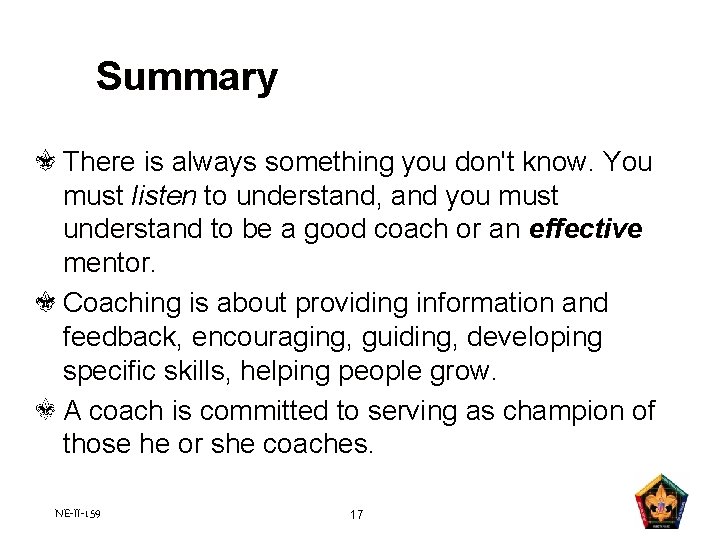
Summary There is always something you don't know. You must listen to understand, and you must understand to be a good coach or an effective mentor. Coaching is about providing information and feedback, encouraging, guiding, developing specific skills, helping people grow. A coach is committed to serving as champion of those he or she coaches. NE-II-159 17
Summary con't A mentor uses trust and loyalty to build a relationship. Mentoring is about thoughtful listening, careful restating, and wise observation. It is not telling, selling or giving advice. Mentoring is usually about helping to clarify major life issues such as values, beliefs, purpose, and direction. Avoid becoming a “Sage on the Stage” - know-it-all who already has the answers. Such a person is rarely seen as a good coach or mentor, and is NE-II-159 18 rarely an effective leader.
Learning Objectives As a result of this session, you should: Understand the different roles of coaching and mentoring. Describe ways in which the skills of coaching and mentoring can be used to lead teams and individuals. NE-II-159 19
Thank You! Your totem goes here, you may use a build if you desire NE-II-177 20