
CO 2 in Power Plant Waters Review Trends
- Slides: 16
CO 2 in Power Plant Waters Review, Trends and Management Kirk Buecher Matarvattenkonferensen 2014
Agenda § Some of the basics - Where does it come from? - What is the impact on corrosion? - What is the impact on analytics? § Industry trends - Cycling Plants - Gas Combined Cycle - "Mega" Coal Plants § Problem with CO 2? § Steps to manage CO 2
Some of the basics Where does it come from? § Directly or indirectly from raw/source waters - Direct : Some surface water and well water sources - have higher levels of carbonates Indirect : Higher levels of Organics in the source water will break down into organic acids and CO 2 § From the processes inside the plant - Air Ingress : 21% O 2 with. 04% CO 2 - Water storage : "Hungry water fighting back to equilibrium" 8 Conductivity increases quickly with air contact from ~0. 06 μS/cm to 1. 8 – 2. 0 μS/cm within 6 -12 hours - Boiler Steam Cycle : Breakdown of some treatment chemicals (amines) and any other organics present 2
Impact on Corrosion A supporting not primary actor § IAPWS - It is considered non-corrosive to the steam turbine, when its concentration is within reasonable limits § CO 2 (Carbonic Acid) is a volatile weak acid However, if it is present with O 2 § The combined effect is even higher levels of corrosion at accelerated rates - Example – Acid in the condensate attacks tube walls forming ferrous bicarbonate. With any O 2 present in the feedwater, it oxidizes to ferric oxide, liberating the CO 2 to repeat the process 3
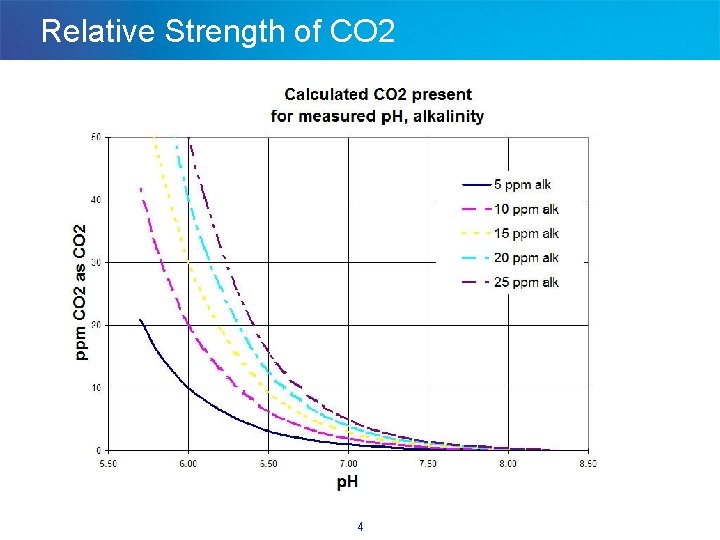
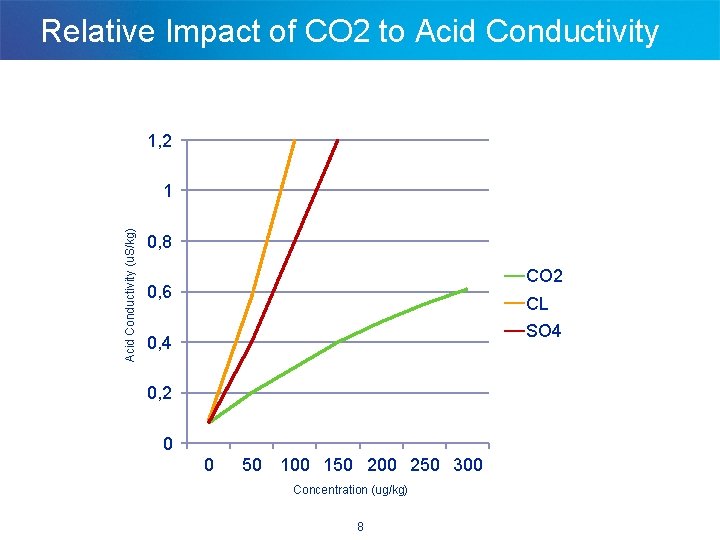
Relative Strength of CO 2 4
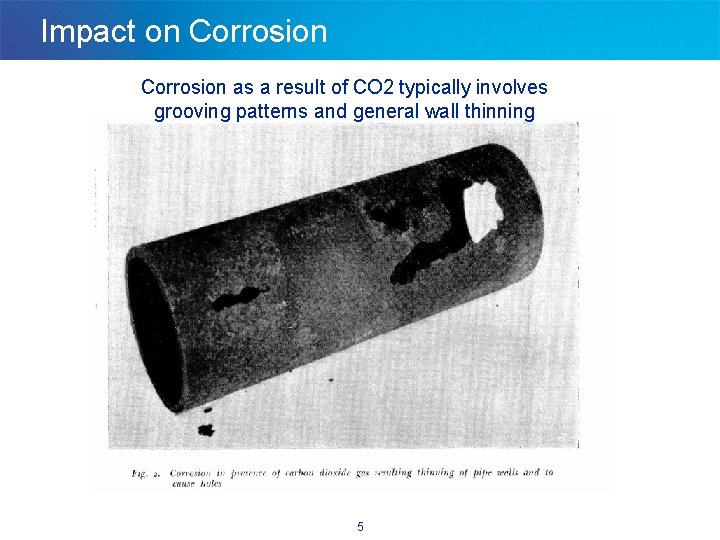
Impact on Corrosion as a result of CO 2 typically involves grooving patterns and general wall thinning 5
Impact on Analytics Interferes with accuracy and clear decision making, based on the relationship between readings § Misleading high readings on Cation Conductivity masking other more serious problems - Creates doubt around the alerts/alarms for the most important water sample panel parameter § Affects p. H leading to overdosing of phosphate or ammonia § But measurement of CO 2 is possible using ASTM methods 6
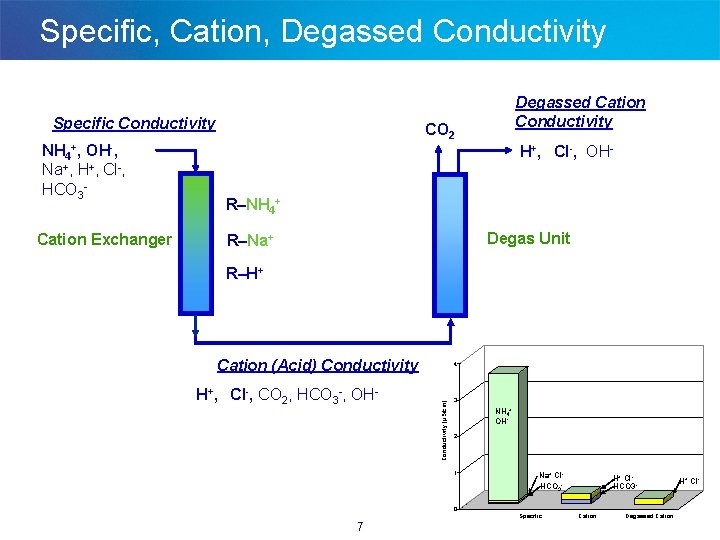
Specific, Cation, Degassed Conductivity Specific Conductivity Cation Exchanger CO 2 H+, Cl-, OH+ + R–H R–NH 4 Degas Unit + + R–Na R–H+ Cation (Acid) Conductivity H+, Cl-, CO 2, HCO 3 -, OH- 4 Conductivity (µS/cm) NH 4+, OH-, Na+, H+, Cl-, HCO 3 - Degassed Cation Conductivity 3 NH 4+ OH 2 1 0 7 Na+ Cl. HCO 3 Specific H+ Cl. HCO 3 - Cation Degassed Cation H+ Cl-
Relative Impact of CO 2 to Acid Conductivity 1, 2 Acid Conductivity (u. S/kg) 1 0, 8 CO 2 0, 6 CL SO 4 0, 2 0 0 50 100 150 200 250 300 Concentration (ug/kg) 8
Computed CO 2 Cation Conductivity minus Degassed Cation Conductivity ASTM D 4519 9
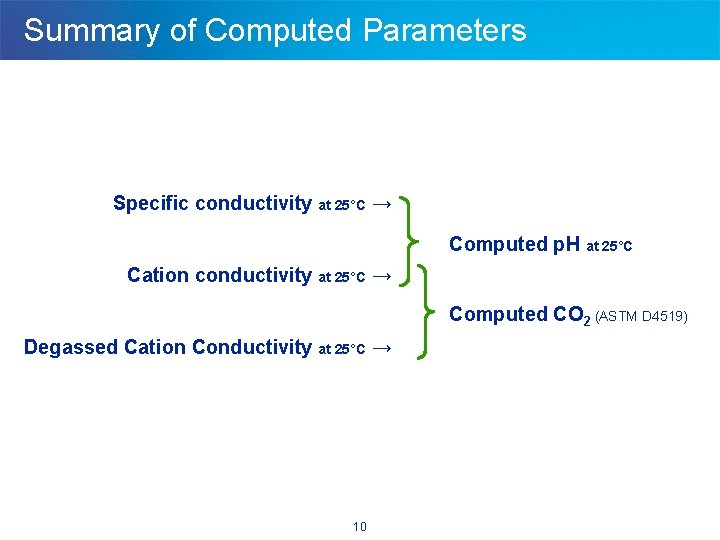
Summary of Computed Parameters Specific conductivity at 25°C → Computed p. H at 25°C Cation conductivity at 25°C → Computed CO 2 (ASTM D 4519) Degassed Cation Conductivity at 25°C → 10
Industry Trends Cycling Plants § Better accuracy, faster response to get to that critical "go/no go" full load decision Gas Turbine/Combined Cycle Plants § Tend to cycle more AND have more problems with high volume water treatment and CO 2 levels "Mega" Coal Plants (2, 000 MW and up) § With Super and Ultra Critical Boilers § China leading the way Industry Standards & Boiler/Turbine Mfgs 11
Problem with CO 2? CO 2 + H 2 O -> H 2 CO 3 -> HCO 3 - + H+ How do you know? § Increased cation conductivity in condensate and feed water (with no condensate polisher) § Decrease in cation conductivity from main condensate to feed water when increasing deaeration in feed water tank § Acid conductivity of steam at the same level as the feed water § No increasing tendency of acid conductivity (caustic, AVT) in boiler water § With Phosphate, no increasing tendency in specific conductivity 12
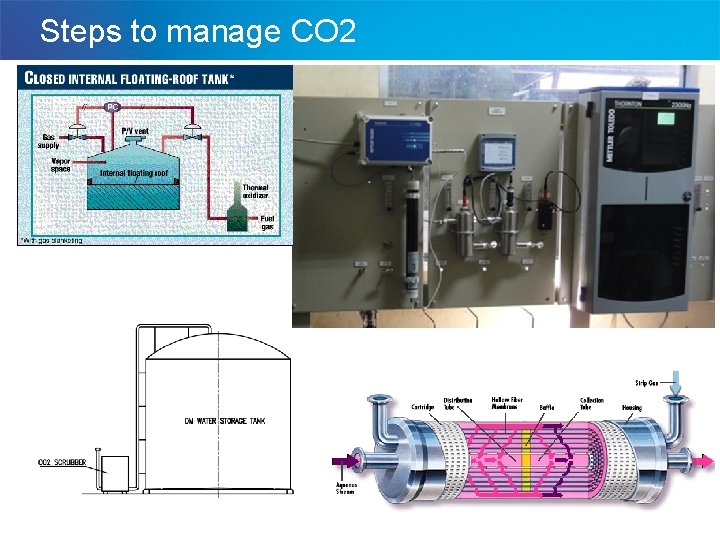
Steps to manage CO 2 13
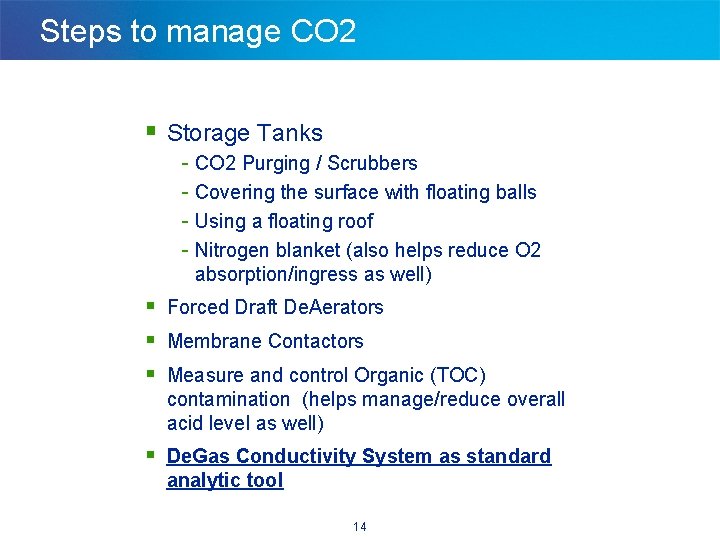
Steps to manage CO 2 § Storage Tanks - CO 2 Purging / Scrubbers - Covering the surface with floating balls - Using a floating roof - Nitrogen blanket (also helps reduce O 2 absorption/ingress as well) § Forced Draft De. Aerators § Membrane Contactors § Measure and control Organic (TOC) contamination (helps manage/reduce overall acid level as well) § De. Gas Conductivity System as standard analytic tool 14
References § IAPWS - Volatile treatments for the steam-water circuits of fossil and combined cycle/HRSG power plants, July 2010 § IAPWS – Technical Guidance Document: Steam Purity for Turbine Operation, Sept 2013 § IAPWS - Technical Guidance Document – 2012 Revision: Instrumentation for monitoring and control of cycle chemistry for the steam-water circuits of fossilfired and combined-cycle power plants § S N Mookerji and J C Kapur – Some problems of Corrosion in Thermal Power Plants § Brad Buecker – Power Plant Water Chemistry : A Practical Guide 1997 § David Addison - High Purity Water for Gas Turbine Injection – Industry Challenges with Storage and Measurement IAPWS PCC Workshop 2014 § Karsten Thomsen – Acid conductivity – basics and some experiences, Matarvattenkonferensen 2013 15 Internal usage only