
CNIT 127 Exploit Development Ch 14 Protection Mechanisms

- Slides: 69
CNIT 127: Exploit Development Ch 14: Protection Mechanisms
Topics • Non-Executable Stack • W^X (Either Writable or Executable Memory) • Stack Data Protection – Canaries – Ideal Stack Layout – AAAS: ASCII Armored Address Space – ASLR: Address Space Layout Randomization
Topics (continued) • Heap Protections • Windows SEH Protections
Protection Mechanisms • General protection mechanisms • Try to reduce the possibility of a successful exploit – Without making the vulnerability disappear • Protections have flaws and can be bypassed
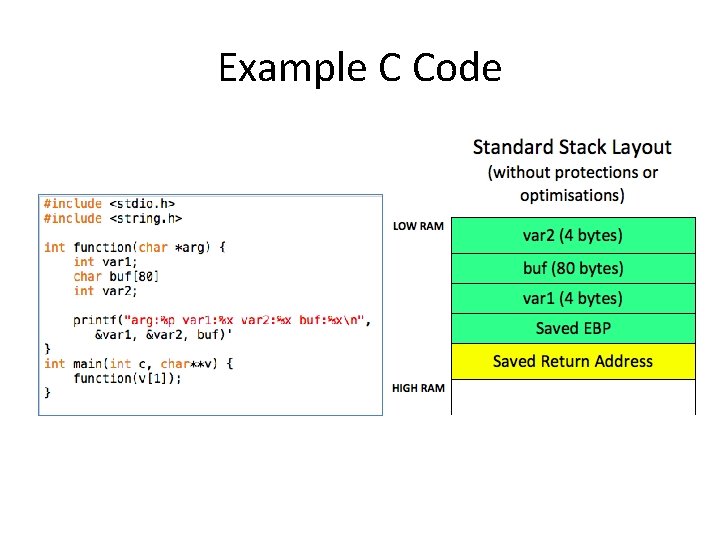
Example C Code
Non-Executable Stack
NX-Stack • Code injected onto the stack will not run • Now enabled by default in most Linux distributions, Open. BSD, Mac OS X, and Windows • Bypass techniques involve executing code elsewhere, not on the stack • The return address can still be over-written
ret 2 data • Place shellcode in the data section – Using buffered I/O, which places data on the heap, or some other technique • Use the corrupted return value to jump to it
ret 2 libc • Use return address to jump directly to code in libc – Such as system() on Unix or Win. Exec() on Windows • In a stack-based buffer overflow – Attacker controls entire stack frame – Including return address and arguments • Limitation: range of valid characters – Can't inject 'x 00'
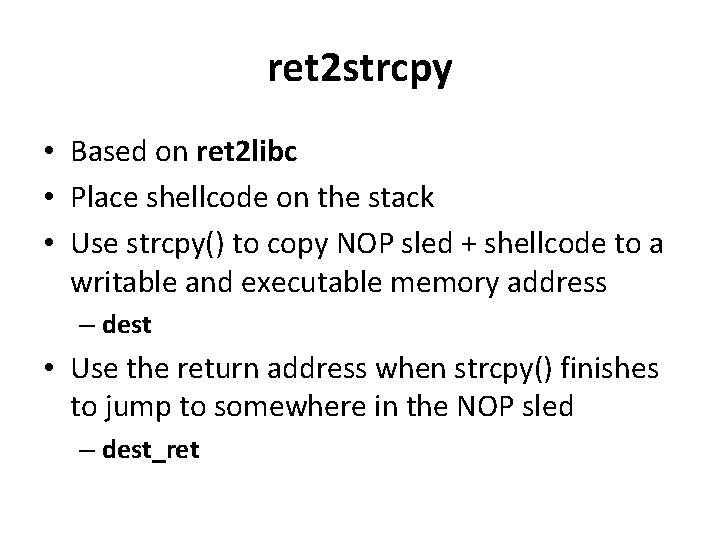
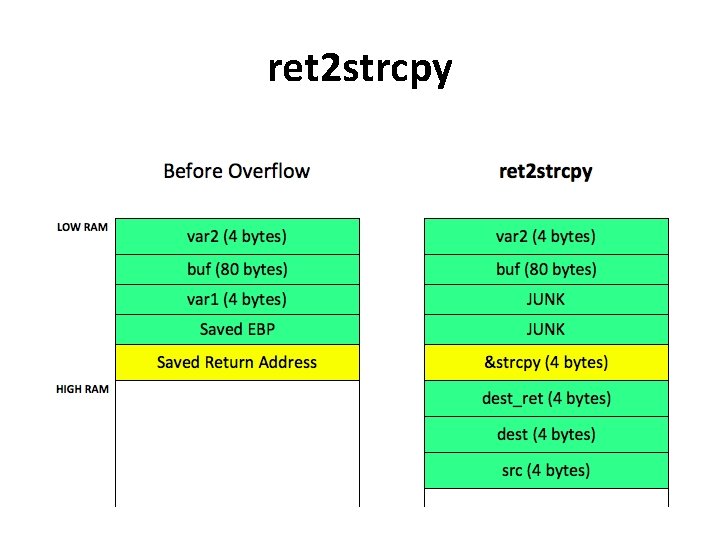
ret 2 strcpy • Based on ret 2 libc • Place shellcode on the stack • Use strcpy() to copy NOP sled + shellcode to a writable and executable memory address – dest • Use the return address when strcpy() finishes to jump to somewhere in the NOP sled – dest_ret
ret 2 strcpy
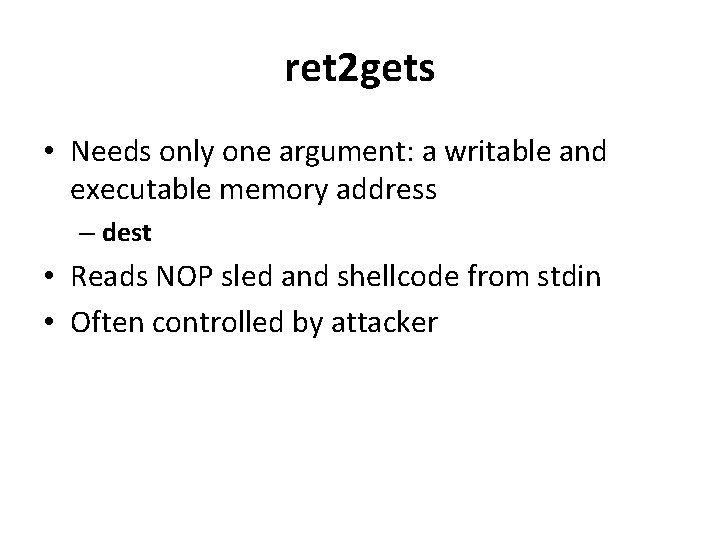
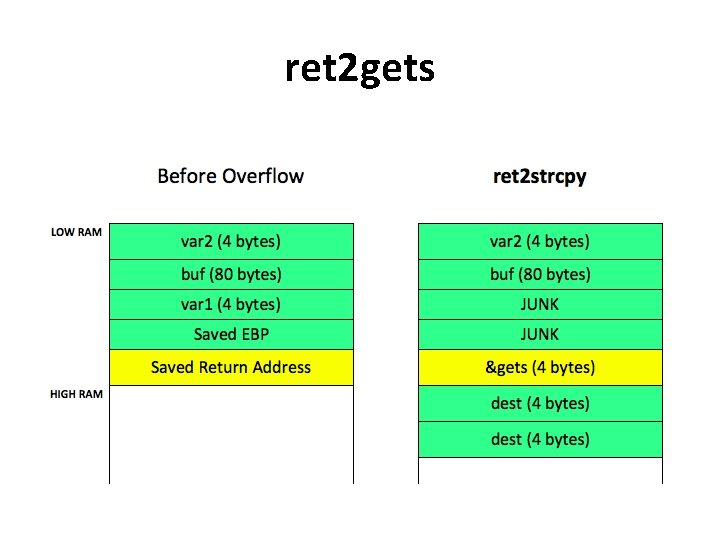
ret 2 gets • Needs only one argument: a writable and executable memory address – dest • Reads NOP sled and shellcode from stdin • Often controlled by attacker
ret 2 gets
ret 2 code • Generic name for all ways of using code that already exists in the application • May be real code that performs function for the application • Or just fragments of existing code
Chained ret 2 code • Also called chained ret 2 libc • Executes a series of calls to existing code • Three techniques – Move stack pointer to a user-controlled buffer – Fix the stack pointer after each return, with poppop-pop-ret – Return into functions implemented using pascal or stdcalling conventions, as used in Windows, which fix the stack upon return
ret 2 syscall • For Linux, the arguments for syscall are in registers • Must find two code fragments and chain them together – First one pops all the needed arguments from stack into desired registers, then returns – Second one issues a syscall • Easier on Windows, BSD, or Mac OS X – Syscall arguments on the stack
ret 2 text • Jump into the. text section of the executable binary itself – Where the program's code lives • Increasingly important to overcome other protections – W^X and ASLR
ret 2 plt • Jump to Procedure Linkage Table – A table of pointers to libc functions – Present in the memory space for every dynamically-linked ELF executable • Limited to the functions called by the program
ret 2 dl-resolve • Jump to ELF's dynamic linker resolver (ld. so) – Can perform ret 2 plt attacks using library functions that are not used by the target binary
Limitations of NX Stack • Still allows return address to be abused to divert execution flow • Does not prevent execution of – Code already present in a process's memory – Code in other data areas
W^X (Either Writable or Executable Memory)
W^X Extends NX Stack • Memory is either – Writable but not executable • or – Non-writable and executable • So injected code won't run, no matter where it goes
Pa. X • An early Linux implementation of W^X • Very secure, but never included in mainstream Linux distributions – To improve performance and maintainability
NX Bit • • Available in Windows starting with Win XP SP 2 Called "Data Execution Prevention" Opt-in for client versions Opt-out for server versions
Limitations of W^X • Chained ret 2 code still works – Using code that's already present, without changing it • ret 2 code works – As long as there is code present that does what the attacker wants • Some memory may still allow W+X • Can use chained ret 2 code to write to disk and then execve() the disk file
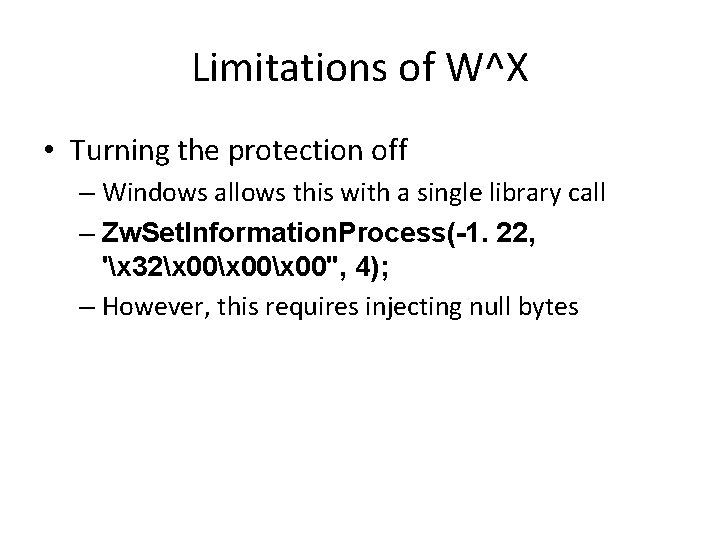
Limitations of W^X • Turning the protection off – Windows allows this with a single library call – Zw. Set. Information. Process(-1. 22, 'x 32x 00x 00", 4); – However, this requires injecting null bytes
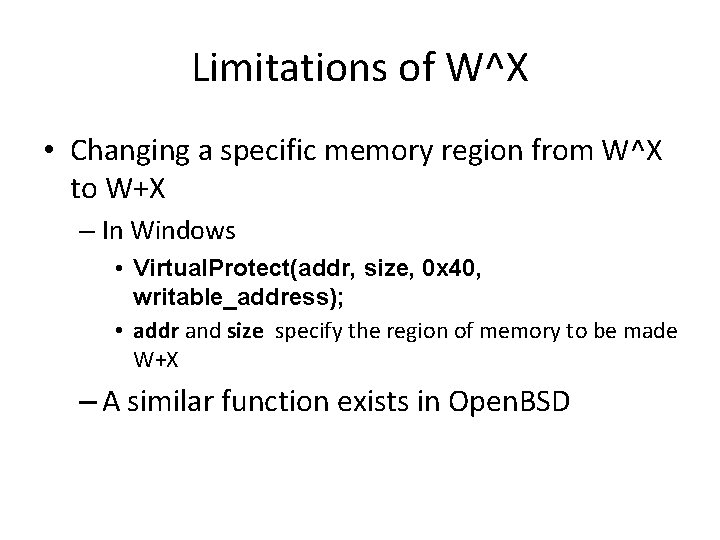
Limitations of W^X • Changing a specific memory region from W^X to W+X – In Windows • Virtual. Protect(addr, size, 0 x 40, writable_address); • addr and size specify the region of memory to be made W+X – A similar function exists in Open. BSD
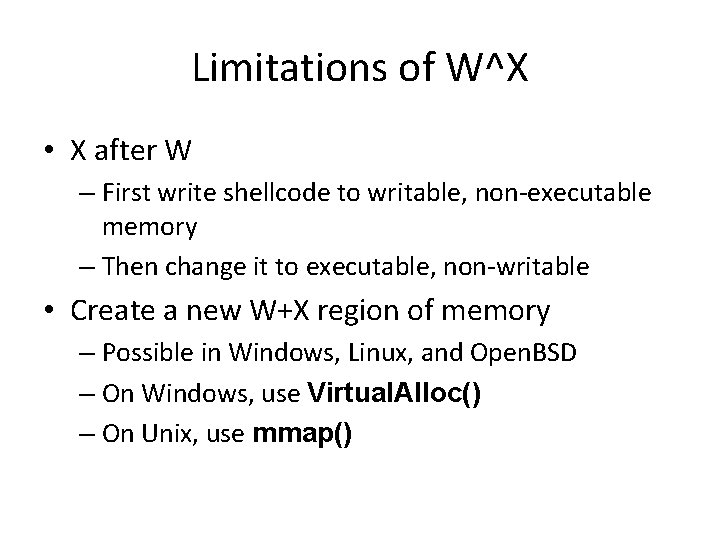
Limitations of W^X • X after W – First write shellcode to writable, non-executable memory – Then change it to executable, non-writable • Create a new W+X region of memory – Possible in Windows, Linux, and Open. BSD – On Windows, use Virtual. Alloc() – On Unix, use mmap()
Stack Data Protection
Canaries • Stack. Guard was first • Pro. Police is improved version – Also called SSP (Stack-Smashing Protector) – Now known as "gcc's Stack-Smashing Protector" or stack-protector – Included in gcc
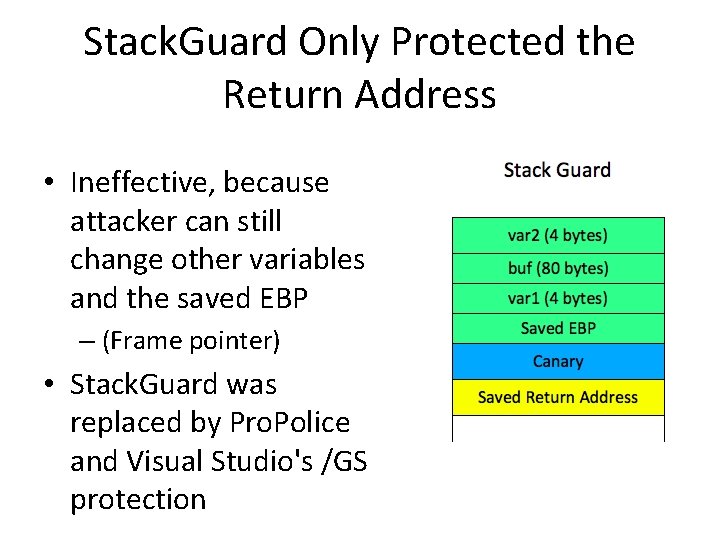
Stack. Guard Only Protected the Return Address • Ineffective, because attacker can still change other variables and the saved EBP – (Frame pointer) • Stack. Guard was replaced by Pro. Police and Visual Studio's /GS protection
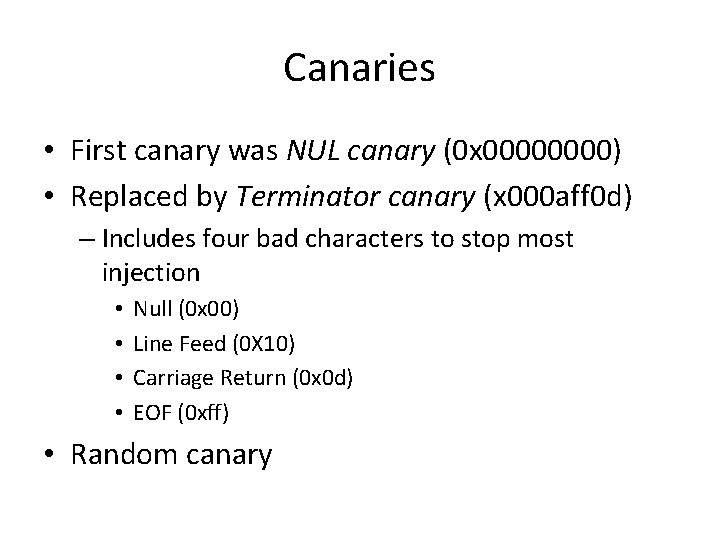
Canaries • First canary was NUL canary (0 x 0000) • Replaced by Terminator canary (x 000 aff 0 d) – Includes four bad characters to stop most injection • • Null (0 x 00) Line Feed (0 X 10) Carriage Return (0 x 0 d) EOF (0 xff) • Random canary
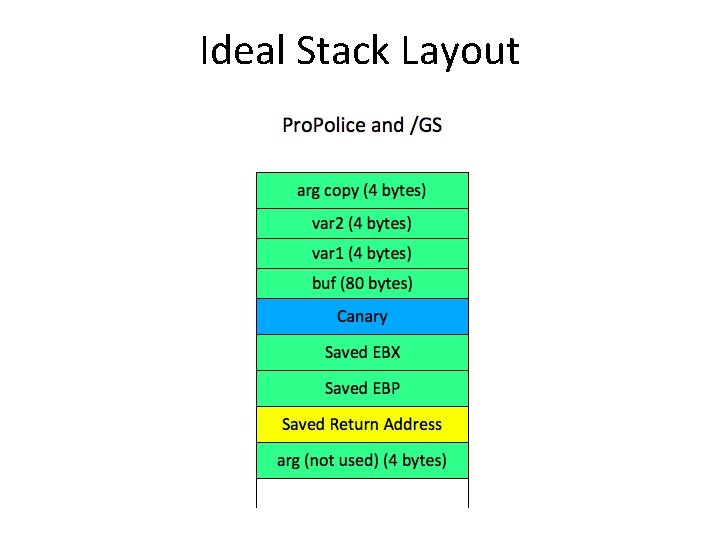
Ideal Stack Layout • Used by Pro. Police and Microsoft's /GS feature • Places local buffers at the end of the stack frame – After other local variables • Copies function arguments into local variables – And relocates them • Protects the saved EBP and return value with a canary
Ideal Stack Layout
Compromises for Performance • Both Pro. Police and Visual Studio make compromises – They protect some functions, and leave others unprotected • Visual Studio only copies vulnerable arguments – Leaving the rest unprotected
Vulnerabilities in Ideal Stack Layout • If a function contains several buffers – One buffer can overflow into the next one – Could turn a buffer overflow into a format string vulnerability • C structure members can't be rearranged – May have an unfavorable order • Functions with a variable number of arguments – Can't be placed in ideal layout
Vulnerabilities in Ideal Stack Layout • Buffers dynamically allocated with alloca() on the stack are always on top of stack frame • There may be something valuable to the attacker located after the buffer – In Windows, Exception Registration Record is stored on the stack – Other variables can be overwritten, because cookie is only checked when the function returns
AAAS: ASCII Armored Address Space
Null Bytes in Addresses • Load all shared libraries in addresses starting with 0 x 00 – Blocks string-based stack overflows – Because null bytes terminate strings • More effective on big-endian architectures – Where the 0 x 00 is at the start of the address • You can inject one 0 x 00, at the end of the string
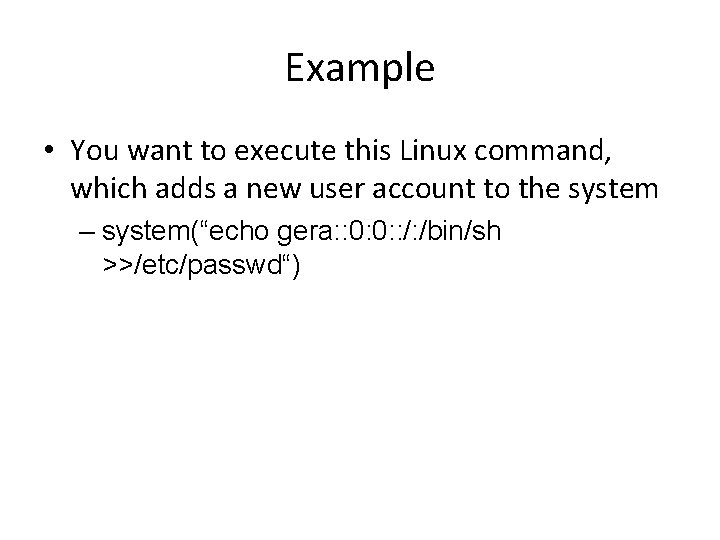
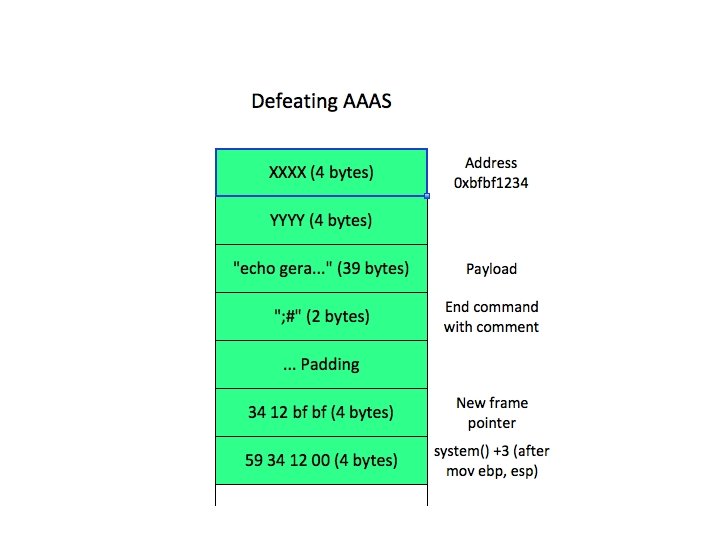
Example • You want to execute this Linux command, which adds a new user account to the system – system(“echo gera: : 0: 0: : /: /bin/sh >>/etc/passwd“)
AAAS Limitations • Main executable is not moved to the ASCII Armored Address Space – It contains lots of useful code – Function epilogues – Programs PLT
ASLR: Address Space Layout Randomization
Not All Code is Randomized • Performance suffers from ASLR – Because it means that a register is permanently occupied holding the code base – There aren't enough registers available in a 32 -bit OS to do that without slowing the system
Ways to Defeat ASLR • Use ret 2 gets – Specify location to put shellcode • Make the application supply the address for you – Useful addresses may be stored in registers or on the stack
linux-gate. so • A table of pointers used for system calls • Sometimes placed at a constant location in Linux distributions – Link Ch 14 a
Insufficient Randomization • If there are only 8 bits of entropy, an attack has 1/256 chance of working just by luck • Memory sections may maintain a fixed distance from each other, moving together by a fixed displacement – So only one guess is needed
Finding Addresses • Local privilege escalation – May be able to access "proc/<pid>/maps" – The memory map • Also, brute-forcing a 16 -bit value is not impossible – 65, 536 runs • Even a 24 -bit value can be brute-forced – 16 million runs
Finding Addresses • Format string exploits reveal contents of RAM – Such as the memory map • Several RPC calls leak memory addresses in handles that are returned to the client • Multithreaded Windows applications – Address space must be the same for all the threads in a process – More chances to find an address
fork() • Unix processes often use fork() to clone themselves • But the new fork has the same memory layout
Heap Protections
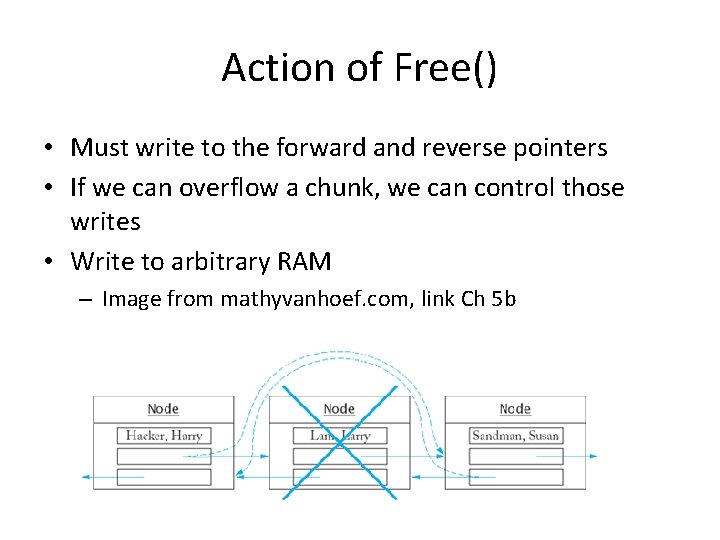
Action of Free() • Must write to the forward and reverse pointers • If we can overflow a chunk, we can control those writes • Write to arbitrary RAM – Image from mathyvanhoef. com, link Ch 5 b
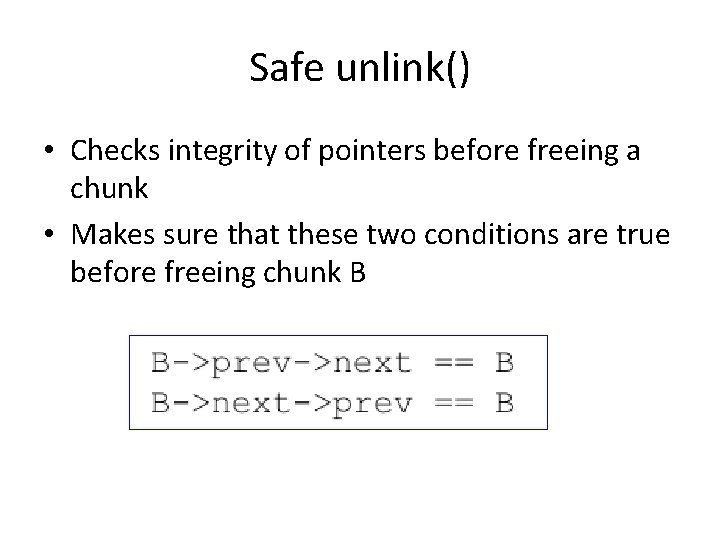
Safe unlink() • Checks integrity of pointers before freeing a chunk • Makes sure that these two conditions are true before freeing chunk B
Implementations in Various OS's • Safe unlink() is implemented in – glibc since 2004 – Windows since Win XP SP 2
Unprotected Heap Operations • Not all heap operations are protected by Safe unlink() • There are several complicated exploit techniques in Malloc Maleficarum – Exploiting code that adds a chunk, not free() – Link Ch 14 b
Heap Exploits on Windows • Unsafe Unlinking – Overwrite back and forward pointers carefully – So that the check passes – But the pointers still do desirable things when the chunk is freed – Allows a write to arbitrary RAM
Heap Exploits on Windows • Chunk-on-lookaside overwrite – Windows lookaside list records free chunks – Singly-linked, no security checks – Allows a write to arbitrary RAM • Windows Vista and later no longer use lookaside lists – Instead they use a Low Fragmentation Heap
Heap Cookies in Win XP • Windows XP SP 2 inserts an 8 -bit random cookie into each heap chunk's header • When a chunk is freed, the cookie is checked, but if the check fails, Rtl. Free. Heap() just exits without doing anything – Instead of halting program execution • So just try 256 times, until you get lucky
Heap Cookies in Vista and Later • Eight random bytes are generated when a heap is created • Used with XOR to validate each chunk's header • Other integrity checks are also used • Some degree of ASLR for the heap • This is strong heap protection
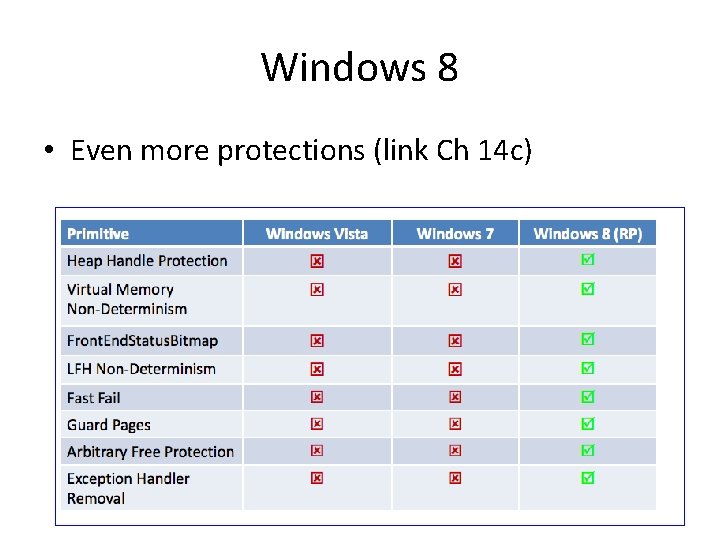
Windows 8 • Even more protections (link Ch 14 c)
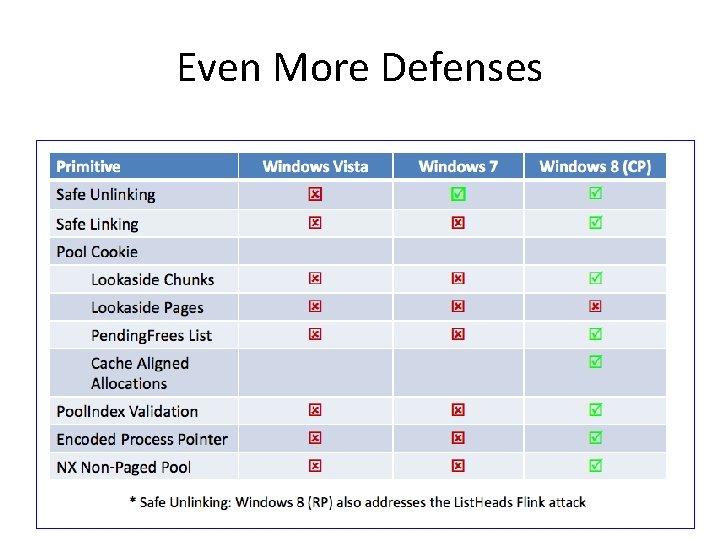
Even More Defenses
And Even More • Cookies in the Kernel Pool – Also protects lookaside lists • Non-executable kernel pool – To thwart heap spraying • Much improved randomization – Especially with Ivy Bridge CPUs – RDRAND – Hardware Random Number Generator
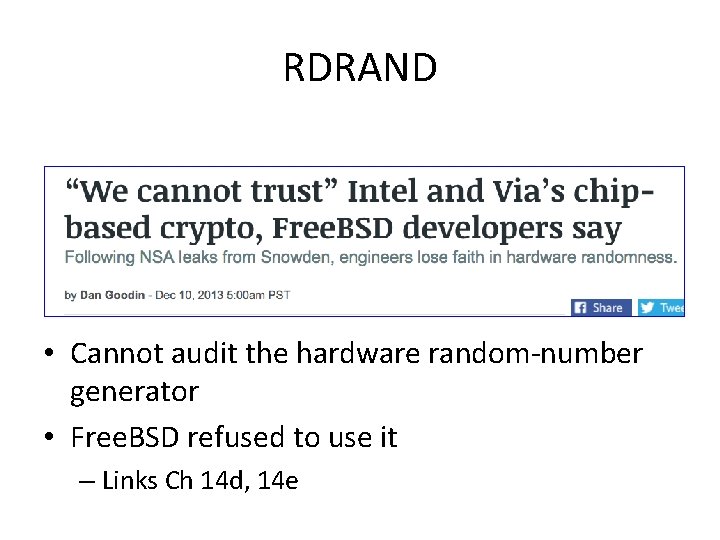
RDRAND • Cannot audit the hardware random-number generator • Free. BSD refused to use it – Links Ch 14 d, 14 e
Open. BSD and Free. BSD Heap • Used phkmalloc() in older versions – Doesn't use linked lists – Doesn't intermix control information with user data • Open. BSD v 3. 8 and later – malloc() uses mmap() – Allocates randomly located chunks of RAM (using ASLR) – No two chunks can ever be adjacent
Heap Exploits • Overwriting control structures in the heap is becoming very difficult • But sometimes there may be something else stored after a heap chunk that's useful – Like a function pointer – In C++, the vtable contains pointers and may sometimes be overwritten
Windows SEH Protections
SEH Protections • Registers are zeroed before calling the handler – So no address information is available to it • Exception handler can't be placed in the stack – So attacker can't inject code on the stack and jump to it • PE binaries (. exe and. dll files) compiled with /Safe. SEH – Whitelist permitted exception handlers
SEH Protections • Memory sections not protected by /Safe. SEH still have some protections – Handlers must be in executable RAM (enforced by either hardware or software) • But DEP isn't in effect for every executable
SEH Exploitation Tools • EEREAP – Reads a memory dump – Finds SEH trampoline code, like pop-ret • pdest – Freezes a process and hunts through its RAM to find good trampoline code • SEHInspector – Inspects a DLL or EXE – Tells you if /Safe. SEH or ASLR are in effect – Lists all valid exception handlers