
CMU SCS Large Graph Mining Power Tools and
![CMU SCS D. I. S. C. • ‘Data Intensive Scientific Computing’ [R. Bryant, CMU]](https://slidetodoc.com/presentation_image_h2/072f4199b53b80fed5cf82991dbc262a/image-10.jpg "CMU SCS D. I. S. C. • ‘Data Intensive Scientific Computing’ [R. Bryant, CMU]")
- Slides: 13
CMU SCS Large Graph Mining: Power Tools and a Practitioner’s guide Task 8: hadoop and Tera/Peta byte graphs Faloutsos, Miller, Tsourakakis CMU KDD '09 Faloutsos, Miller, Tsourakakis
CMU SCS Outline • • • Introduction – Motivation Task 1: Node importance Task 2: Community detection Task 3: Recommendations Task 4: Connection sub-graphs Task 5: Mining graphs over time Task 6: Virus/influence propagation Task 7: Spectral graph theory Task 8: Tera/peta graph mining: hadoop Observations – patterns of real graphs Conclusions KDD '09 Faloutsos, Miller, Tsourakakis
CMU SCS Scalability • How about if graph/tensor does not fit in core? • How about handling huge graphs? KDD '09 Faloutsos, Miller, Tsourakakis
CMU SCS Scalability • How about if graph/tensor does not fit in core? • [‘MET’: Kolda, Sun, ICMD’ 08, best paper award] • How about handling huge graphs? KDD '09 Faloutsos, Miller, Tsourakakis
CMU SCS Scalability • Google: > 450, 000 processors in clusters of ~2000 processors each [Barroso, Dean, Hölzle, “Web Search for a Planet: The Google Cluster Architecture” IEEE Micro 2003] • Yahoo: 5 Pb of data [Fayyad, KDD’ 07] • Problem: machine failures, on a daily basis • How to parallelize data mining tasks, then? KDD '09 Faloutsos, Miller, Tsourakakis
CMU SCS Scalability • Google: > 450, 000 processors in clusters of ~2000 processors each [Barroso, Dean, Hölzle, “Web Search for a Planet: The Google Cluster Architecture” IEEE Micro 2003] • • Yahoo: 5 Pb of data [Fayyad, KDD’ 07] Problem: machine failures, on a daily basis How to parallelize data mining tasks, then? A: map/reduce – hadoop (open-source clone) http: //hadoop. apache. org/ KDD '09 Faloutsos, Miller, Tsourakakis
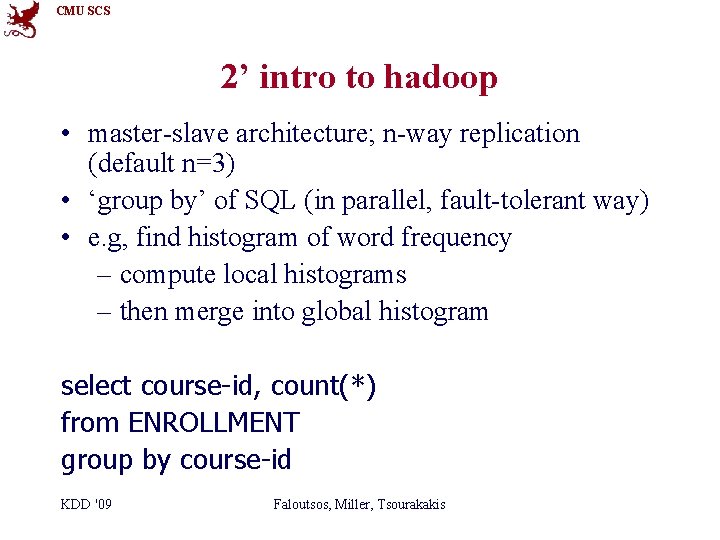
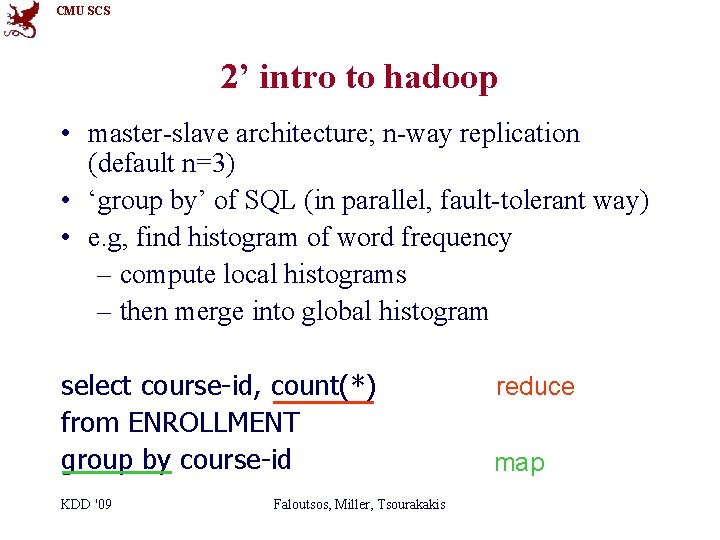
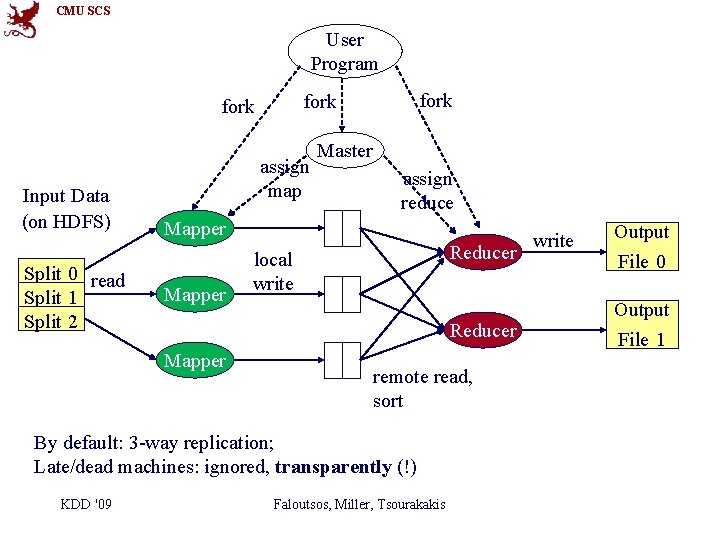
CMU SCS 2’ intro to hadoop • master-slave architecture; n-way replication (default n=3) • ‘group by’ of SQL (in parallel, fault-tolerant way) • e. g, find histogram of word frequency – compute local histograms – then merge into global histogram select course-id, count(*) from ENROLLMENT group by course-id KDD '09 Faloutsos, Miller, Tsourakakis
CMU SCS 2’ intro to hadoop • master-slave architecture; n-way replication (default n=3) • ‘group by’ of SQL (in parallel, fault-tolerant way) • e. g, find histogram of word frequency – compute local histograms – then merge into global histogram select course-id, count(*) from ENROLLMENT group by course-id KDD '09 Faloutsos, Miller, Tsourakakis reduce map
CMU SCS User Program Input Data (on HDFS) Split 0 read Split 1 Split 2 fork assign map Master assign reduce Mapper Reducer local write Reducer Mapper remote read, sort By default: 3 -way replication; Late/dead machines: ignored, transparently (!) KDD '09 Faloutsos, Miller, Tsourakakis write Output File 0 Output File 1
CMU SCS D. I. S. C. • ‘Data Intensive Scientific Computing’ [R. Bryant, CMU] – ‘big data’ – www. cs. cmu. edu/~bryant/pubdir/cmu-cs-07128. pdf KDD '09 Faloutsos, Miller, Tsourakakis
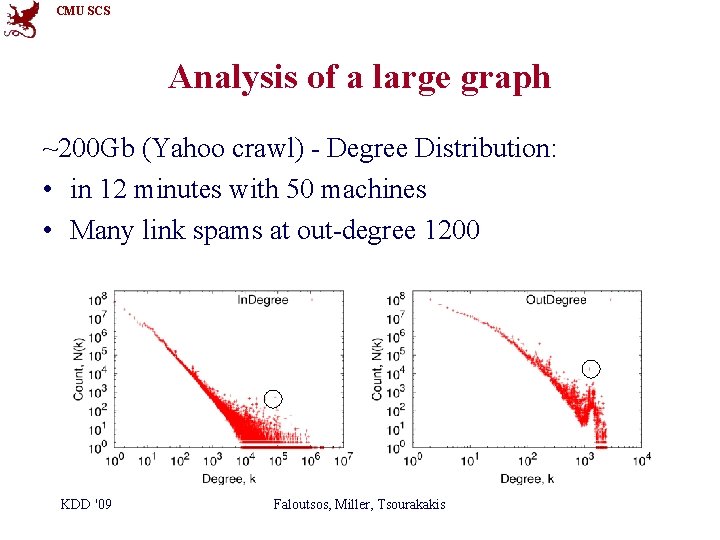
CMU SCS Analysis of a large graph ~200 Gb (Yahoo crawl) - Degree Distribution: • in 12 minutes with 50 machines • Many link spams at out-degree 1200 KDD '09 Faloutsos, Miller, Tsourakakis
CMU SCS Conclusions • Hadoop: promising architecture for Tera/Peta scale graph mining Resources: • http: //hadoop. apache. org/core/ • http: //hadoop. apache. org/pig/ Higher-level language for data processing KDD '09 Faloutsos, Miller, Tsourakakis 12
CMU SCS References • Jeffrey Dean and Sanjay Ghemawat, Map. Reduce: Simplified Data Processing on Large Clusters, OSDI'04 • Christopher Olston, Benjamin Reed, Utkarsh Srivastava, Ravi Kumar, Andrew Tomkins: Pig latin: a not-so-foreign language for data processing. SIGMOD 2008: 1099 -1110 KDD '09 Faloutsos, Miller, Tsourakakis 13