
CMU SCS Carnegie Mellon Univ Dept of Computer


- Slides: 25
CMU SCS Carnegie Mellon Univ. Dept. of Computer Science 15 -415/615 - DB Applications C. Faloutsos – A. Pavlo Lecture#12: External Sorting (R&G, Ch 13)
CMU SCS Last Class • • Static Hashing Extendible Hashing Linear Hashing vs. B-trees Faloutsos/Pavlo CMU SCS 15 -415/615 2
CMU SCS Today's Class • • • Sorting Overview Two-way Merge Sort External Merge Sort Optimizations B+trees for Sorting Faloutsos/Pavlo CMU SCS 15 -415/615 3
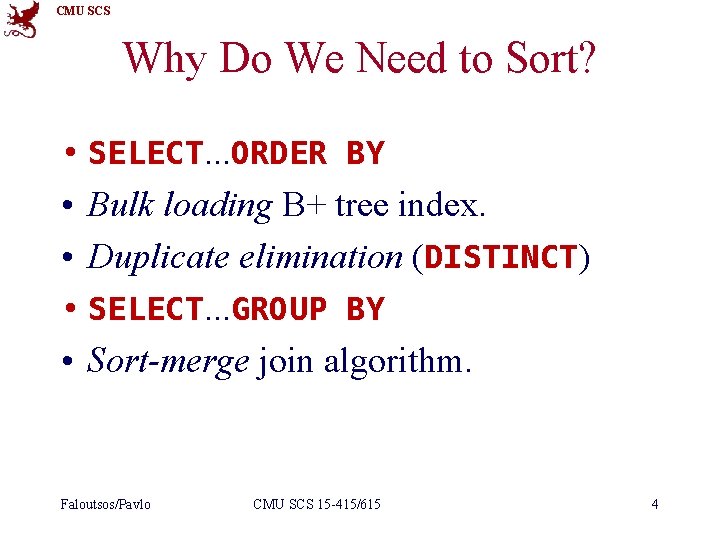
CMU SCS Why Do We Need to Sort? • SELECT. . . ORDER BY • Bulk loading B+ tree index. • Duplicate elimination (DISTINCT) • SELECT. . . GROUP BY • Sort-merge join algorithm. Faloutsos/Pavlo CMU SCS 15 -415/615 4
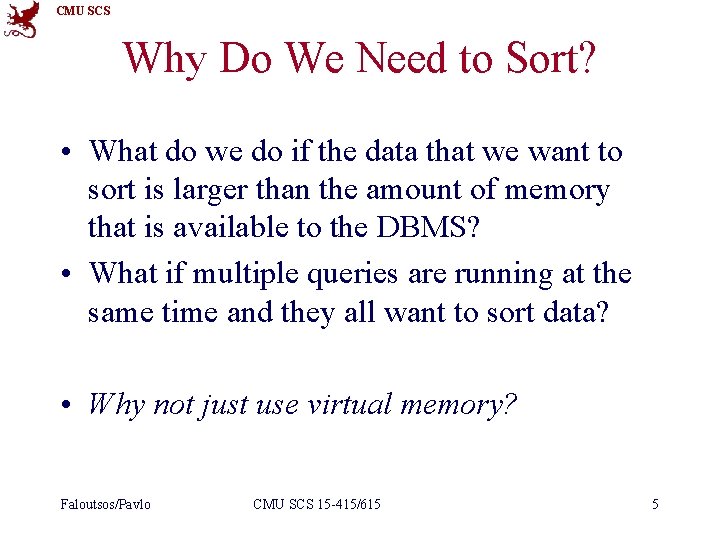
CMU SCS Why Do We Need to Sort? • What do we do if the data that we want to sort is larger than the amount of memory that is available to the DBMS? • What if multiple queries are running at the same time and they all want to sort data? • Why not just use virtual memory? Faloutsos/Pavlo CMU SCS 15 -415/615 5
CMU SCS Overview • Files are broken up into N pages. • The DBMS has a finite number of B fixedsize buffers. • Let’s start with a simple example… Faloutsos/Pavlo CMU SCS 15 -415/615 6
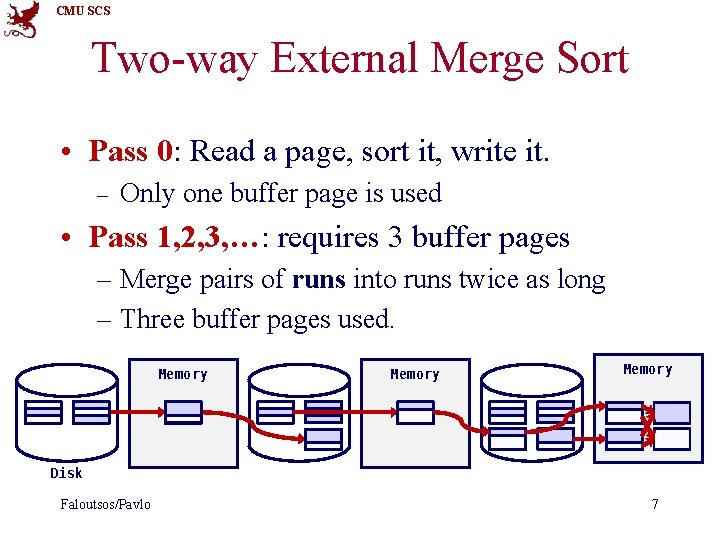
CMU SCS Two-way External Merge Sort • Pass 0: Read a page, sort it, write it. – Only one buffer page is used • Pass 1, 2, 3, …: requires 3 buffer pages – Merge pairs of runs into runs twice as long – Three buffer pages used. Memory Disk Faloutsos/Pavlo 7
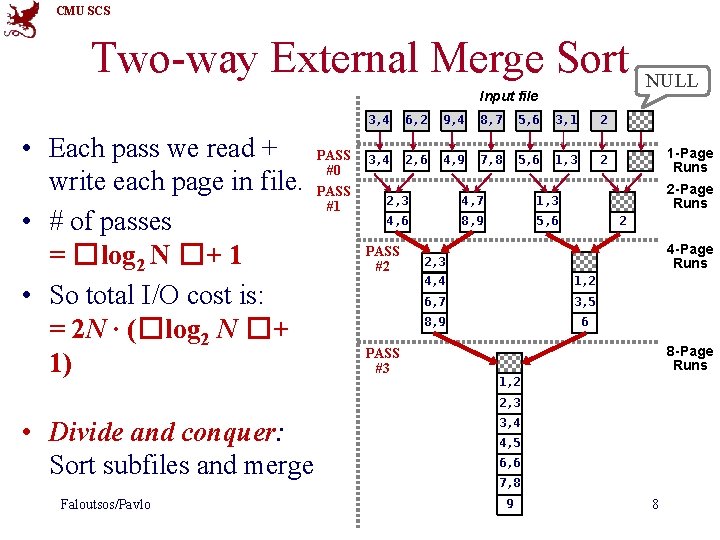
CMU SCS Two-way External Merge Sort Input file • Each pass we read + write each page in file. • # of passes = �log 2 N �+ 1 • So total I/O cost is: = 2 N ∙ (�log 2 N �+ 1) PASS #0 PASS #1 3, 4 6, 2 9, 4 8, 7 5, 6 3, 1 2 3, 4 2, 6 4, 9 7, 8 5, 6 1, 3 2 2, 3 4, 7 1, 3 4, 6 8, 9 5, 6 PASS #2 PASS #3 NULL 1 -Page Runs 2 4 -Page Runs 2, 3 4, 4 1, 2 6, 7 3, 5 8, 9 6 8 -Page Runs 1, 2 2, 3 • Divide and conquer: Sort subfiles and merge Faloutsos/Pavlo 3, 4 4, 5 6, 6 7, 8 9 8
CMU SCS Two-way External Merge Sort • This only requires three buffer pages. • Even if we have more buffer space available, this algorithm does not utilize it effectively. • Let’s look at the general algorithm… Faloutsos/Pavlo 15 -415/615 9
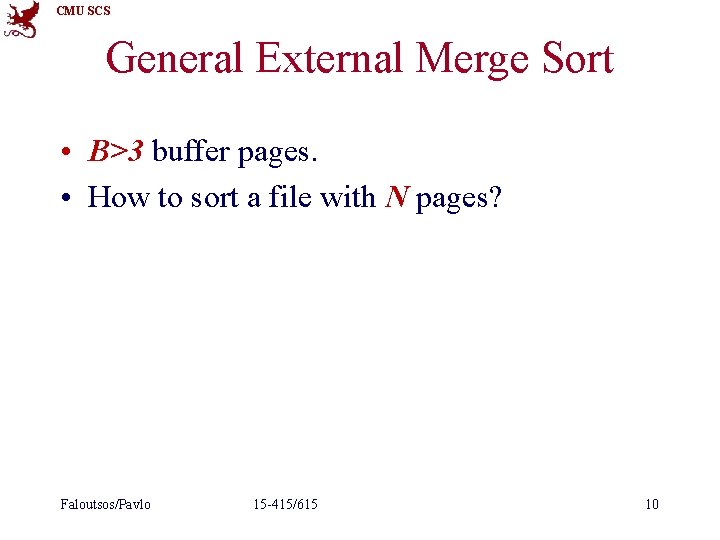
CMU SCS General External Merge Sort • B>3 buffer pages. • How to sort a file with N pages? Faloutsos/Pavlo 15 -415/615 10
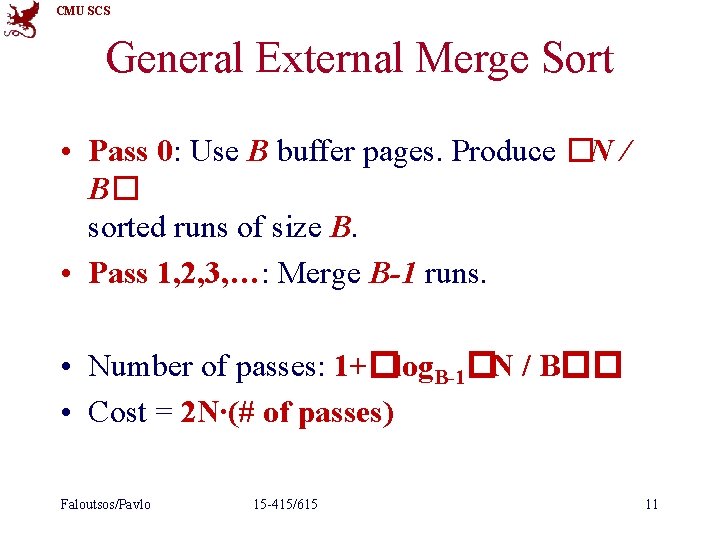
CMU SCS General External Merge Sort • Pass 0: Use B buffer pages. Produce �N / B� sorted runs of size B. • Pass 1, 2, 3, …: Merge B-1 runs. • Number of passes: 1+�log. B-1�N / B�� • Cost = 2 N∙(# of passes) Faloutsos/Pavlo 15 -415/615 11
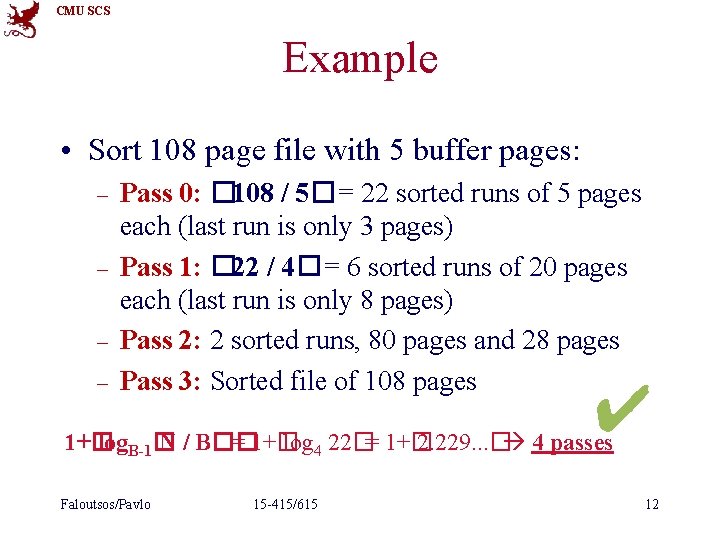
CMU SCS Example • Sort 108 page file with 5 buffer pages: – – Pass 0: � 108 / 5�= 22 sorted runs of 5 pages each (last run is only 3 pages) Pass 1: � 22 / 4�= 6 sorted runs of 20 pages each (last run is only 8 pages) Pass 2: 2 sorted runs, 80 pages and 28 pages Pass 3: Sorted file of 108 pages ✔ 1+� log. B-1� N / B�� = 1+� log 4 22�= 1+� 2. 229. . . � 4 passes Faloutsos/Pavlo 15 -415/615 12
CMU SCS Today's Class • • • Sorting Overview Two-way Merge Sort External Merge Sort Optimizations B+trees for Sorting Faloutsos/Pavlo CMU SCS 15 -415/615 13
CMU SCS Blocked I/O & Double-buffering • So far, we assumed random disk access. • The cost changes if we consider that runs are written (and read) sequentially. • What could we do to exploit it? – Blocked I/O: Exchange a few random reads for several sequential ones using bigger pages. – Double-buffering: Mask I/O delays with prefetching. Faloutsos/Pavlo 15 -415/615 14
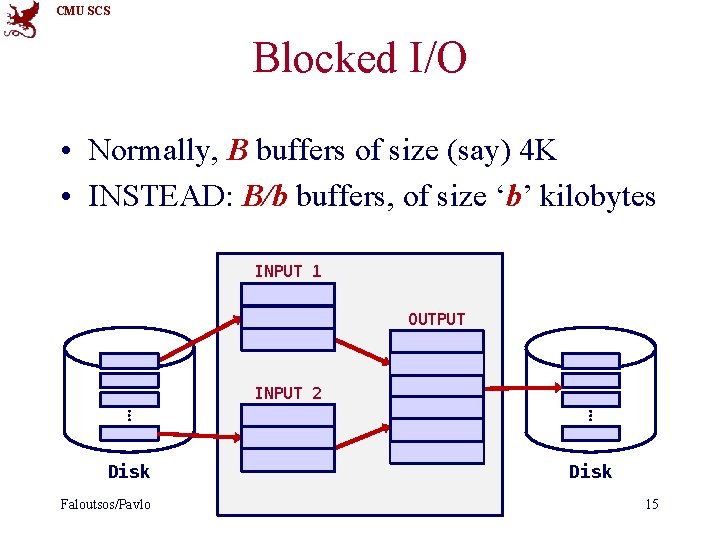
CMU SCS Blocked I/O • Normally, B buffers of size (say) 4 K • INSTEAD: B/b buffers, of size ‘b’ kilobytes INPUT 1 OUTPUT INPUT 2 ⋮ ⋮ Disk Faloutsos/Pavlo 15
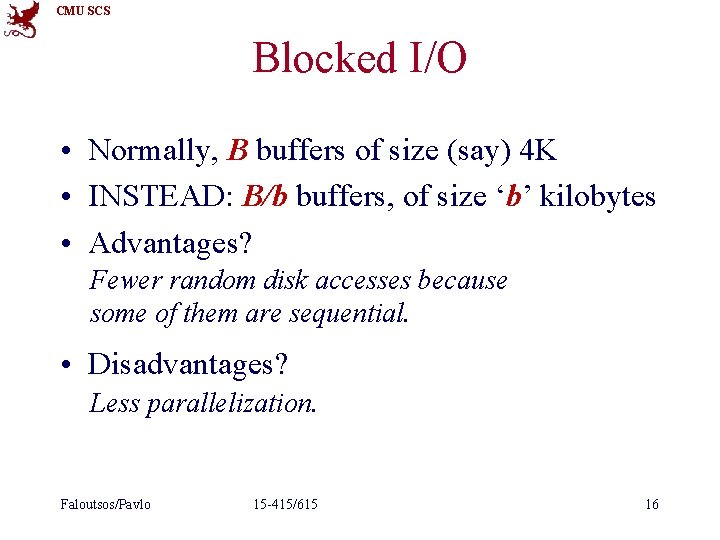
CMU SCS Blocked I/O • Normally, B buffers of size (say) 4 K • INSTEAD: B/b buffers, of size ‘b’ kilobytes • Advantages? Fewer random disk accesses because some of them are sequential. • Disadvantages? Less parallelization. Faloutsos/Pavlo 15 -415/615 16
CMU SCS Blocked I/O & Double-buffering • So far, we assumed random disk access • Cost changes, if we consider that runs are written (and read) sequentially • What could we do to exploit it? – Blocked I/O: Exchange a few random reads for several sequential ones using bigger pages. – Double-buffering: Mask I/O delays with prefetching. Faloutsos/Pavlo 15 -415/615 17
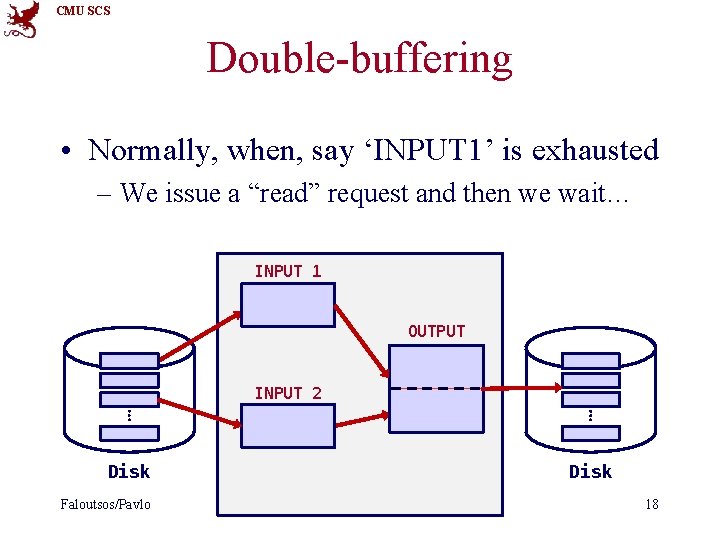
CMU SCS Double-buffering • Normally, when, say ‘INPUT 1’ is exhausted – We issue a “read” request and then we wait… INPUT 1 OUTPUT INPUT 2 ⋮ ⋮ Disk Faloutsos/Pavlo 6 Main memory buffers 18
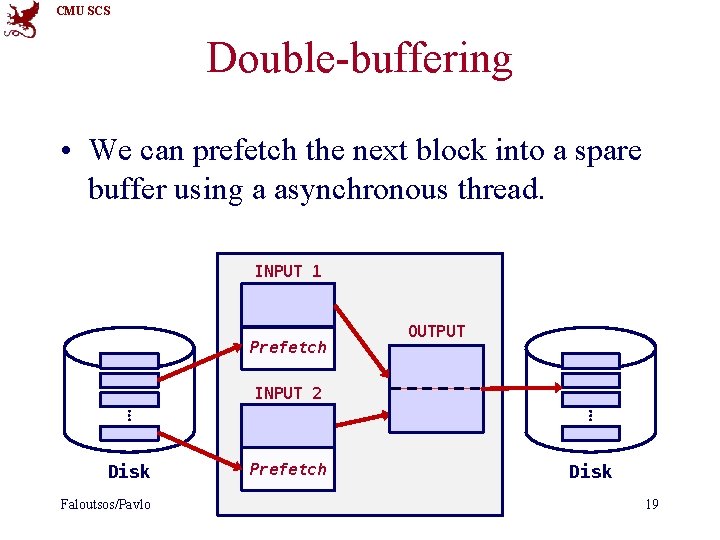
CMU SCS Double-buffering • We can prefetch the next block into a spare buffer using a asynchronous thread. INPUT 1 Prefetch OUTPUT INPUT 2 ⋮ Disk Faloutsos/Pavlo ⋮ Prefetch 6 Main memory buffers Disk 19
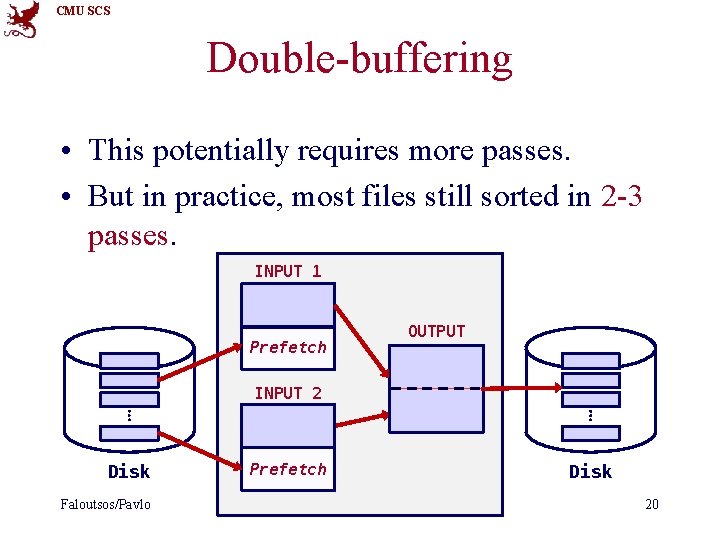
CMU SCS Double-buffering • This potentially requires more passes. • But in practice, most files still sorted in 2 -3 passes. INPUT 1 Prefetch OUTPUT INPUT 2 ⋮ Disk Faloutsos/Pavlo ⋮ Prefetch 6 Main memory buffers Disk 20
CMU SCS Today's Class • • • Sorting Overview Two-way Merge Sort External Merge Sort Optimizations B+trees for Sorting Faloutsos/Pavlo CMU SCS 15 -415/615 21
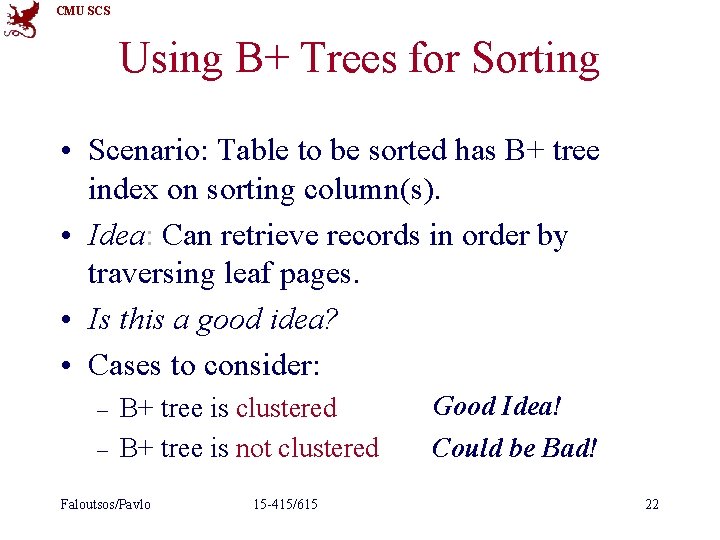
CMU SCS Using B+ Trees for Sorting • Scenario: Table to be sorted has B+ tree index on sorting column(s). • Idea: Can retrieve records in order by traversing leaf pages. • Is this a good idea? • Cases to consider: – – B+ tree is clustered B+ tree is not clustered Faloutsos/Pavlo 15 -415/615 Good Idea! Could be Bad! 22
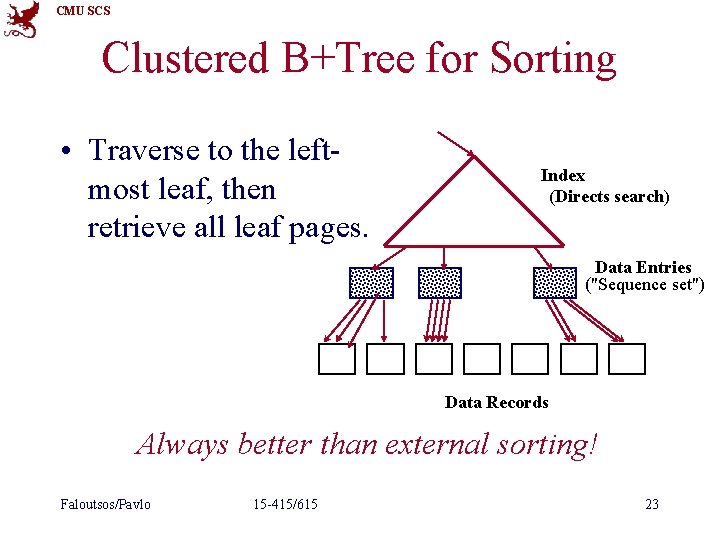
CMU SCS Clustered B+Tree for Sorting • Traverse to the leftmost leaf, then retrieve all leaf pages. Index (Directs search) Data Entries ("Sequence set") Data Records Always better than external sorting! Faloutsos/Pavlo 15 -415/615 23
CMU SCS Unclustered B+Tree for Sorting • Chase each pointer to the page that contains the data. Index (Directs search) Data Entries ("Sequence set") Data Records In general, one I/O per data record! Faloutsos/Pavlo 15 -415/615 24
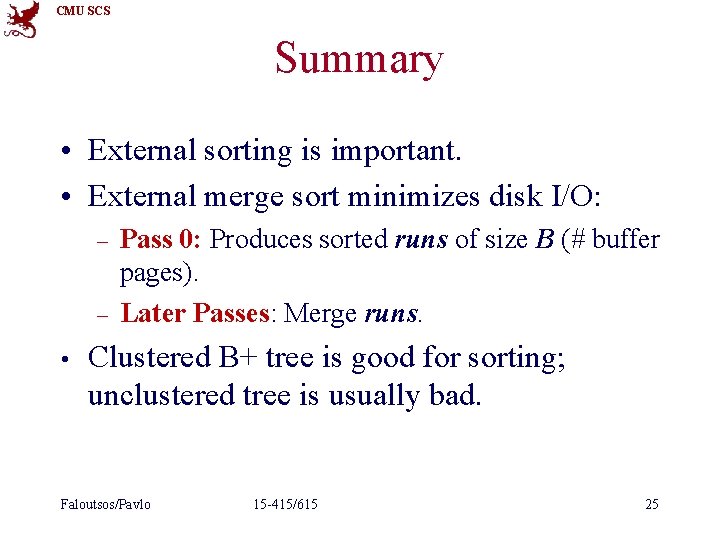
CMU SCS Summary • External sorting is important. • External merge sort minimizes disk I/O: – – • Pass 0: Produces sorted runs of size B (# buffer pages). Later Passes: Merge runs. Clustered B+ tree is good for sorting; unclustered tree is usually bad. Faloutsos/Pavlo 15 -415/615 25