
CMU SCS 15 826 Multimedia Databases and Data
CMU SCS 15 -826: Multimedia Databases and Data Mining Lecture #11: Fractals: M-trees and dim. curse (case studies – Part II) C. Faloutsos
CMU SCS Must-read Material • Alberto Belussi and Christos Faloutsos, Estimating the Selectivity of Spatial Queries Using the `Correlation' Fractal Dimension Proc. of VLDB, p. 299 -310, 1995 15 -826 Copyright: C. Faloutsos (2014) 2
CMU SCS Optional Material Optional, but very useful: Manfred Schroeder Fractals, Chaos, Power Laws: Minutes from an Infinite Paradise W. H. Freeman and Company, 1991 15 -826 Copyright: C. Faloutsos (2014) 3
CMU SCS Outline Goal: ‘Find similar / interesting things’ • Intro to DB • Indexing - similarity search • Data Mining 15 -826 Copyright: C. Faloutsos (2014) 4
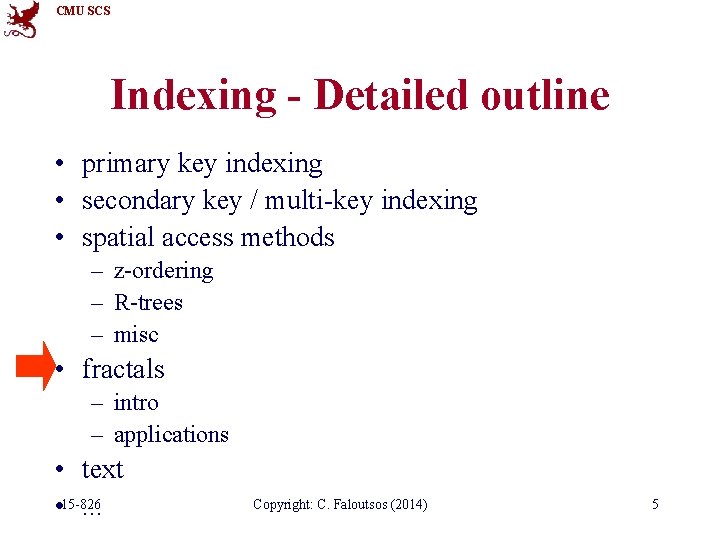
CMU SCS Indexing - Detailed outline • primary key indexing • secondary key / multi-key indexing • spatial access methods – z-ordering – R-trees – misc • fractals – intro – applications • text • 15 -826. . . Copyright: C. Faloutsos (2014) 5
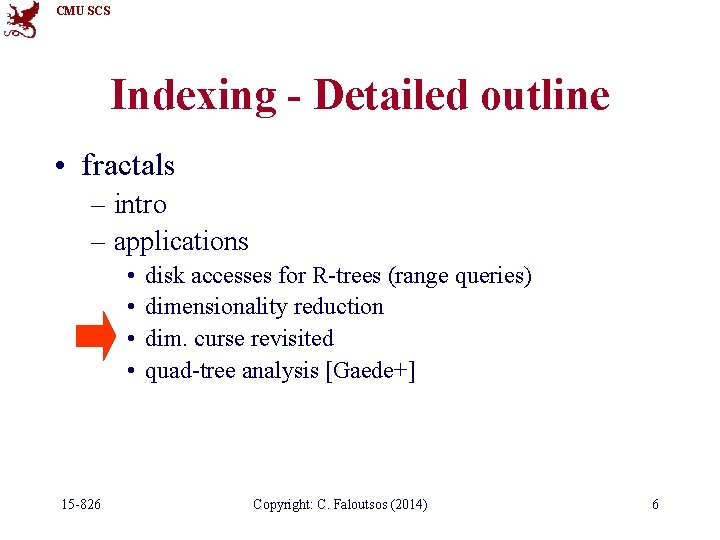
CMU SCS Indexing - Detailed outline • fractals – intro – applications • • 15 -826 disk accesses for R-trees (range queries) dimensionality reduction dim. curse revisited quad-tree analysis [Gaede+] Copyright: C. Faloutsos (2014) 6
![CMU SCS What else can they solve? • • • separability [KDD’ 02] forecasting](http://slidetodoc.com/presentation_image_h2/80a41c08f07e960a1f00198e7446372e/image-7.jpg "CMU SCS What else can they solve? • • • separability [KDD’ 02] forecasting")
CMU SCS What else can they solve? • • • separability [KDD’ 02] forecasting [CIKM’ 02] dimensionality reduction [SBBD’ 00] non-linear axis scaling [KDD’ 02] disk trace modeling [Wang+’ 02] selectivity of spatial/multimedia queries [PODS’ 94, VLDB’ 95, ICDE’ 00] • . . . 15 -826 Copyright: C. Faloutsos (2014) 7
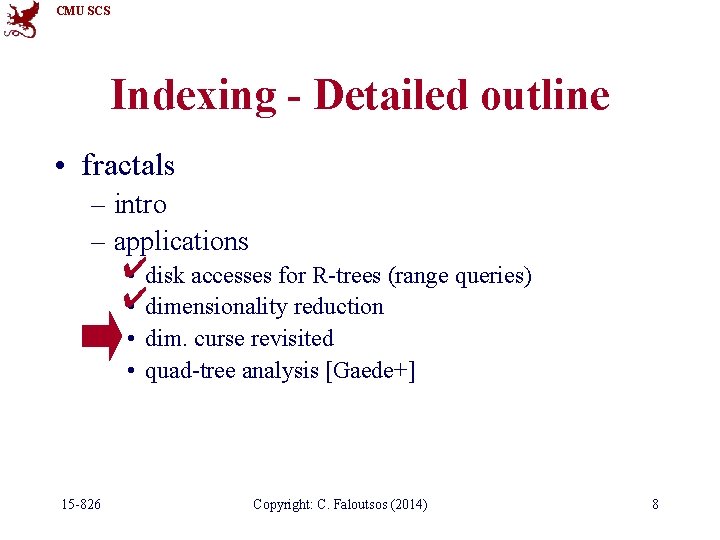
CMU SCS Indexing - Detailed outline • fractals – intro – applications ✔ • disk accesses for R-trees (range queries) ✔ • dimensionality reduction • dim. curse revisited • quad-tree analysis [Gaede+] 15 -826 Copyright: C. Faloutsos (2014) 8
CMU SCS Dimensionality ‘curse’ • Q: What is the problem in high-d? 15 -826 Copyright: C. Faloutsos (2014) #9
CMU SCS Dimensionality ‘curse’ • Q: What is the problem in high-d? • A: indices do not seem to help, for many queries (eg. , k-nn) – in high-d (& uniform distributions), most points are equidistant -> k-nn retrieves too many nearneighbors – [Yao & Yao, ’ 85]: search effort ~ O( N (1 -1/d) ) 15 -826 Copyright: C. Faloutsos (2014) #10
CMU SCS Dimensionality ‘curse’ • (counter-intuitive, for db mentality) • Q: What to do, then? 15 -826 Copyright: C. Faloutsos (2014) #11
CMU SCS Dimensionality ‘curse’ • A 1: switch to seq. scanning • A 2: dim. reduction • A 3: consider the ‘intrinsic’/fractal dimensionality • A 4: find approximate nn 15 -826 Copyright: C. Faloutsos (2014) #12
CMU SCS Dimensionality ‘curse’ • A 1: switch to seq. scanning – X-trees [Kriegel+, VLDB 96] – VA-files [Schek+, VLDB 98], ‘test of time’ award 15 -826 Copyright: C. Faloutsos (2014) #13
CMU SCS Dimensionality ‘curse’ • A 1: switch to seq. scanning • A 2: dim. reduction • A 3: consider the ‘intrinsic’/fractal dimensionality • A 4: find approximate nn 15 -826 Copyright: C. Faloutsos (2014) #14
CMU SCS Dim. reduction a. k. a. feature selection/extraction: • SVD (optimal, to preserve Euclidean distances) • random projections • using the fractal dimension [Traina+ SBBD 2000] 15 -826 Copyright: C. Faloutsos (2014) #15
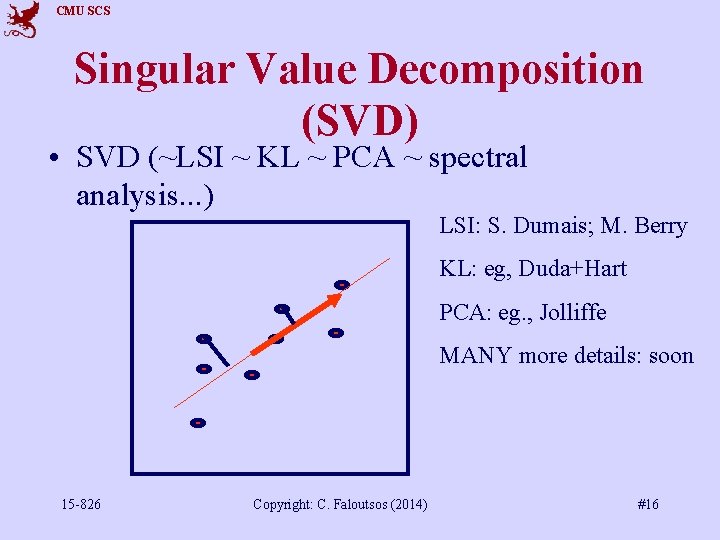
CMU SCS Singular Value Decomposition (SVD) • SVD (~LSI ~ KL ~ PCA ~ spectral analysis. . . ) LSI: S. Dumais; M. Berry KL: eg, Duda+Hart PCA: eg. , Jolliffe MANY more details: soon 15 -826 Copyright: C. Faloutsos (2014) #16
![CMU SCS Random projections • random projections(Johnson-Lindenstrauss thm [Papadimitriou+ pods 98]) 15 -826 Copyright:](http://slidetodoc.com/presentation_image_h2/80a41c08f07e960a1f00198e7446372e/image-17.jpg "CMU SCS Random projections • random projections(Johnson-Lindenstrauss thm [Papadimitriou+ pods 98]) 15 -826 Copyright:")
CMU SCS Random projections • random projections(Johnson-Lindenstrauss thm [Papadimitriou+ pods 98]) 15 -826 Copyright: C. Faloutsos (2014) #17
CMU SCS Random projections • pick ‘enough’ random directions (will be ~orthogonal, in high-d!!) • distances are preserved probabilistically, within epsilon • (also, use as a pre-processing step for SVD [Papadimitriou+ PODS 98] 15 -826 Copyright: C. Faloutsos (2014) #18
CMU SCS Dim. reduction - w/ fractals • Main idea: drop those attributes that don’t affect the intrinsic (‘fractal’) dimensionality [Traina+, SBBD 2000] 15 -826 Copyright: C. Faloutsos (2014) #19
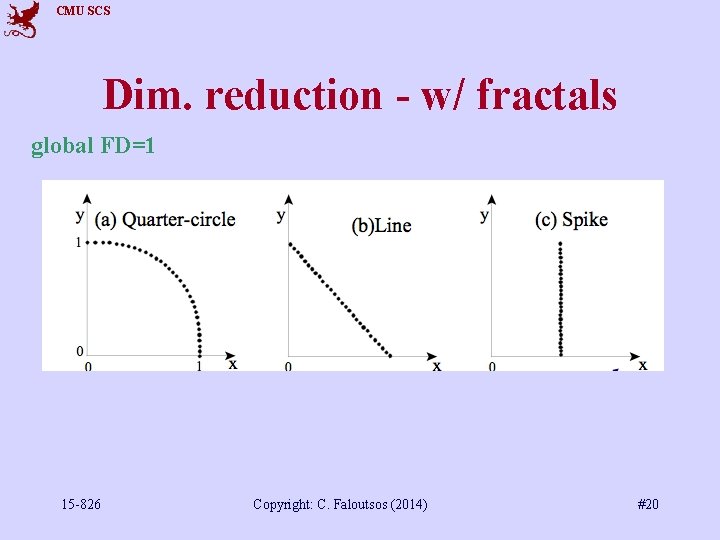
CMU SCS Dim. reduction - w/ fractals global FD=1 15 -826 Copyright: C. Faloutsos (2014) #20
CMU SCS Dimensionality ‘curse’ • A 1: switch to seq. scanning • A 2: dim. reduction • A 3: consider the ‘intrinsic’/fractal dimensionality • A 4: find approximate nn 15 -826 Copyright: C. Faloutsos (2014) #21
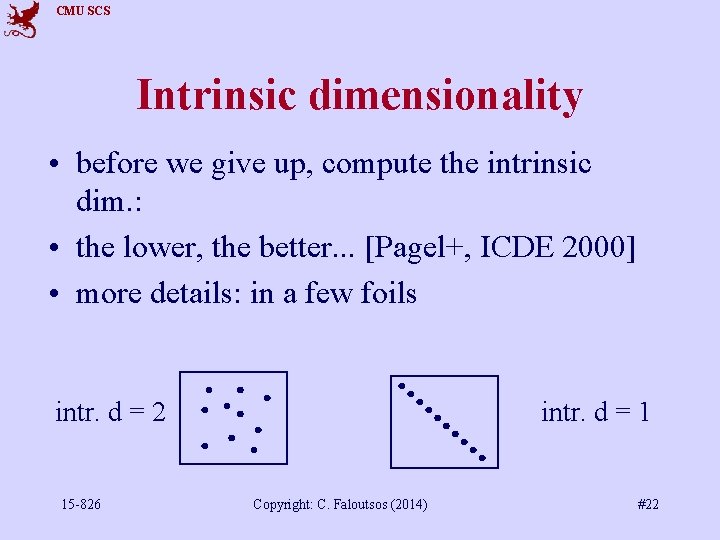
CMU SCS Intrinsic dimensionality • before we give up, compute the intrinsic dim. : • the lower, the better. . . [Pagel+, ICDE 2000] • more details: in a few foils intr. d = 2 15 -826 intr. d = 1 Copyright: C. Faloutsos (2014) #22
CMU SCS Dimensionality ‘curse’ • A 1: switch to seq. scanning • A 2: dim. reduction • A 3: consider the ‘intrinsic’/fractal dimensionality • A 4: find approximate nn 15 -826 Copyright: C. Faloutsos (2014) #23
![CMU SCS Approximate nn • [Arya + Mount, SODA 93], [Patella+ ICDE 2000] •](http://slidetodoc.com/presentation_image_h2/80a41c08f07e960a1f00198e7446372e/image-24.jpg "CMU SCS Approximate nn • [Arya + Mount, SODA 93], [Patella+ ICDE 2000] •")
CMU SCS Approximate nn • [Arya + Mount, SODA 93], [Patella+ ICDE 2000] • Idea: find k neighbors, such that the distance of the k-th one is guaranteed to be within epsilon of the actual. 15 -826 Copyright: C. Faloutsos (2014) #24
CMU SCS Dimensionality ‘curse’ • A 1: switch to seq. scanning • A 2: dim. reduction • A 3: consider the ‘intrinsic’/fractal dimensionality • A 4: find approximate nn 15 -826 Copyright: C. Faloutsos (2014) #25
CMU SCS Dim. curse revisited • (Q: how serious is the dim. curse, e. g. : ) • Q: what is the search effort for k-nn? – given N points, in E dimensions, in an R-tree, with k-nn queries (‘biased’ model) [Pagel, Korn + ICDE 2000] 15 -826 Copyright: C. Faloutsos (2014) 26
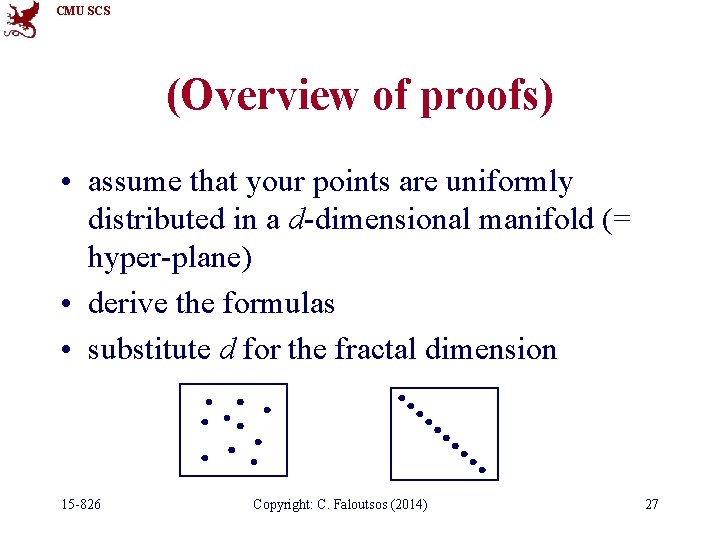
CMU SCS (Overview of proofs) • assume that your points are uniformly distributed in a d-dimensional manifold (= hyper-plane) • derive the formulas • substitute d for the fractal dimension 15 -826 Copyright: C. Faloutsos (2014) 27
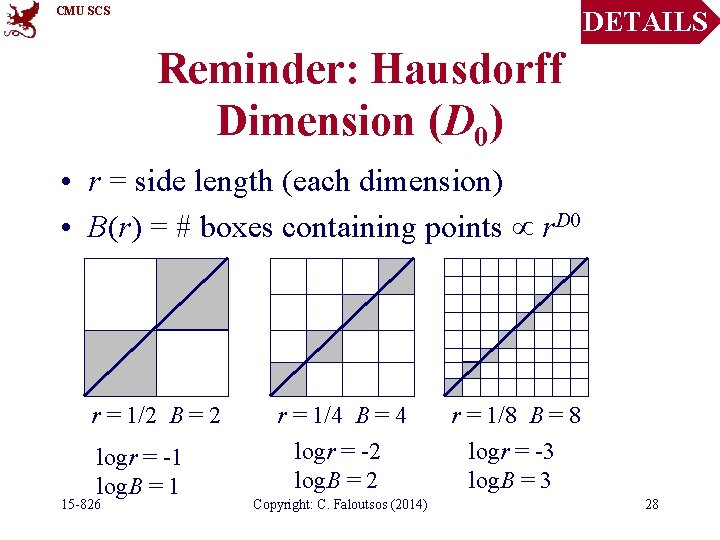
CMU SCS DETAILS Reminder: Hausdorff Dimension (D 0) • r = side length (each dimension) • B(r) = # boxes containing points r. D 0 r = 1/2 B = 2 logr = -1 log. B = 1 15 -826 r = 1/4 B = 4 logr = -2 log. B = 2 Copyright: C. Faloutsos (2014) r = 1/8 B = 8 logr = -3 log. B = 3 28
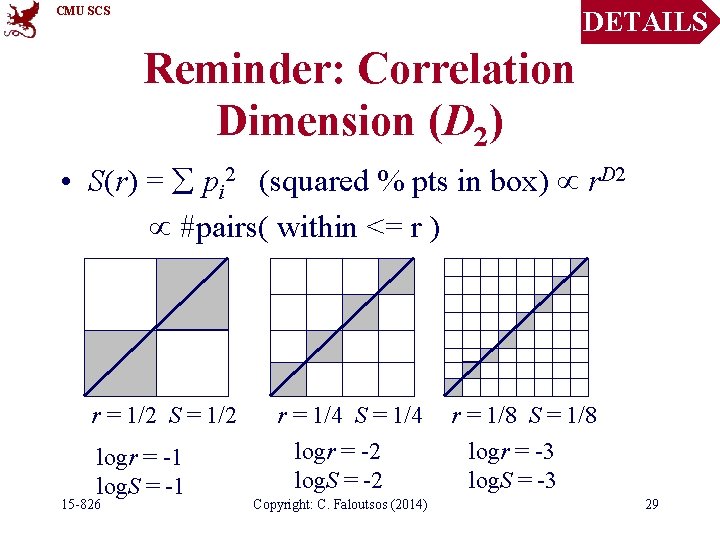
CMU SCS DETAILS Reminder: Correlation Dimension (D 2) • S(r) = pi 2 (squared % pts in box) r. D 2 #pairs( within <= r ) r = 1/2 S = 1/2 logr = -1 log. S = -1 15 -826 r = 1/4 S = 1/4 logr = -2 log. S = -2 Copyright: C. Faloutsos (2014) r = 1/8 S = 1/8 logr = -3 log. S = -3 29
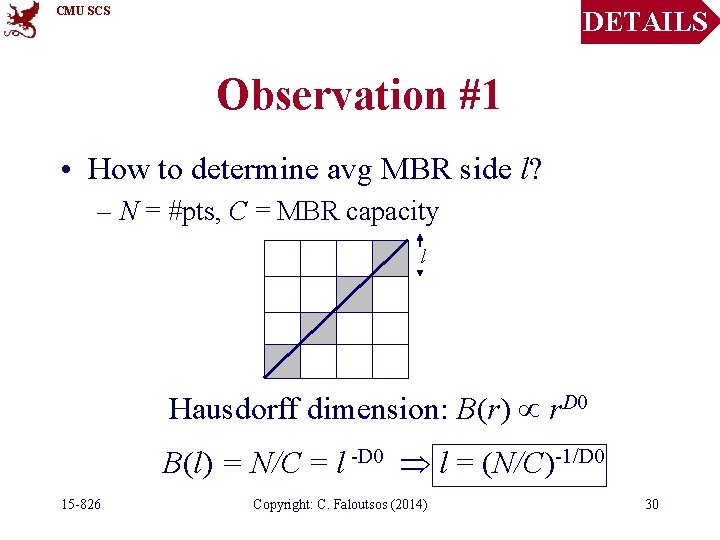
CMU SCS DETAILS Observation #1 • How to determine avg MBR side l? – N = #pts, C = MBR capacity l Hausdorff dimension: B(r) r. D 0 B(l) = N/C = l -D 0 l = (N/C)-1/D 0 15 -826 Copyright: C. Faloutsos (2014) 30
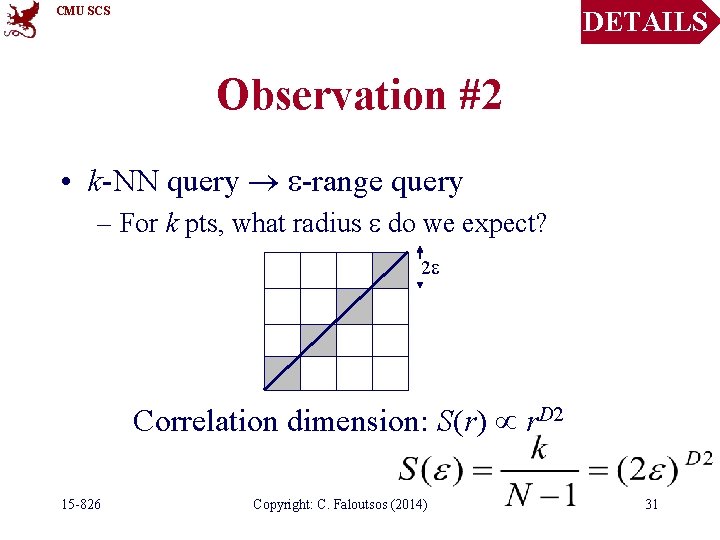
CMU SCS DETAILS Observation #2 • k-NN query -range query – For k pts, what radius do we expect? 2 Correlation dimension: S(r) r. D 2 15 -826 Copyright: C. Faloutsos (2014) 31
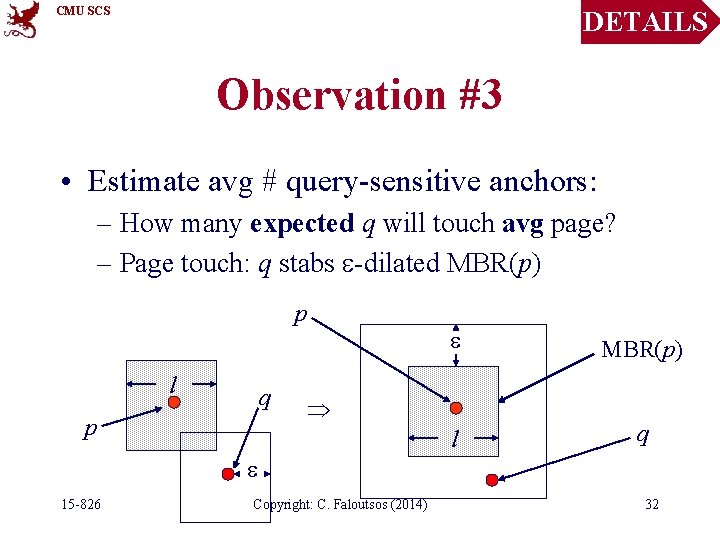
CMU SCS DETAILS Observation #3 • Estimate avg # query-sensitive anchors: – How many expected q will touch avg page? – Page touch: q stabs -dilated MBR(p) p l q p MBR(p) l q 15 -826 Copyright: C. Faloutsos (2014) 32
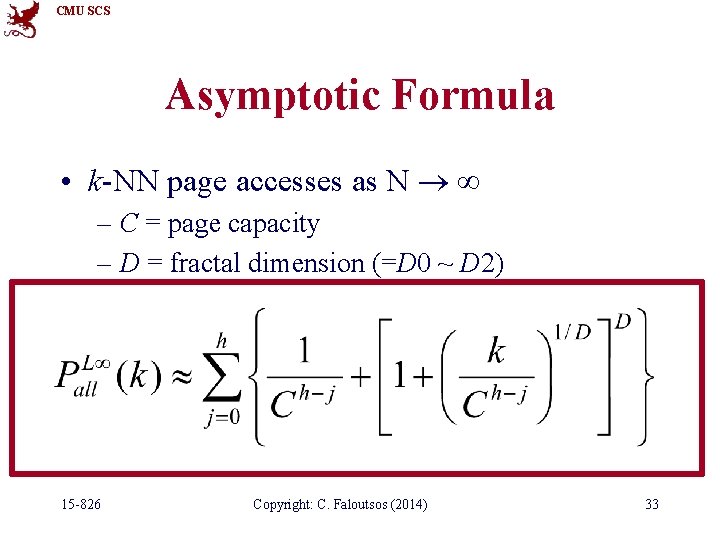
CMU SCS Asymptotic Formula • k-NN page accesses as N – C = page capacity – D = fractal dimension (=D 0 ~ D 2) 15 -826 Copyright: C. Faloutsos (2014) 33

CMU SCS Asymptotic Formula • NO mention of the embedding dimensionality!! • Still have dim. curse, but on f. d. D 15 -826 Copyright: C. Faloutsos (2014) 34
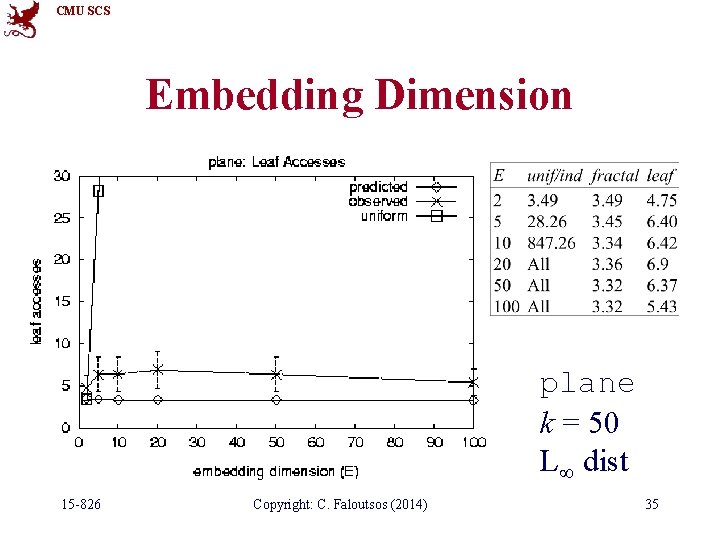
CMU SCS Embedding Dimension plane k = 50 L dist 15 -826 Copyright: C. Faloutsos (2014) 35
CMU SCS Conclusions • Dimensionality ‘curse’: – for high-d, indices slow down to ~O(N) • If the intrinsic dim. is low, there is hope • otherwise, do seq. scan, or sacrifice accuracy (approximate nn) 15 -826 Copyright: C. Faloutsos (2014) #36
CMU SCS Conclusions – cont’d • Worst-case theory is over-pessimistic • High dimensional data can exhibit good performance if correlated, non-uniform • Many real data sets are self-similar • Determinant is intrinsic dimensionality – multiple fractal dimensions (D 0 and D 2) – indication of how far one can go 15 -826 Copyright: C. Faloutsos (2014) 37
CMU SCS References • Sunil Arya, David M. Mount: Approximate Nearest Neighbor Queries in Fixed Dimensions. SODA 1993: 271 -280 ANN library: http: //www. cs. umd. edu/~mount/ANN/ 15 -826 Copyright: C. Faloutsos (2014) #38
CMU SCS References • Berchtold, S. , D. A. Keim, et al. (1996). The Xtree : An Index Structure for High-Dimensional Data. VLDB, Mumbai (Bombay), India. • Ciaccia, P. , M. Patella, et al. (1998). A Cost Model for Similarity Queries in Metric Spaces. PODS. 15 -826 Copyright: C. Faloutsos (2014) #39
CMU SCS References cnt’d • Nievergelt, J. , H. Hinterberger, et al. (March 1984). “The Grid File: An Adaptable, Symmetric Multikey File Structure. ” ACM TODS 9(1): 38 -71. • Pagel, B. -U. , F. Korn, et al. (2000). Deflating the Dimensionality Curse Using Multiple Fractal Dimensions. ICDE, San Diego, CA. • Papadimitriou, C. H. , P. Raghavan, et al. (1998). Latent Semantic Indexing: A Probabilistic Analysis. PODS, Seattle, WA. 15 -826 Copyright: C. Faloutsos (2014) #40
CMU SCS References cnt’d • Traina, C. , A. J. M. Traina, et al. (2000). Distance Exponent: A New Concept for Selectivity Estimation in Metric Trees. ICDE, San Diego, CA. • Weber, R. , H. -J. Schek, et al. (1998). A Quantitative Analysis and Performance Study for Similarity-Search Methods in high-dimensional spaces. VLDB, New York, NY. 15 -826 Copyright: C. Faloutsos (2014) #41
CMU SCS References cnt’d • Yao, A. C. and F. F. Yao (May 6 -8, 1985). A General Approach to d-Dimensional Geometric Queries. Proc. of the 17 th Annual ACM Symposium on Theory of Computing (STOC), Providence, RI. 15 -826 Copyright: C. Faloutsos (2014) #42
- Slides: 42