
CMU EDU 655 The Ontario Governance Framework Original


- Slides: 29
CMU EDU 655 The Ontario Governance Framework
Original Presentation prepared by: Debra Cooper Burger
Outline of Presentation 1. 2. 3. 4. 5. 6. 7. 8. 9. Overview of the College Compensation and Appointments Council (The Council) Colleges’ Mandated Board Responsibilities Governance and Accountability Minister’s Binding Policy Directive on Governance and Accountability Governance Models Policy Governance Responsibilities of Individual Members Overview of Colleges Ontario 3
1. Overview of the Council Major Responsibilities: § Governance § Human Resources § Premier’s Awards § Other duties as assigned 4
1. Overview of the Council Our Mission The College Compensation and Appointments Council is a provincial agency, reporting to the Minister of Training, Colleges and Universities. Our mission is to support Ontario’s Colleges of Applied Arts and Technology through best practices in responsible collective bargaining and effective governance 5
1. Overview of the Council Our Vision To provide valued counsel and outstanding service to Colleges in support of their commitment to meet the diverse needs for applied learning in their communities. 6
1. Overview of the Council Governance n n Appoints external members to College Boards of Governors Reviews the process of removal of a Governor 7
1. Overview of the Council Governance n Provides advice on board governance issues n Other duties as assigned 8
1. Overview of the Council Human Resources n Acts as agent on behalf of the 24 colleges in collective bargaining with academic and support staff 9
1. Overview of the Council Human Resources n n Acts as policy holder for all employee benefits on behalf of the colleges Provides service on human resources management issues 10
1. Overview of the Council Human Resources n Provides support to the Colleges’ Compensation Committee (CCC) 11
1. Overview of the Council Human Resources Administrative Staff Compensation and Terms and Condition of Employment n Provides staff and research so the Colleges’ Compensation Committee (CCC) can bring forward recommendations on administrative staff compensation and terms and conditions of employment to boards 12
1. Overview of the Council Premier’s Awards n n Honour outstanding graduates of Ontario’s Colleges who demonstrate exemplary career success and contribute significantly to their community Recipients: Business; Community Services; Creative Arts and Design; Health Sciences; Technology and a Recent Graduate 13
1. Overview of the Council In Summary n Council’s Prime responsibility is to ensure that its work in the areas of governance and human resources is directed to meeting the Colleges’ objectives and needs, is value added and is in the public interest. 14
2. Colleges’ Mandate n To offer a comprehensive program of careeroriented post-secondary education and training to: - assist individuals in finding and keeping employment - to meet the needs of employers and the changing work environment; and - to support the economic and social needs of their local and diverse communities 15
2. Colleges’ Mandate The Ontario Colleges of Applied Arts and Technology Act, 2002: n n Each Board of Governors of a College has been authorized to govern the College, and is accountable to the students, employers and the communities the College serves for ensuring that it is effectively managed to achieve its mandate and to provide needed services. 16
3. Mandated Board Responsibilities How does a College achieve its mandated responsibilities? n n By putting in place policies, processes and structures to fulfill its mandate - governance By demonstrating it meets its responsibilities accountability 17
4. Governance and Accountability What is governance? n Set of laws, policies, processes and structures – including values, relationships and activities - which define an organization and how it operates n Set of laws or policies, which ensure an organization’s effective operation n Mechanisms to help an organization meet its objectives, achieve accountability; defines the division of power n Set of laws which govern an organization and 18
4. Governance and Accountability What is accountability? n n Demonstration of responsibility Demonstration of the achievement of mandate and objectives carried out in a responsible way The provision of information attesting to the achievement of stated responsibilities and objectives Usually coupled with transparency 19
5. Minister’s Binding Policy Directive on Governance & Accountability April 2003 Effective governance and accountability to taxpayers in achieving the college mandate is the responsibility of the Board which is required to: n Establish governance structures to enable the achievement of expected institutional outcomes with clear lines of communication and accountability n Set the vision, strategic direction, overall goals and outcomes – and demonstrate their achievement by providing to the public and 20
5. Minister’s Binding Policy Directive on Governance & Accountability n n n April 2003 Hire the CEO (i. e. president) and delegate to the CEO responsibility for the performance and operation of the College Evaluate the CEO’s performance Assess the attainment by the CEO of corporate goals and outcomes Assess the effectiveness of the board with respect to governance Ensure corrective action is taken when expected outcomes or quality of performance are not achieved (Board; CEO) Approve the College’s annual business plan, budget and annual report 21
6. Governance Models Effective Governance n n Provides a clear differentiation between the roles of the Board and that of the President who is responsible for managing the day-today operations of the college Defines the Board’s scope of responsibilities and decision-making 22
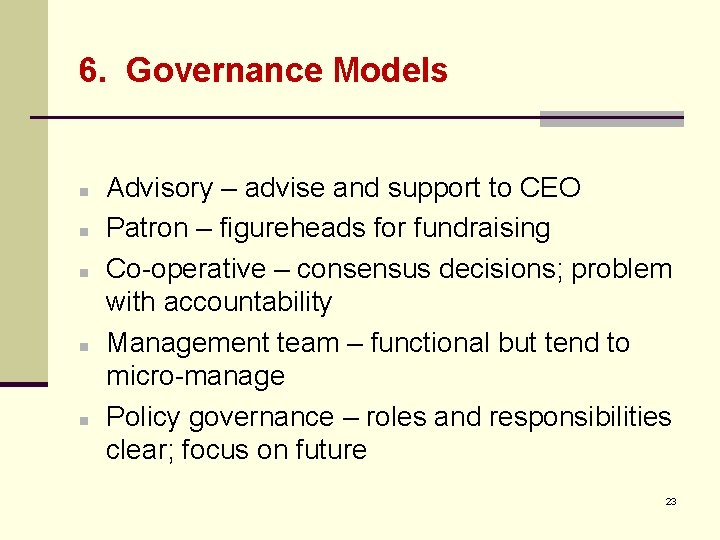
6. Governance Models n n n Advisory – advise and support to CEO Patron – figureheads for fundraising Co-operative – consensus decisions; problem with accountability Management team – functional but tend to micro-manage Policy governance – roles and responsibilities clear; focus on future 23
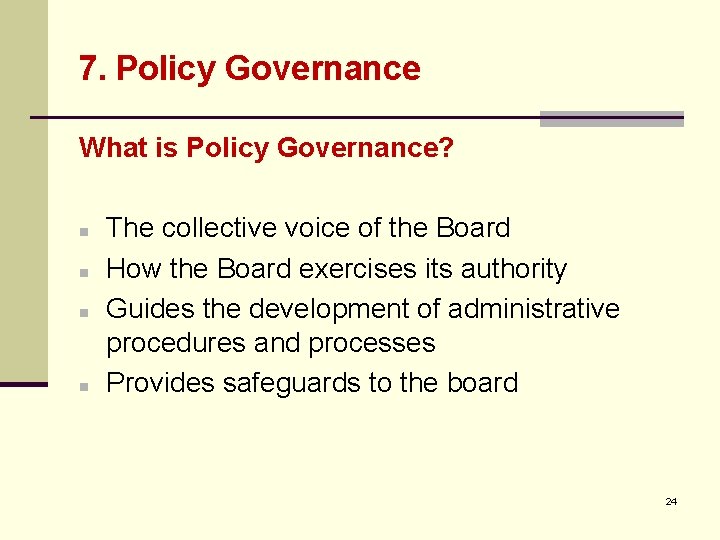
7. Policy Governance What is Policy Governance? n n The collective voice of the Board How the Board exercises its authority Guides the development of administrative procedures and processes Provides safeguards to the board 24
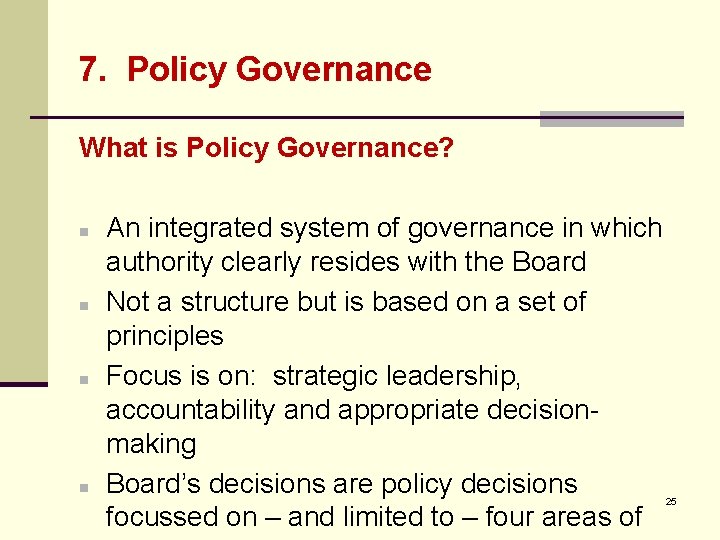
7. Policy Governance What is Policy Governance? n n An integrated system of governance in which authority clearly resides with the Board Not a structure but is based on a set of principles Focus is on: strategic leadership, accountability and appropriate decisionmaking Board’s decisions are policy decisions focussed on – and limited to – four areas of 25
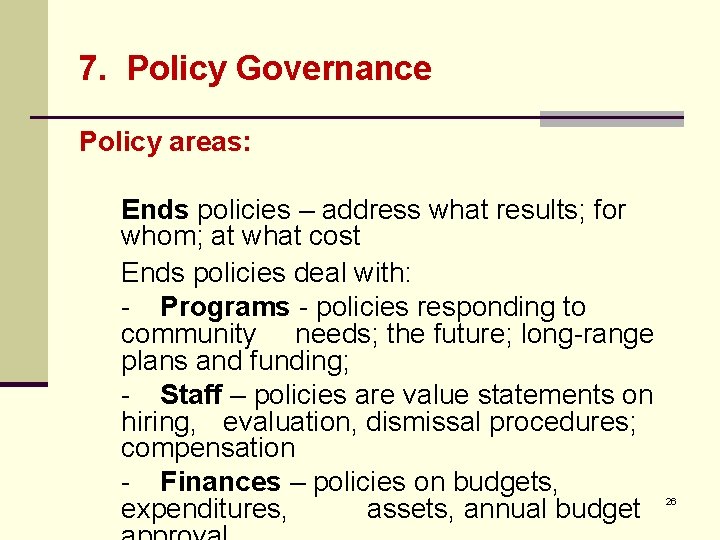
7. Policy Governance Policy areas: Ends policies – address what results; for whom; at what cost Ends policies deal with: - Programs - policies responding to community needs; the future; long-range plans and funding; - Staff – policies are value statements on hiring, evaluation, dismissal procedures; compensation - Finances – policies on budgets, expenditures, assets, annual budget 26
7. Policy Governance areas: Executive limitation policies – which clearly define the limits of the CEO’s authority Board process – defines the operations of the board itself Relationship to management – the delegation of authority and how performance will be evaluated 27
7. Policy Governance President’s role in Policy Governance: Works for and with Board to: n Develop and recommend strategic priorities and goals to assist the board in establishing priorities n Provide leadership to administer the College’s day to day operations n Engage the Board in policy decisions early in the planning and decision-making process n Interpret Board policy into actions to ensure that the College services its students and the public 28
8. Responsibilities of Individual Members n n n Stewardship One voice Code of Ethics or Conduct 29