
CMSTOTEM Glueball Analysis M Berretti III FW Physics

CMS-TOTEM Glueball Analysis M. Berretti III FW Physics Workshop Isola d’Elba, 30/05/2016 OUTLOOK: • Physics Motivations • Preliminary observations on the CMS-TOTEM common data 30/05/2016 M. Berretti – 3 rd FW Phys Workshop – Isola d'Elba 1
Introduction to glueball searches Gluons carry colour charge: as a consequence it is possible that gluonic bound states exist. These states with no valence quarks are called GLUEBALLS. How they should look like? 3 basic conditions: • Selective enhancement in production as a function of the gluon sample purity. • Flavour symmetry in the decay it is expected: glueballs are flavour singlet, and therefore should decay in an Swave of pseudoscalars such as Ks. Ks, K+K-, pp, . NB: this doesn’t mean 1: 1 in branching ratios of the mentioned pairs (as an example many author’s used chirality arguments to favour KK in the observed ratios). • Pure glueballs doesn’t contain electric charge, therefore should have little coupling to photons and 2 decays should be suppressed. Lattice QCD methods are widely used for the calculation of the glueball spectrum candidates. The lightest glueball candidate is predicted to have JPC=0++ and should have a mass in the 1 -2 Ge. V region (more recent calculations make this range smaller [1]). Most of the recent literature and experimental results from the past suggest f 0(1370) f 0(1500) and f 0(1710) as glueball candidates, the latter being favoured from recent calculations. [1] Y. Chen et al. , PRD 73 (2006) 014516; C. J. Morningstar et al. , PRD 60 (1999) 034509 30/05/2016 M. Berretti – 3 rd FW Phys Workshop – Isola d'Elba 2
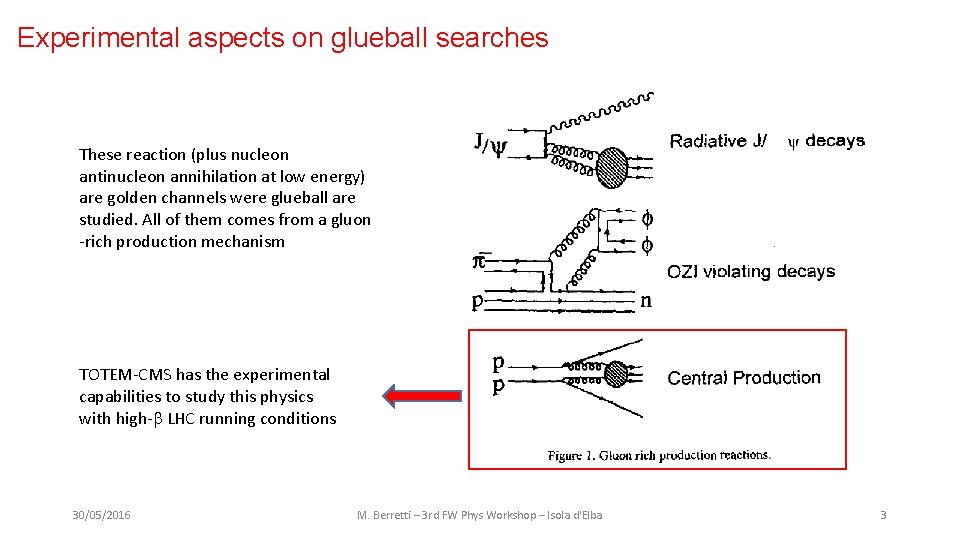
Experimental aspects on glueball searches These reaction (plus nucleon antinucleon annihilation at low energy) are golden channels were glueball are studied. All of them comes from a gluon -rich production mechanism TOTEM-CMS has the experimental capabilities to study this physics with high- LHC running conditions 30/05/2016 M. Berretti – 3 rd FW Phys Workshop – Isola d'Elba 3
Experimental aspects on glueball searches Glueballs are predicted and searched since several decades. Why there is not a general consensus on their findings so far? • In conventional q-qbar mesons, mixing of states with the same JPC is possible. Such situation may also apply for glueballs with mesons, therefore additional care is needed in the interpretation of the data. • Hadronic spectrum in the 1 -2 Ge. V is populated of mesons which can be interpreted as glueball. To disentangle the picture and isolate the possible glueball candidate(s), one need: • A very good experimental apparatus with excellent tracking resolution to low Pt and possibly good neutral acceptance to classify all the decays: mass resolution of O(10) Me. V are needed for disentangling the close resonances, spin-parity analyses requires good angular resolutions. • Selection capability of gluon enriched system where the glueball production can be favoured with a reasonable S/N over the continuous non-resonant production 30/05/2016 M. Berretti – 3 rd FW Phys Workshop – Isola d'Elba 4
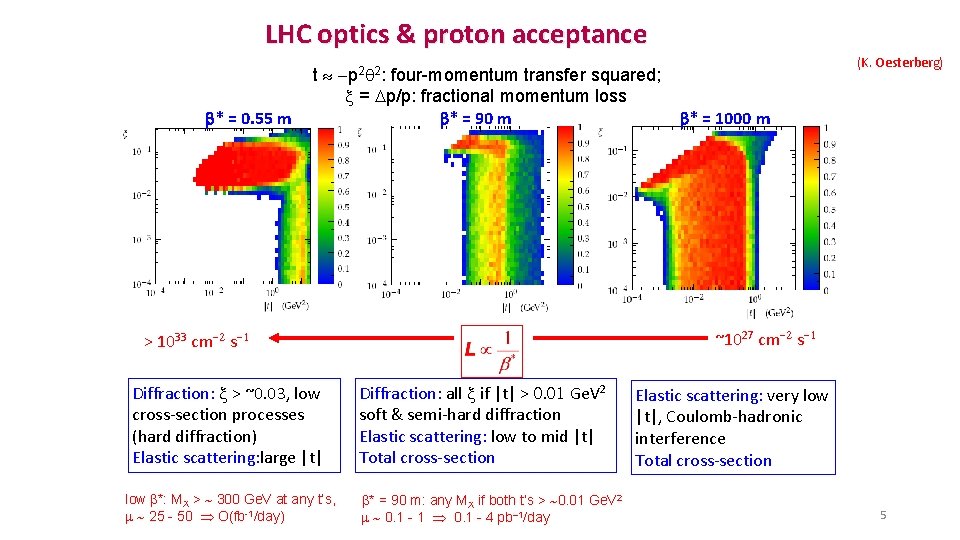
LHC optics & proton acceptance t b* = 0. 55 m p 2 2: four-momentum transfer squared; = p/p: fractional momentum loss b* = 90 m b* = 1000 m ~1027 cm 2 s 1 > 1033 cm 2 s 1 Diffraction: > ~0. 03, low cross-section processes (hard diffraction) Elastic scattering: large |t| low *: MX > 300 Ge. V at any t’s, 25 - 50 O(fb-1/day) (K. Oesterberg) Diffraction: all if |t| > 0. 01 Ge. V 2 soft & semi-hard diffraction Elastic scattering: low to mid |t| Total cross-section * = 90 m: any MX if both t’s > 0. 01 Ge. V 2 0. 1 - 1 0. 1 - 4 pb 1/day Elastic scattering: very low |t|, Coulomb-hadronic interference Total cross-section 5
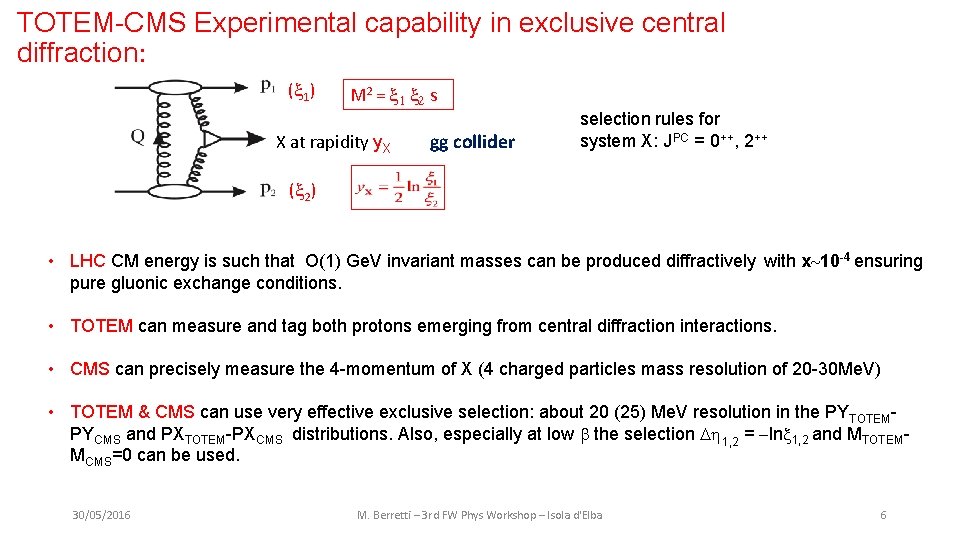
TOTEM-CMS Experimental capability in exclusive central diffraction: ( 1) M 2 = 1 2 s X at rapidity y. X gg collider selection rules for system X: JPC = 0++, 2++ ( 2) • LHC CM energy is such that O(1) Ge. V invariant masses can be produced diffractively with x~10 -4 ensuring pure gluonic exchange conditions. • TOTEM can measure and tag both protons emerging from central diffraction interactions. • CMS can precisely measure the 4 -momentum of X (4 charged particles mass resolution of 20 -30 Me. V) • TOTEM & CMS can use very effective exclusive selection: about 20 (25) Me. V resolution in the PYTOTEMPYCMS and PXTOTEM-PXCMS distributions. Also, especially at low the selection 1, 2 = ln 1, 2 and MTOTEMMCMS=0 can be used. 30/05/2016 M. Berretti – 3 rd FW Phys Workshop – Isola d'Elba 6
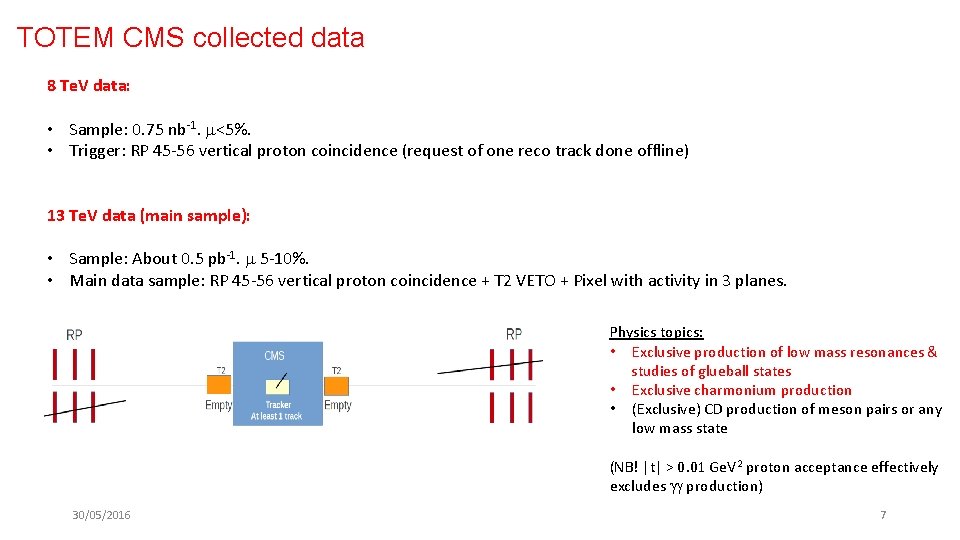
TOTEM CMS collected data 8 Te. V data: • Sample: 0. 75 nb-1. <5%. • Trigger: RP 45 -56 vertical proton coincidence (request of one reco track done offline) 13 Te. V data (main sample): • Sample: About 0. 5 pb-1. 5 -10%. • Main data sample: RP 45 -56 vertical proton coincidence + T 2 VETO + Pixel with activity in 3 planes. Physics topics: • Exclusive production of low mass resonances & studies of glueball states • Exclusive charmonium production • (Exclusive) CD production of meson pairs or any low mass state (NB! |t| > 0. 01 Ge. V 2 proton acceptance effectively excludes production) 30/05/2016 7
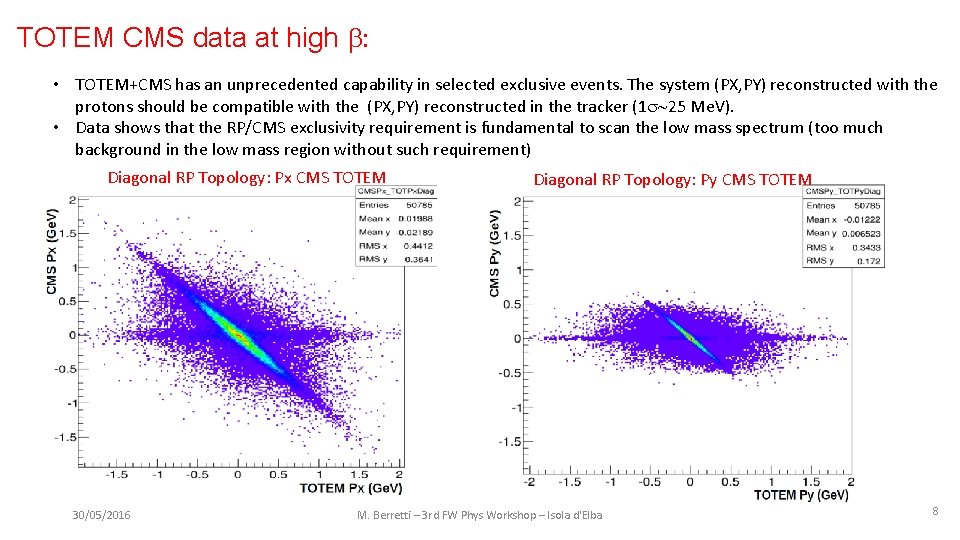
TOTEM CMS data at high : • TOTEM+CMS has an unprecedented capability in selected exclusive events. The system (PX, PY) reconstructed with the protons should be compatible with the (PX, PY) reconstructed in the tracker (1 s~25 Me. V). • Data shows that the RP/CMS exclusivity requirement is fundamental to scan the low mass spectrum (too much background in the low mass region without such requirement) Diagonal RP Topology: Px CMS TOTEM 30/05/2016 Diagonal RP Topology: Py CMS TOTEM M. Berretti – 3 rd FW Phys Workshop – Isola d'Elba 8
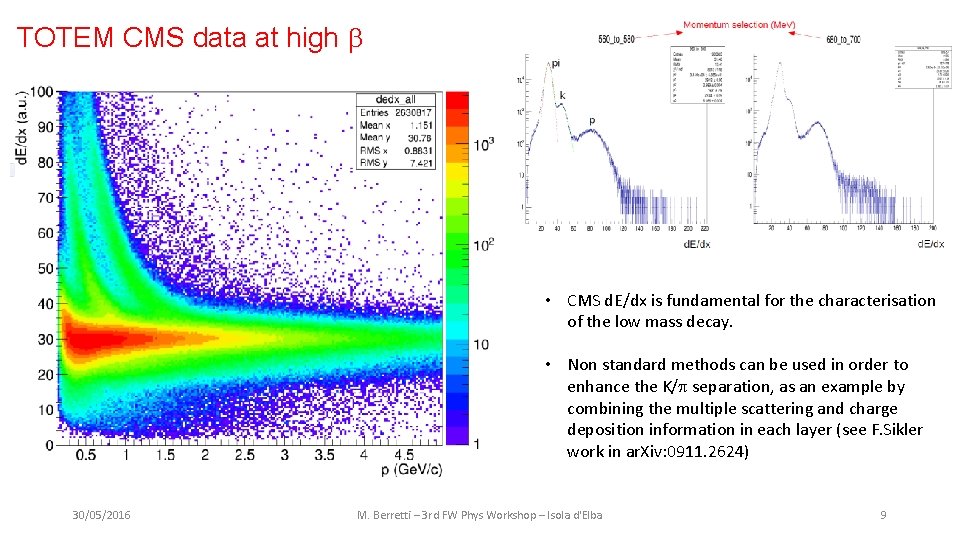
TOTEM CMS data at high • CMS d. E/dx is fundamental for the characterisation of the low mass decay. • Non standard methods can be used in order to enhance the K/p separation, as an example by combining the multiple scattering and charge deposition information in each layer (see F. Sikler work in ar. Xiv: 0911. 2624) 30/05/2016 M. Berretti – 3 rd FW Phys Workshop – Isola d'Elba 9
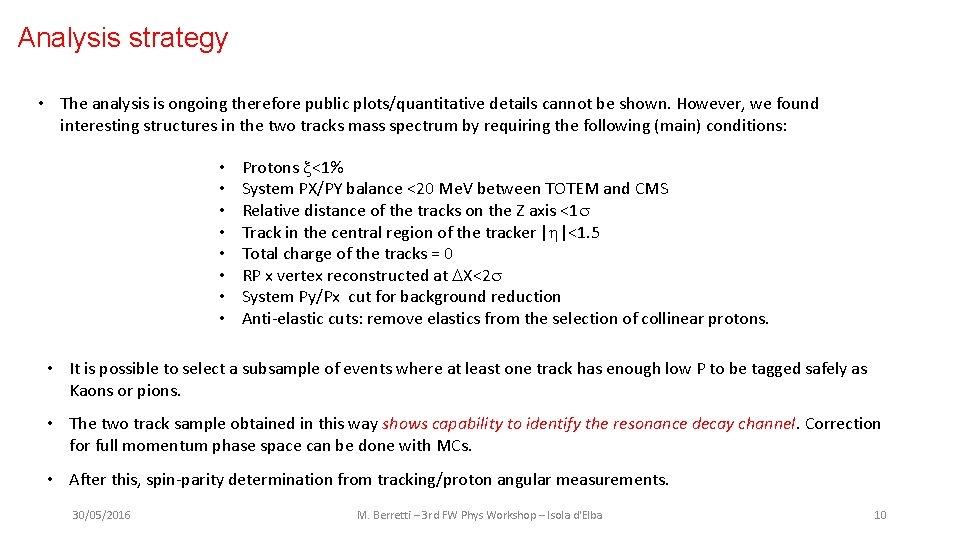
Analysis strategy • The analysis is ongoing therefore public plots/quantitative details cannot be shown. However, we found interesting structures in the two tracks mass spectrum by requiring the following (main) conditions: • • Protons <1% System PX/PY balance <20 Me. V between TOTEM and CMS Relative distance of the tracks on the Z axis <1 s Track in the central region of the tracker | |<1. 5 Total charge of the tracks = 0 RP x vertex reconstructed at X<2 s System Py/Px cut for background reduction Anti-elastic cuts: remove elastics from the selection of collinear protons. • It is possible to select a subsample of events where at least one track has enough low P to be tagged safely as Kaons or pions. • The two track sample obtained in this way shows capability to identify the resonance decay channel. Correction for full momentum phase space can be done with MCs. • After this, spin-parity determination from tracking/proton angular measurements. 30/05/2016 M. Berretti – 3 rd FW Phys Workshop – Isola d'Elba 10
Ongoing work • Understanding of the background (especially beam halo comparison between 2012 and 2015 data): additional information will be introduced in the ntuple to fight more effectively the background. Many people in CMS-TOTEM analysis group involved. • Introduction of improved d. E/dx measurement to allow optimal p/K separation. • Optimization of the tracking capability for low-Pt tracks (thanks also to the CMS trackers conveners for their help/assistance) 30/05/2016 M. Berretti – 3 rd FW Phys Workshop – Isola d'Elba 11
Conclusions • Glueball searches are a very active field in Physics. • Measurement and interpretation of glueball states is challenging both from the experimental and theoretical point of view. • 0. 5 1/pb of data has been collected with a DPE-enriched trigger by the CMS-TOTEM collaboration in 2015. This sample is one of the most natural where to look for glueball. • Analysis on low mass DPE is ongoing. Both CMS and protons information are found to be essential in order to reconstruct the exclusive low mass spectrum with reduced background. • Interesting feature of the data was found. Optimization of many reconstruction tools in order to exploit the data (d. E/dx, low pt track reconstruction …) 30/05/2016 M. Berretti – 3 rd FW Phys Workshop – Isola d'Elba 12
- Slides: 12