
CMSC 611 Advanced Computer Architecture Memory Virtual Memory
- Slides: 25
CMSC 611: Advanced Computer Architecture Memory & Virtual Memory Some material adapted from Mohamed Younis, UMBC CMSC 611 Spr 2003 course slides Some material adapted from Hennessy & Patterson / © 2003 Elsevier Science
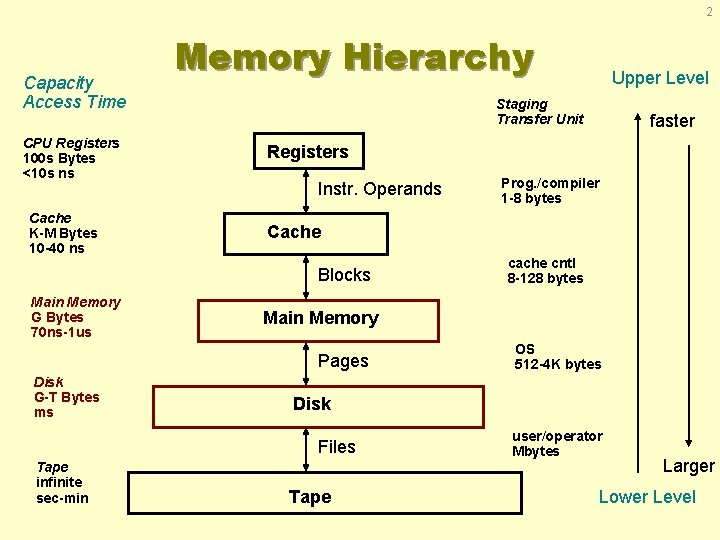
2 Capacity Access Time CPU Registers 100 s Bytes <10 s ns Cache K-M Bytes 10 -40 ns Memory Hierarchy Staging Transfer Unit Instr. Operands cache cntl 8 -128 bytes Main Memory OS 512 -4 K bytes Disk Files Tape infinite sec-min Prog. /compiler 1 -8 bytes Cache Pages Disk G-T Bytes ms faster Registers Blocks Main Memory G Bytes 70 ns-1 us Upper Level Tape user/operator Mbytes Larger Lower Level
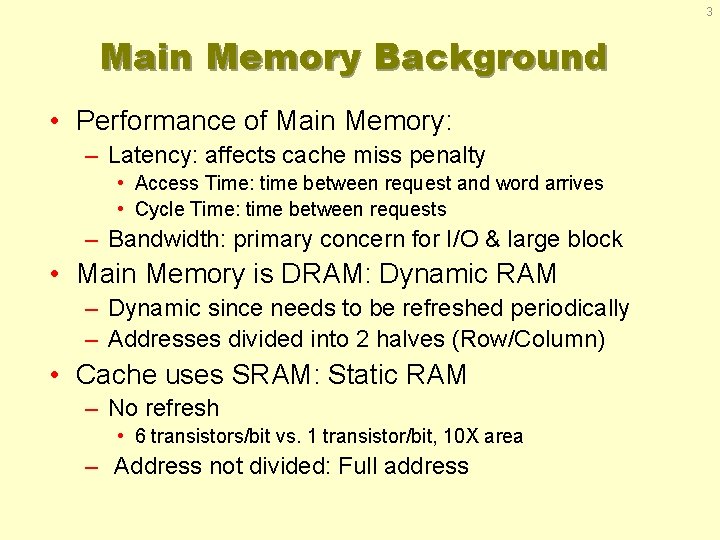
3 Main Memory Background • Performance of Main Memory: – Latency: affects cache miss penalty • Access Time: time between request and word arrives • Cycle Time: time between requests – Bandwidth: primary concern for I/O & large block • Main Memory is DRAM: Dynamic RAM – Dynamic since needs to be refreshed periodically – Addresses divided into 2 halves (Row/Column) • Cache uses SRAM: Static RAM – No refresh • 6 transistors/bit vs. 1 transistor/bit, 10 X area – Address not divided: Full address
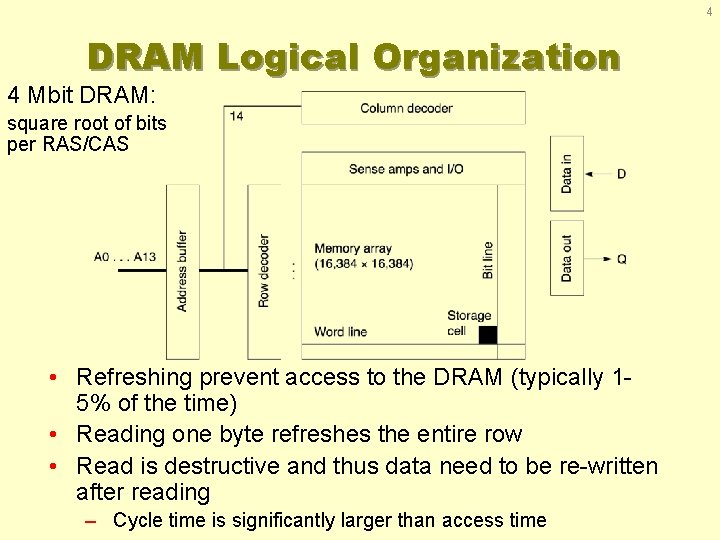
4 DRAM Logical Organization 4 Mbit DRAM: square root of bits per RAS/CAS • Refreshing prevent access to the DRAM (typically 15% of the time) • Reading one byte refreshes the entire row • Read is destructive and thus data need to be re-written after reading – Cycle time is significantly larger than access time
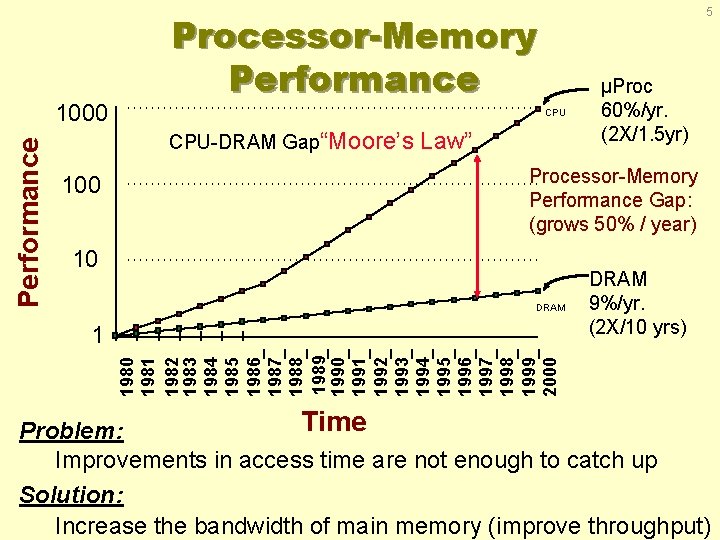
Performance 1000 Processor-Memory Performance CPU-DRAM Gap“Moore’s 100 5 Law” µProc 60%/yr. (2 X/1. 5 yr) Processor-Memory Performance Gap: (grows 50% / year) 10 DRAM 1980 1981 1982 1983 1984 1985 1986 1987 1988 1989 1990 1991 1992 1993 1994 1995 1996 1997 1998 1999 2000 1 DRAM 9%/yr. (2 X/10 yrs) Time Problem: Improvements in access time are not enough to catch up Solution: Increase the bandwidth of main memory (improve throughput)
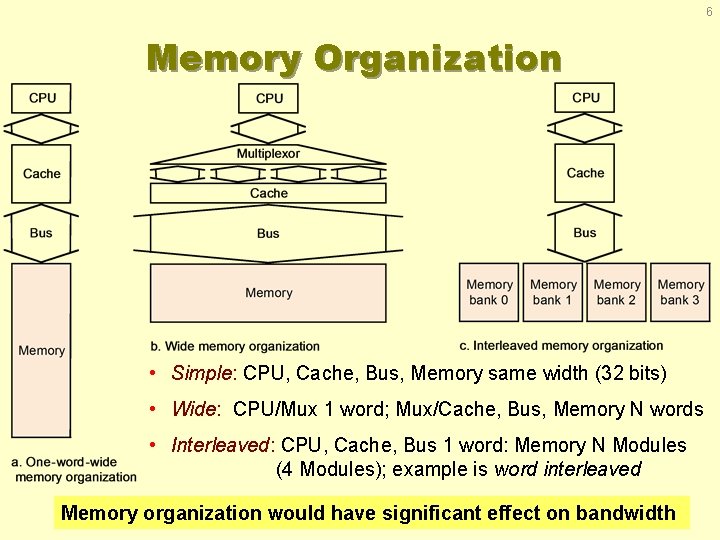
6 Memory Organization • Simple: CPU, Cache, Bus, Memory same width (32 bits) • Wide: CPU/Mux 1 word; Mux/Cache, Bus, Memory N words • Interleaved: CPU, Cache, Bus 1 word: Memory N Modules (4 Modules); example is word interleaved Memory organization would have significant effect on bandwidth
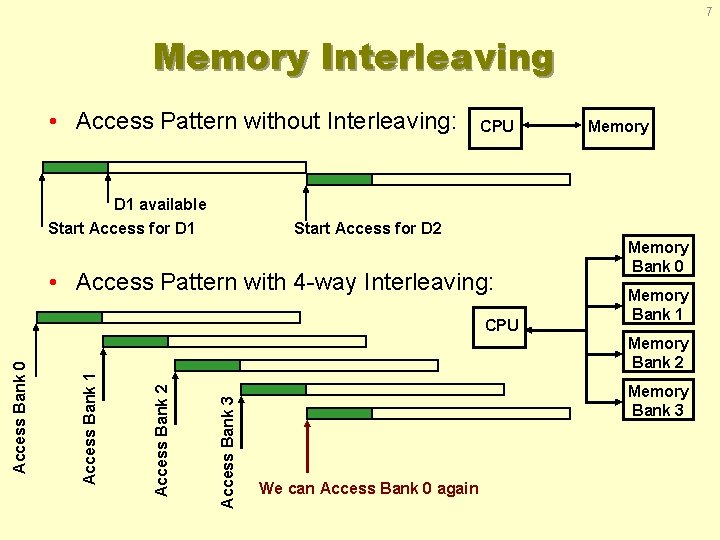
7 Memory Interleaving • Access Pattern without Interleaving: D 1 available Start Access for D 1 CPU Start Access for D 2 • Access Pattern with 4 -way Interleaving: CPU Memory Bank 0 Memory Bank 1 Access Bank 3 Access Bank 2 Memory Bank 2 Access Bank 1 Access Bank 0 Memory Bank 3 We can Access Bank 0 again
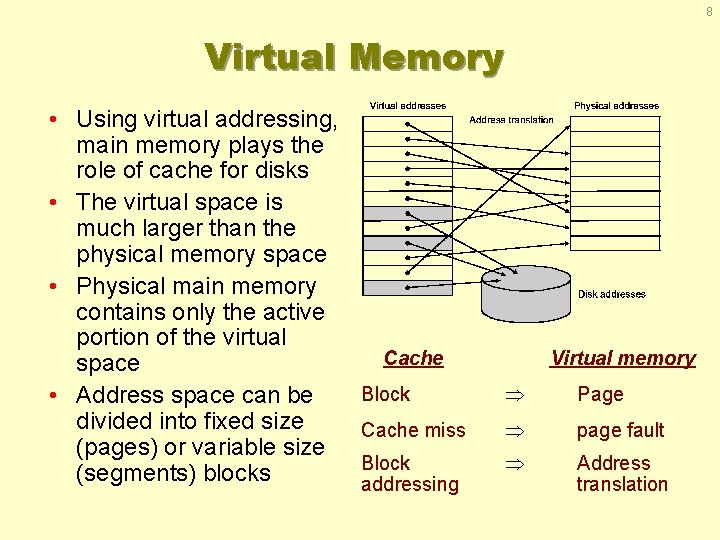
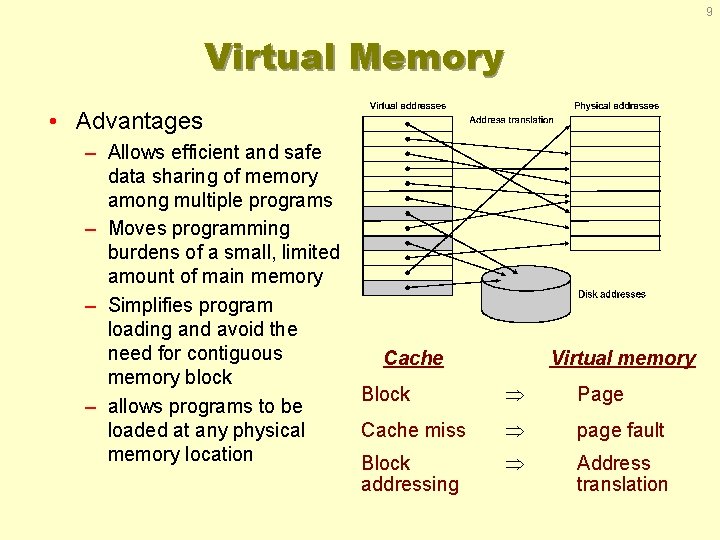
8 Virtual Memory • Using virtual addressing, main memory plays the role of cache for disks • The virtual space is much larger than the physical memory space • Physical main memory contains only the active portion of the virtual space • Address space can be divided into fixed size (pages) or variable size (segments) blocks Cache Virtual memory Block Page Cache miss page fault Block addressing Address translation
9 Virtual Memory • Advantages – Allows efficient and safe data sharing of memory among multiple programs – Moves programming burdens of a small, limited amount of main memory – Simplifies program loading and avoid the need for contiguous memory block – allows programs to be loaded at any physical memory location Cache Virtual memory Block Page Cache miss page fault Block addressing Address translation
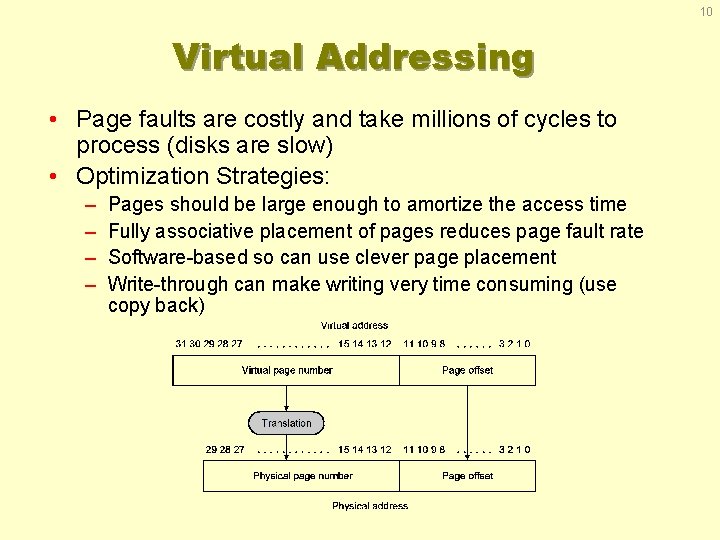
10 Virtual Addressing • Page faults are costly and take millions of cycles to process (disks are slow) • Optimization Strategies: – – Pages should be large enough to amortize the access time Fully associative placement of pages reduces page fault rate Software-based so can use clever page placement Write-through can make writing very time consuming (use copy back)
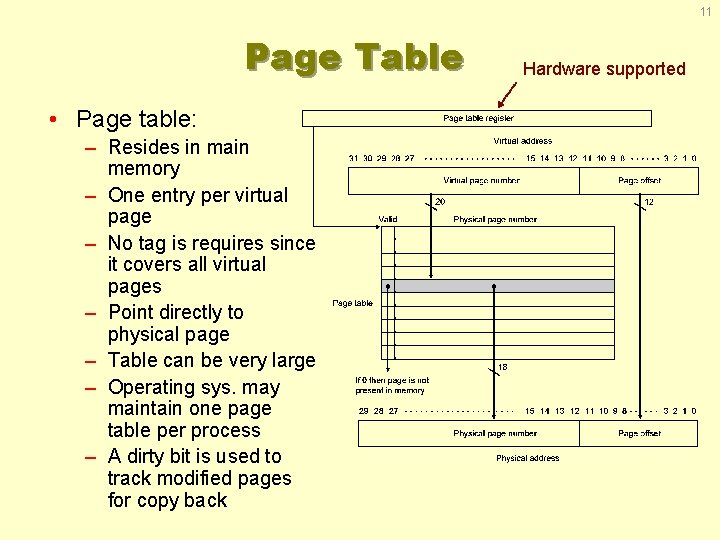
11 Page Table • Page table: – Resides in main memory – One entry per virtual page – No tag is requires since it covers all virtual pages – Point directly to physical page – Table can be very large – Operating sys. may maintain one page table per process – A dirty bit is used to track modified pages for copy back Hardware supported
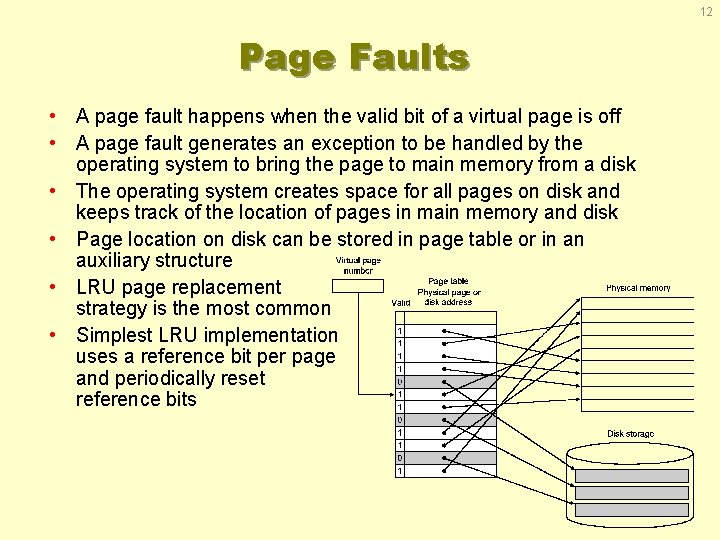
12 Page Faults • A page fault happens when the valid bit of a virtual page is off • A page fault generates an exception to be handled by the operating system to bring the page to main memory from a disk • The operating system creates space for all pages on disk and keeps track of the location of pages in main memory and disk • Page location on disk can be stored in page table or in an auxiliary structure • LRU page replacement strategy is the most common • Simplest LRU implementation uses a reference bit per page and periodically reset reference bits
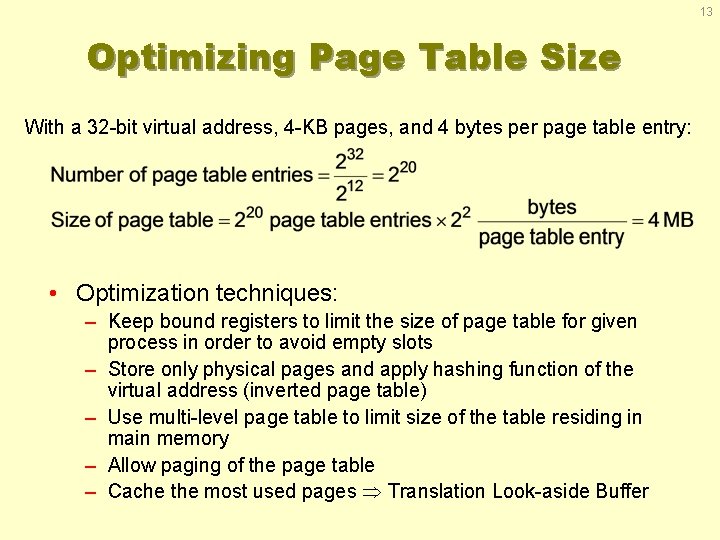
13 Optimizing Page Table Size With a 32 -bit virtual address, 4 -KB pages, and 4 bytes per page table entry: • Optimization techniques: – Keep bound registers to limit the size of page table for given process in order to avoid empty slots – Store only physical pages and apply hashing function of the virtual address (inverted page table) – Use multi-level page table to limit size of the table residing in main memory – Allow paging of the page table – Cache the most used pages Translation Look-aside Buffer
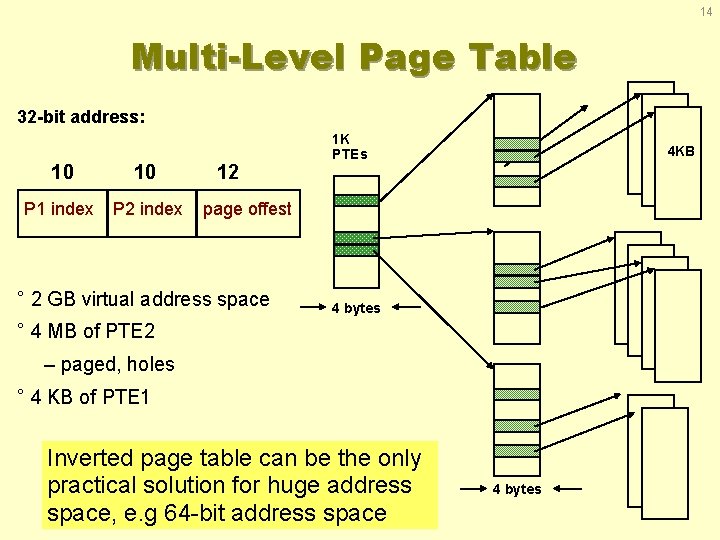
14 Multi-Level Page Table 32 -bit address: 10 10 P 1 index P 2 index 12 1 K PTEs 4 KB page offest ° 2 GB virtual address space 4 bytes ° 4 MB of PTE 2 – paged, holes ° 4 KB of PTE 1 Inverted page table can be the only practical solution for huge address space, e. g 64 -bit address space 4 bytes
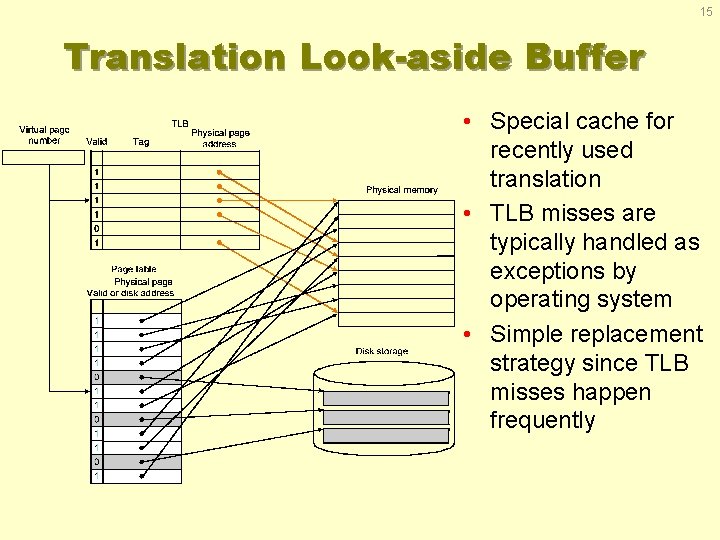
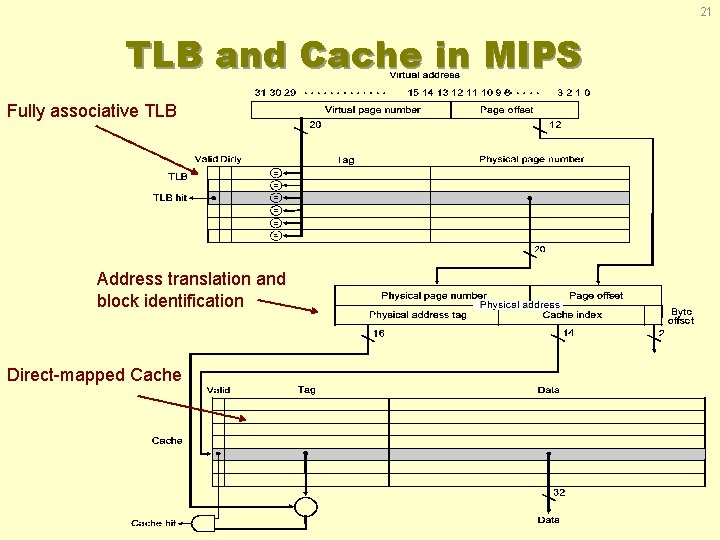
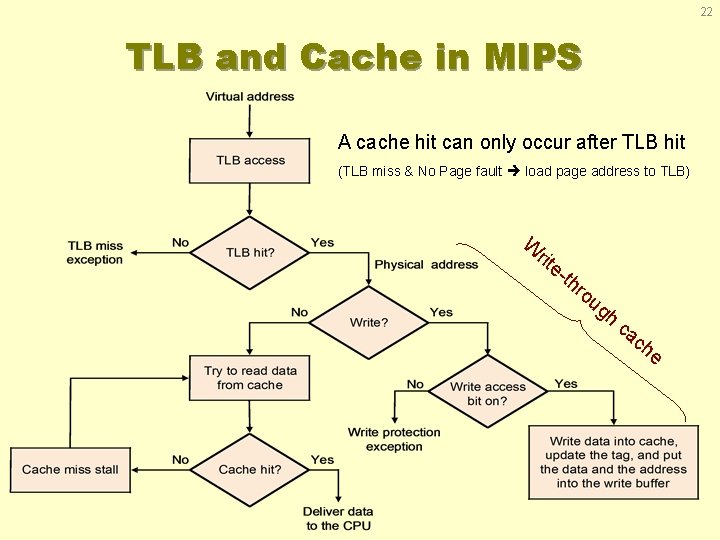
15 Translation Look-aside Buffer • Special cache for recently used translation • TLB misses are typically handled as exceptions by operating system • Simple replacement strategy since TLB misses happen frequently
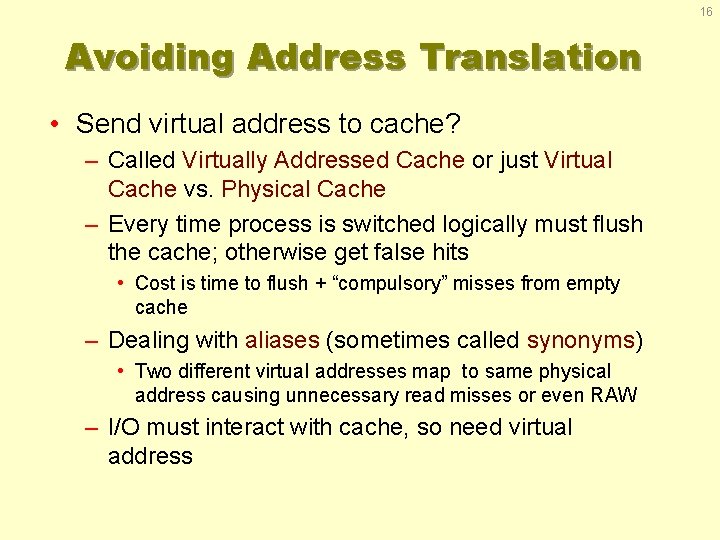
16 Avoiding Address Translation • Send virtual address to cache? – Called Virtually Addressed Cache or just Virtual Cache vs. Physical Cache – Every time process is switched logically must flush the cache; otherwise get false hits • Cost is time to flush + “compulsory” misses from empty cache – Dealing with aliases (sometimes called synonyms) • Two different virtual addresses map to same physical address causing unnecessary read misses or even RAW – I/O must interact with cache, so need virtual address
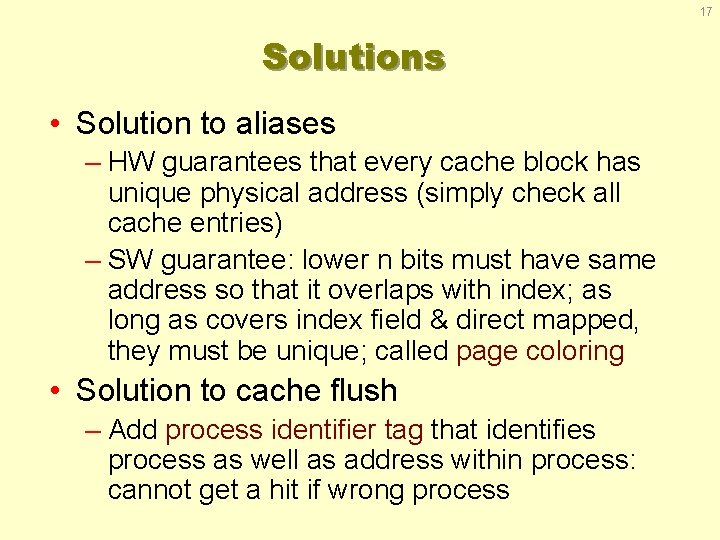
17 Solutions • Solution to aliases – HW guarantees that every cache block has unique physical address (simply check all cache entries) – SW guarantee: lower n bits must have same address so that it overlaps with index; as long as covers index field & direct mapped, they must be unique; called page coloring • Solution to cache flush – Add process identifier tag that identifies process as well as address within process: cannot get a hit if wrong process
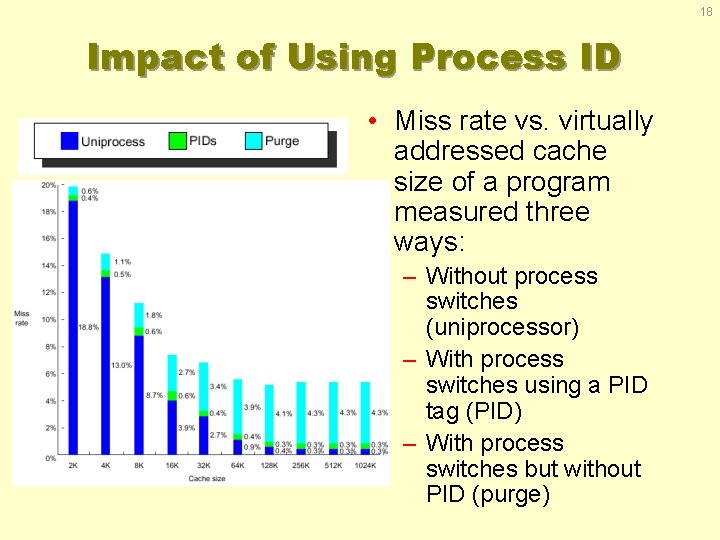
18 Impact of Using Process ID • Miss rate vs. virtually addressed cache size of a program measured three ways: – Without process switches (uniprocessor) – With process switches using a PID tag (PID) – With process switches but without PID (purge)
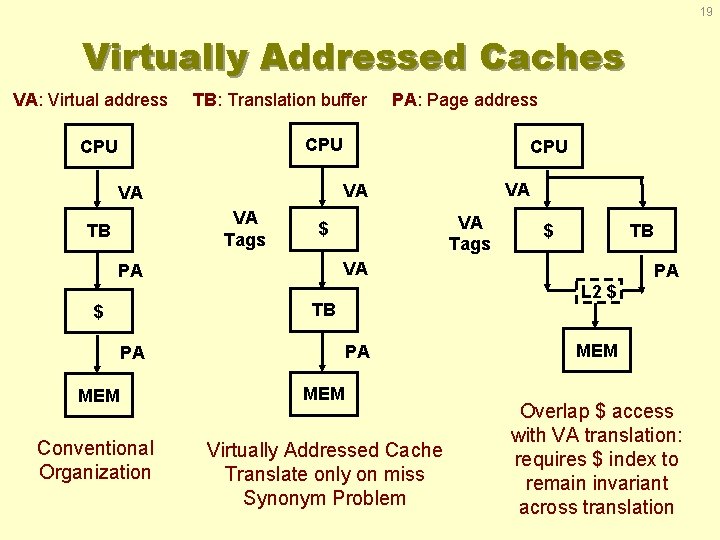
19 Virtually Addressed Caches VA: Virtual address TB: Translation buffer PA: Page address CPU VA Tags $ $ TB VA PA PA L 2 $ TB $ VA VA VA TB CPU MEM Conventional Organization Virtually Addressed Cache Translate only on miss Synonym Problem MEM Overlap $ access with VA translation: requires $ index to remain invariant across translation
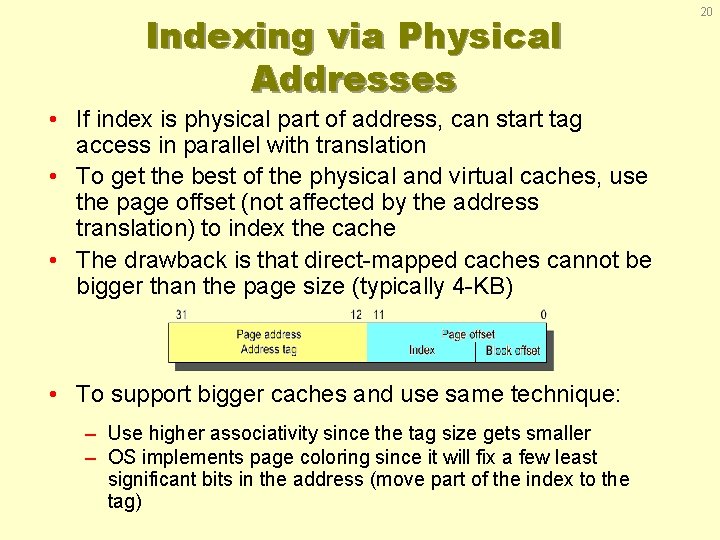
Indexing via Physical Addresses • If index is physical part of address, can start tag access in parallel with translation • To get the best of the physical and virtual caches, use the page offset (not affected by the address translation) to index the cache • The drawback is that direct-mapped caches cannot be bigger than the page size (typically 4 -KB) • To support bigger caches and use same technique: – Use higher associativity since the tag size gets smaller – OS implements page coloring since it will fix a few least significant bits in the address (move part of the index to the tag) 20
21 TLB and Cache in MIPS Fully associative TLB Address translation and block identification Direct-mapped Cache
22 TLB and Cache in MIPS A cache hit can only occur after TLB hit (TLB miss & No Page fault load page address to TLB) W rit e- th ro ug h ca ch e
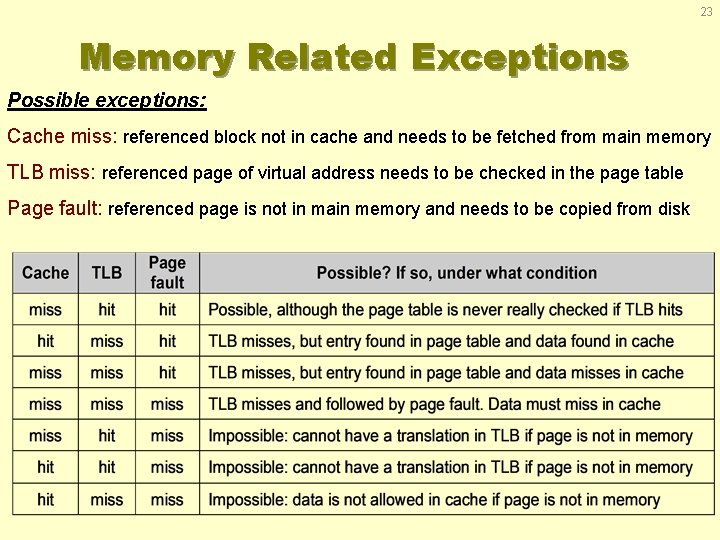
23 Memory Related Exceptions Possible exceptions: Cache miss: referenced block not in cache and needs to be fetched from main memory TLB miss: referenced page of virtual address needs to be checked in the page table Page fault: referenced page is not in main memory and needs to be copied from disk
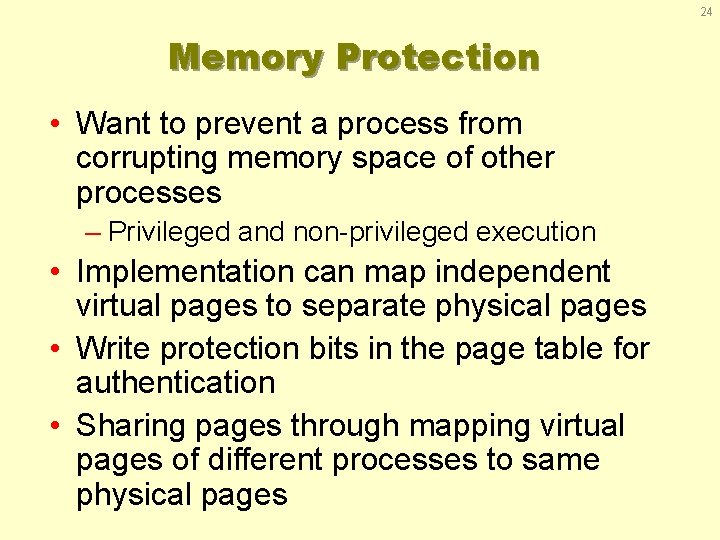
24 Memory Protection • Want to prevent a process from corrupting memory space of other processes – Privileged and non-privileged execution • Implementation can map independent virtual pages to separate physical pages • Write protection bits in the page table for authentication • Sharing pages through mapping virtual pages of different processes to same physical pages
25 Memory Protection • To enable the operating system to implement protection, the hardware must provide at least the following capabilities: – Support at least two mode of operations, one of them is a user mode – Provide a portion of CPU state that a user process can read but not write, • e. g. page pointer and TLB – Enable change of operation modes through special instructions