
CMSC 611 Advanced Computer Architecture Distributed Shared Memory
CMSC 611: Advanced Computer Architecture Distributed Shared Memory Most slides adapted from David Patterson. Some from Mohomed Younis
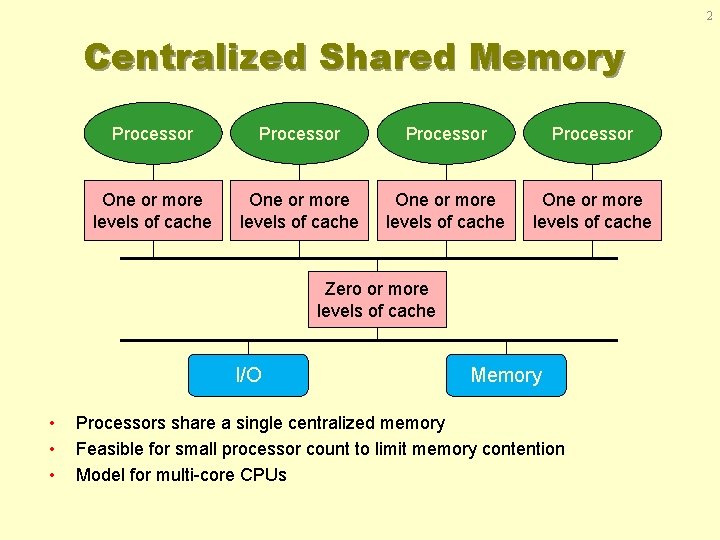
2 Centralized Shared Memory Processor One or more levels of cache Zero or more levels of cache I/O • • • Memory Processors share a single centralized memory Feasible for small processor count to limit memory contention Model for multi-core CPUs

3 Distributed Memory Proc Cache Mem Mem Cache Proc • Uses physically distributed memory to support large processor counts (to avoid memory contention) • Advantages – Allows cost-effective way to scale the memory bandwidth – Reduces memory latency • Disadvantage – Increased complexity of communicating data
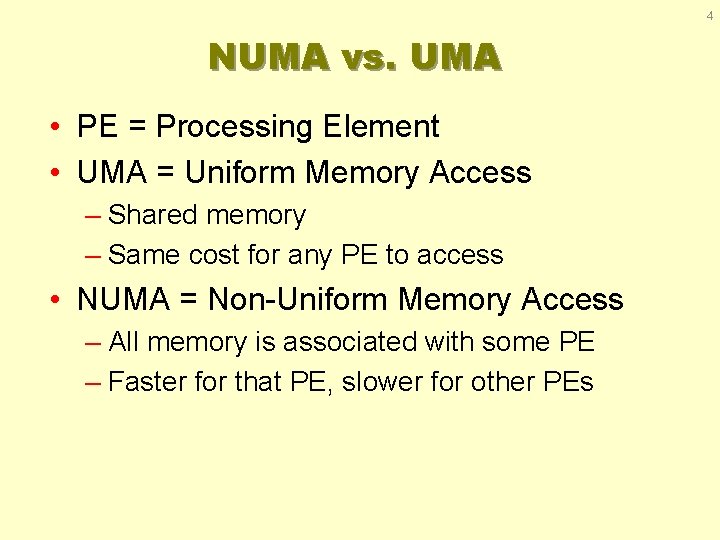
4 NUMA vs. UMA • PE = Processing Element • UMA = Uniform Memory Access – Shared memory – Same cost for any PE to access • NUMA = Non-Uniform Memory Access – All memory is associated with some PE – Faster for that PE, slower for other PEs
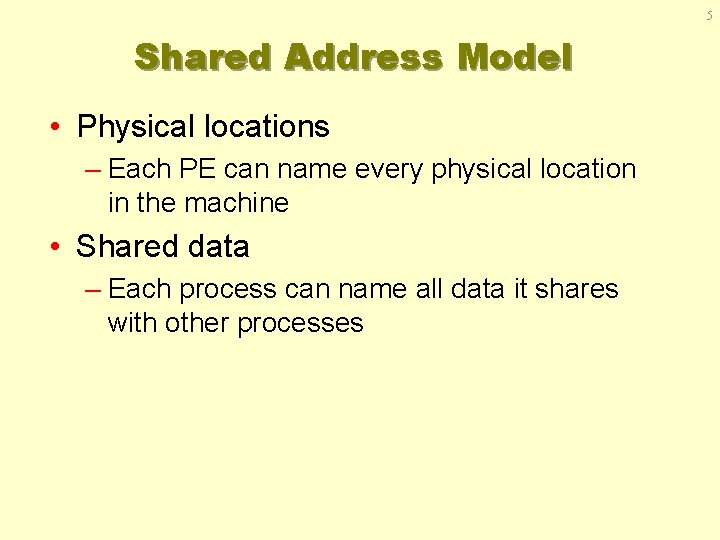
5 Shared Address Model • Physical locations – Each PE can name every physical location in the machine • Shared data – Each process can name all data it shares with other processes
6 Shared Address Model • Data transfer – Use load and store, VM maps to local or remote location – Extra memory level: cache remote data – Significant research on making the translation transparent and scalable for many nodes • Handling data consistency and protection challenging • Latency depends on the underlying hardware architecture (bus bandwidth, memory access time and support for address translation) • Scalability is limited given that the communication model is so tightly coupled with process address space
Three Fundamental Issues (#1: Naming) • • What data is shared? How it is addressed? What operations can access data? How processes refer to each other? • Choice of naming affects code produced by a compiler – Just remember and load address or keep track of processor number and local virtual address for message passing • Choice of naming affects replication of data – In cache memory hierarchy or via SW replication and consistency 7
8 Naming Address Spaces • Global physical address space – any processor can generate, address and access it in a single operation • Global virtual address space – if the address space of each process can be configured to contain all shared data of the parallel program • memory can be anywhere: virtual address translation handles it • Segmented shared address space – locations are named <process number, address> uniformly for all processes of the parallel program
Three Fundamental Issues (#2: Synchronization) • To cooperate, processes must coordinate • Message passing is implicit coordination with transmission or arrival of data • Shared address → additional operations to explicitly coordinate: e. g. , write a flag, awaken a thread, interrupt a processor 9
Three Fundamental Issues (#3: Latency & Bandwidth) • Bandwidth – Need high bandwidth in communication – Match limits in network, memory, and processor – Overhead to communicate is a problem in many machines • Latency – Affects performance, since processor may have to wait – Affects ease of programming, since requires more thought to overlap communication and computation • Latency Hiding – How can a mechanism help hide latency? – Examples: overlap message send with computation, pre-fetch data, switch to other tasks 10
11 Snooping Cache Coherency • Send all requests for data to all processors • Processors snoop to see if they have a copy and respond accordingly • Requires broadcast, since caching information is at processors • Works well with bus (natural broadcast medium)
12 Directory Cache Coherency • Keep track of what is being shared in one centralized place • Distributed memory ⇒ distributed directory for scalability (avoids bottlenecks) • Send point-to-point requests to processors via network • Scales better than Snooping • Actually existed before Snooping-based schemes
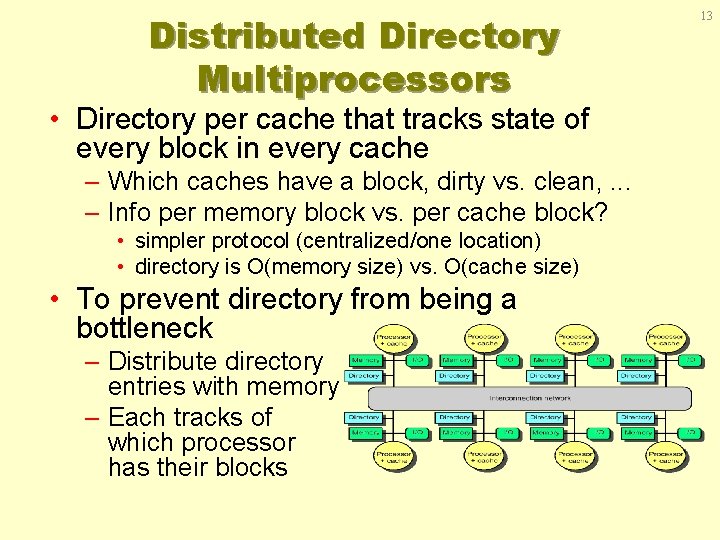
Distributed Directory Multiprocessors • Directory per cache that tracks state of every block in every cache – Which caches have a block, dirty vs. clean, . . . – Info per memory block vs. per cache block? • simpler protocol (centralized/one location) • directory is O(memory size) vs. O(cache size) • To prevent directory from being a bottleneck – Distribute directory entries with memory – Each tracks of which processor has their blocks 13
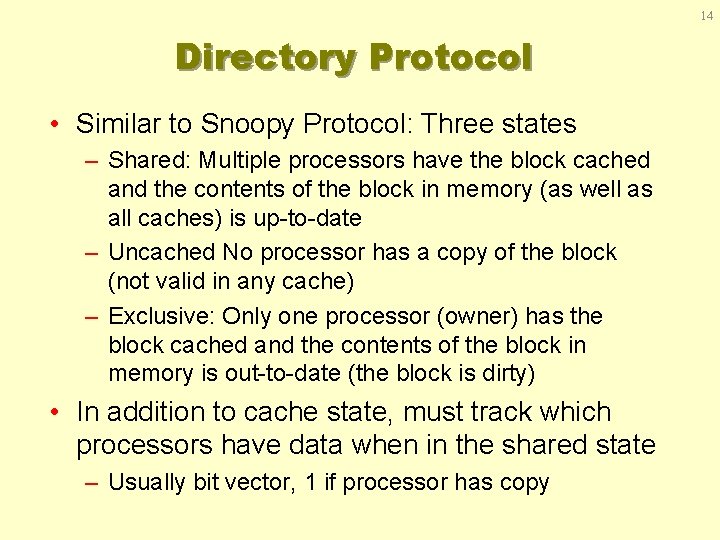
14 Directory Protocol • Similar to Snoopy Protocol: Three states – Shared: Multiple processors have the block cached and the contents of the block in memory (as well as all caches) is up-to-date – Uncached No processor has a copy of the block (not valid in any cache) – Exclusive: Only one processor (owner) has the block cached and the contents of the block in memory is out-to-date (the block is dirty) • In addition to cache state, must track which processors have data when in the shared state – Usually bit vector, 1 if processor has copy
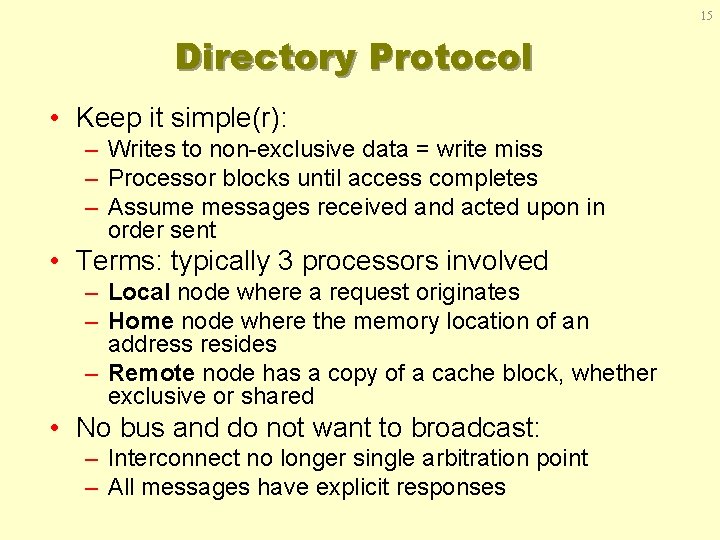
15 Directory Protocol • Keep it simple(r): – Writes to non-exclusive data = write miss – Processor blocks until access completes – Assume messages received and acted upon in order sent • Terms: typically 3 processors involved – Local node where a request originates – Home node where the memory location of an address resides – Remote node has a copy of a cache block, whether exclusive or shared • No bus and do not want to broadcast: – Interconnect no longer single arbitration point – All messages have explicit responses
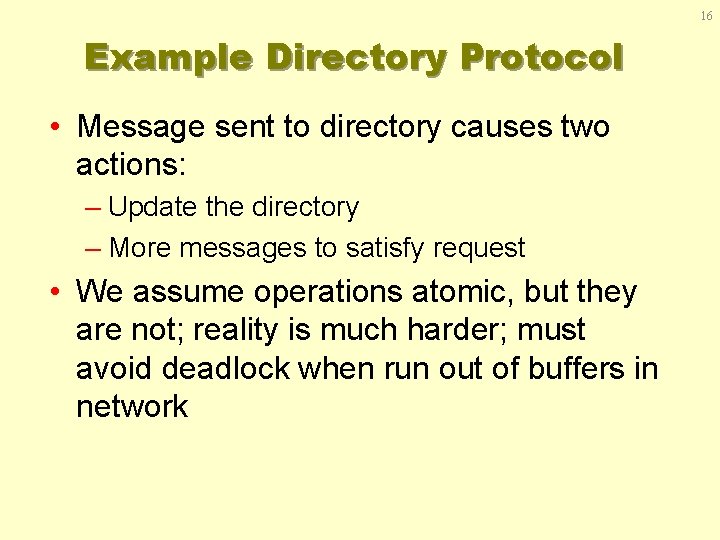
16 Example Directory Protocol • Message sent to directory causes two actions: – Update the directory – More messages to satisfy request • We assume operations atomic, but they are not; reality is much harder; must avoid deadlock when run out of buffers in network
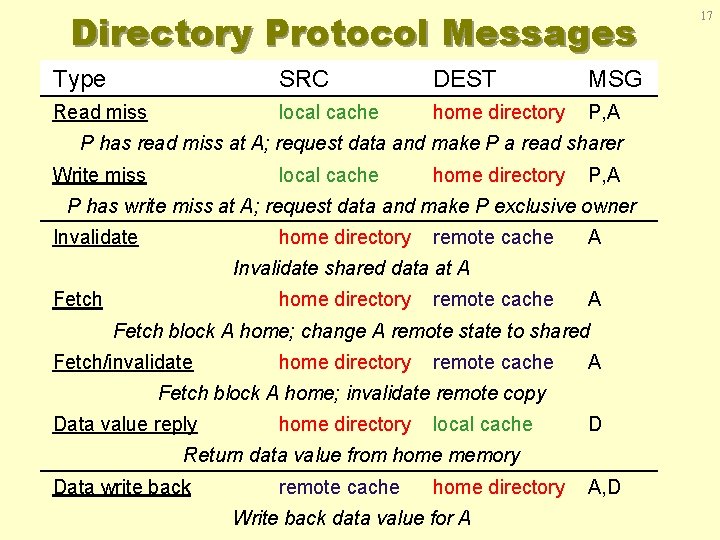
Directory Protocol Messages Type SRC DEST MSG Read miss local cache home directory P, A P has read miss at A; request data and make P a read sharer Write miss local cache home directory P, A P has write miss at A; request data and make P exclusive owner Invalidate home directory remote cache A Invalidate shared data at A Fetch home directory remote cache A Fetch block A home; change A remote state to shared Fetch/invalidate home directory remote cache A Fetch block A home; invalidate remote copy Data value reply home directory local cache D Return data value from home memory Data write back remote cache home directory Write back data value for A A, D 17
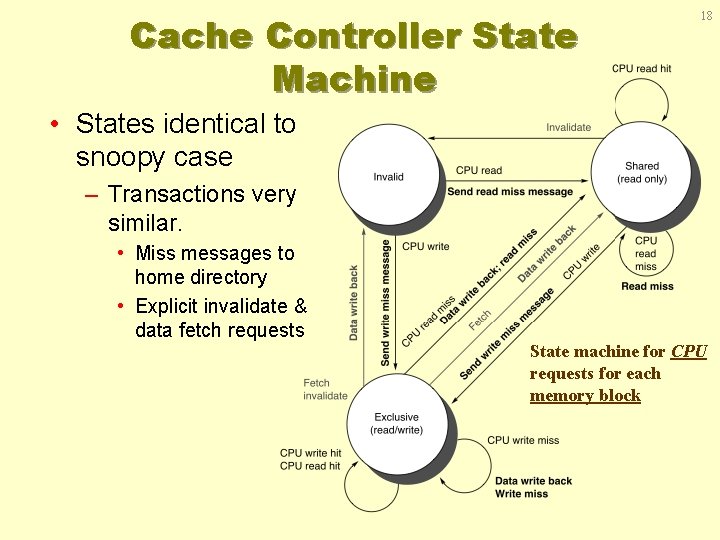
Cache Controller State Machine 18 • States identical to snoopy case – Transactions very similar. • Miss messages to home directory • Explicit invalidate & data fetch requests State machine for CPU requests for each memory block
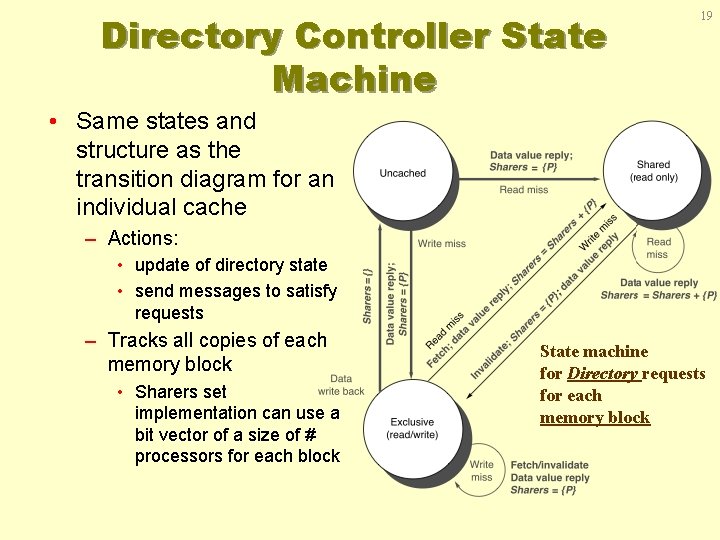
Directory Controller State Machine 19 • Same states and structure as the transition diagram for an individual cache – Actions: • update of directory state • send messages to satisfy requests – Tracks all copies of each memory block • Sharers set implementation can use a bit vector of a size of # processors for each block State machine for Directory requests for each memory block
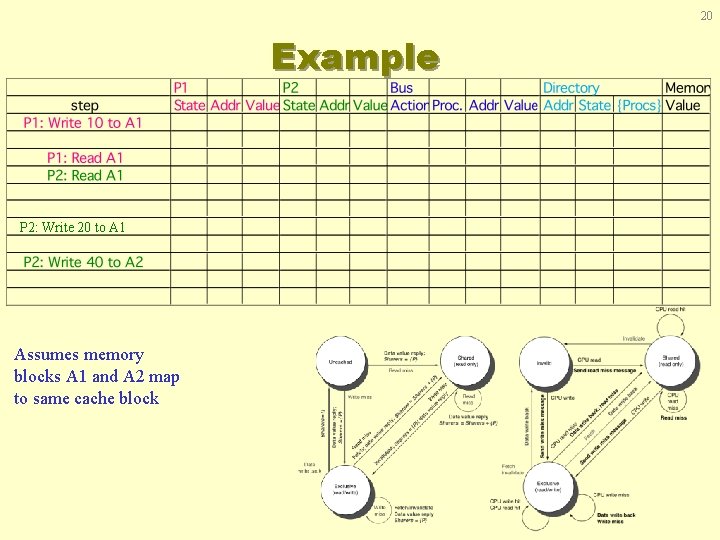
20 Example P 2: Write 20 to A 1 Assumes memory blocks A 1 and A 2 map to same cache block
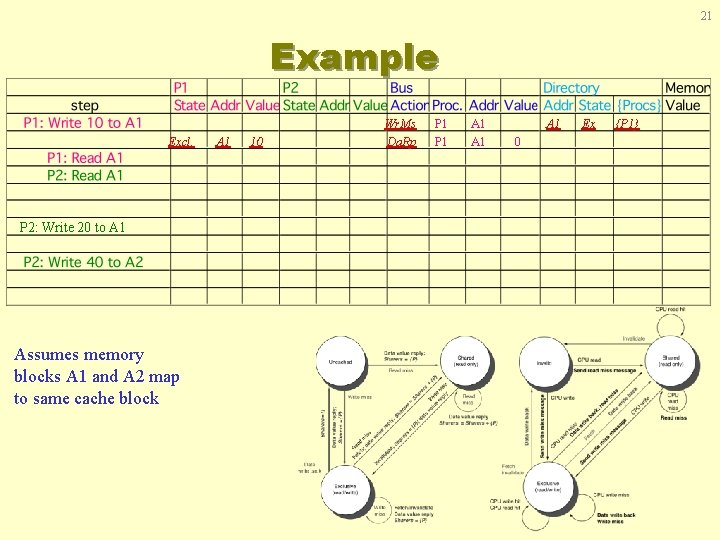
21 Example Excl. P 2: Write 20 to A 1 Assumes memory blocks A 1 and A 2 map to same cache block A 1 10 Wr. Ms Da. Rp P 1 A 1 A 1 0 Ex {P 1}
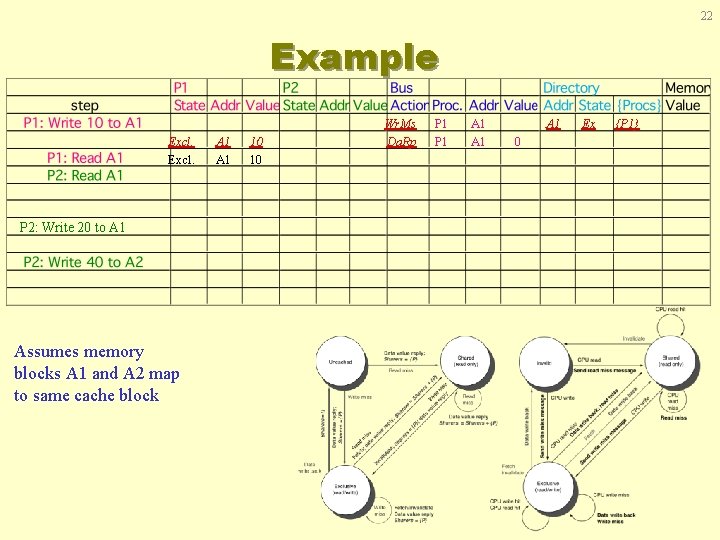
22 Example Excl. P 2: Write 20 to A 1 Assumes memory blocks A 1 and A 2 map to same cache block A 1 10 10 Wr. Ms Da. Rp P 1 A 1 A 1 0 Ex {P 1}
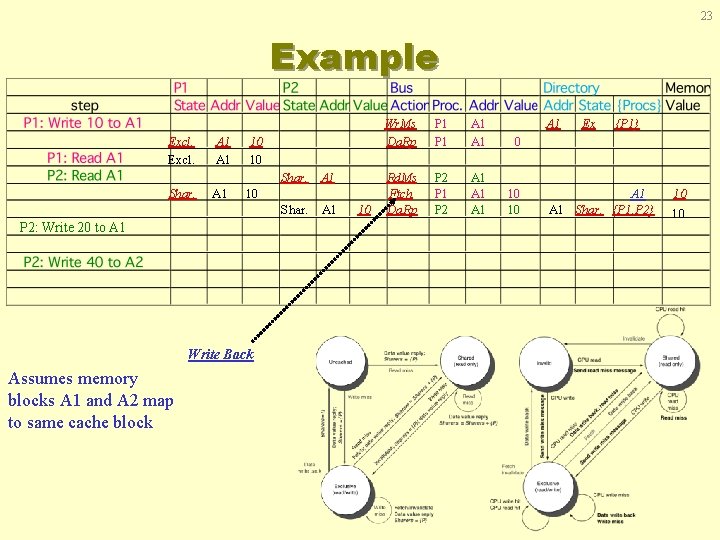
23 Example Excl. A 1 10 10 Shar. A 1 Shar. A 1 10 Shar. P 2: Write 20 to A 1 Write Back Assumes memory blocks A 1 and A 2 map to same cache block A 1 10 Wr. Ms Da. Rp P 1 A 1 A 1 0 Rd. Ms Ftch Da. Rp P 2 P 1 P 2 A 1 A 1 10 10 Ex {P 1} A 1 Shar. {P 1, P 2} 10 10
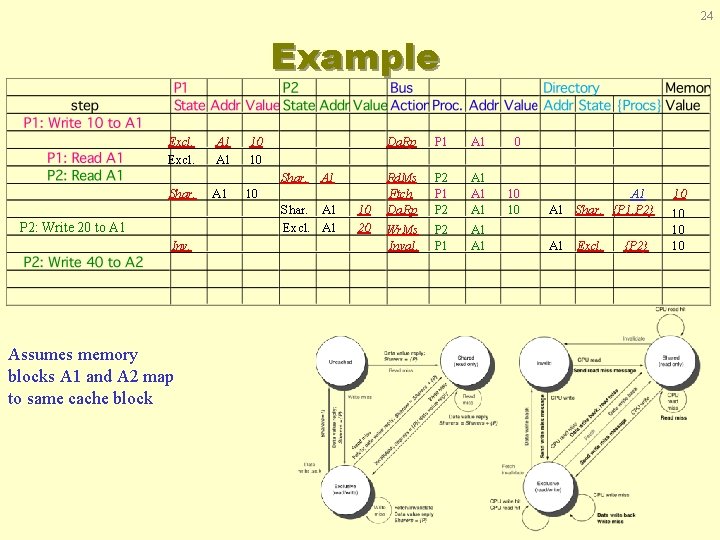
24 Example Excl. A 1 10 10 Shar. A 1 Shar. A 1 10 Shar. A 1 Excl. A 1 P 2: Write 20 to A 1 Inv. Assumes memory blocks A 1 and A 2 map to same cache block 10 20 Da. Rp P 1 A 1 0 Rd. Ms Ftch Da. Rp P 2 P 1 P 2 A 1 A 1 10 10 Wr. Ms Inval. P 2 P 1 A 1 A 1 Shar. {P 1, P 2} A 1 Excl. {P 2} 10 10
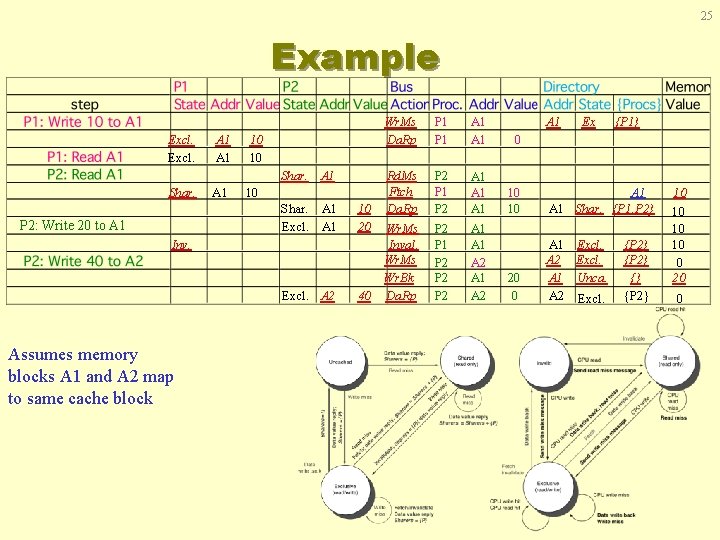
25 Example Excl. A 1 10 10 Shar. A 1 Shar. A 1 10 Shar. A 1 Excl. A 1 P 2: Write 20 to A 1 10 20 Inv. Excl. A 2 Assumes memory blocks A 1 and A 2 map to same cache block 40 Wr. Ms Da. Rp P 1 A 1 A 1 Ex {P 1} 0 Rd. Ms Ftch Da. Rp P 2 P 1 P 2 A 1 A 1 10 10 A 1 Shar. {P 1, P 2} Wr. Ms Inval. Wr. Ms Wr. Bk Da. Rp P 2 P 1 P 2 P 2 A 1 A 2 20 0 A 1 Excl. A 2 Excl. A 1 Unca. A 2 Excl. {P 2} {} {P 2} 10 10 0 20 0
- Slides: 25