
CMSC 341 KD Trees KD Tree n Introduction
![print. Range in a 2 -D Tree In range? If so, print cell low[level]<=data[level]->search](https://slidetodoc.com/presentation_image/436ea5fa285f79b6895687d1bee54016/image-9.jpg "print. Range in a 2 -D Tree In range? If so, print cell low[level]<=data[level]->search")
- Slides: 14
CMSC 341 K-D Trees
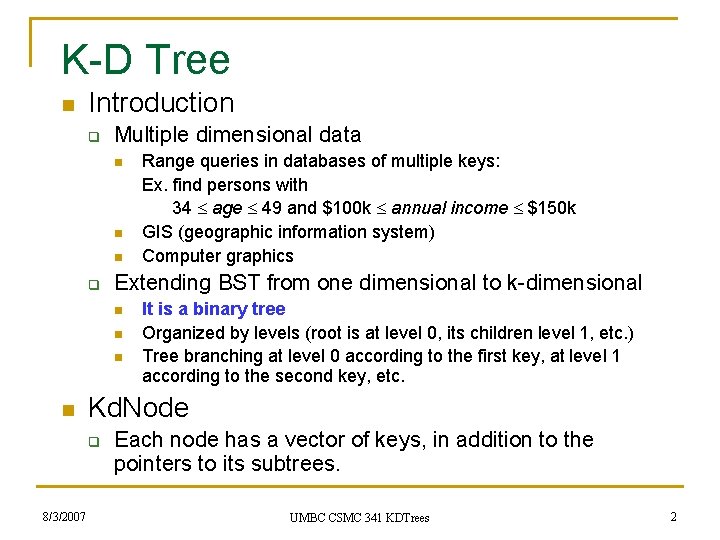
K-D Tree n Introduction q Multiple dimensional data n n n q Extending BST from one dimensional to k-dimensional n n It is a binary tree Organized by levels (root is at level 0, its children level 1, etc. ) Tree branching at level 0 according to the first key, at level 1 according to the second key, etc. Kd. Node q 8/3/2007 Range queries in databases of multiple keys: Ex. find persons with 34 age 49 and $100 k annual income $150 k GIS (geographic information system) Computer graphics Each node has a vector of keys, in addition to the pointers to its subtrees. UMBC CSMC 341 KDTrees 2
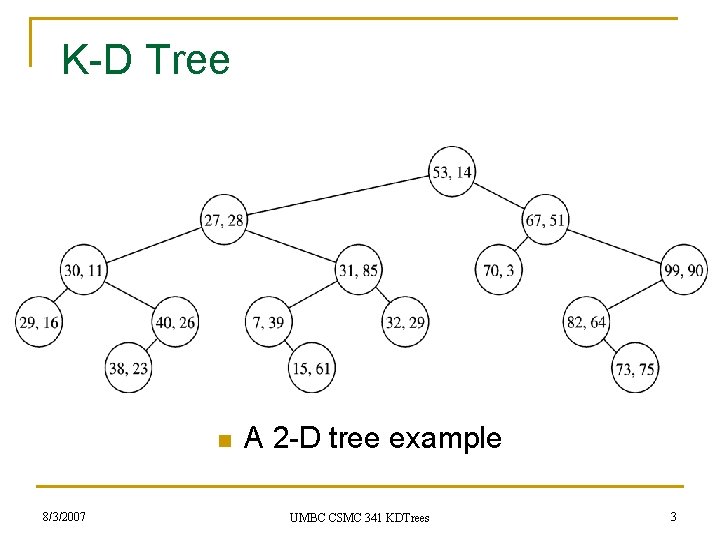
K-D Tree n 8/3/2007 A 2 -D tree example UMBC CSMC 341 KDTrees 3
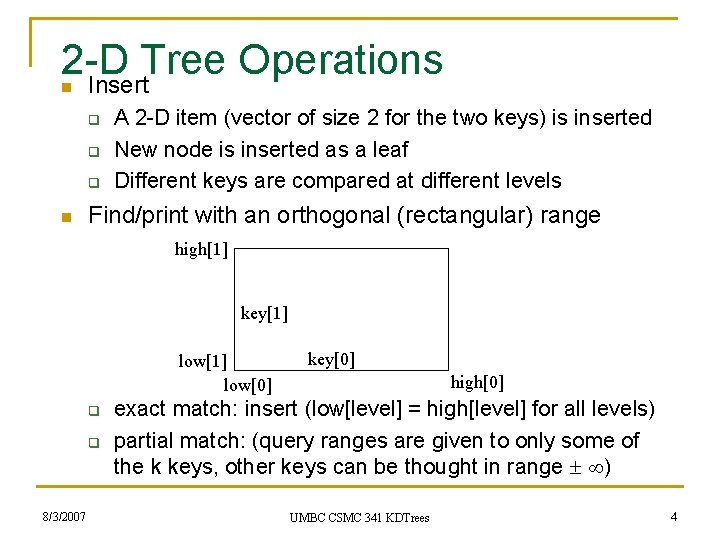
2 -D Tree Operations Insert n q q q n A 2 -D item (vector of size 2 for the two keys) is inserted New node is inserted as a leaf Different keys are compared at different levels Find/print with an orthogonal (rectangular) range high[1] key[1] low[0] q q 8/3/2007 key[0] high[0] exact match: insert (low[level] = high[level] for all levels) partial match: (query ranges are given to only some of the k keys, other keys can be thought in range ) UMBC CSMC 341 KDTrees 4
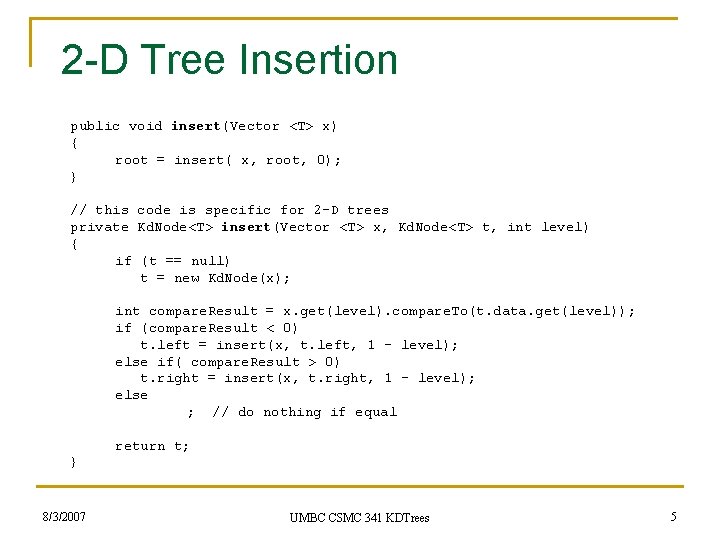
2 -D Tree Insertion public void insert(Vector <T> x) { root = insert( x, root, 0); } // this code is specific for 2 -D trees private Kd. Node<T> insert(Vector <T> x, Kd. Node<T> t, int level) { if (t == null) t = new Kd. Node(x); int compare. Result = x. get(level). compare. To(t. data. get(level)); if (compare. Result < 0) t. left = insert(x, t. left, 1 - level); else if( compare. Result > 0) t. right = insert(x, t. right, 1 - level); else ; // do nothing if equal return t; } 8/3/2007 UMBC CSMC 341 KDTrees 5
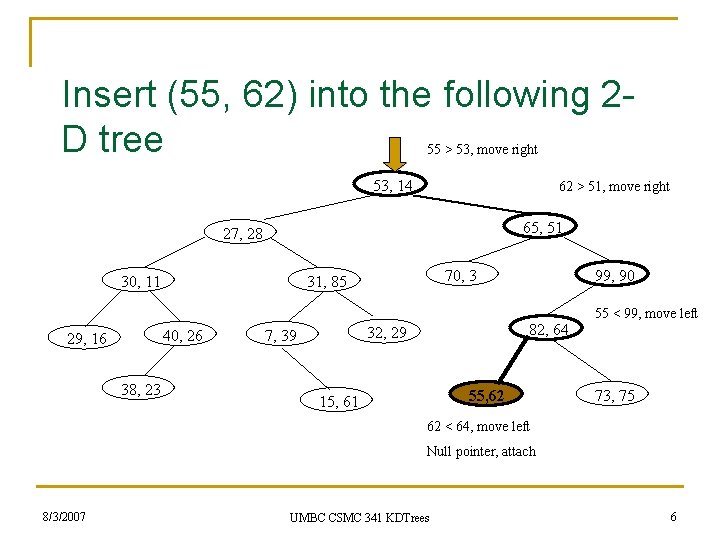
Insert (55, 62) into the following 2 D tree 55 > 53, move right 53, 14 62 > 51, move right 65, 51 27, 28 30, 11 40, 26 29, 16 38, 23 70, 3 31, 85 82, 64 32, 29 7, 39 99, 90 55, 62 15, 61 55 < 99, move left 73, 75 62 < 64, move left Null pointer, attach 8/3/2007 UMBC CSMC 341 KDTrees 6
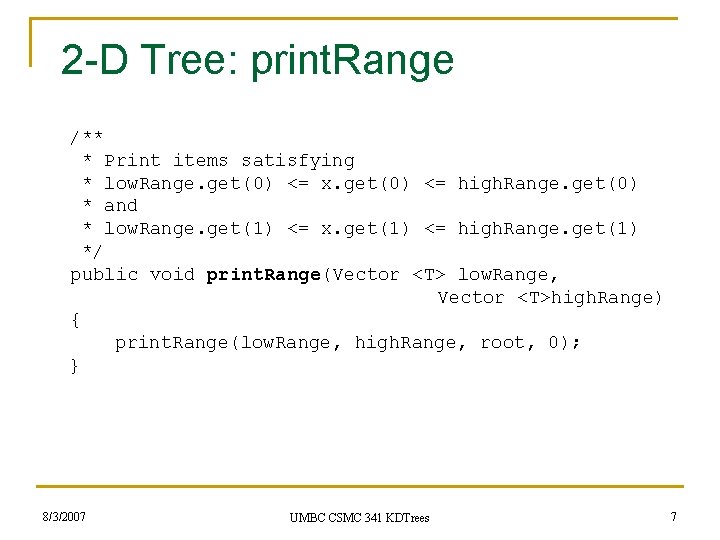
2 -D Tree: print. Range /** * Print items satisfying * low. Range. get(0) <= x. get(0) <= high. Range. get(0) * and * low. Range. get(1) <= x. get(1) <= high. Range. get(1) */ public void print. Range(Vector <T> low. Range, Vector <T>high. Range) { print. Range(low. Range, high. Range, root, 0); } 8/3/2007 UMBC CSMC 341 KDTrees 7
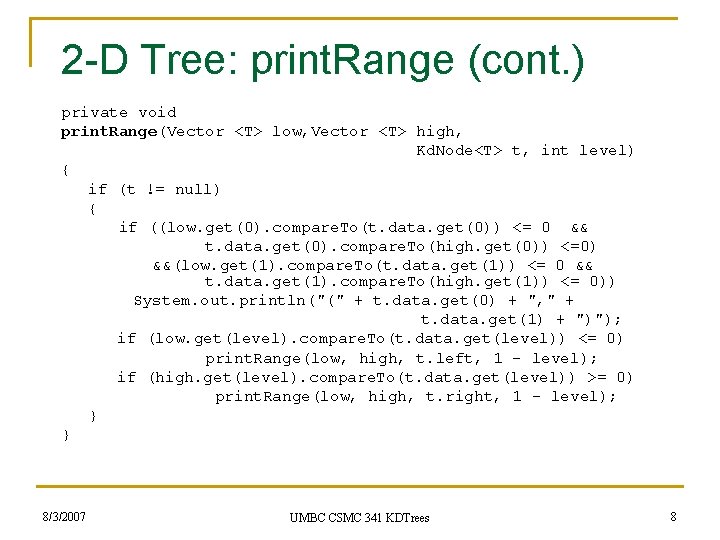
2 -D Tree: print. Range (cont. ) private void print. Range(Vector <T> low, Vector <T> high, Kd. Node<T> t, int level) { if (t != null) { if ((low. get(0). compare. To(t. data. get(0)) <= 0 && t. data. get(0). compare. To(high. get(0)) <=0) &&(low. get(1). compare. To(t. data. get(1)) <= 0 && t. data. get(1). compare. To(high. get(1)) <= 0)) System. out. println("(" + t. data. get(0) + ", " + t. data. get(1) + ")"); if (low. get(level). compare. To(t. data. get(level)) <= 0) print. Range(low, high, t. left, 1 - level); if (high. get(level). compare. To(t. data. get(level)) >= 0) print. Range(low, high, t. right, 1 - level); } } 8/3/2007 UMBC CSMC 341 KDTrees 8
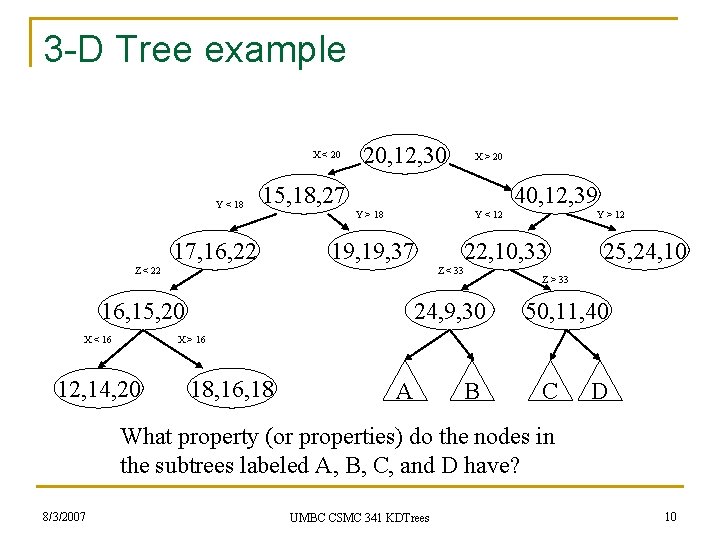
print. Range in a 2 -D Tree In range? If so, print cell low[level]<=data[level]->search t. left high[level] >= data[level]-> search t. right 53, 14 65, 51 27, 28 30, 11 40, 26 29, 16 32, 29 7, 39 38, 23 low[0] = 35, high[0] = 40; low[1] = 23, high[1] = 30; 8/3/2007 70, 3 31, 85 99, 90 82, 64 15, 61 73, 75 This sub-tree is never searched. Searching is “preorder”. Efficiency is obtained by “pruning” subtrees from the search. UMBC CSMC 341 KDTrees 9
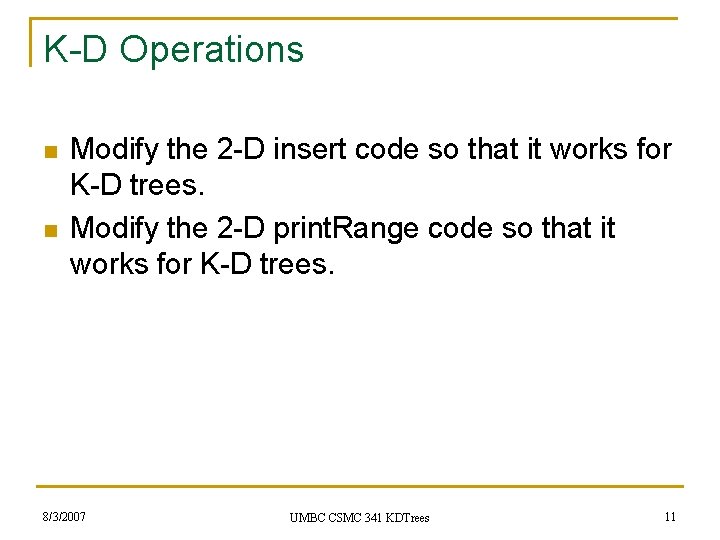
3 -D Tree example X < 20 Y < 18 20, 12, 30 15, 18, 27 17, 16, 22 40, 12, 39 Y > 18 Y < 12 19, 37 Z < 22 Y > 12 22, 10, 33 Z < 33 16, 15, 20 X < 16 X > 20 24, 9, 30 25, 24, 10 Z > 33 50, 11, 40 X > 16 12, 14, 20 18, 16, 18 A B C D What property (or properties) do the nodes in the subtrees labeled A, B, C, and D have? 8/3/2007 UMBC CSMC 341 KDTrees 10
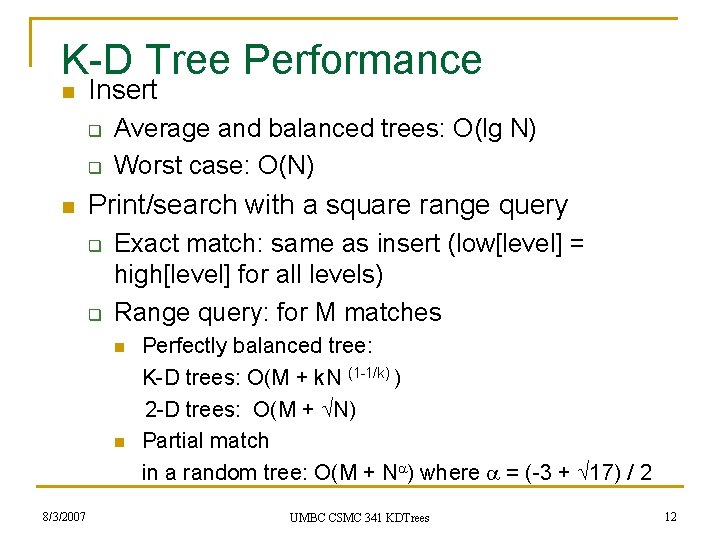
K-D Operations n n Modify the 2 -D insert code so that it works for K-D trees. Modify the 2 -D print. Range code so that it works for K-D trees. 8/3/2007 UMBC CSMC 341 KDTrees 11
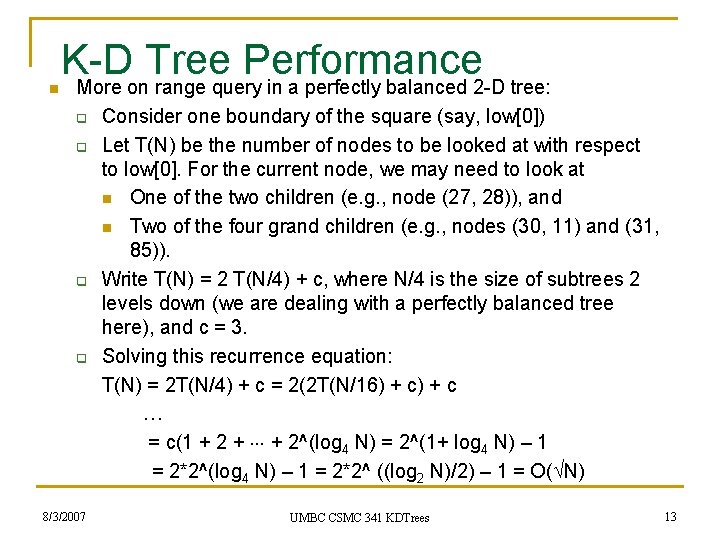
K-D Tree Performance n Insert q q n Average and balanced trees: O(lg N) Worst case: O(N) Print/search with a square range query q q Exact match: same as insert (low[level] = high[level] for all levels) Range query: for M matches n n 8/3/2007 Perfectly balanced tree: K-D trees: O(M + k. N (1 -1/k) ) 2 -D trees: O(M + N) Partial match in a random tree: O(M + N ) where = (-3 + 17) / 2 UMBC CSMC 341 KDTrees 12
n K-D Tree Performance More on range query in a perfectly balanced 2 -D tree: q q 8/3/2007 Consider one boundary of the square (say, low[0]) Let T(N) be the number of nodes to be looked at with respect to low[0]. For the current node, we may need to look at n One of the two children (e. g. , node (27, 28)), and n Two of the four grand children (e. g. , nodes (30, 11) and (31, 85)). Write T(N) = 2 T(N/4) + c, where N/4 is the size of subtrees 2 levels down (we are dealing with a perfectly balanced tree here), and c = 3. Solving this recurrence equation: T(N) = 2 T(N/4) + c = 2(2 T(N/16) + c … = c(1 + 2 + + 2^(log 4 N) = 2^(1+ log 4 N) – 1 = 2*2^(log 4 N) – 1 = 2*2^ ((log 2 N)/2) – 1 = O( N) UMBC CSMC 341 KDTrees 13
K-D Tree Remarks n Remove q n Balancing K-D Tree q q n No known strategy to guarantee a balanced 2 D tree Periodic re-balance Extending 2 -D tree algorithms to k-D q 8/3/2007 No good remove algorithm beyond lazy deletion (mark the node as removed) Cycle through the keys at each level UMBC CSMC 341 KDTrees 14